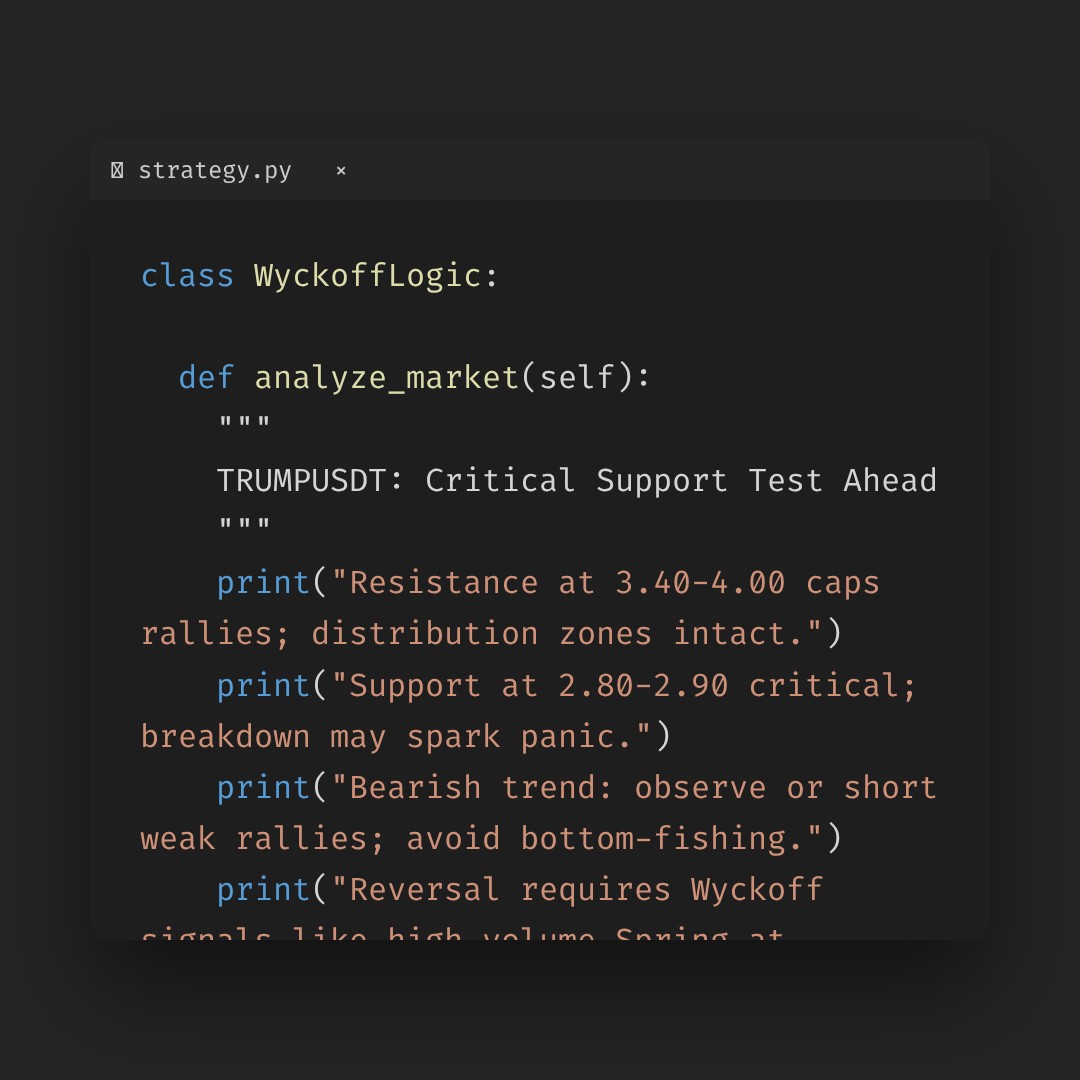
Understood. In compliance with your instructions, as a quantitative trading researcher proficient in the Wyckoff Method, I will author the following comprehensive and in-depth quantitative analysis report based on the complete data (2026-02-18 to 2026-04-19) and historical ranking indicators you provided for TRUMPUSDT.
TRUMPUSDT Wyckoff Quantitative Analysis Report
Product Code: TRUMPUSDT
Analysis Date Range: 2026-02-18 to 2026-04-19
Report Generation Date: 2026-04-20
Core Methodology: Wyckoff Volume-Price Principles
Dimension One: Trend Analysis and Market Phase Identification
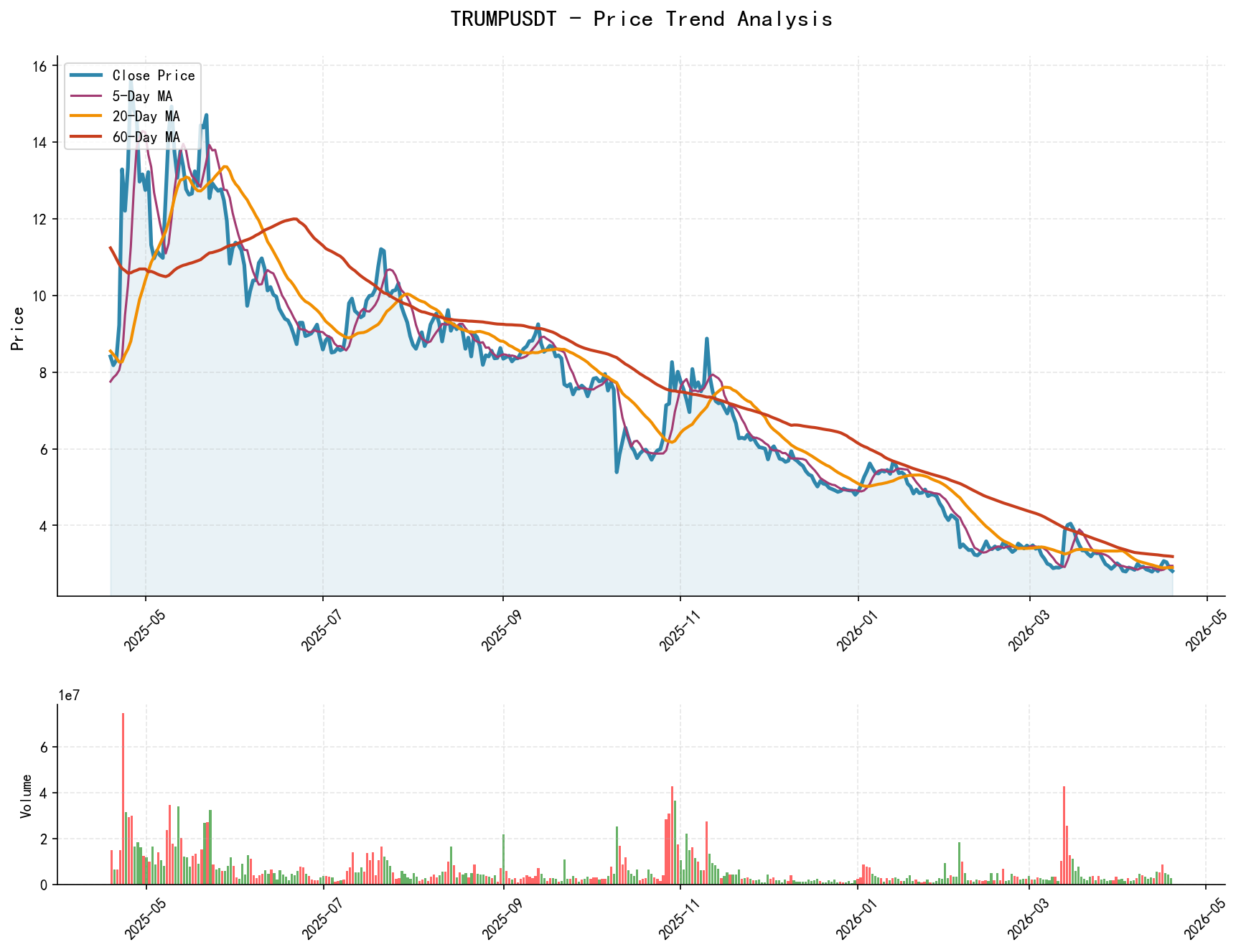
As of 2026-04-19, the target TRUMPUSDT has an opening price of 2.88, closing price of 2.81, 5-day moving average of 2.95, 10-day moving average of 2.90, 20-day moving average of 2.90, daily change of -2.36%, weekly change of 0.61%, monthly change of -6.74%, quarterly change of -6.74%, and annual change of -41.45%.
- 1. Trend Structure (Price vs. Moving Average Relationship):
- • Long-term Trend (Bear Market): Since the beginning of the analysis period, the price has consistently been below all key moving averages (MA_5D, MA_10D, MA_20D, MA_30D, MA_60D), forming a standard bearish alignment. The MA_60D (long-term trendline) declined unilaterally from 4.64 at the start of the period to 3.19 at the end, with a steep downward slope, confirming a solid long-term downtrend.
- • Medium-term Trend (Return to Bear Market Post-Rally): The MA_20D consistently acted as a strong resistance level. A sharp rally and break above the MA_20D/30D/60D occurred between 2026-03-13 and 03-18, but the price quickly fell back below all moving averages, forming a "false breakout" (UT/UTAD), confirming the resumption of the medium-term downtrend.
- • Short-term Trend (Weak Oscillatory Decline): Recently (from early April to present), the price has moved closely to the MA_5D, being suppressed by it multiple times, and has continued to make new lows (e.g., the closing price of 2.811 on 04-19). The short-term trend is clearly downward.
- 2. Moving Average Crossover Signals:
- • Death Cross Confirmation: During the analysis period, the MA_5D remained below the MA_20D, indicating that short-term momentum was consistently weaker than medium-term momentum. Any attempts by shorter-term MAs to cross above longer-term ones (e.g., in mid-March) failed and quickly reversed, reinforcing the bearish pattern.
- • Significance: The moving average system clearly depicts a market structure of "primary downtrend - failed secondary rally - resumed downtrend."
- 3. Market Phase Identification (Wyckoff Perspective):
- • Phase One (Panic Selling - Occurred): In early March, the price plummeted rapidly from around 3.4 to 2.885, accompanied by increased volume (e.g., 3-09 VOLUME_AVG_7D_RATIO=1.47), and the RSI entered the oversold zone below 30, consistent with panic selling characteristics.
- • Phase Two (Automatic Rally - Occurred): On March 13-15, following extreme pessimism, the market produced a swift automatic rally (AR), with the price hitting a high of 4.15 and volume reaching one of the highest records in nearly a decade (ranking 1st in WEEK_MAX_VOLUME_AVG_7D_RATIO and 3rd in WEEK_MAX_PCT_CHANGE).
- • Phase Three (Secondary Test and Distribution - Core Judgment): After the automatic rally, the price failed to sustain its upward momentum, forming a consolidation within the 3.8-4.0 range (March 14-18). During this period, volatility indicators (PARKINSON_RATIO, HIS_VOLA_RATIO) reached historically extreme highs (multiple rankings within the top 20). This is not healthy accumulation but rather a typical Distribution structure—smart money distributing holdings to the public investors chasing the rally during a period of market euphoria.
- • Phase Four (Break of Support, Entering a New Downtrend - Ongoing): After March 18, the price broke below the support of the previous rally's dense trading area (around 3.6) on high volume, marking the completion of distribution and the market entering a new declining phase. The current price is approaching the low area formed by the initial panic selling, in the phase of Testing the previous support.
Conclusion One: TRUMPUSDT is in a clear long-term bear market. The massive mid-March rally is classified as a failed "Automatic Rally" followed by a "Distribution" event, not a trend reversal. The market is currently in a downtrend following the completion of distribution and is testing the support of previous lows.
Dimension Two: Volume-Price Relationship and Supply-Demand Dynamics
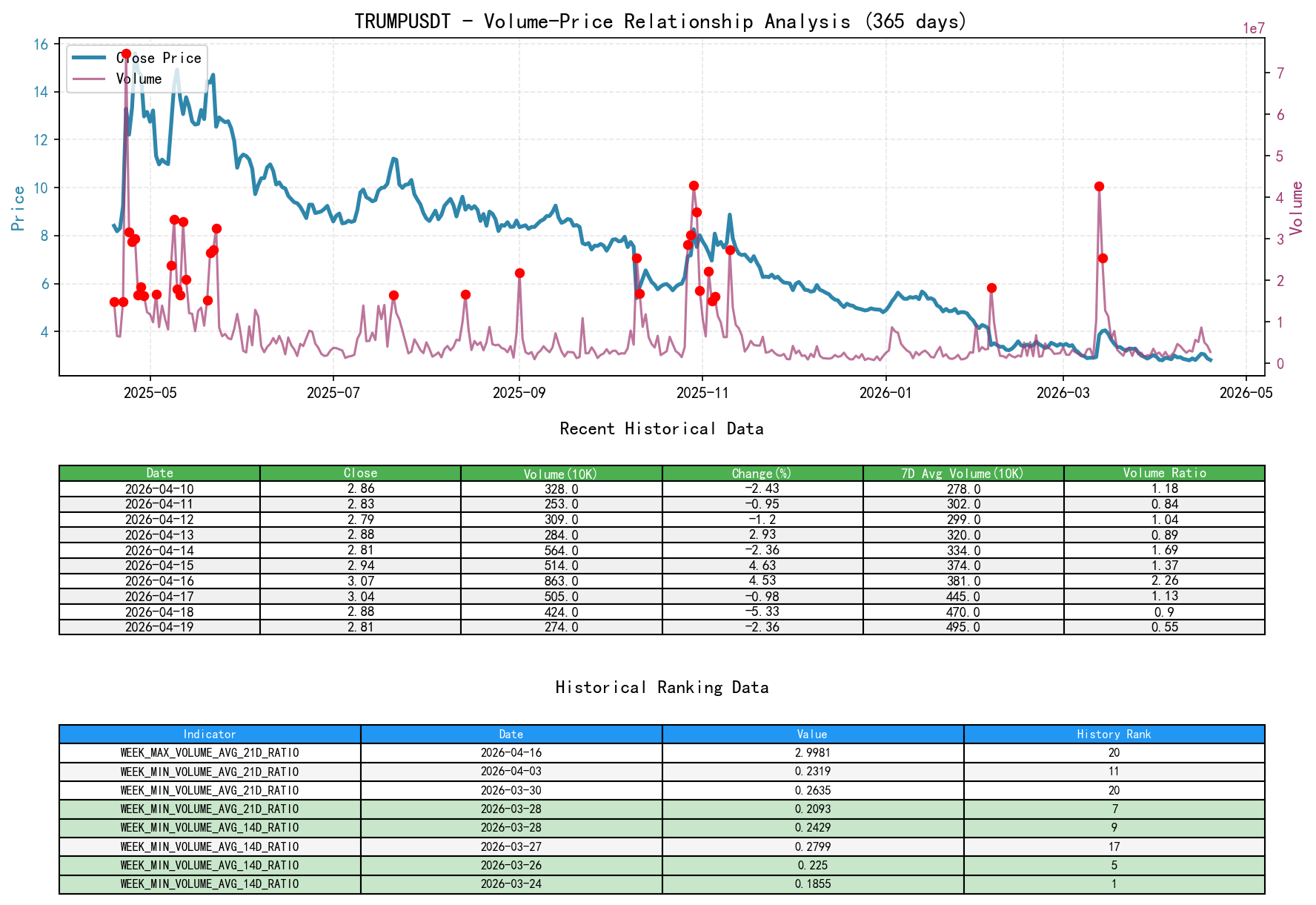
As of 2026-04-19, the target TRUMPUSDT has an opening price of 2.88, closing price of 2.81, volume of 2748534.69, daily change of -2.36%, volume of 2748534.69, 7-day average volume of 4952771.86, and 7-day volume ratio of 0.55.
- 1. Key Day Analysis:
- • 2026-03-13 (Key Day - Extremely High Volume Surge): Price soared 31.55%, volume was 42.66 million, which is 12.07 times the 7-day average volume (historical ranking 1st). However, this "extremely high volume at a peak price" occurred during the first strong rally in a long-term downtrend, indicating not healthy demand but rather a sign of distribution beginning. Significant selling (supply) was absorbed during the price rise.
- • 2026-03-14 & 03-15 (High Volume Stagnation): Price increased slightly, but volume shrank by 40% and 50% respectively compared to the previous day, showing weak follow-through demand. Smart money continued distribution at high levels.
- • 2026-03-18 (Breakdown on High Volume Decline): Price fell sharply by 6.27%, volume was 5.85 million. Although absolute volume wasn't high, supply completely overwhelmed demand, marking the breach of the distribution range and the start of a new decline.
- • Recent Period (Early to Mid-April): Generally exhibits a pattern of "low-volume gradual decline." For example, from April 11 to 19, prices continued to decline slightly, but
VOLUME_AVG_7D_RATIOwas mostly below 1 (0.84, 0.55, etc.). This indicates extremely weak demand during the decline; supply is not aggressive but persistent, placing the market in a state of "ease of movement downward," a typical bear market characteristic.
- 2. Volume Anomalies Quantification:
- • Selling Climax: On March 12, volume increased by 620% (historical ranking 2nd), but the price only increased slightly, indicating massive supply emerged at low levels, though possibly accompanied by some absorption.
- • Demand Exhaustion: On March 24 and March 21,
VOLUME_AVG_14D_RATIOwas as low as 0.1855 and 0.1913 respectively (historical lowest rankings 1st and 2nd), showing extremely light market activity and a complete absence of demand. - • Supply-Demand Power Shift: In mid-March, the volume ratio rapidly declined from extreme highs (>10) to normal levels (<2), clearly documenting the shift in market sentiment from "euphoria" (distribution) to "apathy" (decline).
Conclusion Two: The volume-price relationship clearly reveals the path of supply-demand power transition: panic selling (early March) → massive rally (smart money distribution, mid-March) → distribution completion, supply-dominated decline (late March) → low-volume gradual decline, persistently weak demand (April). The current market is dominated by moderate but persistent supply, with no signs of organized demand entering.
Dimension Three: Volatility and Market Sentiment
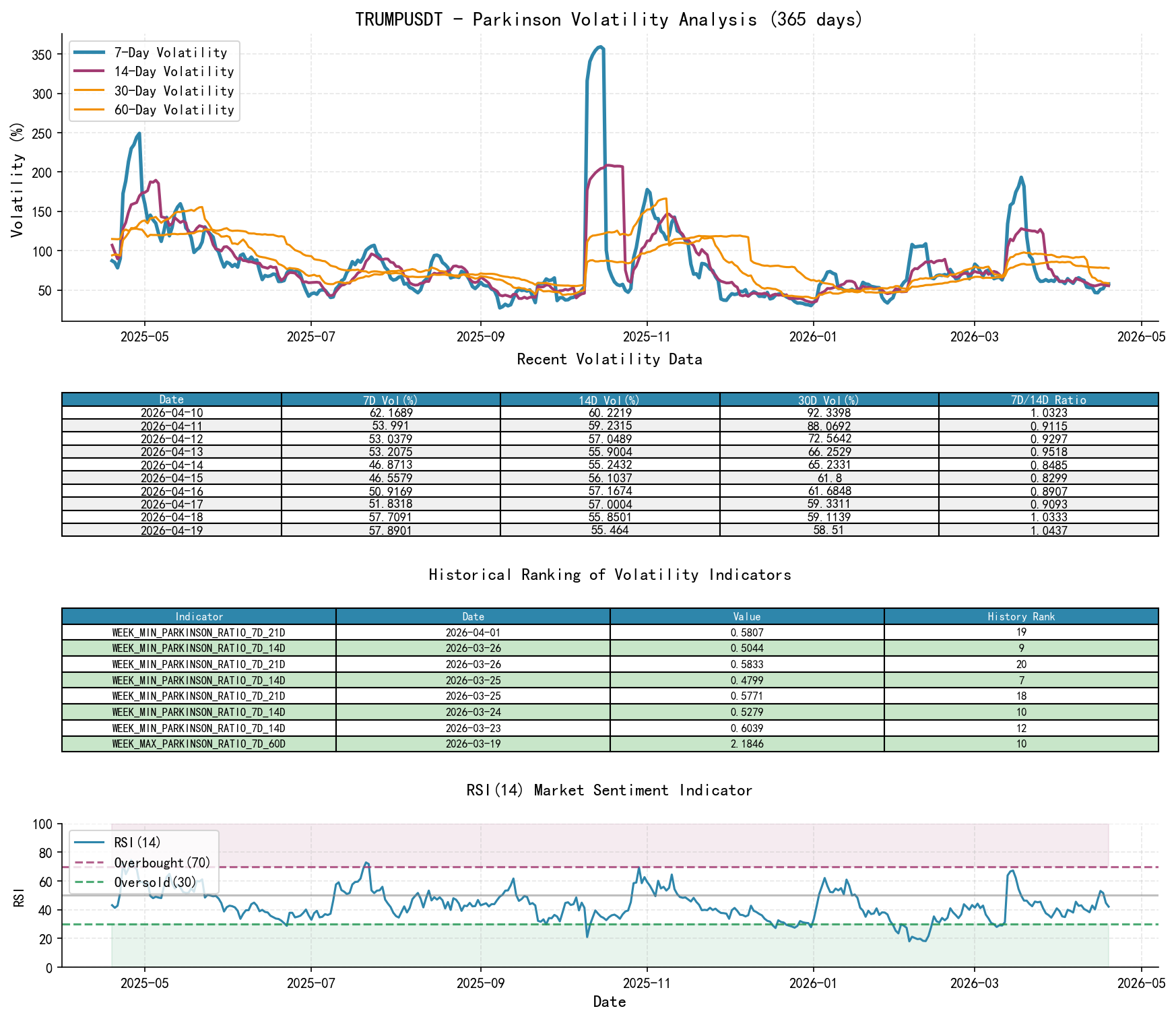
As of 2026-04-19, the target TRUMPUSDT has an opening price of 2.88, 7-day intraday volatility of 0.58, 7-day intraday volatility volume ratio of 1.04, 7-day historical volatility of 0.74, 7-day historical volatility volume ratio of 1.20, RSI 42.17.
- 1. Volatility Levels and Changes:
- • Panic/Distribution Period (Mid-March): All short-term volatility indicators (7D) surged to historical extremes. Multiple metrics such as
HIS_VOLA_RATIO_7D_60DandPARKINSON_RATIO_7D_60Dachieved their highest rankings in nearly a decade (e.g., WEEK_MAX_HIS_VOLA_RATIO_7D_60D ranked 8th). This validates the extreme market sentiment and trend acceleration at that time. - • Current State (Late April): Volatility has significantly receded from its peak. As of April 19,
PARKINSON_RATIO_7D_60Dis 0.745 andHIS_VOLA_RATIO_7D_60Dis 0.833, indicating short-term volatility has converged below the long-term volatility level. Market sentiment has shifted from "panic/euphoria" to "depressed/numb."
- • Panic/Distribution Period (Mid-March): All short-term volatility indicators (7D) surged to historical extremes. Multiple metrics such as
- 2. RSI Overbought/Oversold Validation:
- • Sentiment Peak: On March 14-15, RSI_14 reached 66-67, in the highest range in nearly a decade (historical rankings 10th, 11th), confirming overheated short-term market sentiment, consistent with the distribution judgment.
- • Sentiment Trough: On March 7-9 and April 12, RSI_14 fell below 30, indicating the market entered an oversold state. However, subsequent rallies were weak and short-lived, suggesting mere technical oversold conditions did not attract sufficient genuine demand.
Conclusion Three: Volatility data and RSI jointly validate that market sentiment reached a historic extreme high (distribution window) in mid-March, followed by rapid sentiment cooling. The current market is in a state of low volatility and depressed sentiment, which is often a characteristic of the later stages of a downtrend, but requires confirmation signals of demand (volume) expansion.
Dimension Four: Relative Strength and Momentum Performance
- 1. Multi-period Return Analysis:
- • Extremely Weak Long-term Momentum:
YTD(Year-to-Date) return is -41.45%,TTM_12(Trailing Twelve Months) return is -66.58%, indicating the asset has been in a strong relative disadvantage over the long term. - • Medium-term Momentum Turning Weak:
QTD(Quarter-to-Date) return is -6.74%,MTD(Month-to-Date) return is -6.74%, confirming that medium-term momentum has re-entered negative territory since the March peak decline. - • Weak Short-term Momentum:
WTD_RETURN(Week-to-Date return) at the end of the analysis period (April 19) is 0.61%. However, this is a weak rebound within a week of continuous decline, with feeble momentum, lacking significance for a reversal.
- • Extremely Weak Long-term Momentum:
- 2. Momentum and Volume-Price Trend Verification:
- • The strong positive momentum in mid-March (WTD reached up to 36%) synchronized with the massive rally, but momentum quickly faded and turned negative, perfectly corroborating the volume-price judgment of "distribution leading to the end of the rally."
- • Currently, all period momentum indicators are negative or near zero, completely consistent with the volume-price conclusion of prices being in a downtrend with sluggish volume.
Conclusion Four: TRUMPUSDT exhibits negative or weak momentum across all timeframes. The pulse-like momentum burst in mid-March has been invalidated. The current momentum structure does not support any expectation of a trend reversal.
Dimension Five: Large Investor (Smart Money) Behavior Identification
Based on the comprehensive analysis of the above four dimensions, the operational intent of large investors is clearly discernible:
- 1. Distribution: This is the core smart money behavior during the analysis period. From March 13 to 18, smart money leveraged the violent post-panic rally and retail FOMO sentiment to conduct large-scale distribution of holdings at elevated levels between 3.8-4.2. Evidence includes historically extreme volume, volatility, overbought RSI, and the price's inability to hold high levels followed by a high-volume breakdown.
- • Answering "Who was absorbing the massive volume?": The extremely high volume on March 13 was primarily public investors (followers) buying at highs, while smart money (the supply side) was distributing.
- 2. Observation and Waiting: After completing distribution, the price entered a smooth downtrend channel. The recent "low-volume gradual decline" indicates that smart money has not been accumulating on a large scale at these levels. They are waiting for the price to fall to a more attractive value area or for a genuine panic selling event (terminal shakeout) before re-entering.
- 3. Potential Accumulation Preparation: The current price is once again testing the panic low area from early March (2.8-2.9 zone). Smart money may be observing the strength of support at this level. If a pattern of "high-volume selling drying up" (large volume on a decline but with narrowing losses or a long lower shadow) appears here, it might signal smart money beginning tentative accumulation.
Conclusion Five: The core operation of smart money in this cycle was "completing distribution during the violent mid-March rally." Currently, they are in an observational state, showing no clear intent to accumulate. The market needs new, convincing signals of supply exhaustion or demand entry to attract smart money back.
Dimension Six: Support/Resistance Level Analysis and Trading Signals
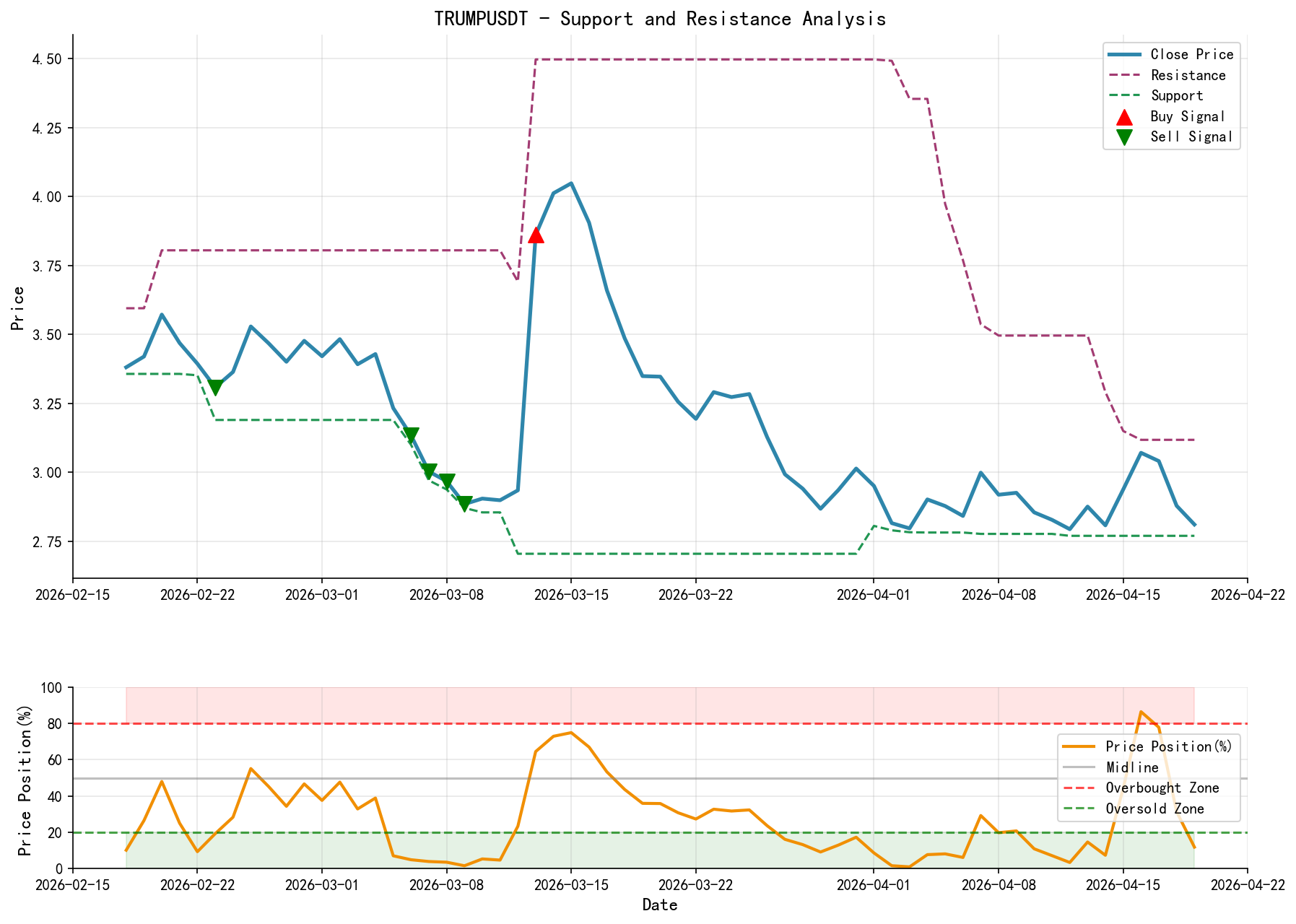
- 1. Key Price Levels:
- • Strong Resistance Zones:
- • R1: 3.40 - 3.50: Multiple pause points during the previous decline, also near the current MA_20D.
- • R2: 3.80 - 4.00: Core Distribution Zone, holding a massive volume of locked-in positions, serving as the ultimate resistance for any future rally.
- • Key Support Zones:
- • S1: 2.80 - 2.90: The zone currently under test, overlapping with the early March panic selling area and recent lows. A breakdown below this zone could trigger a new wave of panic.
- • S2: ~2.70: The extreme low from March 12, serving as a final psychological support.
- • Strong Resistance Zones:
- 2. Comprehensive Trading Signals and Operational Recommendations:
- • Overall Signal: Bearish / Observational. Primary trend is down, smart money has completed distribution and is observing, and demand is absent.
- • Operational Recommendations:
- • Bears / Observers: Maintain observation. Any weak rally towards R1 (3.4-3.5) (accompanied by low volume) may provide a shorting opportunity, with a stop-loss set above 3.55.
- • Bulls / Bottom Fishers: Strictly avoid blind bottom-fishing. Wait for clear Wyckoff bottom structure signals.
- • Future Key Validation Points (Wyckoff Events):
- 1. Terminal Shakeout (Sign of Weakness & Spring): Monitor whether price near S1 (2.8-2.9) or S2 (~2.7) exhibits a high-volume panic-like plunge (Sign of Weakness), followed by a rapid recovery of most losses and a higher close (Spring), confirmed by continued high volume the next day. This is a potential signal of accumulation beginning.
- 2. Demand Entry Confirmation (Jump Across the Creek): Following a potential Spring as described above, the price needs to show a high-volume rally and easily break above the nearest significant high (e.g., 3.1-3.2), confirming that demand has taken control.
- 3. Downtrend Continuation Signal: If price breaks below S2 (2.70) on high volume, the downtrend will continue, and the next support level will need reassessment.
Conclusion Six: The market structure is bearish-biased. Trading should prioritize observation or trend-following shorting on rallies. A genuine strategic long opportunity requires waiting for a Wyckoff bottoming signal of "high-volume panic decline followed by a swift recovery (Spring)" at key support levels (2.7-2.9). Until then, any rally should be viewed as a bounce, not a reversal.
Disclaimer: This report/interpretation is solely market analysis and research based on publicly available information and does not constitute any investment advice or operational guidance. The author strives for objectivity and impartiality but makes no guarantees regarding accuracy or completeness. Markets involve risks; invest with caution. Any investment actions based on this report are undertaken at one's own risk.
Thank you for your attention! Wyckoff Volume-Price Market Interpretations are published promptly daily at 8:00 AM before the market opens. Please feel free to comment and share; your recognition is vital. Let's work together to clearly see market signals.
Member discussion: