Understood. As a quantitative trading researcher proficient in the Wyckoff Method, I will compose a comprehensive and in-depth quantitative analysis report based on the TONUSDT data and historical ranking indicators you provided.
Wyckoff Price-Volume Principles Quantitative Analysis Report: TONUSDT
Product Code: TONUSDT
Analysis Date Range: 2026-02-18 to 2026-04-19 (Target Analysis Date: 2026-04-19)
Report Generation Time: 2026-04-20
1. Trend Analysis and Market Phase Identification
As of April 19, 2026, for the underlying asset TONUSDT, the opening price was 1.31, the closing price was 1.29, the 5-day moving average (MA) was 1.39, the 10-day MA was 1.39, the 20-day MA was 1.31, the daily change was -1.75%, the weekly change was -11.03%, the monthly change was 5.74%, the quarterly change was 5.74%, and the annual change was -22.24%.
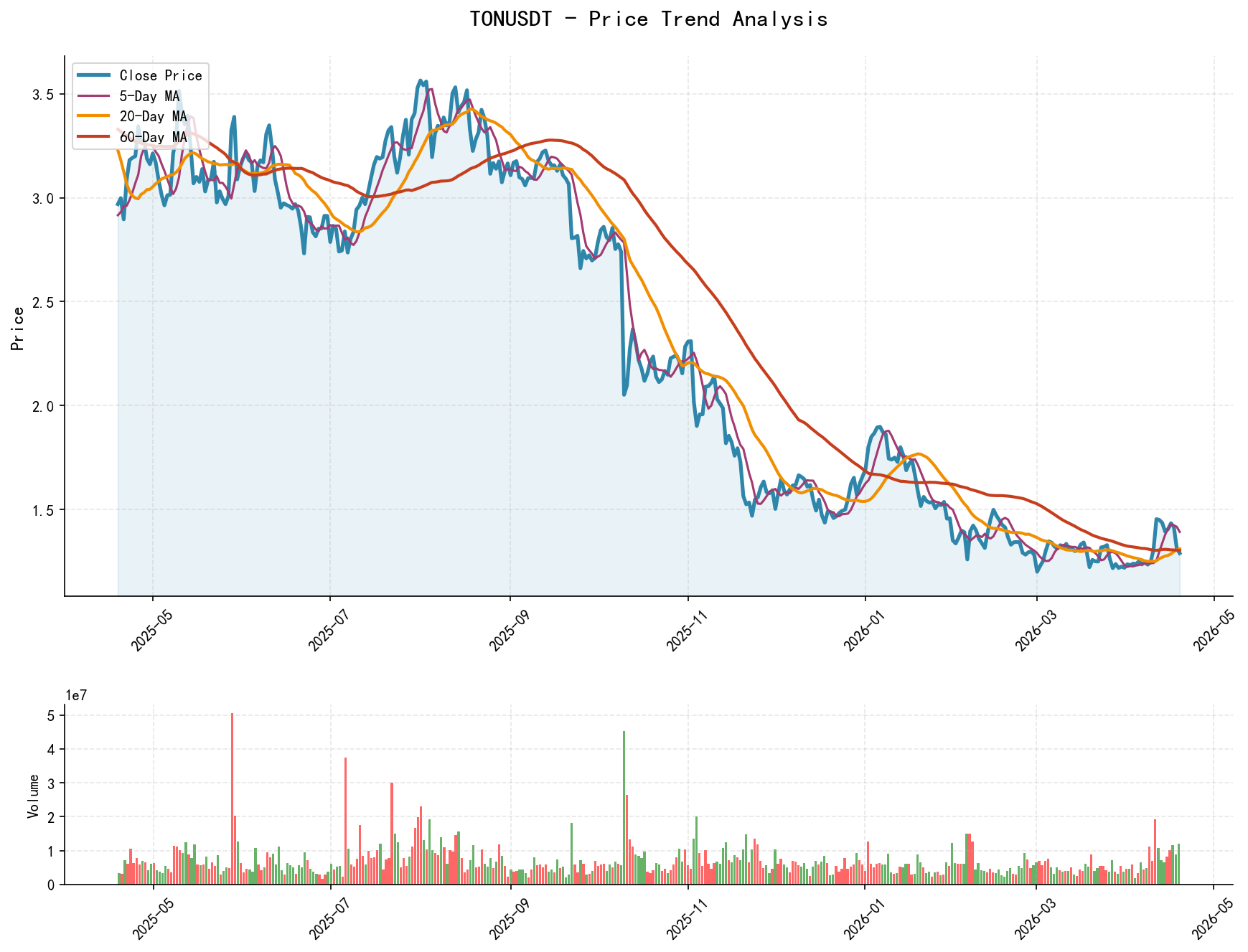
Based on the relationship between price and moving averages (MAs) as well as price action, the current market is at a critical juncture transitioning from distribution at a high level following a sharp short-term rally towards a declining or deep correction phase.
- • MA Alignment and Crossovers: After hitting a low of 1.220 on March 31, 2026, the market initiated a robust rebound. By April 15-16, the price (1.434) had successfully moved above all major short-term MAs (MA_5D, MA_10D, MA_20D), forming the initial shape of a bullish alignment. However, after two consecutive days of significant decline on April 18-19, the price (1.290) has fallen back below the 5-day MA (1.3926) and the 10-day MA (1.3857), indicating that short-term upward momentum has significantly weakened. There is a potential risk of MA_5D crossing below MA_10D, forming a potential "bearish death cross" signal. The price remains well below the long-term MA_60D (1.3031), suggesting the long-term trend remains weak, and this rally is more likely to be defined as a strong rebound rather than a trend reversal.
- • Market Phase Inference (Combined with Wyckoff Theory):
- • Accumulation Phase: Occurred in mid-to-late March 2026. The price oscillated repeatedly within the 1.20-1.26 range. Volume reached an extreme low on March 27 before beginning to expand moderately (e.g., a 69.96% volume increase on March 30), which are signs of initial support testing and absorption. Historical rankings show that during March, several price metrics such as
MIN_OPEN,MIN_CLOSE, andMIN_LOWall ranked within the top 20 lowest levels in the past 10 years, confirming this area as a significant long-term value support zone. - • Markup Phase: Clearly initiated on April 11. On that day, massive volume (
VOLUME_GROWTH174.10%, historical rank 20th) drove an 11.25% increase (PCT_CHANGEhistorical rank 3rd), with the price breaking through key resistance—this is a signal of overwhelming demand dominance. - • Distribution Phase: The current market is in the early stage of this phase. From April 12 to 16, the price stagnated at high levels (1.434-1.455) with wide fluctuations; volume remained high but the price failed to make new highs (the April 16 high of 1.457 was only slightly above the April 11 high). The 7.27% price plunge on April 18 (
PCT_CHANGEhistorical rank 18th) accompanied by high volume is a clear signal of substantial supply entering the market, indicating that distribution behavior may have shifted from "re-accumulation" to "active distribution."
- • Accumulation Phase: Occurred in mid-to-late March 2026. The price oscillated repeatedly within the 1.20-1.26 range. Volume reached an extreme low on March 27 before beginning to expand moderately (e.g., a 69.96% volume increase on March 30), which are signs of initial support testing and absorption. Historical rankings show that during March, several price metrics such as
2. Volume-Price Relationship and Supply-Demand Dynamics
As of April 19, 2026, for the underlying asset TONUSDT, the opening price was 1.31, the closing price was 1.29, the volume was 11962358.94, the daily change was -1.75%, the volume was 11962358.94, the 7-day average volume was 9012817.62, and the 7-day volume ratio was 1.33.
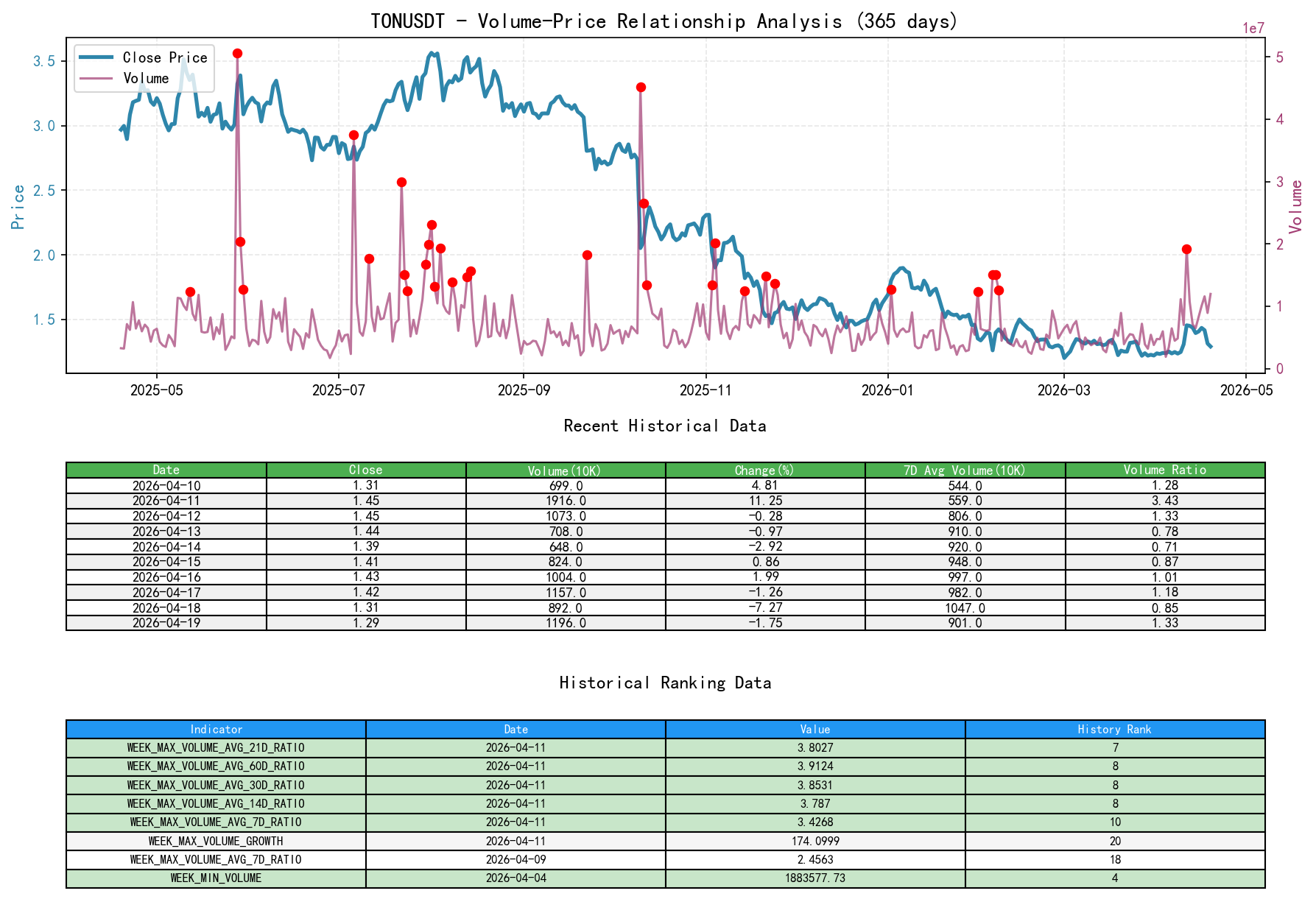
Recent volume-price relationships reveal a dramatic shift in supply and demand forces, with supply currently overwhelming demand.
- • Demand Climax and Exhaustion: The massive rally on April 11 is a typical demand climax.
VOLUME_AVG_7D_RATIOreached 3.43 (historical rank 10th), andVOLUME_AVG_14D_RATIOreached 3.79 (historical rank 8th). These indicators are at historically extreme highs, indicating large-scale, aggressive buying by major players at these price levels. - • Supply Dominance Signals: The supply-demand landscape shifted rapidly after the climax.
- • On April 12, the price closed slightly lower (-0.28%), but volume remained massive (
VOLUME_AVG_7D_RATIO1.33). This is an initial sign of "high volume with price stagnation," indicating the emergence of supply. - • The most critical signal appeared on April 18: a sharp price drop of 7.27%. Although the volume (8.92 million) receded from the previous peak days, the ratio relative to the 7-day average volume (
VOLUME_AVG_7D_RATIO0.85) was not low. Moreover, on the following day (April 19), volume (11.96 million) expanded again (VOLUME_AVG_7D_RATIO1.33) as the price continued to decline. This combination of "increasing volume on declining prices" is the classic Wyckoff pattern of persistent supply influx and insufficient demand absorption, confirming the deepening of the distribution phase.
- • On April 12, the price closed slightly lower (-0.28%), but volume remained massive (
- • Low-Volume Rebound Indicates Insufficient Demand: During the consolidation days following the April 11 surge, occasional price rebounds (e.g., April 15) were accompanied by relatively shrinking volume, indicating that follow-up buying demand was already weakening.
3. Volatility and Market Sentiment
As of April 19, 2026, for the underlying asset TONUSDT, the opening price was 1.31, the 7-day intraday volatility was 0.56, the 7-day intraday volatility ratio was 0.85, the 7-day historical volatility was 0.59, the 7-day historical volatility ratio was 0.75, and the RSI was 45.57.
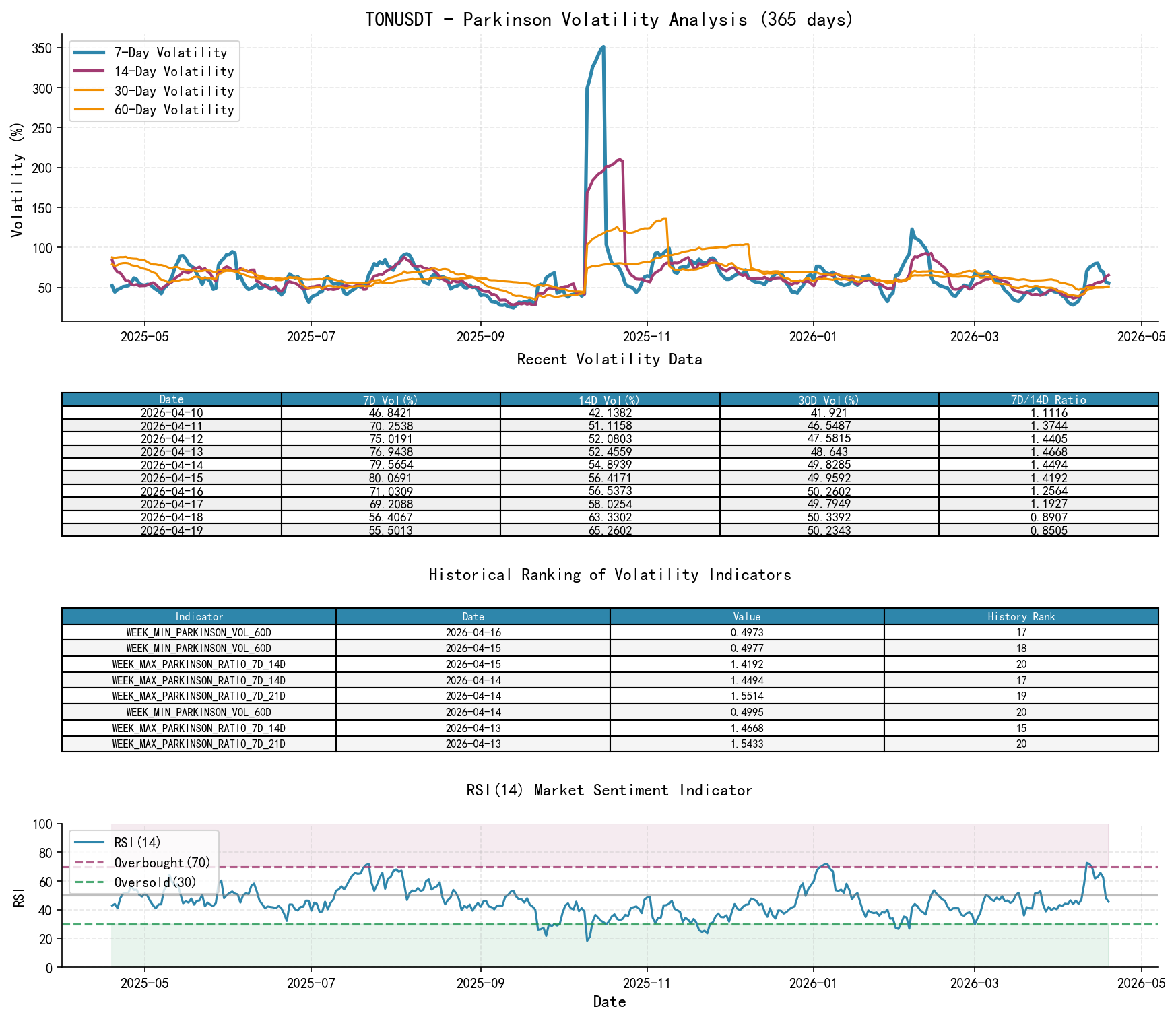
Volatility data confirms that the market has undergone an emotional cycle from extreme excitement to panic selling and is currently in a high-volatility adjustment state.
- • Volatility Spike: Short-term volatility expanded sharply during the April 11 rally climax.
HIS_VOLA_7Dsurged from 0.3769 on April 10 to 0.7952 on April 11, andPARKINSON_VOL_7Drose from 0.4684 to 0.7025. Volatility ratio indicators (e.g.,HIS_VOLA_RATIO_7D_14Dreached 1.3269, historical rank 18th) show short-term volatility far exceeding medium-term levels, which is typical of extreme market sentiment and trend acceleration. - • Volatility Transmission and Sentiment Shift: Subsequently, high volatility transmitted from the 7-day dimension to longer cycles (14-day, 21-day). As of April 19,
HIS_VOLA_14D(0.7775) andPARKINSON_VOL_14D(0.6526) remain at elevated recent levels. However, volatility ratios (e.g.,HIS_VOLA_RATIO_7D_14Dfalling back to 0.7547) indicate that short-term volatility has somewhat converged, while medium-term volatility remains high. Market sentiment is shifting from pure "excitement" to "directional博弈 and panic under high volatility." - • RSI Confirms Overbought Condition and Cooling: RSI_14 reached a significantly overbought level of 72.62 on April 11 (
WEEK_MAX_RSI_14historical rank 3rd), then steadily declined to 45.57 by April 19. This indicates that the market's overbought pressure has been fully released, and momentum has shifted from extremely strong to neutral-weak.
4. Relative Strength and Momentum Performance
Momentum analysis shows that the underlying asset experienced a strong short-term rebound, but the long-term downtrend has not been fundamentally reversed.
- • Short-Term Momentum Surge and Exhaustion:
WTD_RETURNpeaked during the week of April 10 (+17.45%) but had turned to -11.03% by the week ending April 19.MTD_RETURNreached a high of +19.18% in April before falling back to +5.74%. This momentum pattern of "sharp rise followed by rapid decline" is highly consistent with distribution behavior in the resistance zone. - • Medium-to-Long Term Trend Remains Under Pressure: Despite the strong April rebound,
YTD(year-to-date return) remains -22.24%, andTTM_12(trailing 12-month return) is -56.55%, indicating that repairing the long-term downtrend still requires time. This rebound can be viewed as a major secondary rally within a long-term declining trend.
5. Identification of Large Investor ("Smart Money") Behavior
Based on the above volume-price, volatility, and trend analysis, the behavioral path of large investors is clearly discernible:
- • Accumulation at Lows (Late March): Against a backdrop of extreme market pessimism, prices hitting multi-year lows, and extremely low volatility (high rankings for
WEEK_MIN_HIS_VOLA_7D,MIN_PARKINSON_VOL_7D, etc.), smart money began discreet, probing accumulation within the 1.20-1.26 range. High-volume bullish candles on days like March 30 and April 1 are traces of their demand testing and chip collection. - • Markup and Distribution (Early to Mid April): The massive bullish candle on April 11 represents smart money, having completed initial accumulation, using their capital advantage to rapidly mark up the price away from their cost base. Their goal was not to initiate a new long-term bull market, but to create sufficient volatility and attention to establish space and liquidity for subsequent distribution. The subsequent high-level consolidation (April 12-16) and the high-volume plunge on April 18 are classic "distribution" behavior—smart money distributing chips to the market as retail FOMO (fear of missing out) sentiment peaks. The continued high volume during the decline on April 19 suggests the distribution process may still be ongoing.
- • Current Intent: The primary intent of large investors currently is to realize profits at high levels. They leveraged the upward momentum they created earlier to rapidly mark up the price when supply was thin, and then sold into the demand influx. The market is currently in the supply-dominant period of the "Distribution" phase.
6. Support/Resistance Level Analysis and Trading Signals
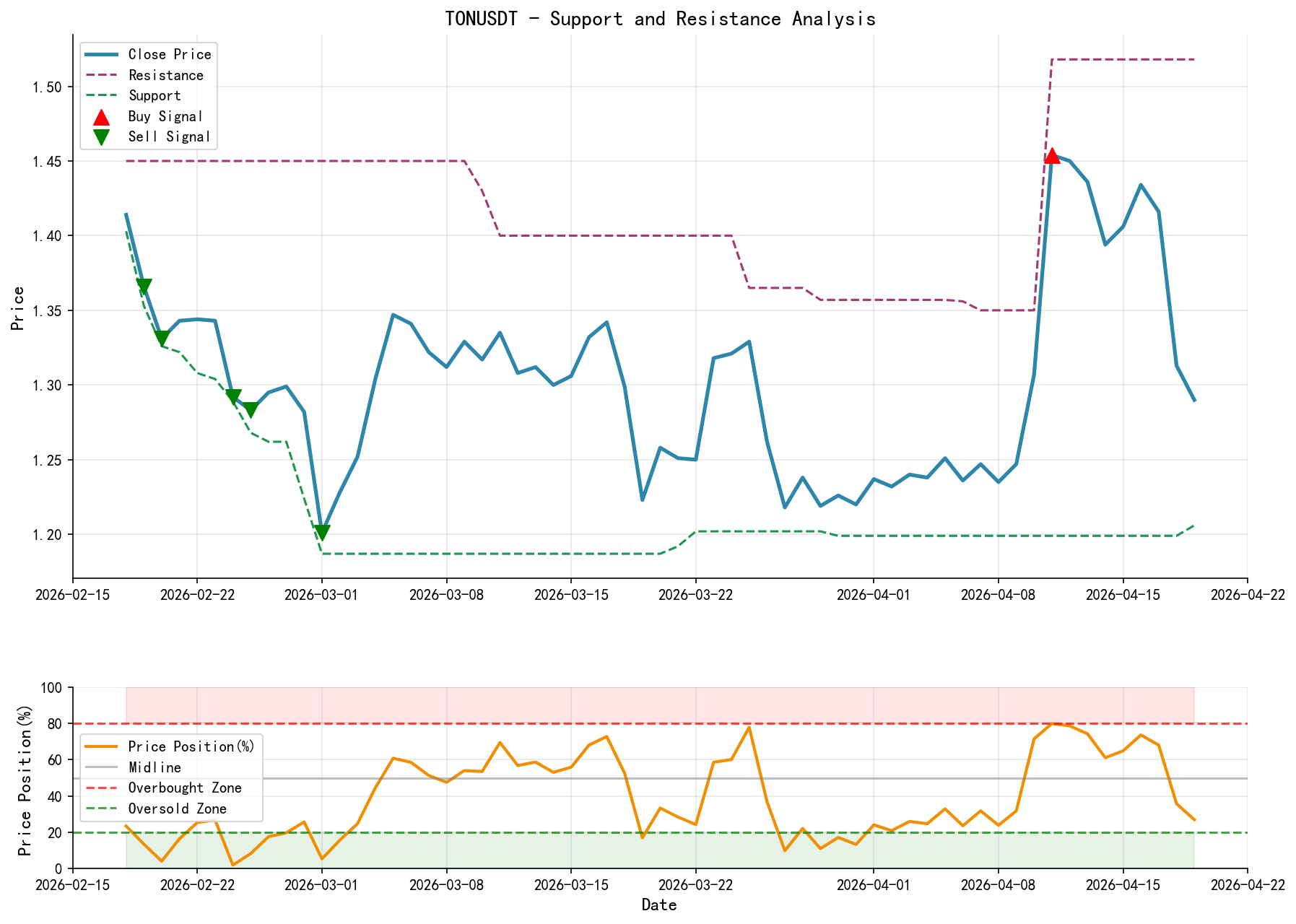
- • Key Resistance Levels (Supply Zones):
- • Primary Distribution Zone (Strong Resistance): 1.450 - 1.480 area. This is the dual high price and volume zone formed on April 11-12, accumulating a large amount of trapped positions and distributed chips. Any rebound towards this area will face strong supply pressure.
- • Secondary Resistance: 1.405 - 1.420 area. The median of the April 17-18 price oscillation and the lower edge of the gap.
- • Key Support Levels (Demand Zones):
- • Primary Support/Test Area: 1.250 - 1.270 area. The dense trading range from late March to early April and the starting point of the recent rebound. If the price retraces here, observe whether demand re-emerges.
- • Primary Accumulation Zone (Strong Support): 1.200 - 1.220 area. Historical ranking data clearly identifies this as an extreme low-price area over the past 10 years. This is the cost base for prior large investor accumulation and the last line of defense for long-term bulls.
Consolidated Wyckoff Events and Trading Signals:
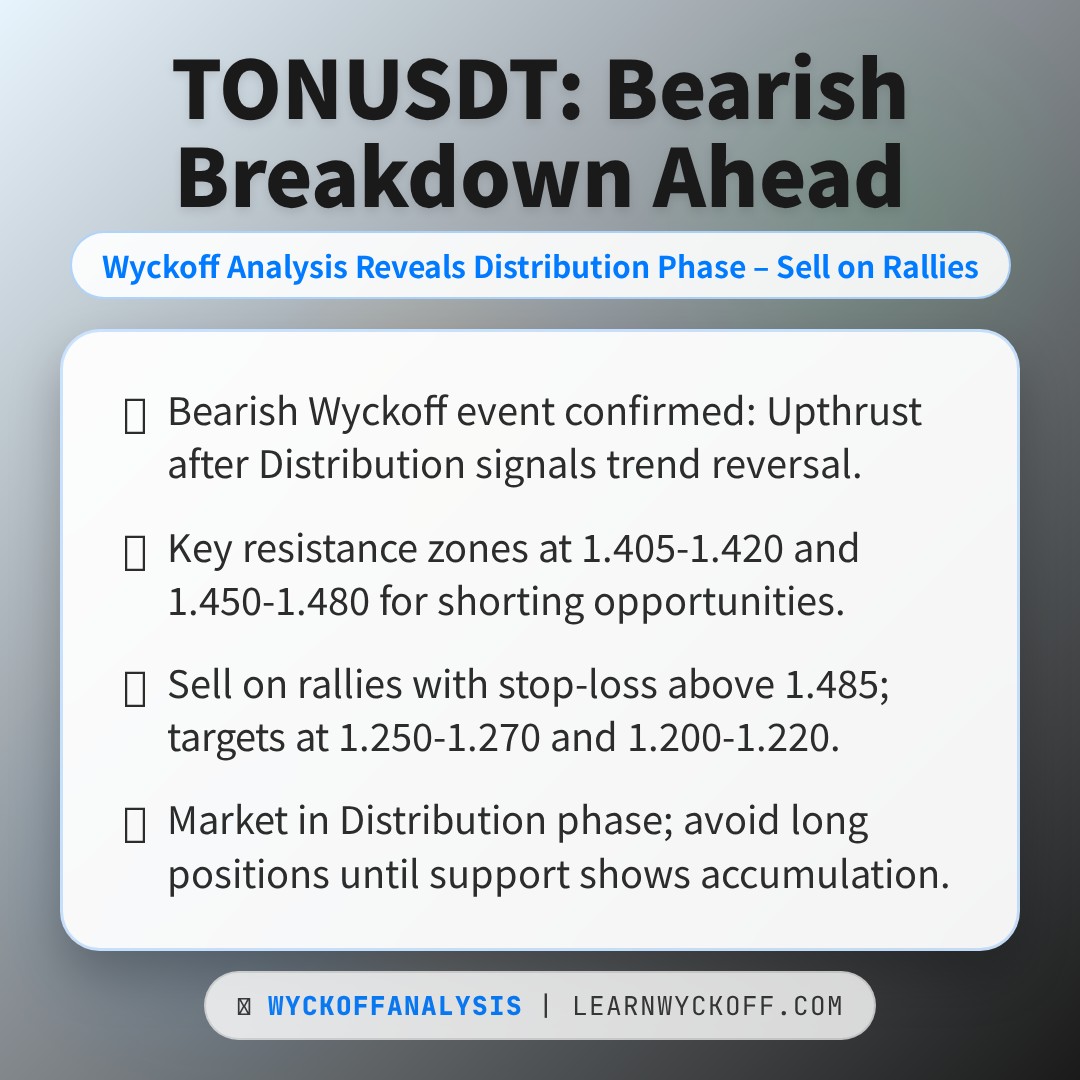
- 1. Bearish Signal Confirmed: The "Upthrust after Distribution" event on April 18—a high-volume plunge following an overbought climax—is a strong bearish Wyckoff event, signaling that the uptrend may have ended.
- 2. Current Phase: The market is in the declining sub-phase of the Distribution phase. Trading strategy should primarily involve selling on rallies or observing from the sidelines, avoiding bargain hunting.
- 3. Operational Recommendations:
- • Shorting Opportunity: Consider establishing short positions if the price rebounds to the 1.405 - 1.420 or stronger 1.450 - 1.460 resistance zones and shows signs of stagnation, shrinking volume, or renewed high-volume decline.
- • Stop-Loss Level: Place above the key resistance zone, e.g., 1.485 (surpassing the previous high).
- • Profit Targets: First target at the 1.250 - 1.270 support area; second target at the 1.200 - 1.220 strong support area if the first is breached.
- • Long Entry Timing: Not suitable for long positions currently. Potential long opportunities should only be considered after the price retraces to the strong support zone (1.20-1.25) and shows clear Wyckoff accumulation signals such as low-volume stabilization followed by renewed high-volume advance (Spring/Test of Support).
- 4. Future Validation Points:
- • Bearish View Validation: The price fails to effectively break above 1.420 on a rebound and subsequently falls below the April 19 low of 1.256, confirming the continuation of the downtrend.
- • Bearish View Invalidation: The price breaks through and sustains above 1.480 with strong volume, indicating distribution failure and a potential restart of the uptrend, necessitating a reassessment of market structure.
Summary Conclusion: Based on Wyckoff price-volume principles, TONUSDT, after experiencing a robust, technically-driven rally fueled by large capital, has shown clear signs of distribution in the 1.45-1.48 area. The current price has broken below the short-term upward structure, and supply is beginning to dominate the market. It is recommended that traders adopt a sell-on-rallies strategy, focusing on supply reactions at the overhead resistance zones, with downside targets pointing towards the key support areas at 1.25 and 1.20. The market needs to build new demand formations near support levels to reverse the current bearish outlook.
Disclaimer: This report/analysis content is solely market analysis and research based on publicly available information and does not constitute any investment advice or operational guidance. The author strives for objectivity and fairness in the content but makes no guarantees regarding its accuracy or completeness. Markets involve risks, investments require caution. Any investment actions based on this report are undertaken at your own risk.
Thank you for your attention! Wyckoff price-volume market analysis is released daily at 8:00 AM before the market opens. Your comments and shares are greatly appreciated. Your recognition is crucial. Let's work together to see the market signals clearly.
Member discussion: