SOLUSDT Quantitative Analysis Report
Product Code: SOLUSDT
Analysis Period: 2026-02-18 to 2026-04-19
Report Generation Date: 2026-04-20
1. Trend Analysis & Market Phase Identification
As of 2026-04-19, the underlying asset SOLUSDT opened at 86.15, closed at 84.96, with moving averages: MA_5D 86.52, MA_10D 85.37, MA_20D 83.54. Performance: Daily change -1.39%, Weekly change +4.21%, Monthly change +2.12%, Quarterly change +2.12%, Yearly change -31.84%.
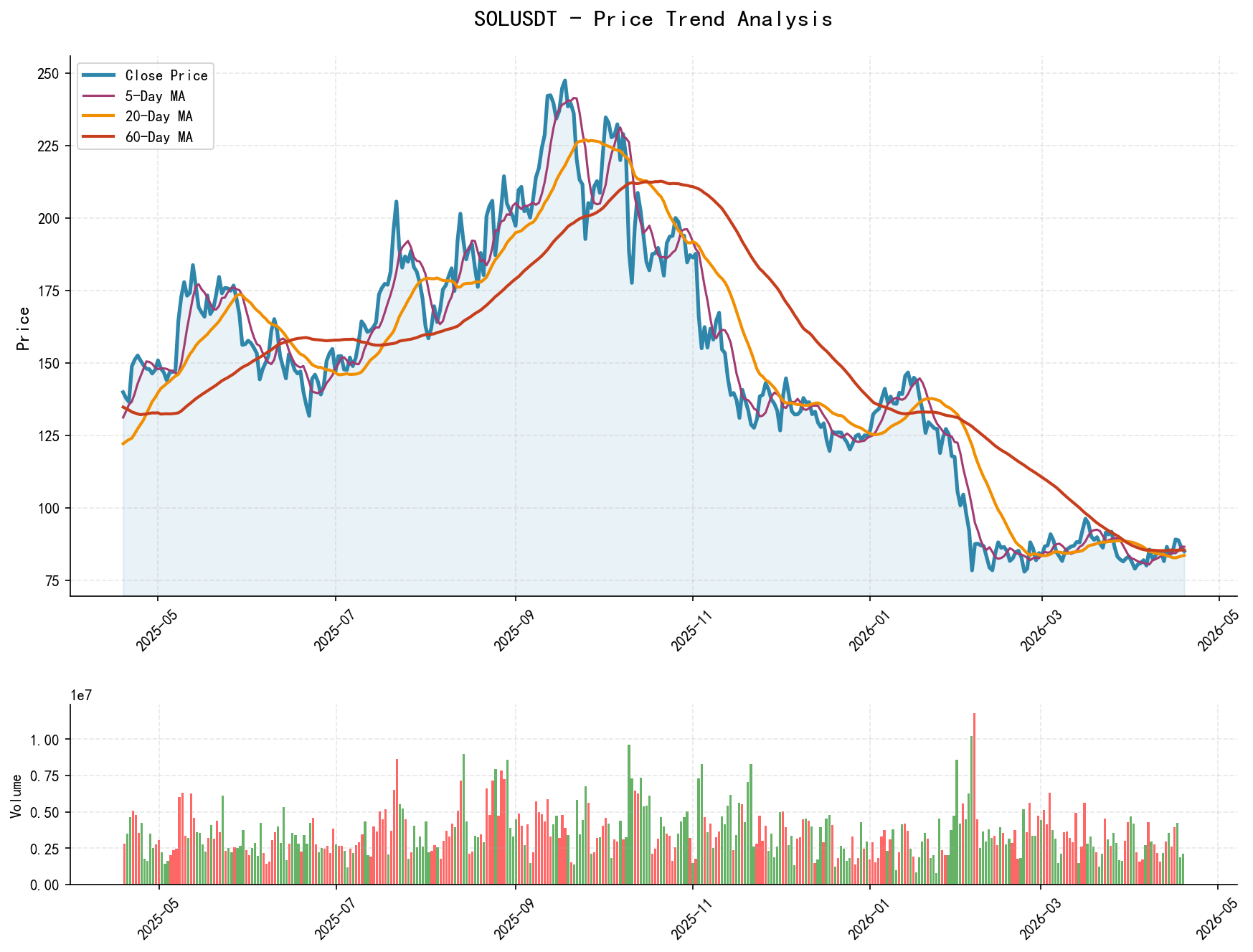
- • Moving Average Alignment & Trend: Throughout the analysis period, the price (closing price ranging from 81.61 to 84.96) has consistently traded below all major moving averages (MA_20D, MA_30D, MA_60D), constituting a clear long-term bearish alignment. The MA_60D (declining from 118.06 to 85.40) and MA_30D (declining from 103.39 to 84.72) show steep downtrends, confirming the primary trend is downward. However, since mid-March, the short-term moving averages (MA_5D and MA_10D) have frequently flattened and intertwined, with the price closing above them on several occasions (e.g., Mar 16, Apr 7, Apr 16), indicating weakening short-term downward momentum and a transition into a consolidation/bottoming phase.
- • Moving Average Crossover Signals: No significant, sustainable golden cross (e.g., MA_5D crossing above MA_20D) occurred during the period. Price rebounds briefly crossed above short-term MAs but quickly fell back, suggesting insufficient upward momentum and continued suppression by the long-term bearish MA alignment.
- • Market Phase Inference (Wyckoff-based): After rebounding from the late-February low (77.9) to the mid-March high (96.2), the price retreated, forming a lower high. Subsequent price declines show characteristics of higher lows (Mar 30 low at 82.54 vs. Feb 23 low at 77.9) and lower highs (Apr 19 high at 87.12 vs. Mar 16 high at 97.68). Combined with volume analysis, the market is transitioning from a Panic Decline (late February) to a potential Accumulation Range (March-April). Currently (Apr 19), the price is oscillating in the mid-lower part of this range, at a critical stage testing support and supply.
2. Price-Volume Relationship & Supply-Demand Dynamics
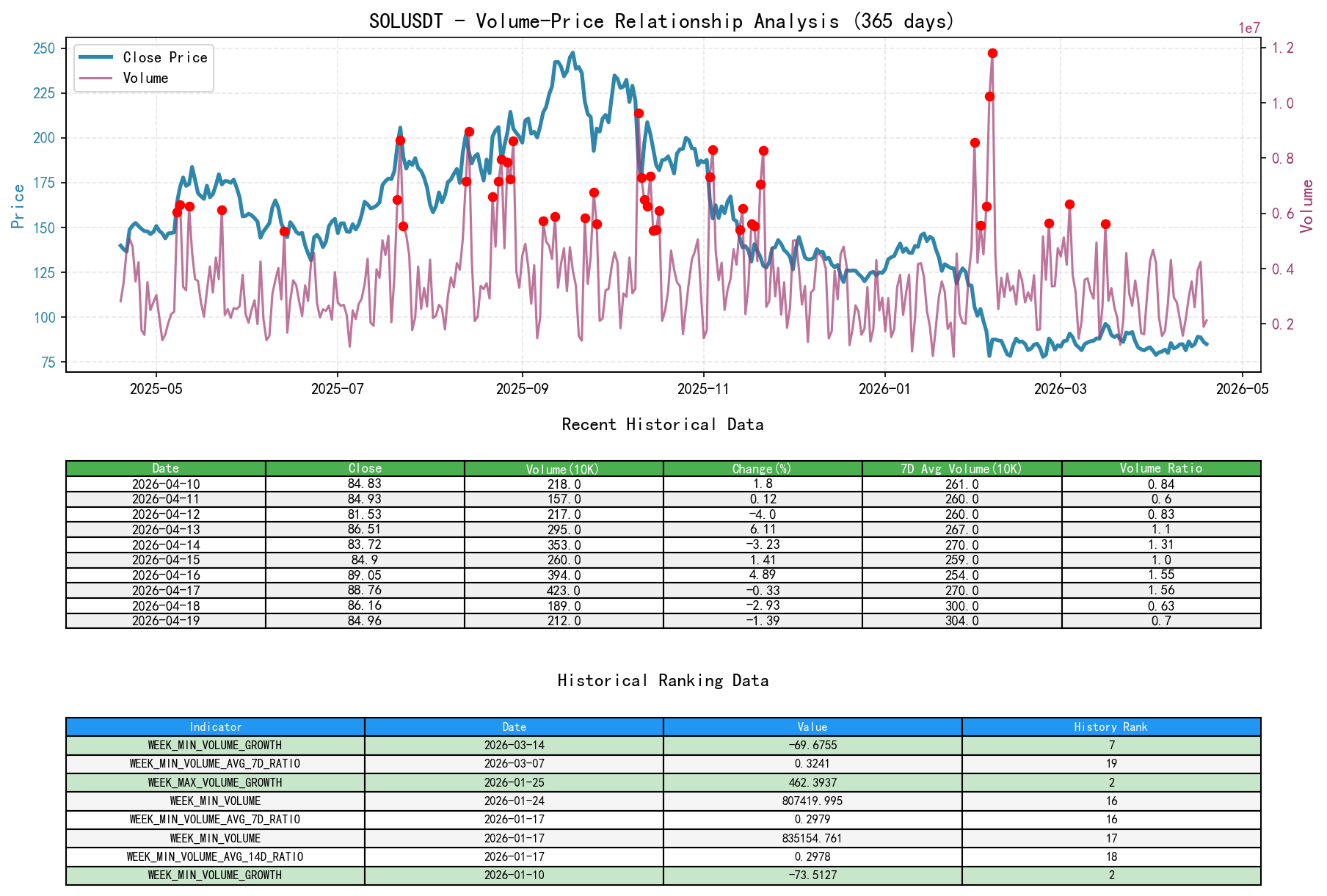
As of 2026-04-19, the underlying asset SOLUSDT opened at 86.15, closed at 84.96, volume 2123183.83, daily change -1.39%, volume 2123183.83, 7-day average volume 3047329.41, 7-day volume ratio 0.70.
- • Key Day Analysis:
- • Panic Selling & Initial Support (2026-02-23): Price plunged -5.91%, with volume surging 187% (
VOLUME_GROWTH) to 5.16 million, a recent peak (VOLUME_AVG_7D_RATIO=1.84). This is typical Panic Selling, but the massive volume also suggests potential accumulation at low levels, possibly marking the start of an Automatic Rally. - • Demand-Driven Rally (2026-03-16): Price surged +4.23%, with volume expanding 115% to 5.62 million (
VOLUME_AVG_7D_RATIO=1.76). This high-volume advance indicates strong demand, a signal of demand entering after a Secondary Test within the accumulation phase. - • Supply Test & Demand Response (2026-04-07): Price rose sharply by +6.91% with volume growth of 58% (
VOLUME_AVG_7D_RATIO=1.41), confirming the validity of support at the prior low (78.94 on Apr 2) and renewed demand entry. - • Signs of Supply Exhaustion (2026-04-19): Price declined slightly by -1.39% on volume of 2.12 million, below the 7-day average (
VOLUME_AVG_7D_RATIO=0.70). This is a low-volume pullback, indicating that following the retreat from the recent high (89.05 on Apr 16), supply did not expand significantly, suggesting limited selling pressure.
- • Panic Selling & Initial Support (2026-02-23): Price plunged -5.91%, with volume surging 187% (
- • Supply-Demand Shift: In summary, the peak in supply occurred on the Panic Selling day of Feb 23. Subsequent peaks in demand on Mar 16 and Apr 7 confirmed buying strength. Recent price pullbacks accompanied by shrinking volume (e.g., Apr 11, Apr 19) are manifestations of contracting supply, which is favorable for price stabilization.
3. Volatility & Market Sentiment
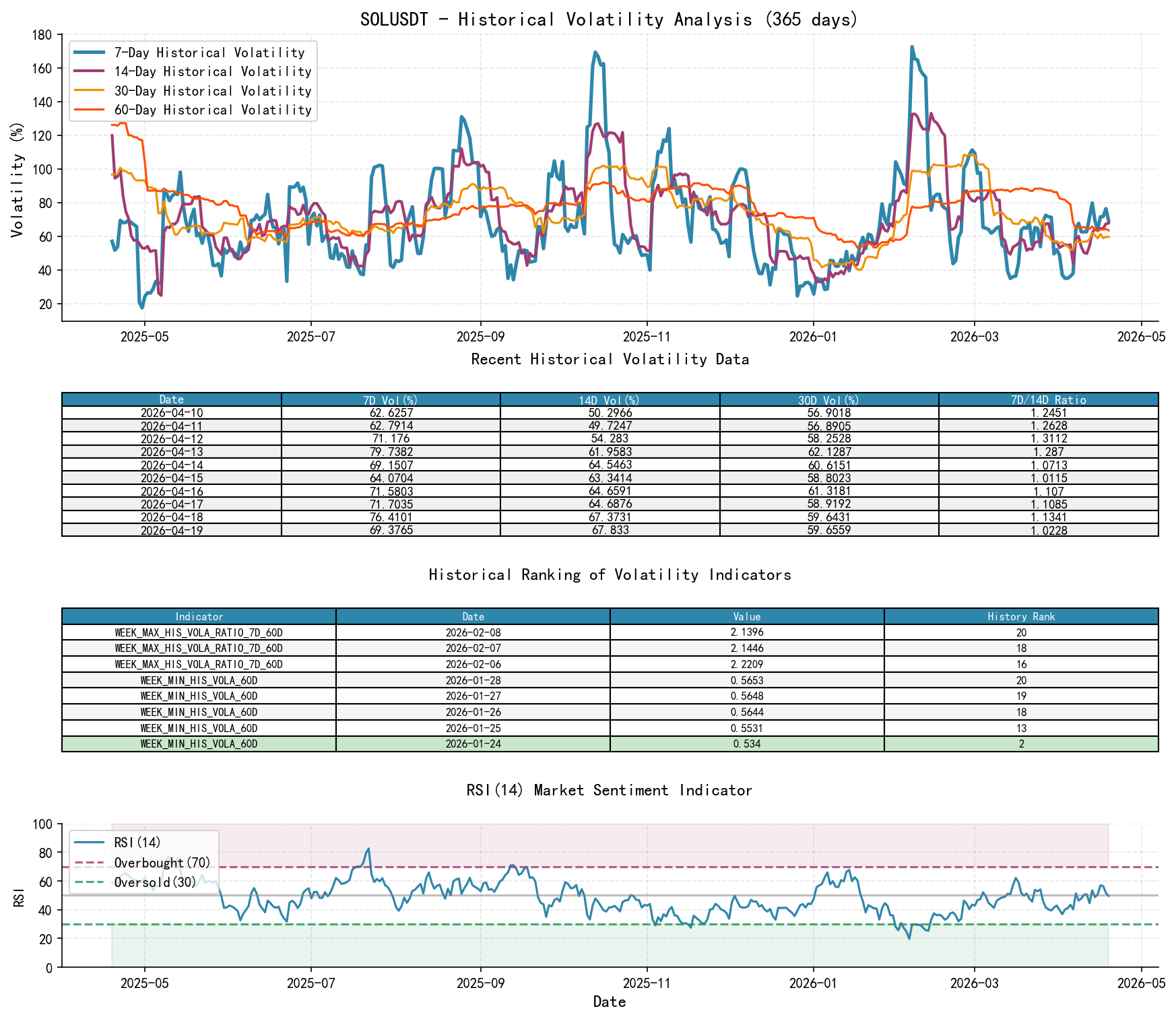
As of 2026-04-19, the underlying asset SOLUSDT opened at 86.15, 7-day intraday volatility (Parkinson) 0.55, 7-day Parkinson volatility ratio 0.97, 7-day historical volatility 0.69, 7-day historical volatility ratio 1.02, RSI 49.65.
- • Volatility Levels & Changes:
- • Panic Period (Late February):
HIS_VOLA_7Dreached a high of 1.08 on Feb 27, andPARKINSON_VOL_7Dreached 0.94 on Feb 28, reflecting tense market sentiment. - • Rally & Convergence Period (March-April): Volatility began a systematic decline from early March. By Apr 19,
HIS_VOLA_7Dfell to 0.69 andPARKINSON_VOL_7Dto 0.55, having converged significantly from their highs. - • Volatility Structure:
HIS_VOLA_RATIO_7D_14DandPARKINSON_RATIO_7D_14Dmostly fluctuated around 1.0 without prolonged extreme deviations, indicating volatility changes were more trend-related than structural panic.
- • Panic Period (Late February):
- • Market Sentiment & Overbought/Oversold:
- •
RSI_14dropped to 31.98 on the panic day of Feb 23, entering oversold territory, providing a technical basis for the subsequent rebound. - • At the rebound high on Mar 16,
RSI_14rose to 62.19, not entering severely overbought territory (>70), indicating a relatively healthy rebound. - • Currently (Apr 19),
RSI_14is at 49.65, in neutral territory, with balanced sentiment and no clear unilateral bias.
- •
- • Historical Extremes (Based on Ranking Data):
- • Volume contraction is notable. The daily volume growth rate on 2026-03-14 (-69.68%) ranked as the 7th lowest in nearly a decade (
HISTORY_RANK: 7), indicating extremely quiet market conditions that day, often seen near trend reversals or at the end of consolidation. - • The 7-day/21-day Parkinson Volatility Ratio on 2026-02-22 (0.577) was the 15th lowest in nearly a decade (
HISTORY_RANK: 15), showing that short-term volatility had compressed to extremely low levels relative to medium-term volatility before the panic decline, a precursor to a volatility explosion (decline).
- • Volume contraction is notable. The daily volume growth rate on 2026-03-14 (-69.68%) ranked as the 7th lowest in nearly a decade (
4. Relative Strength & Momentum Performance
- • Periodic Returns:
- • Short-term (WTD): The recent weekly return (ending Apr 19) is +4.21%, showing short-term momentum has turned from negative to positive, though it has retraced some gains from the weekly high, indicating momentum has weakened somewhat.
- • Medium-term (MTD/QTD): The month-to-date (MTD) return for April is +2.12%, and the quarter-to-date (QTD) return is +2.12%, barely positive, suggesting the medium-term downtrend has paused but a strong upward momentum has not yet formed.
- • Long-term (YTD/TTM): The year-to-date (YTD) return is -31.84%, and the trailing twelve-month (TTM) return is -39.26%. Long-term momentum remains significantly negative, confirming the asset is still in a long-term weak pattern.
- • Momentum Validation: The recovery in short-term momentum (WTD turning positive) is validated by the price-volume behavior showing demand response at key support levels (81-82 zone). However, the deep negative value of long-term momentum (YTD) warrants caution regarding the sustainability of any rally. Observing whether it can overcome the suppression of long-term moving averages is necessary.
5. Large Investor (Smart Money) Behavior Identification
- • Accumulation Behavior Inference:
- 1. Panic Buying: During the historically significant high-volume plunge on Feb 23, counterparties must have absorbed the massive selling. Smart money likely conducted initial accumulation in this zone.
- 2. Accumulation & Testing During Consolidation: In the subsequent rebound (to Mar 16) and pullback, volume expanded on up days (Mar 16, Apr 7) and contracted on down days (Apr 11, 19). This structure indicates demand is active on price rises, while supply hesitates on price declines, aligning with the smart money accumulation characteristic of "selling high and buying low" or "buying on dips" within a range.
- 3. Shakeout Testing: The declines on Apr 2 and Apr 12, accompanied by receding volume from peaks, can be viewed as tests of the support zone. Particularly, the decline on Apr 12 was quickly followed by a high-volume bullish engulfing day on Apr 13, shaking out weak longs and confirming the validity of support.
- • Current Intent: Based on volatility contracting to low levels, volume shrinking during pullbacks, and price repeatedly finding support in the key zone, it is inferred that large investors may currently be in the later stages of the accumulation phase. They are likely consolidating positions through range-bound oscillation and testing the exhaustion of floating supply in preparation for a potential subsequent price advance.
6. Support/Resistance Level Analysis & Trading Signals
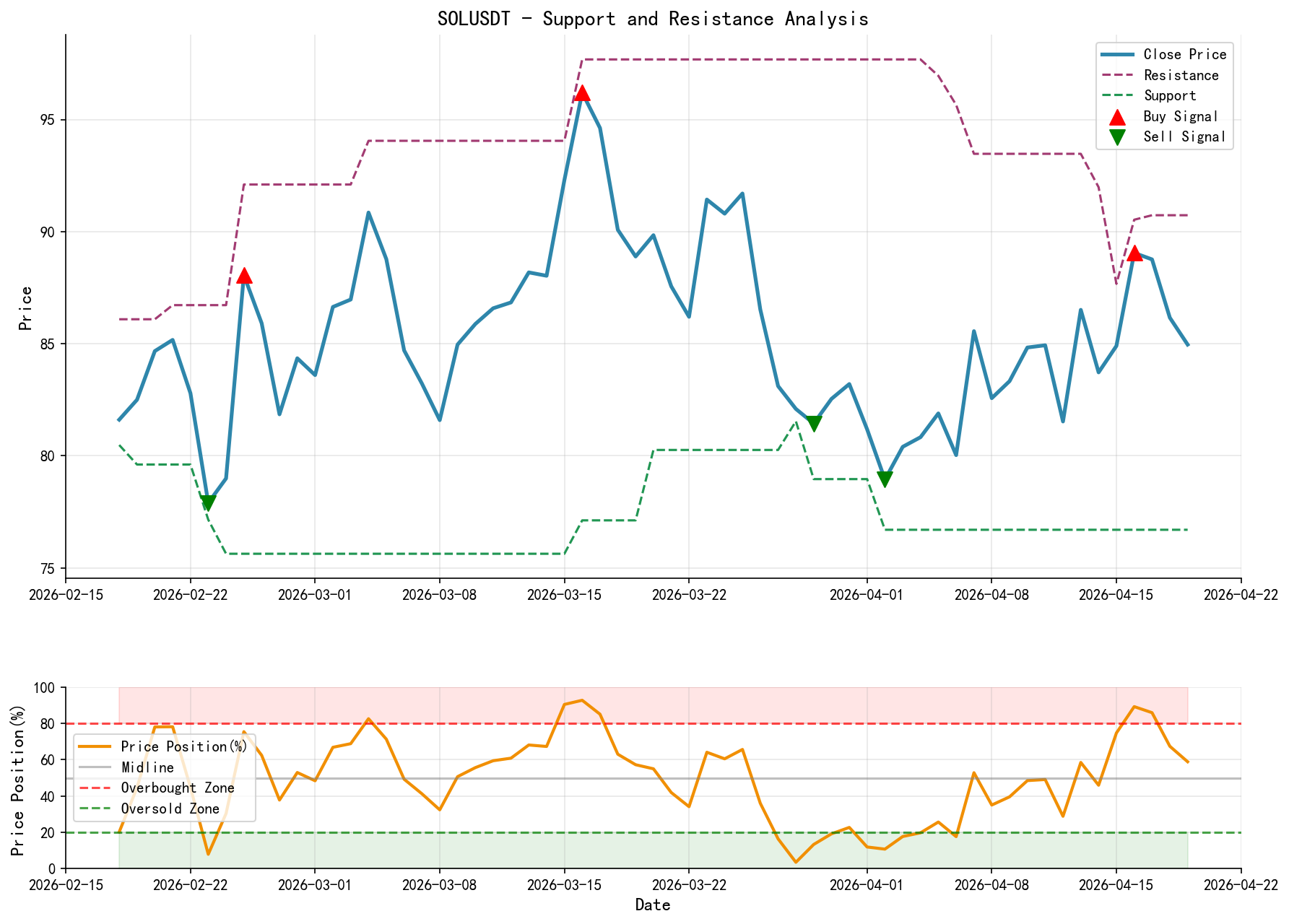
- • Key Levels:
- • Immediate Resistance: The MA_20D (currently around 85.5) is a key dynamic resistance that has suppressed the price multiple times recently. A break above this level is the first signal of short-term strength.
- • Strong Resistance Zone: 89.0 - 90.0 (Apr 16 high and prior congestion area) and 96.0 - 97.0 (Mar 16 high).
- • Immediate Support: 84.0 - 84.5 (lower boundary of the recent consolidation range and the Apr 19 low area).
- • Strong Support Zone: 81.0 - 82.0 (range formed by lows on Apr 2 and Apr 13) and 77.9 (panic low on Feb 23).
- • Integrated Trading Signals & Recommendations:
- • Overall Assessment: Cautiously Bullish / Range-Bound. The long-term market trend remains bearish, but short-to-medium-term price-volume structure and smart money behavior suggest a potential accumulation range is forming between 77.9 and 96.2. The current price is in the mid-lower part of this range, offering a relatively favorable risk-reward ratio.
- • Operational Suggestions:
- 1. Long Strategy (For Range Traders): Consider initiating a small long position near the 84.0 - 84.5 support zone, with a stop-loss set below 81.0. Initial target is 89.0. A high-volume breakout could extend the target to 92.0.
- 2. Breakout Strategy (For Trend Traders): Patiently wait for the price to close above the MA_20D (approx. 85.5) on high volume (VOLUME_AVG_7D_RATIO > 1.2) as a preliminary signal for a potential uptrend initiation. Consider entering a long position on such a breakout, with a stop-loss below the breakout candle's low.
- 3. Short Strategy: Chasing shorts is not advisable in the current zone. If the price rallies to the 89.0 - 90.0 strong resistance zone and shows signs of high-volume stagnation (high volume but inability to make new highs) or long upper shadows, it could be considered a short-term selling opportunity.
- • Future Validation Points:
- 1. Long Failure Signal: A high-volume breakdown below the 81.0 strong support would invalidate the current range accumulation hypothesis, potentially initiating a new wave of decline.
- 2. Long Confirmation Signal: A high-volume breakout and sustained hold above 90.0, with pullbacks on low volume holding above 89.0, could signal the end of the accumulation phase and the start of a markup phase.
- 3. Monitoring Indicators: Closely monitor the behavior of
VOLUME_AVG_7D_RATIOat key price levels and whetherRSI_14can remain above 50 during advances. Also, observe ifPARKINSON_VOL_7Dbegins to expand from its current low levels, which often accompanies the start of a new trend.
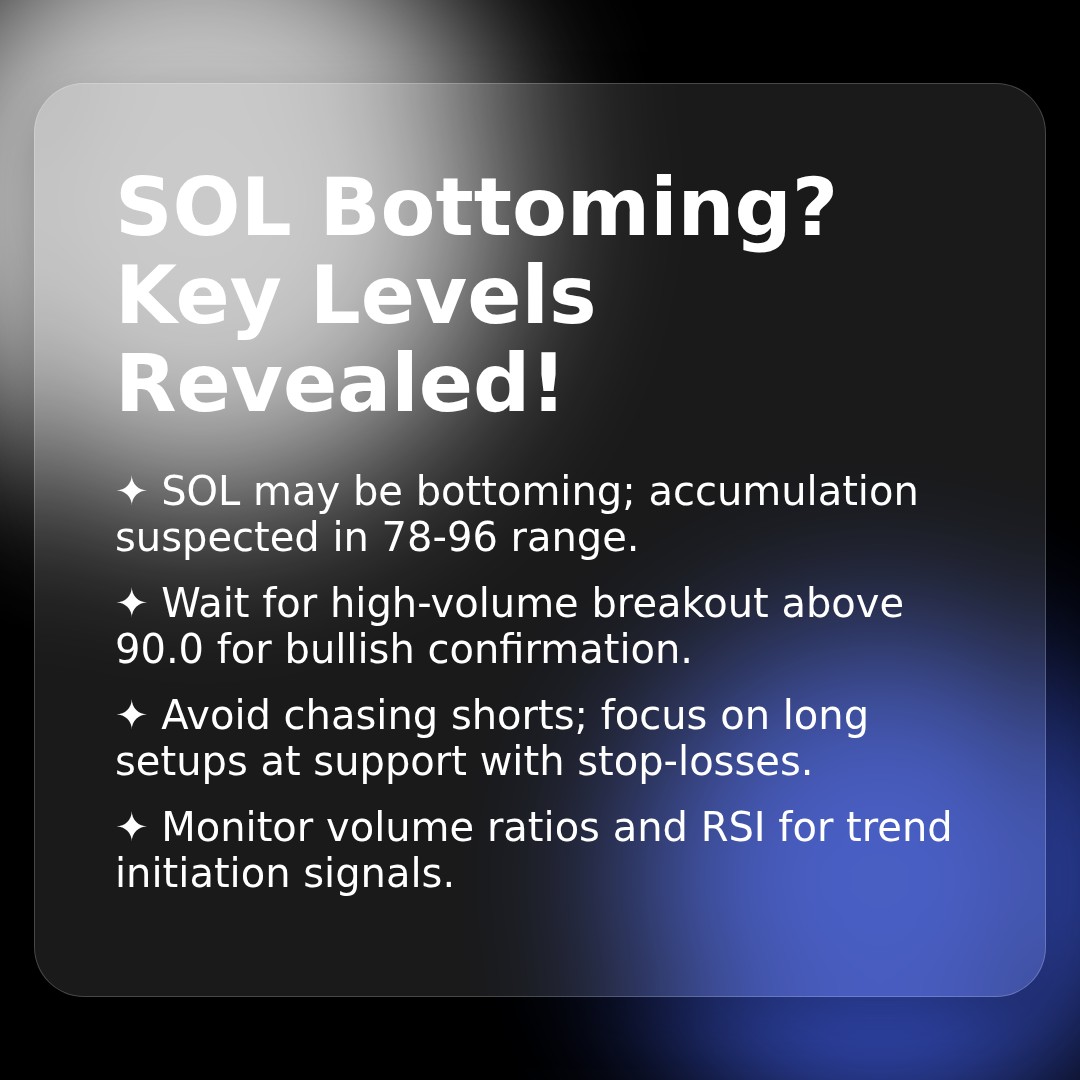
Conclusion Restatement: SOLUSDT is undergoing a potential medium-term bottoming process within a long-term bearish trend. Wyckoff price-volume analysis indicates panic selling has occurred, with smart money疑似 engaged in accumulation within the 78-96 range. Current market volatility and volume have contracted to historically low levels, suggesting an imminent trend change is likely. It is recommended that traders adopt a range-trading mindset, seek high-probability long opportunities at key support levels, and implement strict stop-losses to hedge against downside risk. A high-volume breakout above the MA_20D and the 90.0 level is required to provide effective confirmation for a more optimistic bullish outlook.
Disclaimer: This report/interpretation is solely for market analysis and research based on public information and does not constitute any investment advice or operational guidance. The author strives for objectivity and fairness in the content but makes no guarantees regarding its accuracy or completeness. Markets involve risks; investments require caution. Any investment actions based on this report are taken at one's own risk.
Thank you for your attention! Wyckoff Price-Volume Market Interpretations are published daily at 8:00 AM before market open. We kindly request you leave comments and share this content. Your recognition is crucial. Together, let's empower us to see market signals together.
Member discussion: