Okay, following your instructions. As a quantitative trading researcher proficient in the Wyckoff Method, I will author a comprehensive and in-depth quantitative analysis report based on the DOGEUSDT data you provided.
DOGEUSDT Quantitative Analysis Report (Based on the Wyckoff Method)
Product Code: DOGEUSDT
Analysis Date Range: 2026-02-18 to 2026-04-19
Report Generation Time: 2026-04-20
I. Trend Analysis and Market Phase Identification
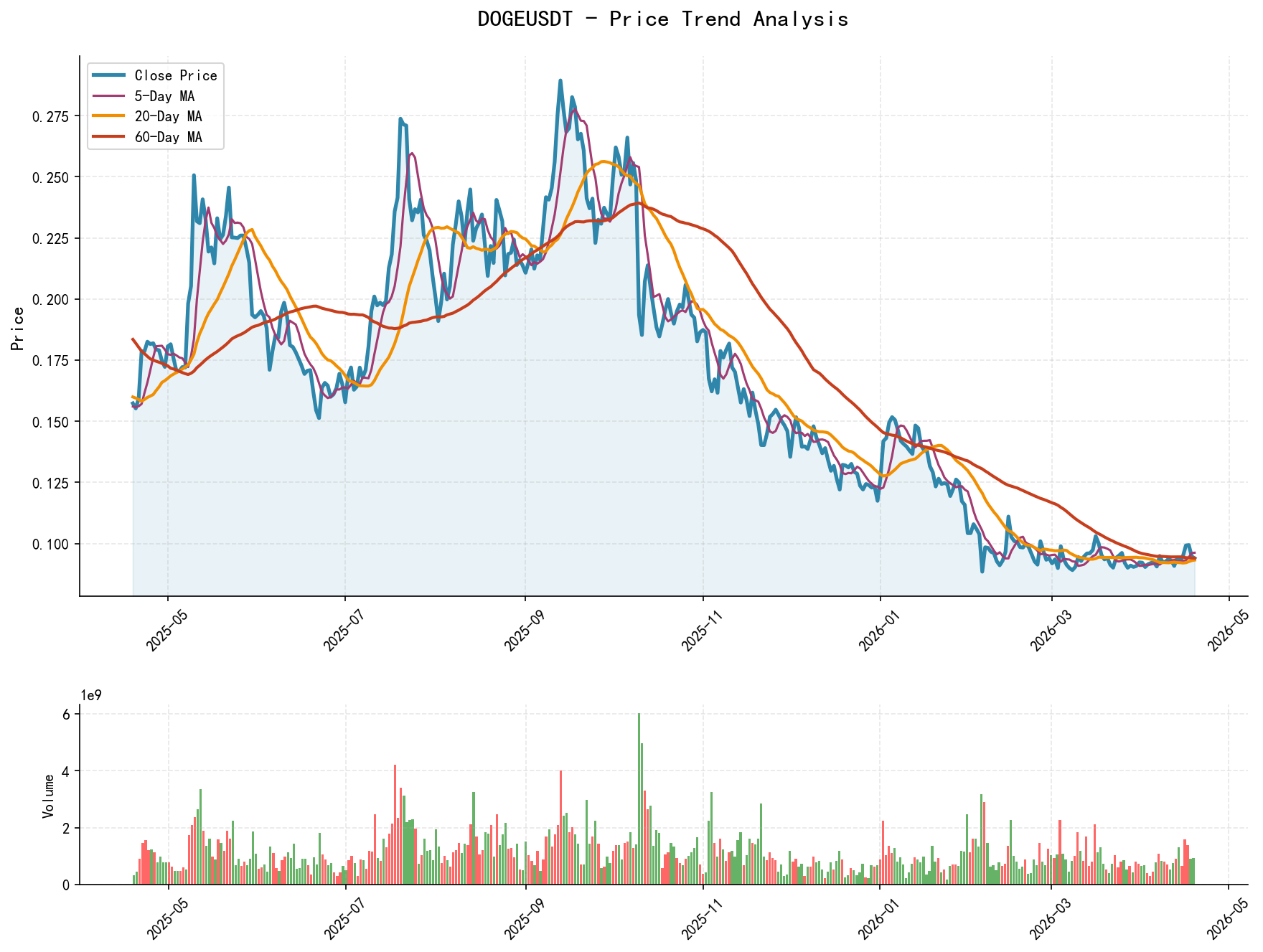
As of April 19, 2026, for the subject DOGEUSDT: Open 0.09, Close 0.09, MA(5) 0.10, MA(10) 0.09, MA(20) 0.09, Daily Return -0.84%, Weekly Return 3.47%, Monthly Return 1.81%, Quarterly Return 1.81%, Year-to-Date Return -19.99%.
Based on the relationship between price and various moving averages, as well as price action, the market phase is identified as follows:
- 1. Dominant Trend: During the analysis period, the price exhibited an overall downtrend. The long-term moving average (MA_60D) declined consistently from 0.1222 to 0.0940, forming a clear resistance band overhead. All short-term moving averages (MA_5D, MA_10D, MA_20D, MA_30D) persistently traded below the MA_60D, forming a classic bearish alignment. The price only briefly pierced above the MA_60D on March 16th (up 5.81%), but fell back the next day, confirming the effectiveness of the long-term pressure.
- 2. Intermediate-Term Structure: Within the downtrend, the market constructed a "wide trading range," with highs at 0.10244 (February 20th) and 0.10218 (April 17th), and lows at 0.08927 (March 7th) and 0.08937 (March 31st). This range can be viewed as a "re-accumulation" or "distribution before markdown" continuation pattern within a downtrend, where the price experienced multiple rallies and pullbacks.
- 3. Inferred Market Phase: Synthesizing the evidence, the market spent most of the analysis period at the juncture between "Markdown after Distribution" and "Re-Accumulation." The rapid decline from late February to early March was accompanied by high volume (e.g., Feb 23, Feb 28), fitting the characteristics of a "selling climax." Subsequently, the price oscillated repeatedly around 0.09 with contracting volume, and the RSI hovered in the 40-50 range, indicating waning downward momentum and entering a potential "secondary test" or "accumulation" process. However, the rebound in mid-April failed to effectively break above the previous high and was followed by another high-volume decline, increasing the possibility of "secondary distribution" occurring at the upper boundary of the range.
II. Volume-Price Relationship and Supply-Demand Dynamics
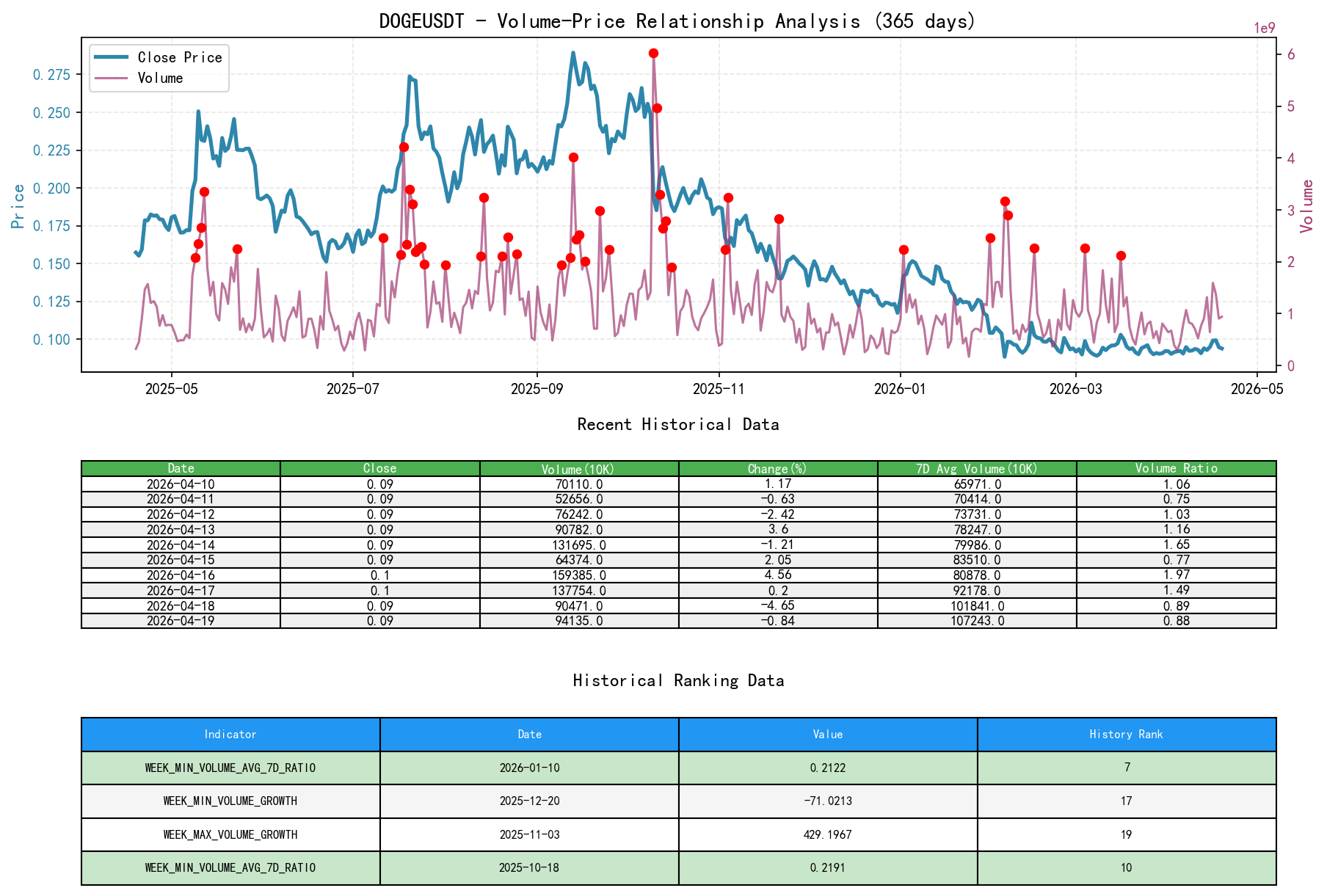
As of April 19, 2026, for the subject DOGEUSDT: Open 0.09, Close 0.09, Volume 941358534.00, Daily Return -0.84%, Volume 941358534.00, 7-Day Average Volume 1072439918.57, Volume Ratio (7D) 0.88.
Volume analysis reveals key supply-demand turning points:
- 1. Demand-Dominated Key Days:
- • 2026-03-04: Price surged 9.96% with a volume of 2.26B, 2.18 times the 7-day average (
VOLUME_AVG_7D_RATIO=2.186) and a volume increase of 113.8% (VOLUME_GROWTH=113.82). This is a classic signal of overwhelming demand influx, occurring at a low point after prior decline, and is a potential accumulation or trend reversal test. - • 2026-03-16: Price rose 5.81% with a volume of 2.12B, 1.86 times the 7-day average and a volume increase of 161.5%. This rally broke above the MA_60D, but the next day (March 17th) saw upthrust after distribution (price fell 2.80% on volume of 1.14B), indicating that supply emerged quickly at higher levels and demand failed to sustain.
- • 2026-04-16: Price rose 4.56% with a volume of 1.59B, 1.79 times the 60-day average. This was a significant recent display of demand.
- • 2026-03-04: Price surged 9.96% with a volume of 2.26B, 2.18 times the 7-day average (
- 2. Supply-Dominated Key Days:
- • 2026-03-05: Following the massive surge on March 4th, the price fell 5.43% the next day on volume of 1.07B (
VOLUME_AVG_7D_RATIO=0.93). This is a textbook "supply overwhelms demand" signal, indicating the demand that entered the previous day was absorbed by even greater supply, resulting in a failed rally effort. - • 2026-04-18 & 2026-04-19: After consecutive gains on April 16-17, the price fell 4.65% on April 18th with volume of 904.7M and continued to fall 0.84% on April 19th with volume of 941.4M. Volume on both days was significantly above recent average levels (
VOLUME_AVG_7D_RATIOof 0.89 and 0.88 respectively), constituting "down days on above-average volume." This clearly shows supply taking dominance after the price rebound, consistent with distribution characteristics. - • From late March to early April, the market repeatedly showed higher volume on down days compared to up days (e.g., March 21, 22, 27), indicating persistent supply pressure.
- • 2026-03-05: Following the massive surge on March 4th, the price fell 5.43% the next day on volume of 1.07B (
- 3. Supply-Demand Balance/Exhaustion Signals:
- • 2026-03-31: Price increased slightly by 1.64%, but volume decreased by 10.04% compared to the previous day, showing lackluster demand follow-through.
- • In late March and early April, volume repeatedly contracted below its moving average (e.g., March 27, April 4) while the price traded in a narrow range. The market entered a state of low volatility, low volume balance, or "coiling," awaiting confirmation of a new direction.
III. Volatility and Market Sentiment
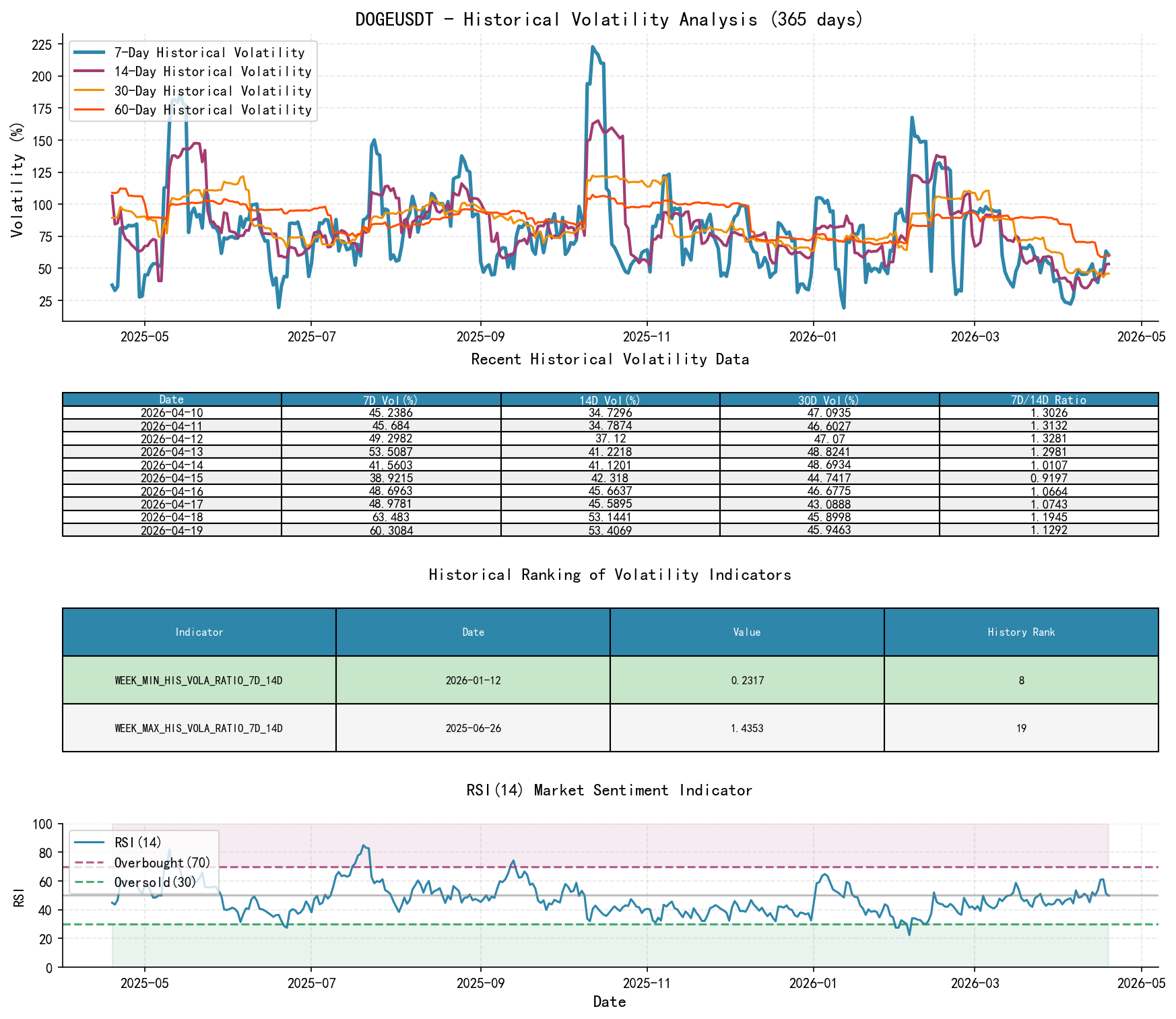
As of April 19, 2026, for the subject DOGEUSDT: Open 0.09, 7-Day Intraday Volatility 0.56, 7-Day Intraday Volatility Ratio 1.10, 7-Day Historical Volatility 0.60, 7-Day Historical Volatility Ratio 1.13, RSI 49.83.
Volatility indicators and RSI together depict the market sentiment cycle:
- 1. Volatility Cycle: Historical volatility (
HIS_VOLA_7D) peaked in late February to early March (>0.94), coinciding with the phase of rapid price decline, indicating market panic and trend acceleration. Subsequently, volatility consistently contracted, falling to a low range of 0.27-0.39 from late March to early April, indicating a market cool-down. Recently (mid to late April), volatility has been rising again (HIS_VOLA_7Dincreased from 0.39 to 0.60), and short-term volatility (7-day) has remained above long-term (60-day) levels (HIS_VOLA_RATIO_7D_60Drose from 0.46 to 1.01), suggesting the market may be selecting a new direction with increased fluctuations. - 2. Market Sentiment: The RSI_14 never entered the overbought zone (>70) throughout the analysis period, with a maximum value of 61.22 (April 17th). It oscillated mostly within the weak 40-55 range and repeatedly touched the oversold line near 40 (e.g., Feb 22, Mar 1, Mar 22). This indicates overall bearish market sentiment; no rebound has triggered strong overbought sentiment, suggesting insufficient upward momentum.
IV. Relative Strength and Momentum Performance
Returns across different periods reveal structural weakness in momentum:
- 1. Extremely Weak Long-Term Momentum: Year-to-date (
YTD) return is -19.99%, and the trailing 12-month (TTM_12) return is -40.27%. This indicates DOGEUSDT is in a long-term bear market cycle and is a relatively weak asset. - 2. Intermediate-Term Momentum Not Reversed: Quarterly return (
QTD_RETURN) is -16.11%, and monthly return (MTD_RETURN) is 1.81% (as of April 19th). Despite the April rebound, intermediate-term momentum (quarterly) remains significantly negative, and the downtrend has not been effectively reversed. - 3. Intermittent Short-Term Momentum: Weekly returns (
WTD_RETURN) fluctuated sharply during the analysis period, ranging from extreme declines like -11.37% (week of Feb 21) to strong rebounds like 13.87% (week of Mar 16), none of which proved sustainable. The current weekly return is 3.47%, indicating recent improvement, but its sustainability needs to be judged in conjunction with volume-price action.
V. Large Investor (Smart Money) Behavior Identification
Based on Wyckoff principle-based volume-price analysis, large investor behavior is inferred as follows:
- 1. Significant Distribution Intent: Within the 0.095-0.104 trading range, a pattern of "sharp rally on high volume" followed immediately by "decline on high volume" occurred multiple times (e.g., Mar 4-5, Apr 16-18). This strongly suggests large capital is using rally-induced buying (demand) to conduct large-scale selling (supply). This is typical "distribution" behavior, transferring holdings from the "strong hands" (smart money) to the "weak hands" (public traders).
- 2. Insufficient Evidence for Accumulation: Although several halts in decline appeared below 0.09, there is a lack of clear, sustained Wyckoff bottoming structures such as "stopping volume" or "massive absorption after a selling climax." The low-volume consolidation in late March resembles a natural pause after a decline rather than proactive accumulation. If large capital were accumulating at lows, more evident, organized "shaking-out" and "spring" effects would typically be seen, which current data does not sufficiently support.
- 3. Current Operation Inference: On April 18-19, the price retreated from the recent high of 0.09941 to 0.09399, accompanied by above-average volume. This is highly likely a continuation of distribution activity at the upper boundary of the range. Large investors may have completed another round of distribution in the 0.099-0.102 area and are now observing market reaction or preparing to test the strength of support below.
VI. Support/Resistance Level Analysis and Trading Signals
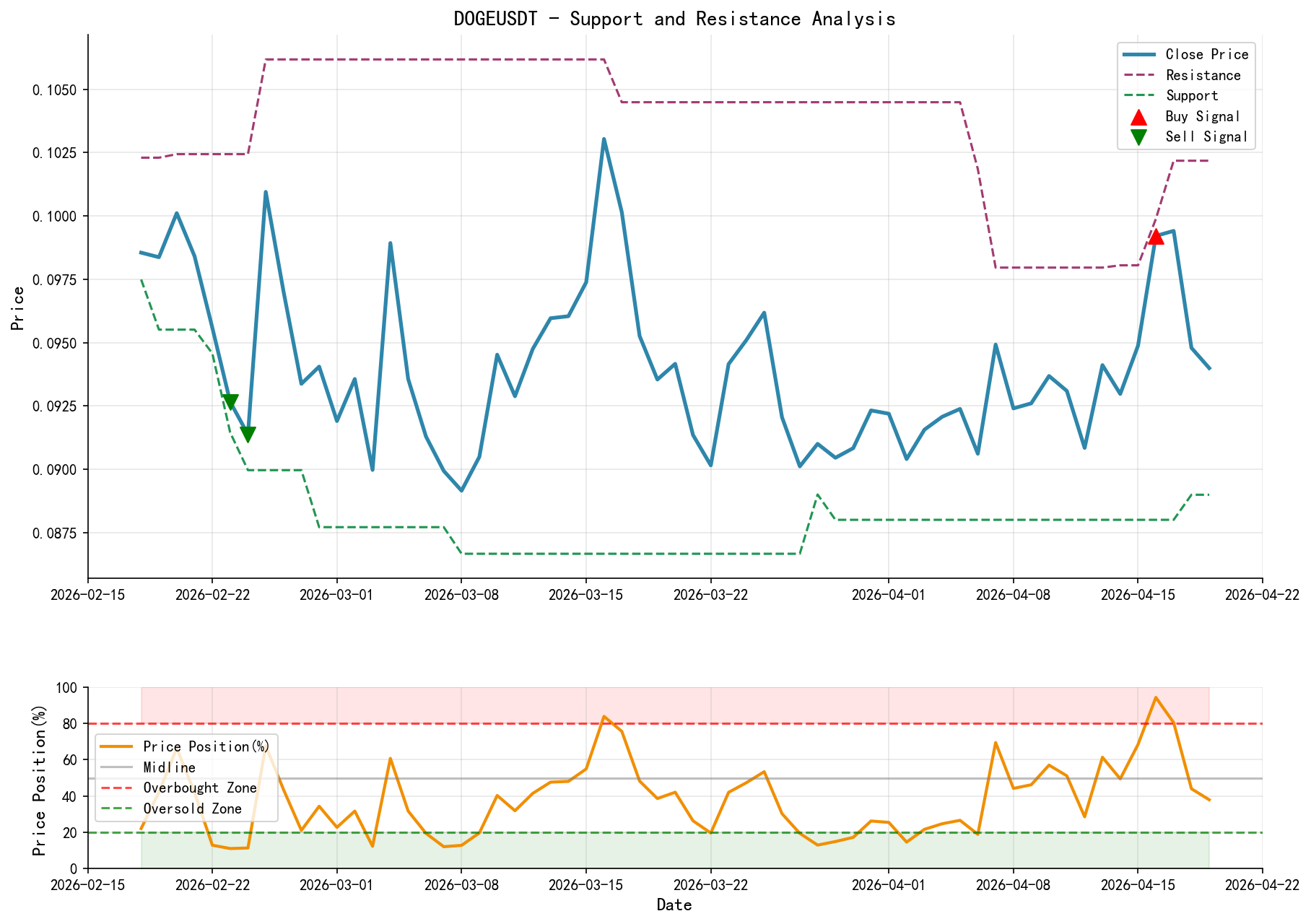
Key Price Levels:
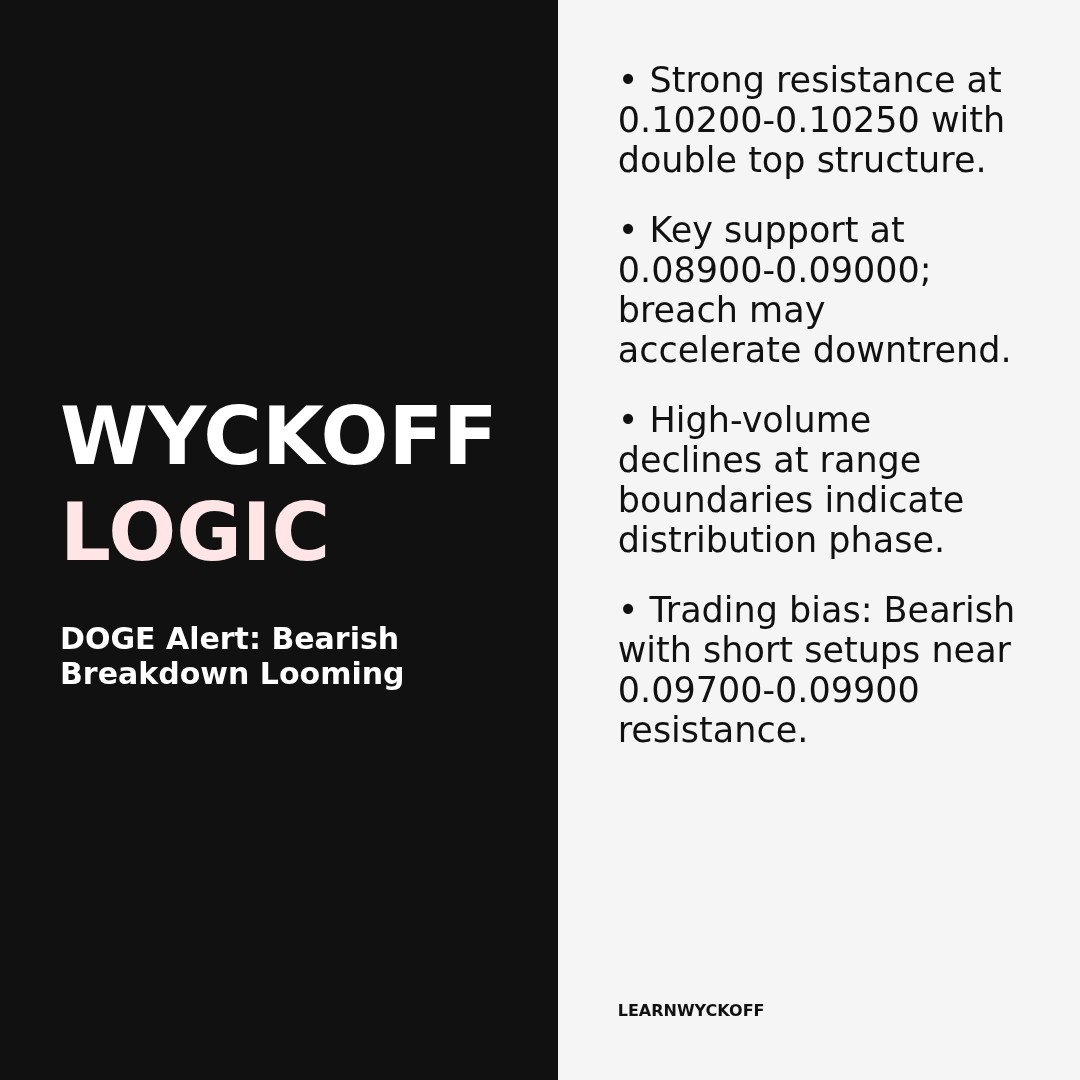
- • Strong Resistance: 0.10200 - 0.10250 (Double top structure in February and April).
- • Range Resistance / Bull-Bear Boundary: 0.09800 - 0.10000 (Area where multiple rallies were rejected, near MA_30D).
- • Dynamic Resistance Near Current Price: MA_5D (0.09625), MA_10D (0.09456).
- • Key Support: 0.08900 - 0.09000 (Dense low-point area tested multiple times in March and late March).
- • Lower Support: If 0.08900 is breached, there is no clear technical support below, potentially opening new downside space.
Synthesized Wyckoff Events and Trading Signals:
- 1. Primary Conclusion (Bearish): Market structure exhibits a bearish alignment with weak long-term momentum. Within the wide 0.102 to 0.089 range, volume-price behavior aligns more with "distribution" characteristics than "accumulation." The recent high-volume decline at the upper range boundary is a clear signal of supply regaining dominance.
- 2. Operational Recommendations:
- • Bearish Strategy (High Priority): On a price rebound to the 0.09700 - 0.09900 area, signs of rally exhaustion such as declining volume, weak closes, or upthrust candles could present shorting opportunities. Initial stop-loss can be placed above the range high at 0.10250. A high-volume break below the 0.08900 support would be a signal for a downtrend resumption, warranting consideration for adding to or initiating short positions.
- • Bullish Strategy (Low Priority / Wait-and-See): Under the current structure, going long carries high risk. Only if the price tests the 0.08900-0.09000 support area again and exhibits significant "stopping volume with a long lower shadow" or a "spring effect" (quick drop below followed by a rapid recovery) accompanied by a sharp volume spike, might a light long position for a bounce be considered, with a stop-loss placed below 0.08800. The target would be limited to the upper range boundary near 0.09800.
- • Observation Zone: While the price trades in a directionless range between 0.091 - 0.096, it is advisable to wait and observe for the outcome of tests at the key levels mentioned above.
- 3. Future Validation Points:
- • Confirmation of Bearish View: Price closes decisively below 0.08900 on high volume (
VOLUME_AVG_7D_RATIO> 1.2). - • Invalidation of Bearish View: Price breaks out and holds firmly above 0.10250 on strong volume (
VOLUME_AVG_7D_RATIO> 1.5), with pullbacks holding above 0.10000. This would negate the distribution hypothesis and point toward stronger accumulation and potential trend reversal. - • Neutral / Range Continuation: Price continues to oscillate within the 0.089-0.102 range with volume at or below average levels.
- • Confirmation of Bearish View: Price closes decisively below 0.08900 on high volume (
Historical Ranking Data Integration Note:
The provided historical_rank_data list in this analysis is empty. Therefore, it is impossible to place current metrics (e.g., volume, volatility extremes) within a longer historical context (e.g., past 10 years) for percentile assessment. This somewhat limits the judgment regarding the "extremeness" and "rarity" of current market phenomena. Future analyses incorporating effective historical ranking data would allow for more precise quantification (e.g., "at what historical level is the volume of this rebound?"), greatly enhancing confidence in judgments about large investor behavior and market phases. Based on existing data, we can only conduct relative comparisons within the cycle.
Disclaimer: This report/analysis is solely market analysis and research based on publicly available information and does not constitute any investment advice or operational guidance. The author strives for objectivity and impartiality but makes no guarantees regarding accuracy or completeness. Markets involve risk; investment requires caution. Any investment actions based on this report are taken at one's own risk.
Thank you for your attention! Daily Wyckoff Volume-Price Market Analysis is released punctually at 8:00 AM before the market opens. Your comments and shares are sincerely appreciated, as your recognition is crucial. Let's see the market signals together.
Member discussion: