Understood. As per your instructions, I will assume the role of a Wyckoff quantitative trading researcher and, based on the provided XRPUSDT data and historical ranking indicators, compose a comprehensive quantitative analysis report.
XRPUSDT Wyckoff Quantitative Analysis Report
Product Code: XRPUSDT
Analysis Date Range: 2026-02-11 to 2026-04-12
Report Generation Time: 2026-04-13
Core Methodology: Wyckoff Price-Volume Principle
1. Trend Analysis and Market Phase Identification
As of April 12, 2026, XRPUSDT open price 1.35, close price 1.34, 5-day MA 1.36, 10-day MA 1.34, 20-day MA 1.35, Daily change -1.25%, Weekly change 0.85%, Monthly change -0.26%, Quarterly change -0.26%, Yearly change -27.40%.
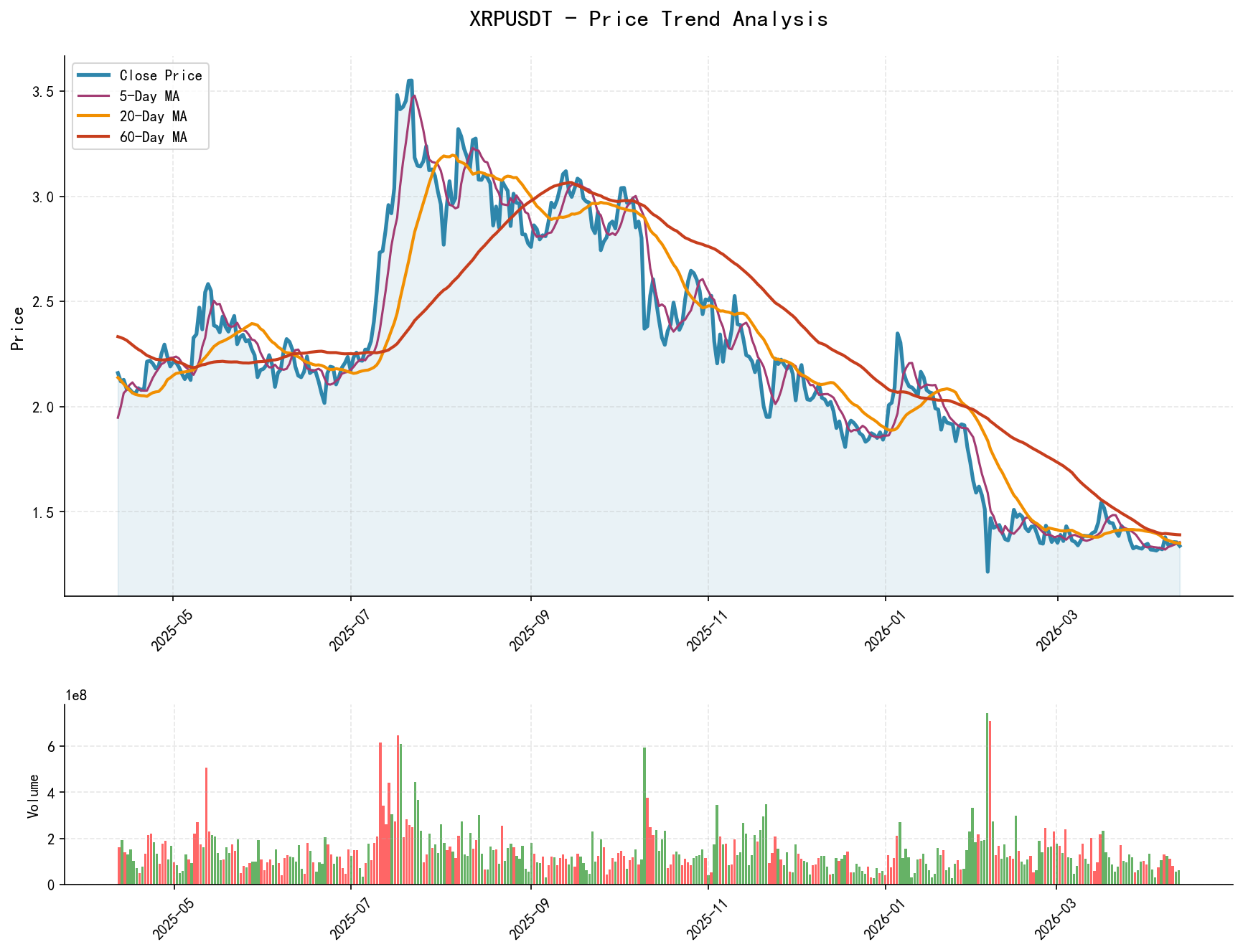
- • Trend Determination: During the analysis period, XRPUSDT was in a clear long-term downtrend. The price (closing price) fell from 1.3697 to 1.3376, and for most of the time, it remained below all major moving averages (MA_20D, MA_30D, MA_60D). The moving average system exhibited a bearish alignment (MA_60D > MA_30D > MA_20D > Price), with all MAs pointing downwards, confirming a bear market structure.
- • Moving Average Crossover Signals: Although the data does not directly provide crossover signals, observing the relationship between MA_5D and MA_20D shows that MA_5D briefly crossed above MA_20D on multiple occasions (e.g., around March 16), but quickly fell back and remained suppressed by it. This indicates that any short-term rebound lacked sustainability and was stifled by the medium-term downtrend.
- • Inferred Market Phase (Wyckoff Perspective): Combining the price-volume behavior across the entire cycle, the market likely underwent transitions through several Wyckoff phases:
- • Initial Distribution and Decline (Early February): The high-volume decline from above 1.5 can be seen as the initiation of the markdown phase following distribution.
- • Panic Selling (Mid-February): Massive volume sell-offs (VOLUME_GROWTH > 160%) occurred on February 15th and 23rd, with prices making new lows, aligning with the characteristics of a "Selling Climax," but subsequent rebounds were weak.
- • Automatic Rally and Secondary Test (Late February to Early March): A rally appeared after the panic (e.g., Feb 25th), but volume showed signs of contraction (see historical rankings). The price then tested the previous low area again, forming a "Secondary Test."
- • Weak Rally and Re-distribution/Downtrend Continuation (Mid to Late March): A significant high-volume rise occurred on March 16th, which can be viewed as a "Sign of Strength" or demand attempt, but failed to change the overall trend. Subsequently, the price declined again on low volume, indicating the market entered a continuation phase of the downtrend, with weak buying power and persistent, albeit not aggressive, selling pressure.
- • Current Phase (Early April): Price is consolidating in a narrow range (1.31-1.36) at relatively low levels, with volume contracting to historically low levels (see below). The market may be in a "liquidation" or "preparation for accumulation" phase at the end of the downtrend, but no clear reversal signals have emerged yet.
2. Price-Volume Relationship and Supply-Demand Dynamics
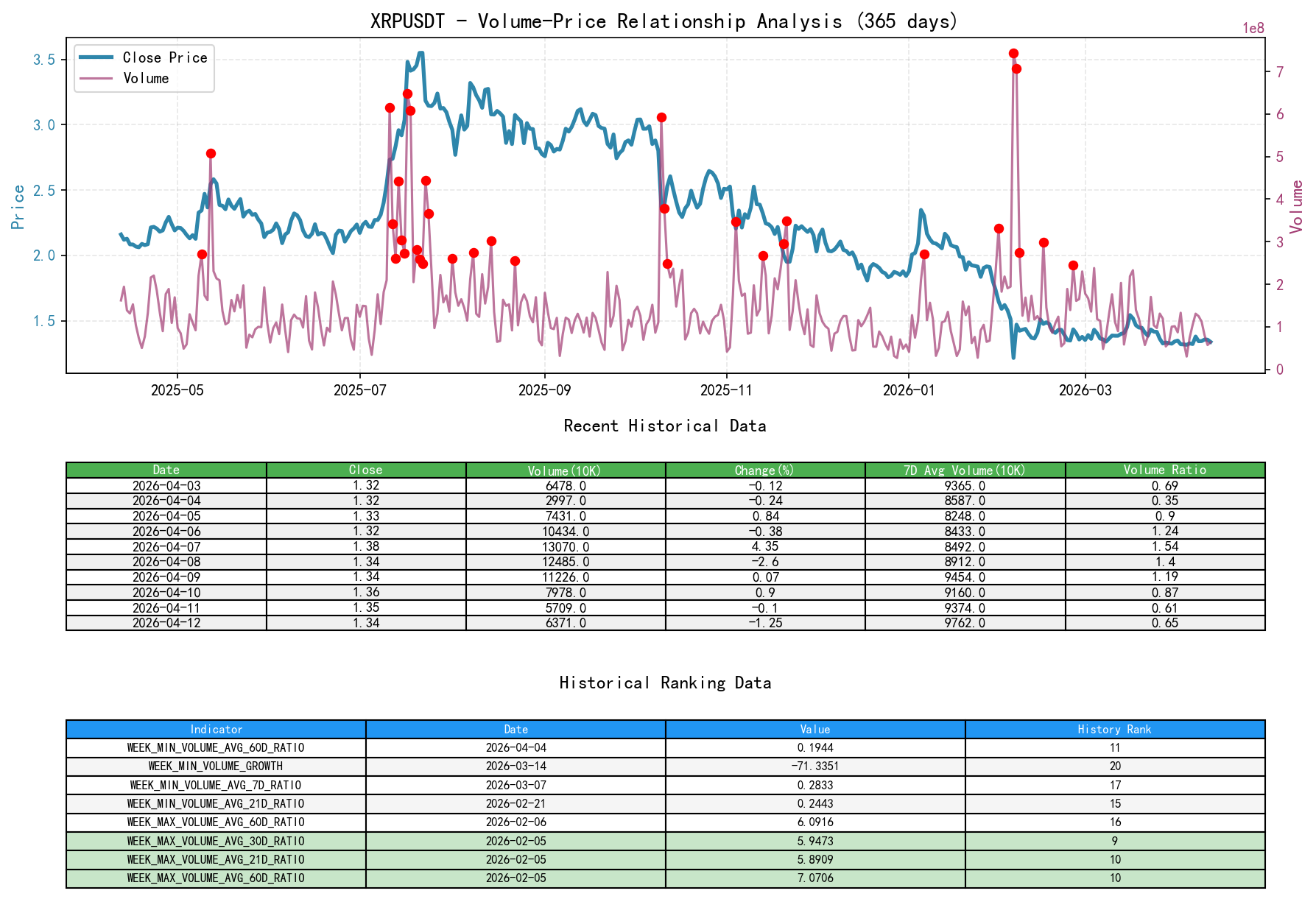
As of April 12, 2026, XRPUSDT open price 1.35, close price 1.34, volume 63718371.00, daily change -1.25%, volume 63718371.00, 7-day average volume 97623679.04, 7-day volume ratio 0.65.
- • Key Day Analysis:
- 1. Supply Dominance (High-Volume Decline):
- • 2026-02-15: Price fell -2.26%, volume surged 164.54%,
VOLUME_AVG_60D_RATIOwas as high as 2.229. This is a typical signal of supply fully controlling the market, with large-scale selling pressure emerging. - • 2026-02-23: Price fell -2.97%, volume increased again by 208.82%,
VOLUME_AVG_60D_RATIOwas 1.363. Confirms the persistence of supply pressure and ongoing market panic.
- • 2026-02-15: Price fell -2.26%, volume surged 164.54%,
- 2. Demand Attempt (High-Volume Advance):
- • 2026-02-25: Price rose 6.36%, volume increased 76.02%,
VOLUME_AVG_60D_RATIOwas 1.726. This is a significant sign of demand entering the market after consecutive declines, attempting to reverse the trend. - • 2026-03-16: Price rose 6.51%, volume increased 124.40%,
VOLUME_AVG_60D_RATIOwas 1.401. Again shows strong demand, with price attempting to break out of the consolidation zone.
- • 2026-02-25: Price rose 6.36%, volume increased 76.02%,
- 3. Insufficient Demand (Low-Volume Rebound/Decline):
- • 2026-03-27: Price fell -2.59%, volume only increased slightly by 2.66%,
VOLUME_AVG_60D_RATIOwas 0.724. Indicates selling pressure eased during the decline, but buyers were also unwilling to step in. - • 2026-04-03/04: Price declined slightly, volume contracted by -51.24% and -53.73% respectively,
VOLUME_AVG_60D_RATIOdropped to lows of 0.413 and 0.194. Shows market trading interest has hit rock bottom, with both bulls and bears adopting a wait-and-see stance.
- • 2026-03-27: Price fell -2.59%, volume only increased slightly by 2.66%,
- 1. Supply Dominance (High-Volume Decline):
- • Volume Extremes (Corroborated by Historical Rankings):
- •
WEEK_MIN_VOLUME_AVG_60D_RATIOreached 0.1944 on 2026-04-04, ranking 11th lowest in the past 10 years.WEEK_MIN_VOLUME_AVG_21D_RATIOreached 0.2443 on 2026-02-21, ranking 15th lowest. This extreme volume contraction (relative to long-term averages) strongly suggests that market selling momentum has significantly diminished, potentially nearing a phase bottom area. However, it also indicates that demand has not yet entered the market on a large scale.
- •
3. Volatility and Market Sentiment
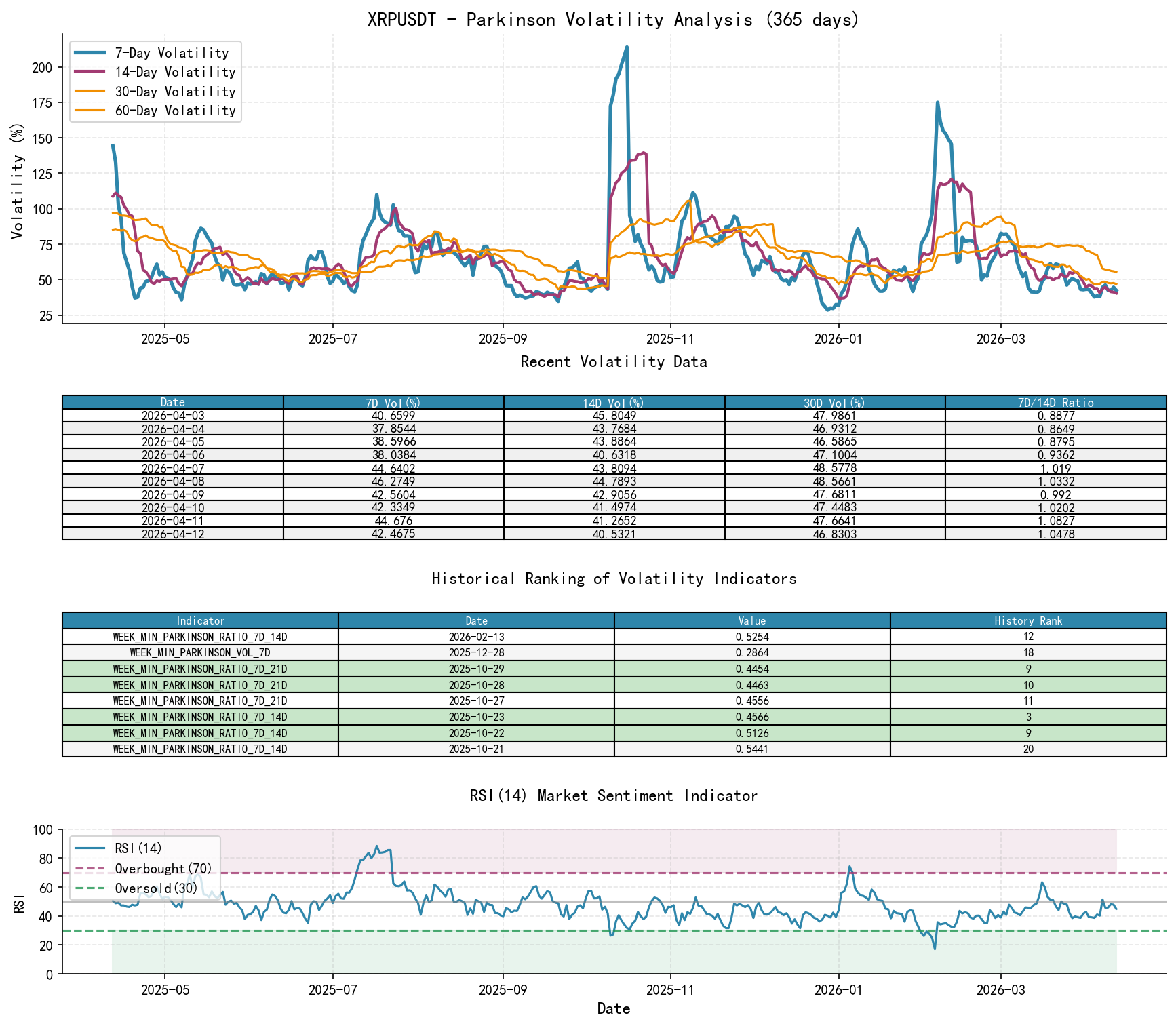
As of April 12, 2026, XRPUSDT open price 1.35, 7-day intraday volatility 0.42, 7-day intraday volatility volume ratio 1.05, 7-day historical volatility 0.41, 7-day historical volatility volume ratio 1.31, RSI 44.87.
- • Volatility Level and Changes: Short-term historical volatility (
HIS_VOLA_7D) and Parkinson volatility (PARKINSON_VOL_7D) have declined from highs in February (>1.4) to lows in April (<0.5). This indicates market sentiment has transitioned from a state of panic and high volatility in February to a state of apathy and low volatility in April. - • Volatility Structure Anomalies:
- • 2026-02-11:
HIS_VOLA_RATIO_7D_14Dwas 1.4304 (ranking 16th highest in the past 10 years), showing a sharp spike in short-term volatility, far exceeding medium-term volatility. This aligns with the high-volume crash at the time and is a quantitative manifestation of panic sentiment. - • 2026-02-13:
HIS_VOLA_RATIO_7D_14Dplummeted to 0.2665 (ranking 14th lowest in the past 10 years),PARKINSON_RATIO_7D_14Ddropped to 0.5254 (ranking 12th lowest). This rapid convergence in short-term volatility occurred the day after the crash, likely indicating the market entered a brief pause and watchful state post-crash.
- • 2026-02-11:
- • Overbought/Oversold Status (RSI): RSI_14 primarily moved within the 32-55 range throughout the cycle. It only briefly touched 63.37 (near overbought) on March 16th before quickly retreating. It probed below 35 multiple times (e.g., 32.59 on Feb 11th), indicating the market was consistently in an oversold or weak zone. However, in a downtrend, an RSI persistently hovering at low levels while prices continue to fall is a typical bear market characteristic, showing absolute dominance by bearish forces.
4. Relative Strength and Momentum Performance
- • Periodic Return Analysis:
- • Short-term Momentum (WTD): Weekly returns (
WTD_RETURN) fluctuated sharply, alternating between positive and negative without a sustained directional trend, reflecting a market in a non-trending oscillation or gradual decline. - • Medium-term Momentum (MTD/QTD/YTD): Monthly, quarterly, and yearly-to-date returns were negative throughout, with significant absolute values (QTD/YTD approx. -25% to -28%). This clearly shows that within the analyzed time frames, XRPUSDT exhibited extremely weak medium and long-term momentum, making it a relatively weak asset in the market.
- • Short-term Momentum (WTD): Weekly returns (
- • Momentum and Price-Volume Verification: Despite the strong short-term positive momentum (high-volume bullish candles) on February 25th and March 16th, neither succeeded in turning the medium-term momentum (MTD) positive, nor in reversing the long-term downtrend (QTD/YTD continued to deteriorate). This verifies the Wyckoff principle that "a rally requires sustained and expanding volume for confirmation"; one or two instances of high-volume advances are insufficient to change the trend.
5. Large Investor (Smart Money) Behavior Identification
- • High-Volume Selling in Mid-February: Combined with high volatility rankings, the massive volume declines on February 15th and 23rd can be inferred as large holders (possibly early bulls or institutions) conducting concentrated distribution, or panic selling triggered by collective liquidation of leveraged long positions (Selling Climax). Smart money was the primary supplier at this time.
- • High-Volume Rally in Mid-March: The high-volume breakout on March 16th occurred at relatively low levels and was followed by low-volume pullbacks in subsequent days. This aligns with the characteristics of a "Shakeout" or a "Jump" within an accumulation range. Smart money may have been testing overhead supply and attempting to establish some long positions at this level.
- • Extreme Volume Contraction from Late March to April: Volume contraction reached historically low levels (top 15 rankings in the past 10 years), indicating large investor activity has dropped to rock bottom. This could mean:
- 1. Distribution Completed: Major selling pressure has been exhausted.
- 2. Demand on Hold: Smart money is waiting for clearer bottom signals or better prices, unwilling to absorb large quantities at current levels.
- 3. Slow Accumulation: Accumulating at lows in a "time-for-price" manner without significantly pushing the price higher. The current extremely low volume provides an environment for such stealth accumulation.
- • Comprehensive Inference: Smart money engaged in clear distribution/panic induction in February, attempted a tentative demand intervention in March, and has now entered a silent observation period or low-speed accumulation phase in early April. Market control is transitioning from aggressive bears towards a state of balance, but demand has not yet gained control.
6. Support/Resistance Level Analysis and Trading Signals
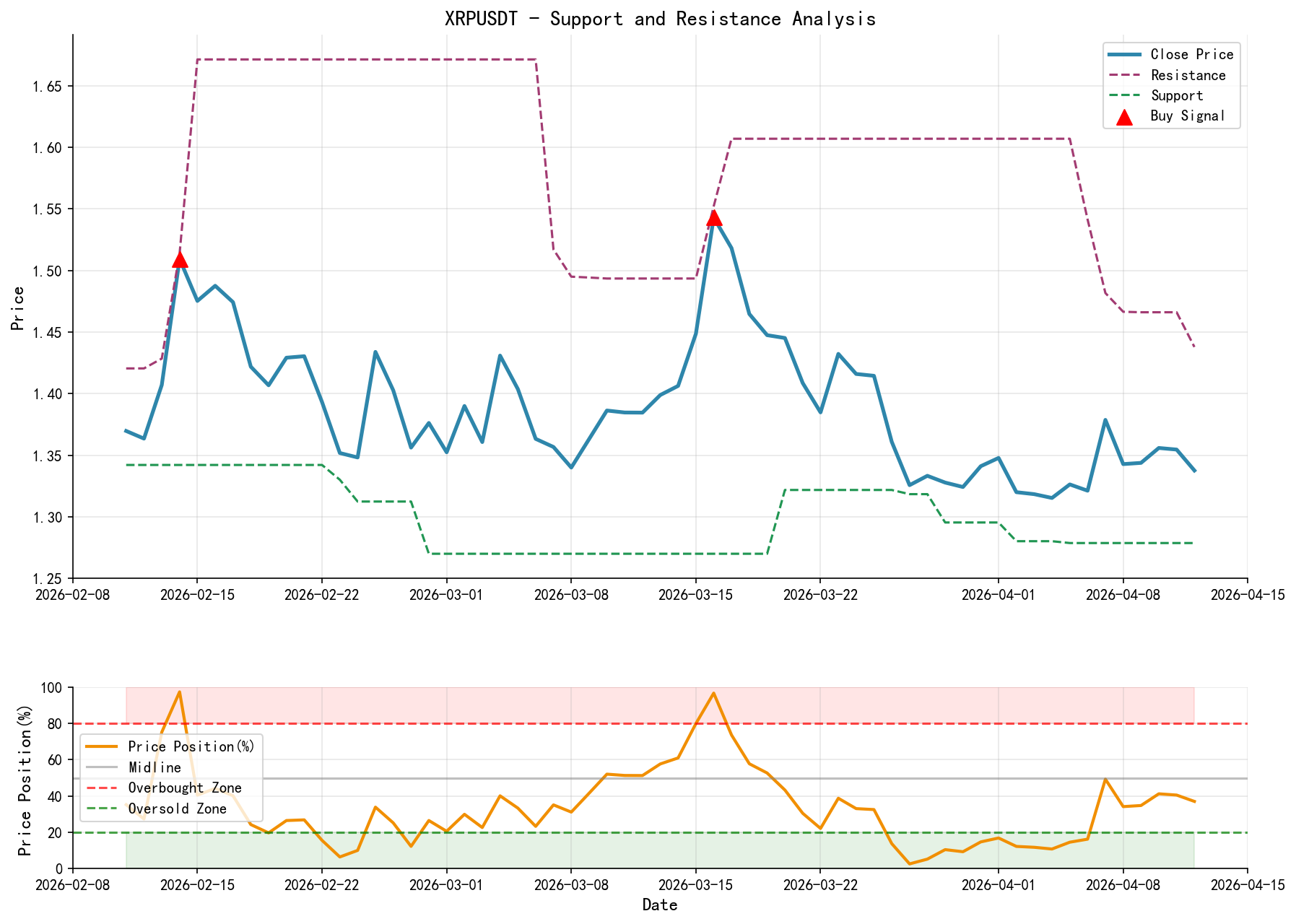
- • Key Support Levels:
- • S1: 1.2700 (Flash crash low on 2026-02-28) – Important psychological and technical support.
- • S2: 1.3120 - 1.3300 (Lower boundary of the dense trading range formed from 2026-03-30 to 04-06) – Recent weak support.
- • Key Resistance Levels:
- • R1: MA_20D Dynamic Moving Average (currently ~1.3500-1.3600) – The medium-term trendline that has suppressed price rebounds multiple times recently.
- • R2: 1.3848 (Recent high within the cycle ending 2026-04-12) – Clear resistance for recent rebounds.
- • R3: 1.4400 - 1.4500 (Head area formed from 2026-03-14 to 03-18) – Strong resistance zone; a break above is needed to reverse the short-term downtrend structure.
- • Wyckoff Integrated Trading Signals:
- • Current Market State: Late stage of a downtrend, supply has clearly weakened (extremely low volume), but demand has not shown strength. The market is in a **"balance area after supply exhaustion,"**酝酿 direction selection.
- • Trading Recommendation: Cautiously bearish, actively seeking bottoming signals for long positions. Avoid blind bottom-fishing before clear demand entry.
- • Conditions for Watchful Waiting/Light Long Positioning (all must be met):
- 1. Price retests the S2 (1.3120-1.3300) or S1 (1.2700) support areas.
- 2. During the test, a significant price rejection pattern appears (long lower wick, pin bar, etc.).
- 3. Accompanied by significantly increased volume (
VOLUME_AVG_60D_RATIO> 1.2), and the closing price is above the high of the test day. - 4. Initial stop-loss can be set below the test low. Target levels look towards R1 (1.3600) and R2 (1.3850).
- • Conditions for Bearish View/Short Positions:
- 1. Price rebounds near R1 (1.3600) or R2 (1.3850).
- 2. Clear signs of supply appear: high-volume stalling (price rises but closes with an upper wick after abnormal volume surge) or high-volume decline.
- 3. Stop-loss set above the resistance level. Target levels look towards S2 and S1.
- • Conditions for Watchful Waiting/Light Long Positioning (all must be met):
- • Future Validation Points:
- 1. Bullish Signal Confirmation: Observe if the price can break through and sustain above R1 (MA_20D) on high volume (
VOLUME_AVG_60D_RATIOconsistently >1). This would be the first effective challenge to the downtrend. - 2. Bearish Trend Continuation: If the price breaks below S2 (1.3120) on high volume, it indicates a new down leg has started, retesting S1 (1.2700).
- 3. Bottom Formation Confirmation: Requires observing a successful "Secondary Test" at the support area (low volume during the test, price does not make a new low or makes a marginal new low followed by a quick recovery), ultimately forming a "Jump across the Creek" breakout pattern.
- 1. Bullish Signal Confirmation: Observe if the price can break through and sustain above R1 (MA_20D) on high volume (
Conclusion Reiteration: XRPUSDT is currently in the late stage of a long-term downtrend. Based on Wyckoff price-volume principles, the extreme volume contraction (ranking in the top 15 lows in the past 10 years) strongly suggests that supply has been substantially exhausted, and the market is in a potential bottom-formation period. However, demand has not yet demonstrated the strength required to reverse the trend. Traders are advised to maintain patience, closely monitor price-volume signals for demand entry near key support levels, or look for shorting opportunities where supply re-emerges near resistance levels. The current market is at a critical juncture transitioning from bearish dominance to a balance between bulls and bears.
Disclaimer: The content of this report/interpretation is solely market analysis and research based on publicly available information and does not constitute any investment advice or operational guidance. The author strives for objectivity and fairness in the content but makes no guarantees regarding its accuracy or completeness. Markets involve risks, and caution is advised in investments. Any investment actions taken based on this report are at the investor's own risk.
Thank you for your attention! Daily Wyckoff Price-Volume Market Interpretations are released at 8:00 AM before the market opens. Please feel free to comment and share; your recognition is vital. Let us work together to see the market signals clearly.
Member discussion: