TONUSDT Wyckoff Quantitative Analysis Report
Analysis Period: 2026-02-11 to 2026-04-12
Report Generation Time: 2026-04-13
Core Conclusion
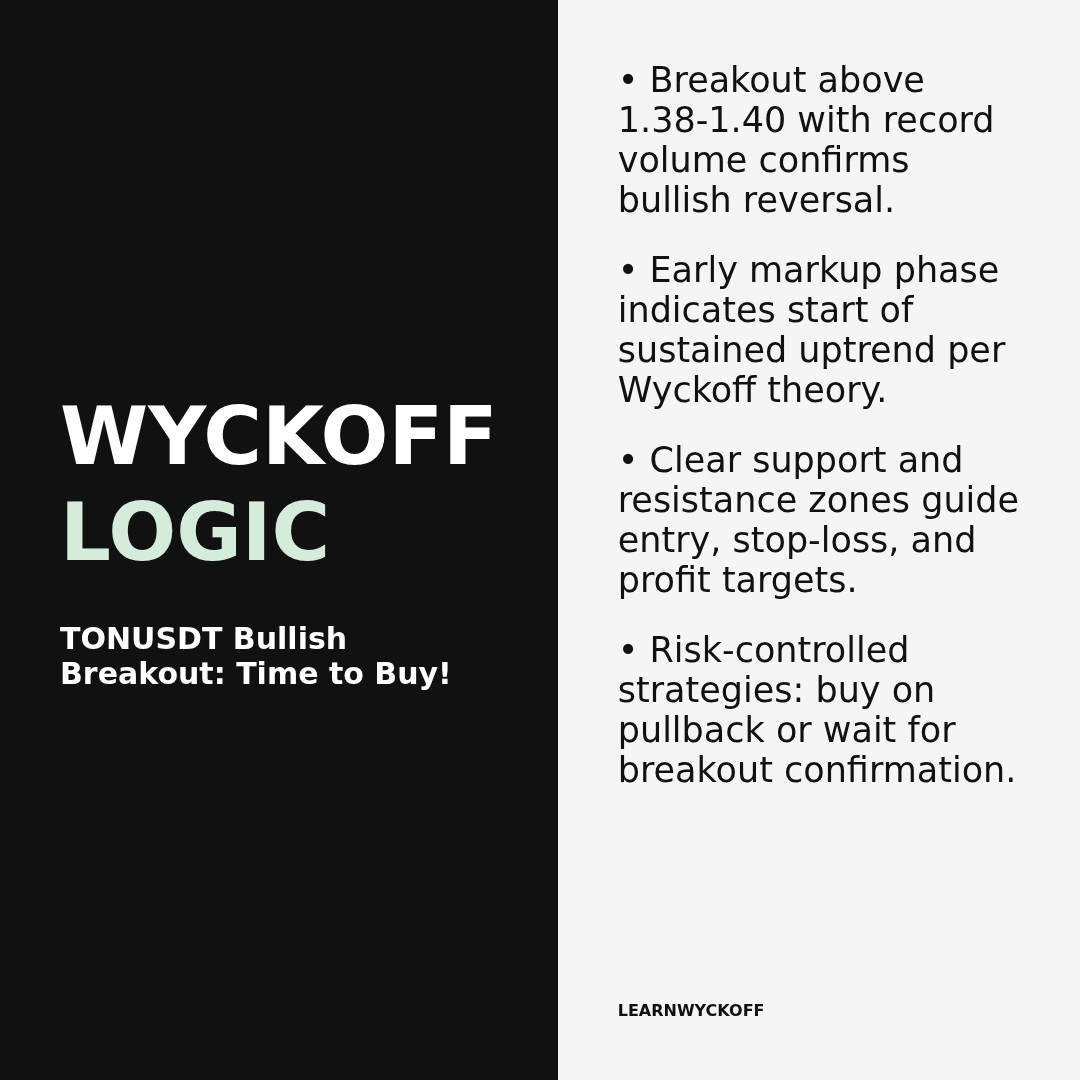
Based on Wyckoff price-volume principles applied to the past two months of data and historical ranking analysis, TONUSDT has completed a full cycle transition from prolonged decline and accumulation at low levels to a strong rebound. The market is currently in the early phase of a new upward trend, with clear demand intervention by large investors (smart money) at key levels. Trading signals are biased positively; however, given the substantial short-term gains and proximity to key resistance, the strategy should primarily focus on identifying low-risk long opportunities after pullbacks.
1. Trend Analysis and Market Phase Identification
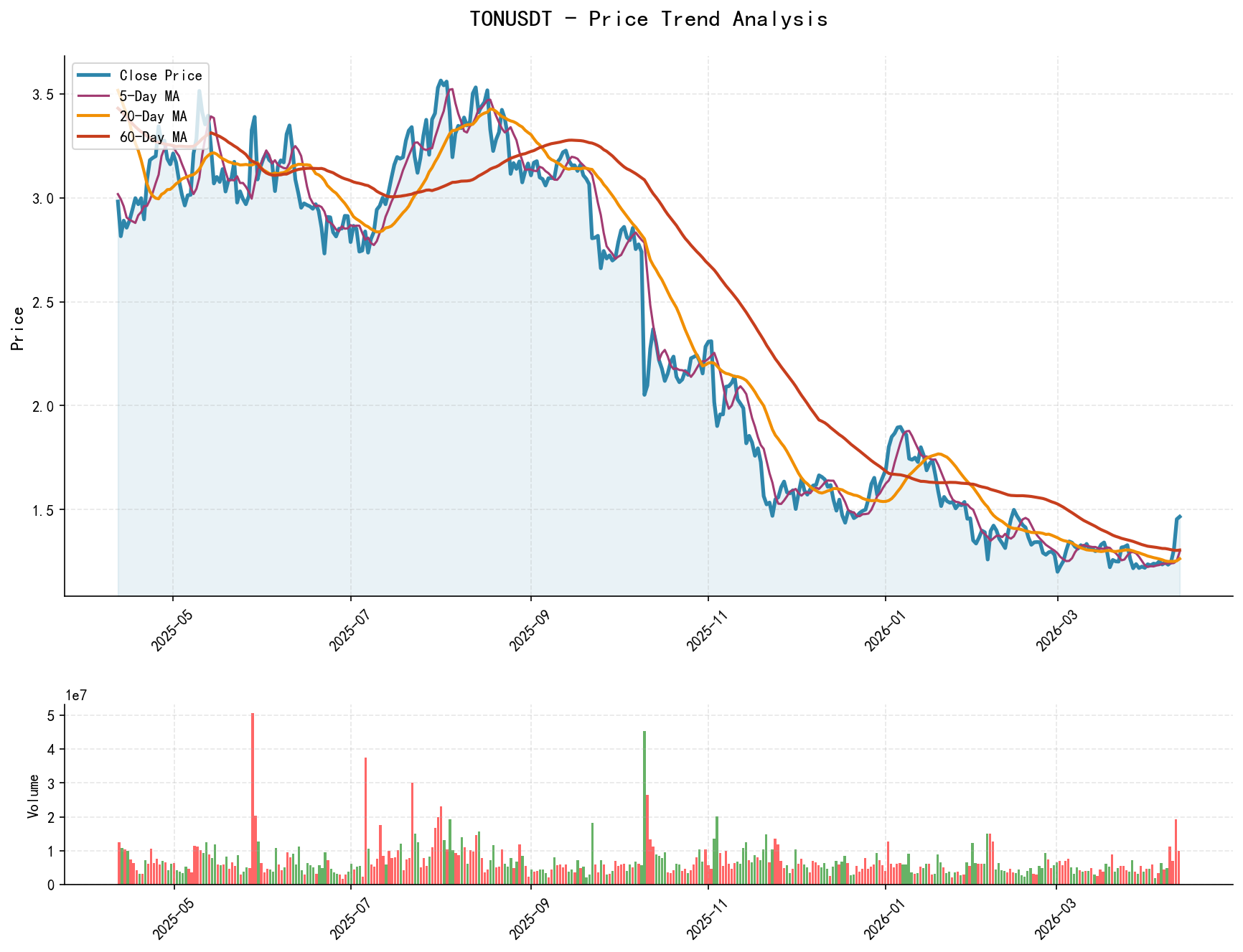
As of 2026-04-12, for the asset TONUSDT: Opening Price 1.46, Closing Price 1.47, 5-day MA 1.30, 10-day MA 1.27, 20-day MA 1.26, Daily Change +0.83%, Weekly Change +17.19%, Monthly Change +20.16%, Quarterly Change +20.16%, Annual Change -11.63%
- • Moving Average Alignment and Trend Evolution:
- • Early February to Mid-Late March: The price (CLOSE) consistently traded below all moving averages (MA_5D, MA_10D, MA_20D, MA_30D, MA_60D), showing a standard bearish alignment, indicating a clear downtrend.
- • Late March to Early April: The price oscillated repeatedly within the 1.20-1.26 range. MA_5D and MA_10D gradually flattened and intertwined, with the price testing MA_20D multiple times but failing to sustainably break above it. This represents a typical bottoming/consolidation formation.
- • April 11-12: The price broke through MA_5D and MA_10D with massive bullish candles and approached MA_20D aggressively (1.466 vs MA_20D 1.2638). The short-term moving average (MA_5D) began turning upward and crossed above MA_10D, forming the embryonic stage of a short-term bullish alignment. However, MA_20D, MA_30D, and MA_60D remain downward-sloping, indicating the long-term downtrend line is being challenged but not completely reversed.
- • Market Phase Assessment:
- • Earlier Phase (Until Late March): Combined with the price making multi-year lows (historical ranking: the closing price of 1.201 on March 1st was the lowest in nearly ten years), shrinking volume (see below), and volatility hitting rock-bottom levels, this aligns with the Wyckoff theory characteristics of the tail end of a downtrend and the Accumulation phase.
- • Current Phase (April 12th): The price has broken upward from the accumulation range with immense demand and record-high volume, signaling the market is transitioning from the Accumulation phase to the Markup phase. This is a key signal of a potential fundamental trend reversal.
2. Price-Volume Relationship and Supply-Demand Dynamics
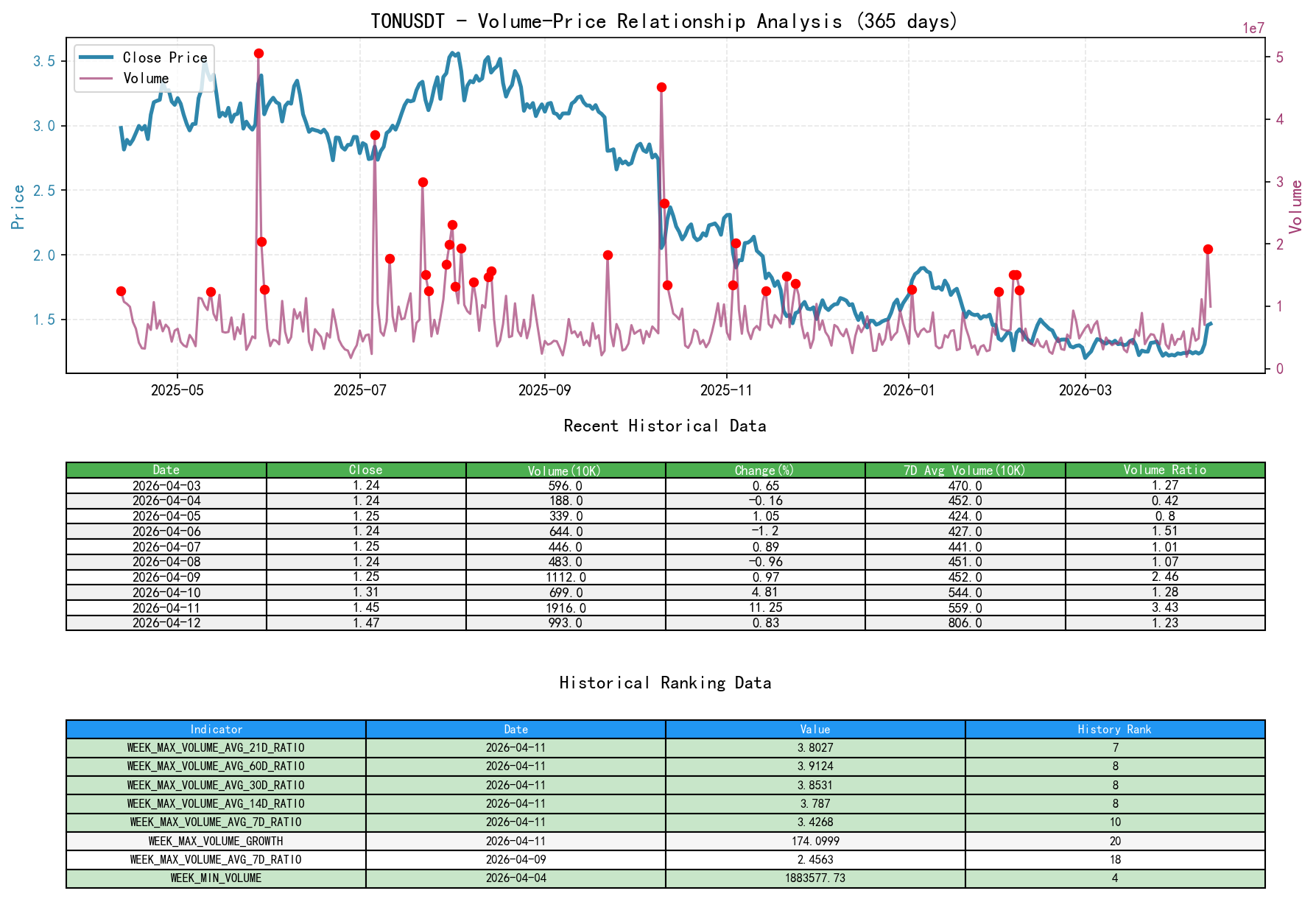
As of 2026-04-12, for the asset TONUSDT: Opening Price 1.46, Closing Price 1.47, Volume 9935417.04, Daily Change +0.83%, Volume 9935417.04, 7-day Average Volume 8060345.33, 7-day Volume Ratio 1.23
- • Key Day Analysis:
- • Demand-Dominated Days (Strong Signals):
- • 2026-04-11:
PCT_CHANGE: +11.25%,VOLUME: 19.16 million. This was a decisive demand day. Volume surged to 3-4 times the recent average (VOLUME_AVG_60D_RATIO: 3.91, historical ranking 8th highest). The price closed near the intraday high. This is typical of large-scale demand influx aimed at breaking out of and escaping the accumulation zone. - • 2026-04-12:
PCT_CHANGE: +0.83%,VOLUME: 9.94 million. Following the huge surge the previous day, volume remained elevated (VOLUME_AVG_60D_RATIO: 1.93). The price made a new high before a slight pullback but still closed higher, indicating demand remained dominant after absorbing short-term profit-taking. - • 2026-02-12/13: Two consecutive days of high-volume rallies (
VOLUME_AVG_7D_RATIO > 1) represented a strong rebound test within the downtrend, but subsequent demand failed to persist.
- • 2026-04-11:
- • Supply-Dominated Days (Weak Signals):
- • 2026-03-01 / 03-19: High-volume (
VOLUME_AVG_7D_RATIO > 1) sharp declines (PCT_CHANGE: -6.32% / -5.85%) to new lows, representing Selling Climax or Last Point of Supply events within the downtrend, creating conditions for subsequent accumulation. - • 2026-04-04:
VOLUME: 1.88 million(historical ranking 4th lowest),PCT_CHANGE: -0.16%. This is a classic low-volume Test, with volume drying up to an extreme level just before the rally, indicating exhaustion of supply and scarcity of floating stock.
- • 2026-03-01 / 03-19: High-volume (
- • Low-Volume Rallies (Insufficient Demand):
- • Days like 2026-03-10 / 03-17: Price rose but volume was below various period averages (
VOLUME_AVG_*D_RATIO < 0.8), showing the rally lacked sustained demand support, making it prone to pullbacks.
- • Days like 2026-03-10 / 03-17: Price rose but volume was below various period averages (
- • Demand-Dominated Days (Strong Signals):
- • Supply-Demand Dynamics Summary: The market's supply-demand forces underwent a fundamental shift around the end of March. Previously dominated by persistent supply, the decline included multiple panic selling episodes. Entering April, supply dried up drastically to extreme levels (record low volume on April 4th), followed by a complete reversal via the massive demand surge on April 11th. The current structure shows demand significantly stronger than supply.
3. Volatility and Market Sentiment
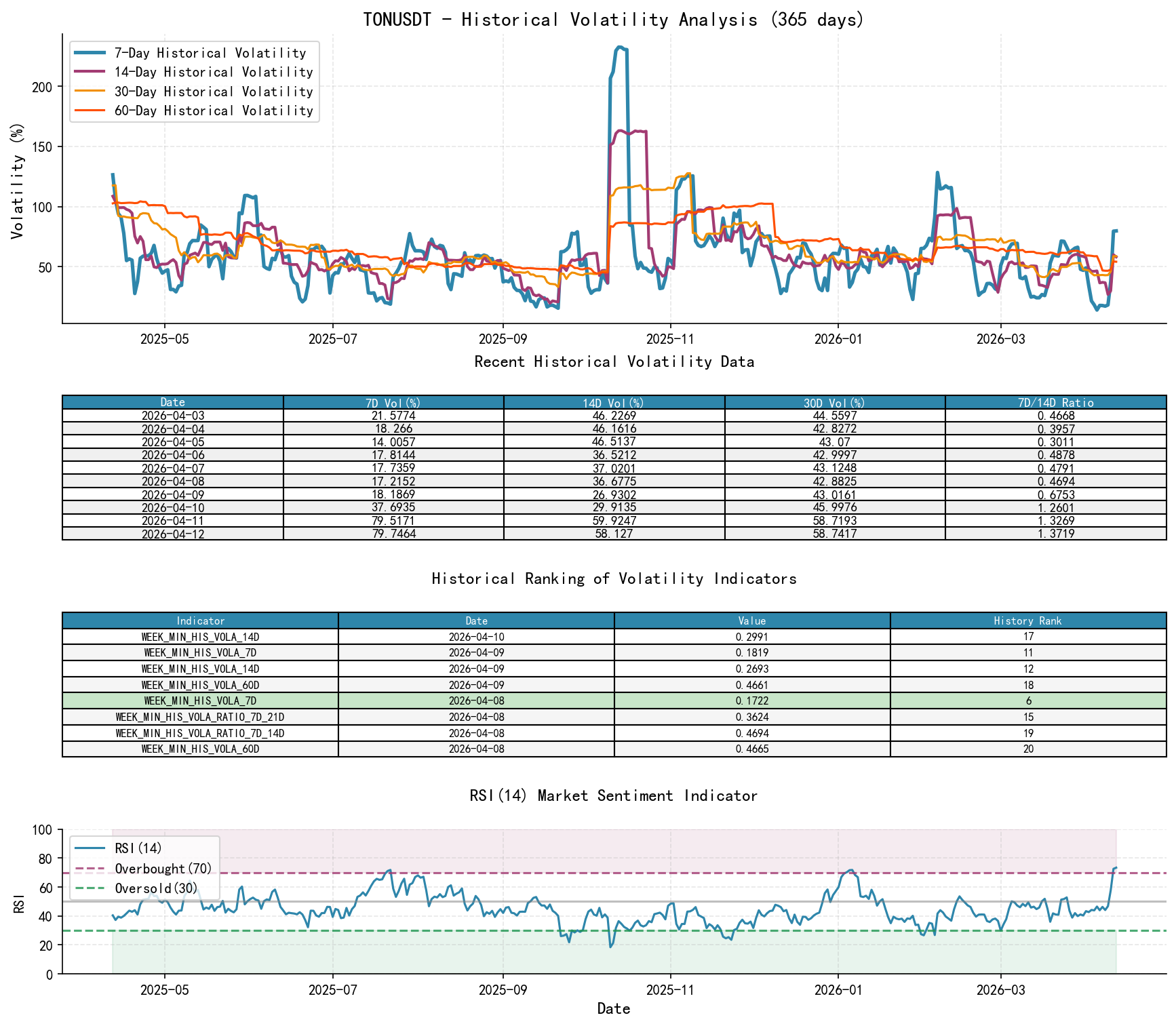
As of 2026-04-12, for the asset TONUSDT: Opening Price 1.46, 7-day Parkinson Volatility 0.75, 7-day Parkinson Volatility Ratio 1.44, 7-day Historical Volatility 0.80, 7-day Historical Volatility Ratio 1.37, RSI 73.44
- • Volatility Levels and Changes:
- • Compression Period: In early April, volatilities across all horizons dropped to historically extreme lows.
HIS_VOLA_7Dfell to 0.1401 on April 5th (historical ranking lowest), andPARKINSON_VOL_7D/14Dwere also at historical lows. This indicates extreme market sentiment suppression and directional confusion — the calm before the storm — often preceding a major trend shift. - • Expansion Period: On April 11-12, short-term volatility spiked sharply.
HIS_VOLA_7Dsurged to 0.7975, andPARKINSON_VOL_7Drose to 0.7502. More importantly, volatility ratios soared:HIS_VOLA_RATIO_7D_60Dreached 1.473 (historical ranking very high), andPARKINSON_RATIO_7D_14Dreached 1.440 (historical ranking 16th highest). Short-term volatility far exceeding long-term volatility confirms the initiation of a trending move and rapid sentiment heating.
- • Compression Period: In early April, volatilities across all horizons dropped to historically extreme lows.
- • Market Sentiment (RSI):
- • RSI_14 touched 29.87, the oversold region, on March 1st, forming a divergence with the price low — an early signal of waning downside momentum.
- • The current RSI_14 has risen to 73.44 (historical ranking 3rd highest), entering the strong bullish zone. This indicates short-term market sentiment has shifted from extreme pessimism to optimism, bordering on overbought conditions in the near term. While caution is warranted for a potential technical pullback, in the context of the high-volume breakout, this is more likely to signify robust trend momentum.
4. Relative Strength and Momentum Performance
- • Momentum Analysis:
- • Extremely Strong Short-Term Momentum:
MTD_RETURNandQTD_RETURNwere both as high as +20.16% on April 12th, withWTD_RETURNat +17.19%. This indicates a dramatic reversal in price momentum over the past month, shifting forcefully from negative to strongly positive momentum. - • Mid-Term Momentum Recovery: Although
YTDis still -11.63%, it shows significant recovery compared to the March low (-27.61%). The price has reclaimed most of its year-to-date losses, indicating the mid-term downtrend has been effectively halted and is beginning to reverse.
- • Extremely Strong Short-Term Momentum:
- • Relative Strength Conclusion: TONUSDT's intrinsic momentum has achieved a "V-shaped" reversal in the short term, with remarkable intensity. This explosive growth in momentum is perfectly synchronized with the high-volume surge and volatility expansion, forming a powerful signal for trend initiation.
5. Large Investor (Smart Money) Behavior Identification
Integrating the above dimensions, the operational intent of large investors is clear:
- 1. Accumulation: During the final stage of the March decline (price range 1.20-1.26), accompanied by multiple high-volume declines (panic selling) and extreme low volume, smart money was quietly accumulating positions. Historical ranking data showing numerous "MIN_Open/Close/Low" values corroborates this area as a significant long-term bottom.
- 2. Test and Shakeout: The extreme low volume of 1.88 million on April 4th was a perfect test of the accumulation zone's support validity, proving that supply had dried up. Subsequent minor rallies can be seen as tests of the weak overhead supply.
- 3. Explosive Demand Entry (Sign of Strength): The massive bullish candle on April 11th is the "handiwork" of smart money. Historical rankings show its volume ratios (relative to 7/14/21/30/60-day averages) all rank within the top 10 highest in nearly a decade. This is not achievable by retail forces. This is the clear signal of smart money, after confirming a solid bottom, seizing positions with overwhelming demand and aiming to quickly distance from the cost zone. The high-level consolidation with reduced volume on April 12th indicates they are not in a hurry to distribute but are controlling the pace of the advance.
6. Support/Resistance Level Analysis and Trading Signals
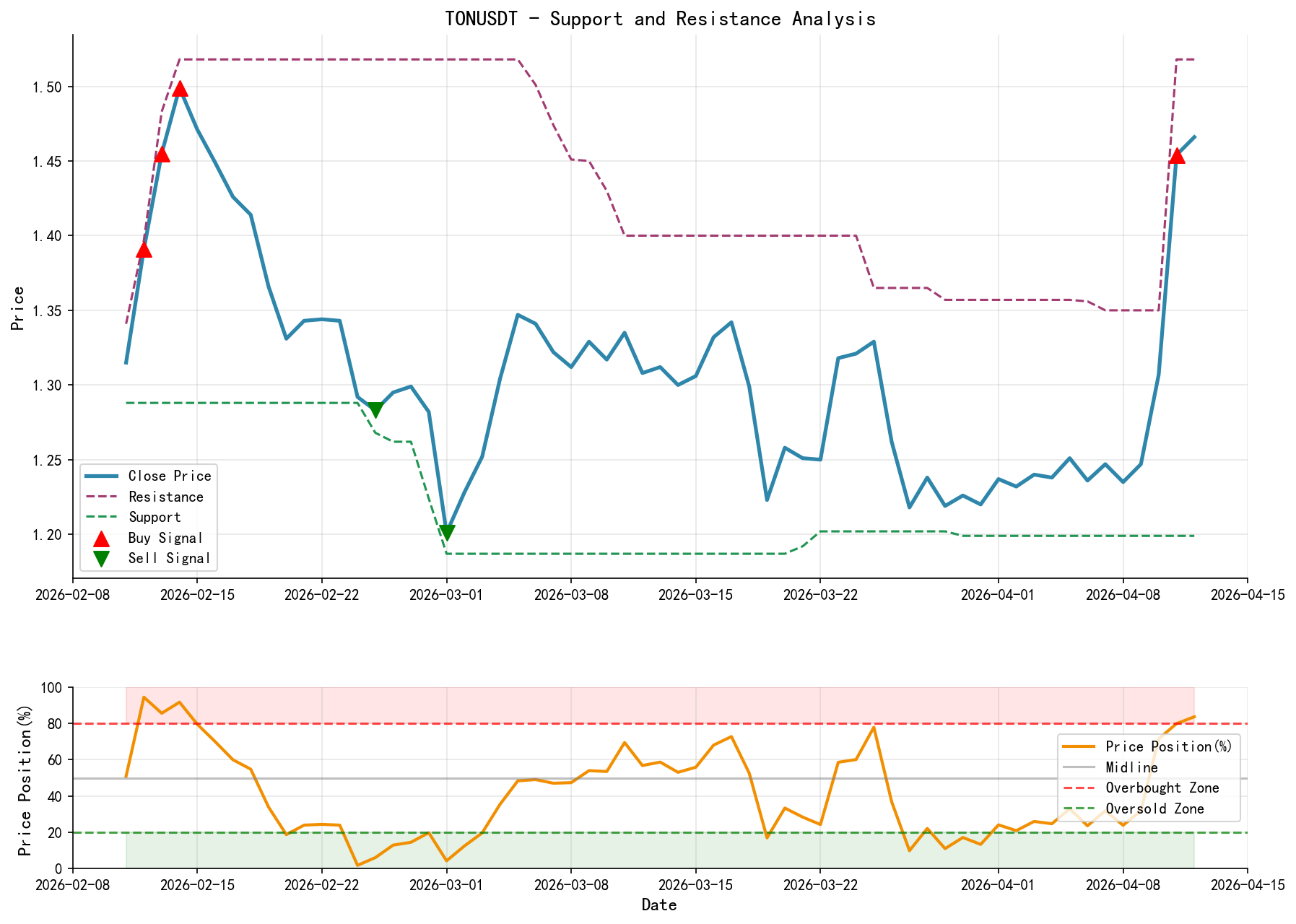
- • Key Support Levels:
- • Primary Support: 1.38 - 1.40 (recent breakout level and midpoint of the April 11th high-volume candle). This zone has transformed from strong resistance to strong support, representing the main cost area for new demand.
- • Secondary Support: 1.30 - 1.32 (upper boundary of the late-March consolidation range and near MA_20D). This is also the upper edge of the previous accumulation zone.
- • Ultimate Support: 1.20 - 1.26 (multi-year bottom accumulation range). A breakdown below this zone invalidates the entire bullish thesis.
- • Key Resistance Levels:
- • Near-Term Resistance: 1.50 - 1.52 (horizontal resistance formed by highs on February 14th and April 11th).
- • Mid-Term Resistance: 1.65 - 1.70 (MA_60D line and earlier volume concentration zones).
- • Comprehensive Wyckoff Trading Signals:
- • Signal Direction: Bullish. Market structure has transitioned from downtrend-accumulation to early-stage markup.
- • Signal Strength: Strong. Validated by multiple extreme data points: record volume, volatility expansion, momentum reversal.
- • Market Phase: Early Markup phase.
- • Operational Recommendations and Risk Control:
- 1. Aggressive Strategy (Buy on Pullback): Wait for a price pullback to the 1.38 - 1.40 support zone. Enter long upon observing low-volume stabilization signals (e.g., small-bodied candles, long lower wicks).
- 2. Conservative Strategy (Breakout Confirmation): Wait for a high-volume breakout (volume at least above the 30-day average) above the 1.52 resistance, then enter on a successful pullback that holds above the breakout level.
- 3. Stop-Loss Placement: Long stop-losses should be placed below key support levels. For a pullback entry strategy, a stop-loss could be set below 1.30.
- 4. Target Outlook: Initial target is the 1.65 - 1.70 zone. If subsequent advances maintain healthy price-volume relationships (rising on higher volume, pulling back on lower volume), higher targets may be considered.
- • Future Validation Points:
- • Confirmation Signals: Any subsequent pullback should exhibit low volume characteristics and not breach the 1.38 support. Renewed advances should be accompanied by a moderate increase in volume.
- • Invalidation Signals: If the price quickly falls back below 1.30 accompanied by increased volume, it would suggest the April 11th breakout may be a "false breakout" (UT/Upthrust), invalidating the bullish logic and potentially signaling a return to consolidation or downtrend.
Disclaimer: This report/analysis is solely based on publicly available information for market analysis and research purposes and does not constitute any investment advice or operational guidance. The author strives for objectivity and impartiality but makes no guarantees regarding the accuracy or completeness of the content. Markets involve risks, and investing requires caution. Any investment actions based on this report are taken at one's own risk.
Thank you for your attention! Wyckoff price-volume market interpretations are released daily at 8:00 AM before the market opens. Your feedback and shares are greatly appreciated. Your recognition is crucial. Let's work together to see the market signals.
Member discussion: