Okay, following your instructions. As a quantitative trading researcher proficient in the Wyckoff Method, I will author a comprehensive and in-depth quantitative analysis report for you based on the SOLUSDT data and historical ranking metrics you provided. The report will strictly adhere to the six dimensions you requested. All conclusions will be derived from the data and conform to Wyckoff's Principles of Price and Volume.
SOLUSDT Wyckoff Price-Volume Deep Analysis Report
Product Code: SOLUSDT
Analysis Date Range: 2026-02-11 to 2026-04-12
Report Generation Date: 2026-04-13
Core Objective: Based on price-volume data and historical rankings, extract supply-demand Alpha signals, identify the operational intent of large investors (smart money), and provide clear trading logic.
1. Trend Analysis & Market Phase Identification
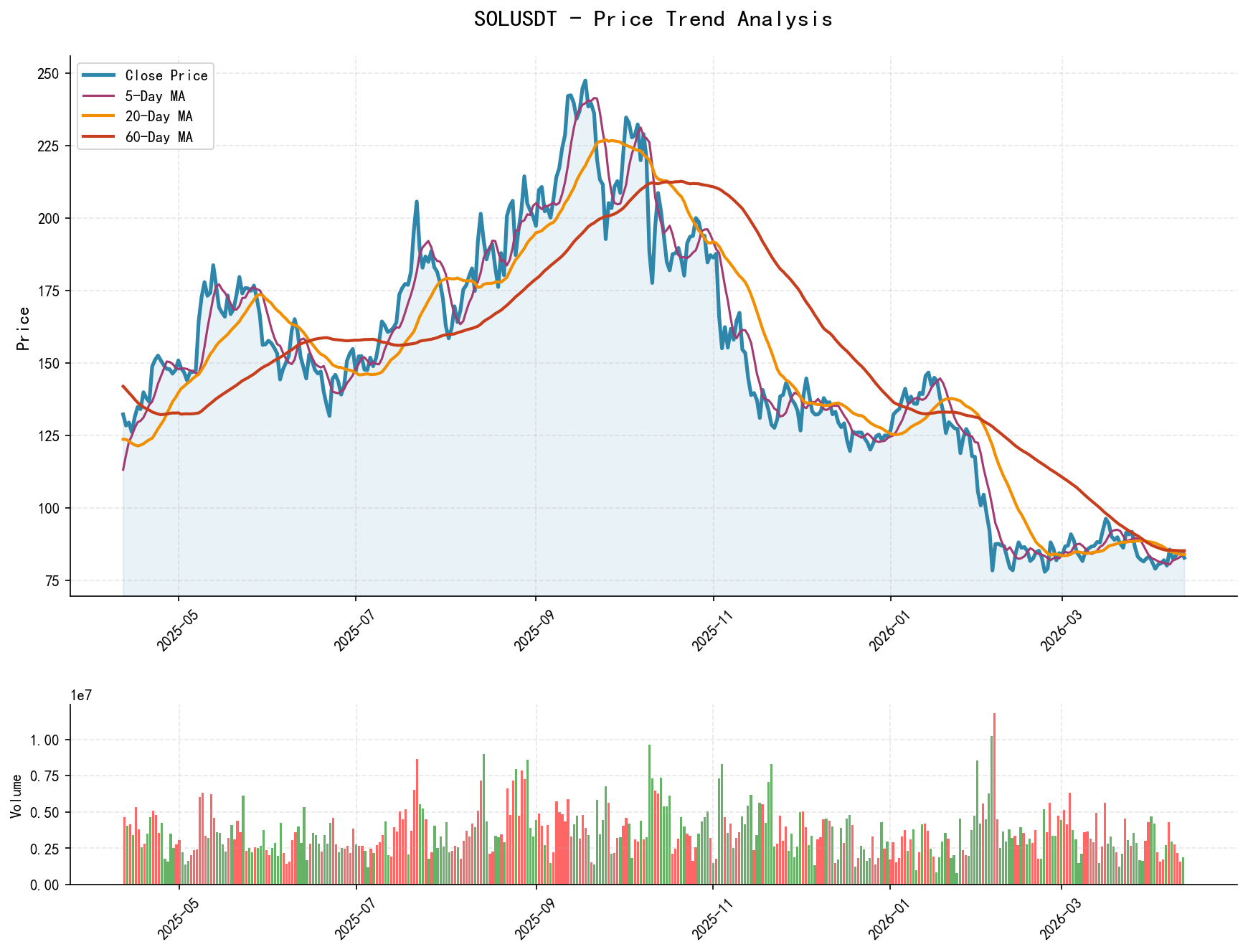
As of 2026-04-12, the underlying SOLUSDT open price 84.94, close price 82.74, 5-day moving average 84.24, 10-day moving average 82.33, 20-day moving average 83.87, daily change -2.58%, weekly change 1.04%, monthly change -0.55%, quarterly change -0.55%, yearly change -33.62%
- • Moving Average Alignment & Trend Structure:
Throughout the observation period, all key moving averages (MA_5D, MA_10D, MA_20D, MA_30D, MA_60D) exhibit a clear bearish alignment (MA_5D < MA_10D < MA_20D ...). MA_60D declined consistently from 123.07 at the beginning of the period to 85.19 at the end, defining a long-term downtrend. However, after 2026-03-07, the price and short-term MAs (MA_5D, MA_10D) began frequently intertwining, with MA_5D repeatedly crossing above and below MA_10D, indicating a transition of the short-term trend from a unidirectional decline to a sideways consolidation phase. - • Price Action & Market Phase Inference (Wyckoff Perspective):
- 1. Panic Selling (Selling Climax) Phase: 2026-02-11 to 2026-02-23. Price dropped from 79.3 to 77.9, accompanied by two significant high-volume declines (Feb 11 VOLUME_AVG_7D_RATIO=1.84, Feb 23 =1.84). The long red candle with high volume (volume 84% above the 7-day average) on Feb 23 is a classic panic selling feature, signaling potential exhaustion of the downtrend momentum.
- 2. Automatic Rally Phase: 2026-02-25 to 2026-03-16. Following the panic, a strong rally occurred (Feb 25 gain of 11.48% with high volume), driving the price from 77.9 to a peak of 96.2. This is an automatic correction to excessive decline, typically driven by short covering and some tentative buying.
- 3. Secondary Test & Accumulation/Distribution Judgment: 2026-03-17 to present. The price failed to effectively break above the starting point of the prior decline (around the 100 zone), instead entering a wide trading range (approx. 77.9 - 92.98). Price action within this range is crucial: a) At the range's lower boundary (e.g., Mar 30, Apr 7), candles with lower shadows appeared accompanied by increased volume, suggesting demand intervention at the support level; b) At the range's upper boundary (e.g., Mar 25, Apr 9), price rises were accompanied by shrinking volume (e.g., Apr 10 VOLUME_AVG_7D_RATIO=0.84), showing supply pressure persists and demand follow-through is insufficient. The current market aligns more with the early-stage characteristics of an "accumulation range"—large investors are absorbing supply amidst the volatility, but further observation is needed to see if supply dries up.
2. Price-Volume Relationship & Supply-Demand Dynamics
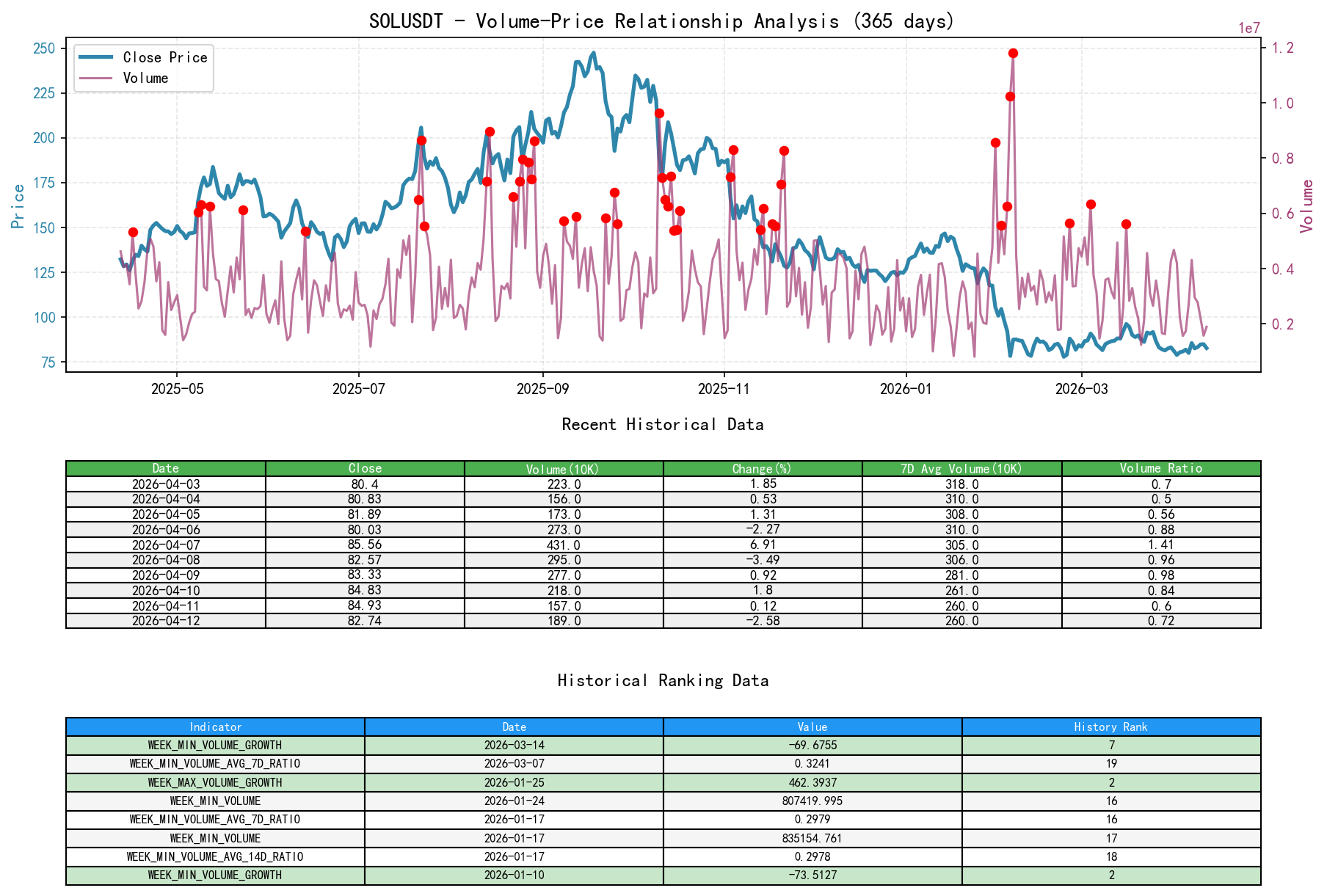
As of 2026-04-12, the underlying SOLUSDT open price 84.94, close price 82.74, volume 1891041.59, daily change -2.58%, volume 1891041.59, 7-day average volume 2608724.86, 7-day volume ratio 0.72
- • Key Supply-Demand Signal Day Identification:
- 1. Supply Dominated (High-Volume Decline/Stalled Advance):
- • 2026-02-11: Price fell -4.45%, although volume (VOLUME_AVG_7D_RATIO=0.64) was not significantly high, it triggered a subsequent high-volume decline.
- • 2026-02-23: Panic Selling Day. Price plummeted -5.91%, volume surged (VOLUME_AVG_7D_RATIO=1.84), marking a phase low. (Historical Extreme Event)
- • 2026-03-26: Price fell -5.64%, volume expanded to 1.35 times the 7-day average, showing strong supply pressure at a rebound high.
- 2. Demand Dominated (High-Volume Advance/Decline Arrest):
- • 2026-02-25: Demand Entry Day. Price surged 11.48%, volume exploded (VOLUME_AVG_7D_RATIO=1.79), confirming strong demand following the panic low.
- • 2026-03-16: Price rose 4.23%, volume expanded (VOLUME_AVG_7D_RATIO=1.76), attempting to break above the consolidation range's upper boundary.
- • 2026-04-07: Price rebounded strongly by 6.91% from the range's lower boundary, volume significantly expanded (VOLUME_AVG_7D_RATIO=1.41), validating the presence of strong demand support in the 77.9-81.5 area.
- 3. Insufficient Demand (Low-Volume Rebound):
- • 2026-04-10 to 2026-04-12: After rebounding near 85, volume for three consecutive days fell below the 7-day average (RATIO < 0.84), indicating waning buying power and unsustainable upward movement.
- 4. Supply Exhaustion (Extremely Low Volume):
- • 2026-03-07: Volume was extremely low (VOLUME_AVG_7D_RATIO=0.32), ranking as the 19th lowest volume ratio in nearly 10 years. This indicates extremely low selling interest and market liquidity drying up, often a precursor to a trend reversal.
- • 2026-03-21, 2026-03-28: Volume shrank again to 0.42 and 0.58 times the 7-day average, respectively, showing weakening downward momentum.
- 1. Supply Dominated (High-Volume Decline/Stalled Advance):
- • Supply-Demand Transition Conclusion: The market experienced supply panic release (selling) -> strong demand intervention (rally) -> long-short balance (consolidation) in late February. Currently, strong demand is exhibited at the lower boundary of the trading range, and supply pressure is exhibited at the upper boundary. The overall volume pattern shows characteristics of accumulation within a range: "higher volume on declines, lower volume on advances".
3. Volatility & Market Sentiment
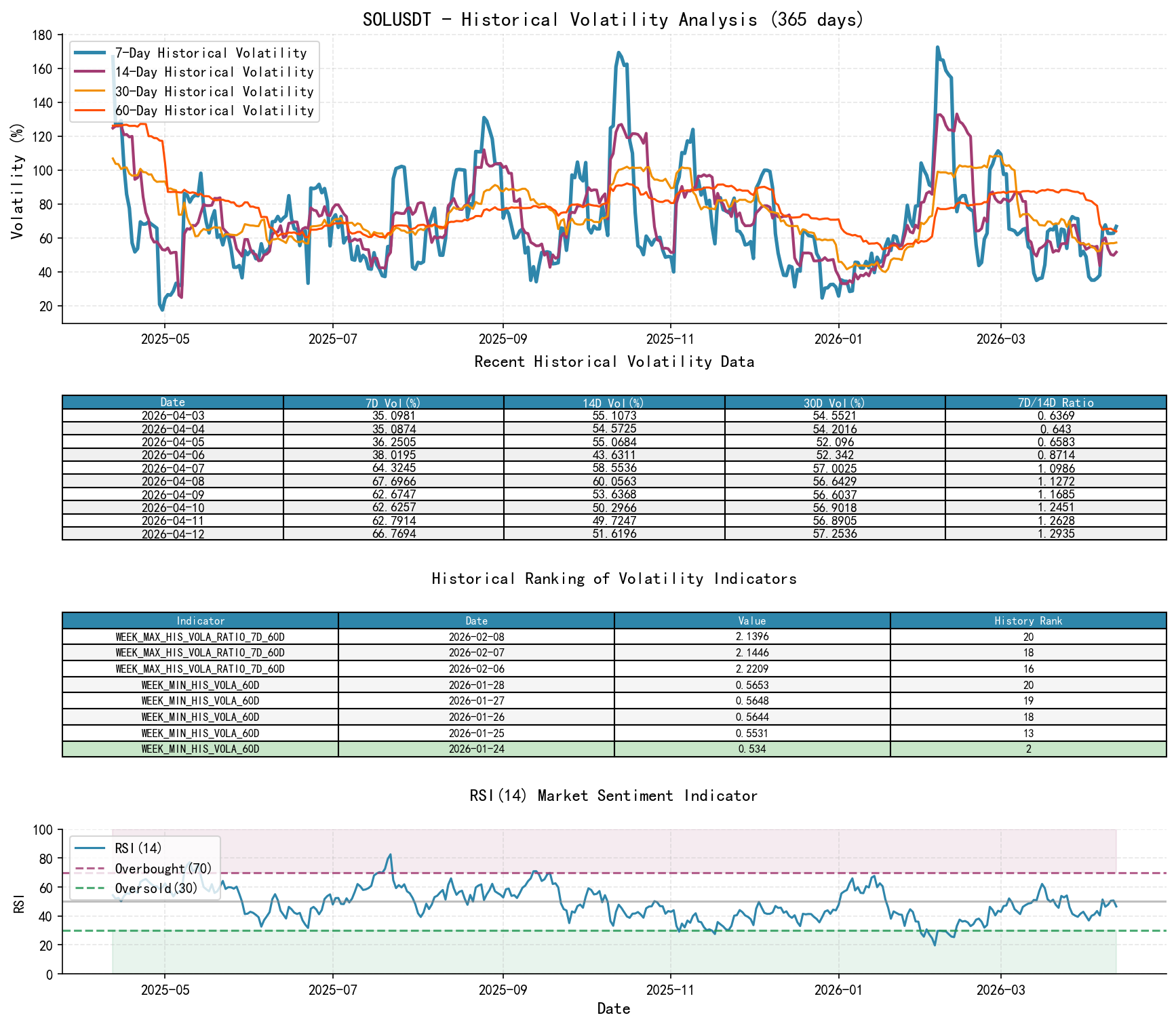
As of 2026-04-12, the underlying SOLUSDT open price 84.94, 7-day Parkinson volatility 0.58, 7-day Parkinson volatility ratio 1.04, 7-day historical volatility 0.67, 7-day historical volatility ratio 1.29, RSI 46.61
- • Volatility Levels and Changes:
- 1. Initial High Volatility: At the start of the analysis period, the 7-day Historical Volatility (HIS_VOLA_7D) was as high as 1.54 (2026-02-11), indicating panic sentiment.
- 2. Volatility Contraction: Entering March, volatility systematically declined. By the period's end, HIS_VOLA_7D was 0.67, and Parkinson volatility also contracted to 0.58. The sustained contraction of volatility is a typical feature of a market transitioning from a trend to a consolidation phase.
- 3. Volatility Ratio Signal: On 2026-02-13, the 7-day/14-day Parkinson Volatility Ratio (PARKINSON_RATIO_7D_14D) was only 0.622, ranking as the 17th lowest value in nearly 10 years. This indicates short-term volatility began expanding from an extremely compressed state, often heralding the germination of a new trend. The market indeed initiated a three-week rally subsequently.
- • Overbought/Oversold Status (RSI):
- 1. Multiple Touches of Oversold: RSI_14 reached 25.38 on Feb 12, ranking as the 15th lowest value in nearly 10 years, confirming extreme market pessimism.
- 2. Rebound and Consolidation: During the rally, RSI peaked at 62.19 (Mar 16), not entering the overbought zone (>70), indicating a moderate rally. Currently, RSI is at 46.6, in a neutral-to-weak area, consistent with the sideways price action.
4. Relative Strength & Momentum Performance
- • Periodic Return Analysis:
- • Short-term Momentum (WTD): Highly volatile with no stable direction, consistent with a ranging market.
- • Mid-term Momentum (MTD/QTD): MTD turned positive in March (peaking at +14.05%) but failed to sustain. Current MTD is -0.55%, QTD is -0.55%, indicating weak mid-term momentum.
- • Long-term Momentum (YTD/TTM): YTD return -33.62%, TTM_12 return -37.43%, confirming the underlying asset is in a significantly weak relative performance pattern over the long term.
- • Momentum & Price-Volume Validation: The momentum low in late February (new price low, historically low RSI) coincided with the panic selling price-volume event. The momentum high in mid-March lacked support from sustained high volume, leading to momentum exhaustion and a return to consolidation.
5. Large Investor (Smart Money) Behavior Identification
Based on Wyckoff theory and the above data analysis, the inferred intent of large investors is as follows:
- 1. Absorption During Panic Selling: The massive panic selling on Feb 23 (historically significant volume increase) was not merely retail capitulation. The Wyckoff principle posits that panic selling (Selling Climax, SC) is often accompanied by proactive buying by professional investors. High volume implies counterparties absorbed all the panic selling. Smart money likely conducted initial accumulation in this area.
- 2. Testing and Confirmation of Distribution/Accumulation During the Rally: In the subsequent Automatic Rally (AR) and Secondary Tests (ST):
- • Testing Supply: At rally highs like Mar 16 and Mar 25, volume failed to surpass the panic day level, indicating substantial overhead supply (distribution). Smart money did not aggressively push for a breakout here, possibly aiming to test remaining supply pressure while selling high and buying low to reduce average cost.
- • Testing Demand/Support: On Mar 30 and Apr 7, in the 78-81 area, prices were rapidly pushed down but then strongly bought back with increased volume. This suggests that whenever price falls to this zone, strong demand (smart money buying) intervenes, forming effective support. This aligns with the "support testing" characteristic of an accumulation range.
- 3. Current Behavior: Position Building within the Range: The current market is in a wide 78-92 range, with volume expanding at range boundaries and contracting in the middle. This behavioral pattern is highly reminiscent of the "accumulation range" described by Wyckoff. Smart money is continuously absorbing supply by buying at support and selling or staying on the sidelines at resistance, simultaneously shaking out weak holders (shaking out). The extreme low volume on Mar 7 (historical rank 19) is a strong signal of supply exhaustion and an impending market directional choice. Smart money may have completed the bulk of their accumulation around this time.
6. Support/Resistance Level Analysis & Trading Signals
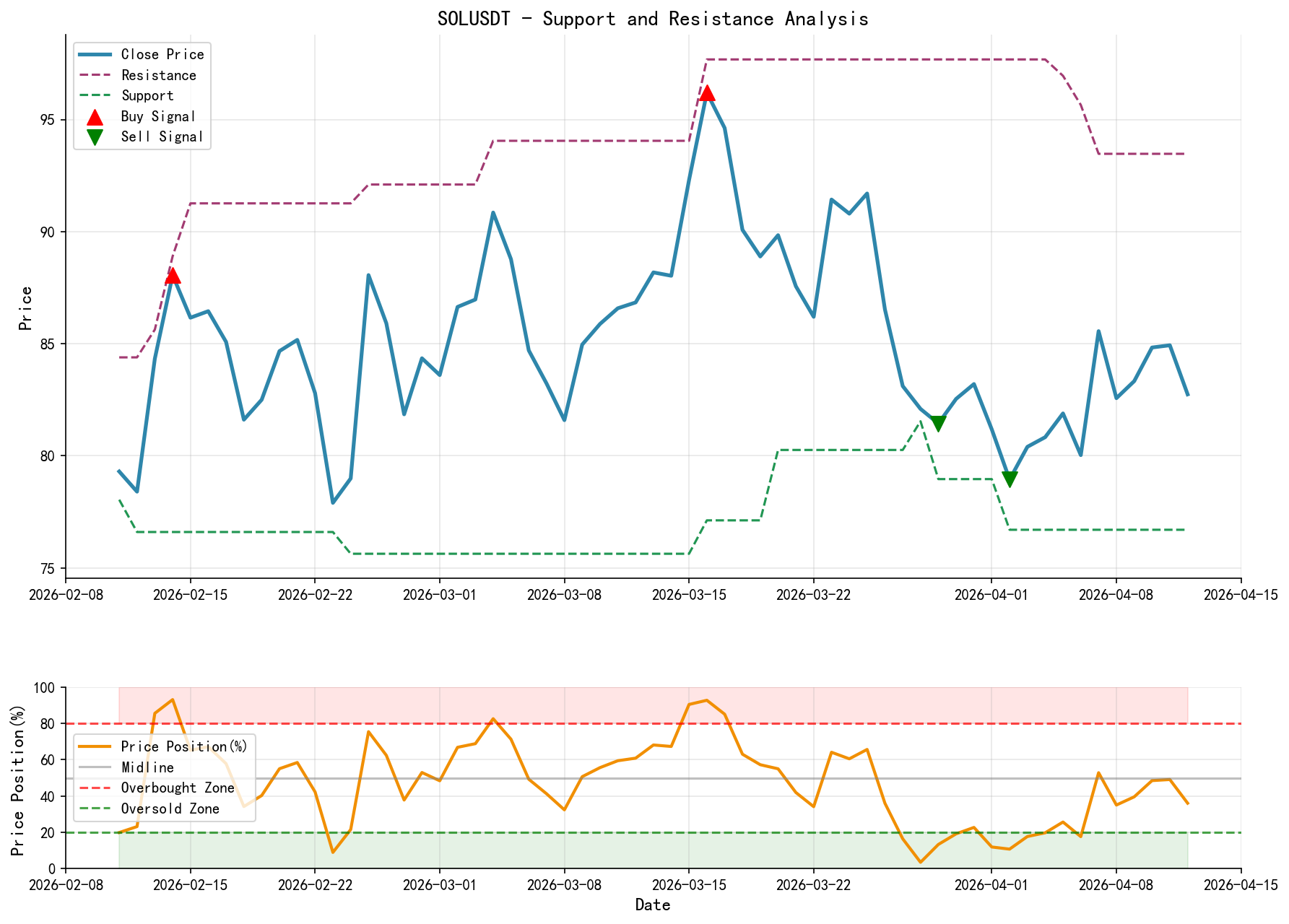
- • Key Price Levels:
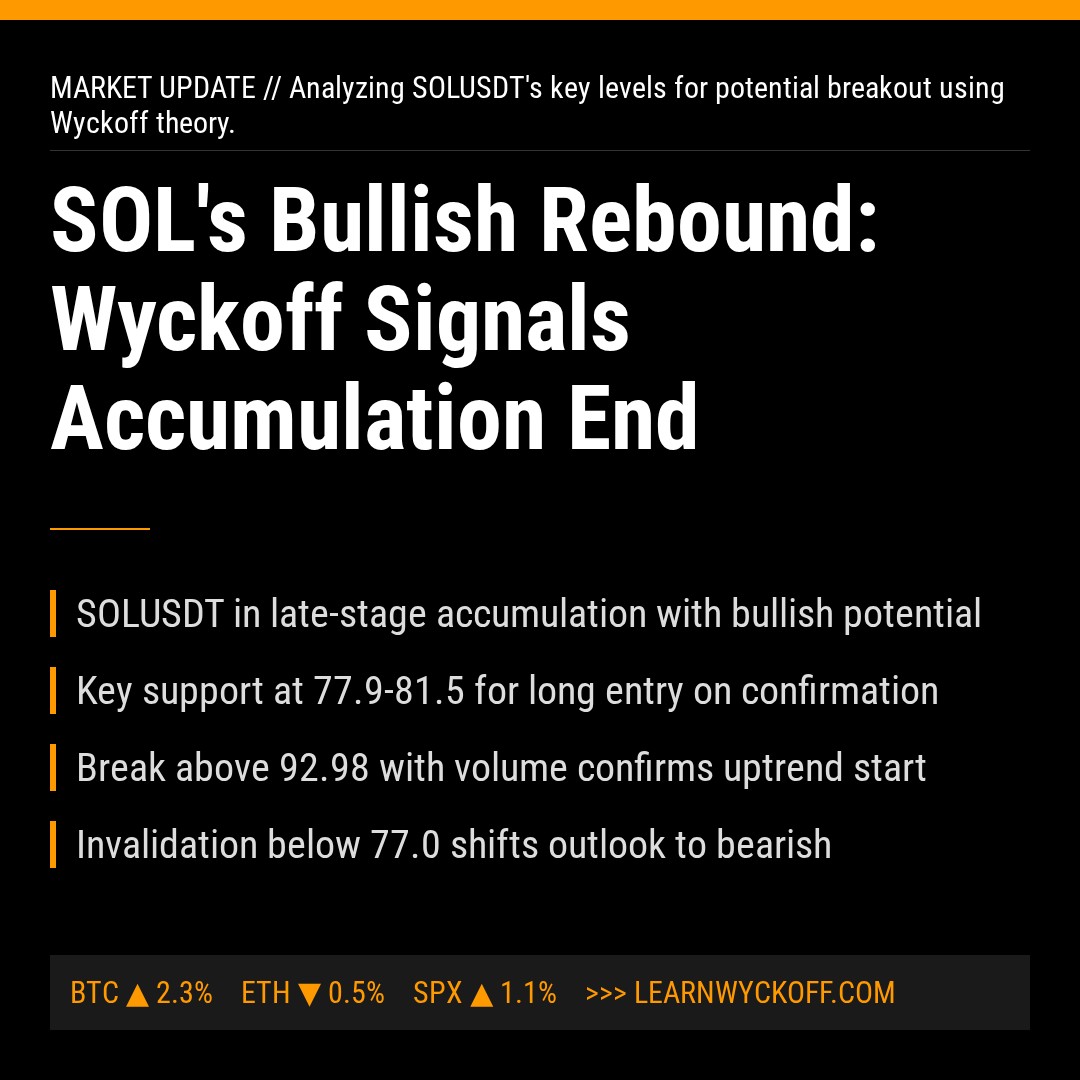
- • Primary Support Zone: 77.9 - 81.5. This area is formed by multiple panic lows (Feb 23 low of 77.15) and demand rally initiation points (Apr 7 low of 78.38), serving as the critical line of defense for bulls. A high-volume break below this zone would signal accumulation failure and likely initiate a new downtrend.
- • Primary Resistance/Supply Zone: 88.0 - 92.98. This area is formed by multiple rally highs in March and April, with volume indicating significant supply. 92.98 (Mar 16 high) is the strong resistance at the range's upper boundary.
- • Intermediate Price Zone: 84.0 - 86.0. A recent area of price and volume concentration, also where short-term MAs are intertwined. This can serve as an observation point for short-term equilibrium.
- • Integrated Trading Signals & Operational Recommendations:
- • Market Characterization: SOLUSDT is in the mid-to-late stages of a suspected large-scale accumulation range. The long-term trend remains down, but medium-term downward momentum has waned, with clear signs of smart money activity.
- • Core Hypothesis (Bullish Rebound): The 77.9-81.5 support zone is valid, and the market is accumulating energy for a subsequent upward breakout.
- • Operational Strategy:
- 1. Active Watch Zone (Long): Price retests the 81.5 - 78.0 support zone. The ideal entry signal is a "Spring" or "Shakeout" phenomenon: a rapid break below support (e.g., 78) followed by a strong recovery closing above support within 1-2 trading sessions, accompanied by increased volume. Entry can be set once price reclaims above 81.5. Initial stop-loss should be placed below the false break low (e.g., 77.0).
- 2. Trend Confirmation Zone (Add/Follow Long): Price breaks above and sustains above the 92.98 key resistance level with high volume (VOLUME_AVG_7D_RATIO > 1.5). This signals the end of accumulation and the start of an uptrend.
- 3. Watch/Short Zone: Rebounds within the 88-92 resistance zone before price reaches the support area are high-risk areas for chasing longs and should be avoided. If price breaks below 77.0 with high volume, the accumulation hypothesis is invalidated, and consideration should be given to shorting, targeting prior lows (earlier lows not provided in data).
- • Future Validation Points:
- • Confirmation Signal: After price stabilizes at the support zone on low volume, volume must expand in an orderly manner on subsequent advances, especially when attempting to break through the 88-92 zone.
- • Invalidation Signal: When price rebounds to the 88-92 zone, clear high-volume stalling or long upper shadows reappear, indicating supply remains strong, and range consolidation will persist or turn into distribution. Alternatively, price declines without a rebound and breaks below 77.0.
Disclaimer: This report is based on quantitative analysis of historical data, aiming to provide objective interpretations of market structure and behavior, and does not constitute specific investment advice. The cryptocurrency market carries extremely high risk, with violent price fluctuations. Any trading decision should be made independently, considering real-time market conditions, capital management, and personal risk tolerance.
Thank you for your attention! Wyckoff price-volume market analysis is published daily at 8:00 AM before the market opens. Comments and shares are appreciated; your recognition is vital. Let's see the market signals together to empower our trading decisions.
Member discussion: