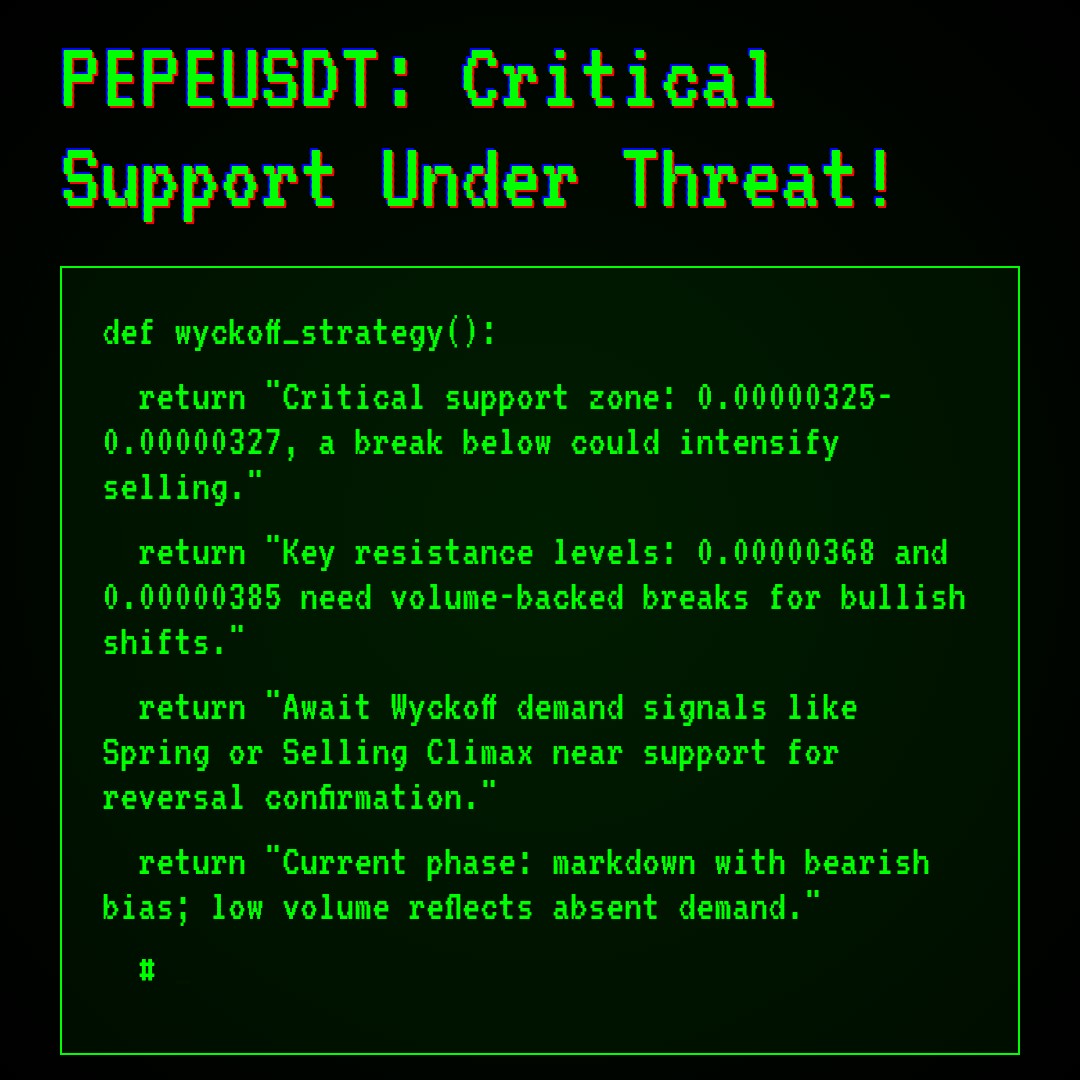
Alright, I will use the Wyckoff method as the framework, combined with the provided detailed data, to write an in-depth quantitative analysis report on PEPEUSDT for you.
PEPEUSDT Quantitative Analysis Report
Analysis Period: 2026-02-11 to 2026-04-12
Report Generation Time: 2026-04-13
I. Trend Analysis and Market Phase Identification
As of April 12, 2026, for the asset PEPEUSDT: Opening Price 0.00, Closing Price 0.00, 5-Day MA 0.00, 10-Day MA 0.00, 20-Day MA 0.00, Daily Change -3.57%, Weekly Change 0.57%, Monthly Change 2.93%, Quarterly Change 2.93%, Yearly Change -12.90%
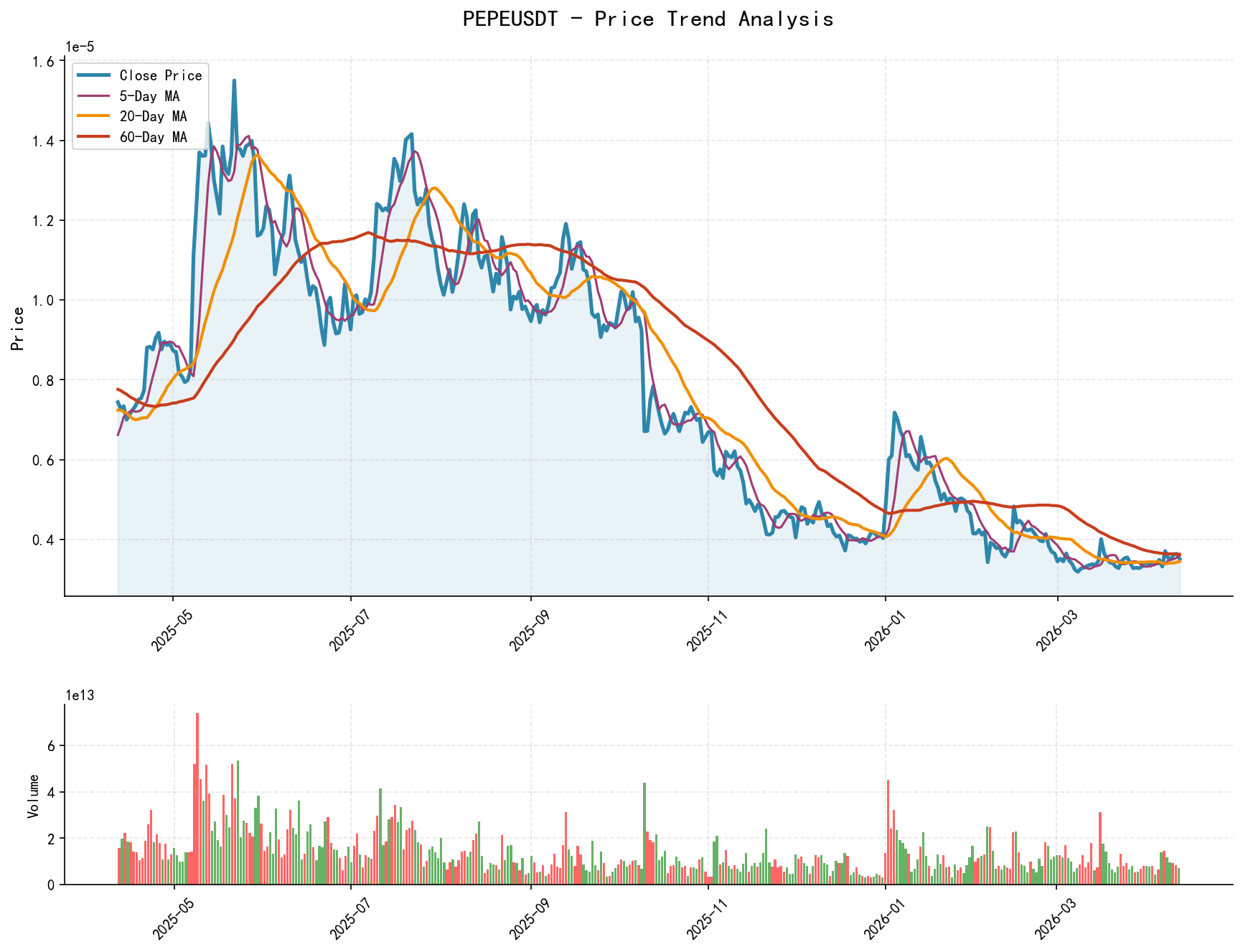
Based on Wyckoff's volume-price principles and the analysis of price structure, moving average alignment, and the evolution of highs and lows, the market has undergone a complete cyclical phase transition.
- 1. Trend and Moving Average Analysis:
- • Bullish Alignment and Main Advance Wave (Feb 14 - Mar 16): The market initiated a strong upward move on February 14th with a single-day surge of 27.78%, accompanied by the 7th highest daily volume growth (330.58%) in nearly ten years. The price successively broke through and closed above all major moving averages (MA_5D, MA_10D, MA_20D, MA_30D, MA_60D), forming a classic bullish alignment.
- • Trend Reversal and Bearish Alignment Established (Mar 17 - Apr 12): After touching a wave high (0.00000401) on March 16th, the price failed to sustain its advance and experienced a high-volume decline of 8.73% the next day. Subsequently, the price broke below the short-to-medium-term moving averages (MA_5D, MA_10D, MA_20D, etc.) one after another, and finally confirmed a break below the long-term MA_60D in early April. By the end of the analysis period, the closing price (0.00000351) was below all periodic moving averages, forming a clear bearish alignment, indicating the establishment of a medium-term downtrend.
- 2. Market Phase Identification:
- • Distribution Phase: The price action on February 15th and March 16th-17th is highly representative. After reaching new highs or rebound highs, the market showed "high-volume stagnation" or "high-volume decline". For example, on February 15th, the price rose sharply, retraced, and closed down (-8.49%) with volume remaining extremely high (VOLUME_AVG_7D_RATIO 2.43); on March 17th, the price fell sharply by 8.73%, with volume still above its 21-day average (VOLUME_AVG_21D_RATIO 1.46). This aligns with the Wyckoff characteristic of professional capital ("smart money") distributing holdings to the public at high price levels.
- • Markdown Phase: Since late March, the price entered its main decline phase. Although there were rebounds during this period (e.g., March 23rd), the highs of successive rebounds were lower (0.00000346 -> 0.00000355 -> 0.00000340), and volume contracted during these rebounds (VOLUME_AVG_7D_RATIO often below 1). The price action in April has been within this phase, characterized by a sustained, low-volume grind lower.
II. Volume-Price Relationship and Supply-Demand Dynamics
As of April 12, 2026, for the asset PEPEUSDT: Opening Price 0.00, Closing Price 0.00, Volume 7167431734440.00, Daily Change -3.57%, Volume 7167431734440.00, 7-Day Average Volume 10546599576502.57, 7-Day Volume Ratio 0.68
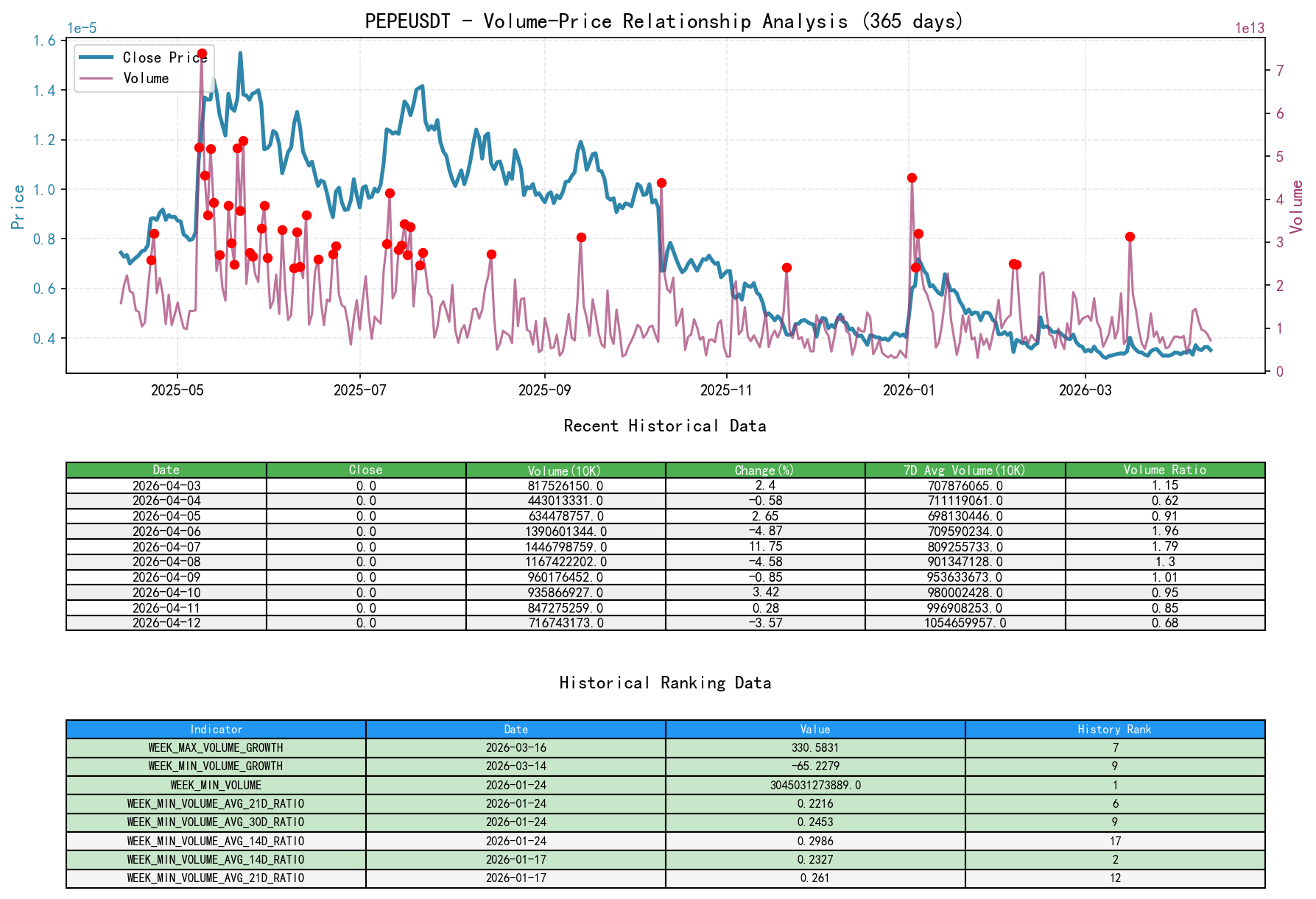
The volume-price relationship clearly reveals the transition of supply and demand forces.
- 1. Demand-Driven Advance (Demand in Control):
- • Feb 14: Price surged 27.78%, with volume exploding by 230.53% (VOLUME_GROWTH), reaching 2.69 times the 7-day average volume (VOLUME_AVG_7D_RATIO). This is a classic signal of overwhelming demand inflow, constituting the starting point of this upward move.
- • Mar 16: Price surged again by 16.23%, with volume exploding by 330.58%, setting the 7th highest record for daily volume growth in nearly ten years. This was a second major display of demand, attempting to restart the advance.
- 2. Supply-Driven Reversal (Supply Takes Over):
- • Feb 15 & Mar 17: On the days immediately following the demand days, the price closed down (-8.49%, -8.73%) with volume remaining at high levels. This indicates that at the elevated price zones following rises, strong supply pressure was encountered; smart money distributed using public buying enthusiasm. This is a key volume-price divergence signal for a market turn from rising to falling.
- • From Late March to Present: During the price decline, there have been multiple instances of low-volume rebounds (e.g., March 24-25), indicating lack of demand follow-through, representing technical corrections within a downtrend. Conversely, occasional high-volume declines (e.g., April 6th, down 4.87%, VOLUME_AVG_7D_RATIO 1.96) further confirm the control of the supply side.
- 3. Current Supply-Demand Status:
- • As of April 12th, the price fell 3.57%, with volume insufficient compared to both the 7-day and longer-term averages (VOLUME_AVG_7D_RATIO 0.68, VOLUME_AVG_14D_RATIO 0.82). This is "low-volume decline", indicating that while supply is still pushing prices lower, panic or active selling (supply) has somewhat diminished. Simultaneously, buyers (demand) have no intention of aggressively entering at these price levels. The market has entered a low-activity phase of grinding lower.
III. Volatility and Market Sentiment
As of April 12, 2026, for the asset PEPEUSDT: Opening Price 0.00, 7-Day Intraday Volatility 0.96, 7-Day Volatility Volume Ratio 1.24, 7-Day Historical Volatility 1.09, 7-Day Historical Volatility Volume Ratio 1.40, RSI 50.43
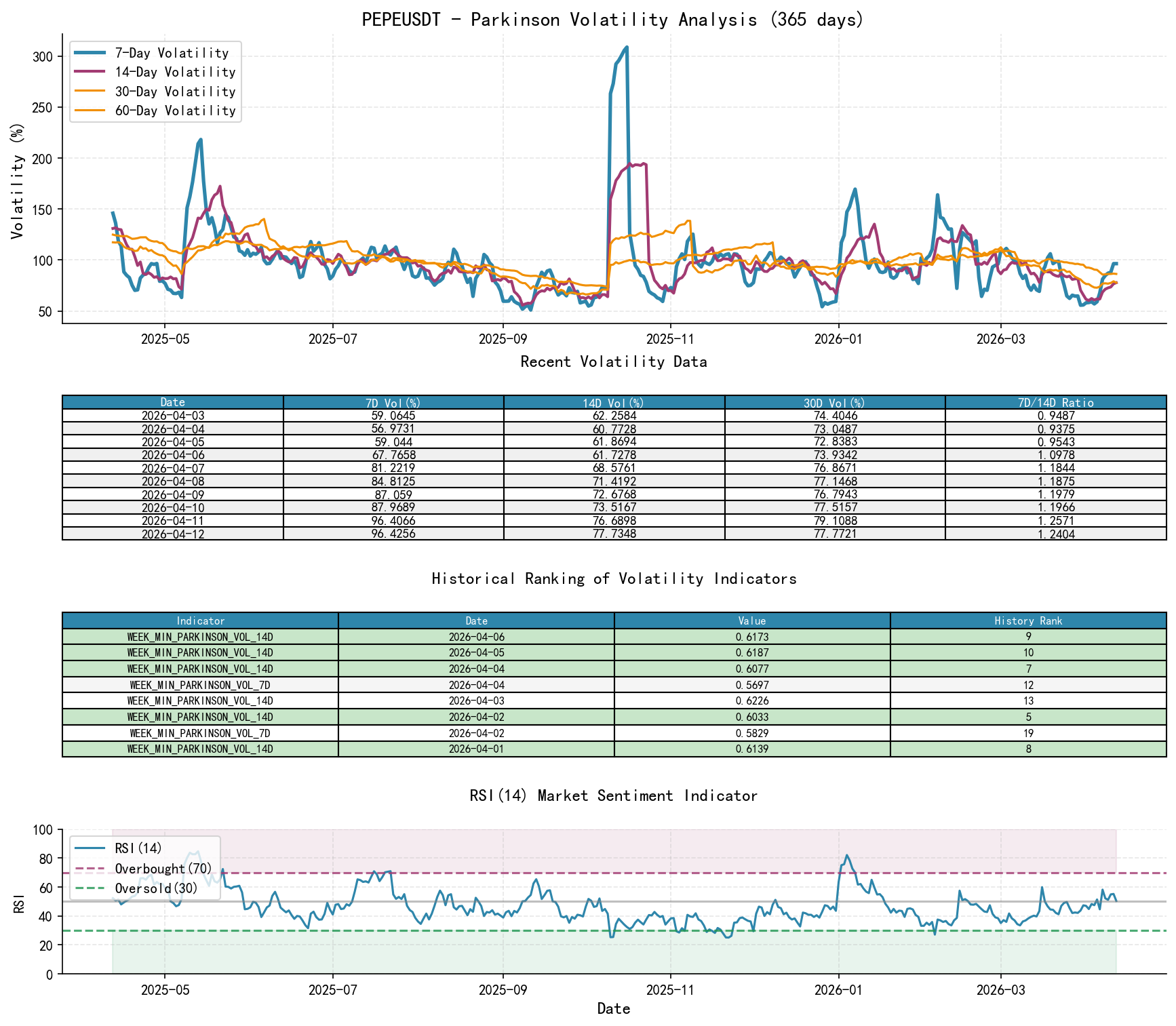
Volatility data precisely delineates the extreme shifts and current state of market sentiment.
- 1. Sentiment Climax and Panic:
- • During the early stage of the decline in mid-to-late March, volatility expanded sharply. The ratio of 7-day historical volatility to 14-day volatility (HIS_VOLA_RATIO_7D_14D) reached 1.4478 on March 21st, setting a record high in nearly ten years. This indicates that the intensity of short-term volatility far exceeded the medium-term average, placing the market in a state of panic or trend acceleration.
- • During the same period, RSI_14 fell into the 33-35 range on several occasions (March 1st, 7th, 8th), entering a technical oversold condition, corroborating pessimistic market sentiment.
- 2. Sentiment Cooling and Dullness:
- • Upon entering April, volatility metrics exhibited historic convergence. On April 4th, the 14-day historical volatility (HIS_VOLA_14D) dropped to 0.4835, the second-lowest level in nearly ten years. Concurrently, the 7-day volatility (HIS_VOLA_7D) reached an extremely low value of 0.2163 on March 15th, the lowest in nearly ten years. The sharp contraction in volatility indicates the market emerged from panic into a phase of dull sentiment, low trading activity, and unclear direction.
- • The current RSI_14 is 50.43, in neutral territory. However, combined with the context of the price being below all moving averages, it suggests a weak equilibrium in the market with insufficient upward momentum.
IV. Relative Strength and Momentum Performance
Momentum indicators show the asset is in comprehensive weakness.
- • Short-Term Momentum (WTD_RETURN: 0.57%): The week closed with a slight gain, but combined with the low-volume grind-lower daily structure, this constitutes a feeble technical rebound.
- • Medium-Term Momentum (MTD_RETURN: 2.93%; QTD_RETURN: 2.93%): Although quarterly and monthly returns are positive, this is mainly influenced by the single-day 11.75% surge on April 7th; structurally, it has not altered the downtrend.
- • Long-Term Momentum (YTD: -12.90%; TTM_12: -52.82%): Year-to-date and trailing twelve-month returns are significantly negative, confirming the strength of the long-term downtrend.
- • Conclusion: The momentum performance aligns with the conclusions from trend and volume-price analysis, confirming that PEPEUSDT is currently in a medium-to-long-term weak pattern, where brief rebounds have failed to reverse the downtrend.
V. Large Investor ("Smart Money") Behavior Identification
Integrating the above dimensions allows for inference regarding the intent and behavioral path of large investors:
- 1. Distribution at Highs: In the two "extremely high-volume" price events on February 14th-15th and March 16th-17th, the pattern of high-volume advance immediately followed by high-volume decline is a classic distribution combination. Smart money capitalized on market FOMO sentiment, completing large-scale inventory transfer at high prices, moving assets into the hands of subsequent chasing investors.
- 2. Lack of Accumulation Intent During Decline: During the decline from late March through April, volume continued to contract, and no high-volume stopping action signals comparable to those on February 14th or March 16th appeared. This indicates that smart money has not engaged in large-scale accumulation at current price levels; they are choosing to wait on the sidelines for lower prices or a clearer bottoming structure.
- 3. Current Phase: The market is in the natural decline (Markdown) phase following distribution completion. The current low-volume grind lower is primarily driven by a lack of new demand (smart money not buying) and residual selling pressure from retail investors. Signs of smart money activity (volume-price anomalies caused by large orders) are minimal, indicating they are in an exited,观望 state.
VI. Support/Resistance Level Analysis and Trading Signals
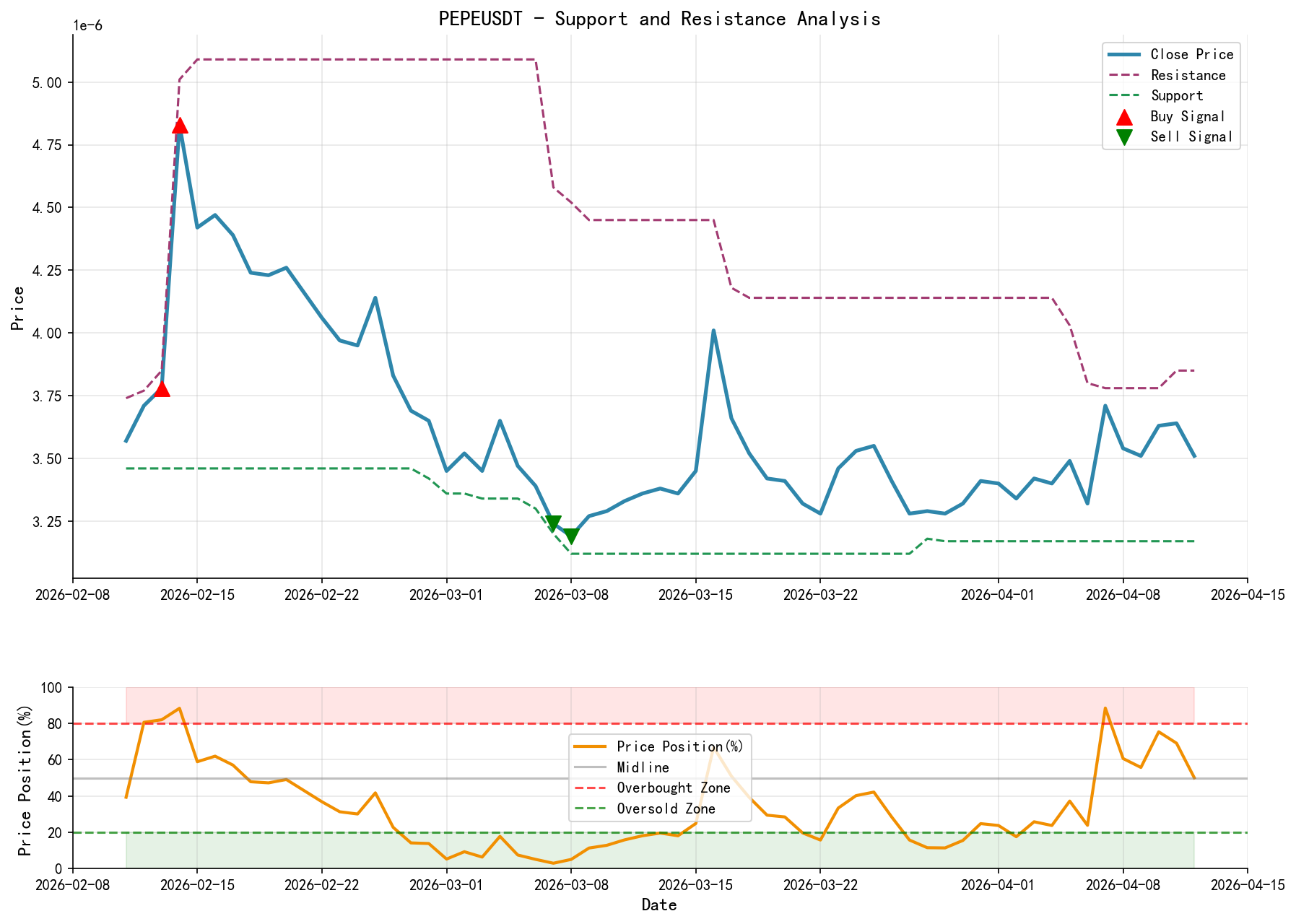
- 1. Key Price Levels:
- • Critical Support: 0.00000325 - 0.00000327 (the low area on March 27th and 30th). This is the zone tested multiple times during the recent decline. A high-volume break below could potentially open new downside space.
- • Immediate Resistance: 0.00000368 (high on April 10th) and 0.00000385 (high on April 11th). The price needs to break above this zone with volume to initially alleviate short-term downward pressure.
- • Major Resistance: 0.00000414 (closing price on March 16th) and 0.00000509 (high on February 15th). These are core price levels within the prior distribution area and will serve as significant tests for any major future rally.
- 2. Comprehensive Wyckoff Events and Trading Signals:
- • Current Market Phase: Markdown phase following distribution, demand is scarce, supply is dominant but selling pressure has somewhat diminished.
- • Comprehensive Signal: Cautious and waiting for demand signals. Bias is bearish.
- • Operational Suggestions:
- • For those not holding positions: It is not advisable to initiate long positions at this level. Patience is required to wait for clear signals of demand emergence, such as: a "Spring" or "high-volume stopping-action bullish candle" appearing near the critical support level (around 0.00000325), followed by a successful "Secondary Test" (low-volume retest that does not break the previous low).
- • For holders (long positions): If the price cannot rise above and stabilize within the 0.00000368-0.00000385 resistance zone, consider reducing positions on rallies. If the price breaks below the 0.00000325 support with volume, decisive stop-loss is warranted.
- • Future Validation Points:
- • Bearish Confirmation: Price experiences a low-volume rebound to the 0.00000368-0.00000385 zone and is rejected and falls back, or breaks below the 0.00000325 support with volume.
- • Bullish Reversal Signal: Near 0.00000325 or lower, a "Selling Climax" (very high volume with a long lower shadow) appears, followed by an "Automatic Rally (AR)" and a "Secondary Test (ST)" where volume is significantly lower during the test. This is an early signal that the market may be entering an accumulation phase.
Conclusion Reiteration: Based on data analysis up to April 12, 2026, PEPEUSDT is in a definitive downtrend triggered by distribution behavior from large investors. Market sentiment has transitioned from panic to dullness, with low volume reflecting the absence of demand. Before a demand-driven bottoming structure, as defined by Wyckoff theory, emerges, any rebound should be viewed as an opportunity to reduce exposure or remain观望, rather than a buy signal. Traders should focus on the defense of the 0.00000325 support level and volume anomalies at key price levels.
Disclaimer: This report/interpretation is solely for market analysis and research based on publicly available information and does not constitute any investment advice or operational guidance. While the author strives for objectivity and fairness, no guarantee is made regarding its accuracy or completeness. Markets involve risks; investment requires caution. Any investment actions taken based on this report are at your own risk.
Thank you for your attention! Wyckoff Volume-Price Market Interpretations are released daily at 8:00 AM before market open. Please feel free to leave comments and share; your recognition is paramount. Let's work together to see the market signals clearly.
Member discussion: