ETHUSDT Quantitative Analysis Report (Wyckoff Method)
Product Code: ETHUSDT
Analysis Date Range: 2026-02-11 to 2026-04-12
Report Generation Date: 2026-04-13
Core Summary
Based on volume and price data analysis from February 11th to April 12th, 2026, ETHUSDT has undergone a complete bottom-building process, transitioning from Panic Selling to Preliminary Support, and then to a Sign of Strength. The market confirmed a trend reversal in mid-March, entering the Markup phase. However, after touching a key resistance zone (~2288-2330) in early April, signs of increased supply and waning demand emerged, indicating the market may have entered a phase of short-term Distribution or Reaccumulation. The current price (2213) is at this critical decision point, and the next directional move will depend on the outcome of the struggle between bullish and bearish forces around key price levels.
1. Trend Analysis and Market Phase Identification
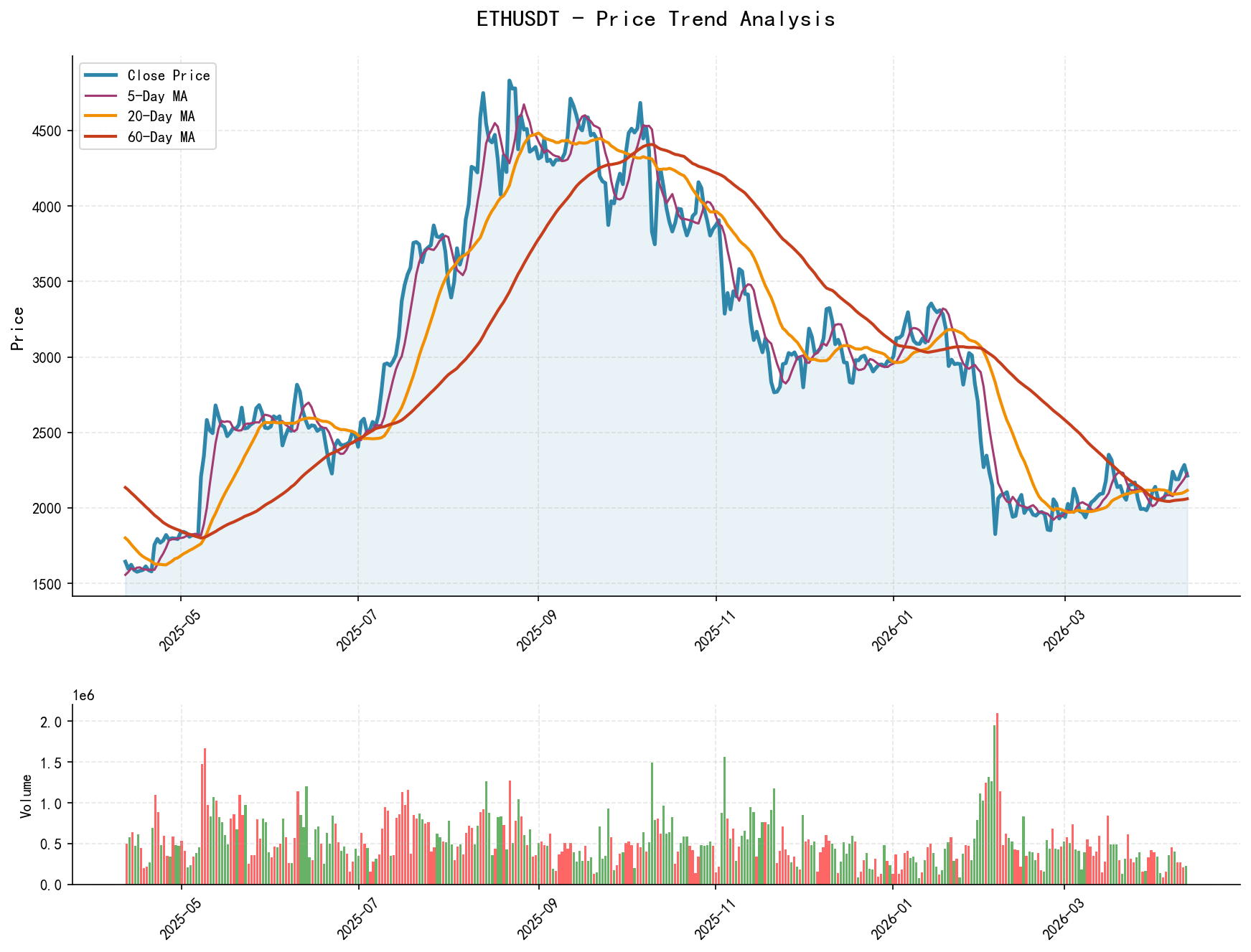
As of 2026-04-12, ETHUSDT had an opening price of 2285.00, a closing price of 2213.76, a 5-day moving average of 2230.05, a 10-day moving average of 2154.41, a 20-day moving average of 2116.31, with a daily change of -3.12%, a weekly change of 4.91%, a monthly change of 5.15%, a quarterly change of 5.15%, and a year-to-date change of -25.50%.
- • Moving Average Alignment and Price Relationship:
- • Bearish Alignment Period (2026-02-11 to 2026-03-15): The price consistently traded below all major moving averages (MA_5/10/20/30/60). All moving averages formed a perfect bearish alignment (MA_5 < MA_10 < MA_20 ...) with downward slopes, confirming a clear downtrend. During this phase, prices continuously made new lows, aligning with the characteristics of the Markdown and Panic phases in Wyckoff theory.
- • Trend Reversal and Repair Period (2026-03-16 to Present): On March 16th, the price broke above the MA_5, MA_10, and MA_20 with a high-volume (846k, 1.53x the 60-day average) long bullish candle (+8.02%), marking the break of the downtrend. Subsequently, the price entered a phase of moving average system repair, with short-term MAs (MA_5, MA_10) starting to flatten and cross above longer-term MAs. By early April, the price had stabilized above all short-term MAs, but the MA_60 still posed resistance overhead. The moving average system transitioned from a bearish alignment to a tangled state.
- • Inferred Wyckoff Market Phases:
- 1. Accumulation: From late February to early March, the price oscillated repeatedly within the 1800-2000 range, exhibiting a classic bottom reversal pattern of "high-volume plunge (Feb 23rd) immediately followed by a high-volume surge (Feb 25th)". Concurrently, volume significantly shrank at price lows (e.g., Feb 21-22), indicating diminishing selling pressure. This aligns with the "Selling Climax (SC)" and "Automatic Rally (AR)" characteristics of the Wyckoff Accumulation Range.
- 2. Markup: On March 16th and 25th, accompanied by exceptionally high volume, the price broke above the upper boundary of the previous consolidation range (~2100) and the swing high, confirming that demand had taken full control of the market, entering the Markup phase.
- 3. Distribution / Reaccumulation: After hitting a high of 2288 on April 8th, upward momentum clearly weakened. Subsequent trading days saw "lower volume on new highs (April 11th)" and "higher volume on decline (April 12th)", with the price failing to hold firmly above 2300. This suggests supply pressure exists in the area where the previous decline began (~2300-2500). The market may be undergoing Distribution or entering a Reaccumulation (Re-accumulation) phase here to absorb selling pressure.
2. Volume-Price Relationship and Supply-Demand Dynamics
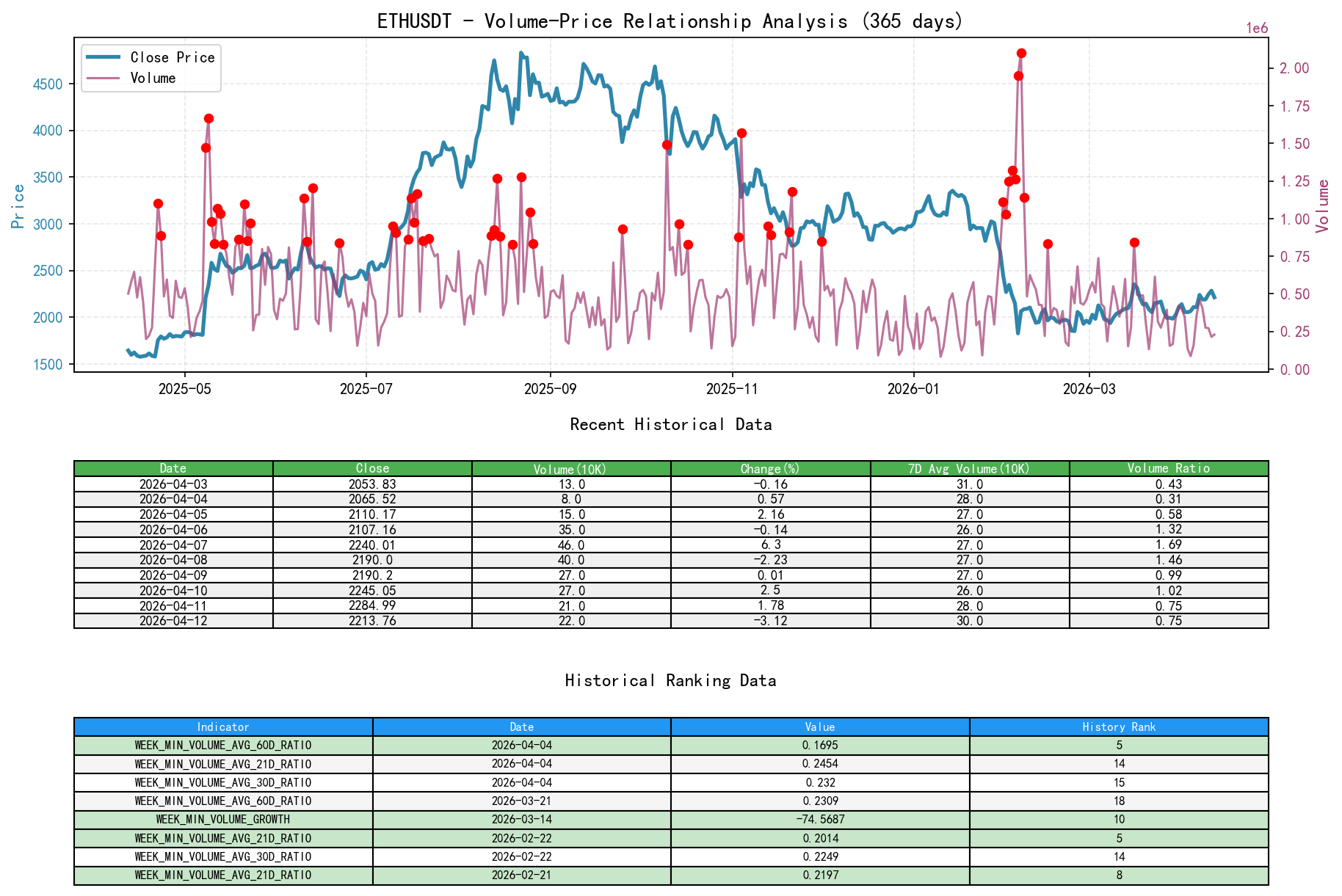
As of 2026-04-12, ETHUSDT had an opening price of 2285.00, a closing price of 2213.76, volume of 229546.62, a daily change of -3.12%, volume of 229546.62, a 7-day average volume of 305888.93, and a 7-day volume ratio of 0.75.
- • Key Demand Days (Demand Dominant):
- • 2026-02-25: Price surged 11.10% from a low, with volume of 683k (
VOLUME_AVG_60D_RATIO=1.37). This was the first strong demand response following the panic sell-off, indicating large buyers were actively absorbing supply at low levels. - • 2026-03-16: Price rose 8.02%, with volume of 846k (
VOLUME_AVG_60D_RATIO=1.53). This was a "Jump Across the Creek (JAC)" signal breaking key resistance. The volume was among the highest in the analysis period, confirming the trend reversal was driven by strong demand.
- • 2026-02-25: Price surged 11.10% from a low, with volume of 683k (
- • Key Supply Days (Supply Dominant):
- • 2026-02-23: Price plunged -5.19%, with volume of 547k (
VOLUME_AVG_60D_RATIO=1.12). This was Panic Selling at the end of the decline. However, the absolute volume was not a historical peak. Combined with the subsequent rebound, this can be interpreted as the absorption of the last batch of retail selling. - • 2026-04-12 (Latest Trading Day): Price fell -3.12%, with volume of 229k (
VOLUME_AVG_14D_RATIO=0.80). This was a pullback after a failed attempt to break resistance. Volume increased relative to the recent average, indicating the emergence of supply.
- • 2026-02-23: Price plunged -5.19%, with volume of 547k (
- • Supply-Demand Shift Signals:
- • Demand Weakening Alert: On April 11th, price made a new rebound high of 2329, but volume was only 215k (
VOLUME_AVG_7D_RATIO=0.75), presenting a classic Upthrust after Distribution. This shows that at higher price levels, demand could not keep up, and upward momentum was exhausted. - • Supply Emergence Confirmation: On April 12th, price declined with volume growing 6.9% compared to the previous day (
VOLUME_GROWTH=6.87%), forming a higher volume decline. This is a preliminary signal that supply is beginning to dominate the market.
- • Demand Weakening Alert: On April 11th, price made a new rebound high of 2329, but volume was only 215k (
3. Volatility and Market Sentiment
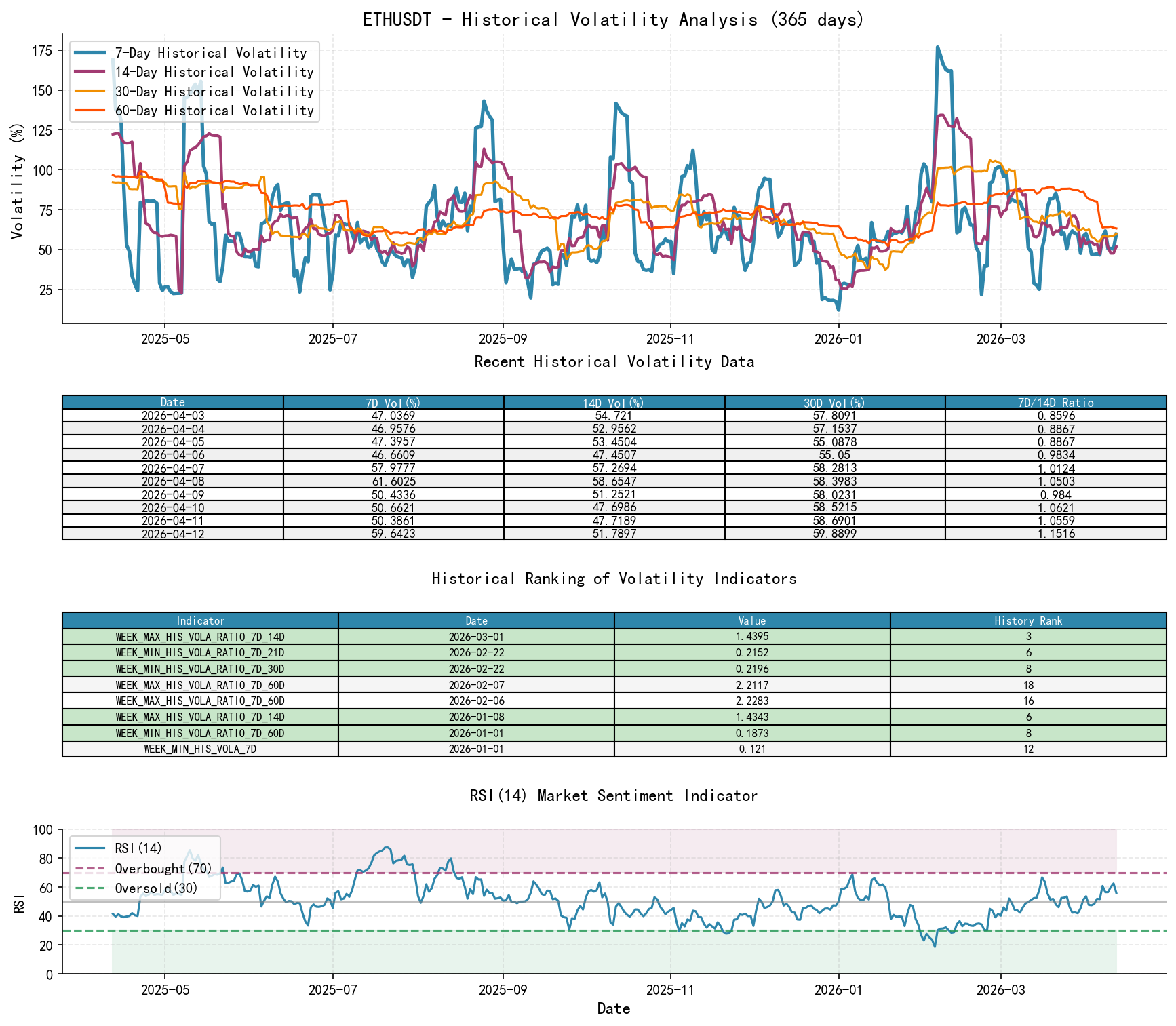
As of 2026-04-12, ETHUSDT had an opening price of 2285.00, a 7-day intraday volatility of 0.58, a 7-day intraday volatility ratio of 1.08, a 7-day historical volatility of 0.60, a 7-day historical volatility ratio of 1.15, and an RSI of 55.97.
- • Volatility Extreme Compression and Expansion:
- • Compression (Depressed Sentiment): On February 21-22,
HIS_VOLA_RATIO_7D_21DandHIS_VOLA_RATIO_7D_30Ddropped to 0.456 and 0.485 respectively, ranking as the 6th and 8th lowest in nearly a decade (see historical ranking data). Simultaneously,PARKINSON_RATIO_7D_21Dwas also at historical lows (ranked 17th). This marks extreme compression of market volatility and depressed trading sentiment, typically foreshadowing an imminent trend change. - • Expansion (Sentiment Release): On March 1st,
HIS_VOLA_RATIO_7D_14Dsurged to 1.44, reaching the third-highest value in nearly a decade (historical rank #3). This confirms that volatility exploded as the market initiated its move from the bottom in early March, with sentiment shifting from depressed to active.
- • Compression (Depressed Sentiment): On February 21-22,
- • Overbought/Oversold Status (RSI):
- • During the February decline,
RSI_14repeatedly touched the oversold zone below 30 (lowest 28.37), forming divergences with price lows, strengthening the judgment of a bottoming area. - • When making new highs on April 11th,
RSI_14was 62.57, not entering the extreme overbought zone (>70). This indicates that, from a momentum perspective, bullish sentiment was not overheated yet but had moved out of the safe zone.
- • During the February decline,
4. Relative Strength and Momentum Performance
- • Momentum Repair: From the perspective of
YTD(Year-to-Date Return), the loss narrowed from over -34% in mid-February to -25.50% on April 12th, showing significant repair in medium-term momentum. - • Strong Short-Term Momentum Turning Weak:
WTD_RETURN(Weekly Return) showed strong positive values multiple times in the second half of March (e.g., +18.06% for the week of March 16th), confirming short-term buying power. However, as of the week ending April 12th, the return rate fell back to +4.91%, slowing down compared to previous weekly highs (e.g., +13.79% for the week of March 30th), consistent with the conclusion of weakening upward momentum from the volume-price analysis.
5. Large Investor (Smart Money) Behavior Identification
- • Accumulation Behavior:
- • Absorption at Lows: During the panic selling on February 23rd, despite the sharp price drop, the
VOLUME_AVG_60D_RATIOwas only 1.12, and historical data shows the day's volume was not an extreme historical value. This suggests the selling likely came mainly from retail investors, while large investors were absorbing supply in an orderly, non-panicked manner. - • Aggressive Position Building: February 25th (high-volume surge) and March 16th (high-volume breakout) are clear signals of smart money entering the market openly and aggressively. The massive volume on March 16th, in particular, is a classic sign of demand taking control of the market.
- • Absorption at Lows: During the panic selling on February 23rd, despite the sharp price drop, the
- • Distribution/Observation Behavior:
- • Supply Test at Highs: After April 8th, when prices rose to around 2300, volume noticeably shrank (e.g., lower volume on new highs, April 11th). This implies smart money may have slowed their buying pace at this level or began testing market supply pressure. The higher volume decline on April 12th could be the result of some smart money taking profits or new short positions entering.
- • Exploiting Volatility: Smart money accumulated positions quietly during the extreme volatility compression in February and propelled prices higher during the volatility expansion and clear trend in March, aligning with their operational pattern of exploiting market sentiment extremes.
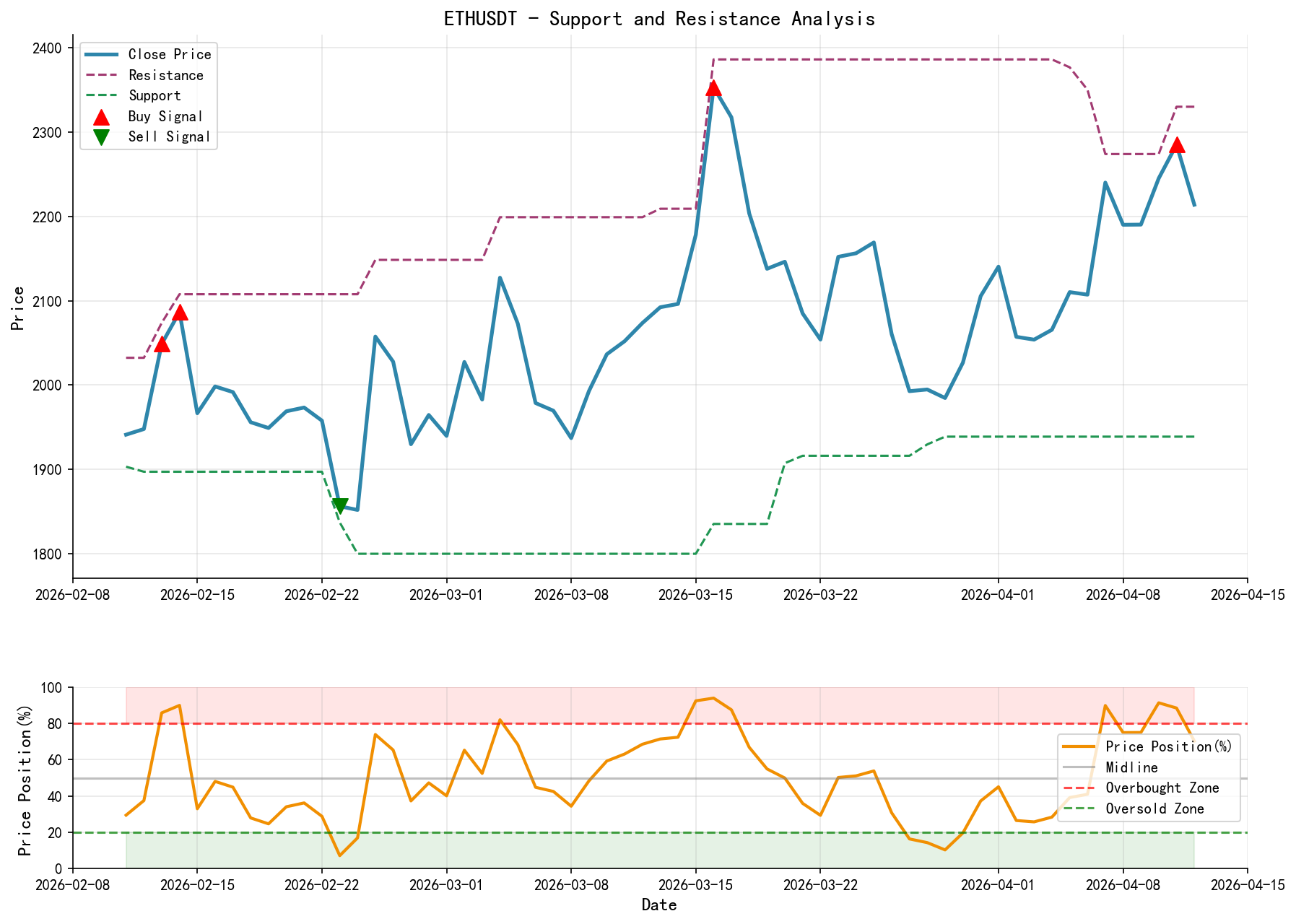
6. Support/Resistance Level Analysis and Trading Signals
- • Key Price Levels:
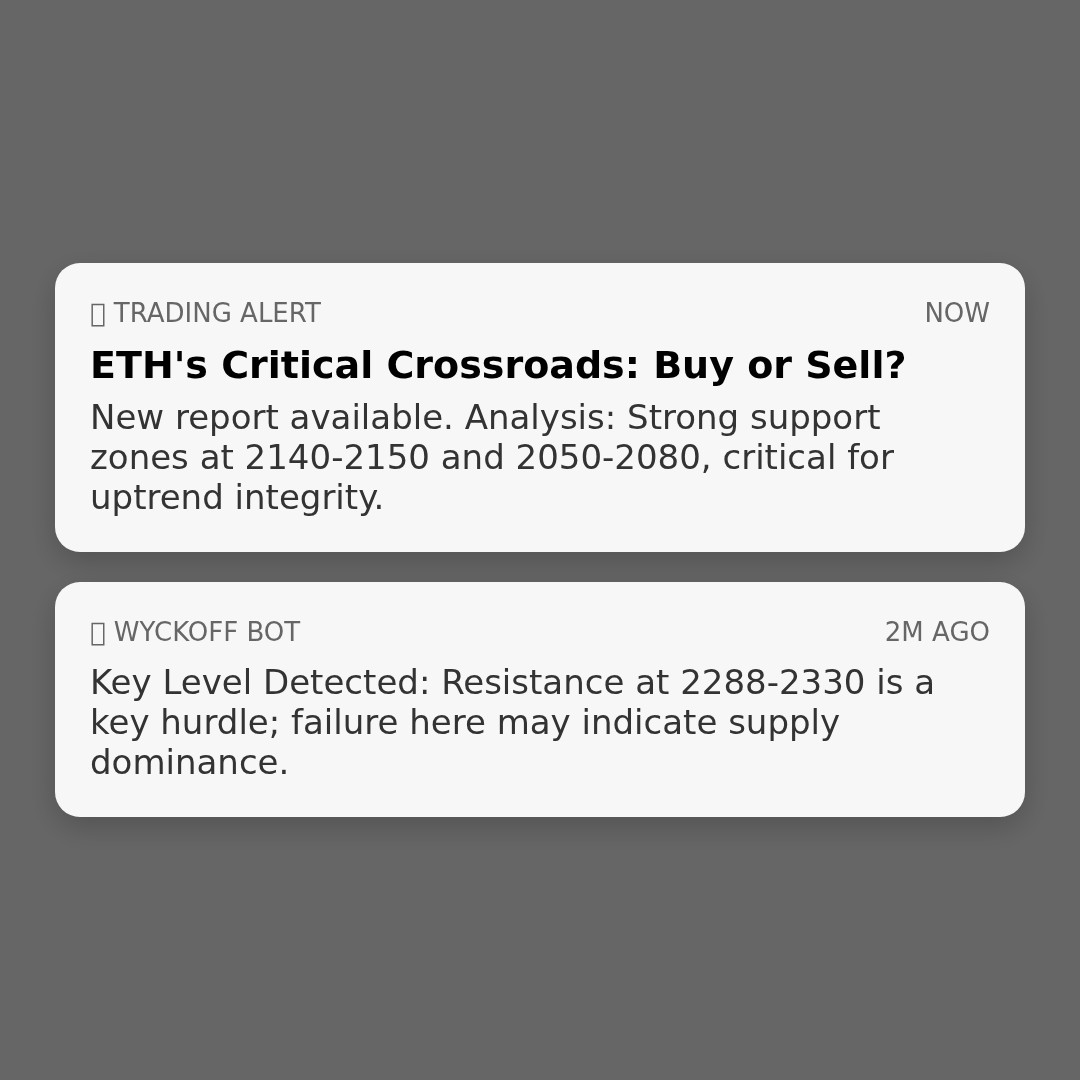
- • Support Level 1 (Strong): 2140 - 2150. This zone represents the early April pullback low and the location of the recent uptrend line (connecting lows from March 24th and April 2nd).
- • Support Level 2 (Very Strong): 2050 - 2080. The breakout level from mid-March and the upper boundary of the previous consolidation platform. A break below this would damage the uptrend structure.
- • Resistance Level 1 (Near-term Critical): 2288 - 2330. The high zone from April 11-12, where supply has recently emerged.
- • Resistance Level 2 (Major): 2500 - 2600. Corresponds to the area where the previous decline (January) began and is near the MA_60.
- • Synthesized Wyckoff Events and Trading Signals:
- • Current State: The market is in a pullback test within an uptrend. The higher volume decline on April 12th is a Secondary Test of the uptrend, aiming to test the strength of underlying demand.
- • Bullish Signal Conditions: Price shows signs of selling exhaustion on low volume or another high-volume advance (demand response) at either Support Level 1 (2140-2150) or Support Level 2 (2050-2080). Ideally, pullback volume should be significantly lower than rally volume.
- • Bearish Signal Conditions: Price反弹 fails to break Resistance Level 1 (2288) again, and shows consecutive high-volume stagnation or declining candles below that level. If price breaks below Support Level 2 (2050) with accompanying high volume, it would宣告 the end of this rally, potentially reverting the trend to downtrend.
- • Future Confirmation Points:
- 1. Demand Confirmation: Observe price reaction in the 2140-2150 zone. A swift recovery with expanding volume would prove demand remains strong, continuing the uptrend.
- 2. Supply Confirmation: Observe if subsequent rebounds can challenge 2288 again. Weak, low-volume rebounds would证明 supply is effectively suppressing price, possibly prolonging the Distribution phase.
Trading Implications (Based on Current Data):
- • Bulls: Advised to maintain a观望 stance, waiting for clear demand response signals (e.g., long lower wick, bullish engulfing pattern with expanding volume) at key support zones (2140 or 2050) before considering entry. Initial stop-loss can be placed below the low of the signal candle.
- • Bears: Aggressive traders could consider light short positions near 2280 if upward momentum falters with萎缩 volume, with a stop-loss above 2330. A more robust bearish signal requires a clear break below the 2140 support.
- • Core Principle: The market is currently at a critical博弈 level. The price's突破 or rejection reaction at the aforementioned key levels, confirmed by volume, is the core basis for determining the next course of action.
Disclaimer: This report is derived entirely from quantitative analysis of the provided historical data and Wyckoff theory, and does not constitute any investment advice. Financial markets carry significant risk. Past performance is not indicative of future results. Please make decisions based on your own independent judgment.
Thank you for your attention! Daily Wyckoff volume-price market interpretations are published promptly before the 8:00 AM market open. We kindly request your comments and shares; your recognition is crucial. Let's work together to see the market signals clearly.
Member discussion: