
DOGEUSDT Wyckoff Quantitative Analysis Report
Product Code: DOGEUSDT
Analysis Date Range: 2026-02-11 to 2026-04-12
Report Generation Date: 2026-04-13
1. Trend Analysis and Market Phase Identification
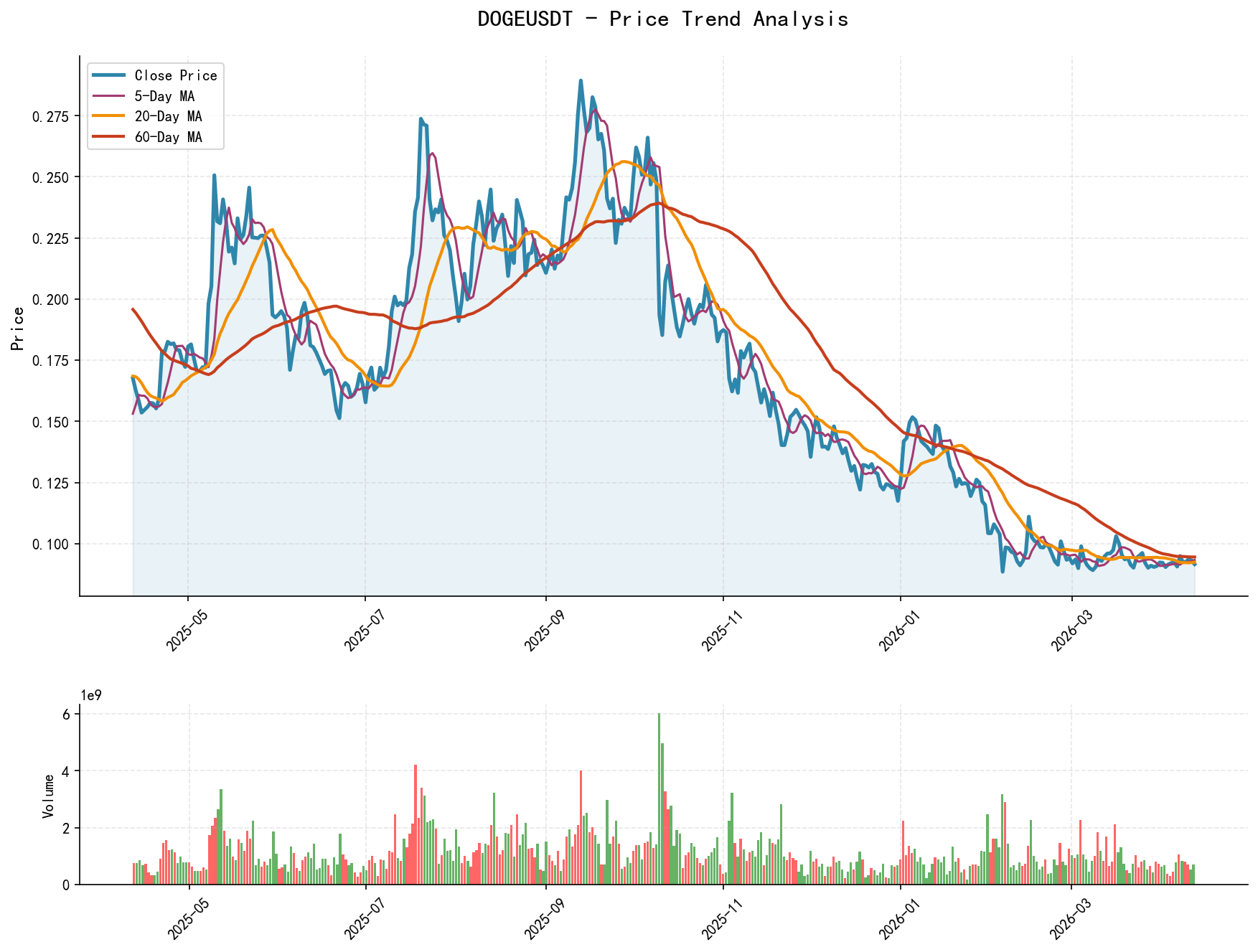
As of 2026-04-12, the underlying asset DOGEUSDT has an open price of 0.09, a close price of 0.09, a 5-day moving average of 0.09, a 10-day moving average of 0.09, a 20-day moving average of 0.09, a daily change of -1.62%, a weekly change of -0.87%, a monthly change of -0.80%, a quarterly change of -0.80%, and an annual change of -22.04%.
- 1. Trend Structure (Bear-Dominated):
- • Within the analysis period, DOGEUSDT exhibits a clear medium-to-long-term bearish trend. All moving averages (MA_5D, MA_10D, MA_20D, MA_30D, MA_60D) display a standard bearish alignment (MA_60D > MA_30D > MA_20D > MA_10D > MA_5D). Price is suppressed below all MAs within a descending channel.
- • Key Observation: The MA_5D attempted to cross above the MA_20D multiple times around late February, mid-March, and early April (e.g., March 16, March 25), but failed to sustain the breakout on each occasion, subsequently being pushed back down. This confirms the fragility of rebounds within the downtrend. The price's consistent inability to effectively break through the MA_20D indicates a downward intermediate trend.
- 2. Market Phase Inference (Consolidation and Potential Accumulation at the End of a Downtrend):
- • Early Phase (Early to Mid-February): A massive rebound (+14.87%) occurred on February 14, but was completely reversed the next day (February 15) by an even larger bearish candlestick. This forms a classic pattern of "supply coming in after an overbought rebound," marking a failed rebound attempt. The market then entered a new round of decline.
- • Core Phase (Late February to Present): Price has formed a wide consolidation range between 0.1185 (the high in early February) and 0.0880 (the low in late March). Particularly since late March, price has tested the 0.0880-0.0900 zone multiple times (e.g., March 28, March 30, April 6), but has not led to a clean breakdown.
- • Wyckoff Phase Assessment: Integrating price and volume behavior, the market may be transitioning from "Panic Selling" to an "Automatic Rally" and entering a "Secondary Test" or early "Accumulation" phase. Price oscillating within a low-level range, accompanied by unusual volume activity at key levels, suggests large players may be testing support and building positions, but a trend reversal has not yet been confirmed.
2. Volume-Price Relationship and Supply-Demand Dynamics
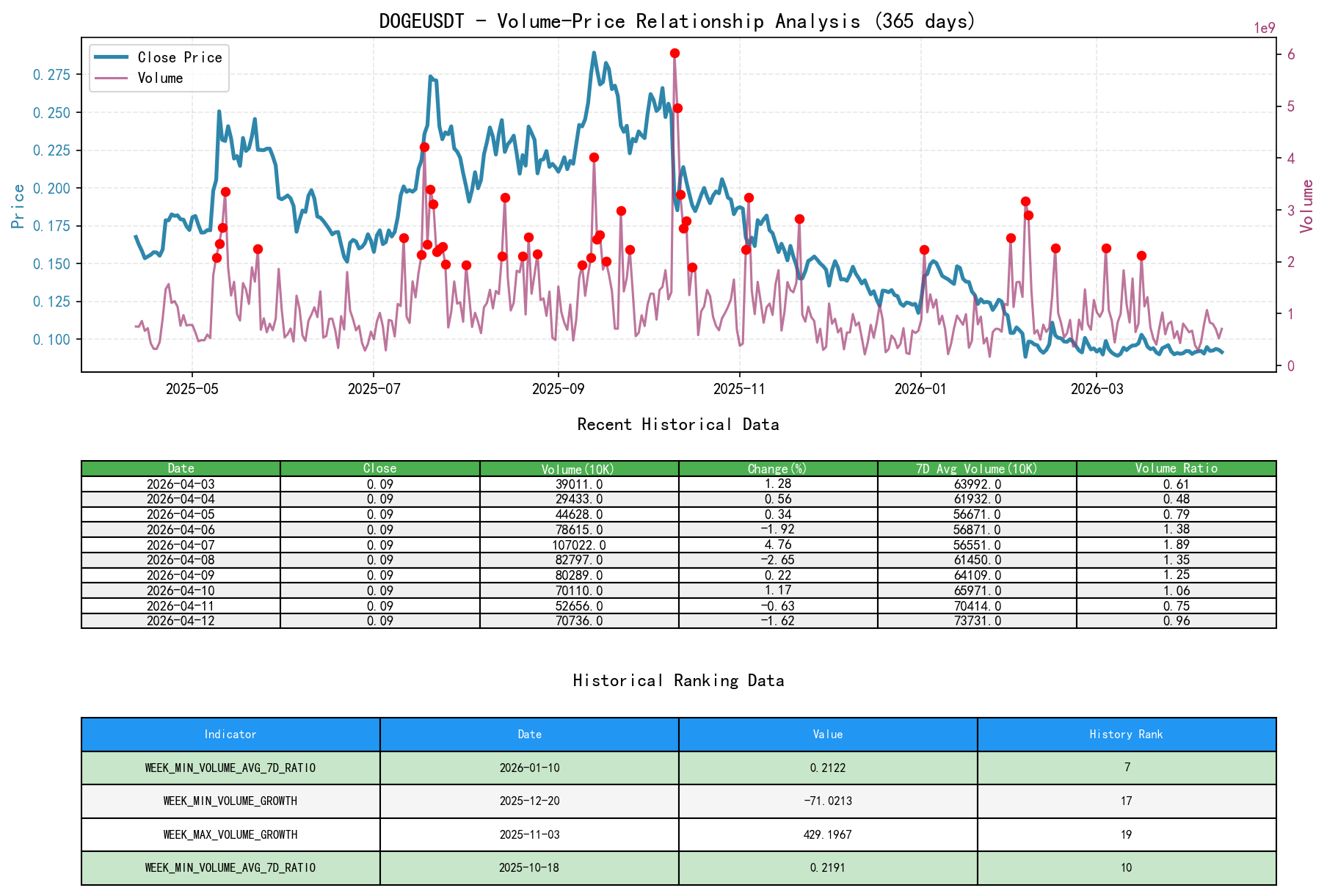
As of 2026-04-12, the underlying asset DOGEUSDT has an open price of 0.09, a close price of 0.09, volume of 707363698.00, a daily change of -1.62%, volume of 707363698.00, a 7-day average volume of 737316871.86, and a 7-day volume ratio of 0.96.
- 1. Key Supply-Dominated Days:
- • 2026-02-15: Following a 14.87% surge the previous day, price opened high and closed low, falling 7.52%, with volume exploding to 2.98 times the 7-day average (
VOLUME_AVG_7D_RATIO=2.98). This is a textbook "Supply Coming In" signal, indicating powerful selling pressure at the rebound high, confirming the February 14 rally as a "trap move." - • 2026-03-05: After a high-volume 9.96% gain on March 4, price fell 5.43% the next day while volume remained elevated (
VOLUME_AVG_7D_RATIO=0.93). This constitutes "Supply Appearing After a Rally Without Follow-Through Demand," again verifying that any rebound in the current market is prone to selling pressure.
- • 2026-02-15: Following a 14.87% surge the previous day, price opened high and closed low, falling 7.52%, with volume exploding to 2.98 times the 7-day average (
- 2. Demand Emergence and Support Testing:
- • 2026-03-16: Price rose 5.81% with volume surging to 1.86 times the 7-day average. This is a significant "Demand Coming In" signal, fueling the subsequent days' rebound. It represents an important display of demand within the consolidation range.
- • 2026-03-30 & 2026-04-06: When testing the lower boundary of the range, volume reached 1.15 and 1.38 times the 7-day average, respectively. Although these were down days, the high volume at key support levels may suggest "Panic Selling" or "Shakeouts," with some selling being absorbed, setting the stage for a potential "Secondary Test."
- 3. Supply-Demand Balance and Transition:
- • Recently (since early April), volume has generally contracted below the 7-day average (
VOLUME_AVG_7D_RATIOoften below 1.0), while price has moved within a narrow range. This aligns with the characteristics of "Lack of Selling" or "Testing" in the Wyckoff Accumulation phase—selling pressure is diminishing, but demand has not yet entered significantly. The market is in a state of watchfulness and balance.
- • Recently (since early April), volume has generally contracted below the 7-day average (
3. Volatility and Market Sentiment
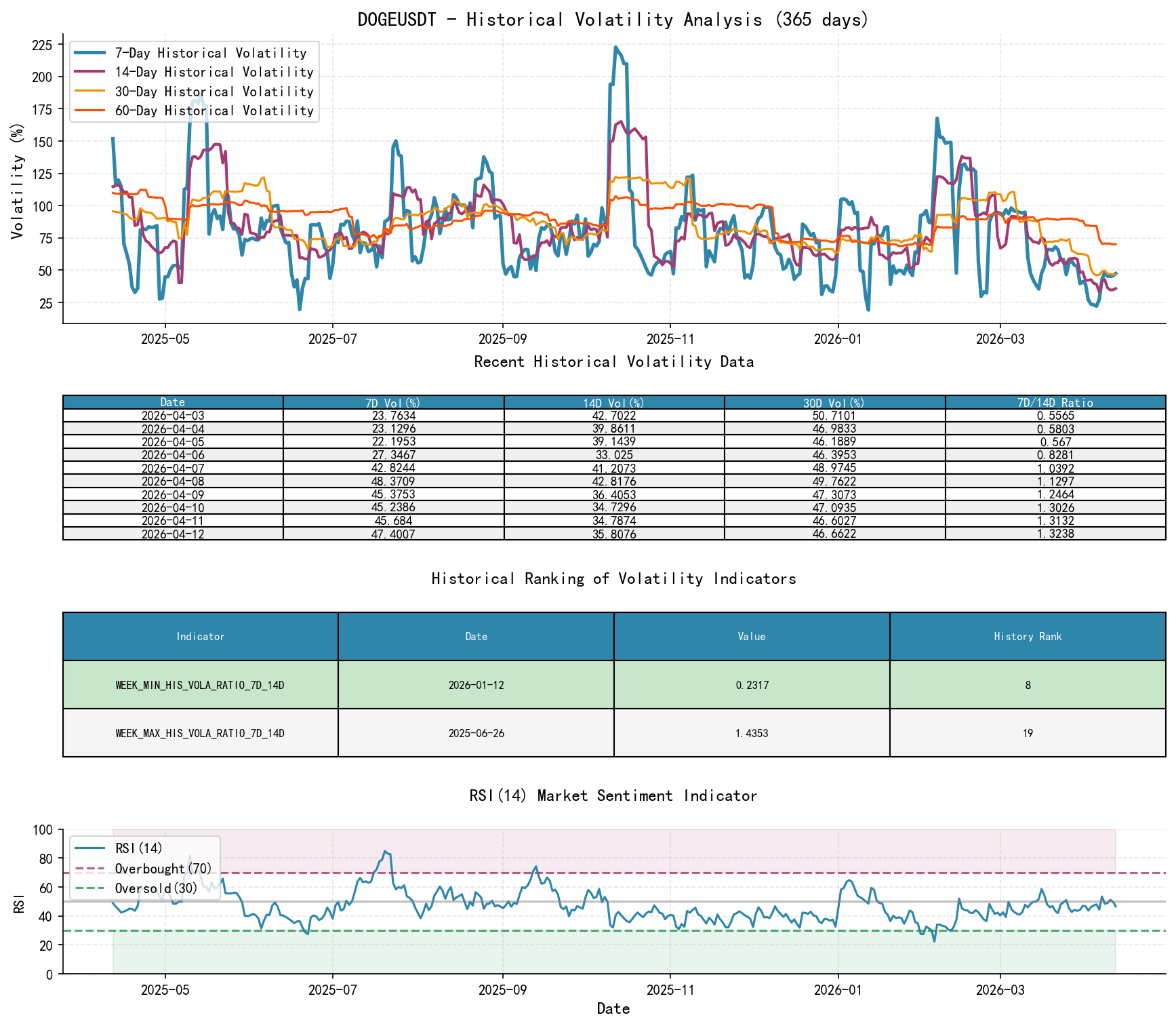
As of 2026-04-12, the underlying asset DOGEUSDT has an open price of 0.09, a 7-day intraday volatility of 0.46, a 7-day intraday volatility ratio of 1.09, a 7-day historical volatility of 0.47, a 7-day historical volatility ratio of 1.32, and an RSI of 46.63.
- 1. Volatility Level:
- • Current short-term volatility (
HIS_VOLA_7D=0.474,PARKINSON_VOL_7D=0.463) is at a relatively low level within the analysis period, significantly below the highs seen in mid-February and early March. The volatility ratioHIS_VOLA_RATIO_7D_14D(1.32) indicates short-term volatility is above its 14-day average, whilePARKINSON_RATIO_7D_14D(1.09) suggests intraday volatility is relatively mild. Conclusion: The market is not exhibiting panic-driven volatility expansion; sentiment is shifting from extreme turbulence towards convergence.
- • Current short-term volatility (
- 2. Sentiment Indicators:
- • The current value of RSI_14 is 46.63, in the neutral-to-weak zone. Throughout the analysis period, RSI dipped below 30 on multiple occasions (e.g., 29.77 on Feb 11, 36.47 on Feb 24), indicating the market experienced oversold conditions. Currently, RSI has moved out of the oversold zone but has not entered strong territory, reflecting persistently bearish but not extreme sentiment.
4. Relative Strength and Momentum Performance
- 1. Momentum Trend (Comprehensive Weakness):
- • All period returns are negative:
YTD=-22.04%,QTD=-0.80%,MTD=-0.80%, indicating the asset has underperformed across short, medium, and long-term horizons and is in a state of relative weakness. - • Positive Signal: Recent momentum shows slight improvement.
WTD_RETURNis -0.87%, still negative, but its absolute value has narrowed significantly compared to previous weeks (e.g., -7.42% in the final week of March), hinting that downward momentum may be waning.
- • All period returns are negative:
5. Large Investor (Smart Money) Behavior Identification
Based on Wyckoff principles and the above volume-price analysis, inferences regarding large investor behavior are as follows:
- 1. Distribution Behavior: Clearly occurred on February 14-15 and March 4-5. Smart money utilized strong rebounds to attract public buyers (retail following the trend) and conducted large-scale distribution at highs (the 0.113-0.118 zone and the 0.104 zone), manifested as high-volume stalling or reversal downwards.
- 2. Potential Accumulation/Testing Behavior: Since late March, price has found support multiple times in the 0.088-0.090 zone. Although several tests of this zone were accompanied by high-volume declines, the repeated testing at the same level without a decisive breakdown, followed by volume contraction, aligns with the characteristic of "Testing Support." Smart money may be utilizing market pessimism to conduct planned, phased accumulation at low levels, testing whether supply at this level is exhausted. On April 12, price tested lower again with moderately increased volume. It is necessary to observe whether subsequent price action shows a "Spring" effect (quick intraday drop followed by a strong recovery on low volume) or a "Successful Secondary Test" pattern to gain confirmation.
6. Support/Resistance Level Analysis and Trading Signals
- 1. Key Price Levels:
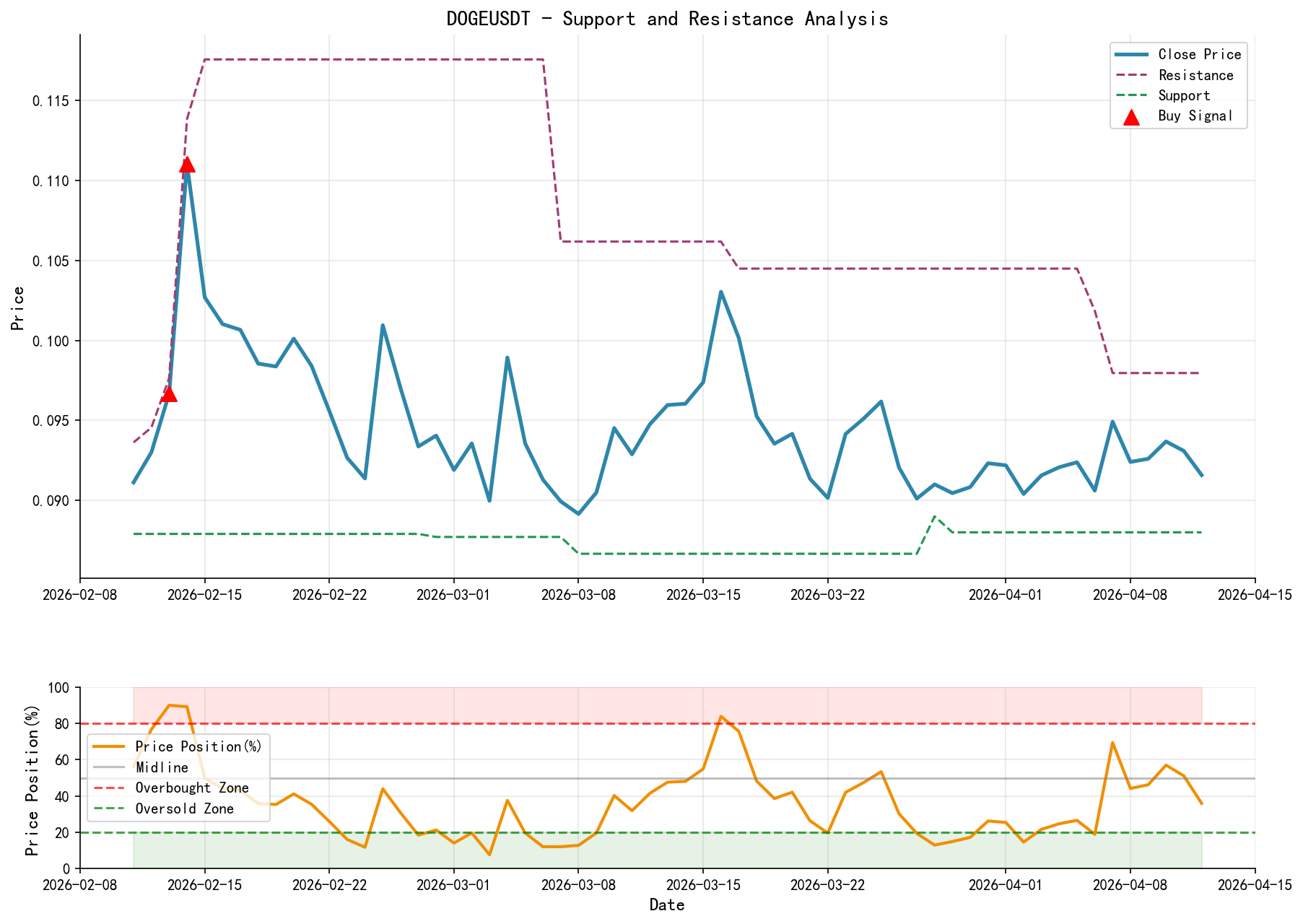
- • Primary Resistance Zone: 0.1000 - 0.1030. This zone is formed by the mid-March rebound highs and multiple consolidation tops. It is the key area to verify if demand can be sustained. A breakout above this zone is required to initially alter the short-term bearish structure.
- • Core Resistance Zone: 0.1100 - 0.1130. The upper boundary of the mid-February distribution range. This is the major supply zone that must be conquered for a medium-term trend reversal.
- • Immediate Support/Demand Zone: 0.0880 - 0.0900. The low zone tested multiple times from late March to present. This is the critical level for judging whether the market is entering panic or completing accumulation.
- • Lower Support: If 0.0880 is lost, the next key support level would need to be referenced from longer-term data.
- 2. Integrated Trading Signals and Operational Suggestions:
- • Current Status: Observe / Await Signal Confirmation. The market is in a consolidation structure at the end of a downtrend, suspected to be building a bottom, but a clear trend reversal signal has not yet appeared.
- • Bullish Scenario and Entry Trigger:
- • Signal: Price breaks out and sustains above 0.0950 (recent minor resistance) with significant volume, then challenges the 0.1000-0.1030 resistance zone. The breakout should be accompanied by a notable volume surge (
VOLUME_AVG_7D_RATIO> 1.5). - • Entry Level: After a successful breakout above 0.0950 followed by a pullback and confirmation, or upon a high-volume breakout above 0.1030.
- • Stop-Loss Level: Below 0.0880, placed under the entry point.
- • Target Level: Initially towards 0.1100.
- • Signal: Price breaks out and sustains above 0.0950 (recent minor resistance) with significant volume, then challenges the 0.1000-0.1030 resistance zone. The breakout should be accompanied by a notable volume surge (
- • Bearish Scenario and Entry Trigger:
- • Signal: Price rallies to the 0.1000-0.1030 zone and again shows signs of stalling with high volume or long upper shadows (supply reappearing), OR price breaks below the 0.0880 support with high volume.
- • Entry Level: When a bearish rejection signal appears during the rally, or upon a confirmed closing break below 0.0880.
- • Stop-Loss Level: Above 0.1050 relative to the entry point (for shorting the rally) or above 0.0910 (for shorting a breakdown).
- • Target Level: Downward extension towards prior lows.
- • Future Confirmation Points:
- 1. Bullish Confirmation Point: A "Spring" effect appears near 0.0900 (intraday quick drop below followed by a strong recovery) or a "Successful Secondary Test" (low-volume retest of 0.0900 holds), followed by expanding demand (volume increase on rallies).
- 2. Bearish Confirmation Point: Price fails to rally above 0.0950, and every rebound exhibits low volume. Ultimately, a high-volume break below 0.0880 confirms the continuation of the downtrend.
Risk Warning: The cryptocurrency market is highly volatile. The above analysis is derived from historical data and does not constitute direct investment advice. Traders should combine this with real-time market conditions and strictly manage risk. Note: The provided historical_rank_data is empty; therefore, this report does not include related historical percentile analysis.
Disclaimer: This report/interpretation is solely for market analysis and research based on publicly available information and does not represent any investment advice or operational guidance. The author strives for objectivity and fairness but makes no guarantees regarding the accuracy or completeness of the content. The market involves risk; investing requires caution. Any investment actions based on this report are taken at one's own risk.
Thank you for your attention! Daily Wyckoff Volume-Price Market Analysis is published promptly before the market opens at 8:00 AM. Your feedback and shares are sincerely appreciated and crucial. Let's work together to better perceive market signals.
Member discussion: