
Alright, I will conduct a comprehensive quantitative analysis of XRPUSDT guided by the Wyckoff Method. All conclusions are strictly based on the data and historical rankings you provided.
XRPUSDT Quantitative Analysis Report
- • Product Code: XRPUSDT
- • Analysis Date Range: 2026-02-09 to 2026-04-10
- • Report Generation Date: 2026-04-11
1. Trend Analysis and Market Phase Identification
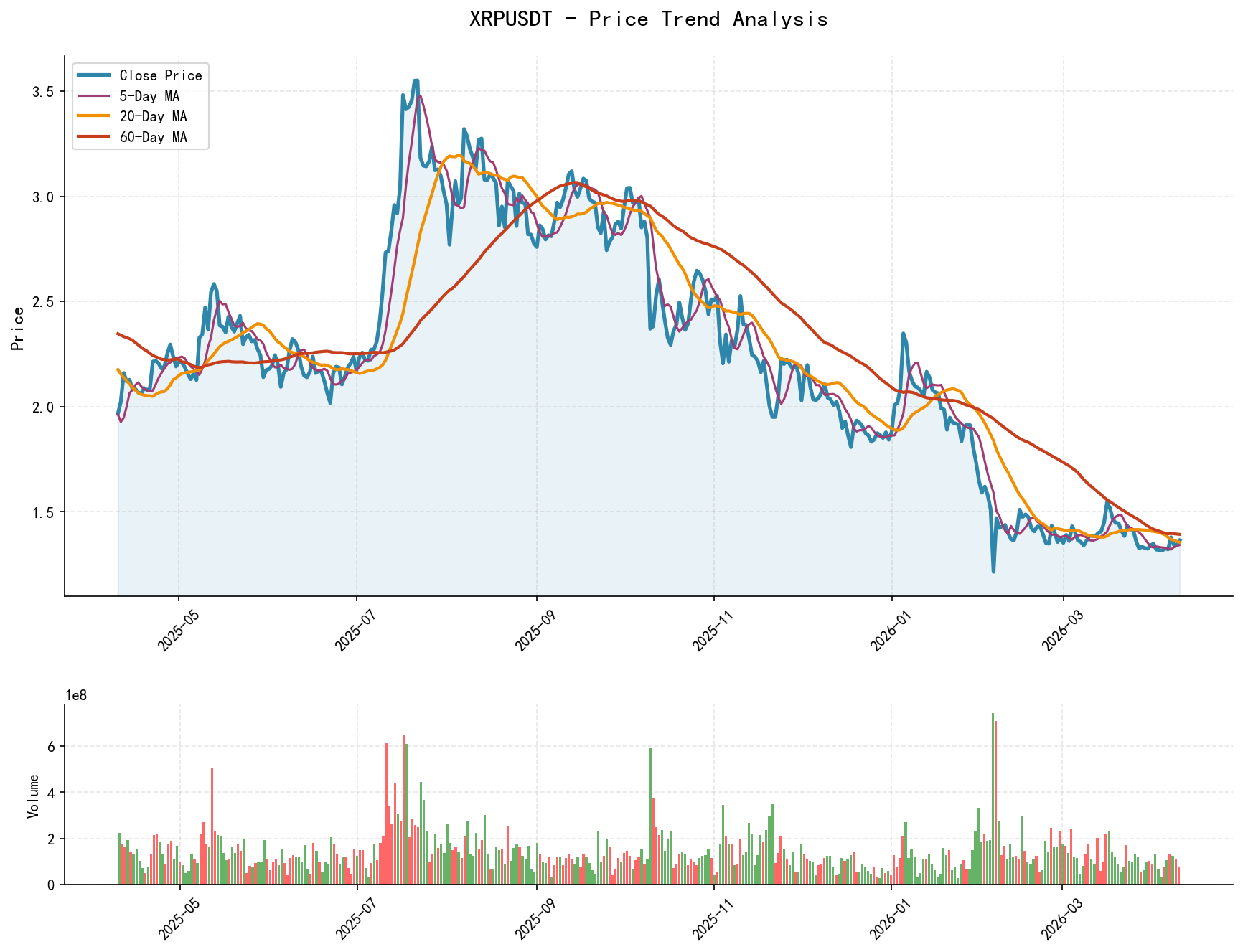
As of April 10, 2026, the underlying asset XRPUSDT has an opening price of 1.34, a closing price of 1.36, a 5-day moving average of 1.34, a 10-day moving average of 1.34, a 20-day moving average of 1.35, a daily change of 1.48%, a weekly change of 3.44%, a monthly change of 1.69%, a quarterly change of 1.69%, and an annual change of -25.98%.
Price and Moving Average Relationship:
- • Bearish Alignment Confirmed: As of the end of the analysis period (2026-04-10), the closing price
CLOSE: 1.3637is below all major moving averages (MA_5D: 1.34256,MA_10D: 1.33554,MA_20D: 1.35418,MA_30D: 1.38418,MA_60D: 1.39245). All moving averages are sloping downward, clearly indicating the market is in a strong downtrend. Since late February, the price has been suppressed by moving averages across various timeframes, failing to form an effective breakout. - • Moving Average Crossover Signals: Medium-term moving averages consistently suppress short-term ones. For example,
MA_20Dhas been declining and suppressingMA_5Dsince mid-February;MA_30DandMA_60Dformed a long-term death cross and continue to diverge downward. The recent relationship betweenMA_5DandMA_20Dremains bearish, with no golden cross signal, confirming short-term weakness.
Wyckoff Market Phase Inference:
- • The overall trend from 2026-02-09 to 2026-04-10 presents a pattern of: Sharp Decline (PSY) -> Brief Rebound (AR) -> Secondary Decline.
- • Current Phase (Late March to Early April): The price fell from the March 16 high of 1.5430 to the March 30 low of 1.3242, followed by narrow-range consolidation within the 1.32-1.38 band. Trading volume has contracted (see below), and volatility has plummeted. This aligns with the characteristics of either the "Reaccumulation" or "Initial Supply" phase in Wyckoff theory. After a panic-driven decline, the price has entered a relatively balanced consolidation zone. However, the overall trend (moving averages) still points downward, indicating that Supply (sellers) remains dominant, and Demand (buyers) lacks the strength to reverse the trend. The market is accumulating energy for another potential decline.
2. Volume-Price Relationship and Supply-Demand Dynamics
As of April 10, 2026, the underlying asset XRPUSDT has an opening price of 1.34, a closing price of 1.36, a trading volume of 75194760.50, a daily change of 1.48%, a trading volume of 75194760.50, a 7-day average volume of 91606209.21, and a 7-day volume ratio of 0.82.
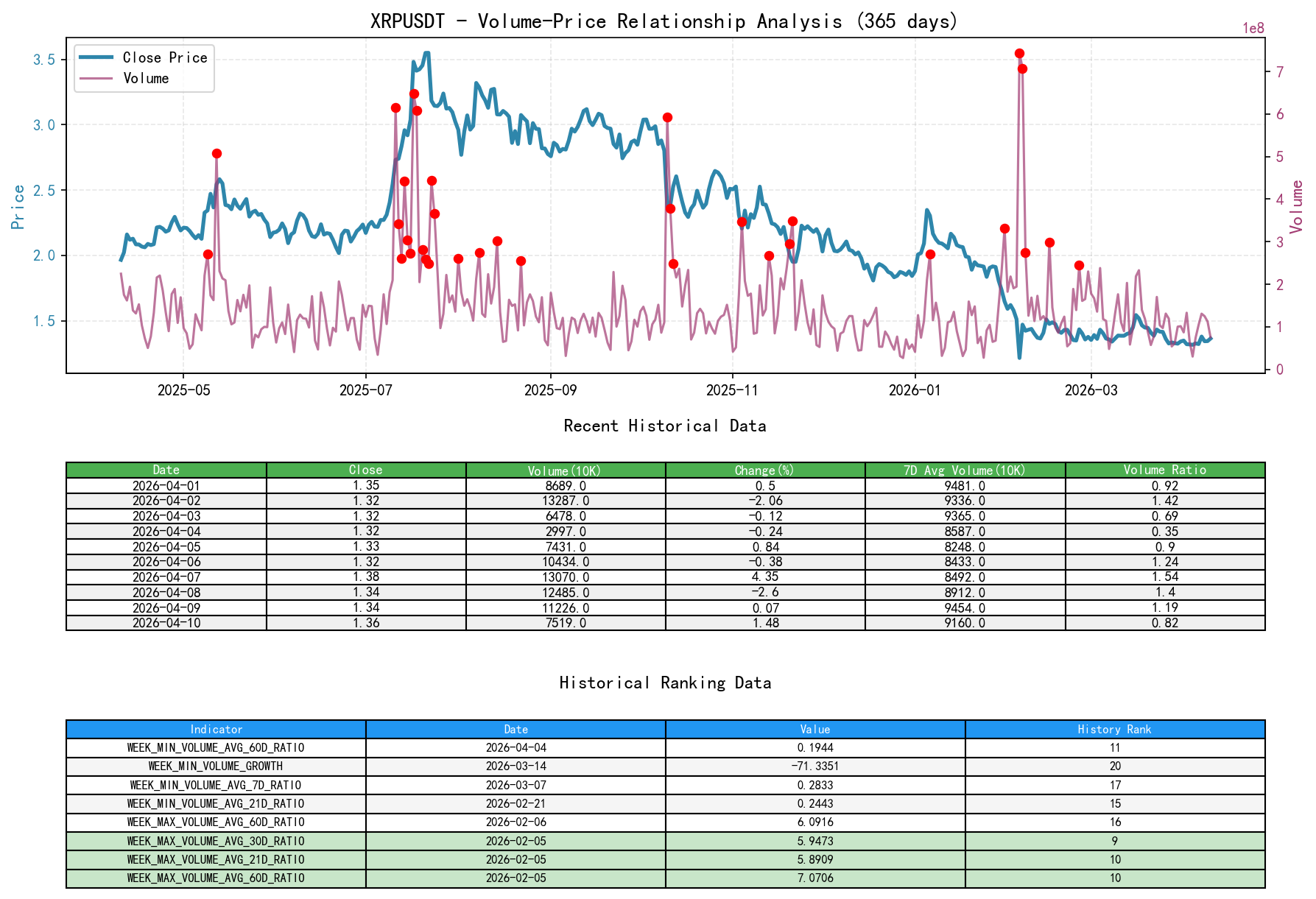
Based on Wyckoff principles, we analyze key volume-price junctures:
- 1. Signs of Demand Entry (Not Sustained):
- • 2026-04-07: The price surged by +4.35% with a sharp spike in volume (
VOLUME_AVG_7D_RATIO: 1.54). This is a classic "rising price on high volume" day, indicating active buying demand momentarily broke the downward inertia.
- • 2026-04-07: The price surged by +4.35% with a sharp spike in volume (
- 2. Evidence of Supply Overpowering Demand Immediately:
- • 2026-04-08: Following the previous day's demand entry, the price fell -2.60% the next day, with volume remaining elevated (
VOLUME_AVG_7D_RATIO: 1.40). This formed a "falling price on high volume" pattern, indicating the demand that entered the previous day was quickly absorbed and suppressed by stronger Supply (selling). This is a classic signal of the market being in a Distribution or Supply-dominated phase.
- • 2026-04-08: Following the previous day's demand entry, the price fell -2.60% the next day, with volume remaining elevated (
- 3. Demand-Deficient Rebound:
- • 2026-04-10: The price rose +1.48%, but volume contracted significantly (
VOLUME_AVG_7D_RATIO: 0.82, below the 7-day average). This is a "rising price on low volume" move, suggesting the price increase lacks broad buying support, potentially driven by short covering or minimal buying interest, indicating weak demand.
- • 2026-04-10: The price rose +1.48%, but volume contracted significantly (
- 4. Extreme Supply Exhaustion and Demand Scarcity (Historical Data Support):
- • Historical ranking data shows extreme volume contraction:
- •
2026-03-07:WEEK_MIN_VOLUME_AVG_7D_RATIOwas 0.2833, ranking as the 17th lowest in nearly a decade. - •
2026-02-21:WEEK_MIN_VOLUME_AVG_21D_RATIOwas 0.2443, ranking as the 15th lowest in nearly a decade. - •
2026-04-04:WEEK_MIN_VOLUME_AVG_60D_RATIOwas 0.1944, ranking as the 11th lowest in nearly a decade. - •
2026-03-14:WEEK_MIN_VOLUME_GROWTHwas -71.34%, ranking as the 20th lowest in nearly a decade.
- •
- • Inference: This data indicates multiple instances of extreme volume contraction during the analysis period, reaching extreme levels in nearly a decade. This aligns with the Wyckoff "Ice Line" concept, suggesting that at specific price levels, both active Supply (selling) and Demand (buying) have significantly diminished, leading to market illiquidity. This often occurs at the end of trend movements but can also be a consolidation.
- • Historical ranking data shows extreme volume contraction:
Supply-Demand Conclusion: The market exhibited a pattern evolving from "Supply-dominated to both weak Supply and Demand" towards the end of the analysis period. Although there were sporadic demand attempts (April 7th), they were immediately suppressed by stronger Supply. The recent volume contraction to historically low levels indicates low market participation, with both bulls and bears in a wait-and-see mode, awaiting a new catalyst to break the balance.
3. Volatility and Market Sentiment
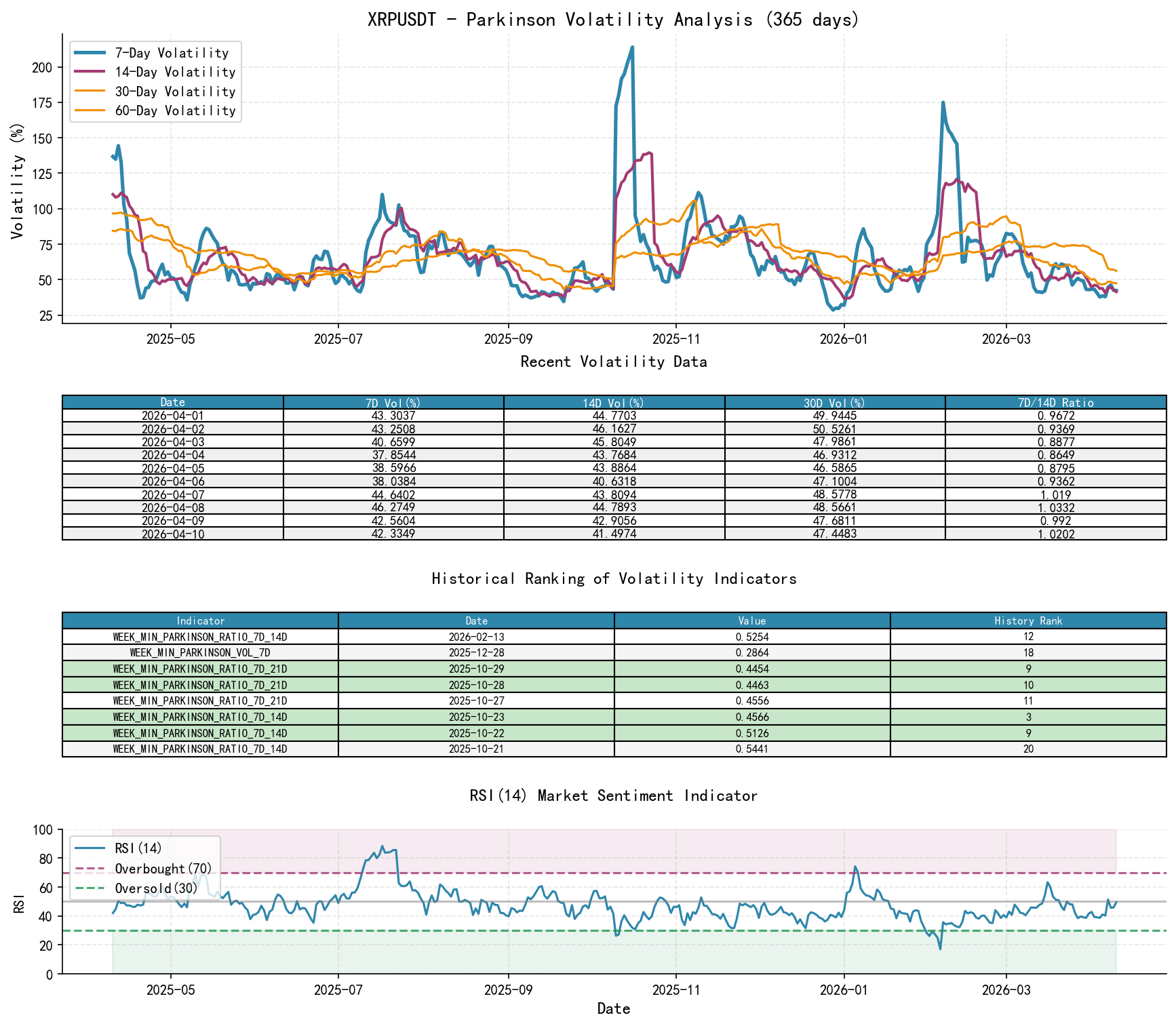
As of April 10, 2026, the underlying asset XRPUSDT has an opening price of 1.34, a 7-day Parkinson volatility of 0.42, a 7-day Parkinson volatility ratio of 1.02, a 7-day historical volatility of 0.40, a 7-day historical volatility ratio of 1.29, and an RSI of 49.48.
- 1. Volatility Level and Structure:
- • Significant Volatility Contraction: Rapid decline from the high-volatility state in early February (with
HIS_VOLA_7Das high as 2.29%). By April 10th,HIS_VOLA_7Dhad dropped to 0.40% andPARKINSON_VOL_7Dto 0.42%, both at the absolute lows within the data period. This marks a shift in market sentiment from panic/trend acceleration to suppression/directionless. - • Abnormal Volatility Term Structure:
- •
HIS_VOLA_RATIO_7D_14Don April 10th was 1.29, andPARKINSON_RATIO_7D_14Dwas 1.02. This indicates short-term volatility is slightly higher than medium-term (14-day) volatility, but still far below the extreme levels of early February (whenHIS_VOLA_RATIO_7D_14Dranked as the 12th-16th highest in nearly a decade). The current market does not show panic-driven volatility spikes.
- •
- • Significant Volatility Contraction: Rapid decline from the high-volatility state in early February (with
- 2. Overbought/Oversold Status:
- •
RSI_14at the end of the analysis period was 49.48, in the neutral zone. Throughout the data period, the RSI primarily oscillated within the 30-55 weak-to-neutral range, only briefly touching 63.37 on March 16th. This indicates the market never reached severe overbought conditions during the downtrend, and recent lows did not trigger severe oversold conditions (RSI didn't fall below 30). This, combined with volume contraction, confirms market sentiment as apathetic and watchful, rather than extremely pessimistic.
- •
Sentiment Conclusion: Market sentiment has calmed from the fear-driven decline of February-March, entering a "low volatility, low sentiment, directionally ambiguous" compression state. Such an environment is often fertile ground for trend continuation or reversal formation, but does not itself constitute a directional signal.
4. Relative Strength and Momentum Performance
- 1. Periodic Returns:
- • Short-term:
WTD_RETURN(weekly return) on April 10th was +3.44%, showing a technical rebound over the past week. - • Medium-term:
MTD_RETURN(month-to-date return, from April 1st) was +1.69%,QTD_RETURN(quarter-to-date return, from April 1st) was also +1.69%, indicating a slight rebound at the start of the quarter. - • Long-term:
YTD_RETURN(year-to-date) was -25.98%,TTM_12(past 12 months) was -30.63%. Long-term momentum indicators clearly point to strong negative momentum.
- • Short-term:
- 2. Momentum Validation: The short-term rebound momentum (positive WTD/MTD) contrasts sharply with the long-term downtrend momentum (deeply negative YTD/TTM). This momentum structure does not support a trend reversal and is more consistent with technical rebound or range consolidation following an oversold condition. The rebound's lack of sustained volume support (see volume-price analysis) further undermines its credibility.
5. Large Investor (Smart Money) Behavior Identification
Integrating volume-price, volatility, and trend analysis allows for inferences regarding the behavioral intent of large participants:
- 1. Distribution Behavior:
- • Key Evidence: The high-volume rise on April 7th was immediately followed by an even larger high-volume decline on April 8th. This aligns with the Wyckoff principle of "Effort vs. Result" – significant buying effort (April 7th) resulted in only a brief price rise, subsequently overwhelmed by stronger selling pressure. This strongly suggests large investors may be using demand inflows for distribution, transferring holdings to chasing retail or passive buyers during high-liquidity moments (high-volume days).
- 2. Accumulation Behavior Not Yet Clear:
- • In the low-price range of late March to early April (1.32-1.34), the market repeatedly exhibited extreme volume contraction (ranking high historically). This could imply:
- • Large Investor Wait-and-See: Smart money believes prices have not yet fallen to their target accumulation zone, or they await clearer right-hand side signals.
- • Slow Accumulation: To avoid pushing prices higher, a slow, stealthy collection might be occurring at the bottom range with extremely low volume. However, due to the absence of clear accumulation signals like "panic selling" and "high-volume stopping of decline," current evidence is insufficient to support a conclusion of "large-scale accumulation underway."
- • In the low-price range of late March to early April (1.32-1.34), the market repeatedly exhibited extreme volume contraction (ranking high historically). This could imply:
- 3. Behavior Summary: Based on recent volume-price structure, the dominant behavior of large investors appears to be "distribution on rebounds" rather than "accumulation on dips." They utilized the demand rebound on April 7th to reduce long exposure or establish short positions. The market's extreme low volume reflects their hesitation and caution at current price levels.
6. Support/Resistance Level Analysis and Trading Signals
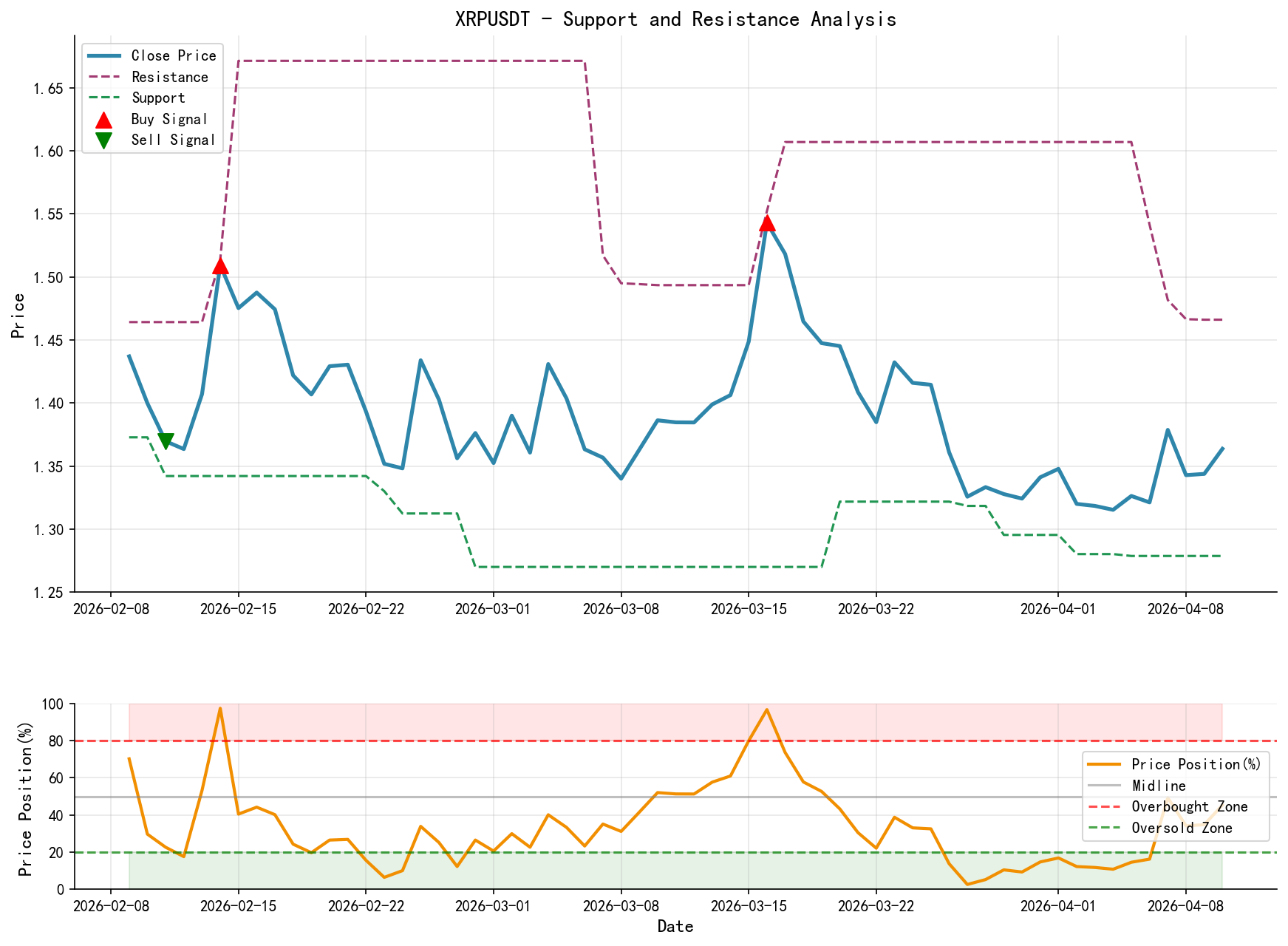
Key Price Levels:
- • Immediate Resistance: 1.3898 (2026-04-08 high), also the dynamic resistance zone formed by
MA_20D(1.3542) andMA_30D(1.3842). A decisive upward breakout through this zone is the first signal for trend strengthening. - • Immediate Support: 1.3218 (2026-04-09 low) and 1.2949 (2026-04-07 low). This band is the lower boundary of the recent month's consolidation range. A breakdown would confirm the start of a new decline wave.
- • Strong Support: Around 1.2700 (near the 2026-02-28 low).
- • Strong Resistance: Around 1.4649 (2026-03-15 high) and
MA_60D(1.3925).
Integrated Trading Signals Based on Wyckoff Events:
- 1. Trend Signal: Bearish. Price below all major moving averages, long-term momentum deeply negative, overall structure is a downtrend with lower highs and lower lows.
- 2. Volume-Price Signal: Bearish-Biased. Rebound day on low volume (April 10), rebound immediately followed by high-volume decline (April 8), indicating active Supply and weak Demand.
- 3. Smart Money Signal: Bearish-Biased. Behavioral pattern points towards distribution rather than accumulation.
Integrated Conclusion and Operational Suggestions:
- • Main View: XRPUSDT is in a weak rebound/consolidation phase within a long-term downtrend. Market sentiment is apathetic, both Supply and Demand are weak, but Supply shows greater strength at key levels. Large investors show no signs of active buying.
- • Operational Suggestions:
- • Direction: Leaning bearish, awaiting shorting opportunities on rebounds.
- • Entry Level (Short): Consider establishing short positions when price rallies into the 1.3800 - 1.3900 resistance zone and shows signs of stalling (e.g., long upper wick) or weakness on smaller timeframes.
- • Stop-Loss Level: Set above key resistance, e.g., 1.4000 (breaking above
MA_30Dand recent highs). - • Target Levels: First target 1.3200, second target 1.2950.
- • Alternative Strategy (Wait-and-See): If price breaks down below 1.3200 directly with expanding volume, it could be seen as a signal of downtrend resumption. However, chasing the short requires caution; waiting for a pullback confirmation is preferable.
- • Future Validation Points:
- 1. Bearish Validation: Price fails to break through the 1.3898 resistance and shows high-volume bearish candles below it.
- 2. Bullish Warning (Requiring Vigilance): If price breaks through and sustains above the 1.3900-1.4000 zone with persistently high volume (
VOLUME_AVG_7D_RATIO > 1.5), especially ifRSI_14rises above 55 concurrently, the downtrend may pause, requiring re-evaluation. - 3. Trend Acceleration Signal: Price breaks below the 1.2949 support accompanied by synchronous expansion in volatility (
HIS_VOLA_7D) and volume (VOLUME_GROWTH).
Disclaimer: This report/analysis is solely market analysis and research based on public information and does not constitute any investment advice or operational guidance. The author strives for objectivity and impartiality but makes no guarantees regarding accuracy or completeness. Markets involve risks; investment requires caution. Any investment actions based on this report are taken at your own risk.
Thank you for your attention! Wyckoff Volume-Price Market Interpretations are released daily at 8:00 AM before market opening. Your comments and shares are greatly appreciated. Your recognition is crucial. Let's work together to see the market signals clearly.
Member discussion: