Quantitative Analysis Report: XLY (2026-02-09 to 2026-04-10)
Report Generation Time: 2026-04-11
Analysis Period: 2026-02-09 to 2026-04-10
1. Trend Analysis and Market Phase Identification
As of 2026-04-10, the underlying asset XLY opened at 113.00, closed at 112.89. The 5-day moving average (MA) is 109.70, the 10-day MA is 108.75, the 20-day MA is 109.69. The daily change is +0.13%, weekly change is +4.38%, monthly change is +3.59%, quarterly change is +3.59%, and yearly change is -5.46%.
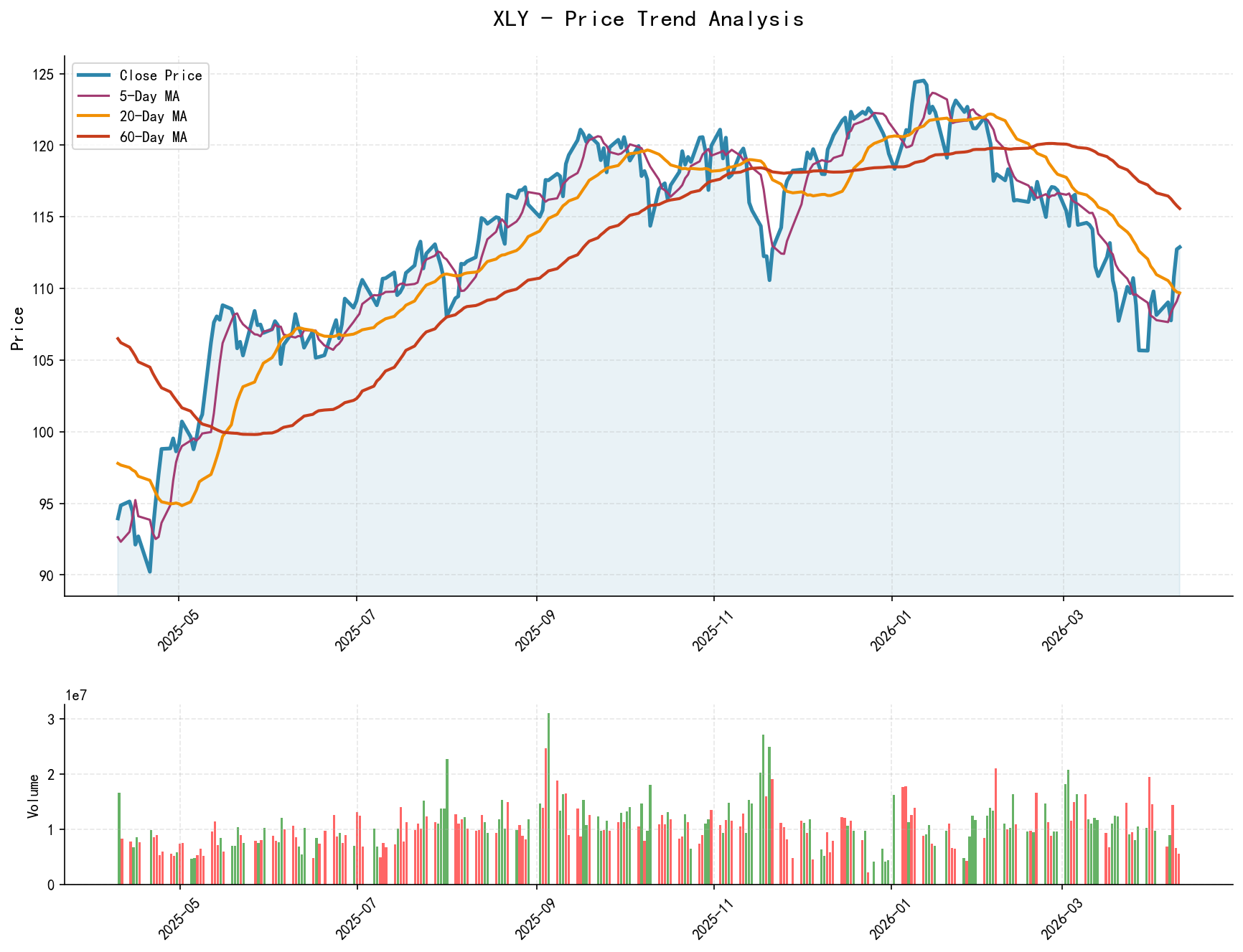
- • Trend Structure: Throughout the analysis period, XLY was in a clear intermediate-term downtrend. The price (CLOSE) declined from 117.55 at the beginning of the period to 112.89 at the end. A bearish alignment is notably prominent: from recent data, the price consistently trades below all major moving averages (MA_5D, MA_10D, MA_20D, MA_30D, MA_60D), with short-term MAs below long-term MAs (e.g., MA_5D 109.70 < MA_20D 109.69 < MA_60D 115.58).
- • Key Turning Points:
- • Late February to Mid-Late March: The price exhibited a smooth decline with moving averages in a perfect bearish divergence, characteristic of a typical Markdown phase.
- • Late March: After hitting the cycle low of 105.68 on March 27th, the price rebounded. On March 31st, a high-volume bullish candlestick appeared (gain of +3.14%, volume of 195 million, 1.69 times the 60-day average). This is a potential Stopping Action signal, suggesting the decline may have temporarily halted.
- • Early April to Present: The price rebounded to 112.89, but the rebound process showed divergence between price and volume (see below). Furthermore, the price touched the MA_30D (111.60) on April 10th and then retreated, indicating the rally encountered supply.
- • Inferred Market Phase: Synthesizing the evidence, the market is likely transitioning from the late stage of Markdown to the early stage of Accumulation. The panic low and massive rebound in late March align with the characteristics of the left side of an accumulation range (panic selling). However, the subsequent rebound lacked sustained high-volume follow-through, suggesting the accumulation process may not yet be complete. The market may enter a phase of consolidating and building a base.
2. Price-Volume Relationship and Supply-Demand Dynamics
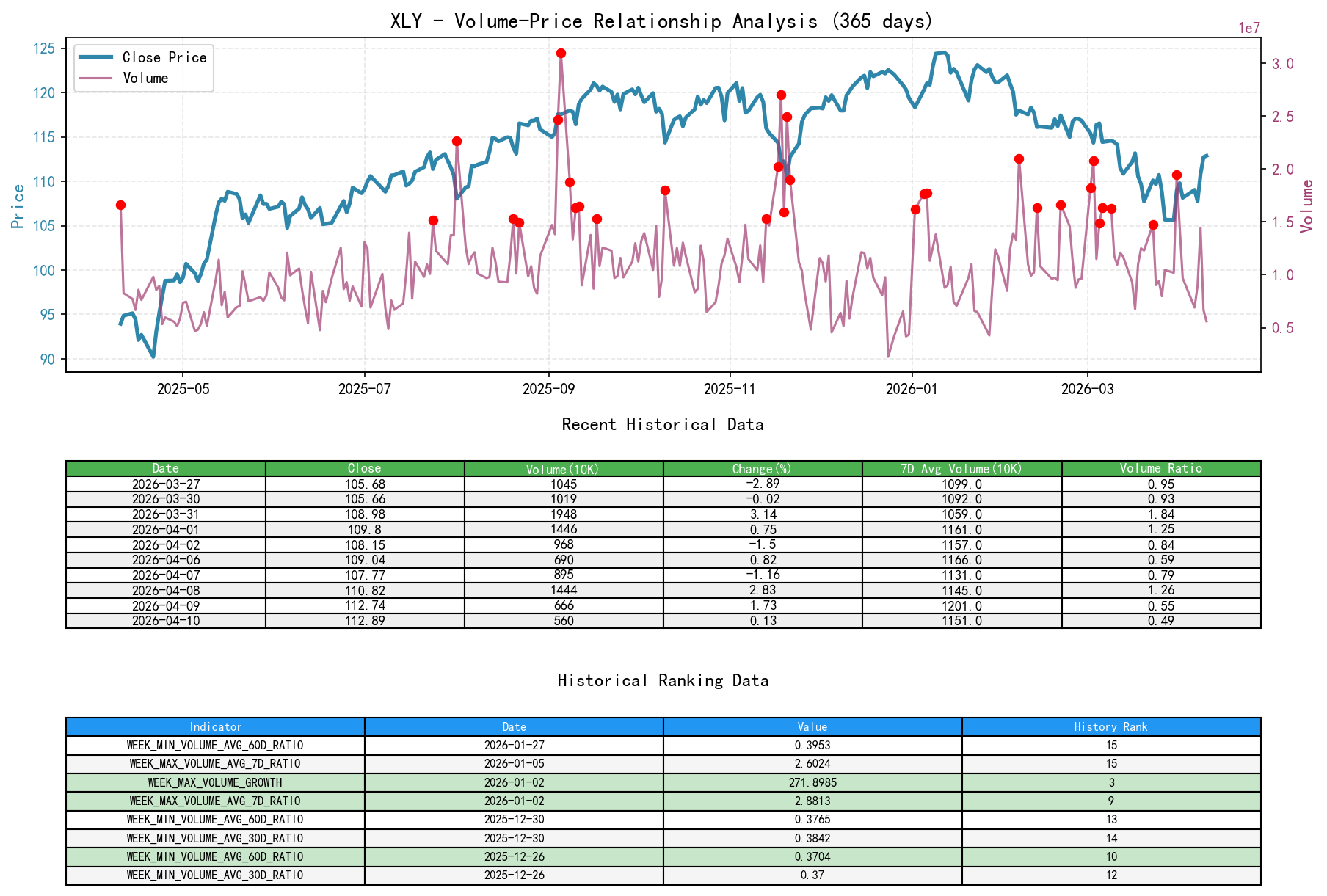
As of 2026-04-10, the underlying asset XLY opened at 113.00, closed at 112.89, volume was 5,606,834, daily change was +0.13%, the 7-day average volume is 11,515,495.43, and the 7-day volume ratio is 0.49.
- • Panic Selling and Preliminary Support:
- • 2026-03-12: Price dropped -2.30% on volume of 121 million (
VOLUME_AVG_60D_RATIO: 1.10). This was a supply-driven decline, but volume was not extremely high. - • 2026-03-20: Price dropped -1.79% on volume of 123 million (
VOLUME_AVG_60D_RATIO: 1.12). Another high-volume decline after consecutive down days, intensifying panic. - • 2026-03-27: Price dropped -2.89% on volume of 105 million. This decline established a new low (105.68).
- • Key Signal: 2026-03-31: Price surged +3.14% accompanied by a massive volume spike to 195 million (
VOLUME_AVG_60D_RATIO: 1.69). This high-volume advance following a series of declines to new lows is defined in Wyckoff theory as "Preliminary Support" or "Large-scale buying after panic selling." It is a strong signal of smart money beginning to intervene, indicating demand beginning to overwhelm supply.
- • 2026-03-12: Price dropped -2.30% on volume of 121 million (
- • Weak Rally and Demand Test:
- • Entering April, prices rebounded but volume contracted significantly.
- • 2026-04-08: Price rose +2.83% on volume of 144 million (
VOLUME_AVG_60D_RATIO: 1.28), which is acceptable. - • 2026-04-09 & 10: Two consecutive up days (+1.73%, +0.13%), but volume plunged sharply to 67 million and 56 million (
VOLUME_AVG_60D_RATIO0.59 and 0.50, respectively). This is a classic low-volume rally, indicating insufficient follow-through demand and casting doubt on the sustainability of the advance. The extremely low-volume small bullish candlestick on April 10th could be a Test to see if supply is exhausted.
- • Supply-Demand Conclusion: The massive bullish candlestick in late March confirmed strong demand at a potential interim bottom. However, the April rally failed to gain confirmation from increasing volume, showing demand is hesitant at current levels. Supply has weakened but not completely disappeared. The market is in a fragile state of supply-demand rebalancing.
3. Volatility and Market Sentiment
As of 2026-04-10, the underlying asset XLY opened at 113.00, the 7-day Parkinson intraday volatility is 0.20 (ratio: 0.94), the 7-day historical volatility is 0.29 (ratio: 0.86), and the RSI is 54.39.
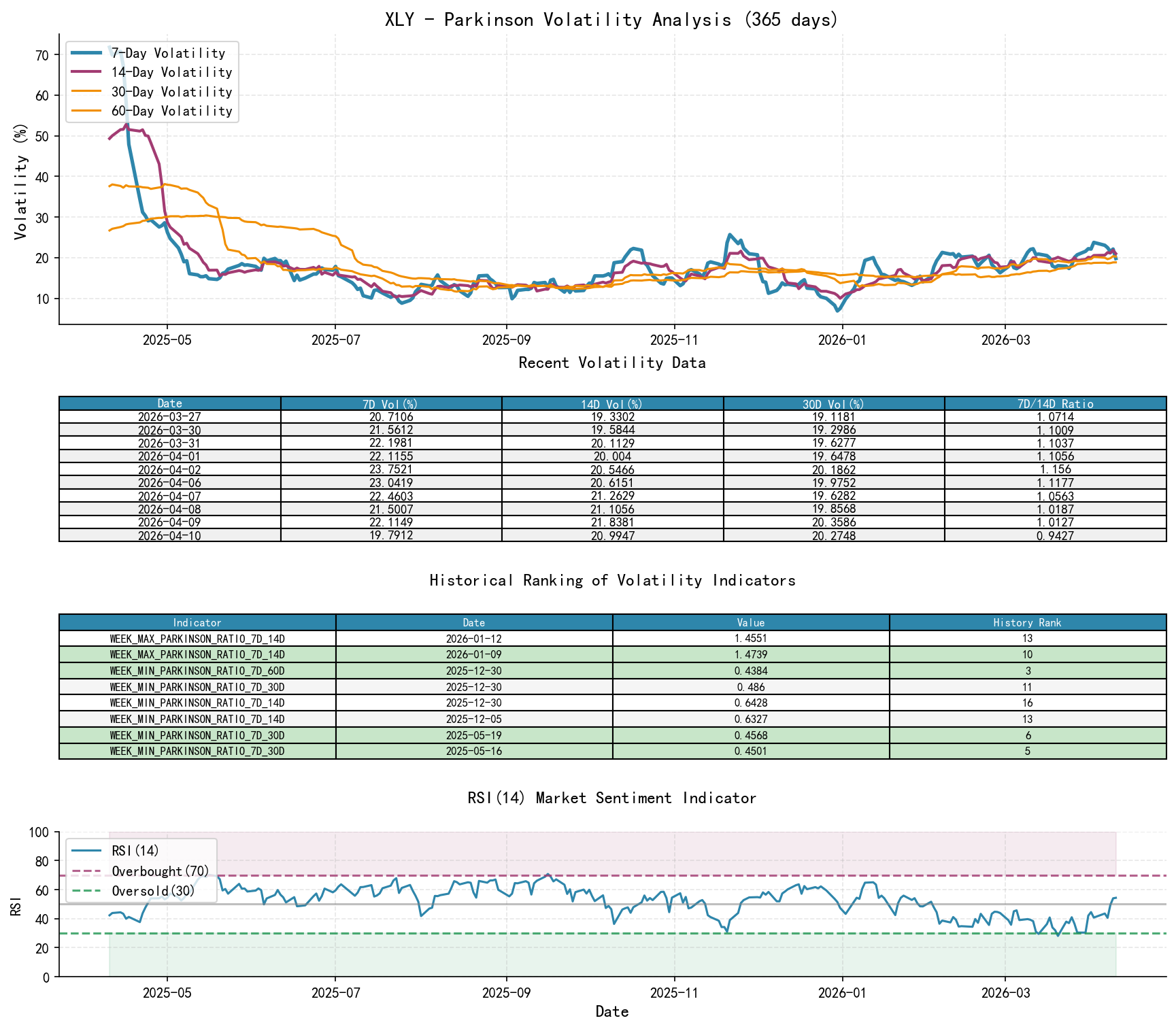
- • Volatility Peak and Panic: Historical volatility (
HIS_VOLA_7D) peaked during the cycle from late March to early April (March 31st: 0.404,HIS_VOLA_RATIO_7D_60D: 1.68). Parkinson intraday volatility (PARKINSON_VOL_7D) also rose synchronously (March 31st: 0.222). This corroborates the panic and confusion in market sentiment observed in late March, aligning with the sharp price drop and massive rebound. - • Volatility Contraction and Sentiment Calming: By the end of the analysis period (April 10th), short-term volatility had declined significantly (
HIS_VOLA_7D: 0.291,PARKINSON_VOL_7D: 0.198). Their ratios to long-term volatility (HIS_VOLA_RATIO_7D_60D: 1.16,PARKINSON_RATIO_7D_60D: 1.05) had also fallen from their highs. This indicates market sentiment has eased from extreme panic into a relatively calm, watchful phase. - • RSI Oversold Condition and Recovery: The RSI_14 dropped below 30 multiple times in mid-to-late March (March 13th: 29.51, March 20th: 28.11), confirming a severe oversold condition. Subsequently, the RSI recovered to 54.39 by April 10th, moving out of the oversold zone but not entering overbought territory, suggesting momentum has recovered but is not overheating.
4. Relative Strength and Momentum Performance
- • Short-Term Momentum Turns Positive: As of April 10th, the weekly return (
WTD_RETURN) is +4.38% and the monthly return (MTD_RETURN) is +3.59%, indicating a strong short-term momentum rebound. - • Intermediate-Term Trend Remains Weak: The quarterly return (
QTD_RETURN) is +3.59%, but the year-to-date return (YTD) remains -5.46%. This shows that despite the recent strong rally, the intermediate-term downtrend has not been completely reversed. The rally still faces pressure from positions trapped since the beginning of the year. - • Momentum Validation: The improvement in short-term momentum is logically consistent with the price rebound from lows, declining volatility, and RSI recovery, collectively pointing to the exhaustion of downward momentum and the initiation of a rebound.
5. Large Investor (Smart Money) Behavior Identification
- • Inferred Accumulation Behavior: The massive long bullish candlestick on 2026-03-31 is a textbook case of smart money behavior. After a prolonged decline to new lows, an exceptionally high-volume advance occurs, which is unlikely driven by retail investors. This strongly suggests large investors were conducting large-scale absorption (Accumulation) at panic prices, their buying absorbing the final wave of panic selling in the market.
- • Subsequent Cautious Behavior: After the significant intervention on March 31st, smart money did not continue to aggressively push prices higher during the April rally (manifested as low volume). This may have two intentions:
- 1. Accumulation Incomplete: They are still utilizing market hesitation to patiently continue gathering shares at current or lower prices, without urgency to drive prices up.
- 2. Testing Supply: They are allowing the price to rally naturally to test for any remaining selling pressure (supply) above. The low-volume minor pullback after touching the moving average on April 10th might be the result of such a test—supply is limited, but demand is also temporarily weak.
- • Current Phase: Based on a comprehensive judgment, large investors have completed the first stage of panic selling absorption and may currently be in a phase of consolidation accumulation or testing, with their behavior shifting from "aggressive buying" to "controlled buying and testing."
6. Support/Resistance Level Analysis and Trading Signals
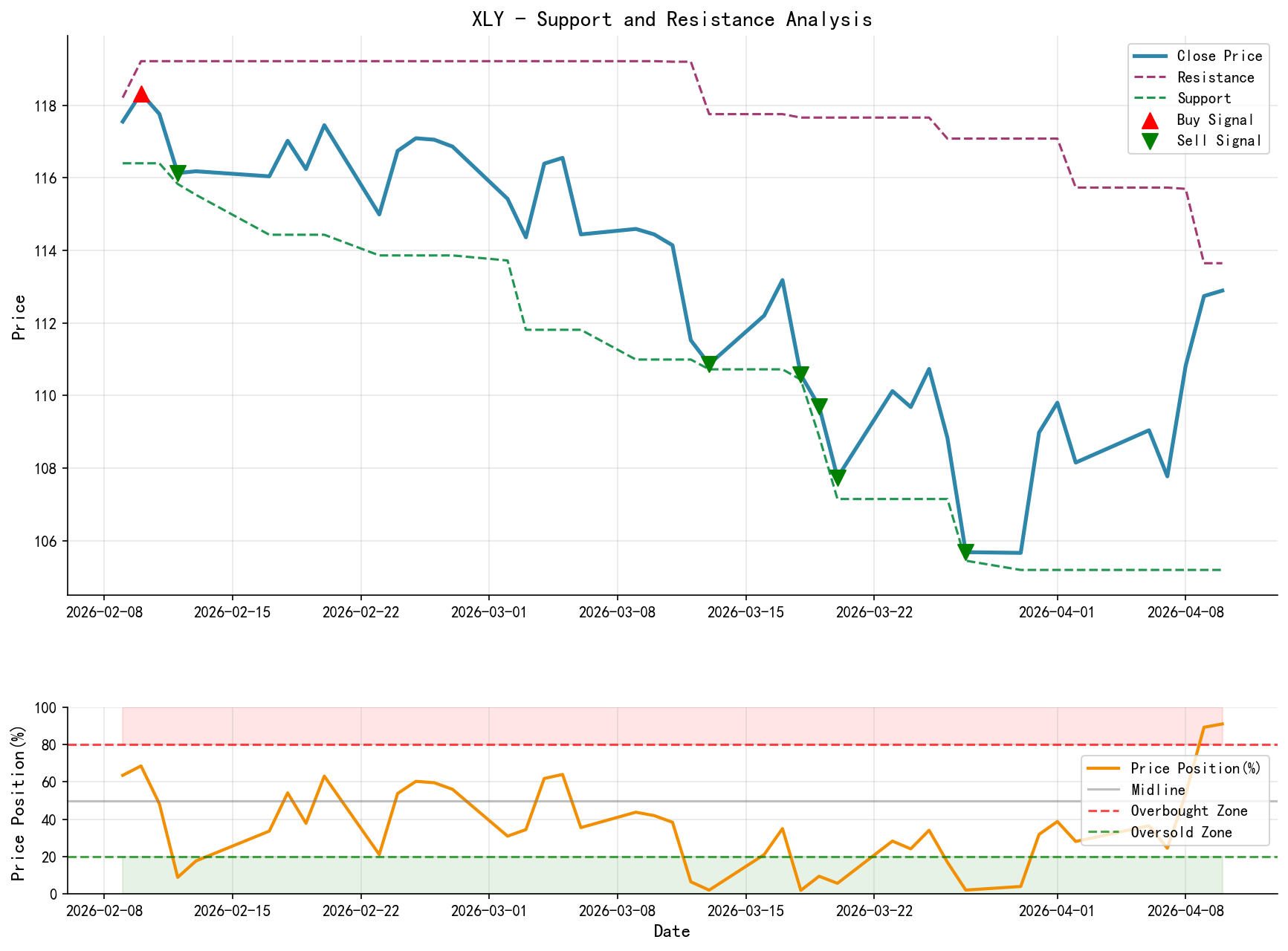
- • Key Support Levels:
- • Primary Support (Accumulation Range Low): 107.74 - 105.68 (the low area from March 20th, 27th, 30th). This area experienced panic selling and massive absorption, forming an important bottom support zone. 105.68 is the ultimate line of defense that must hold.
- • Secondary Support: 110.00 psychological level and recent consolidation platform.
- • Key Resistance Levels:
- • Near-term Resistance: 116.74 (the high from February 24th, also the platform before the breakdown).
- • Dynamic Resistance: MA_30D (currently around 111.60) and MA_60D (currently around 115.58). The price needs to sustainably trade above these moving averages to reverse the intermediate-term trend.
- • Integrated Wyckoff Events and Trading Signals:
- • Current Signal: Neutral to slightly bullish, awaiting confirmation. The market has shown characteristics of the Accumulation phase such as panic, stopping action, and rally testing, but a breakout confirmation has not yet appeared.
- • Bullish Confirmation Signals (Long Triggers):
- 1. High-Volume Breakout: Price advances on high volume (
VOLUME_AVG_60D_RATIO> 1.2) and closes above MA_30D (around 112), ideally breaking through the 116.74 resistance level. - 2. Successful Secondary Test: Price pulls back to the 110-108 support zone, showing significant volume contraction (sign of supply exhaustion), followed by another high-volume advance.
- 1. High-Volume Breakout: Price advances on high volume (
- • Bearish Risk Signals:
- 1. Price breaks down below the key 105.68 support on high volume, indicating accumulation has failed and the downtrend will resume.
- 2. The rally remains low-volume and price breaks below 110 again, indicating demand has completely dried up.
- • Operational Recommendations:
- • Aggressive Approach: Consider testing long positions with light capital if price pulls back to the 110-108 support zone and shows signs of low-volume stabilization. Initial stop-loss should be placed just below 105.60.
- • Conservative Approach: Remain on the sidelines and wait for the aforementioned bullish confirmation signals to appear before entering.
- • Bearish Approach: If price fails to break above MA_30D and shows signs of high-volume stagnation or decline, consider testing short positions with light capital around the 113-116 resistance area, with a stop-loss placed above recent highs.
Conclusion: Following an intermediate-term decline, XLY showed clear signs of smart money accumulation in late March, entering a potential bottom-building phase. However, the subsequent rally has shown weakness due to a lack of volume confirmation, indicating the reversal process will not be straightforward. Traders should closely monitor the defense of the 110-108 support zone and the price-volume relationship during any attempt to break above MA_30D. The current strategy should focus on cautiously positioning for long trades or patiently waiting for clearer breakout signals.
Data Note: This analysis did not utilize historical ranking data as the provided historical_rank_data was an empty array. If relevant data were available, it could further assess the extremity and historical percentile of current indicators like volume and volatility to enhance the statistical significance of the conclusions.
Disclaimer: This report/interpretation is solely for market analysis and research based on public information and does not constitute any investment advice or operational guidance. The author strives for objectivity and impartiality but makes no guarantees regarding its accuracy or completeness. The market carries risks, and investing requires caution. Any investment actions based on this report are undertaken at one's own risk.
Thank you for your attention! Daily Wyckoff price-volume market interpretations are released promptly before the market opens at 8:00. Your comments and shares are highly appreciated. Let's work together to see the market signals clearly.
Member discussion: