Excellent, following your instructions. As a quantitative trading researcher proficient in the Wyckoff Method, I will compose a comprehensive, in-depth quantitative analysis report based on the XLV data you provided.
XLV (Health Care Sector ETF) Wyckoff Quantitative Analysis Report
Product Code: XLV
Analysis Date Range: 2026-02-09 to 2026-04-10
Report Generation Time: 2026-04-11
1. Trend Analysis and Market Phase Identification
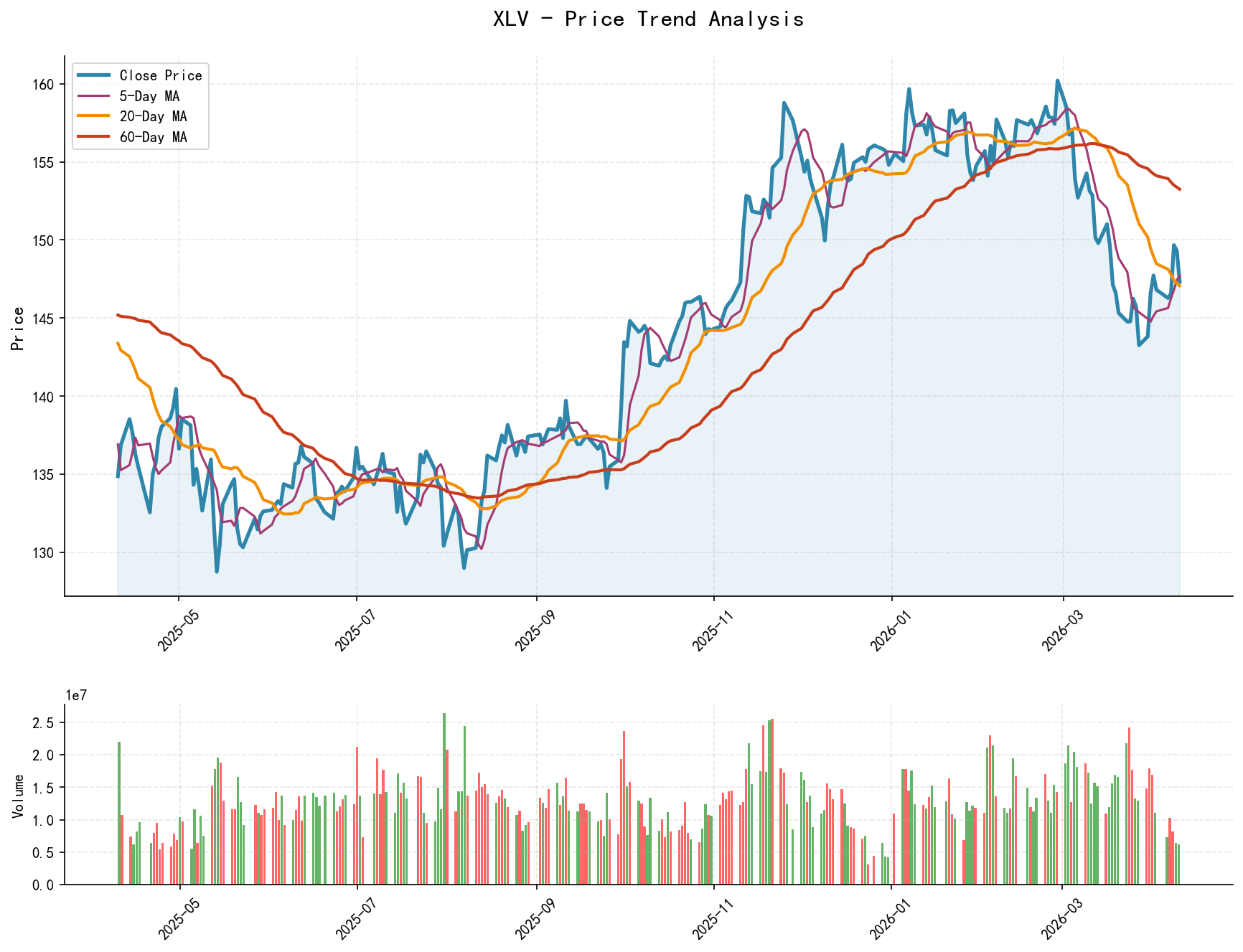
As of 2026-04-10, the underlying asset XLV had an opening price of 149.78, a closing price of 147.31, a 5-day moving average (MA) of 147.73, a 10-day MA of 146.58, a 20-day MA of 147.07, a daily change of -1.35%, a weekly change of 0.34%, a monthly change of 0.48%, a quarterly change of 0.48%, and an annual change of -4.84%.
- • Moving Average Alignment and Trend Direction:
As of the analysis date (2026-04-10), the closing price of 147.31 is below all short-term to long-term moving averages (MA_5D=147.73, MA_10D=146.58, MA_20D=147.07, MA_30D=149.94, MA_60D=153.24). The MA_5D is below the MA_20D, and all moving averages are in a bearish alignment (MA_5D < MA_10D < MA_20D < MA_30D < MA_60D), clearly indicating the market is in a medium-term downtrend. - • Moving Average Crossover Signals:
Since the price broke below all moving averages on 2026-03-05, the MA_5D has consistently remained below the MA_20D, failing to form a valid golden cross. During this period, the MA_5D tested the MA_20D upwards three times (in late March, April 1st, and April 8th), but all attempts failed, with the MA_5D moving away again on April 10th. This confirms the strength and persistent resistance of the downtrend. - • Price Action and Market Phase:
- 1. Distribution Phase Confirmation (Late February): The price reached a historical high of 160.20 on February 27th, ranking first in terms of closing price over the past decade (data-supported), accompanied by high volume (VOLUME_AVG_7D_RATIO=1.075). However, this was immediately followed by heavy-volume declines on March 2nd and 3rd (with volume ranking high historically), which is a classic Wyckoff "distribution" characteristic—the inability to sustain new highs, with smart money distributing holdings during the buying climax.
- 2. Markdown Phase (March to Present): Following the high in early March, the price began a unilateral decline. Although there were rebounds (e.g., March 31st), they were capped by the MA_20D and accompanied by low volume, indicating weak rallies.
- 3. Potential Proximity to Panic Phase (Late March): From March 20th to 27th, the price accelerated its decline, volume remained relatively high, but the price range narrowed, exhibiting characteristics of panic selling. Combined with historical rankings, the trading volume on March 24th ranked the 12th highest, indicating significant transfer of holdings during the rapid decline, potentially signaling a concentrated release of selling pressure.
- • Conclusion: The market is currently in a clear markdown phase following distribution. The trend structure is bearish, and the current price has retreated significantly from its historical high. The market is searching for a supply-demand equilibrium downward, with signs suggesting it may be approaching, but has not yet completed, a panic selling phase.
2. Volume-Price Relationship and Supply-Demand Dynamics
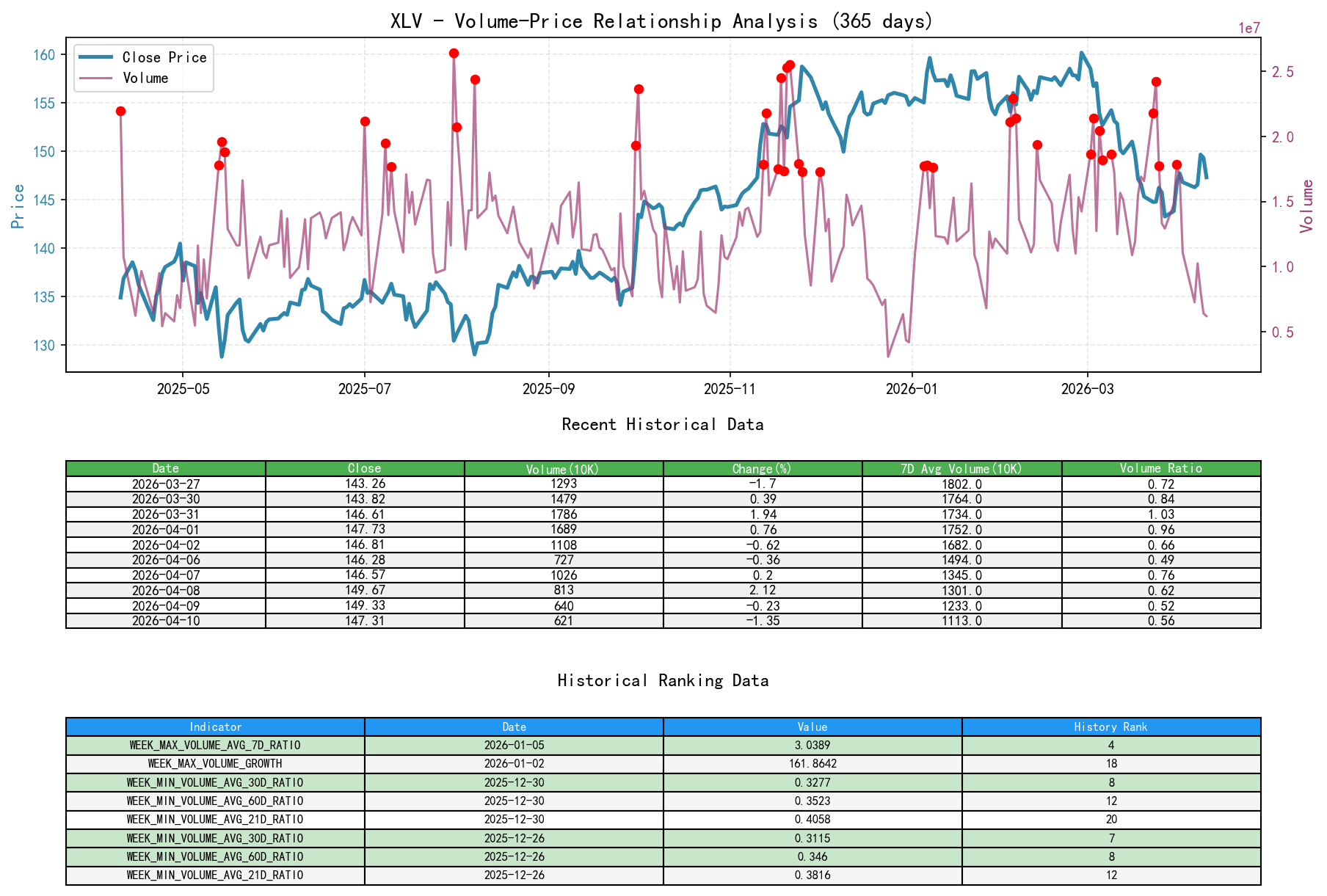
As of 2026-04-10, the underlying asset XLV had an opening price of 149.78, a closing price of 147.31, a volume of 6,212,760, a daily change of -1.35%, a volume of 6,212,760, a 7-day average volume of 11,132,330.43, and a 7-day volume ratio of 0.56.
- • Key Day Volume-Price Analysis:
- • February 27th (High Point Day): High-volume advance (+1.77%, VOLUME_AVG_7D_RATIO=1.075). This was the buying climax, raising concern about whether it represented the final concentrated release of demand.
- • March 2nd-3rd (Reversal Days): Consecutive high-volume, sharp declines (volume ranked high). This is a signal of overwhelming supply dominance, confirming the distribution judgment. Notably on March 3rd, a sharp price drop against the backdrop of historically high trading volume (ranked 10th) is a strong bearish signal.
- • March 23rd-24th (Mid-Downturn): Price consolidated at low levels with unusually high volume (VOLUME_AVG_30D_RATIO>1.45). This is a typical manifestation of panic selling, with a large influx of supply.
- • March 31st (Rebound Day): High-volume advance (+1.94%, VOLUME_AVG_14D_RATIO=1.137), initially showing demand attempting to enter and absorb, but the subsequent rally failed to sustain.
- • April 8th (Recent High): High-volume advance (+2.12%, VOLUME_AVG_7D_RATIO=0.625), but the absolute volume was significantly lower compared to the earlier panic days, suggesting limited demand strength.
- • April 9th-10th (Pullback Days): Consecutive low-volume declines (VOLUME_AVG_7D_RATIO only 0.52 and 0.56 respectively), indicating that demand quickly vanished after the rebound, and while supply was not strong, it was sufficient to push prices lower.
- • Supply-Demand Dynamics Conclusion:
Supply has been overwhelmingly dominant since early March. The panic selling in late March exhausted significant selling pressure. Recent (April) rebounds show a "divergence between price and volume"—insufficient volume on rallies, and declines accompanied by low volume, suggesting the decline is more due to exhaustion of demand rather than active selling pressure. The market is overall in a demand vacuum period following supply dominance.
3. Volatility and Market Sentiment
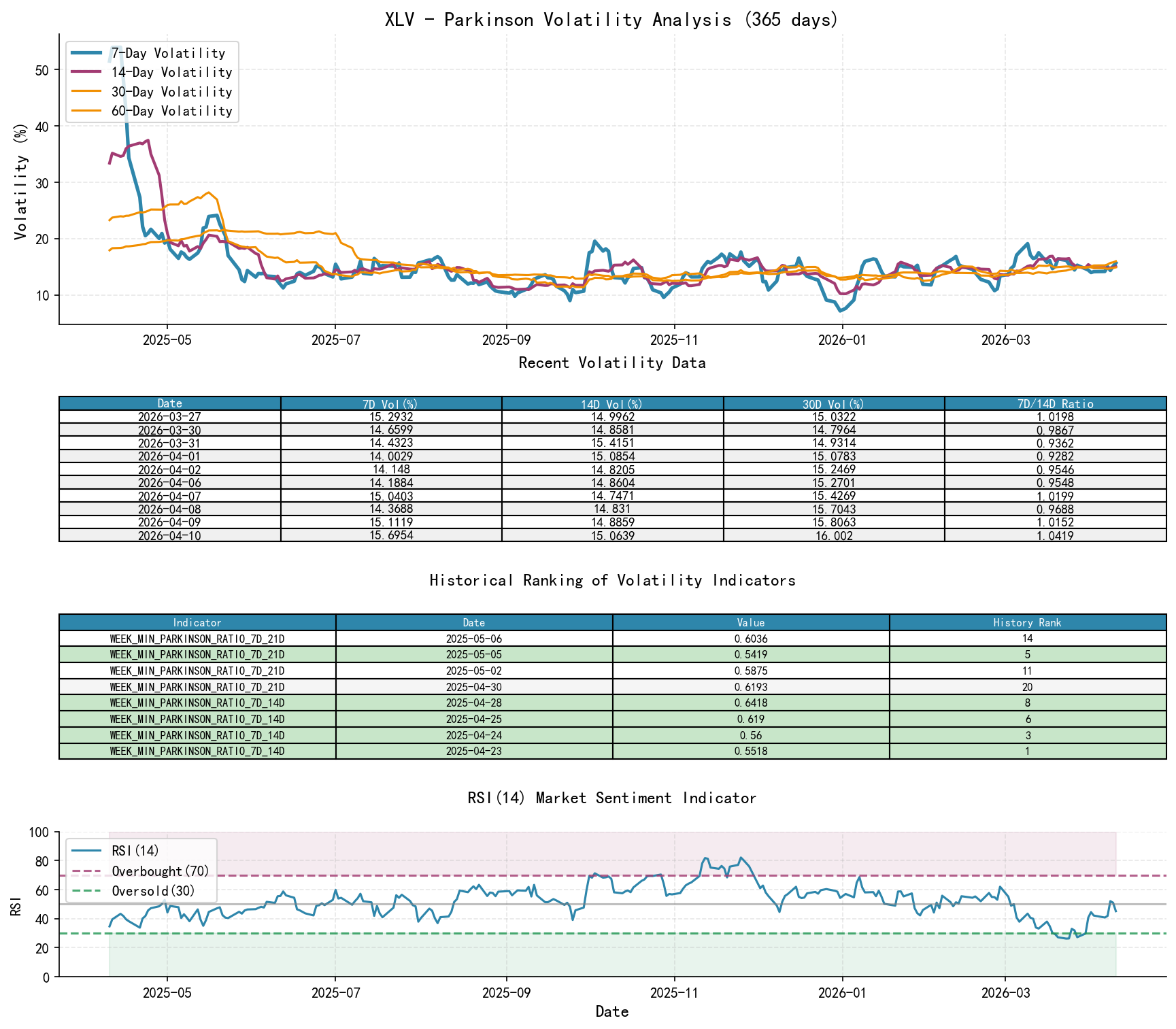
As of 2026-04-10, the underlying asset XLV had an opening price of 149.78, a 7-day intraday volatility of 0.16, a 7-day intraday volatility volume ratio of 1.04, a 7-day historical volatility of 0.21, a 7-day historical volatility volume ratio of 1.02, and an RSI of 45.16.
- • Volatility Levels and Changes:
- • Historical Volatility (HIS_VOLA) and Parkinson Volatility were at relatively high levels from late February to early March (price top area), indicating market nervousness.
- • During the sharp drop on March 5th-6th, short-term volatility spiked sharply (HIS_VOLA_RATIO_7D_60D reached 1.357 and 1.368), far exceeding the long-term average, which is a quantitative expression of panic sentiment and trend acceleration.
- • Entering late March to early April, although prices continued to fall, the short-term volatility ratio (HIS_VOLA_RATIO_7D_60D) retreated from its peak to the 1.1-1.2 range, and the Parkinson ratio also converged, indicating some easing of panic sentiment, with the market possibly entering a gradual decline mode.
- • RSI Overbought/Oversold Verification:
- • On February 27th, RSI_14 reached 62.07, approaching but not reaching extreme overbought (70). Combined with high-volume stagnation, this served as a top warning.
- • On March 20th, RSI_14 hit a low of 27.16, entering oversold territory, aligning with the timing of the price acceleration and panic selling, validating extreme sentiment.
- • The current (April 10th) RSI_14 is 45.16, in a neutral-to-weak zone, showing market sentiment has recovered somewhat from extreme pessimism, but no strong oversold rebound momentum has emerged.
- • Conclusion: The market has gone through a process from "high volatility tension at the top" to "panic-driven high volatility during the decline", to the current "converging volatility during a gradual decline". Sentiment indicators (RSI) show selling pressure has retreated from its peak, but strong buying sentiment has not emerged.
4. Relative Strength and Momentum Performance
- • Periodic Return Analysis:
- • Short-term (WTD): The week-to-date return as of April 10th was 0.34%, a slight positive, related to the April 8th rebound, but momentum has weakened.
- • Medium-term (MTD/QTD/YTD): Month-to-date (MTD) return is 0.48%, quarter-to-date (QTD) is 0.48%, year-to-date (YTD) is -4.84%. The data clearly shows that the strong upward momentum from early in the year (February) has been completely reversed by the deep decline in March, with medium-term momentum turning negative.
- • Long-term (TTM): The past 12-month return remains positive (9.21%), but has significantly retreated from the February high, indicating the long-term uptrend is facing a severe test.
- • Momentum Conclusion:
Short-term momentum has slightly recovered due to a technical rebound, but the medium-term momentum structure has clearly weakened. The market has rapidly switched from a strong upward momentum state to a downward momentum state, currently in a weak consolidation phase after the decline, lacking clear upward momentum.
5. Large Investor ("Smart Money") Behavior Identification
Based on Wyckoff principles and the above volume-price and volatility analysis, the operational intentions of large investors can be inferred:
- 1. Distribution at High Levels (Late February - Early March): Around the time of the historical high (160.20), they attracted public buyers through the "buying climax" while conducting large-scale distribution themselves. The heavy-volume plunge on March 2nd-3rd is clear evidence of their completed distribution and shift to active shorting. Historical ranking data (high trading volume) supports the scale of this distribution.
- 2. Guiding the Decline and Testing Demand (March): After completing distribution, large investors guided prices downward through sustained selling pressure. During the panic selling in late March (high volume, low price), they may have covered some short positions and tested the strength of demand below. The results showed that despite retail panic selling, no strong institutional buying support emerged.
- 3. Lack of Active Accumulation (April to Present): The recent weak rebound (April 8th) and subsequent low-volume decline (April 9th-10th) indicate that large investors are not conducting active, sustained accumulation at this price level. They are likely observing, waiting for better prices (lower support levels) or clearer panic signals to begin the next accumulation cycle.
- • Core Inference: The smart money has successfully completed distribution at high levels and is guiding a downtrend. They are currently in a wait-and-see or mildly shorting state and have not yet initiated large-scale long positions on the other side. The market awaits the "accumulation" phase, which requires a signal of "strong absorption following panic selling", which has not yet appeared.
6. Support/Resistance Level Analysis and Trading Signals
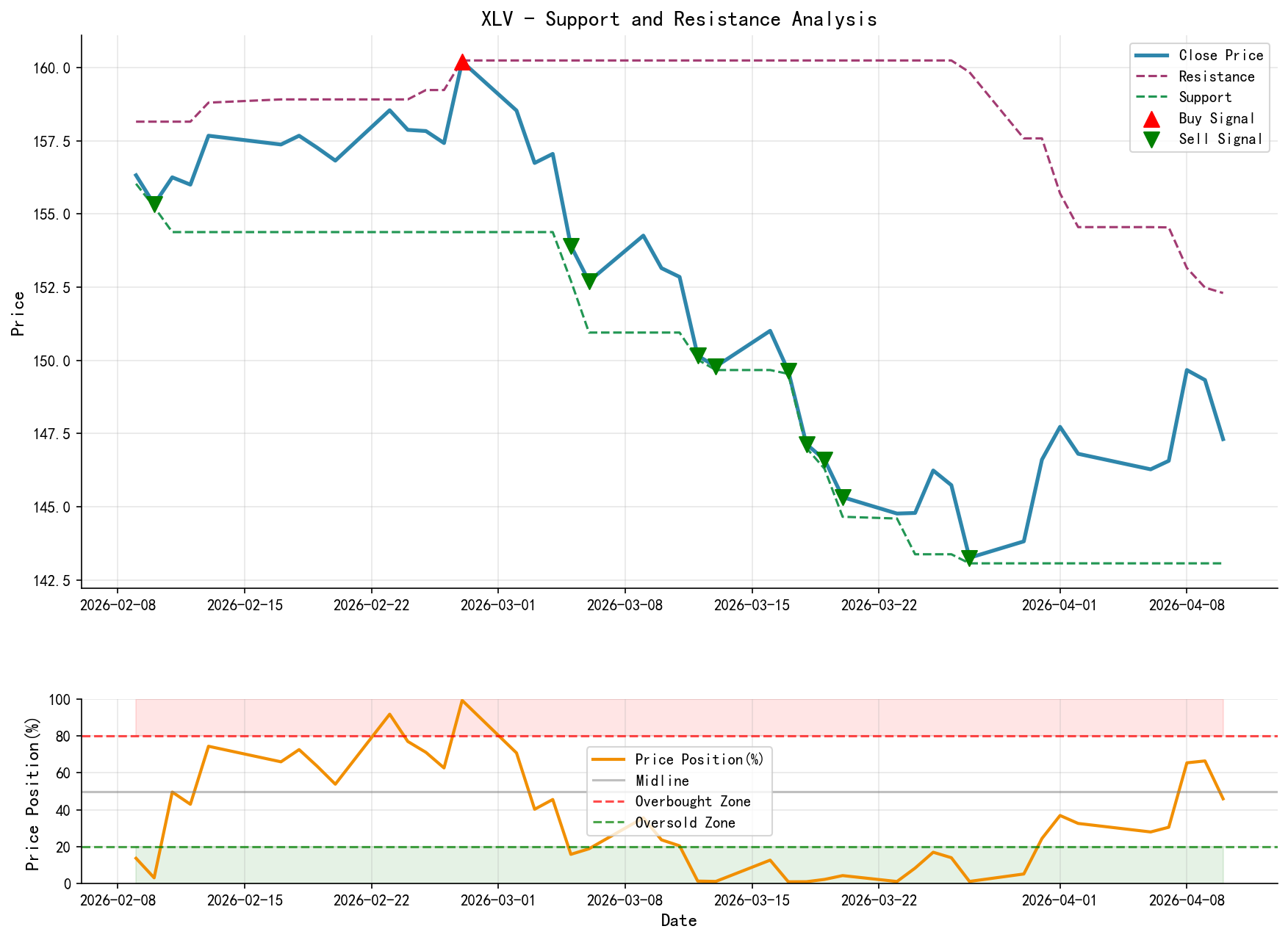
- • Key Levels:
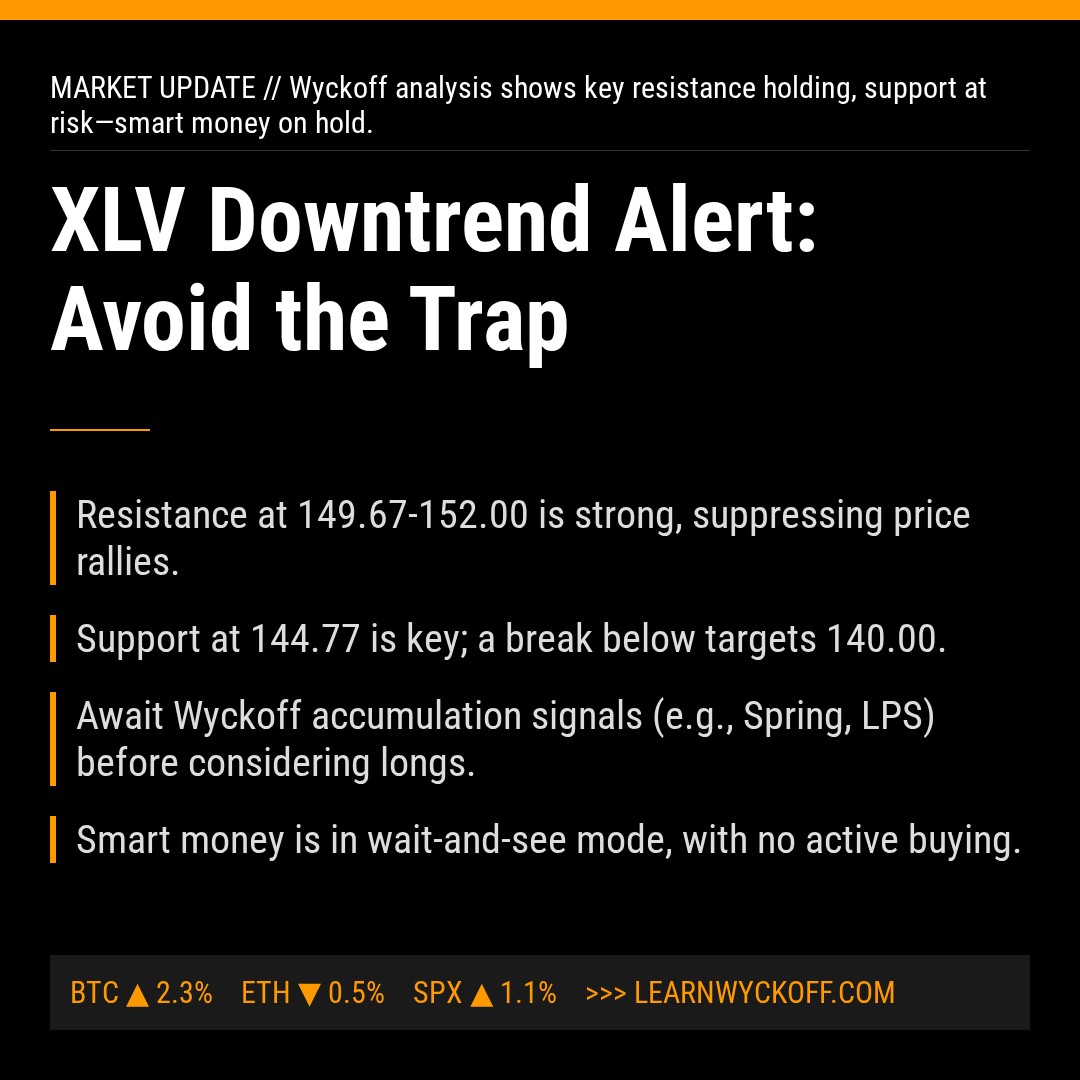
- • Resistance Levels (Supply Zone): 149.67 (April 8th high, recent rally peak); 152.00 (psychological barrier and lower boundary of the mid-March consolidation zone); stronger resistance at 156.00-157.00 (former support turned resistance, coinciding with MA_30D).
- • Support Levels (Demand Test Zone): 144.77 (March 23rd low, recent panic low, key observation level). A break below would target the next support at the 140.00 psychological level.
- • Historical Ranking Perspective: The current price of 147.31 is far below the top-ranked high zone of the past decade (157-160), but still some distance from confirming a historically significant bottom (which would require breaking below multi-year support), currently positioned in the middle-to-later stage of a medium-term downtrend.
- • Comprehensive Wyckoff Trading Signal:
- • Primary View: Bearish/Watchful. The market is in a markdown phase post-distribution, the medium-term trend is down, and smart money shows no intention of active buying.
- • Specific Operational Recommendations:
- 1. Aggressive Short-Sellers: Consider shorting with light positions if the price rebounds near the 149.00-149.67 resistance zone and shows signs of rally fatigue with low volume. Set stop-loss above 150.50. Target the 144.77 support level.
- 2. Cautious Investors/Potential Longs: Remain watchful, awaiting accumulation signals. Avoid blindly buying the dip in a downtrend. Closely monitor the test of the 144.77 support level.
- 3. Key Validation Points (Conditions for a Bullish Signal): Future observation needs to show, after testing or slightly breaking the 144.77 support, the emergence of a "high-volume stopping decline bullish candle" or a "Spring" (brief dip below support followed by a quick recovery), followed by low-volume retest that does not make a new low (Last Point of Support, LPS), accompanied by steadily increasing volume breaking above the downtrend line or key moving average (e.g., MA_20D). This would be preliminary evidence of large investors beginning accumulation.
- 4. Risk Warning: If the price breaks below 144.77 on high volume effectively, it would signify a continuation of the downtrend, potentially initiating a new wave of panic selling, with the next target at 140.00. All bullish hypotheses should be postponed.
Summary: Following a rally to historical highs, XLV has confirmed entry into a medium-term downtrend guided by large investor distribution. Current market sentiment is weak, demand is insufficient, and smart money is in a wait-and-see state. Trading strategies should primarily favor following the bearish trend or patiently watching, with a focus on observing whether a Wyckoff structure transitioning from "panic" to "accumulation" forms near the previous low of 144.77. Before clear accumulation signals appear, initiating medium-term long positions is not recommended.
Disclaimer: This report/analysis is solely market analysis and research based on publicly available information and does not constitute any investment advice or operational guidance. The author strives for objectivity and impartiality but makes no guarantees regarding accuracy or completeness. The market carries risks; investment requires caution. Any investment actions based on this report are taken at one's own risk.
Thank you for your attention! Wyckoff Volume-Price Market Interpretations are published daily at 8:00 AM before the market opens. Your comments and shares are greatly appreciated. Your recognition is crucial. Let's work together to see the market signals.
Member discussion: