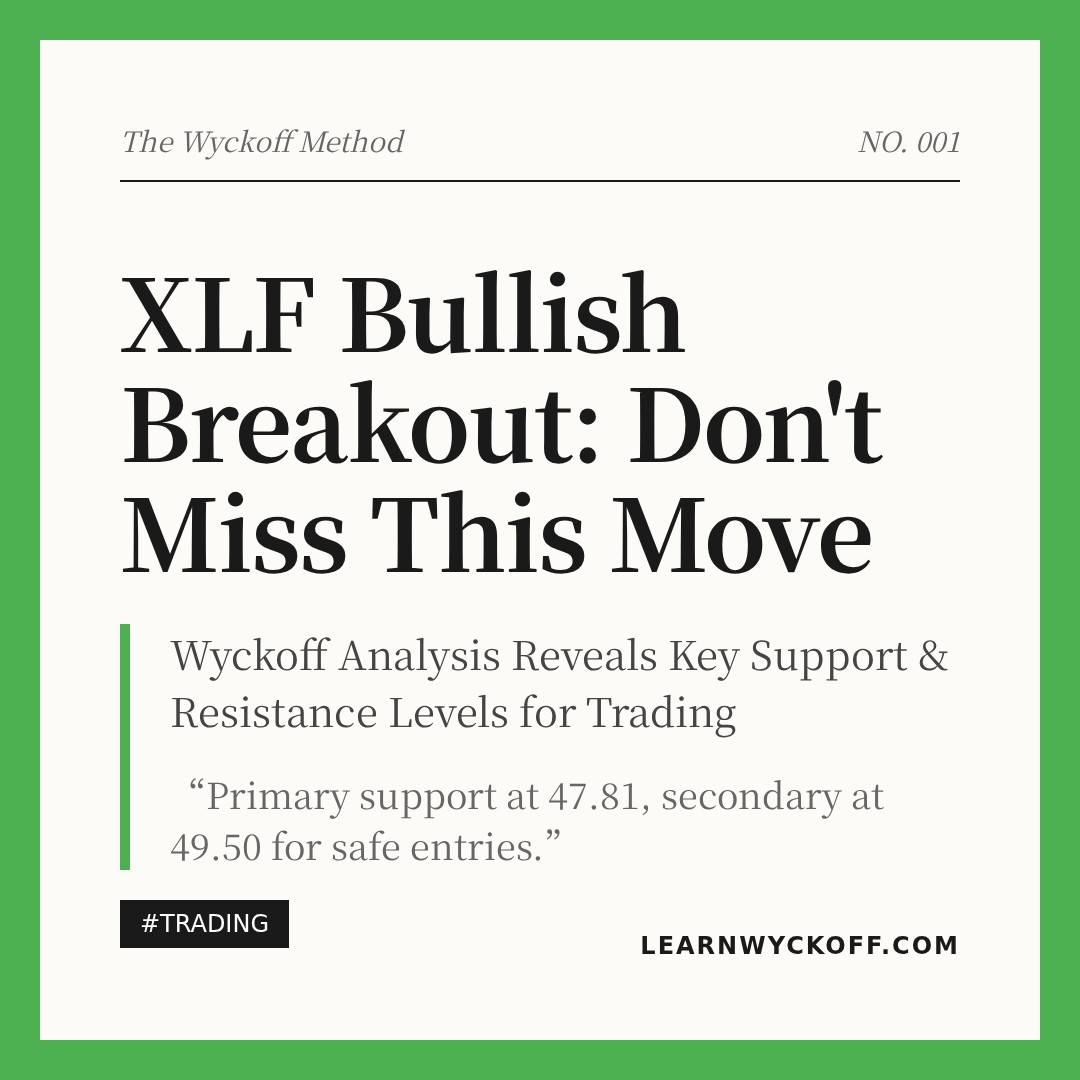
XLF Quantitative Analysis Report (Based on the Wyckoff Method)
Product Code: XLF (Financial Select Sector SPDR Fund)
Analysis Period: 2026-02-09 to 2026-04-10
Report Generation Time: 2026-04-11
Analyst: Quantitative Trading Researcher
I. Trend Analysis and Market Phase Identification
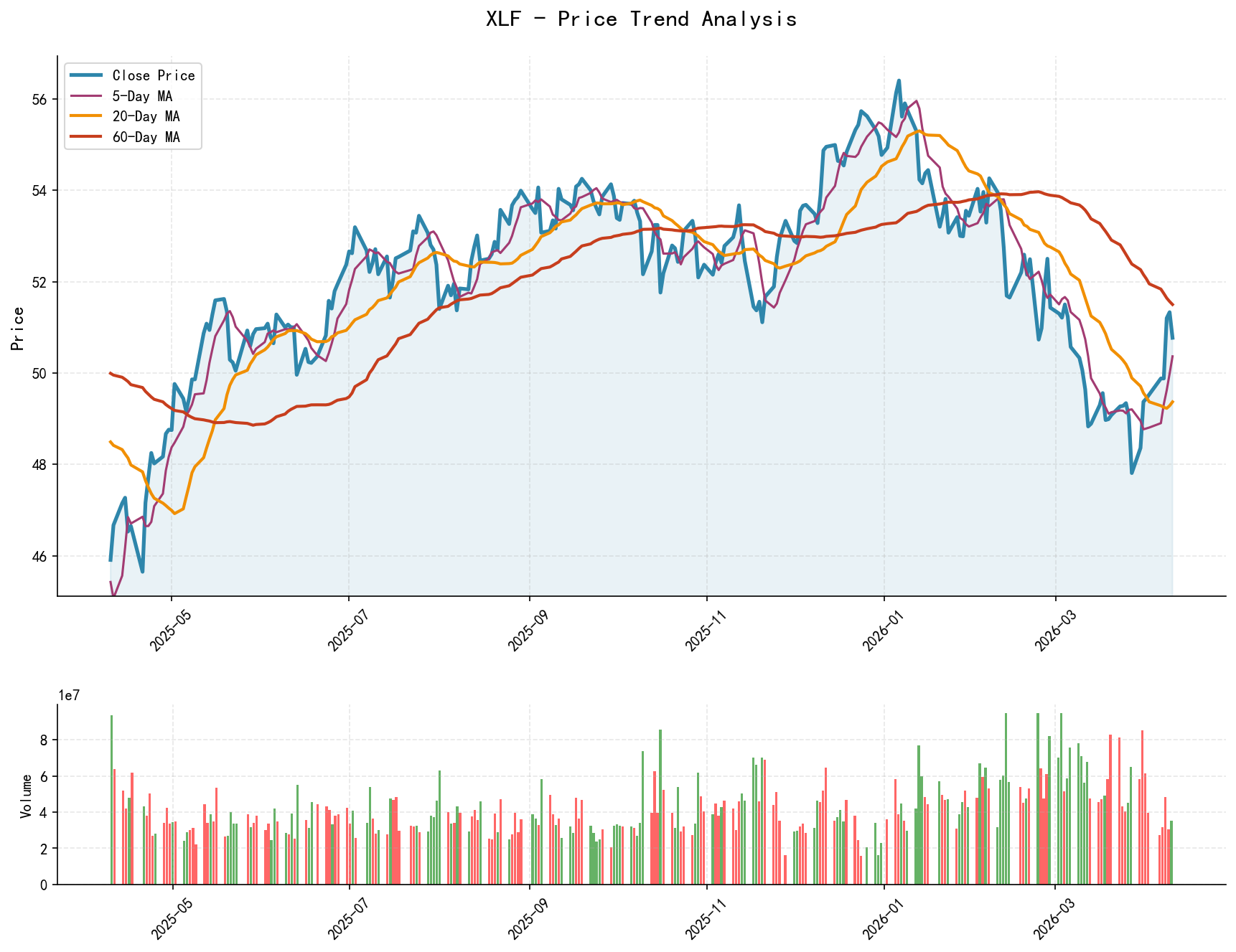
As of April 10, 2026, the target XLF had an opening price of 51.23, a closing price of 50.77, a 5-day moving average of 50.36, a 10-day moving average of 49.59, a 20-day moving average of 49.37, a daily change of -1.09%, a weekly change of 2.50%, a monthly change of 2.84%, a quarterly change of 2.84%, and a yearly change of -7.30%.
- 1. Moving Average Alignment and Trend Structure:
- • Initial Decline Phase (Feb 9 - Feb 27): Price (CLOSE) declined continuously from51.43. During this period, MA_5D, MA_10D, MA_20D, MA_30D, MA_60D formed a bearish alignment (Price < MA_5D < MA_10D ...), with all MAs pointing downwards, confirming a strong downtrend.
- • Accelerated Bottoming and Consolidation Phase (Feb 23 - Mar 27): Price experienced a sharp single-day plunge (-3.35%) to47.81 on Mar 27. In this phase, short-to-medium-term MAs (MA_5D, MA_10D, MA_20D) continued to suppress price, while MA_60D remained relatively high and flat, indicating long-term trend pressure but not a collapse.
- • Trend Reversal and Initial Rebound (Mar 30 - Apr 10): Price saw a significant high-volume rebound (+2.09%) on Mar 31. MA_5D began to cross above MA_10D (after Apr 2). By the end of the analysis period (Apr 10), price (50.36) and MA_10D (49.37) and MA_30D ($49.90). The current moving average structure indicates that the short-term downtrend has halted, and the market is entering the initial stage of transition from a bearish to a bullish alignment.
- 2. Market Phase Inference (Wyckoff Perspective):
- • February: Distribution & Markdown: Price began its decline from the relatively high level of $54.39, accompanied by intermittent high volume (e.g., Feb 10, 12), consistent with the characteristics of "Distribution" followed by the "Markdown" phase.
- • Mid-to-Late March: Panic Selling & Preliminary Support: From Mar 6 to Mar 27, price continuously made new lows, with volume remaining high on down days (VOLUME_AVG_30D_RATIO often > 1). Particularly on Mar 12 (high-volume decline of -1.63%) and Mar 27 (high-volume decline of -2.53%), these are classic signs of a Selling Climax (SC), often signaling exhaustion of downward momentum.
- • Late March to Early April: Automatic Rally & Secondary Test: The high-volume bullish candle on Mar 31 (volume 85.36M, VOLUME_AVG_30D_RATIO=1.39) can be viewed as the "Automatic Rally (AR)". Subsequent days saw a minor price pullback without making new lows, accompanied by contracting volume (e.g., VOLUME_AVG_30D_RATIO=0.63 on Apr 2), forming a "Secondary Test (ST)" of the previous low area around $47.81, with the test showing diminishing supply.
- • Current Assessment: XLF is likely in the latter stages of the Wyckoff "Accumulation phase". Key events such as the Selling Climax (SC), Automatic Rally (AR), and Secondary Test (ST) have already appeared. The market is accumulating energy for a potential subsequent uptrend.
II. Volume-Price Relationship and Supply-Demand Dynamics
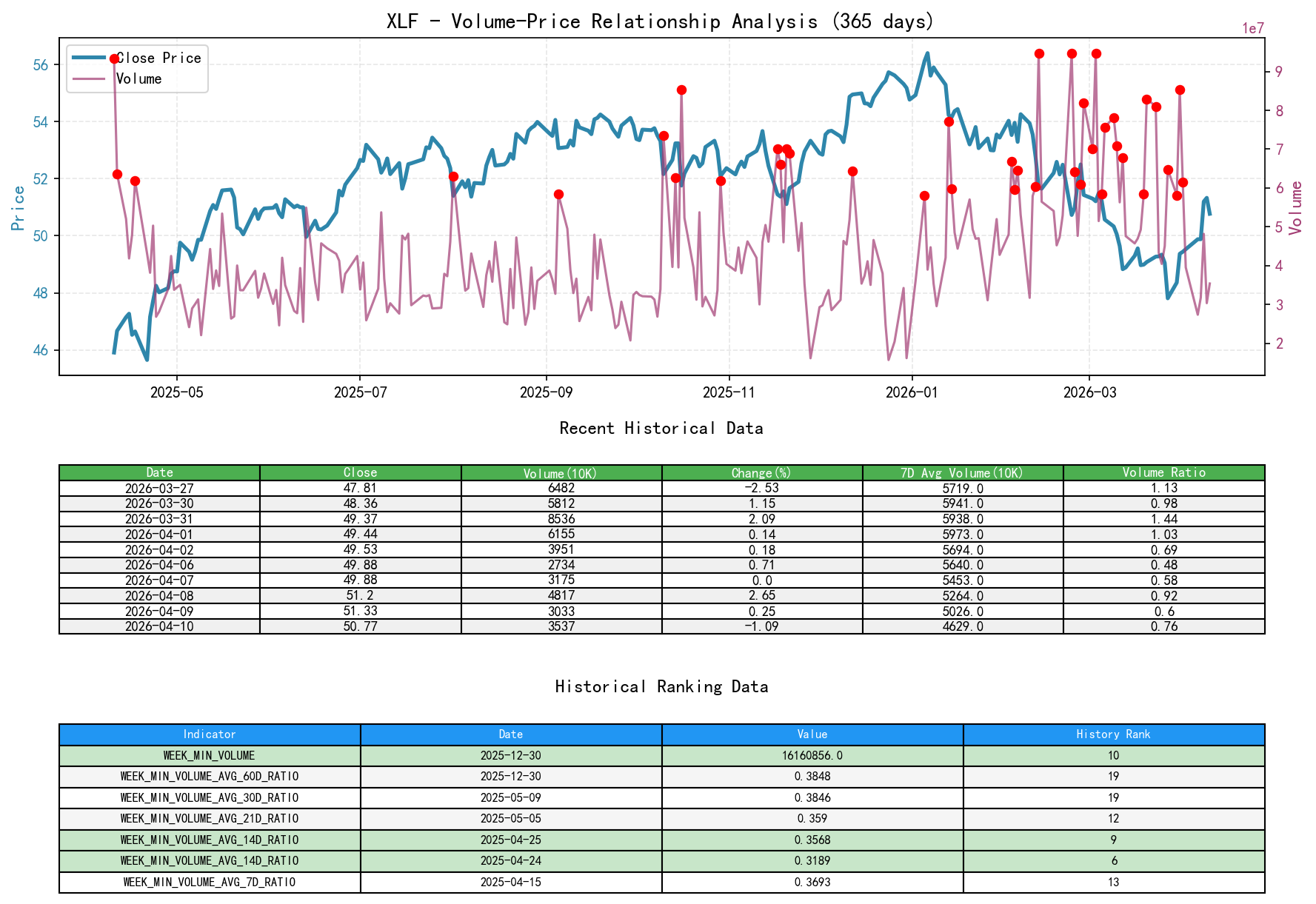
As of April 10, 2026, the target XLF had an opening price of 51.23, a closing price of 50.77, a volume of 35377575, a daily change of -1.09%, a volume of 35377575, a 7-day average volume of 46291693.43, and a 7-day volume ratio of 0.76.
- 1. Key Day Analysis:
- • Supply-Dominated Days (Expanding Supply):
- • 2026-02-12: Price declined -1.99%, volume surged to 94.65M (VOLUME_AVG_30D_RATIO=2.02). A high-volume decline clearly indicates absolute dominance of supply. Historical ranking shows the trading volume ranked 18th highest in the past decade, confirming this was a major selling event.
- • 2026-02-23: Price plunged -3.35%, volume was 94.60M (VOLUME_AVG_30D_RATIO=1.84), another wave of panic supply release.
- • 2026-03-27: Price declined -2.53%, volume was 64.82M (VOLUME_AVG_30D_RATIO=1.04), representing the final wave of supply at the tail end of the decline.
- • Demand-Dominated Days (Expanding Demand):
- • 2026-03-31: Price increased +2.09%, volume was 85.36M (VOLUME_AVG_30D_RATIO=1.39). High-volume advance occurring after a prolonged decline at a low level is a strong signal of active demand entry, possibly a "scramble for shares".
- • 2026-04-08: Price increased +2.65%, volume was 48.18M (VOLUME_AVG_30D_RATIO=0.81). Price broke through the $50 psychological level; volume was not extremely high but above the recent average, indicating demand was in control.
- • Supply Exhaustion / Insufficient Demand Days:
- • 2026-04-02, 04-06, 04-07: Price rose slightly or remained flat, but volume was significantly below the 30-day average (RATIO between 0.43-0.63). This is a typical "low-volume rebound", indicating either insufficient follow-up demand in the early stages of the rebound or a temporary pause in selling pressure.
- • Supply-Dominated Days (Expanding Supply):
- 2. Supply-Demand Dynamics Summary:
- • February to Mid-March: Market dominated by persistent supply. Every bounce met with greater selling pressure (high-volume declines).
- • Late March: A turning point emerged. The Panic Selling (Mar 27) exhausted the last of the long stop-loss orders and shares held by weak holders, clearing the way for demand entry.
- • Early April to Present: Demand has begun to appear and gain local control. Manifested as: 1) Contracting volume during the Secondary Test (diminishing supply); 2) Mildly expanding volume accompanying the breakout of key levels (demand participation). However, the strength of demand is not yet stable, as seen in low-volume rebounds.
III. Volatility and Market Sentiment
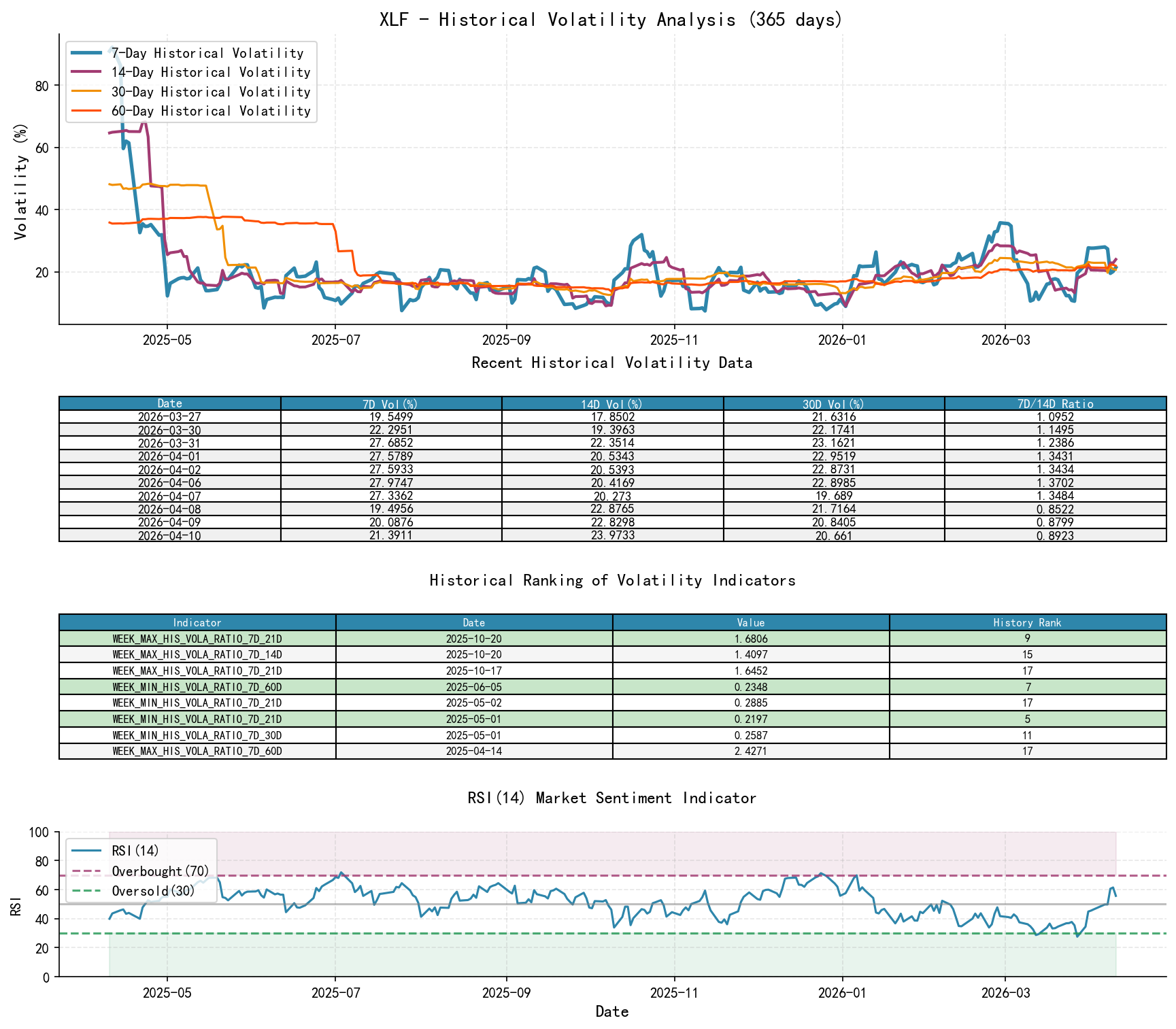
As of April 10, 2026, the target XLF had an opening price of 51.23, a 7-day intraday volatility of 0.16, a 7-day intraday volatility ratio of 0.91, a 7-day historical volatility of 0.21, a 7-day historical volatility ratio of 0.89, and an RSI of 55.73.
- 1. Volatility Levels and Changes:
- • Panic Period (Late February to Early March): Short-term volatility spiked sharply. For example, on Feb 27, HIS_VOLA_7D (0.357) far exceeded HIS_VOLA_60D (0.207), with a ratio as high as 1.72; the Parkinson volatility ratio was 1.41. This clearly signaled market panic and heightened uncertainty.
- • Volatility Convergence Period (Late March to Early April): Entering April, short-term volatility (HIS_VOLA_7D: 0.214, PARKINSON_VOL_7D: 0.161) has fallen significantly, with ratios close to 1 relative to long-term volatility (HIS_VOLA_60D: 0.219, PARKINSON_VOL_60D: 0.176). The convergence of volatility from extreme highs typically indicates a subsiding of panic, with the market entering a new equilibrium or a consolidation phase before a new trend initiates.
- 2. Sentiment Indicator (RSI) Validation:
- • RSI_14 dropped into the oversold zone below 30 (lowest 28.72) at key lows such as Feb 23, Mar 12, and Mar 27, resonating with the volatility spike and high-volume declines, confirming extreme pessimism.
- • The current RSI_14 (Apr 10) is 55.73, having moved out of the oversold zone into a neutral-to-strong area, indicating market sentiment has recovered from extreme pessimism, providing an emotional foundation for potential further gains.
IV. Relative Strength and Momentum Performance
- 1. Momentum Trends:
- • Weak Mid-Term Momentum: QTD_RETURN and YTD were mostly negative throughout the analysis period, reaching as low as -12.71% (Mar 27), confirming the mid-term downtrend.
- • Significant Improvement in Short-Term Momentum: WTD_RETURN and MTD_RETURN turned positive in late March. As of Apr 10, MTD_RETURN was +2.84%, and WTD_RETURN was +2.50%. Short-term momentum has reversed upwards, consistent with the conclusions of price breaking above short-term MAs and RSI recovery.
- • Conclusion: XLF's short-term momentum has become significantly stronger than its mid-term momentum, indicating positive internal structural changes in the market. This is an early signal of strengthening from weakness.
V. Large Investor ("Smart Money") Behavior Identification
Based on Wyckoff principles and the volume-price analysis above, inferences about smart money behavior are as follows:
- 1. Distribution and Shakeout (February - Early March): High volume during the initial decline could indicate smart money distribution in the52 range. The sharp plunges on Feb 23, Mar 12, etc., accompanied by extreme volume, more likely represent a composite event—including both panic selling by retail investors (Selling Climax) and orderly absorption of that panic by smart money at low levels. The historically high trading volume (ranking 18th) is unlikely to be driven solely by retail behavior.
- 2. Active Accumulation (Late March - April): The high-volume bullish candle on Mar 31 is the key signal. After a prolonged decline and panic, with price at low levels (49), a large-volume advance at this point has a high probability of being smart money initiating large-scale position building (accumulation) after confirming supply exhaustion. The subsequent low-volume pullback (Secondary Test) and moderate-volume breakout (Apr 8) are typical structures of an accumulation phase.
- 3. Current Intent: Smart money has likely completed or is nearing completion of its major accumulation operations. It may be waiting for a catalyst or using consolidation (like the minor pullback on Apr 9-10) to test market floating supply and further solidify cost bases, preparing for the launch of an uptrend.
VI. Support/Resistance Level Analysis and Trading Signals
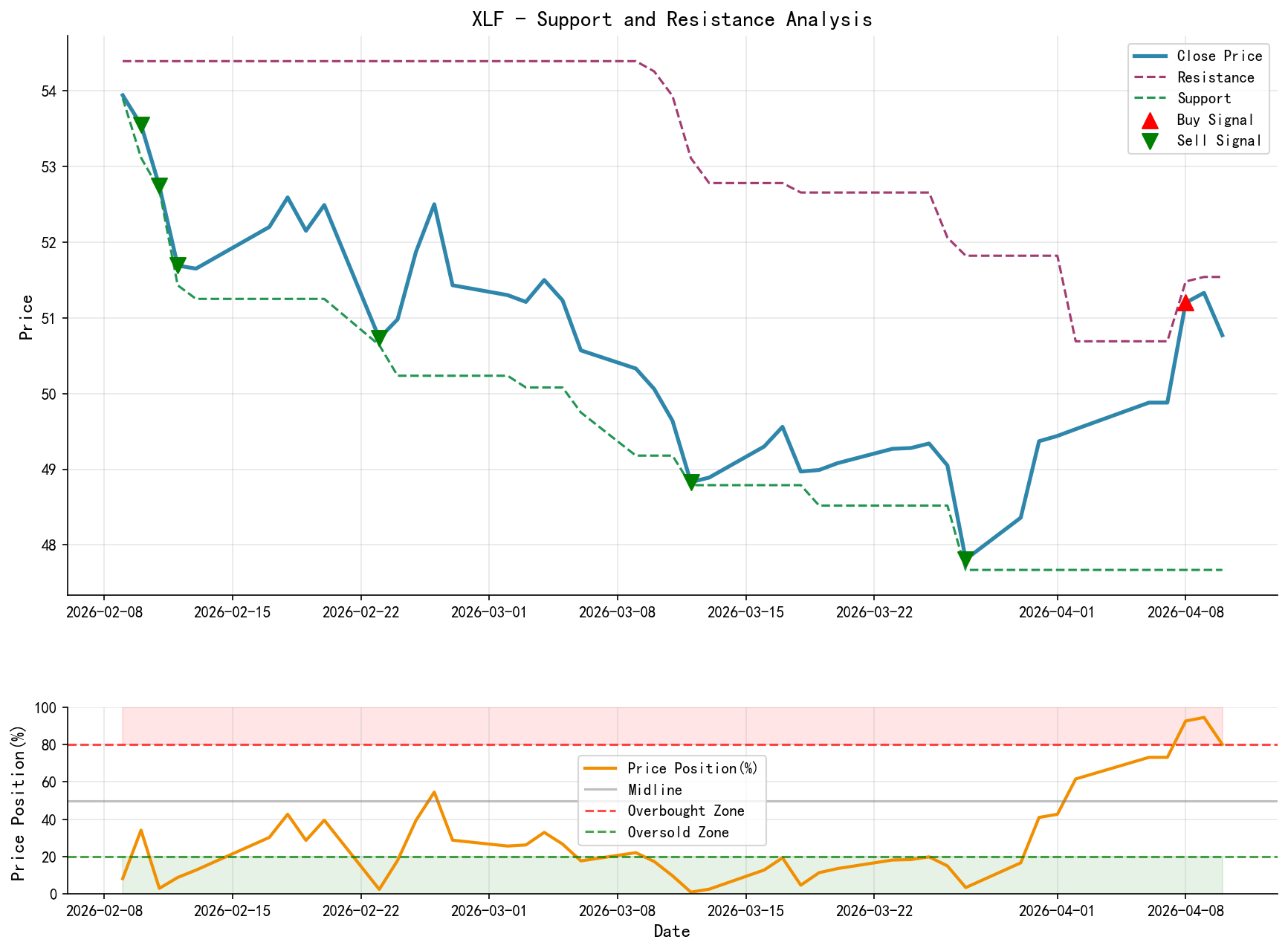
- 1. Key Price Levels:
- • Primary Support:47.81 (Mar 27 low and the March panic selling zone). This is the bottom of the accumulation range and the last line of defense for longs.
- • Secondary Support:49.50 (lower boundary of the recent consolidation platform and the convergence area of MA_5D/MA_10D).
- • Primary Resistance (Near-Term Target): $51.54 (Apr 9 high, also a minor high after the February decline).
- • Next Level Resistance:53.00 (the trading congestion zone from mid-to-late February and the pressure area from the long-term MA_30D/MA_60D).
- 2. Integrated Trading Signals and Operational Suggestions:
- • Wyckoff Event Signals: The market has shown the preliminary structure of a complete Accumulation phase (Selling Climax SC -> Automatic Rally AR -> Secondary Test ST). Current signals lean bullish.
- • Operational Suggestions:
- • Long Strategy (Primary Strategy): Await entry on a pullback confirming support.
- • Ideal Entry Level 1: The49.50 zone, especially if accompanied by a low-volume stabilization (e.g., single-day volume below the 30-day average).
- • Ideal Entry Level 2: A high-volume (VOLUME_AVG_30D_RATIO > 1.1) breakout and sustained hold above $51.54 can be seen as a confirmation signal that accumulation has ended and an uptrend is starting, warranting an add-to-position.
- • Stop-Loss Level: Firmly set below $47.67. If price breaks below this level, the accumulation structure fails, and the bullish thesis needs reassessment.
- • Initial Target Level:53.00.
- • Long Strategy (Primary Strategy): Await entry on a pullback confirming support.
- • Future Validation Points:
- 1. Demand Continuity Validation: Any subsequent advance, especially near resistance levels, must be accompanied by moderately expanding volume (VOLUME_AVG_*D_RATIO > 0.9). Persistent low-volume advances increase the risk of failure.
- 2. Supply Disappearance Validation: Any price retracement (like the current pullback from50.77) should see significantly contracting volume (VOLUME_AVG_30D_RATIO < 0.8), indicating supply does not expand with the price decline.
- 3. Structure Confirmation: Price needs to hold above $49.00 and form a higher low (HL) within the next 1-2 weeks to confirm the萌芽 of an uptrend. Ultimately, a high-volume breakout above $51.54 will be a strong confirmation signal for trend reversal.
Risk Disclaimer: Should a high-volume break below $49.00 occur in the future, it would indicate that the accumulation process might be more complex (e.g., entering a "re-accumulation" phase) or that the downtrend is not over, necessitating a timely strategy adjustment. This analysis is based on historical data and does not guarantee future performance.
Disclaimer: The content of this report/interpretation is solely market analysis and research based on publicly available information and does not constitute any investment advice or operational guidance. The author strives for objectivity and fairness but makes no guarantees regarding its accuracy or completeness. Markets carry risks, and investment requires caution. Any investment actions taken based on this report are at the investor's own risk.
Thank you for your attention! Wyckoff Volume-Price Market Analysis is published daily before the 8:00 AM market open. Your comments and shares are sincerely appreciated and crucial. Let us see the market signals together.
Member discussion: