XLE Quantitative Analysis Report (Based on the Wyckoff Method)
Product Code: XLE
Analysis Date Range: 2026-02-09 to 2026-04-10
Report Generation Time: 2026-04-11
1. Trend Analysis and Market Phase Identification
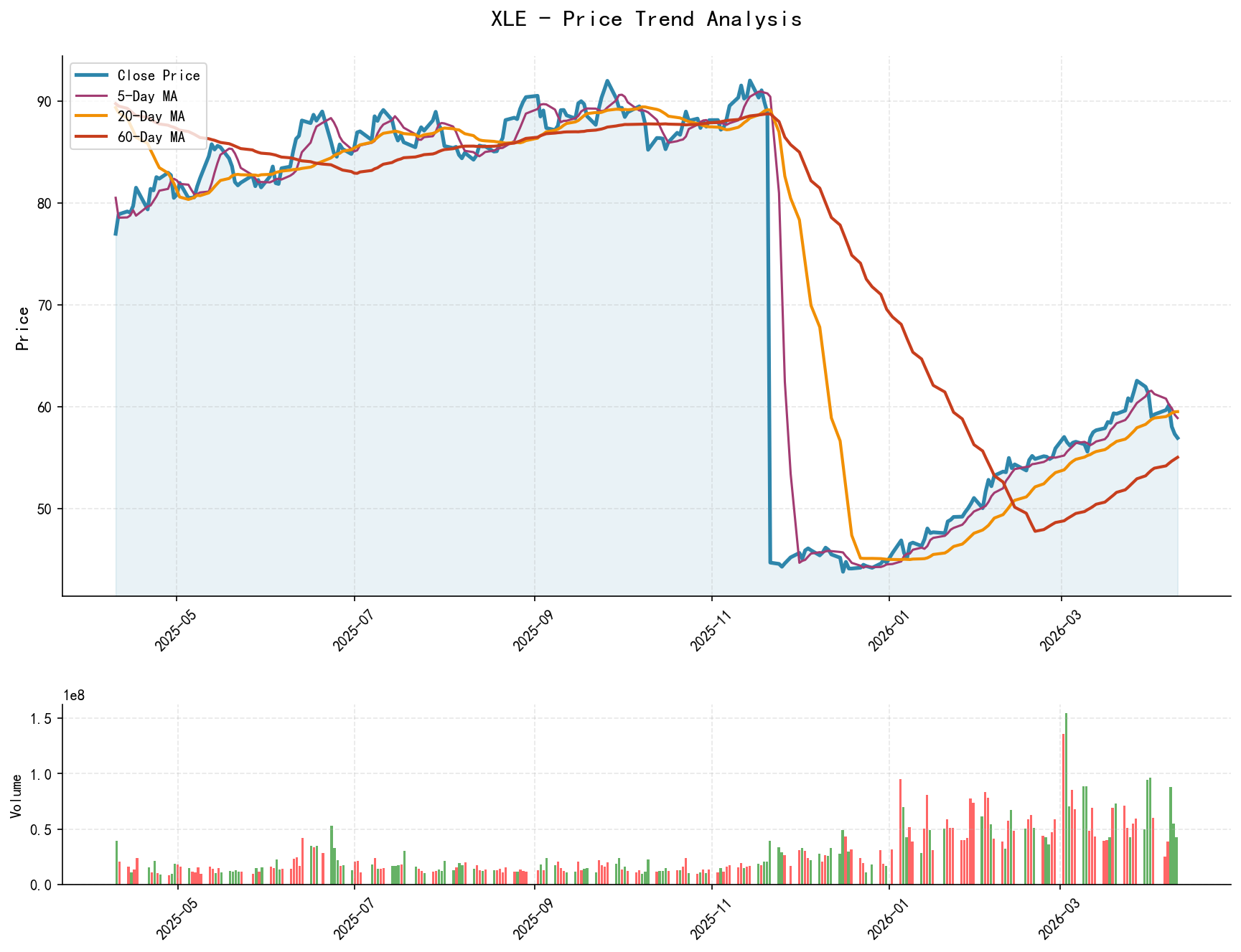
As of April 10, 2026, the underlying asset XLE had an opening price of 57.17, a closing price of 56.94, with moving averages: MA5 at 58.89, MA10 at 60.07, MA20 at 59.53. The daily change was -0.68%, weekly change -3.90%, monthly change -7.05%, quarterly change -7.05%, and yearly change +27.35%.
1.1 Price and Moving Average Analysis
The data clearly shows a complete process of uptrend reversal to a downtrend.
- • Bullish Alignment and Trend Confirmation (February to March 27): Prior to reaching the cycle high of $62.56 on March 27, the price consistently traded above the short-term (MA_5D), medium-term (MA_20D), and long-term (MA_60D) moving averages. All moving averages exhibited a standard bullish alignment (MA_5D > MA_10D > MA_20D > MA_30D > MA_60D), confirming a strong uptrend.
- • Trend Reversal Signal (March 30 to Present): Starting March 30, the price consecutively broke below key short and medium-term moving averages such as MA_5D, MA_10D, and MA_20D. By the end of the analysis period (April 10), the closing price of $56.94 was significantly below the MA_5D (59.53). The MA_5D has turned downward and is about to form a death cross with the MA_10D and MA_20D. The moving average system has shifted from a bullish alignment to a tangled state and is poised to form a bearish alignment, marking the end of the uptrend and the market's entry into a declining phase.
1.2 Inferred Market Phase (Based on Wyckoff Theory)
Combining price action and volume-price relationships, the market has experienced a typical "Markup - Distribution - Decline" cycle:
- • Markup Phase (Mid-February to Mid-March): Price rose steadily accompanied by increased volume (e.g., Feb 11, Feb 19), with retracements being healthy and on low volume (e.g., Feb 12), characteristic of demand-driven advances.
- • Distribution Phase (Late March): After making a new high of $62.79 (March 27), key signs emerged:
- 1. Stalling at Highs: On March 30, the price gapped up and sold off, closing as a bearish candle with a long upper shadow, indicating significant supply emerging at high levels.
- 2. Effort vs. Result: On the day of the new high (March 27), the volume (59.55M) was far lower than the massive volume seen on March 2-3 (135M, 155M), indicating that the "effort" of the price rise did not meet with a corresponding volume "result," signifying weakening demand.
- 3. Break of Key Support: On April 1, the price gapped down significantly, plunging -3.74% on high volume, directly breaking below the prior uptrend and consolidation range, confirming the completion of distribution and trend reversal. Historical ranking data confirms the extremity of the distribution: The March 3 volume (155M) set a record high for the past decade; the March 27 RSI_14 (81.94) reached the fifth-highest level in the past decade, indicating extreme market optimism, creating conditions for distribution.
- • Decline Phase (Early April to Present): Price entered a clear downward channel, initially with high-volume decline (expanding supply), recently transitioning to low-volume drifting decline (exhausted demand).
2. Volume-Price Relationship and Supply-Demand Dynamics
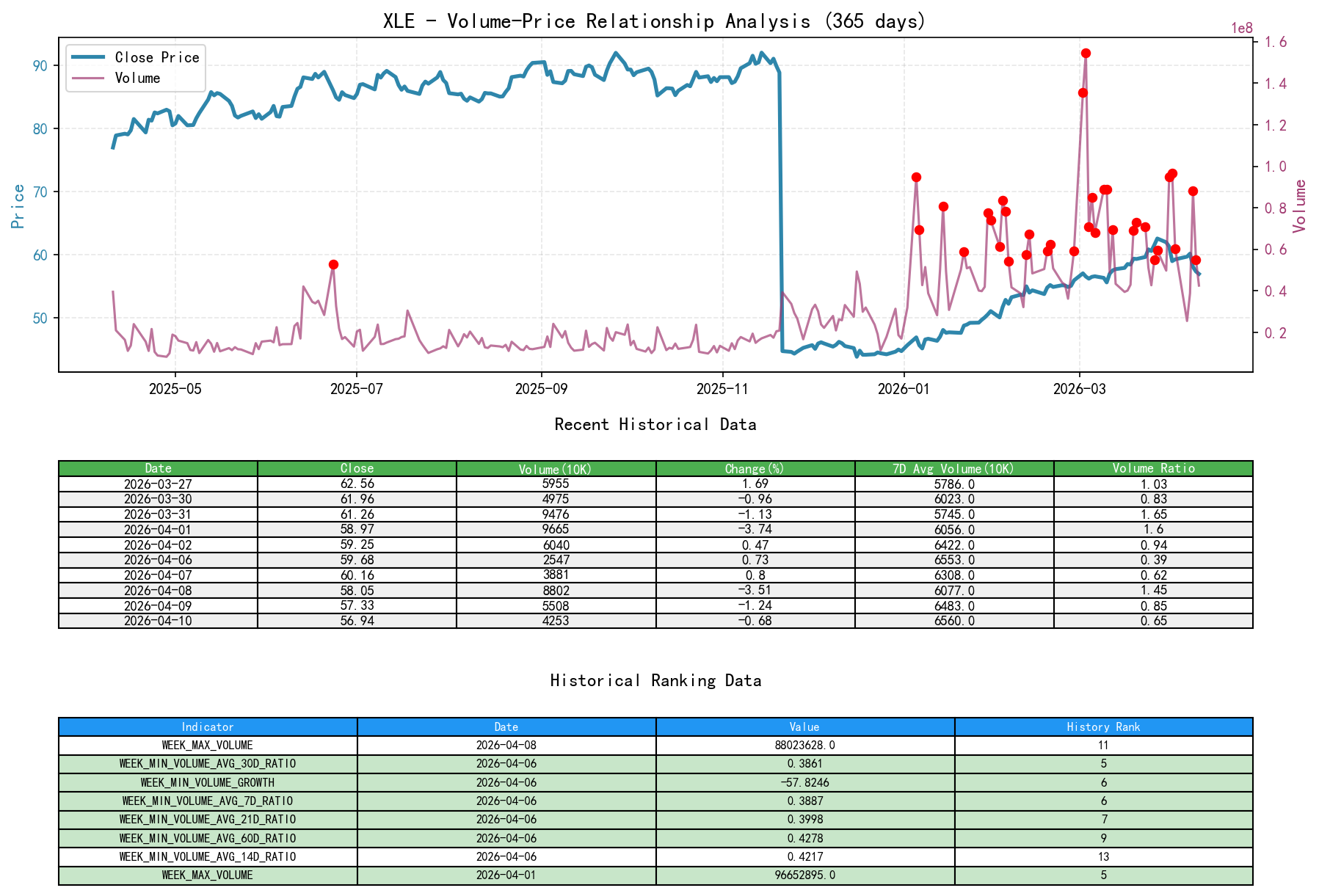
As of April 10, 2026, the underlying asset XLE had an opening price of 57.17, closing price 56.94, volume 42530689, daily change -0.68%, volume 42530689, 7-day average volume 65602621.14, 7-day volume ratio 0.65.
2.1 Analysis of Key Volume-Price Events
- • Distribution Confirmation Signals (2026-03-30 & 2026-04-01):
- • 03-30: Price attempted a rebound but failed, closing down -0.96%, with volume remaining at a relatively high level of 498M. This is a typical supply-dominated "Upthrust" pattern.
- • 04-01: The decisive signal. Price gapped down and plunged -3.74%, with volume surging to 96.65M (
VOLUME_GROWTH: +1.99%), and theVOLUME_AVG_30D_RATIOreaching 1.49. This is a clear sign of panic selling or concentrated large-scale selling, confirming that supply completely overwhelmed demand. Historical rankings show the day's trading value ranked sixth in the past decade.
- • Demand Exhaustion Signals (2026-04-06 to 2026-04-10):
- • Price continued to decline, but volume contracted significantly. For example, on April 6, volume was only 25.47M, with
VOLUME_AVG_7D_RATIOas low as 0.39 andVOLUME_GROWTHat -57.82%, ranking sixth lowest in the past decade. This is not accumulation but a sign of severely insufficient demand—the decline doesn't require high volume because buyers are scarce.
- • Price continued to decline, but volume contracted significantly. For example, on April 6, volume was only 25.47M, with
- • Secondary Rally Test (2026-04-08):
- • Price gapped down significantly but rallied, still closing down -3.51% on huge volume (88.02M). This was a test of the supply zone; the massive volume indicates the rally encountered strong selling pressure (supply), resulting in a failed test.
2.2 Summary of Supply-Demand Forces
The current market is absolutely dominated by supply. The massive volume during the distribution phase has exhausted all floating demand. Upon entering the decline phase, the persistent low-volume drifting decline indicates that new demand has not stepped in to absorb supply. While supply has weakened somewhat, it is still being released gradually. The market is in an imbalanced state of oversupply.
3. Volatility and Market Sentiment
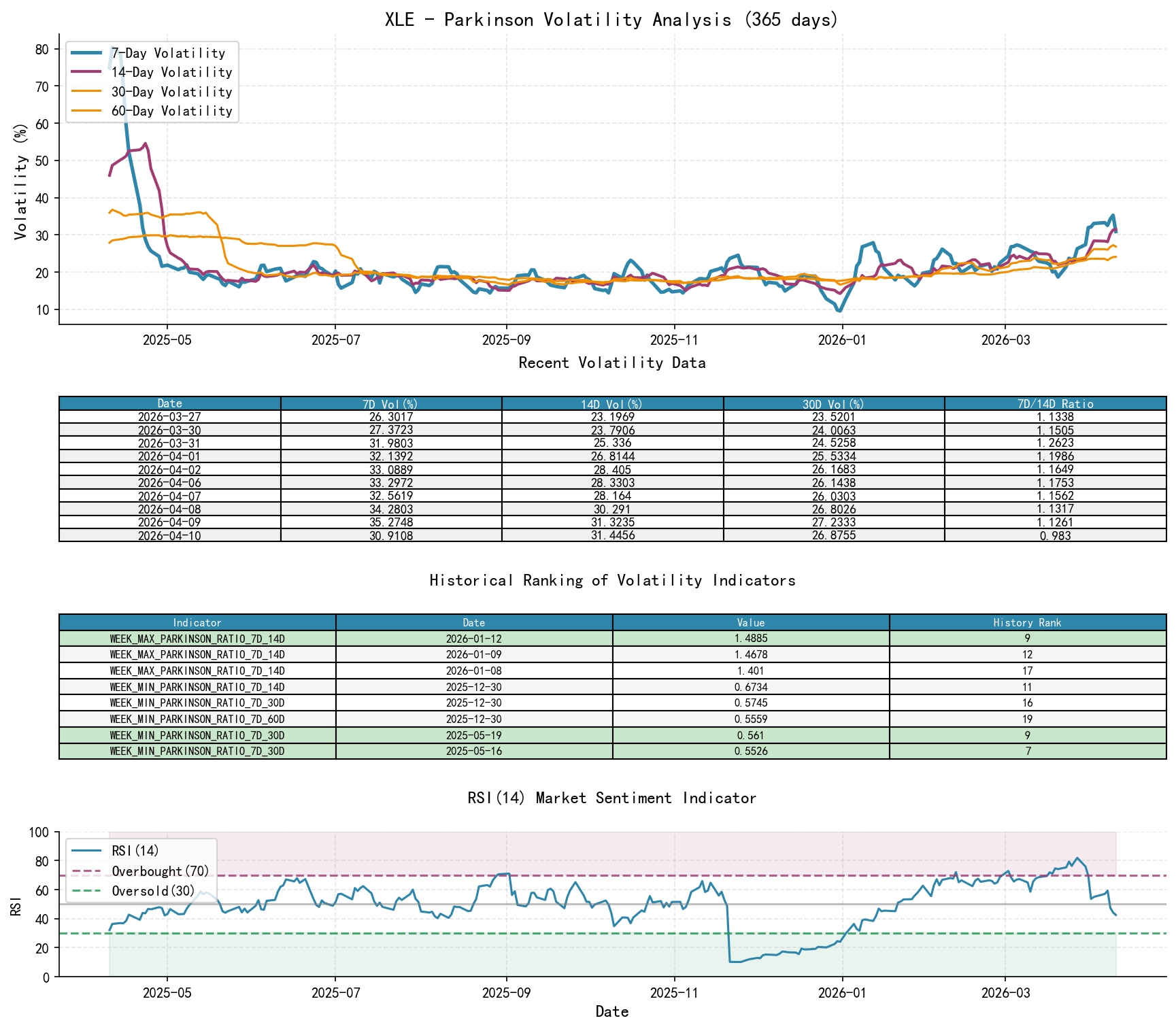
As of April 10, 2026, the underlying asset XLE had an opening price of 57.17, 7-day intraday volatility 0.31, 7-day intraday volatility ratio 0.98, 7-day historical volatility 0.37, 7-day historical volatility ratio 1.10, RSI 42.57.
3.1 Volatility Analysis
- • Volatility Surge: Starting March 31, short-term volatility metrics spiked sharply.
HIS_VOLA_7Dsurged from around 0.25 to 0.37 by April 10;PARKINSON_VOL_7Dalso rose concurrently. - • Abnormal Volatility Structure: The key metric
HIS_VOLA_RATIO_7D_30D(7-day volatility / 30-day volatility) reached an extreme level of 1.645 on April 1. This indicates that short-term panic and price volatility far exceeded recent norms, a characteristic feature of the initial phase of a trend reversal. Historical rankings show this ratio is at an extreme high for the past decade. - • Signs of Volatility Convergence: Although absolute levels remain high,
PARKINSON_RATIO_7D_14Ddropped to 0.98 on April 10, showing intraday volatility has converged relative to the prior 14 days, possibly suggesting the first wave of panic selling is nearing an end, but the trend remains unchanged.
3.2 Market Sentiment (RSI)
RSI_14 perfectly depicts the sentiment cycle: from an overbought extreme of 81.94 on March 27, it rapidly declined to 42.57 by April 10, having exited the overbought zone and entered neutral-to-bearish territory. The rapid cooling of sentiment aligns with the price decline and has not yet entered the oversold zone (<30), indicating downside momentum still has room for release.
4. Relative Strength and Momentum Performance
- • Complete Short-Term Momentum Reversal:
WTD_RETURN(week-to-date as of April 10) is -3.90%,MTD_RETURN(month-to-date for April) is -7.05%. Short-term momentum has shifted from strongly positive to significantly negative. - • Medium-Term Momentum Eroded but Not Fully Broken:
QTD_RETURN(quarter-to-date) turned negative to -7.05% due to the April plunge. However,YTD(year-to-date) still shows a significant positive return of +27.35%, indicating this decline currently remains a correction to the substantial gains since the start of the year but has severely eroded the medium-term upward progress. - • Conclusion: Short-term momentum is extremely weak, medium-term momentum has weakened. Price needs to stop declining and rebound quickly to preserve the gains of the medium-term uptrend.
5. Identification of Large Investor ("Smart Money") Behavior
Based on volume-price analysis using Wyckoff principles, inferences about large investor behavior are as follows:
- 1. Distributors (Mid to Late March): Against the backdrop of new price highs, exuberant market sentiment (extremely high RSI), and record-breaking volume (historically ranked #1), large investors successfully distributed. They leveraged strong demand to transfer holdings to the public chasing the rally at high prices.
- 2. Sellers and Observers (April):
- • The high-volume plunge on April 1 likely included not only panic selling by the public but also stop-loss orders or further position reduction by some institutional investors.
- • The subsequent low-volume drifting decline indicates that large buyers have not entered the market to absorb supply at these price levels. Smart money is on the sidelines, waiting for lower prices or clearer signs of a bottom. The current volume contraction reflects a "lack of buying interest," not "holding."
- 3. Behavior Summary: Smart money completed distribution at highs and is currently in a phase of leading the decline and observing. There are no signs yet of them engaging in large-scale accumulation.
6. Support/Resistance Level Analysis and Trading Signals
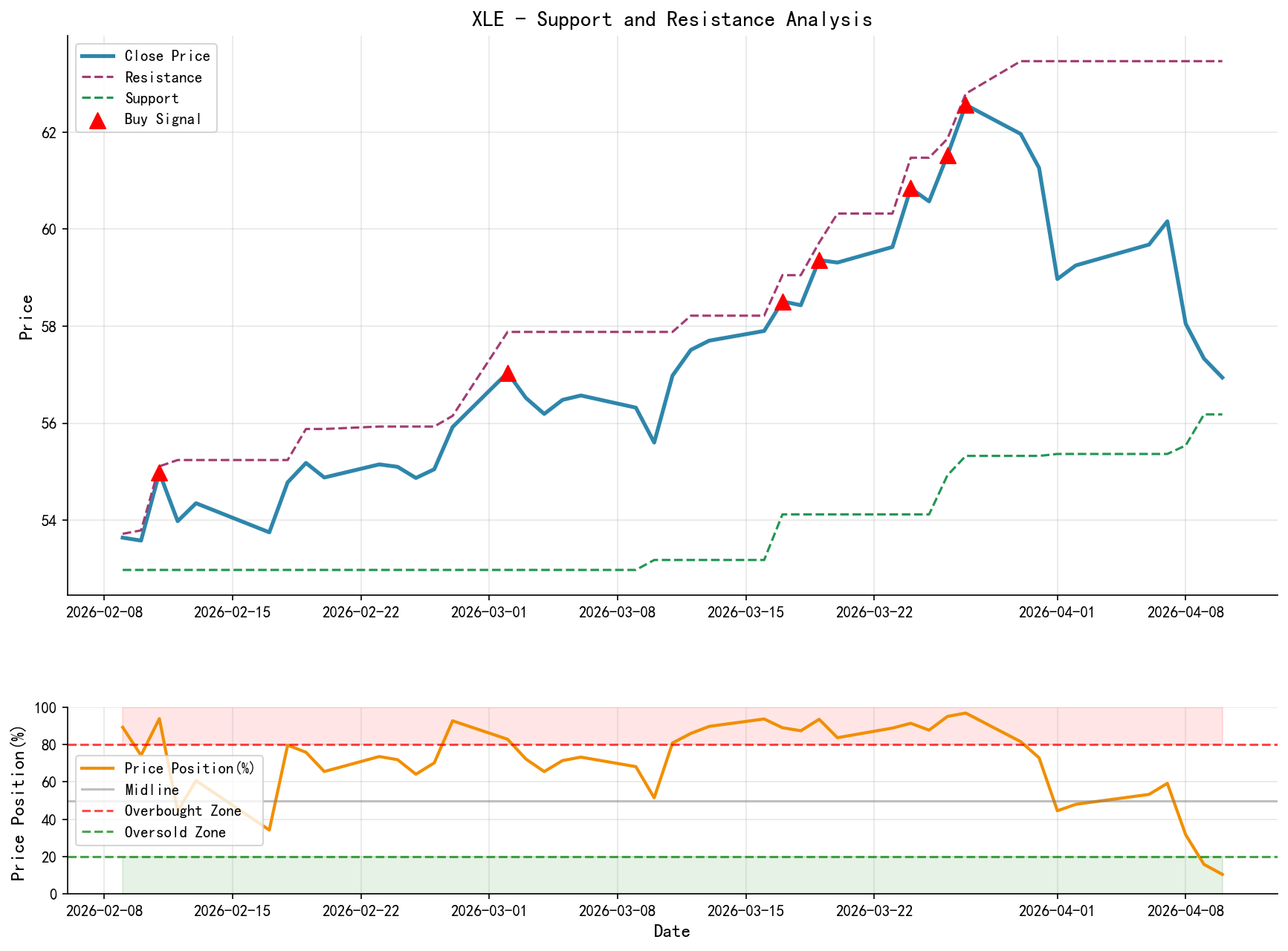
6.1 Key Price Levels
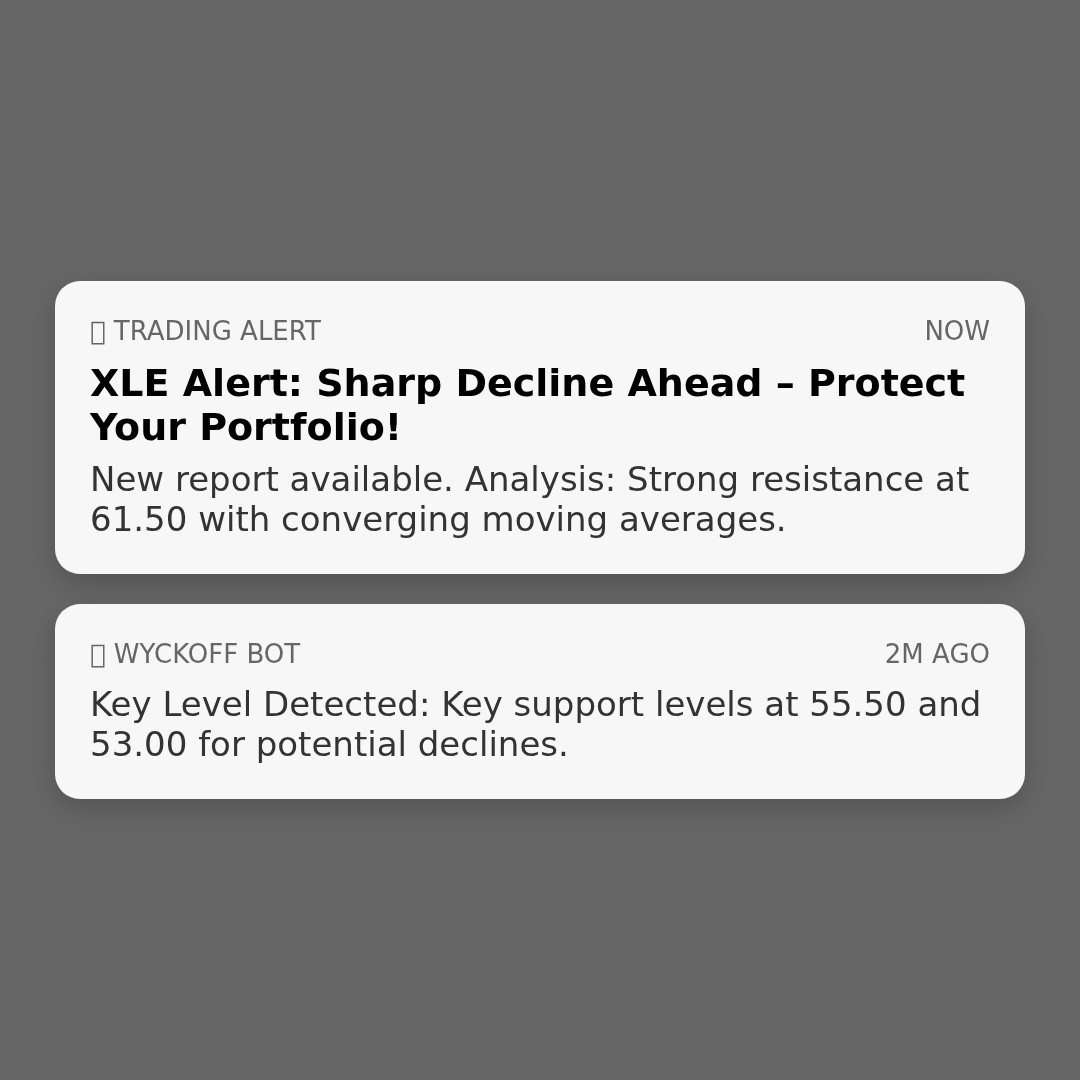
- • Strong Resistance Zone:61.50. This is the dense trading and distribution area from late March and where various short-to-medium-term moving averages are currently converging. Any rally to this zone will face strong selling pressure.
- • Initial Support: Around $55.50. This was a minor plateau high from late February to early March.
- • Next Key Support: The53.00 area. Corresponds to the breakout point from late January and the potential region where the 60-day moving average (currently around $55.05, moving down dynamically) may be approached.
6.2 Comprehensive Wyckoff Trading Signals
- • Primary Trend Signal: Bearish. The market has completed distribution and entered a supply-dominated decline phase.
- • Market Phase: Early to mid-stage of the decline phase. The initial wave of panic selling may be pausing, but demand shows no recovery; price is inclined to continue probing lower for support.
6.3 Operational Recommendations
- 1. For Existing Holders (Long Positions): Any rally towards the58.00 resistance zone represents an opportunity to reduce positions or exit. Risk-averse holders should have already exited.
- 2. For Bears or Those Seeking Short Positions: Consider establishing short positions if price rallies to the58.00 area and shows signs of weakness (e.g., long upper shadows, intraday volume-price divergence). Initial stop-loss should be placed above $59.00 (breaking the recent rally high).
- 3. Target Zones: Initially target $55.50; if broken, the next target is $52.50.
- 4. For Potential Longs (Waiting to Buy the Dip): Remain on the sidelines; do not attempt to catch a falling knife. Ideal entry signals require waiting for:
- • Price Action: Clear reversal candlestick patterns (e.g., long lower shadows, bullish engulfing) at key support levels (like52.50).
- • Volume-Price Confirmation: Such reversal signals must be accompanied by significantly increased volume, indicating demand is actively entering to absorb supply.
- • Successful Secondary Test: After a bounce, a subsequent retest of the support level occurs on reduced volume, indicating supply exhaustion.
6.4 Future Validation Points
- • Bearish View Invalidation: If price stages a strong, high-volume rally, recapturing and holding above $59.00, it would suggest the decline might only be a deep correction, requiring a reassessment of market structure.
- • Bearish View Confirmation / Continuation of Decline: Price rallies to the58.50 zone and encounters resistance, turning lower, or directly drifts lower on low volume, breaking below $55.50.
- • Early Signs of Trend Reversal: After declining to key support levels, the appearance of the Wyckoff accumulation structure described in the "Operational Recommendations" above: high-volume stopping action followed by a low-volume retest.
Disclaimer: This report is based on quantitative analysis of the provided data. Conclusions are derived from historical data and specific models and do not constitute any investment advice. Financial markets involve risks; invest with caution.
Thank you for your attention! Wyckoff Volume-Price Market Insights are published daily at 8:00 AM before the market opens. Your comments and shares are greatly appreciated. Your recognition is crucial. Let's work together to see the market signals clearly.
Member discussion: