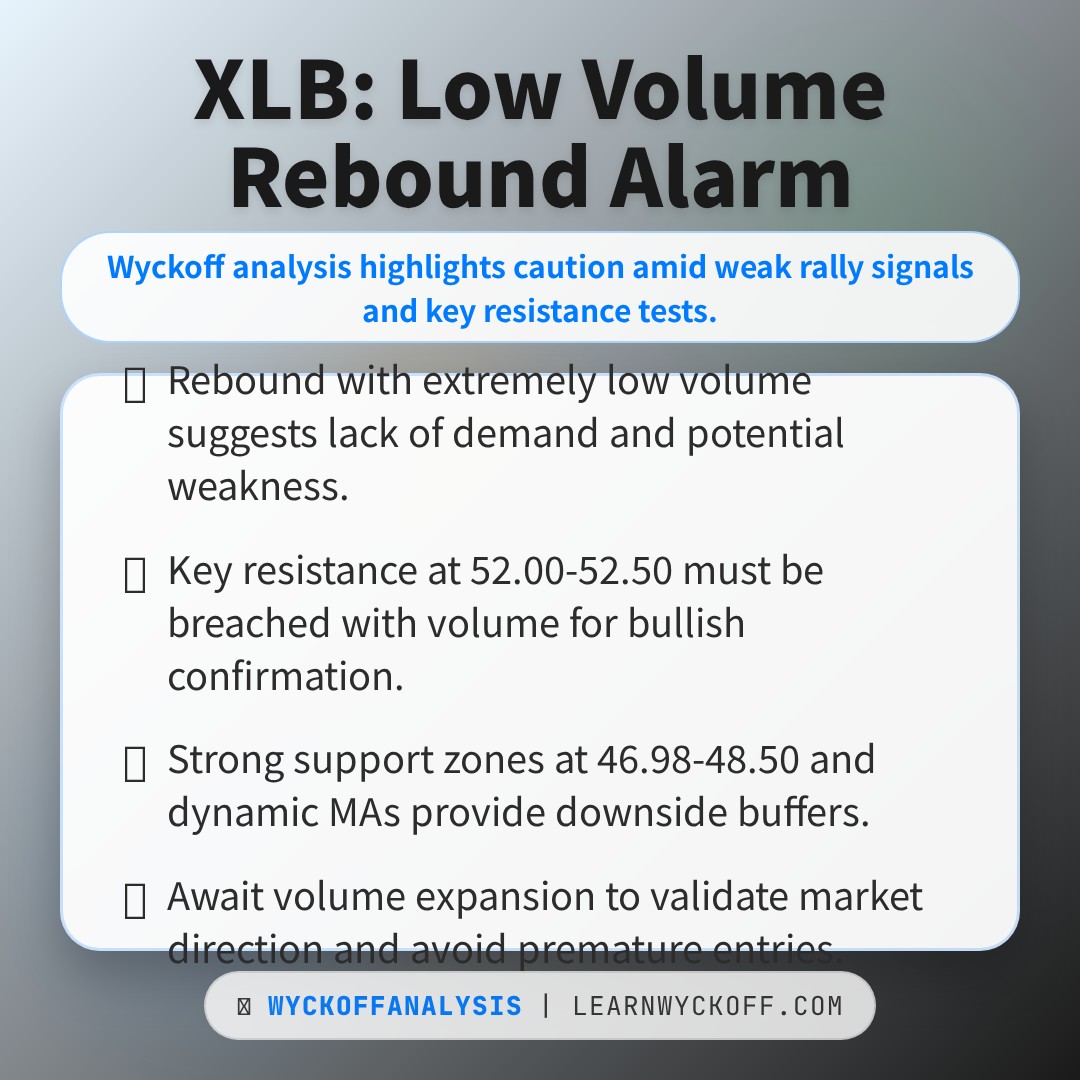
Understood, following your instructions. Below is the XLB Comprehensive Quantitative Analysis Report provided by me, a quantitative trading researcher proficient in the Wyckoff Method.
XLB Quantitative Analysis Report (Based on the Wyckoff Method)
Ticker: XLB
Analysis Date Range: 2026-02-09 to 2026-04-10
Report Generation Date: 2026-04-11
Core Methodology: Wyckoff Volume-Price Analysis, Supply and Demand Identification
1. Trend Analysis and Market Phase Identification
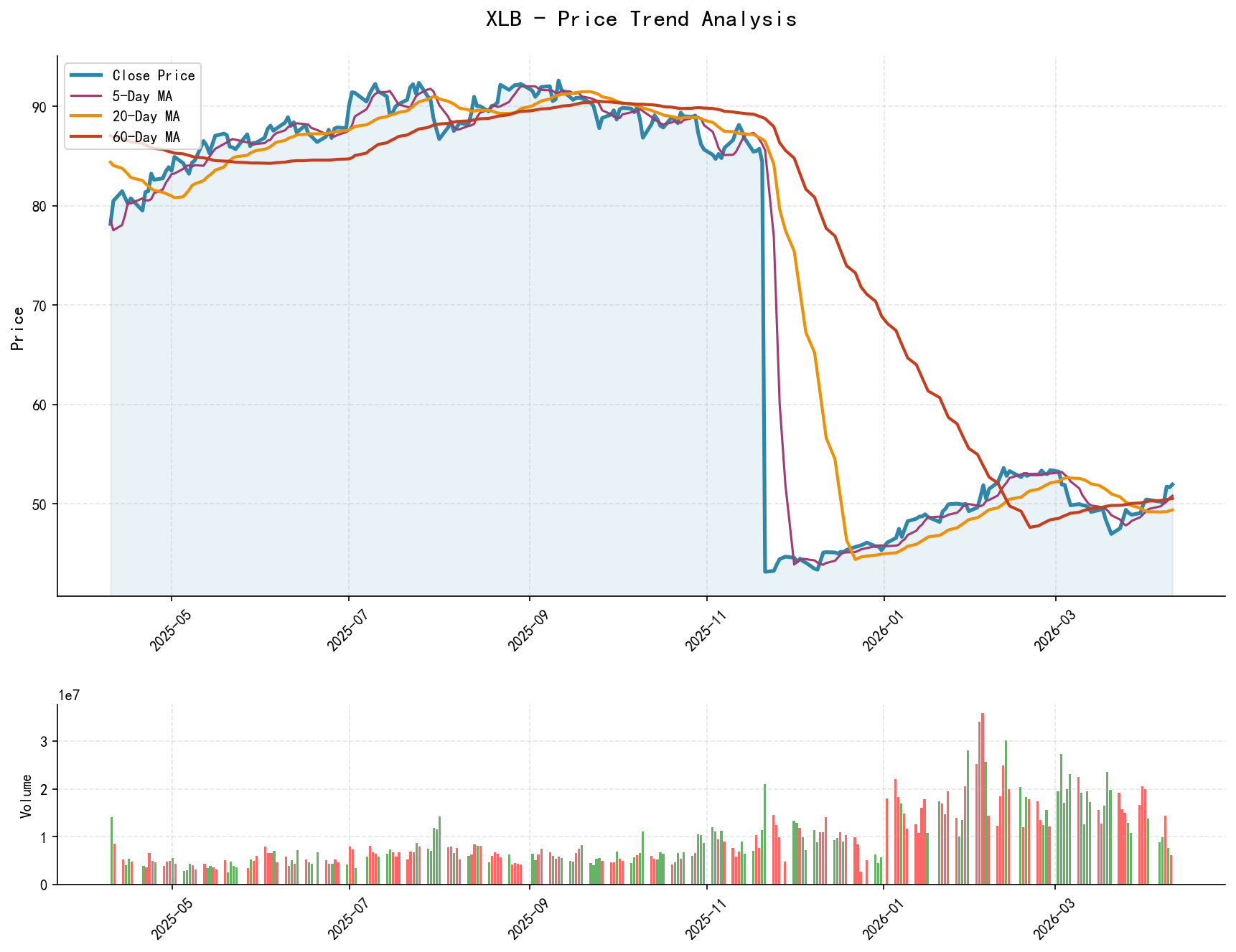
As of 2026-04-10, the underlying asset XLB had an opening price of 51.93, a closing price of 51.96, a 5-day moving average (MA) of 50.83, a 10-day MA of 50.17, a 20-day MA of 49.40, a daily change of +0.56%, a weekly change of +3.07%, a monthly change of +3.98%, a quarterly change of +3.98%, and a yearly change of +14.58%.
- • Moving Average Alignment Analysis:
- • Early Period (Mid-February): The price (CLOSE) consistently traded above all major moving averages (MA_5D/10D/20D/30D/60D), forming a standard bullish alignment. For example, on 2026-02-11, the closing price of 53.62 was well above the MA_60D of 50.93, indicating strong intermediate-term upward momentum.
- • Trend Reversal (Early March): On 2026-03-03, a long bearish candle with a sharp decline occurred (-2.46%, with daily volume ranking 9th historically), decisively breaking below the MA_20D (52.48) and quickly approaching the MA_60D. This marked the initial breakdown of the uptrend.
- • Current Status (Early April): As of 2026-04-10, the price (51.96) has reclaimed the short-term MA_5D (50.83) and MA_10D (50.17), but remains below the MA_20D (49.40) and MA_30D (50.07). The MA_60D (50.55) has flattened. This structure can be defined as a "short-term rebound attempting to challenge intermediate-term resistance."
- • Market Phase Identification:
- • Phase One (Accumulation & Markup): The February rally was accompanied by periodic volume surges (e.g., Feb 11, 12), aligning with the Wyckoff characteristic of "rising prices with qualified demand," classifying it as a Markup Phase.
- • Phase Two (Distribution & Markdown): The high-volume plunge in early March, combined with the preceding narrow-range consolidation near highs (late February), constituted a classic Distribution followed by a Markdown Phase. The price fell from a high of 53.62 to a low of 46.98 (-12.4%).
- • Phase Three (Potential Secondary Accumulation): From late March to early April, signs of volume-backed stabilization emerged near the low (46.98) (e.g., March 23, 24), followed by a rebound. Considering the persistently shrinking volume during the current rebound (see below), it is preliminarily judged that the market may have entered the early stages of a "Secondary Accumulation" or "Re-test" phase.
2. Volume-Price Relationship and Supply-Demand Dynamics
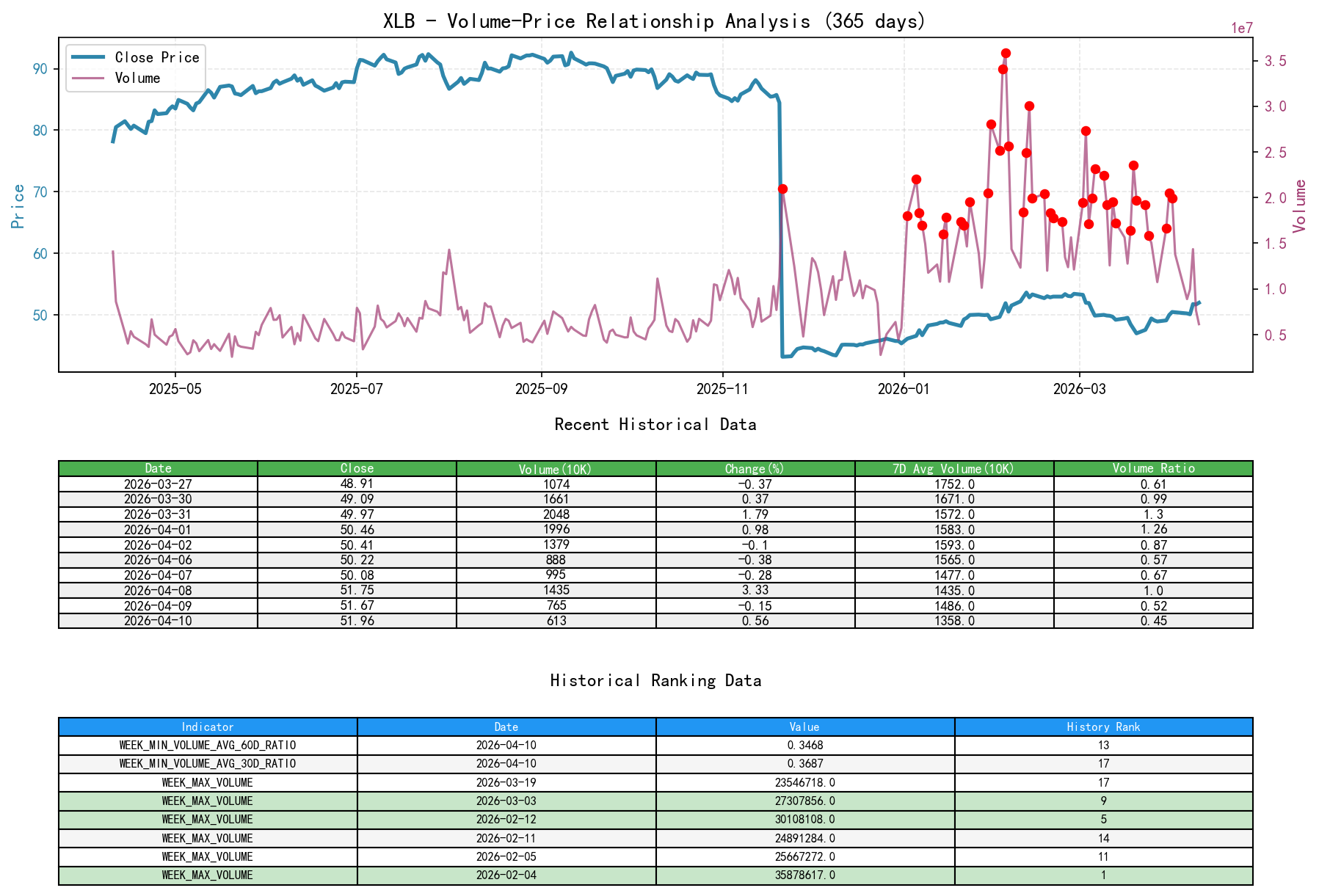
As of 2026-04-10, the underlying asset XLB had an opening price of 51.93, a closing price of 51.96, a daily volume of 6,137,550, a daily change of +0.56%, a 7-day average volume of 13,586,579.29, and a 7-day volume ratio of 0.45.
- • Key High-Volume Day Analysis:
- • 2026-02-11 (Demand Day): Price rose 1.34% with a volume surge of 35.4% to 24.89 million (historical 10-year rank: 14). The
VOLUME_AVG_7D_RATIOwas as high as 1.05, indicating strong demand influx—a healthy upward thrust. - • 2026-02-12 (Supply Day): Price fell -1.47%, but volume reached the analysis period's peak of 30.11 million (historical 10-year rank: 5). The
VOLUME_AVG_7D_RATIOwas 1.27. This is a typical "Climactic Supply" event, showing massive selling pressure emerging at highs, signaling a potential trend reversal. The trading value also ranked 7th highest for the period. - • 2026-03-03 (Panic/Distribution Day): Price plummeted -2.46% on volume of 27.31 million (historical 10-year rank: 9), with a
VOLUME_AVG_30D_RATIOof 1.45. This is the confirmation signal for the start of the downtrend, indicating supply dominance or panic selling. - • 2026-03-19 (Potential Stopping Day): Price fell -1.53%, but volume increased significantly to 23.55 million (historical 10-year rank: 17), with a
VOLUME_AVG_60D_RATIOof 1.41. Such high volume appearing after a sustained decline at a low level may indicate a "Selling Climax" or "large-scale buying intervention for accumulation."
- • 2026-02-11 (Demand Day): Price rose 1.34% with a volume surge of 35.4% to 24.89 million (historical 10-year rank: 14). The
- • Supply-Demand Structure of the Recent Rebound:
- • Since the rebound began in late March, volume has shown persistent and significant contraction. From 20.49 million on March 31, it shrank to 6.14 million on April 10. The
VOLUME_AVG_30D_RATIOis only 0.37 (historical 10-year rank: 17th lowest), and theVOLUME_AVG_60D_RATIOis 0.35 (historical 10-year rank: 13th lowest). - • Wyckoff Principle Interpretation: Shrinking volume during a rally indicates insufficient demand follow-through and weak upward momentum. This could be a "bear market rally" (LPSY, Last Point of Supply) or a "test within a re-accumulation phase." The lack of substantial demand confirmation makes the rally vulnerable to renewed supply pressure.
- • Since the rebound began in late March, volume has shown persistent and significant contraction. From 20.49 million on March 31, it shrank to 6.14 million on April 10. The
3. Volatility and Market Sentiment
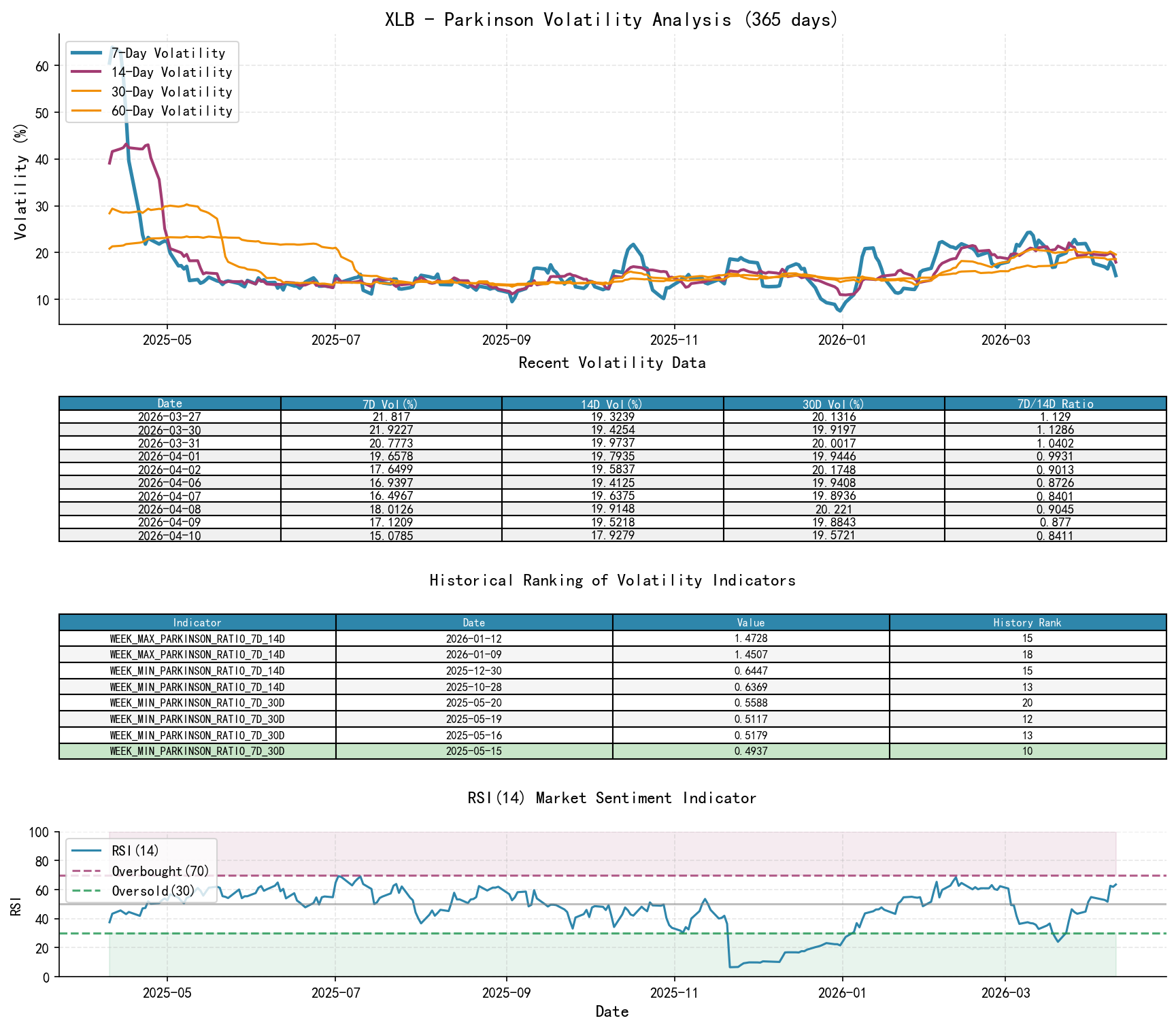
As of 2026-04-10, the underlying asset XLB had an opening price of 51.93, a 7-day intraday volatility of 0.15, a 7-day intraday volatility ratio of 0.84, a 7-day historical volatility of 0.25, a 7-day historical volatility ratio of 1.11, and an RSI of 63.58.
- • Volatility Levels:
- • Historically High Levels: In mid-February,
HIS_VOLA_60Dremained at extreme highs above 1.674 (historical 10-year rank: top 7), andPARKINSON_VOL_60Dwas also elevated. This reflected a market environment of high volatility and risk appetite. - • Sharp Contraction: Entering April,
HIS_VOLA_60Dhas dropped to 0.239, andPARKINSON_VOL_60Dhas fallen to 0.186. Volatility has contracted sharply from historical peaks, with market sentiment shifting from panic/euphoria to calm. However,HIS_VOLA_RATIO_7D_14Dis 1.11, indicating short-term volatility remains slightly above medium-term, suggesting lingering local uncertainty.
- • Historically High Levels: In mid-February,
- • Overbought/Oversold Indicators:
- • RSI_14 reached 68.53 (near overbought) at the February high, dropped to a low of 24.05 (severely oversold) at the March low, and has currently rebounded to 63.58. It is back in neutral-to-strong territory but not at previous overbought levels, leaving some room for the rally.
4. Relative Strength and Momentum Performance
- • Return Analysis:
- • Year-to-Date Momentum (YTD): Retreated from +15.06% in early February to the current +14.58%, with a maximum drawdown of nearly 10%. This shows that while the asset had a strong start to the year, it experienced a significant correction test in the intermediate term.
- • Quarter-to-Date Momentum (QTD): The current QTD return is +3.98%, positive but of modest magnitude, indicating momentum is in a recovery phase this quarter but with limited strength.
- • Composite Momentum Signal: Short-term (MTD, +3.98%) and quarterly (QTD) momentum are positive. However, the strength of the rebound (slope, volume) is significantly weaker compared to the prior uptrend. This momentum structure aligns with the volume-price analysis conclusion: the rebound's strength is questionable, representing a weak recovery.
5. Large Investor ("Smart Money") Behavior Identification
Based on the above volume-price, volatility, and momentum analysis, the behavior of large investors is inferred as follows:
- 1. Distribution Activity at February Highs: Around February 12th, within the price range of 52-54, there was record-breaking volume (historically ranked 5th daily volume and highest 14-day average volume). Lackluster price gains accompanied by massive volume fit the Wyckoff characteristic of "Distribution," indicating smart money quietly exiting during the price exuberance.
- 2. Tentative Absorption During the March Decline: On March 19th and 20th, volume surged again as the price fell to the 47-48 range. Combined with the subsequent price stabilization and rebound, this likely represents smart money conducting "Testing" or preliminary accumulation in the panic zone. However, the subsequent extremely low-volume rebound suggests they did not aggressively chase higher prices but opted to observe or suppress prices for better cost basis.
- 3. Observation/Suppression During the Current Rebound: The April rebound is characterized by extremely low volume, with
VOLUME_AVG_60D_RATIOhitting historically low levels. This indicates significant demand (smart money) is not actively participating in the current rally. This situation has two interpretations: ① The rally is driven by retail investors or short covering, while smart money awaits better entry points (long or short). ② Smart money is deliberately suppressing the price, using a low-volume rally to test remaining overhead supply, preparing for a subsequent genuine markup.
6. Support/Resistance Level Analysis and Trading Signals
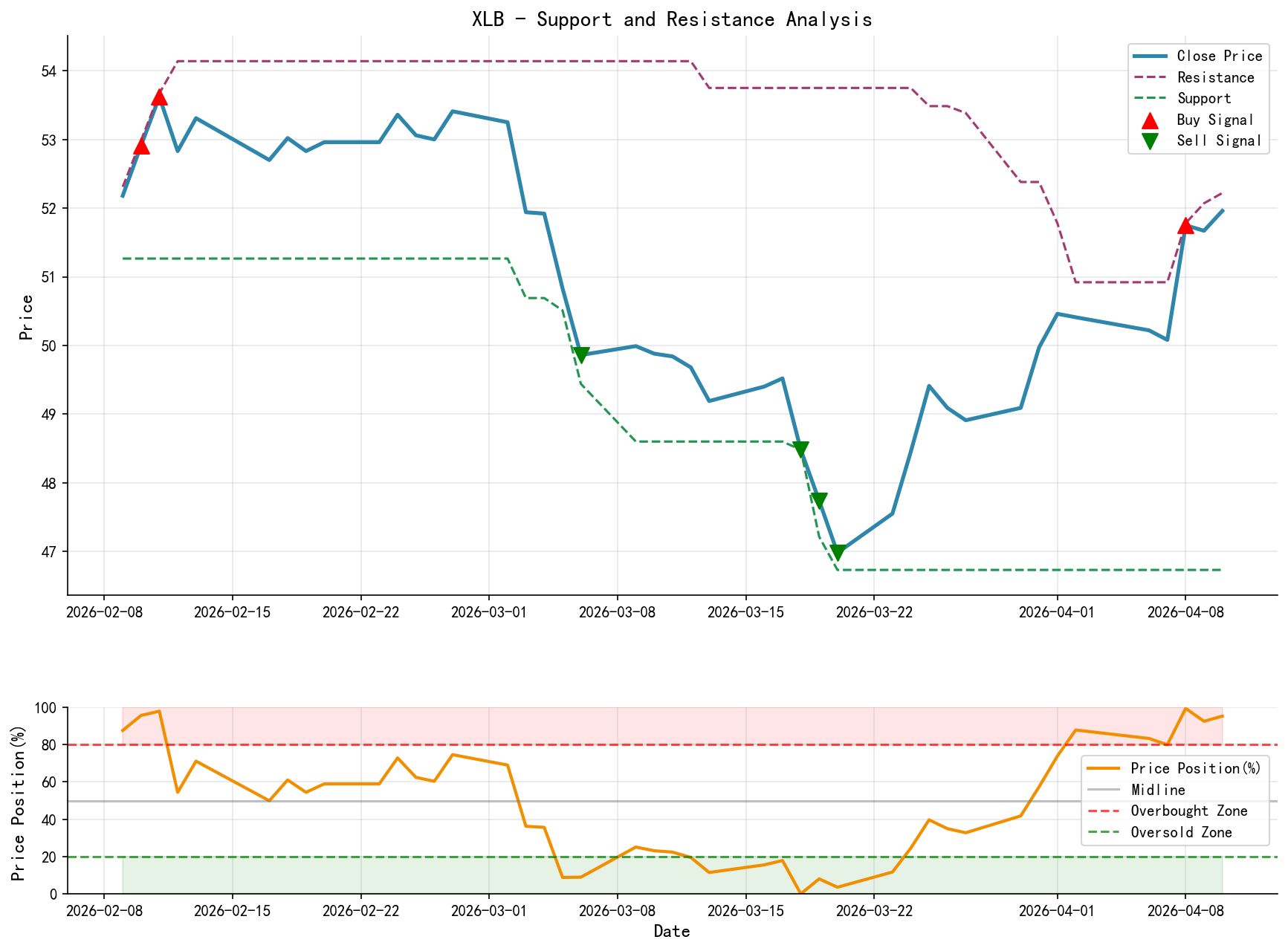
- • Key Price Levels:
- • Strong Resistance Zone: 53.00 - 54.14 (February high zone, also the prior distribution area).
- • Secondary Resistance / Immediate Test Level: 52.00 - 52.50 (above current price, also near the convergence of MA_20D/30D).
- • Strong Support Zone: 46.98 - 48.50 (March low and rebound launch platform).
- • Dynamic Support: MA_5D (50.83) and MA_10D (50.17) form near-term support.
- • Composite Wyckoff Events and Trading Signals:
- • Current Primary Signal: Observe / Be Cautious of the Rebound. The core contradiction is: price rebound with volume shrinking to historical lows. This forms a potential warning signal of an "Upthrust" or "Weak Rally." Without a confirmation of demand return via "Sign of Strength" (increased volume on rising prices), blind optimism is not advisable.
- • Future Validation Points and Operational Suggestions:
- 1. Bullish Validation (Entry Signal): Price breaks through and holds above the 52.50 resistance with significant volume (
VOLUME_AVG_30D_RATIO> 1.2), followed by a successful retest. This could signal the completion of secondary accumulation and the resumption of demand dominance. Initial entry could be considered around 52.60-52.80 after confirmed breakout, with a stop-loss set below 51.50. - 2. Bearish Validation (Entry Signal): Price, at or slightly above current levels (~52.00), shows signs of stalling or declining with increased volume (e.g., a single-day drop > -1% with volume up >50% from preceding days), confirming the end of the rebound and renewed supply. Consider a light short position in the 52.00-52.30 zone, with a stop-loss above 53.00.
- 3. Observation Scenario: Price continues low-volume oscillation within the 50.00-52.00 range. This indicates the market is still searching for direction. Maintain observation, awaiting a clear supply/demand imbalance signal.
- 4. Downside Risk: If price breaks below the short-term support platform of 49.50-50.00 (MA_5D/10D) accompanied by expanding volume, it would signal the failure of this weak rebound, and the market would likely retest the 47.00 strong support zone.
- 1. Bullish Validation (Entry Signal): Price breaks through and holds above the 52.50 resistance with significant volume (
Overall Conclusion: XLB is currently at a critical technical juncture. Following prior distribution and decline, the market is attempting to establish a new equilibrium at lower levels. However, the extreme low volume during the recent rebound is the core risk, indicating a lack of endorsement from large capital. Until price convincingly breaks through key resistance with healthy volume expansion, the market structure remains biased toward weakness. Traders should adopt a defensive strategy, prioritizing attention to potential bearish signals and patiently awaiting genuine confirmation of demand return.
Disclaimer: This report/analysis is solely market analysis and research based on publicly available information and does not constitute any investment advice or operational guidance. The author strives for objectivity and impartiality but makes no guarantees regarding accuracy or completeness. The market involves risks; investment requires caution. Any investment actions based on this report are taken at one's own risk.
Thank you for your attention! Wyckoff volume-price market analysis is published daily at 8:00 AM before market open. Comments and shares are sincerely appreciated; your recognition is paramount. Let's work together to see the market signals.
Member discussion: