
Very well. Following your instructions, as a quantitative trading researcher proficient in the Wyckoff Method, I will write a comprehensive, in-depth quantitative analysis report for you based on the XBI data you provided.
XBI Quantitative Analysis Report (Based on Wyckoff Theory)
Product Code: XBI
Analysis Date Range: 2026-02-09 to 2026-04-10
Report Generation Date: 2026-04-11
1. Trend Analysis and Market Phase Identification
As of 2026-04-10, the underlying XBI had an opening price of 132.09, closing price of 129.44, 5-day MA of 129.82, 10-day MA of 126.76, 20-day MA of 124.45, daily change of -1.81%, weekly change of 0.37%, monthly change of 1.34%, quarterly change of 1.34%, and yearly change of 6.16%.
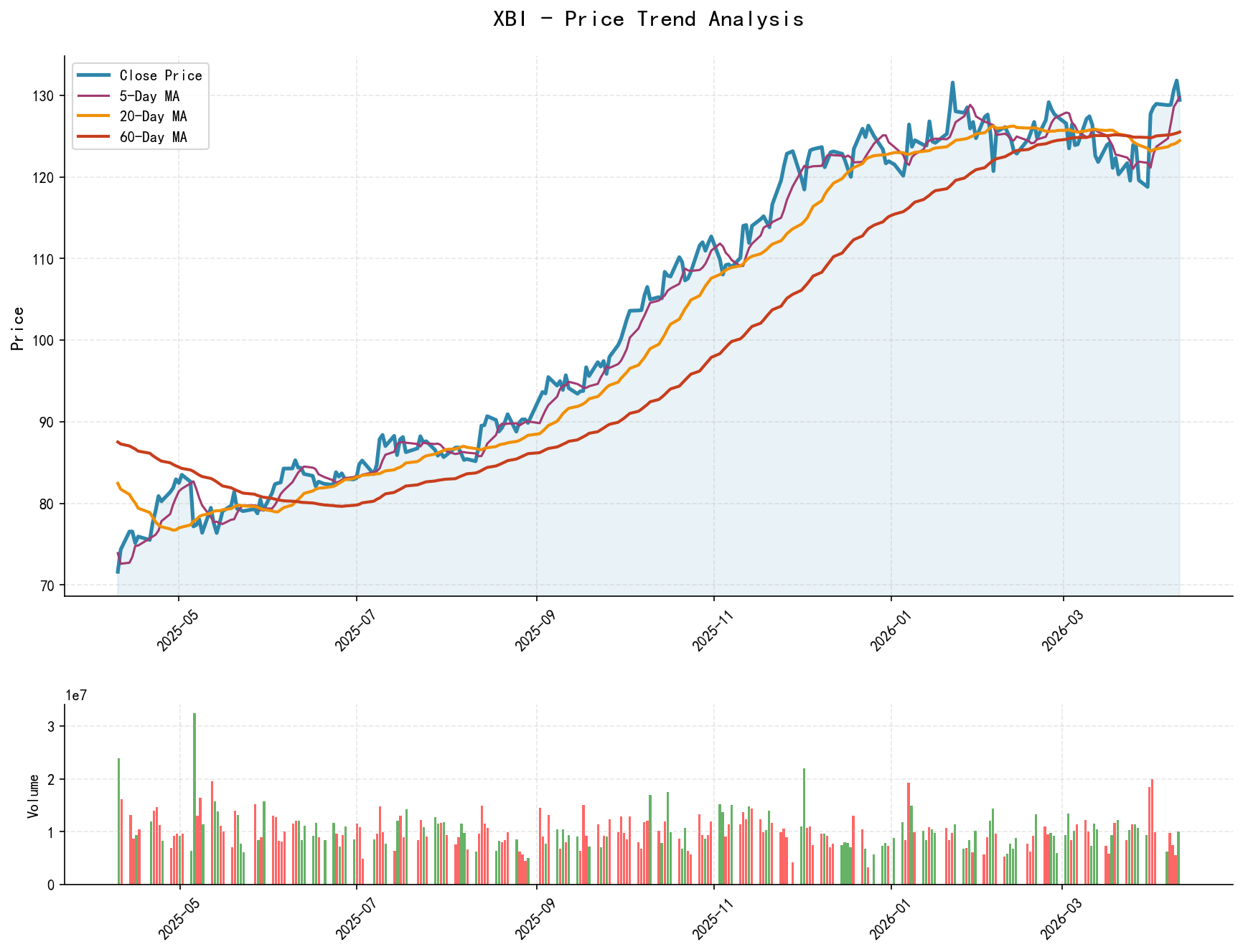
Price-Moving Average Relationship:
- • Current Alignment (2026-04-10): Closing Price
129.44> MA_5D (129.82) > MA_10D (126.76) > MA_20D (124.45) > MA_30D (124.98) > MA_60D (125.51).- • Conclusion: The market exhibits a bullish alignment after a short-term correction. The MA_20D/30D/60D have all turned upward, indicating a reversal from a medium-to-long-term downtrend to an uptrend. However, the price briefly fell below the MA_5D, suggesting a temporary pause in short-term upward momentum.
- • Moving Average Cross Signals:
- • MA_CROSS_5_20: Around 2026-04-01, the MA_5D (
122.78) clearly crossed above the MA_20D (123.34), issuing a short-term bullish signal. - • MA_CROSS_DIRECTION: The MA_5D and MA_20D remain in a golden cross state. More critically, the MA_20D began a sustained upward move in late March and crossed above the MA_60D in early April, confirming the reversal of the medium-term trend.
- • MA_CROSS_5_20: Around 2026-04-01, the MA_5D (
Market Phase Inference (Wyckoff Theory):
Combining price action and volume analysis, the market experienced a complete Wyckoff cycle phase during the analysis period:
- 1. Panic Selling: In mid-to-late March, the price fell from around 127 to 118.78 (March 30), accompanied by high volume (e.g., March 12, March 20), particularly the -3.48% drop on March 27 on high volume, consistent with the characteristics of panic selling.
- 2. Automatic Rally: On March 31, the price surged by a massive 7.53% (the 4th highest single-day gain in history) on extremely high volume, breaking away from the lows, marking the end of the panic phase.
- 3. Secondary Test & Accumulation: In early April, following the initial surge, the price did not form a direct V-shaped reversal but instead consolidated within the 125-130 range, with volume receding from extreme highs but remaining active. This indicates large investors were absorbing supply, conducting secondary tests, and accumulating within the range. The current price pullback to 129.44 may represent another test of the support zone.
Current Phase Judgment: Transition period of "Testing and Re-accumulation/Uptrend" following a strong rally. The market has moved away from the bottom but needs to verify the effectiveness of support in the 125-127 area (midpoint of the high-volume bar on March 31 and breakout level) to confirm the sustainability of the uptrend.
2. Volume-Price Relationship and Supply-Demand Dynamics
As of 2026-04-10, the underlying XBI had an opening price of 132.09, closing price of 129.44, volume of 10033482, daily change of -1.81%, volume of 10033482, 7-day average volume of 11085383.86, and 7-day volume ratio of 0.91.
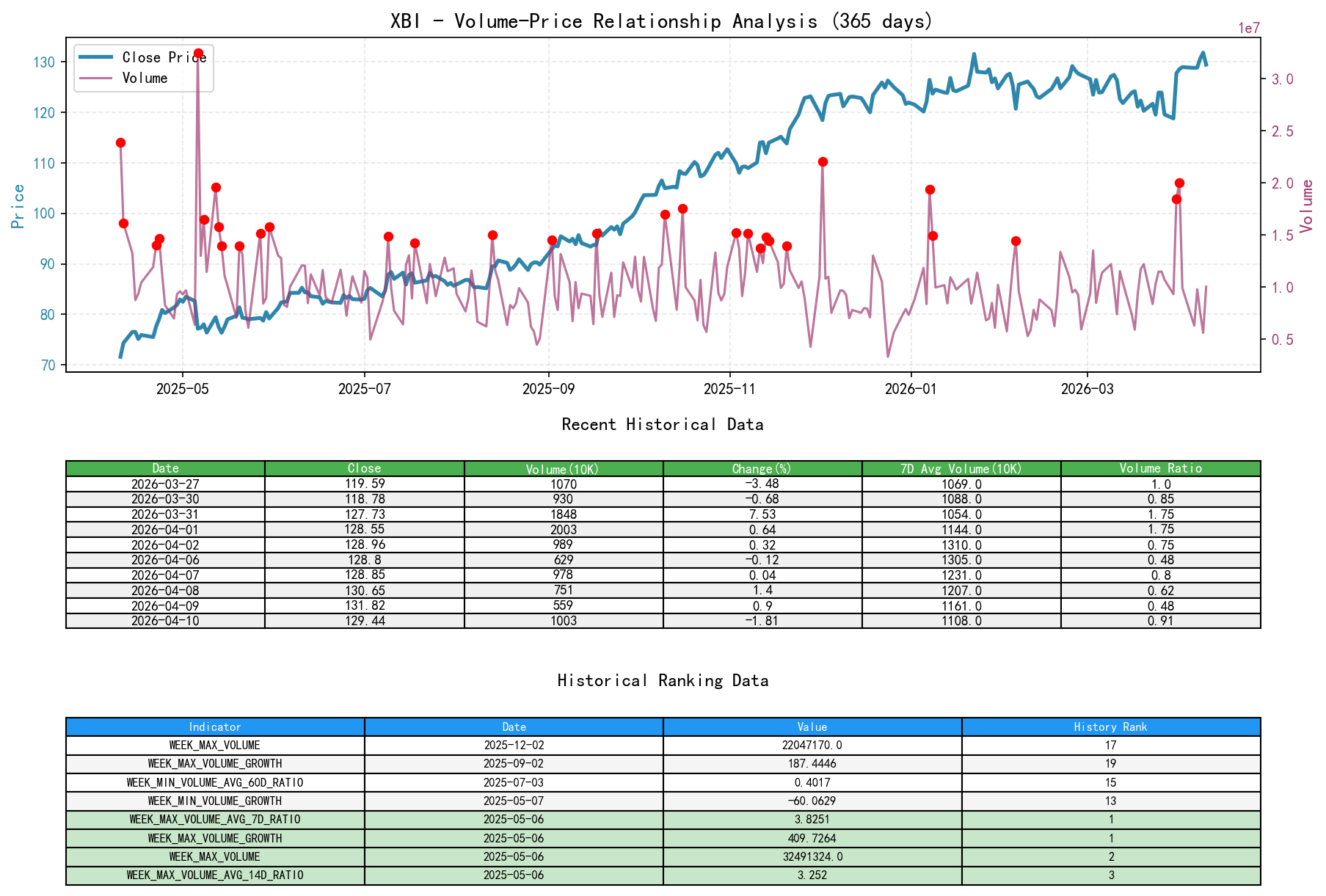
Key Volume-Price Event Analysis:
- • High-Volume Rise (Demand Dominant):
- • 2026-03-31: Extreme Demand Day.
PCT_CHANGE(+7.53%, 4th highest in history) accompanied byVOLUMEof 18.48M (VOLUME_AVG_60D_RATIO: 1.91). This is a clear signal of overwhelming demand entering the market, declaring the end of the downtrend. Historical ranking data shows that day's turnover reached the 8th highest in nearly 10 years. - • 2026-04-01: Continued high-volume rise (+0.64%, volume 20.03M,
VOLUME_AVG_60D_RATIO: 2.03), with turnover reaching the 3rd highest in nearly 10 years. Two days of massive volume gains constitute the Wyckoff "Jump Across the Creek" pattern, indicating strong demand.
- • 2026-03-31: Extreme Demand Day.
- • High-Volume Stagnation/Decline (Supply Dominant):
- • 2026-04-10: Potential Supply Appearance Day. Price declined -1.81% with volume of 10.03M (
VOLUME_AVG_60D_RATIO: 1.05). This is the first significant high-volume pullback after consecutive rises to the 132.27 high. Supply appeared but did not trigger panic.
- • 2026-04-10: Potential Supply Appearance Day. Price declined -1.81% with volume of 10.03M (
- • Low-Volume Rebound (Insufficient Demand/Exhausted Supply):
- • 2026-04-06 to 2026-04-09: Price edged higher, but volume continued to shrink (
VOLUME_AVG_60D_RATIOdeclined from 0.63 to 0.58). This reveals insufficient demand follow-through for the price rise, setting the stage for the April 10 pullback. Simultaneously, it may indicate that supply was temporarily exhausted near previous highs, with limited selling pressure.
- • 2026-04-06 to 2026-04-09: Price edged higher, but volume continued to shrink (
- • High-Volume Plunge (Panic Selling - Concluded):
- • 2026-03-27:
PCT_CHANGE(-3.48%), volume 10.71M (VOLUME_AVG_60D_RATIO: 1.11). This represents final panic selling at the end of the decline, clearing out weak hands ahead of the strong March 31 rally.
- • 2026-03-27:
Supply-Demand Force Shift:
- •
VOLUME_GROWTHdata shows that after the demand explosion on March 31, volume gradually contracted until it expanded again during the April 10 pullback. This aligns with the "rise - low-volume pullback - high-volume support confirmation" adjustment phase within a typical healthy uptrend structure. - • Core Contradiction: Massive demand in early April vs. recent low-volume rise. This indicates dominant demand has completed its accumulation at lower levels, and the current market has entered a game stage dominated by new buyers and profit-taking sellers.
3. Volatility and Market Sentiment
As of 2026-04-10, the underlying XBI had an opening price of 132.09, 7-day Parkinson volatility of 0.28, 7-day Parkinson volatility ratio of 0.94, 7-day historical volatility of 0.20, 7-day historical volatility ratio of 0.40, and RSI of 57.16.
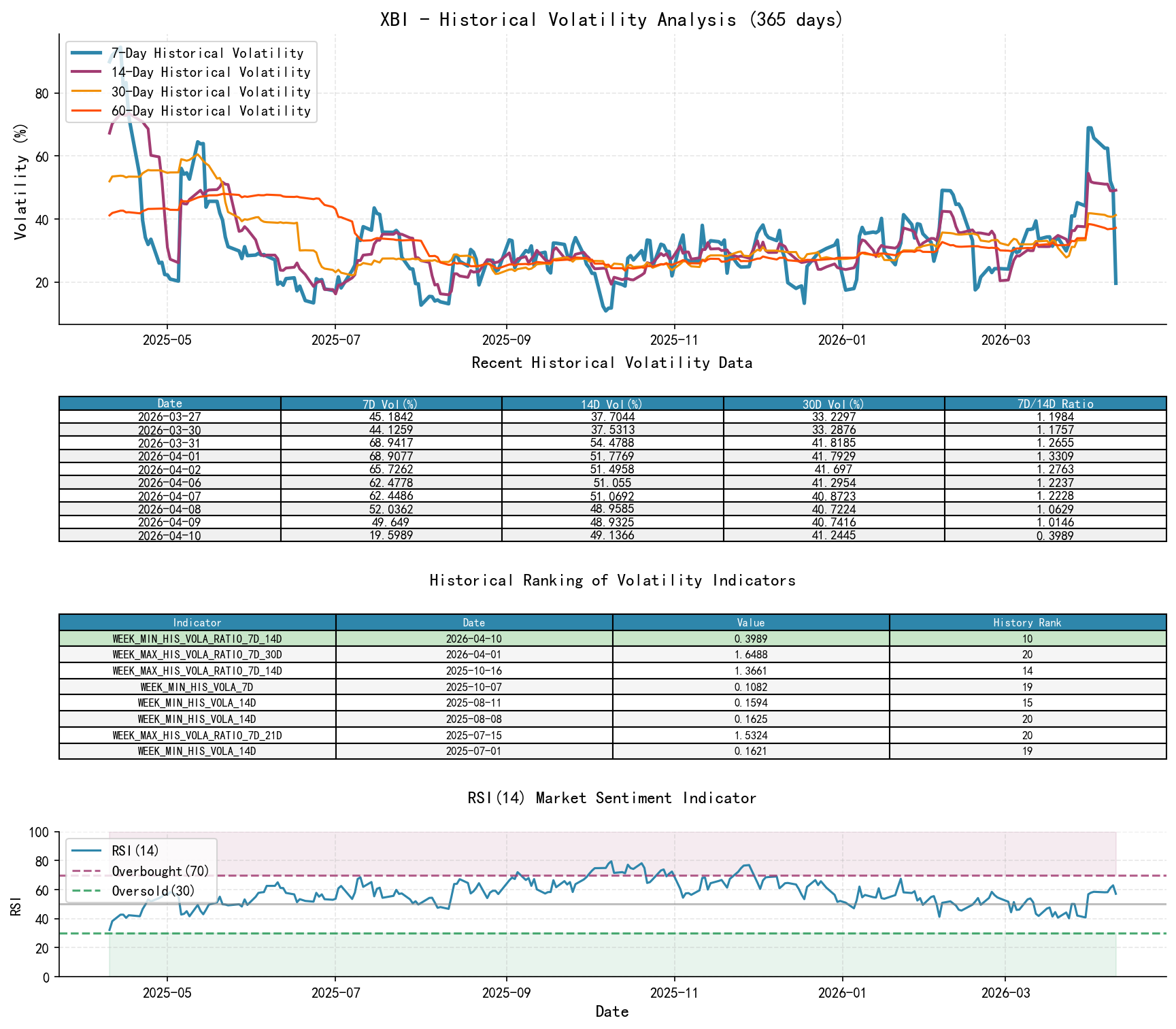
Volatility Level and Change:
- • Historical Volatility (HIS_VOLA): The 7-day volatility (
HIS_VOLA_7D) surged to an extreme high of 68.94% on March 31 before plummeting to 19.60% on April 10. Short-term volatility contracted sharply. - • Volatility Ratio (Key Signal):
- •
HIS_VOLA_RATIO_7D_14D: Plummeted from a peak of 1.33 on April 1 to 0.40 on April 10. Historical ranking data shows this value hit the 10th lowest level in nearly 10 years. - • Interpretation: Extreme contraction of short-term volatility relative to medium-term volatility. This typically occurs after a major trend move (like the late March surge), as the market enters a brief period of hesitation and directional choice. Volatility returning from panic/euphoria to calm is a classic feature of the market digesting previous major changes and brewing the next wave of movement.
- •
- • Parkinson Intraday Volatility: Consistent with the historical volatility trend, the 7-day value (
PARKINSON_VOL_7D) decreased from 0.326 (April 1) to 0.280 (April 10), indicating narrowing intraday ranges.
Market Sentiment (RSI):
- •
RSI_14reached 62.99 on April 9, approaching but not entering the overbought zone (>70). After the April 10 pullback, it fell to 57.16, residing in a neutral-to-strong region. - • Conclusion: Market sentiment quickly recovered from oversold conditions in late March (RSI low of 41.47) to neutral-to-strong, not yet reaching extreme optimism, leaving room for potential further gains. The current pullback provides a healthy correction for the RSI.
4. Relative Strength and Momentum Performance
Multi-Period Return Analysis:
- • Short-term Momentum (WTD):
WTD_RETURNis +0.37%, significantly slower compared to previous weeks (e.g., +6.85% in the final week of March), confirming a weakening of short-term upward momentum. - • Medium-term Momentum (MTD/QTD/YTD):
MTD_RETURN(+1.34%),QTD_RETURN(+1.34%),YTD(+6.16%) are all positive and significantly higher than the lackluster performance in February-March (YTD once turned negative). - • Interpretation: Medium-term momentum has clearly turned positive and strengthened, benefiting from the late March surge. Although short-term momentum has slowed, it remains above the zero line, representing a normal pause within an uptrend. The momentum structure validates the price breakout and the bullish moving average alignment.
5. Large Investor ("Smart Money") Behavior Identification
Based on Wyckoff theory and the above volume-price and volatility analysis, inferring the operational intent of large investors:
- 1. High-Volume Accumulation at Lows (Accumulation): The consecutive, historically significant high-volume rises on March 31 and April 1 were decidedly not retail activity. This is the classic move of smart money building positions and accumulating decisively and centrally after the panic selling (PS) and secondary test (ST). They absorbed all panic and hesitant selling.
- 2. Control and Testing During the Rise (Testing): The low-volume rise from April 2 to April 9 indicates that major buying temporarily paused, allowing the market to float freely to test natural supply pressure above and support strength below. The high-volume pullback on April 10 can be interpreted as smart money intentionally testing selling pressure at a key level (around the previous high of 129.16), while partially taking profits to observe if buyers are willing to continue absorbing at this price.
- 3. Current Intent: Smart money has completed the establishment of core positions (cost zone approximately 125-128). The current operational focus has shifted from "buying" to "position management" and "trend guidance". They are testing support, shaking out weak longs (shakeout), and accumulating energy for the next wave of advance. A high-volume decline that does not break key support can be viewed as a successful "shakeout" or "test."
6. Support/Resistance Level Analysis and Trading Signals
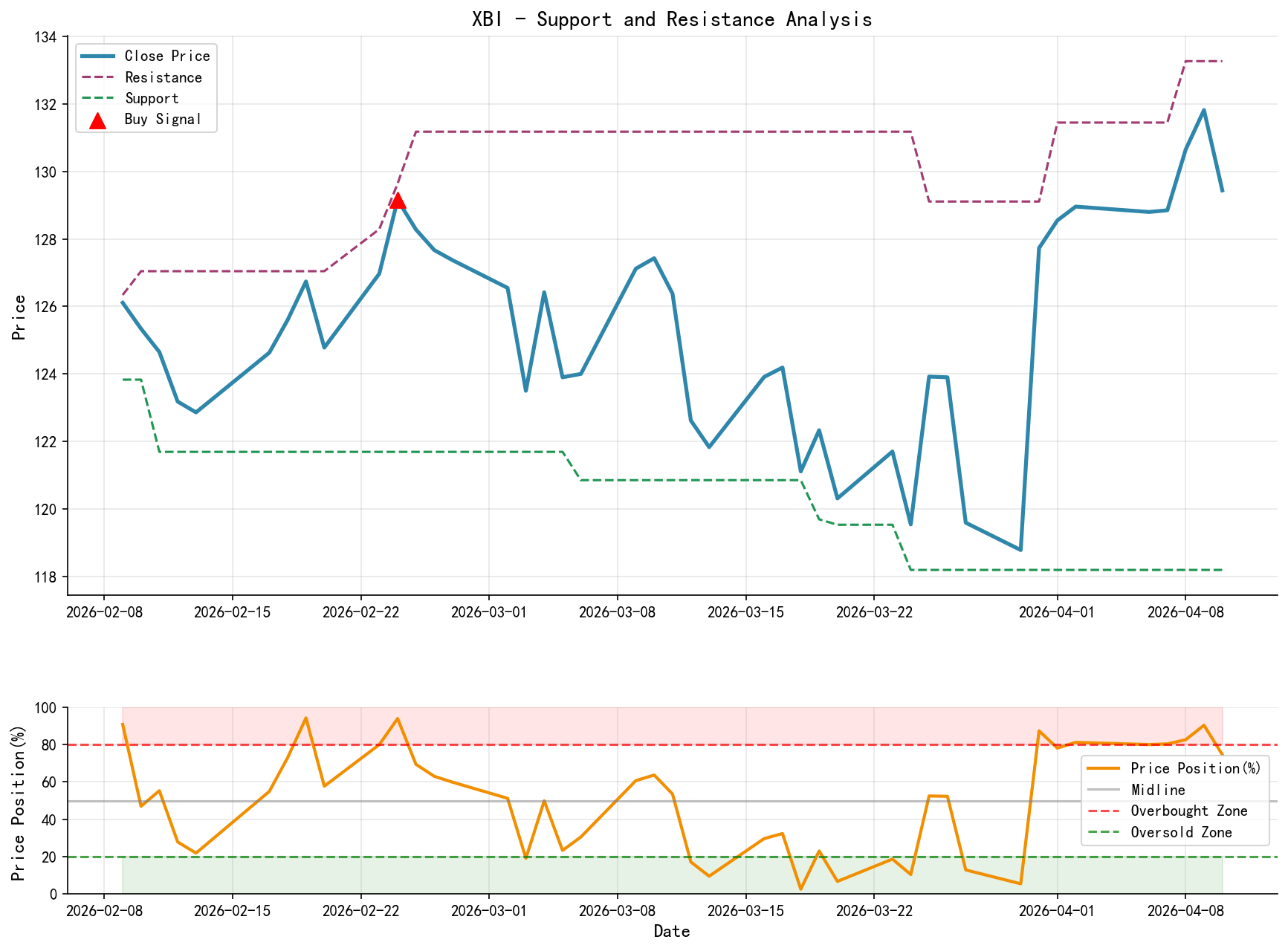
Key Price Levels:
- • Important Support Levels:
- 1. ~127.00: Midpoint of the March 31 high-volume bullish bar and the lower boundary of the early April consolidation platform, also near the MA_10D. Strong support, the line bulls must defend.
- 2. ~125.00: Opening price of March 31 and the dense area of MA_20D/30D. Ultimate support; a break below invalidates the logic of this rally.
- • Important Resistance Levels:
- 1. ~131.80-132.30: Short-term resistance formed by recent highs (April 8, April 9).
- 2. ~133.27: Highest point within the analysis period (April 8); a breakout opens new upside potential.
- 3. ~129.16: Previous high from February 24, now transformed into support, but often sees a retest after the initial breakout.
Comprehensive Wyckoff Trading Signals:
- • Overall Assessment: ** Bullish medium-term, consolidating short-term, awaiting opportunities to buy on dips. The market structure has completely shifted from bearish to bullish, but short-term digestion of profits and support testing is needed.
- • Operational Suggestions:
- • For Observers/Awaiting Signals: Wait for the price to pull back to the 127.00-127.50 support zone and look for low-volume stabilization (volume shrinking below the 60-day average volume) or another high-volume rise as bullish signals to consider entering long positions.
- • For Existing Holders: Consider raising the stop-loss level to just below 125.00. If the price stabilizes above 127 and breaks above 131.80 again on high volume, it could be considered a signal to add to positions.
- • Future Confirmation Points:
- 1. Bullish Confirmation: Price finds support in the 127-128 area, followed by the Wyckoff bullish combination of "low-volume pullback + high-volume rise", with the RSI remaining above 50.
- 2. Bearish Warning: Price breaks below the 125.00 key support on high volume, with weak rebounds. This would indicate the massive late-March buying is trapped, and the market may return to consolidation or decline.
- 3. Volatility Signal: Monitor whether
HIS_VOLA_RATIO_7D_14Dbegins to rise from its current extreme low (0.40). The renewed expansion of volatility typically accompanies the initiation of a new trend.
Conclusion Summary:
Following the epic, smart money-led demand entry in late March, XBI has confirmed a medium-term bottom. The current market is in a healthy phase of trend retracement and support testing. The 3rd highest turnover and 4th highest single-day gain in nearly 10 years established a powerful demand foundation. Short-term adjustment is an inevitable process for digesting extreme volatility and profit-taking. Traders should focus on the defense of the 127-125 core support zone, positioning for long opportunities. The trigger for the market's next wave of advance will be another high-volume breakout above recent highs.
Disclaimer: The content of this report/interpretation is solely market analysis and research based on publicly available information and does not constitute any investment advice or operational guidance. The author strives for objective and impartial content but makes no guarantees regarding its accuracy or completeness. Markets involve risks, and investments require caution. Any investment actions based on this report are taken at one's own risk.
Thank you for your attention! Wyckoff volume-price market analysis is published daily at 8:00 AM before the market opens. Your comments and shares are sincerely appreciated, as your recognition is crucial. Let's work together to see the market signals clearly.
Member discussion: