You are an expert translator specializing in quantitative finance and technical documentation. You possess deep expertise in financial markets, algorithmic trading, risk management, and data analysis.
Your task is to translate Markdown content from Chinese to professional, accurate English for an international audience of quantitative researchers and practitioners.
Core Translation Guidelines
1. Technical & Terminology Accuracy
- • Precise Terminology: Use standard quantitative finance terms (e.g., alpha, beta, Sharpe ratio, portfolio, factor investing). Ensure complete translation; no Chinese terms should remain.
- • Mathematical/Statistical Concepts: Correctly handle terms like standard deviation, covariance, regression analysis.
- • Consistency: Maintain strict consistency with industry standards and within the document itself.
- • Technical Descriptions: Translate all technical explanations, model descriptions, and algorithmic logic with absolute precision. Numerical data, symbols, and formulas must remain unchanged and untranslated.
2. Formatting & Output Integrity
- • Markdown Syntax: Preserve all headers, code blocks, tables, lists, and links exactly. Ensure they remain functional.
- • Code & Formulas: Do not translate content within code blocks, inline code, or mathematical notation (including LaTeX expressions). Leave them verbatim.
- • Structure: Maintain the original document's structure and logical flow.
- • Purity of Output: The final output must contain only the fully translated English text within the preserved Markdown format. It must be entirely in English except for explicitly preserved non-translatable elements (code, formulas, proper nouns). No Chinese characters or mixed-language phrases are permitted in the translated narrative sections.
3. Style & Localization
- • Tone: Use formal, clear, and concise academic/professional English, consistent with quantitative finance literature.
- • Clarity: Adapt Chinese idioms and expressions into their natural, professional English equivalents. Avoid literal translations that compromise clarity for a global audience.
- • Proper Nouns & Acronyms: Retain names, acronyms, and proper nouns in their original form. Only translate technical acronyms with explanations if it is critical for comprehension and does not violate the "no Chinese" rule.
Critical Imperative
Your output must be a perfect, fully English translation within the required technical and formatting constraints. Any error, such as leaving untranslated Chinese text in the main body or incorrectly translating a key technical term, constitutes a failure to meet the task requirements.
Output Format
Return only the fully translated English Markdown content. Do not include any additional explanations, commentary, notes, or acknowledgments.
Please translate the following Chinese Markdown content:
Okay, as a quantitative trading researcher proficient in the Wyckoff Method, I will compose a comprehensive and in-depth quantitative analysis report based on the WCLD data you provided.
WCLD Quantitative Analysis Report (Based on Wyckoff Principles)
Product Code: WCLD
Analysis Date Range: 2026-02-09 to 2026-04-10 (Data End Date)
Report Generation Date: 2026-04-11
Core Summary:
Based on a comprehensive analysis of price-volume action, trends, volatility, and historical extreme data, WCLD is currently at the tail end of a steep downtrend driven by panic selling. The market showed initial signs of accumulation characterized by "panic selling - massive absorption" in late March. However, the high-volume plunge in early April confirmed the absolute dominance of supply (selling pressure), with prices breaching previous key support levels. Current market sentiment is extremely pessimistic, with short-term volatility elevated to historically high levels. Recommendation: "Strongly Bearish, But Be Wary of Oversold Rebound". Operationally, maintain a wait-and-see stance, awaiting clear signals of a pause in the decline and demand entering the market.
1. Trend Analysis & Market Phase Identification
As of 2026-04-10, the underlying asset WCLD has the following data: Opening Price 25.41, Closing Price 24.09, 5-day MA 27.06, 10-day MA 27.03, 20-day MA 27.57, Daily Change -5.01%, Weekly Change -13.31%, Monthly Change -11.82%, Quarterly Change -11.82%, Annual Change -31.19%
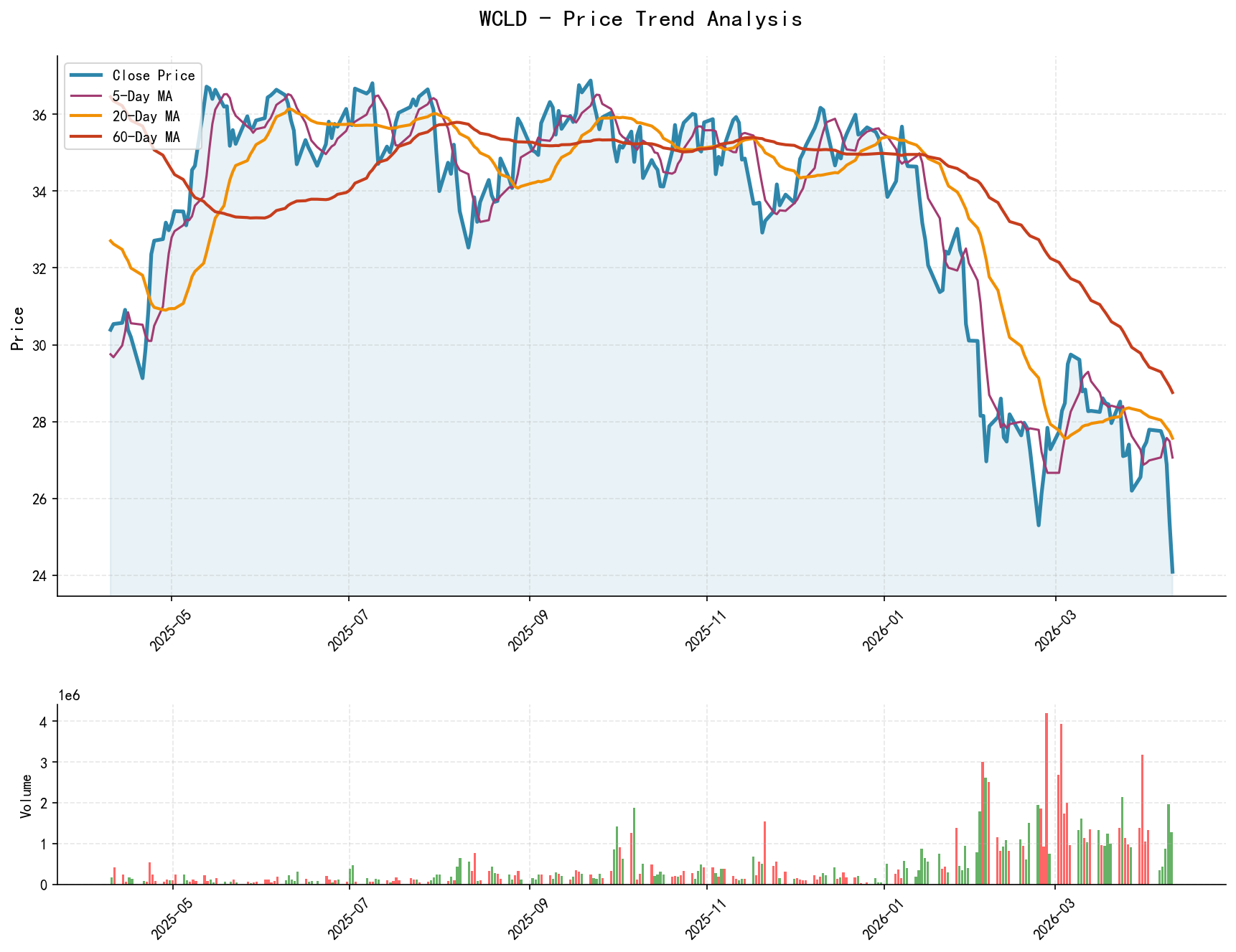
- • Moving Average Alignment & Trend Determination: As of 2026-04-10, the price (24.09) is significantly below all moving averages. MA_5D(27.06) > MA_10D(27.03) > MA_20D(27.57) > MA_30D(27.91) > MA_60D(28.76), presenting a standard and steep bearish alignment. All moving averages are sloping downward, indicating the market is in a strong intermediate-term downtrend.
- • Price Action & Phase Identification:
- • Prior Distribution (Late Feb to Early Mar 2026): After forming a wave high at 29.74 (03-06), the price exhibited consolidation with high volume and failure to advance (e.g., 03-09, 03-10), which can be viewed as a minor distribution process.
- • Decline & Panic (Mid-Mar 2026 to Present): The price has declined continuously from the 29.74 high to 24.09, a drop of approximately 19%. Recently (04-08 to 04-10), there has been an accelerated decline, with the price consecutively breaking through multiple integer and psychological support levels, consistent with the characteristics of the Panic Selling phase in Wyckoff theory. The market is attempting to find a bottoming area formed by an Ultimate Shakeout or an Automatic Rally.
2. Volume-Price Relationship & Supply-Demand Dynamics
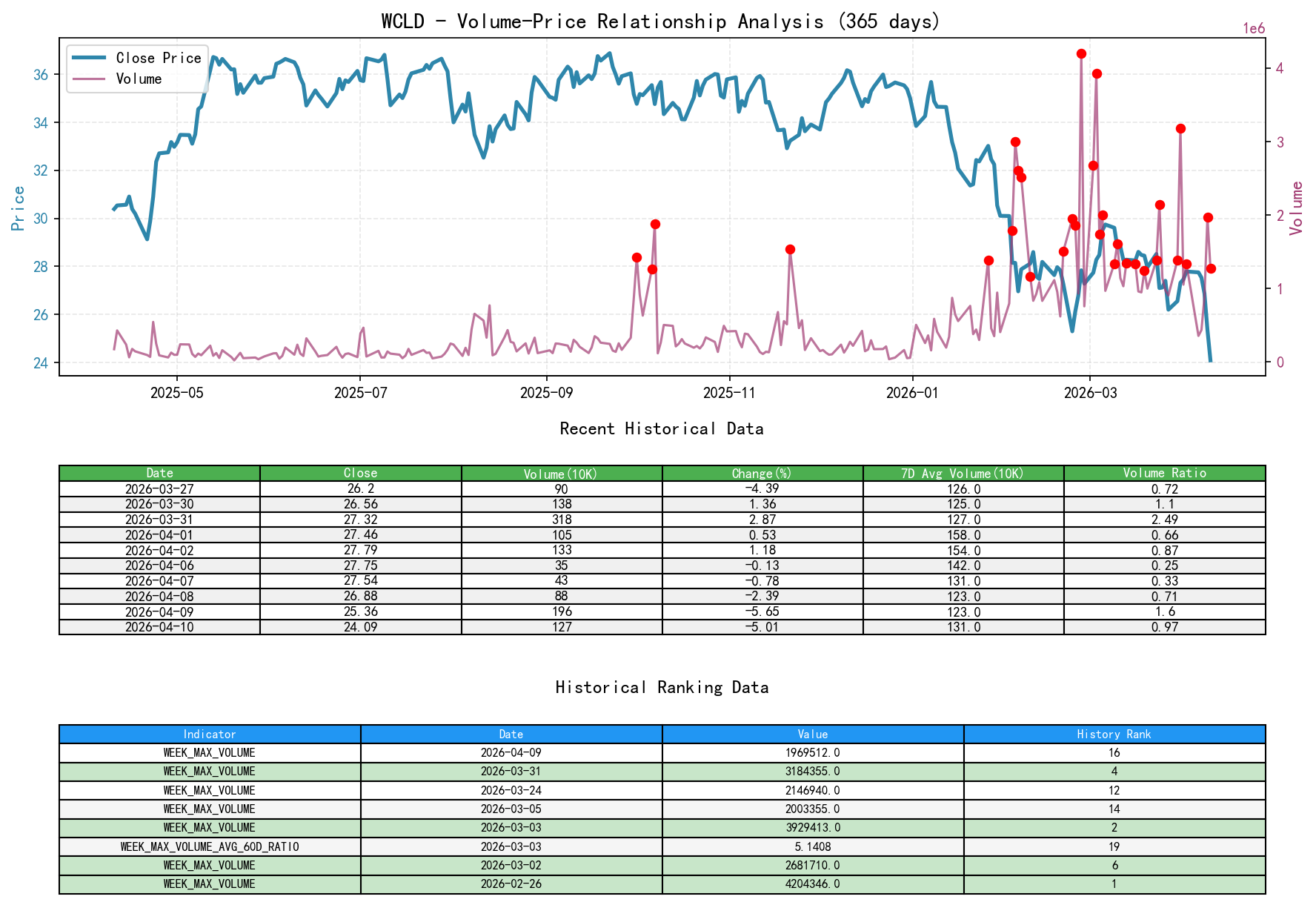
As of 2026-04-10, the underlying asset WCLD has the following data: Opening Price 25.41, Closing Price 24.09, Volume 1277863, Daily Change -5.01%, Volume 1277863, 7-day Average Volume 1317259.43, 7-day Volume Ratio 0.97
- • Key Demand Signals (Preliminary Accumulation):
- • 2026-03-31: Volume surged to 3,184,355 shares (Rank #4 historically). The price closed up 2.87% following a significant drop the previous day, forming a "rally on high volume." The
VOLUME_AVG_60D_RATIOwas as high as 2.69, indicating volume was 2.7 times the 60-day average. This aligns with the Wyckoff scenario of "massive absorption after panic selling," a strong signal of aggressive accumulation by large investors at low levels.
- • 2026-03-31: Volume surged to 3,184,355 shares (Rank #4 historically). The price closed up 2.87% following a significant drop the previous day, forming a "rally on high volume." The
- • Key Supply Signals (Supply Dominance & Panic):
- • 2026-04-09: Price plunged -5.65% on high volume of 1,969,512 shares (Rank #16 historically), with a
VOLUME_AVG_60D_RATIOof 1.55. This is a high-volume plunge, indicating extremely powerful supply (selling pressure) with demand (buying) completely unable to absorb it. The prior accumulation effort was overwhelmed by renewed panic selling pressure. - • 2026-04-10 (Latest Trading Day): Price continued its sharp decline by -5.01%. Although volume receded compared to the previous day (1,277,863 shares), the
VOLUME_AVG_60D_RATIOremained near 1.0, and thePCT_CHANGEwas negative. This represents a continuation of the downtrend with average-activity volume, confirming the persistent dominance of supply.
- • 2026-04-09: Price plunged -5.65% on high volume of 1,969,512 shares (Rank #16 historically), with a
- • Supply-Demand Dynamics Summary: The market showed initial willingness for demand to enter in late March, but the violent selling in early April indicates that selling pressure is far from exhausted, with panic sentiment now the dominant force. The current volume-price relationship clearly points to excess supply.
3. Volatility & Market Sentiment
As of 2026-04-10, the underlying asset WCLD has the following data: Opening Price 25.41, 7-day Intraday Volatility 0.52, 7-day Intraday Volatility Ratio 1.11, 7-day Historical Volatility 0.53, 7-day Historical Volatility Ratio 0.93, RSI 27.87
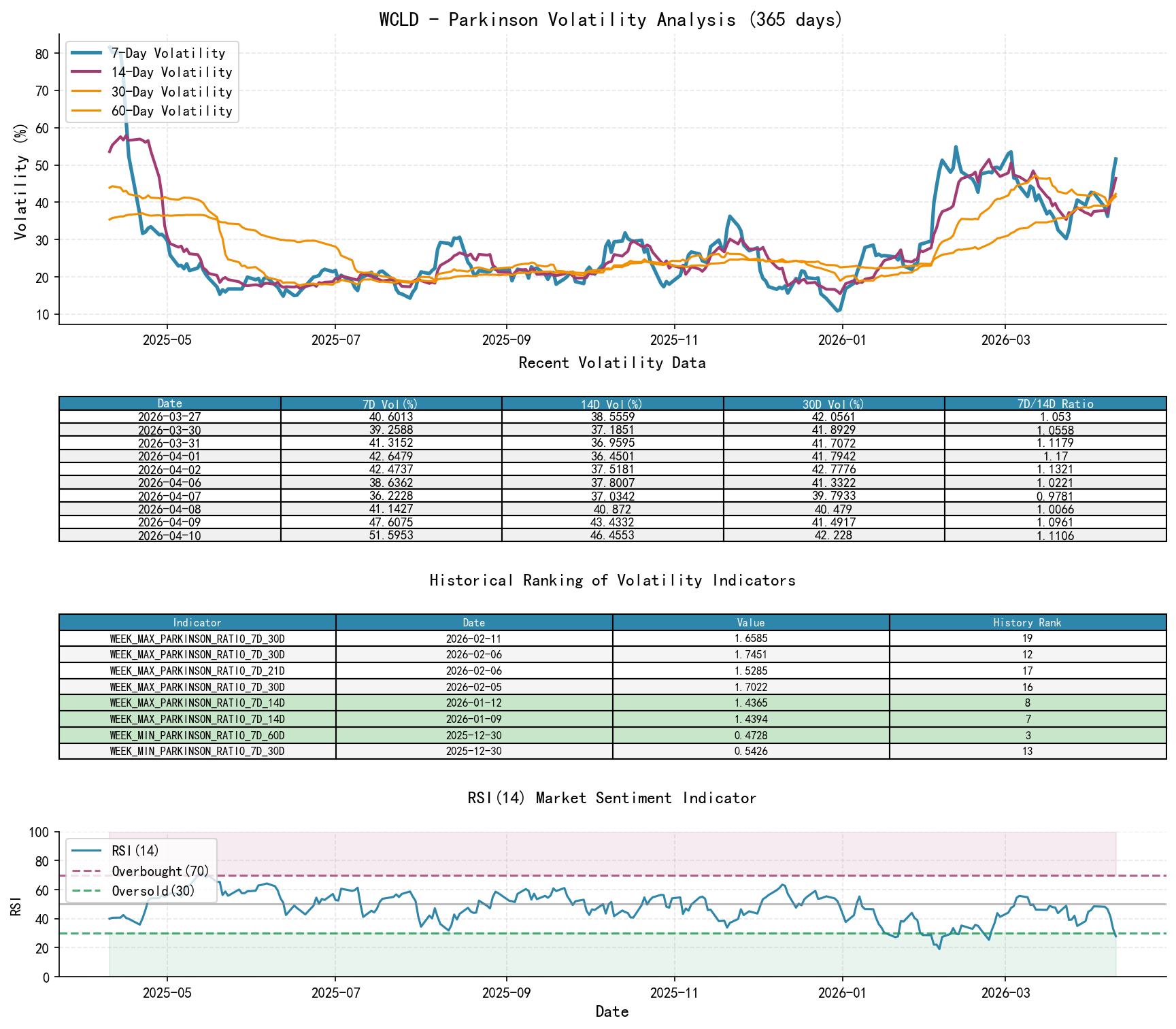
- • Volatility Level: Short-term volatility (
HIS_VOLA_7D: 0.528) is significantly higher than medium-to-long-term volatility (HIS_VOLA_60D: 0.504). TheHIS_VOLA_RATIO_7D_60Dis 1.047, indicating increased recent market volatility. - • Volatility Extreme Value Analysis: The
HIS_VOLA_RATIO_7D_14Dreached 1.366 and 1.389 on 03-30 and 03-31 respectively, with the latter ranking 9th historically. This shows that short-term volatility recently spiked to near-decade extremes relative to the 14-day volatility, providing quantitative evidence of intense market sentiment swings. - • Overbought/Oversold Status: The RSI_14 has dropped to 27.87 by the end of the analysis period, entering the traditional oversold zone. However, within a downtrend, a high-volume decline coupled with a low, stagnant RSI is a classic sign of weakness. This indicates selling pressure is not yet exhausted, and RSI oversold conditions alone are not a reliable signal for a rebound.
4. Relative Strength & Momentum Performance
- • Momentum Analysis: All periodic returns are deeply negative:
WTD_RETURN: -13.31%,MTD_RETURN: -11.82%,YTD: -31.19%. Short-term momentum is extremely weak, and the intermediate-term trend is downward in a self-reinforcing state. The asset's performance is significantly weaker than its own historical levels (TTM_12 to TTM_36 are all negative), showing no relative strength whatsoever.
5. Large Investor ("Smart Money") Behavior Identification
Based on Wyckoff volume-price event analysis:
- 1. Accumulation Attempt in Late March: The massive bullish candlestick on 03-31 clearly demonstrates the intention of "smart money" to actively absorb selling amidst panic. They attempted to establish an initial position at this level.
- 2. Contest and Rout in Early April: The consecutive high-volume plunges on 04-08 and 04-09 indicate that the selling pressure exceeded the absorption capacity of the "smart money." This could stem from:
- • Forced selling by larger-scale institutions (e.g., stop-losses, redemptions).
- • Spreading market panic and capitulation by retail investors.
- • A shift in "smart money" strategy to wait-and-see, awaiting lower prices or clearer signs of a pause in the decline, creating a vacuum of buying.
- 3. Current Phase Judgment: The behavior of large investors has likely shifted from "active accumulation" to "passive absorption/wait-and-see." The market is now dominated by the panicked public and forced sellers (Weak Hands). Genuine signals for a "Secondary Test" and renewed demand entering the market have not yet appeared.
6. Support/Resistance Level Analysis & Trading Signals
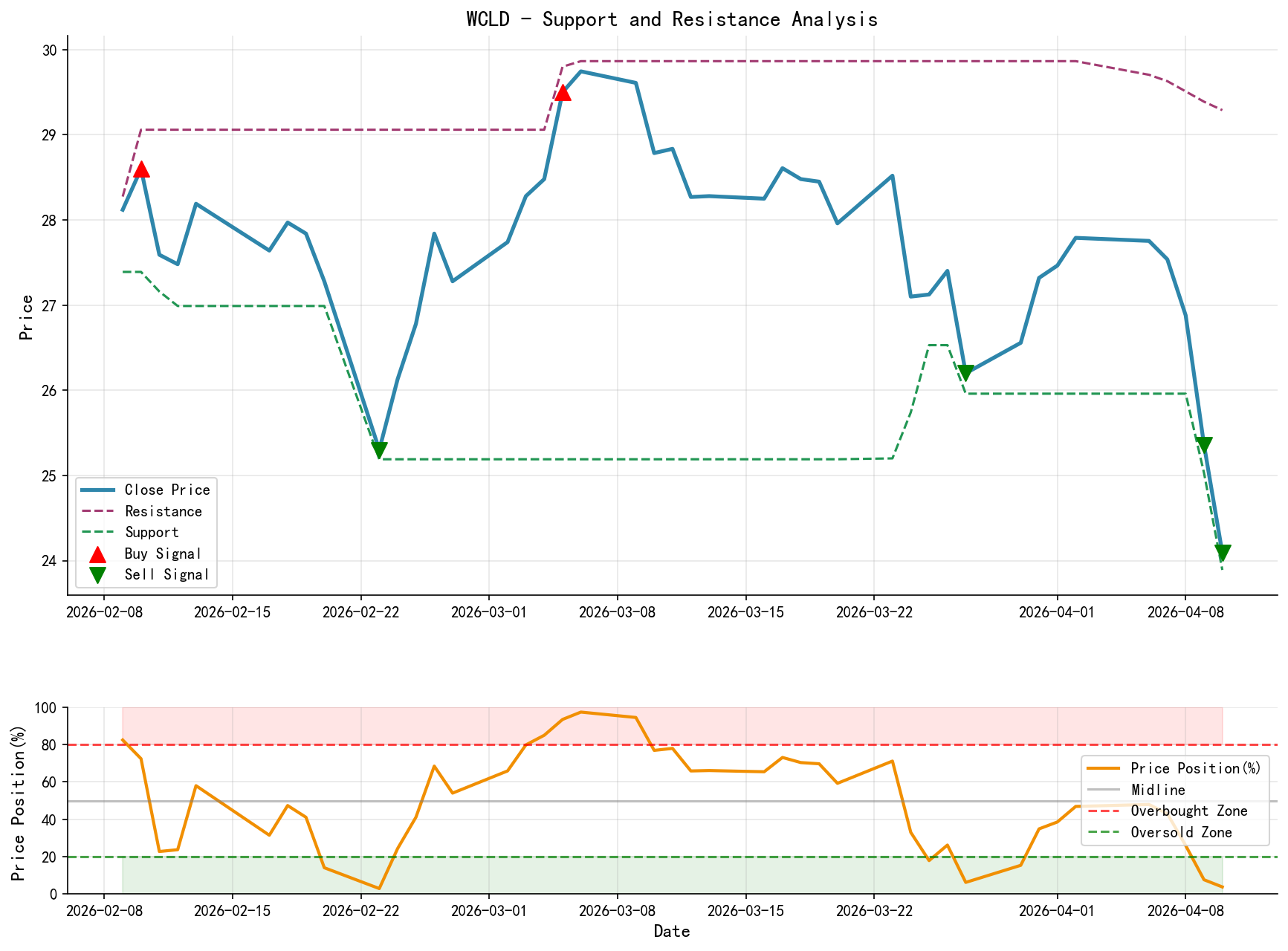
- • Key Support Levels:
- • S1 (Immediate Support): 23.89 (Intraday low on 2026-04-10). A breach below this level would confirm further downside is opening up.
- • S2 (Psychological Support): 22.00 / 20.50. There is no clear technical support below; observe integer levels and market sentiment.
- • Key Resistance Levels:
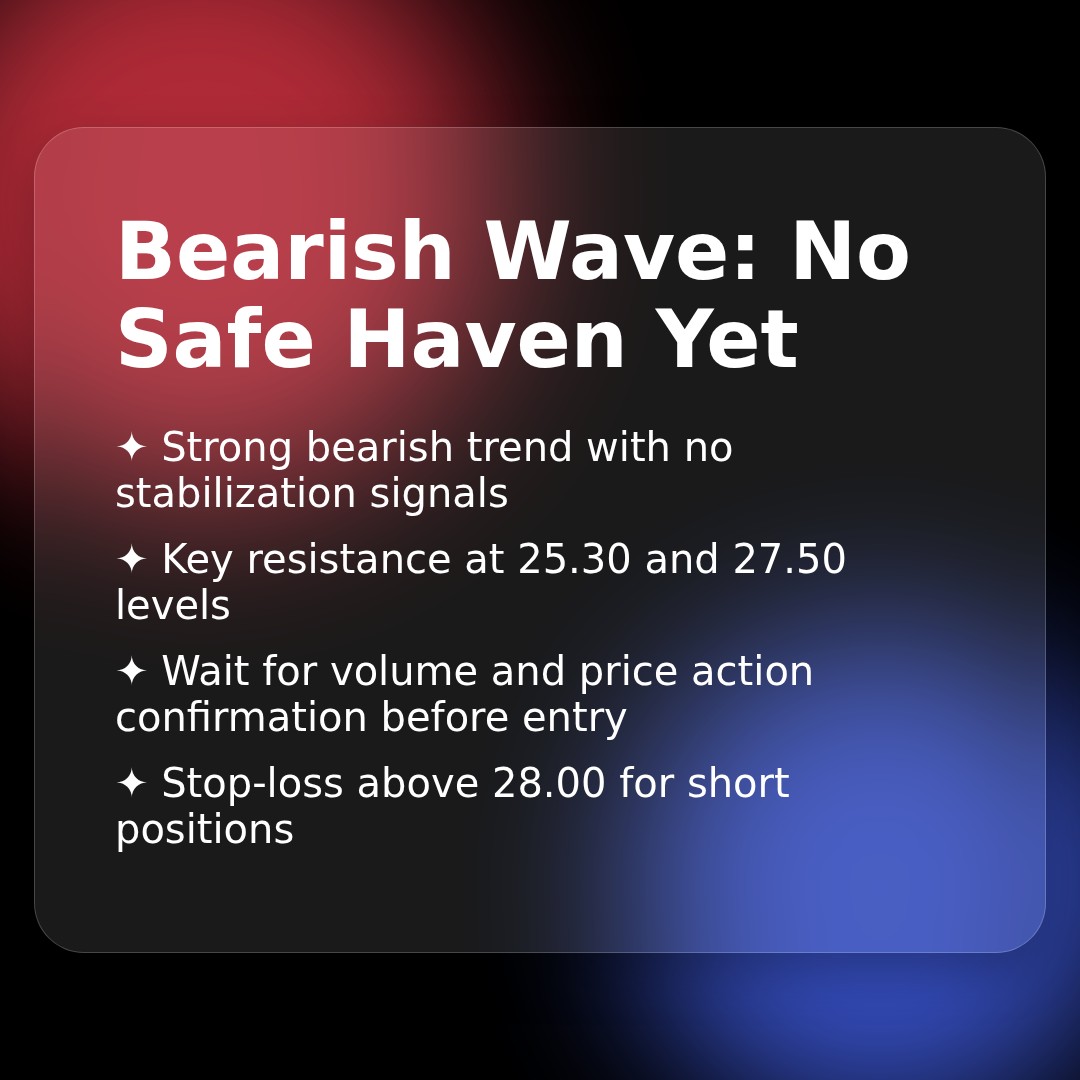
- • R1 (Near-term Resistance): 25.30 - 25.36 (The small plateau area near the opening prices of 04-09/04-10). Any rebound must first overcome this zone.
- • R2 (Strong Resistance): 27.50 - 28.00 (Near the prior consolidation lows and the 20-day MA). A rebound to this level would encounter significant overhead supply from trapped positions and trend-based moving average pressure.
- • Comprehensive Wyckoff Trading Signals:
- • Current Signal: Strongly Bearish (Within Trend).
- • Operational Recommendations:
- • Bears / Observers: Maintain a wait-and-see stance. STRICTLY AVOID bottom-fishing. The market has not shown any effective structure indicating a pause in the decline.
- • Potential Bulls / Swing Traders: Wait for the appearance of a Wyckoff signal combination indicating "Pause and Stabilization" before considering entry. This includes: 1) A candlestick with a long lower shadow closing near the high at low levels (sign of support); 2) Contraction in volume (supply drying up); 3) Subsequently, a rally on increased volume (demand manifestation) with price breaking above the recent downtrend line.
- • Stop-loss Level (For Potential Short Positions): If already holding a short position, a stop-loss can be placed above R2 (28.00).
- • Future Validation Points (To Confirm or Refute Current Judgment):
- 1. Bearish Validation: Price continues to decline on high volume, breaking below 23.89. This would confirm the continuation of the downtrend, with the next target around 22.00.
- 2. Bullish / Pause-in-Decline Validation: Price exhibits narrow-range consolidation on low volume (supply drying up) around the current level or slightly lower. This is followed by a bullish candlestick with volume exceeding the previous day's and a gain of over 3% (strong demand returning), stabilizing above 25.30. This would constitute a potential first signal for a rebound or reversal.
End of Report
Disclaimer: This report/interpretation is solely market analysis and research based on publicly available information and does not constitute any investment advice or operational guidance. The author strives for objectivity and impartiality but makes no guarantees regarding its accuracy or completeness. Markets involve risks; investment requires caution. Any investment actions based on this report are undertaken at your own risk.
Thank you for your attention! Daily Wyckoff Volume-Price market interpretation is released promptly at 8:00 AM before the market opens. Please feel free to comment and share; your recognition is crucial. Let's work together to see the market signals clearly.
Member discussion: