Very well. As a quantitative trading researcher proficient in the Wyckoff Method, I will compose a comprehensive and in-depth quantitative analysis report based on the VAW data (2026-02-09 to 2026-04-10) and historical ranking indicators provided. The report will strictly adhere to six dimensions, with all conclusions derived from data analysis and consistent with Wyckoff price-volume principles.
Product Code: VAW
Analysis Date Range: 2026-02-09 to 2026-04-10
Wyckoff Quantitative Analysis Report - VAW
1. Trend Analysis & Market Phase Identification
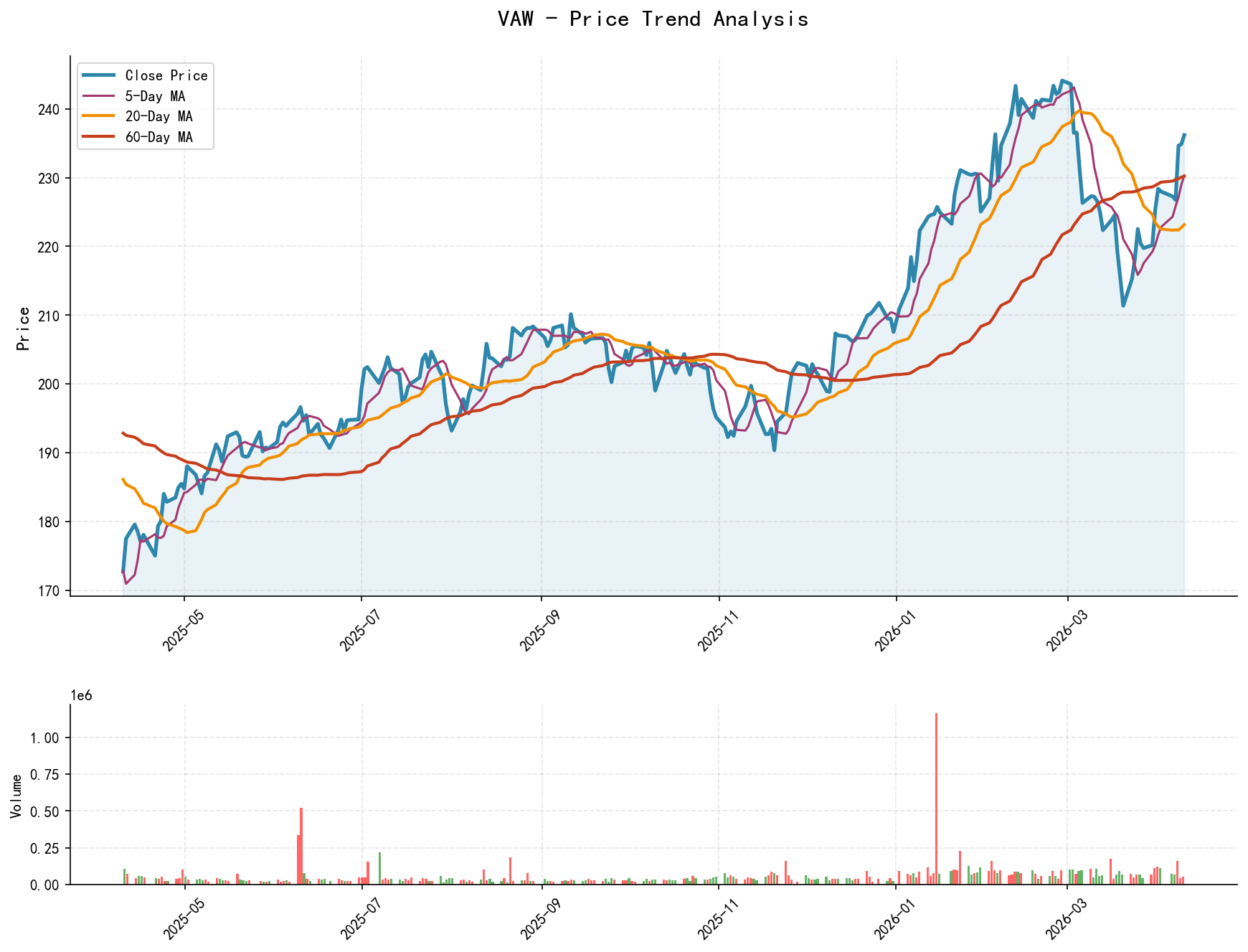
As of April 10, 2026, the target VAW has an opening price of 236.29, a closing price of 236.20, a 5-day moving average of 230.31, a 10-day moving average of 226.56, a 20-day moving average of 223.16, with daily change of +0.57%, weekly change of +3.60%, monthly change of +4.82%, quarterly change of +4.82%, and yearly change of +13.80%.
- • Moving Average Alignment and Trend Evolution:
- • Phase One (Advance/Acceleration): From February 9th to February 27th, the closing price (CLOSE) consistently remained above all short, medium, and long-term moving averages (MA_5D, MA_10D, MA_20D, MA_30D, MA_60D), exhibiting a typical bullish alignment, with the price rising strongly along the MA_5D.
- • Phase Two (Reversal/Decline): After March 2nd, the price rapidly fell below all short-term moving averages (MA_5D/10D), and on March 5th-6th, it broke below the medium and long-term averages (MA_20D/30D), forming a bearish alignment. The price retreated from its historical highs, entering a significant downtrend.
- • Phase Three (Rebound/Recovery): From late March to early April, the price stabilized and rebounded from low levels. As of April 10th, the closing price (236.20) has reclaimed positions above the MA_5D (230.31) and MA_10D (226.562), but hovers near the MA_20D (223.163), MA_30D (226.841), and MA_60D (230.235). This indicates the short-term trend has turned from down to up and is re-testing and challenging medium-term moving average resistance.
- • Wyckoff Market Phase Inference:
- • February: Distribution Phase. The price reached decade-high ranking highs (e.g., the opening price of 245.26 on February 25th ranked 1st in ten years), but upward momentum waned (a high-open, low-close, high-volume bearish candlestick on February 12th), followed by a rapid decline. This aligns with characteristics of the Distribution phase: an inability to sustain new highs followed by large capital unwinding positions at elevated levels.
- • March: Panic and Preliminary Support Phase. From March 3rd to March 20th, there were consecutive high-volume plunges (e.g., -2.27% on March 5th with volume 115.7% above the 7-day average). The RSI briefly fell below 25, indicative of classic panic selling. After the panic, volume contracted (e.g., March 19th), and the price oscillated in a narrow range at lows, showing signs of Preliminary Support (PS) and Secondary Test (ST).
- • April (to date): Initial stage of a New Uptrend after Accumulation. On April 8th, a Jump Over the Creek (JOC)-style breakout occurred—a high-volume (162,773, 156.4% of the 60-day average) long bullish candlestick (+3.48%) that decisively broke above the upper boundary of the prior consolidation range, confirming demand has regained control of the market. The low-volume pullback on April 9th-10th tested the validity of the breakout, constituting a Last Point of Support (LPS).
2. Price-Volume Relationship & Supply-Demand Dynamics
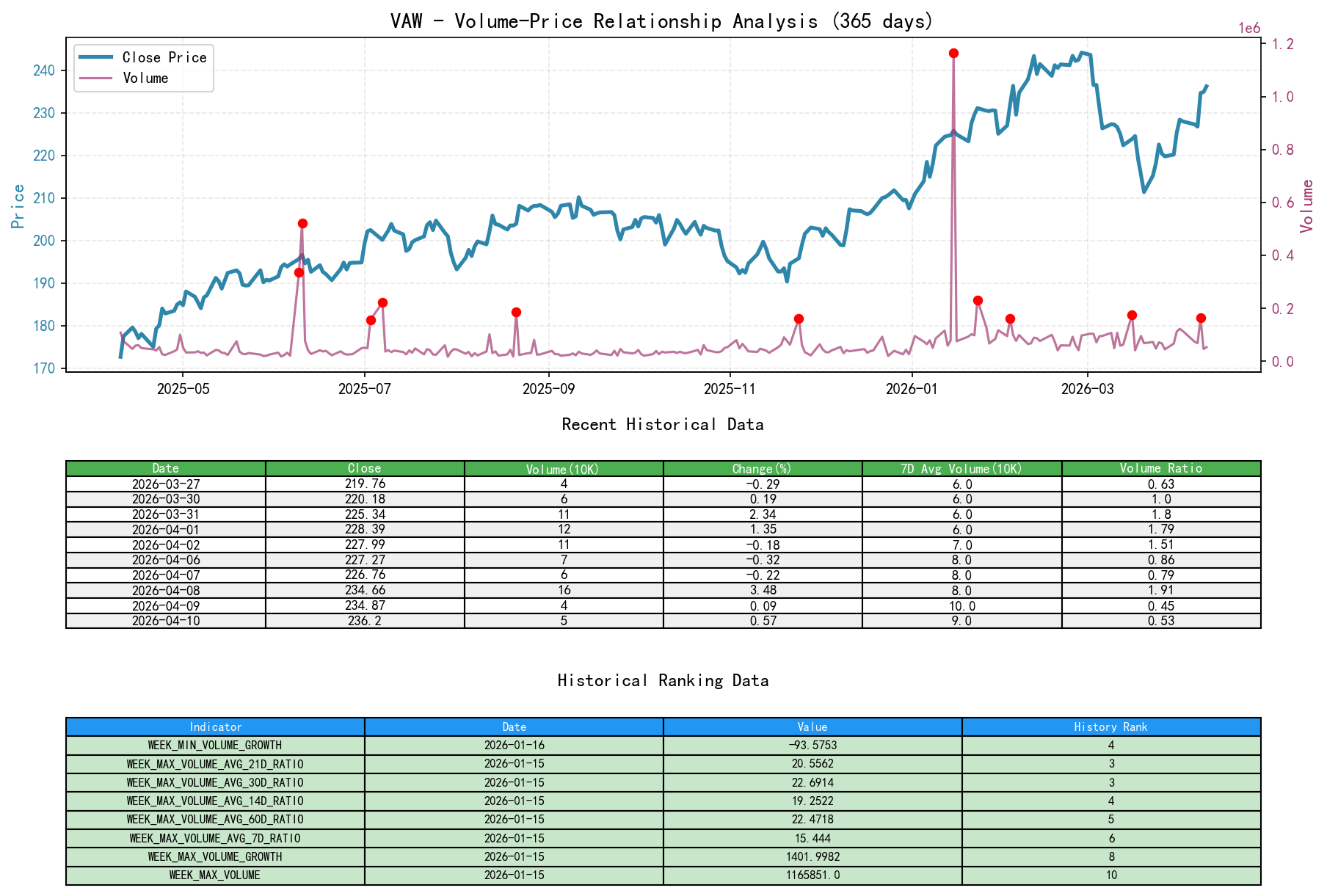
As of April 10, 2026, the target VAW has an opening price of 236.29, a closing price of 236.20, volume of 52,479, daily change of +0.57%, volume of 52,479, 7-day average volume of 99,424.86, and a 7-day volume ratio of 0.53.
- • Demand-Dominated Periods (Bullish Price-Volume Structures):
- • February 9th-11th: Consecutive price gains (+1.35%, +1.09%, +1.20%) accompanied by steadily increasing volume (VOLUME_AVG_7D_RATIO rising from 0.62 to 0.94), presenting the classic pattern of rising price on rising volume, indicating strong demand.
- • April 8th: Key turning day. A price surge of +3.48% accompanied by a massive volume spike to 162,773 contracts, 190.7% of the 7-day average and 156.4% of the 60-day average (HISTORY_RANK data indicates this volume level is at an extreme high recently). This is a clear signal of overwhelming demand, indicating substantial buying interest entering at the breakout level.
- • Supply-Dominated Periods (Bearish Price-Volume Structures):
- • February 12th: The price opened high and closed low, falling -1.75%, but volume (86,252) did not contract (VOLUME_AVG_7D_RATIO was 0.93). This is a typical Sign of Weakness (SOW), indicating significant selling pressure at highs.
- • March 3rd, March 5th-6th: Consecutive sharp price declines (-2.91%, -2.27%, -2.10%), all accompanied by volume significantly above the short-term average (VOLUME_AVG_7D_RATIO > 1.15). This is panic selling, with supply being released continuously during the decline.
- • Supply-Demand Transition Points:
- • March 23rd, March 25th: Price rebounded after the decline (+1.84%, +2.00%), but volume was notably lower compared to the preceding panic selling (VOLUME_AVG_7D_RATIO < 1.0). This suggests supply was exhausted (Selling Climax followed by Automatic Rally), as the decline lacked follow-through selling.
- • April 10th: A minor price increase of +0.57% with volume (52,479) contracting sharply compared to the previous day's huge volume (VOLUME_GROWTH was +14.56%, but VOLUME_AVG_7D_RATIO dropped to 0.53). A low-volume pullback following a breakout bullish candlestick indicates supply did not actively emerge, suggesting market reluctance to sell, which is a good test of the breakout's validity.
3. Volatility & Market Sentiment
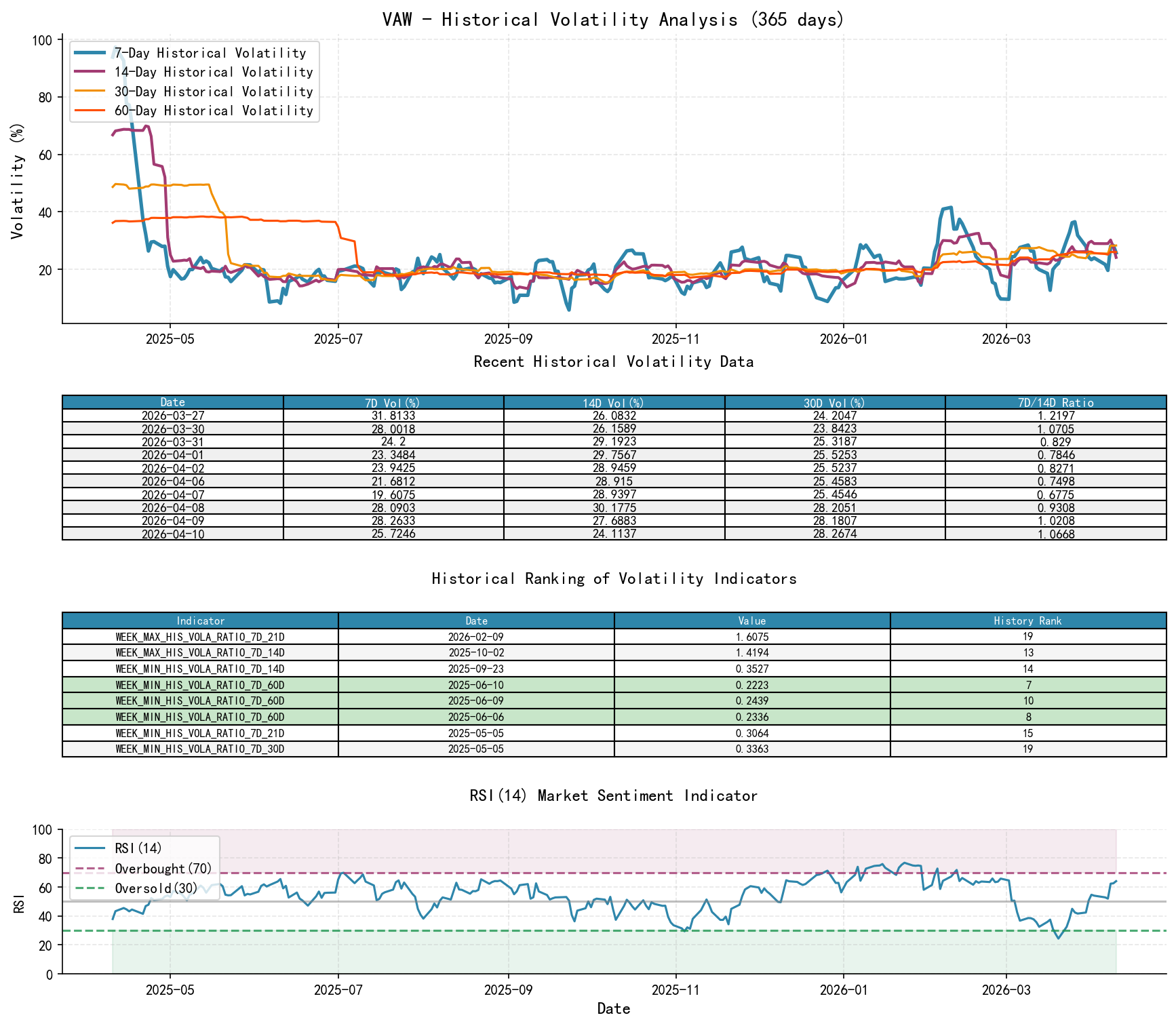
As of April 10, 2026, the target VAW has an opening price of 236.29, a 7-day Parkinson volatility of 0.14, a 7-day Parkinson volatility ratio of 0.81, a 7-day historical volatility of 0.26, a 7-day historical volatility ratio of 1.07, and an RSI of 64.10.
- • Volatility Level and Changes:
- • Euphoria and Panic: In late February during the advance, the ratio of short-term historical volatility (HIS_VOLA_7D) to long-term (60-day) volatility (HIS_VOLA_RATIO_7D_60D) reached as high as 1.84 (February 9th), indicating heightened market euphoria. During the March decline, this ratio remained above 1.0, with volatility expanding again, reflecting market panic. Historical ranking data confirms that the "7-day/21-day historical volatility ratio" on February 9th ranked 19th in the past decade, at a high percentile, foreshadowing the subsequent trend change.
- • Sentiment Repair and Convergence: Entering April, short-term volatility converged rapidly. HIS_VOLA_7D retreated from March highs above 0.36 to 0.257 on April 10th, with the ratio to 60-day volatility (HIS_VOLA_RATIO_7D_60D) falling to 0.99. The Parkinson intraday volatility (PARKINSON_VOL_7D) dropped further to 0.139, only 77.3% of its 60-day level. The comprehensive convergence of volatility indicates the market is moving away from extreme sentiment into a relatively stable and rational trading environment, conducive to the healthy development of a new trend.
- • RSI Overbought/Oversold Validation:
- • On February 11th, the RSI_14 reached 71.85, entering overbought territory, providing a momentum-based early warning for the exhaustion of the uptrend.
- • On March 19th-20th, the RSI_14 fell to the severely oversold range of 25-27, precisely corresponding to the price lows (215.35, 211.37), confirming the emotional pessimism extreme.
- • The current RSI_14 is 64.10, within a strong range but not overbought, leaving room for further price appreciation.
4. Relative Strength & Momentum Performance
- • Momentum Trend: The YTD (Year-to-Date Return) clearly depicts the "strong-weak-strong" transition of momentum. From the +17.6% high in late February, it collapsed to the low of +1.84% on March 20th, with momentum nearly exhausted. Subsequently, momentum recovered strongly, with the YTD rebounding to +13.80% as of April 10th.
- • Recent Momentum: The WTD_RETURN (Weekly Return) has been consistently positive since early April (+3.60% on April 10th), and the MTD_RETURN (Monthly Return) is +4.82%, indicating that short and medium-term momentum have simultaneously strengthened. This validates the effectiveness of the April 8th breakout identified in the Price-Volume Analysis and aligns with the conclusion of short-term moving average golden crosses in the Trend Analysis.
5. Large Investor (Smart Money) Behavior Identification
- • Distribution Behavior (Mid-late February): After prices reached historical highs (HISTORY_RANK data shows opening, closing, high, and low prices all at decade highs), instances of "high volume with price stalling or declining" appeared (e.g., February 12th). Smart money completed distribution at elevated levels amidst optimistic sentiment and ample liquidity.
- • Panic Absorption and Accumulation Behavior (Mid-late March): During the panic decline (high-volume plunge on March 5th-6th), a large amount of stop-loss and panic selling inevitably emerged. The subsequent low-volume rebound (March 23rd, 25th) and low-level consolidation indicate selling pressure subsided. Smart money likely began selective accumulation during this phase, but actions were discreet (low volume). The true signal of active accumulation appeared with the high-volume bullish candlestick on April 8th, which represents smart money openly and assertively confirming the bottom and establishing long positions. The low-volume pullback on April 9th-10th is their action of "testing the market" and consolidating the cost area, with no significant selling pressure emerging.
6. Support/Resistance Level Analysis & Trading Signals
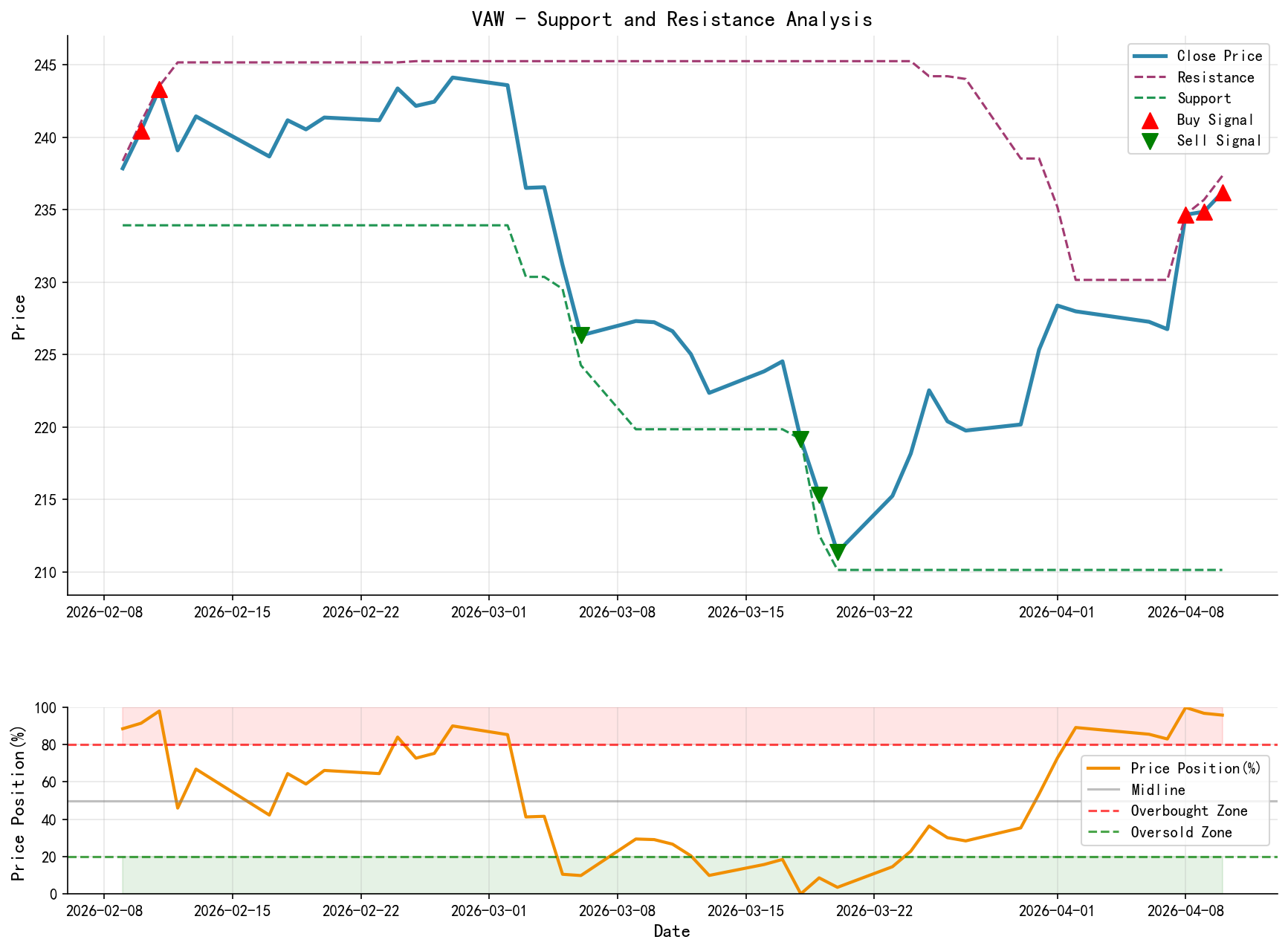
- • Key Levels:
- • Strong Resistance: The 244.00 - 245.50 zone. This is the historical high zone reached in February (high of 245.26 on Feb 25th, high of 244.22 on Feb 27th), serving as the primary target and resistance area for the next stage of advance.
- • Recent Resistance/Support Pivot: The 230.00 - 232.00 zone. Corresponding to the MA_30D/60D and the upper boundary of the early April consolidation platform, currently broken, which should transform into significant support.
- • Strong Support: The 218.00 - 220.00 zone. The low area tested multiple times in late March, also serving as the ultimate line of defense for the current uptrend.
- • Comprehensive Wyckoff Events & Trading Signals:
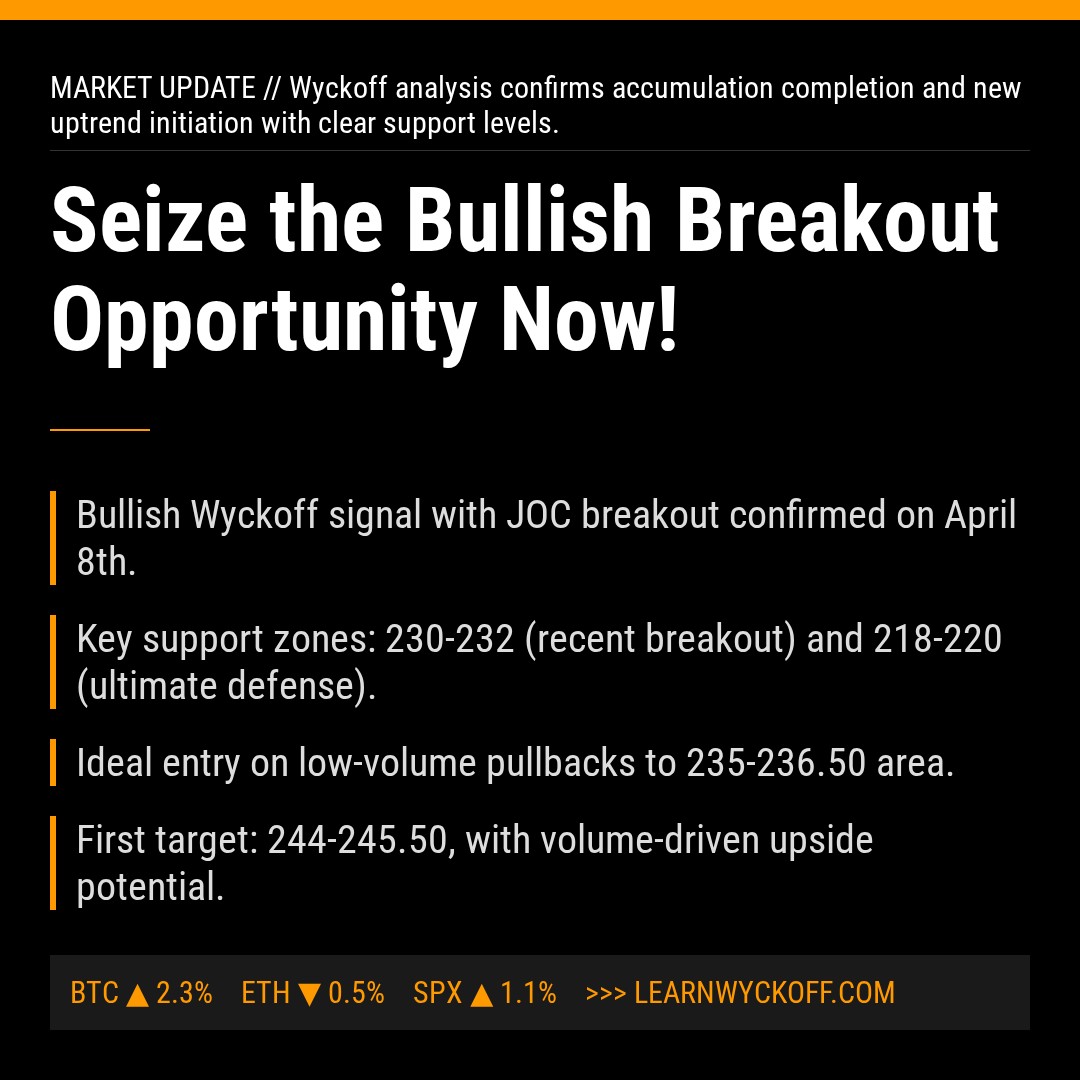
- • Signal Nature: Bullish. The market has confirmed completion of the accumulation process involving "Selling Climax (SC) - Automatic Rally (AR) - Secondary Test (ST)" and initiated a new uptrend with the "Jump Over the Creek (JOC)" event on April 8th.
- • Operational Recommendations:
- 1. Entry Strategy: View any low-volume pullback above the breakout zone (~230-232) positively (such as the price action on April 9th-10th) as an opportunity to add/enter positions. Ideal Entry Zone: 235.00 - 236.50 (the recent LPS area).
- 2. Stop-Loss Setting: Set strictly below the key support level at 218.00. A break below this level would invalidate the accumulation structure, necessitating a reassessment of the bullish thesis.
- 3. Target Outlook: The first target points towards the previous high zone of 244.00 - 245.50. A breakout with volume would further open the upside potential.
- • Future Validation Points:
- 1. Positive Validation: The price maintains consolidation above the 230-232 support zone, with consistently low volume during pullbacks. This is followed by another high-volume (volume above 7-day/60-day average) advancing candlestick.
- 2. Risk Warning (Invalidation Signal): A high-volume break below the 230.00 support, followed by a breach of 225.00, would indicate the April 8th breakout may be a "false breakout," with demand failing to sustain, and the market likely reverting to consolidation or a downtrend. Immediate stop-loss activation and market structure reassessment would be required.
Disclaimer: This report/interpretation is solely market analysis and research based on publicly available information and does not constitute any investment advice or operational guidance. The author strives for objectivity and impartiality but makes no guarantee regarding the accuracy or completeness of the content. The market involves risks; investment requires caution. Any investment actions based on this report are taken at one's own risk.
Thank you for your attention! Wyckoff Price-Volume Market Interpretations are published daily at 8:00 AM before the market opens. Your comments and shares are sincerely appreciated and crucial. Let's work together to see the market signals clearly.
Member discussion: