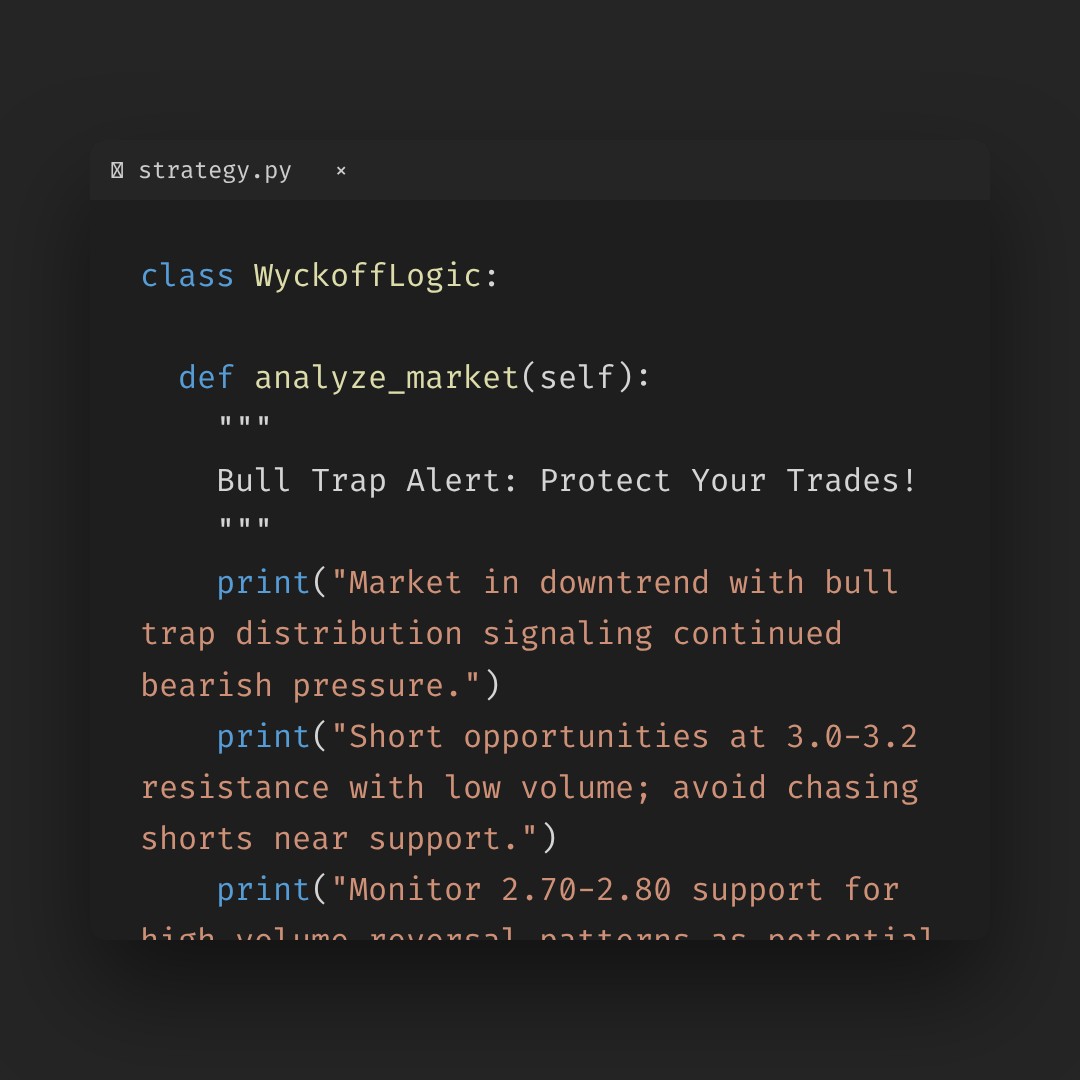
I will assume the role of a quantitative trading researcher proficient in the Wyckoff method and, based on the provided TRUMPUSDT data and historical ranking metrics, produce a comprehensive and in-depth quantitative analysis report.
TRUMPUSDT Quantitative Analysis Report
Product Code: TRUMPUSDT
Analysis Date Range: 2026-02-09 to 2026-04-10
Report Generation Time: 2026-04-11
Executive Summary
Based on an analysis of daily data from the past 61 trading days (2026-02-09 to 2026-04-10), TRUMPUSDT exhibits a clear market evolution path characterized by "Panic Decline -> Massive Bull Trap Rebound -> Post-Distribution Return to Downtrend". The core conclusions are as follows:
- 1. Long-term and Medium-term Trends (MA_60D, MA_30D): Significantly suppressed, with the price in a clear mid-to-long-term downtrend channel.
- 2. Key Turning Point Event (2026-03-13): That day witnessed a record-breaking volume, price increase, and volatility, constituting a significant "Buying Climax"-style rebound. However, subsequent price action failed to make new highs and swiftly retreated. The price-volume relationship indicates that this event was a supply-driven Distribution rather than a demand-driven start of a new uptrend.
- 3. Large Investor Behavior: Analysis indicates that smart money executed distribution at elevated prices during the massive mid-March rebound, after which the price naturally declined due to exhausted demand. The current price is near recent lows, with the market in a phase of seeking support.
- 4. Current Market Phase: The asset is in the downtrend phase following distribution, currently testing previous low support. RSI and volatility indicators have retreated from extreme highs, indicating a shift in market sentiment from frenzy to cooling.
- 5. Composite Signal: Short-term bearish, medium-term bearish bias. Any rebound towards the 3.0-3.2 zone, if accompanied by declining volume, represents a potential shorting or position-reduction opportunity. Key support lies in the 2.70-2.80 zone. It is crucial to observe whether this level exhibits signals of "accumulation on high-volume stopping" or "panic selling."
Dimension One: Trend Analysis & Market Phase Identification
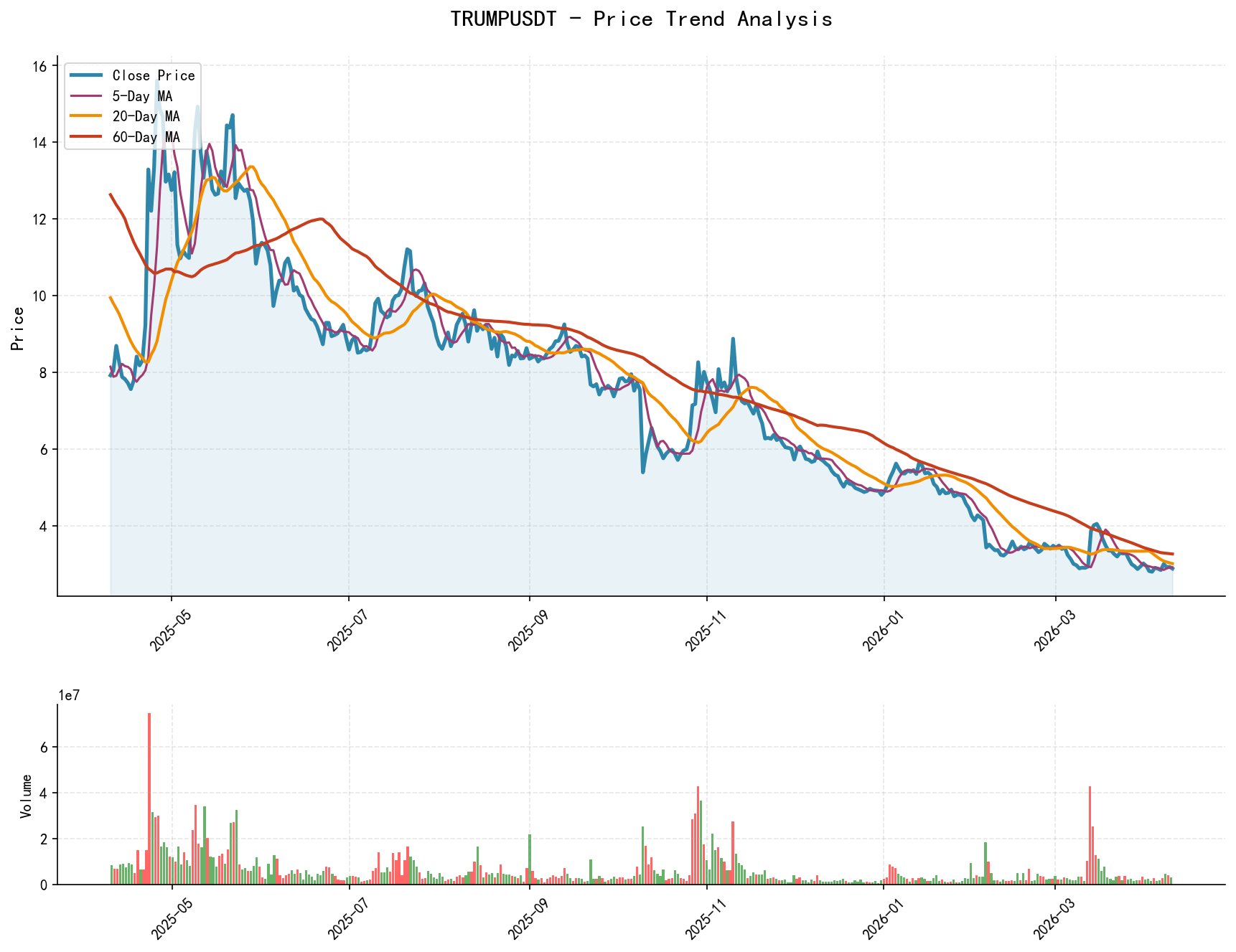
As of April 10, 2026, the underlying asset TRUMPUSDT has an open price of 2.93, a close price of 2.88, a 5-day moving average of 2.91, a 10-day moving average of 2.90, a 20-day moving average of 3.01, a daily change of -1.54%, a weekly change of 3.00%, a monthly change of -4.41%, a quarterly change of -4.41%, and a yearly change of -39.99%.
1. Moving Average Alignment Analysis:
Observing from the period's end (2026-04-10), MA_5D (2.913) < MA_10D (2.904) < MA_20D (3.010) < MA_30D (3.190) < MA_60D (3.262). The price (2.881) is below all moving averages, and the MAs are arranged in a bearish order, indicating a clear mid-to-long-term downtrend. During this period, only during the massive mid-March rebound did the price briefly break above all short-term MAs, but it failed to reverse the downward direction of the MA_30D and MA_60D and was subsequently suppressed and fell back.
2. Moving Average Crossovers and Price Action:
Throughout the analysis period, the price has consistently been suppressed by the MA_5D and MA_10D, forming a standard "rally-resistance" pattern within a downtrend. The massive bullish candlestick on March 13 triggered a brief golden cross where MA_5D crossed above MA_10D. However, this crossover signal became invalid as the price retreated rapidly, and the moving average system reverted to a bearish alignment. This validates that in a downtrend, moving average crossover signals lacking sustained volume support are false.
3. Market Phase Inference (Wyckoff Perspective):
- • February 9 to March 12: Panic Decline and Preliminary Stopping (Accumulation?):
The price declined gradually from around 3.3 to 2.9. During this period, RSI_14 fell below 20 multiple times (reaching a low of 18.17 on Feb 11, historically ranked 2nd), entering oversold territory. On March 12, a candlestick with a long lower shadow appeared (low of 2.705), accompanied by a 620% surge in volume (historically ranked 2nd). This could be considered a test of a panic sell-off (Selling Climax, SC). However, the subsequent massive rebound altered the nature of this structure. - • March 13 to March 19: Massive Rebound and Distribution:
An explosive move occurred on March 13 (+31.55%), with volume reaching 42.66 million (historically ranked 11th). This rapidly reversed market pessimism. However, after consolidating at high levels in the 4.0-4.4 range for 5 trading days, the price failed to advance further and eventually turned downward. This process aligns with the "Buying Climax (BC) -> Distribution" structure in Wyckoff theory. Smart money used the massive rally to attract public buying interest and completed distribution at elevated prices. - • March 20 to April 10: Downtrend Following Distribution (Markdown):
The price declined smoothly from the highs, with volume gradually diminishing. During the decline, multiple low-volume rebounds occurred (e.g., March 23, March 31), which were technical bounces under conditions of insufficient supply but did not show effective demand absorption signals. The current market is in this downtrend phase, testing previous lows.
Dimension Two: Price-Volume Relationship & Supply-Demand Dynamics
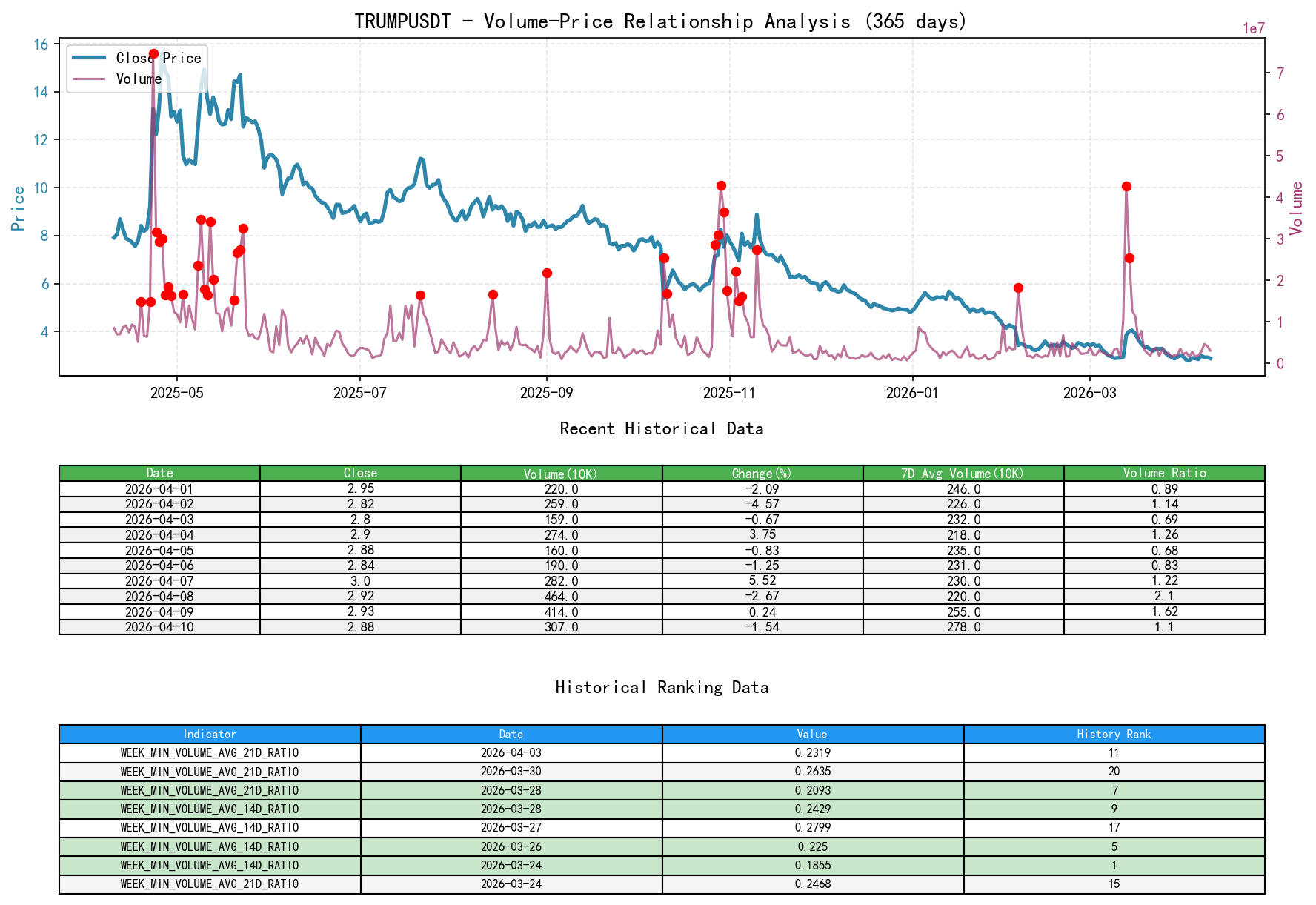
As of April 10, 2026, the underlying asset TRUMPUSDT has an open price of 2.93, a close price of 2.88, volume of 3070418.68, a daily change of -1.54%, volume of 3070418.68, a 7-day average volume of 2781340.91, and a 7-day volume ratio of 1.10.
1. Identification of Key Price-Volume Days:
- • 2026-03-13 (Demand Climax? Supply-Driven?):
PCT_CHANGE: +31.55%(historically ranked 3rd),VOLUME: 42.66 million,VOLUME_AVG_14D_RATIO: 13.77(historically ranked 1st). This is a typical "buying climax." However, Wyckoff theory emphasizes observing subsequent developments. If this huge volume represented genuine demand, the price should have found support and continued to rise, but the opposite occurred. - • 2026-03-14 to 2026-03-16 (Emergence of Supply): The price consolidated above 4.0. Daily volumes remained well above average (
VOLUME_AVG_14D_RATIObetween 1.37-4.25), but the price failed to make new highs (March 16 was a bearish day opening high and closing low). This is high-volume stagnation, a clear signal that supply began to dominate the market. - • 2026-03-17 (Demand Exhaustion): The price fell sharply by -6.27%. The ratio of volume (5.85 million) to the 14-day average (
VOLUME_AVG_14D_RATIO) plummeted to 0.657, indicating a sharp contraction in demand during the decline and a lack of buying support. - • 2026-02-10 / 2026-03-11 (Demand Trough): On these days, the ratio of volume to the short-term average (
VOLUME_AVG_7D_RATIO) was below 0.3, ranking among the lowest five historically, indicating extremely light market activity, a period of directionless sluggishness or watchful waiting.
2. Supply-Demand Dynamics Conclusion:
During the analysis period, a core shift occurred in the supply-demand relationship:
- • Before March 13: Supply gradually diminished (extremely low RSI), leading to panic selling.
- • March 13: A massive influx of demand suddenly emerged, violently reversing sentiment.
- • March 14-19: At elevated price levels, sustained and powerful supply (profit-taking/distribution) began to emerge, offsetting and ultimately overpowering demand.
- • After March 20: Demand continued to shrink, supply dominated the market, and the price entered a phase of low-volume, gradual decline.
Dimension Three: Volatility & Market Sentiment
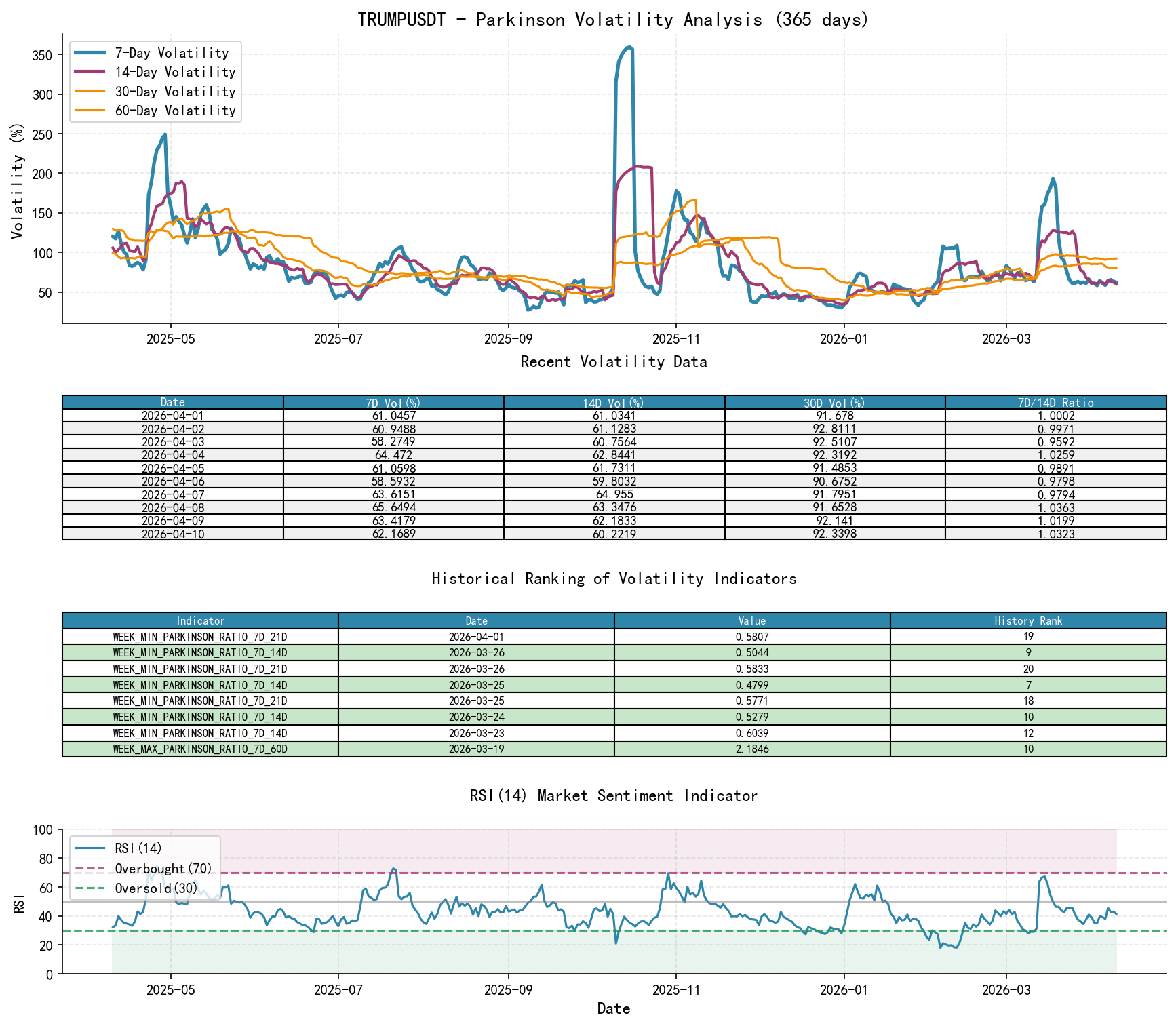
As of April 10, 2026, the underlying asset TRUMPUSDT has an open price of 2.93, a 7-day intraday volatility of 0.62, a 7-day intraday volatility volume ratio of 1.03, a 7-day historical volatility of 0.57, a 7-day historical volatility volume ratio of 1.06, and an RSI of 41.40.
1. Volatility Levels and Structural Changes:
- • Around March 13: Short-term volatility spiked sharply.
HIS_VOLA_7Djumped from around 0.4 to 2.09;PARKINSON_VOL_7Drose from 0.66 to 1.34. More critically, the ratio of short-term to long-term volatility reached extreme historical levels. For example,HIS_VOLA_RATIO_7D_14Dreached 1.419 on March 19 (historically ranked 5th), andPARKINSON_RATIO_7D_60Dreached 2.33 on March 18 (historically ranked 8th). This indicates that market sentiment was extremely distorted and amplified within a short period, typically corresponding to trend acceleration or turning points. - • Current (April 10): Volatility across timeframes has significantly retreated from peak levels. Short-term to long-term volatility ratios have returned to normal ranges (e.g.,
HIS_VOLA_RATIO_7D_14Dis 1.063). The convergence of volatility from extremes suggests that one-sided, intense fluctuations may have temporarily concluded, with the market entering a consolidation or slow downtrend seeking a bottom.
2. Overbought/Oversold Conditions (RSI_14):
- • Early February: RSI fell below 20 multiple times, entering deeply oversold territory (historically ranked top 6), forming the basis for a technical rebound.
- • Mid-March: RSI reached 66-67 on March 14-15, entering historically high top 20 ranks, indicating a short-term overbought state.
- • Current: RSI_14 is 41.4, in a neutral-to-weak zone. It lacks the momentum for an oversold rebound or the pressure from being overbought, consistent with the slow downtrend.
Sentiment Conclusion: Market sentiment experienced a dramatic switch from "extreme pessimism" to "extreme euphoria" in mid-March, followed by a cooling of enthusiasm. It has now shifted to "cautious/cold." The volatility structure indicates that the explosive, sentiment-driven rally has concluded.
Dimension Four: Relative Strength & Momentum Performance
1. Analysis of Returns Across Different Periods:
- • Long-term Momentum (TTM_12, YTD):
TTM_12: -78.82%,YTD: -39.99%. Extremely weak long-term momentum, indicating the asset is in a deep bear market structure. - • Mid-term Momentum (MTD, QTD):
MTD: -4.41%,QTD: -4.41%. Even after the massive mid-March rebound, returns for the current quarter and month remain negative, proving the rebound failed to effectively reverse the medium-term downtrend. - • Short-term Momentum (WTD): As of April 10,
WTD_RETURN: 3.00%, indicating a minor weekly rebound. However, combined with shrinking volume (VOLUME_AVG_7D_RATIO: 1.10), this is judged as a technical bounce within a downtrend, with questionable momentum sustainability.
2. Momentum Validation Conclusion:
All medium-to-long-term momentum indicators are negative with significant absolute values, confirming the dominance of the bearish trend. The short-term explosive positive momentum on March 13 (+31.55%) proved to be counter-trend and unsustainable. Its function was to create space for distribution, not to initiate a new uptrend.
Dimension Five: Large Investor (Smart Money) Behavior Identification
Based on Wyckoff theory and the above price-volume and volatility analysis, the operational intent of smart money is clear:
- 1. Accumulation at Lows? Insufficient Evidence: In the low-price zone around 2.7-2.9 in February, although a single day of panic selling occurred (March 12), sustained, orderly high-volume accumulation was not observed. Volume remained depressed most of the time (frequently appearing in historical lowest rankings), indicating large capital was not actively building positions in this zone.
- 2. Distribution at Highs (Distribution): This is the most significant large investor activity during the analysis period.
- • Motive: To leverage significant news or market sentiment by creating a "Buying Climax" (the massive bullish candle on March 13) to quickly drive up prices and attract public investors to chase the rally.
- • Behavior: In the high consolidation range of 4.0-4.4, despite price fluctuation, volume remained consistently elevated (e.g., March 14-16). This is a classic characteristic of a "Distribution range": Who was buying the huge volume? Chasing retail investors. Who was selling? Smart money liquidating pre-existing positions or distributing at these highs.
- • Confirmation: After distribution was completed, the price broke below the lower boundary of the consolidation range (3.9-4.0), and with demand shrinking, a smooth decline began. This indicates supply was successfully distributed, leaving the market without support.
- 3. Current Behavior: As prices returned to lower levels, volume shrank again (e.g., April 3, April 5 volume metrics are in historically low territory), showing that smart money is in a wait-and-see mode, not rushing to buy at current levels. They are awaiting better prices or clearer panic signals.
Dimension Six: Support/Resistance Analysis & Trading Signals
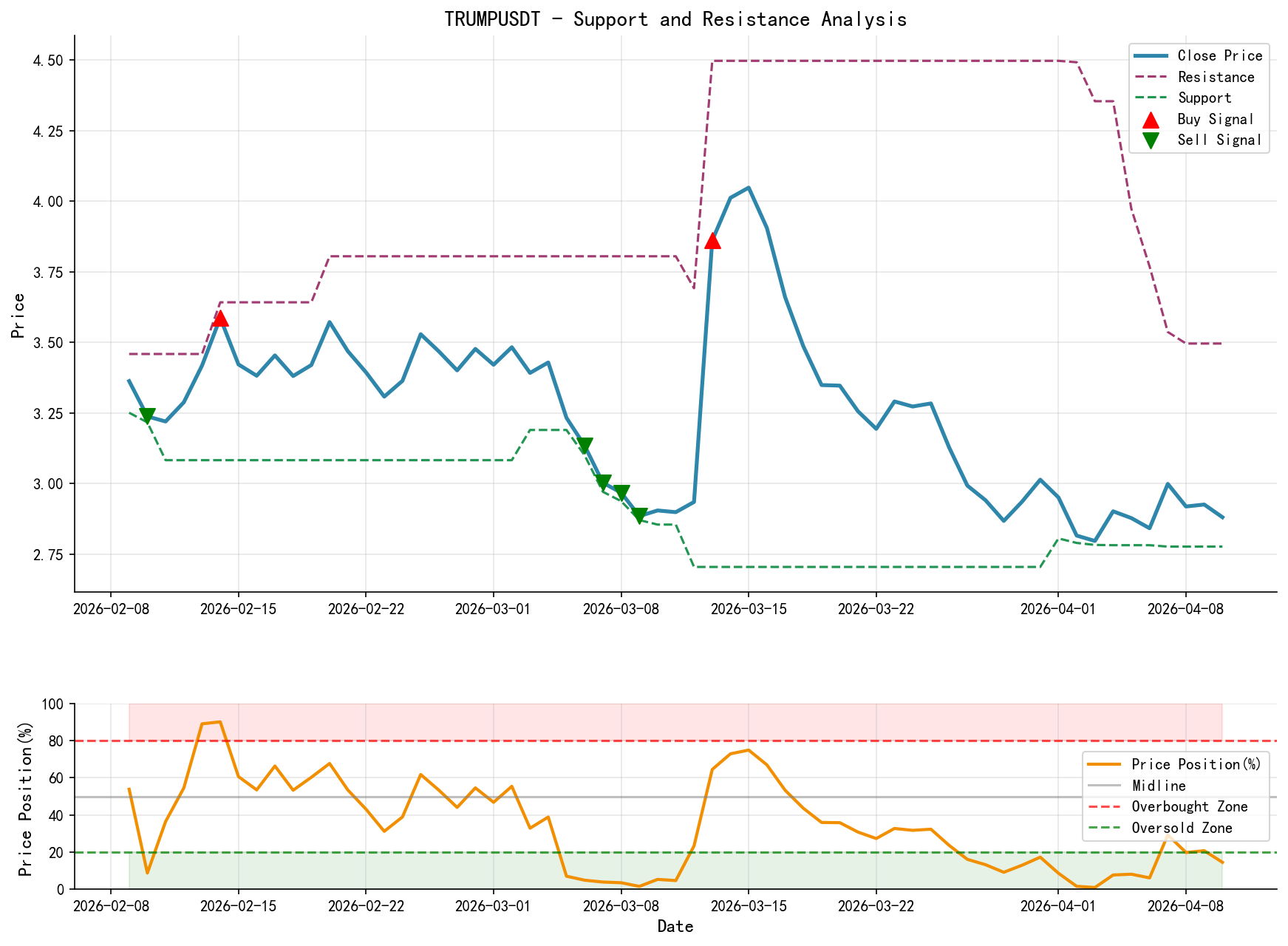
1. Key Price Level Identification:
- • Strong Resistance Zones:
- • 3.9 - 4.4: The previous distribution range; will act as a strong supply zone for any future rebounds. Any rally approaching this zone is an opportunity for position reduction or shorting.
- • 3.4 - 3.5: The high platform of the late March rebound, forming secondary resistance.
- • 3.0 - 3.2: The recent upper bound of the consolidation range and a psychological level; the nearest resistance.
- • Key Support Zones:
- • 2.78 - 2.80: The low point area tested multiple times recently (April 3, April 5).
- • 2.70 - 2.71: The panic low on March 12, representing the ultimate support level. A decisive break below this level would open new downside space.
2. Integrated Wyckoff Trading Signals & Operational Recommendations:
- • Market Phase: Downtrend following distribution (Markdown), currently testing support.
- • Core Judgment: Short-term bearish, medium-term trend downward. The massive mid-March rebound is judged as a "bull trap distribution," not the start of a new bull market.
- • Operational Recommendations:
- • Active Shorting/Position Reduction Point: A price rebound to the 3.0-3.2 zone, accompanied by an inability to significantly expand volume (
VOLUME_AVG_7D_RATIO< 1.5), can be considered an opportunity to initiate short positions or maintain existing shorts. Stops can be placed above 3.35. - • Short Position Observation Point: With the current price near support, chasing the short side is not advisable. Those holding short positions can consider partial profit-taking around 2.80 and observe the price-volume reaction at that level.
- • Potential Long Observation Point (Not for Immediate Action): Closely monitor the 2.70-2.80 support zone. If this area exhibits a "high-volume stopping bullish candle" or the more extreme "massive reversal following a panic sell-off (Spring)" (volume needs to rank historically high), it could signal the beginning of a new accumulation phase, allowing for planning long-side trades.
- • Stand Aside: Near the current price (2.88), clear entry signals are lacking; standing aside is recommended.
- • Active Shorting/Position Reduction Point: A price rebound to the 3.0-3.2 zone, accompanied by an inability to significantly expand volume (
3. Future Validation Points:
- • Conditions to Invalidate Bearish View: Price breaking above and sustaining above 3.5 on high volume (
VOLUME_AVG_14D_RATIO> 2) would indicate the downtrend might be broken, requiring re-evaluation of the market structure. - • Conditions to Confirm Bearish View: Price retreating after being resisted around 3.2 on low volume (
VOLUME_AVG_7D_RATIO< 0.8) or breaking below the 2.70 support on high volume would indicate the continuation of the downtrend. - • Early Trend Reversal Signals: The appearance of the aforementioned "high-volume stopping" or "panic reversal" price-volume patterns in the 2.70-2.80 zone.
Disclaimer: This report/interpretation is solely market analysis and research based on publicly available information and does not constitute any investment advice or operational guidance. The author strives for objectivity and fairness in the content but makes no guarantees regarding its accuracy or completeness. Markets carry risks; investments require caution. Any investment actions taken based on this report are done at one's own risk.
Thank you for your attention! Wyckoff Price-Volume Market Interpretations are published daily at 8:00 before market open. Your feedback and shares are greatly appreciated. Your recognition is crucial. Let's work together to see the market signals clearly.
Member discussion: