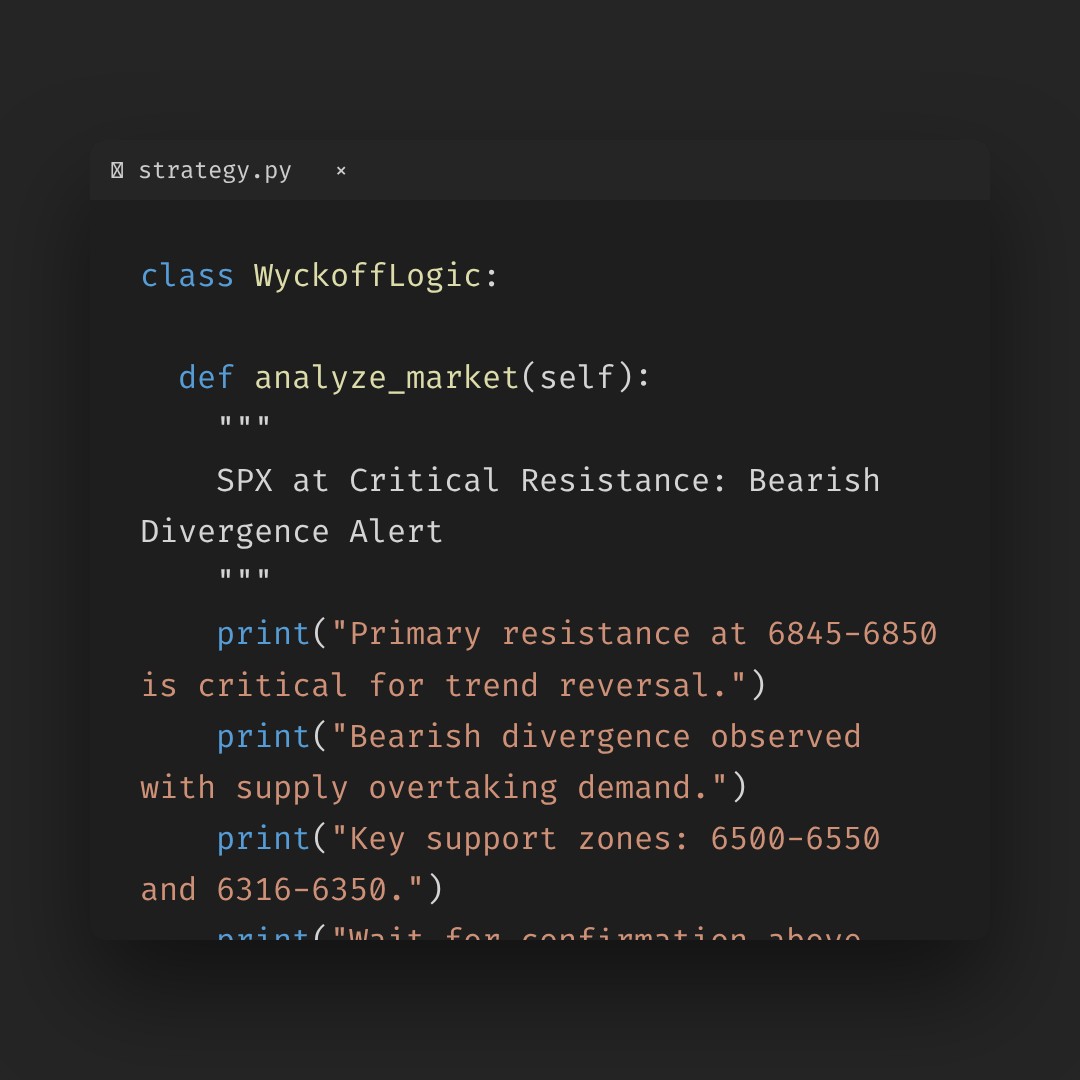
S&P 500 Index (.SPX) Quantitative Analysis Report
Analysis Period: 2026-02-09 to 2026-04-10
Report Generation Date: 2026-04-11
Methodology: Wyckoff Price-Volume Analysis | Quantitative Signal Extraction | Large Investor Behavior Inference
1. Trend Analysis and Market Phase Identification
As of 2026-04-10, the underlying .SPX had an opening price of 6839.24, a closing price of 6816.89, a 5-day moving average of 6683.77, a 10-day MA of 6571.24, a 20-day MA of 6594.98, a daily change of -0.11%, a weekly change of 3.56%, a monthly change of 4.42%, a quarterly change of 4.42%, and a yearly-to-date change of -0.42%.

Price Relationship with Moving Averages:
- • Long-Term Trend Structure: Since the mid-February high (~6993), the price has undergone a significant decline, breaking through all major moving averages (MAs). As of April 10th, the closing price (6816.89) remains below all MAs (MA_5D to MA_60D), forming a clear bearish alignment. This indicates that the market's medium-to-long-term uptrend has been broken, entering a correction or decline phase.
- • Moving Average Crossover Signals: During the decline in mid-to-late March, the short-term MA (MA_5D) rapidly crossed below the medium-term MA (MA_20D), forming a classic Death Cross. Currently, MA_5D (6683.77) remains significantly lower than MA_20D (6594.98) and MA_60D (6791.08), with the crossover signal pointing to a weakening trend.
- • Inferred Market Phase: Based on price action and Wyckoff theory:
- • February 2026 (High Area): After reaching the 2nd highest weekly price (~6993.48) in nearly a decade, the price showed signs of high-volume stalling and decline (e.g., Feb 12), consistent with characteristics of a Distribution Phase, where smart money may have been transferring holdings to the public.
- • March 2026 (Rapid Decline): The price plunged rapidly from the distribution range, with a particularly severe sell-off on March 20, marking the end of the distribution phase and the entry into the Markdown Phase, potentially accompanied by panic selling.
- • Late March to Early April 2026 (Current): The price rebounded from an extremely oversold low (6316.91), but the rally met resistance near former support (now resistance) and the long-term MA, accompanied by diminishing volume. This aligns with the Wyckoff concept of an Automatic Rally following a downtrend or early testing behavior within a potential new Accumulation Phase. A trend reversal has not yet been confirmed.
2. Volume-Price Relationship and Supply-Demand Dynamics
As of 2026-04-10, the underlying .SPX had an opening price of 6839.24, a closing price of 6816.89, a volume of 2775581838, a daily change of -0.11%, a 7-day average volume of 3087008440.71, and a 7-day volume ratio of 0.90.

Key Volume-Price Signal Identification:
- 1. Supply-Dominated Top Confirmation (Distribution):
- • 2026-02-12: Price fell -1.57% on a volume surge to 4.555 billion, significantly exceeding the 7-day average (VOLUME_AVG_7D_RATIO=1.11). This is a typical high-volume decline, clearly revealing strong supply pressure at high levels—a key signal of the distribution phase.
- 2. Panic Selling and Potential Accumulation Point (Climactic Volume):
- • 2026-03-20: Price fell -1.51% on a massive volume spike to 7.054 billion, marking the highest single-day volume record in nearly a decade (Historical Rank #1), with a daily volume growth rate of 116.34% (Historical Rank #12). This "climactic" high-volume plunge signals market panic and liquidation selling. According to Wyckoff principles, such extreme selling is often absorbed by large investors (smart money) at low levels, indicating potential accumulation activity. Subsequent low-volume stabilization and the initial rebound validate the exhaustion of supply.
- 3. Demand-Lacking Rally (Current Critical Signal):
- • 2026-04-08 to 2026-04-10: The price rallied to a key resistance zone (~6845), but volume showed volume-price divergence. Following a high-volume surge on April 8th, volume contracted consecutively on the 9th and 10th (VOLUME_AVG_7D_RATIO dropped to 0.96 and 0.90, respectively). Notably on April 10th, price declined slightly, but volume (2.776 billion) was significantly below the 7-day and 14-day averages. This indicates the rally lacks sustained demand follow-through, a clear signal of weak upward momentum, suggesting supply may be re-emerging at current price levels.
3. Volatility and Market Sentiment
As of 2026-04-10, the underlying .SPX had an opening price of 6839.24, a 7-day intraday Parkinson volatility of 0.12, a 7-day Parkinson volatility ratio of 0.81, a 7-day historical volatility of 0.17, a 7-day historical volatility ratio of 0.68, and an RSI of 59.98.

Volatility Analysis:
- • Panic Peak: During the plunge on March 20th, short-term historical volatility (HIS_VOLA_7D) and Parkinson volatility (PARKINSON_VOL_7D) both reached local highs (0.187 and 0.139, respectively), and the ratio of short-term to long-term volatility (HIS_VOLA_RATIO_7D_60D=1.28) increased significantly, confirming a sharp expansion in market panic sentiment.
- • Sentiment Repair and Convergence: Entering the April rebound, volatility converged rapidly. As of April 10th, HIS_VOLA_7D (0.167) is significantly below its 14-day average (HIS_VOLA_RATIO_7D_14D=0.68), and Parkinson volatility (0.116) is also at recent lows. This indicates short-term market panic has been released, and the market has entered a relatively calm consolidation period.
- • RSI Sentiment Indicator: RSI_14 touched a deep oversold level of 27.72 in late March, confirming the formation of a sentiment bottom. Currently, RSI has recovered to 59.98, out of the oversold zone but not yet overbought (>70), suggesting sentiment has repaired but is not overheated. Combined with price hesitation at resistance, this indicates bullish momentum may be waning.
4. Relative Strength and Momentum Performance
Periodic Return Analysis:
- • Short-Term Momentum (WTD/MTD): Weekly (WTD_RETURN=3.56%) and monthly (MTD_RETURN=4.42%) returns are positive, showing strong short-term rebound momentum. This is primarily a technical recovery from the March plunge.
- • Medium-Term Weakness (QTD/YTD): Quarterly (QTD_RETURN=4.42%) and Year-to-Date (YTD=-0.42%) returns reveal deeper structural issues. Despite the recent rebound, the year-to-date return remains negative, and the QTD return is entirely contributed by April, highlighting the destructiveness of the March decline. The market has not yet recovered its losses since the beginning of the year, and medium-term momentum remains weak.
- • Conclusion: Short-term rebound momentum has failed to reverse the medium-term weak structure. This momentum behavior, corroborated by price meeting resistance and diminishing volume, suggests this rally may be more of a technical recovery rather than the start of a trend reversal.
5. Large Investor (Smart Money) Behavior Identification
Based on Wyckoff events and volume-price anomalies, inferring the operational intent of large investors:
- 1. Distribution at Highs (Mid-Early February): Multiple instances of high-volume stalling/decline (e.g., Feb 10, 12) occurred as prices reached multi-year highs (historically high ranks). This matches the typical behavior of smart money distributing holdings amidst public euphoria.
- 2. Absorption/Accumulation During Panic (Mid-Late March): The record-breaking high-volume plunge on March 20th was a liquidation event. Such massive volume implies powerful buying capital absorbed all panic selling at fearful price levels. This is highly likely block accumulation by smart money. Subsequent stabilization and rebound verified the effective absorption of supply.
- 3. Testing and Observation / Secondary Distribution During the Rally (Current): The current price rebound reaching a key resistance zone (previous lows, MA cluster) is accompanied by contracting volume. This suggests:
- • Smart money may have paused buying here, switching to observation to test the market's inherent demand strength and overhead supply pressure.
- • Alternatively, some smart money that accumulated at lows may be conducting secondary distribution using the rally at the high resistance zone. The high-volume up day (April 8) may have attracted followers, with subsequent low-volume stalling indicating distribution signs.
6. Support/Resistance Level Analysis and Trading Signals
Key Price Level Identification:
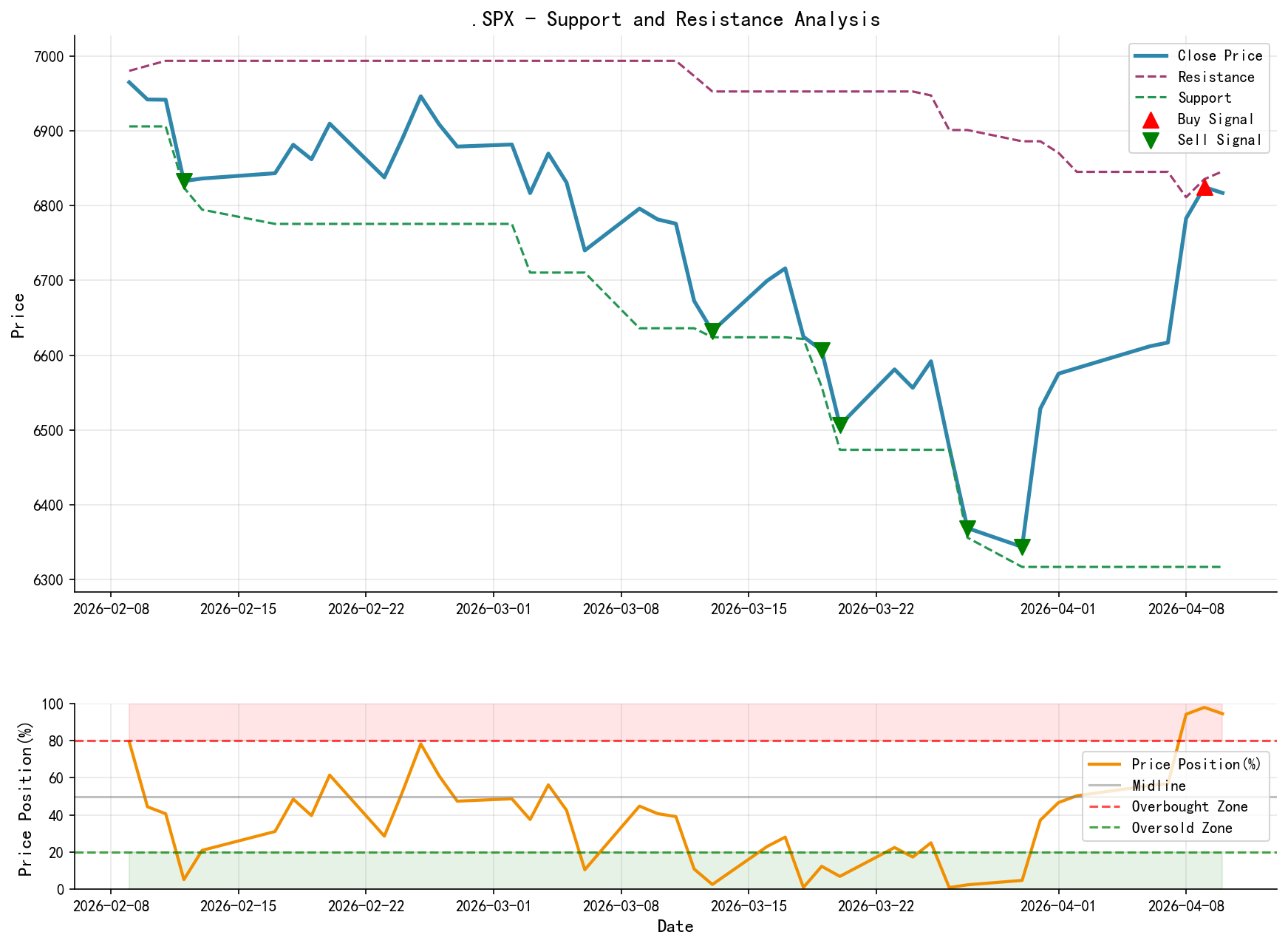
- • Primary Resistance Zone: 6845 - 6850. This is the April 10th high (6845.77) and the area near the 60-day MA (~6791), also the platform area before the March breakdown. This zone is the litmus test for whether the rebound can upgrade into a reversal.
- • Secondary Resistance Zone: 6900 - 6950. The dense trading range from late February to early March and previous lows; stronger resistance.
- • Key Support Zone: 6500 - 6550. The recent rebound launch platform and the small accumulation zone from March 23-25.
- • Primary Support Zone: 6316 - 6350. The low formed by the panic selling on March 30th, a crucial psychological and technical support for the market.
Integrated Wyckoff Events and Trading Signals:
- • Current Market State: The market is at the end of an automatic rally following a downtrend, testing a key resistance level. Supply (resistance) is emerging, and demand (volume) is contracting, forming a potential bearish divergence structure.
- • **Trading Signal: ** Leaning bearish / neutral. This is not a high-conviction position for chasing longs or initiating reversal long positions.
- • Operational Recommendations:
- 1. Aggressive Strategy (Short): If the price fails to decisively break through the 6845-6850 resistance zone (e.g., a bearish candlestick with a long upper wick accompanied by high volume), it can be viewed as a shorting opportunity. Initial stop-loss can be placed above 6900 (a break of key resistance). Downside targets are first 6550 support, then 6316.
- 2. Conservative Strategy (Neutral): Wait for the market to provide clearer directional signals.
- • Bullish Validation Point: Price needs to break and hold firmly above 6900 with strong volume (VOLUME_AVG_7D_RATIO > 1.2), indicating demand has decisively overcome resistance, significantly increasing the probability of a trend reversal.
- • Bearish Validation Point: Price shows a clear high-volume bearish candlestick at current levels, or after the rebound ends, breaks back below the 6550 support, which would confirm the resumption of the downtrend, pointing towards a test of the previous low.
- • Risk Warning: If the March low (6316) is decisively broken with significant volume, it could initiate a new downtrend.
Disclaimer: This report/analysis content is solely market analysis and research based on public information and does not constitute any investment advice or operational guidance. The author strives for objectivity and fairness but makes no guarantees regarding accuracy or completeness. The market carries risks; investments require caution. Any investment actions based on this report are undertaken at one's own risk.
Thank you for your attention! Daily Wyckoff Volume-Price market analysis is released promptly at 8:00 AM before the market opens. We kindly ask for your comments and shares—your recognition is crucial. Let's work together to see the market signals.
Member discussion: