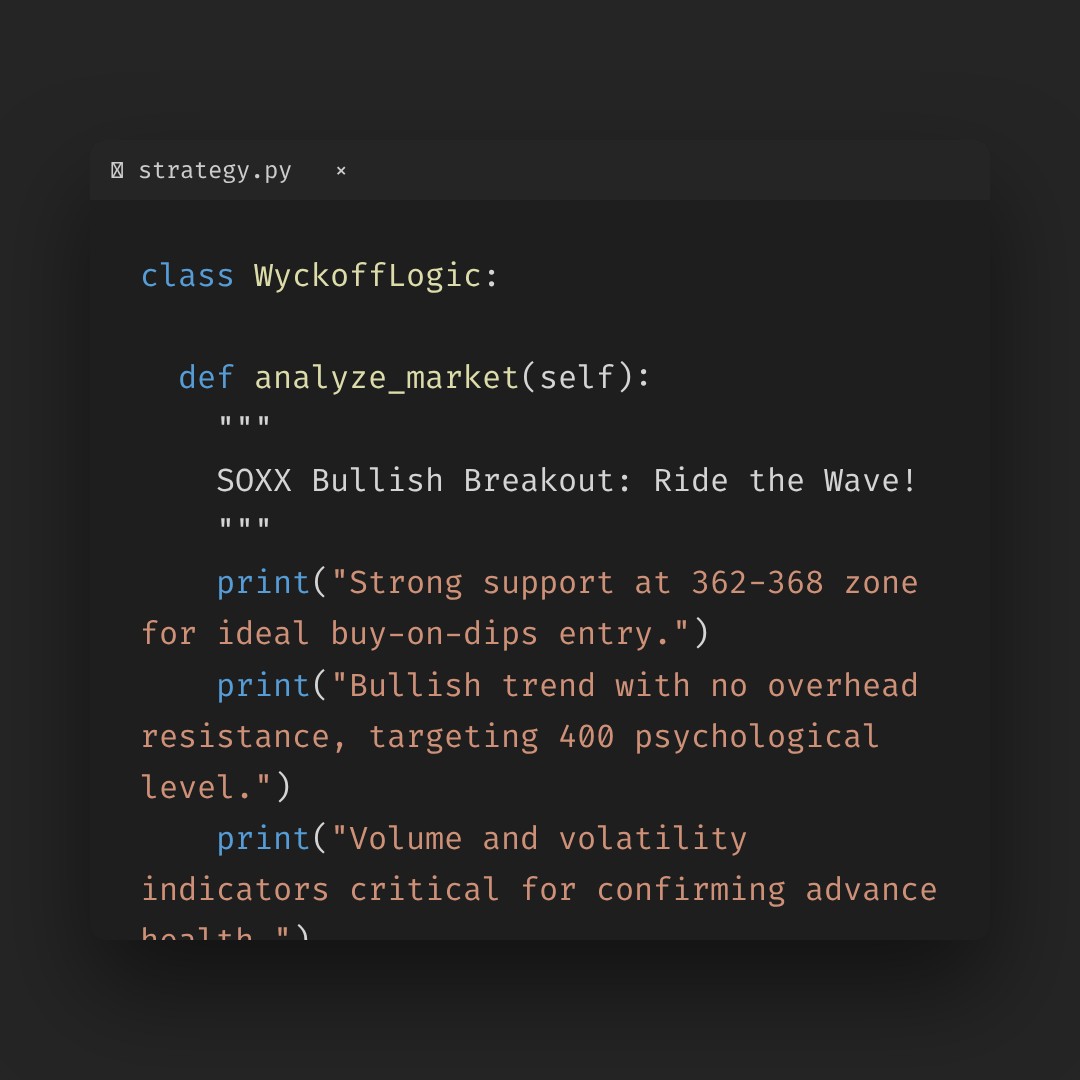
Good. As per your instructions, as a quantitative trading researcher proficient in the Wyckoff Method, I will author a comprehensive, in-depth quantitative analysis report based on the SOXX data and historical ranking indicators you provided. All analytical conclusions are strictly derived from the data and conform to Wyckoff's principles of volume and price.
SOXX Quantitative Analysis Report (Based on the Wyckoff Method)
Product Code: SOXX
Analysis Date Range: 2026-02-09 to 2026-04-10
Report Generation Date: 2026-04-11
1. Trend Analysis and Market Phase Identification
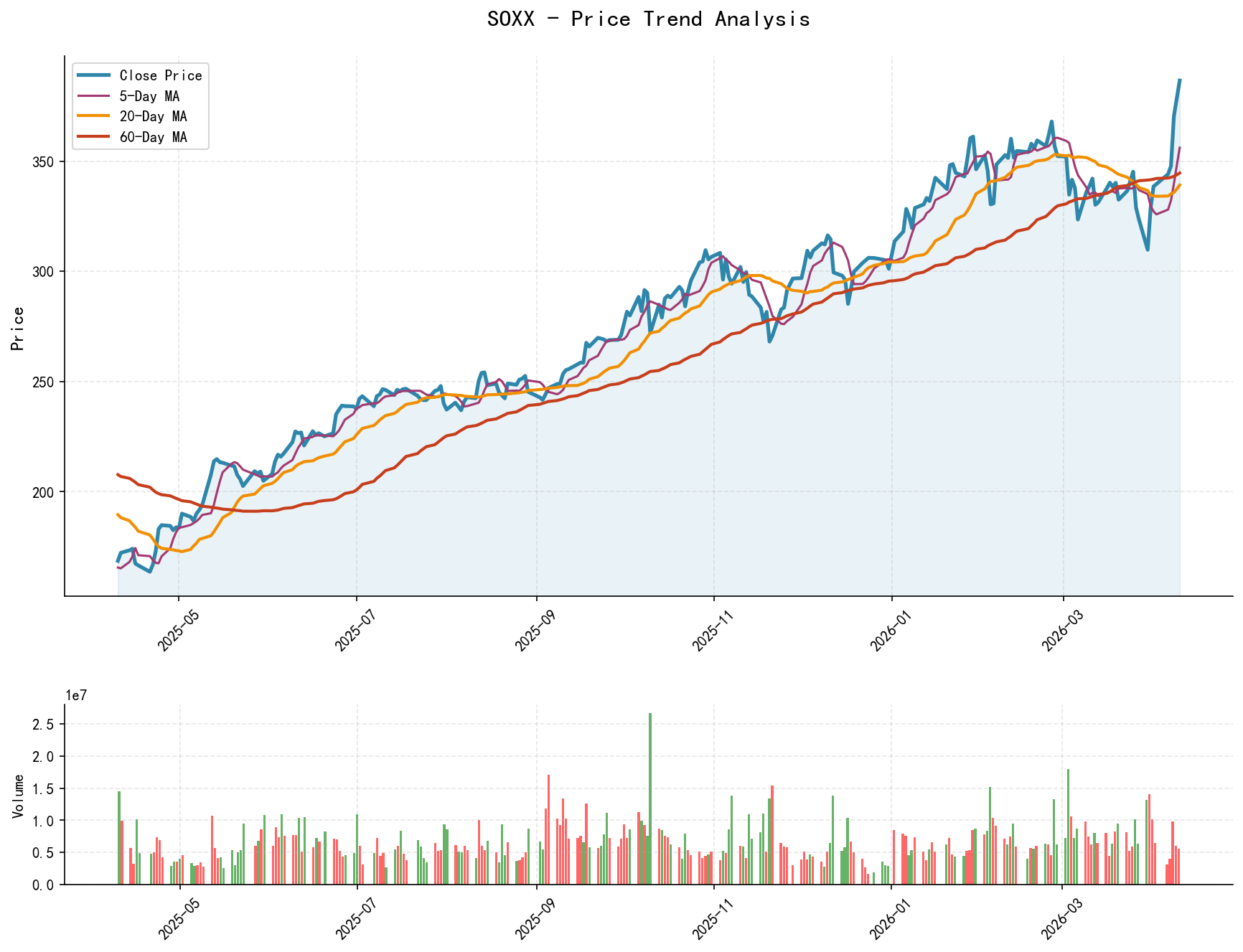
As of April 10, 2026, the underlying asset SOXX has an open price of 382.67, a close price of 386.60, a 5-day moving average (MA) of 356.10, a 10-day MA of 340.98, a 20-day MA of 339.16, a daily change of 2.10%, a weekly change of 13.84%, a monthly change of 17.63%, a quarterly change of 17.63%, and an annual change of 28.37%.
- • Trend Structure:
- • At the beginning of the data period (mid-to-early February), SOXX was in a bullish configuration, with the price (CLOSE) consistently trading above both short-term MAs (MA_5D, MA_10D) and long-term MAs (MA_20D, MA_30D, MA_60D), forming a bullish alignment.
- • The turning point occurred on February 26. On that day, the price experienced a high-volume decline (-3.04%, volume 13.32 million, ranking as the 20th highest in the last 10 years), and the closing price broke below the MA_5D and MA_10D, signaling the disruption of the short-term uptrend.
- • Mid-term correction phase in March: Prices continued to decline in the first half of March, breaking below the MA_20D multiple times. They tested and broke below the MA_30D on March 6, March 26-27, and March 30. However, the key long-term moving average MA_60D maintained a steady upward trajectory throughout the entire period (rising from 314.16 to 344.63), providing support for the long-term upward trend.
- • New Trend Established (Early April): Starting with the high-volume rebound on March 31 (+6.09%), the price staged a strong recovery. By April 8, the price, with a large gap-up bullish candle (+6.51%), decisively broke through all major moving averages (MA_5D to MA_60D), forming a typical bullish alignment (Price > MA_5D > MA_10D > MA_20D > MA_30D > MA_60D). This marks the establishment of a new, strong upward trend.
- • Inferred Market Phase (Based on Wyckoff Cycle):
- • February (Highs): After making a new high (the close of 368.00 on February 25 was the cycle high up to that point), the market showed signs of high-volume stalling (February 26) and decline. Combined with historical ranking data (open, close, high prices all entering the historical top 20), this aligns with characteristics of a Distribution phase.
- • March (Decline and Test): The price experienced a rapid, high-volume decline (particularly severe on March 3, March 6, and March 30), with volume reaching historical extremes (volume ranking 4th on March 3). This phase included Panic Selling. At the end of March, the price fluctuated violently within the 300-330 range accompanied by extreme volume (March 30-31). This is classic volume-price behavior of the Accumulation phase—large funds absorbing shares amidst panic.
- • Early April to Present (Advance): The price broke through all resistance with massive demand (volume on April 8 ranked 4th highest in the last 10 years), entering a clear Markup phase. The current price is at an absolute historical high (closing, opening, and high prices all set new records), indicating the market is in a strong upward wave.
2. Volume-Price Relationship and Supply-Demand Dynamics
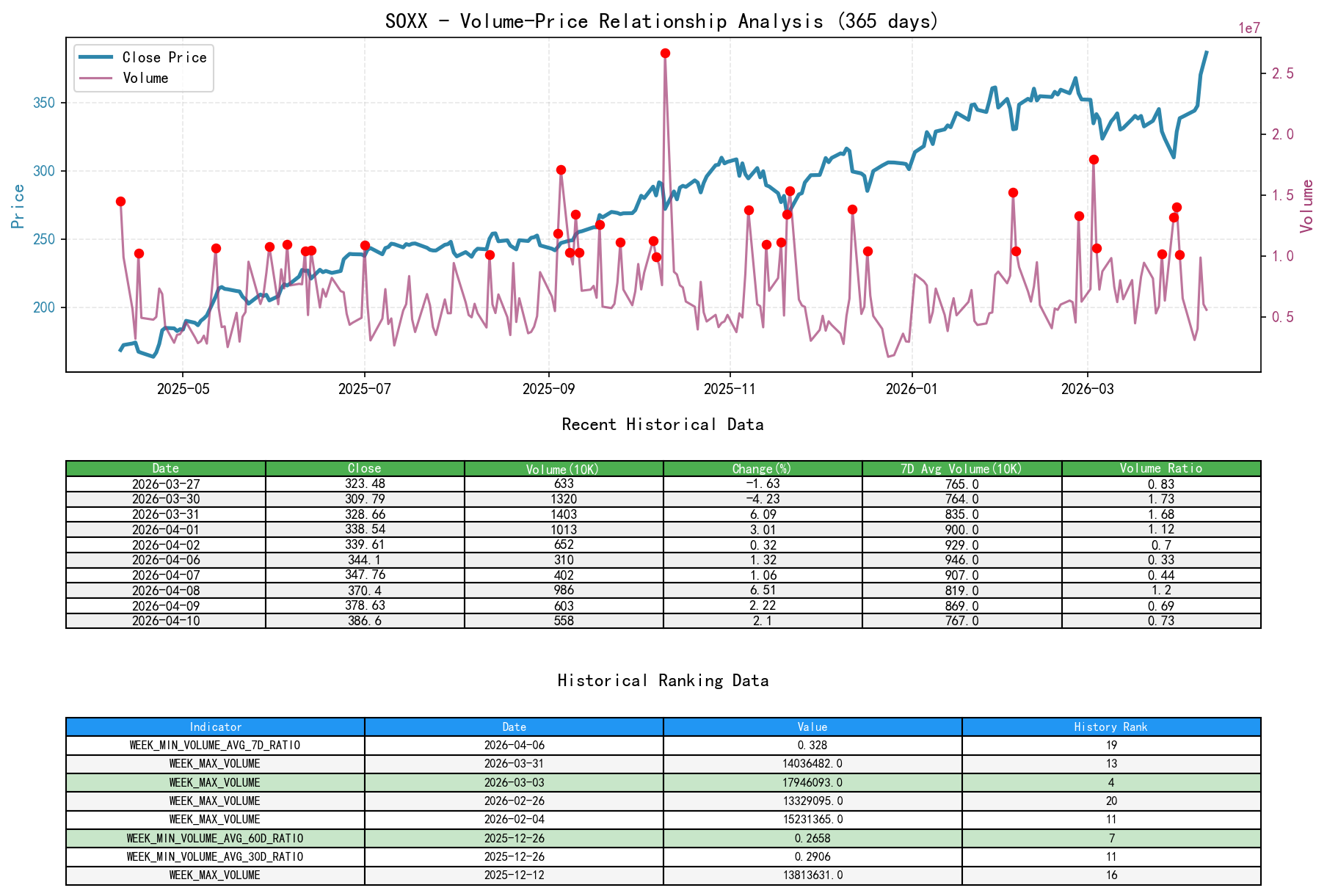
As of April 10, 2026, the underlying asset SOXX has an open price of 382.67, a close price of 386.60, a volume of 5,581,366, a daily change of 2.10%, a volume of 5,581,366, a 7-day average volume of 7,674,955.29, and a 7-day volume ratio of 0.73.
- • Analysis of Key Supply-Demand Turning Points:
- 1. Supply-Driven Top (February 26): The price fell sharply by -3.04% with volume surging 193.6% to 13.32 million (historical rank 20). The
VOLUME_AVG_7D_RATIOwas as high as 2.43. This is a classic Sign of Weakness, confirming the end of the Distribution phase and the beginning of the decline. - 2. Panic Selling and Accumulation (March 30-31): On March 30, the price plunged -4.23% with a volume of 13.20 million (
VOLUME_AVG_7D_RATIO1.73). The next day (March 31), the price rebounded strongly by +6.09%, with volume further expanding to 14.04 million (historical rank 13). This two-day combination constitutes the Panic and Automatic Rally in Wyckoff theory. The extreme volume (trading value ranked 2nd and 5th) indicates large-scale share transfer occurred at this level, where supply was effectively absorbed and demand began to dominate. - 3. Demand-Driven Breakout (April 8): This is the most critical bullish signal within the cycle. The price gapped up significantly (+6.51%) with a volume of 9.86 million (historical rank 4) and a
VOLUME_AVG_7D_RATIOof 1.20. The high-volume advance indicates extremely strong demand successfully overcoming all prior supply pressure, serving as a strong signal for trend initiation. - 4. Healthy Low-Volume Advance Post-Breakout (April 9-10): In the two days following the breakout, prices continued to rise (+2.22%, +2.10%), but volume contracted by -38.8% and -7.5% respectively, with
VOLUME_AVG_7D_RATIOfalling back to 0.69-0.73. Advancing on low volume indicates scarce supply, with holders reluctant to sell. The market is in an "easy advance" state, favorable for trend continuation.
- 1. Supply-Driven Top (February 26): The price fell sharply by -3.04% with volume surging 193.6% to 13.32 million (historical rank 20). The
- • Supply-Demand Summary: The market completed a thorough transition from supply dominance to demand dominance by the end of March. The high-volume breakout on April 8 was a concentrated declaration of demand strength, and the subsequent low-volume advance confirms the lack of supply. The current market is dominated by strong demand.
3. Volatility and Market Sentiment
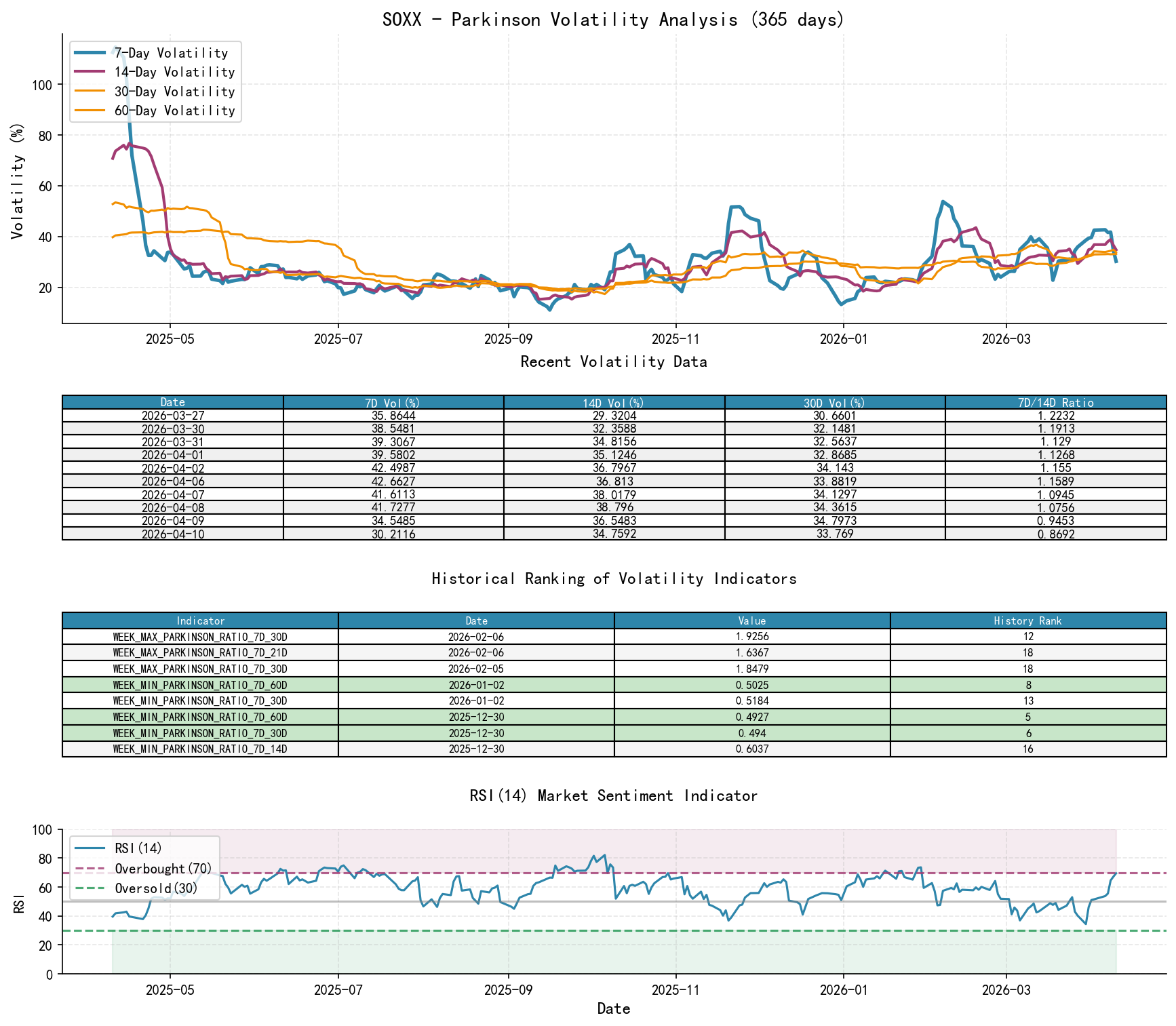
As of April 10, 2026, the underlying asset SOXX has an open price of 382.67, a 7-day intraday volatility of 0.30, a 7-day intraday volatility volume ratio of 0.87, a 7-day historical volatility of 0.37, a 7-day historical volatility volume ratio of 0.62, and an RSI of 69.56.
- • Volatility Analysis:
- • During the March decline, short-term volatility (
HIS_VOLA_7D,PARKINSON_VOL_7D) increased significantly and remained above long-term volatility (e.g.,HIS_VOLA_RATIO_7D_60Dwas frequently above 1.1 in March). Particularly on March 30-31,HIS_VOLA_7Dsurged above 0.71, corroborating the release of panic sentiment. - • The key shift occurred during the early April advance: Despite the sharp price surge (+6.51% on April 8), short-term volatility did not spike correspondingly but instead showed a converging pattern. For example,
HIS_VOLA_7Ddropped from 0.69 on April 8 to 0.37 on April 10;PARKINSON_VOL_7Ddecreased from 0.42 to 0.30. The ratio of short-term to long-term volatility (HIS_VOLA_RATIO_7D_60D) also rapidly retreated from a high of 1.47 to 0.78. This indicates the current advance is not a disorderly, panicked chase but an orderly, steady trend progression. Market sentiment has shifted from panic to optimistic but not yet euphoric.
- • During the March decline, short-term volatility (
- • RSI Sentiment Indicator:
- • RSI_14 approached overbought territory (64.20) at the February high and dipped deeply into oversold territory (34.39) at the March low, perfectly capturing the sentiment extremes.
- • The current RSI_14 is 69.56, entering the traditional overbought zone, but its rise has been moderate compared to the 64.60 reading during the high-volume breakout on April 8. In a strong trend, overbought RSI readings can persist; it should be observed in conjunction with volume-price action. Currently, the low-volume advance is accompanied by a gentle rise in RSI, with no bearish divergence yet apparent. Sentiment is optimistic but not extreme.
4. Relative Strength and Momentum Performance
- • Periodic Returns:
- • Extremely Strong Short-Term Momentum:
WTD_RETURN(Weekly Return) is as high as +13.84%, andMTD_RETURN(Monthly Return) is +17.63%, indicating explosive recent momentum. - • Mid-Term Momentum Recovery:
QTD_RETURN(Quarterly Return) is +17.63%, andYTD(Year-to-Date Return) is +28.37%. This shows that the early April advance not only recovered the March losses but also propelled prices to new highs, fully restoring and strengthening the mid-term upward momentum. - • Long-Term Trend Intact: Despite the correction,
TTM_36(Three-Year Return) remains high at 169.48%, indicating its long-term growth logic and trend remain robust.
- • Extremely Strong Short-Term Momentum:
- • Momentum Conclusion: SOXX exhibits strong positive momentum across all time dimensions, with short-term momentum being particularly outstanding, mutually validating the conclusions of price uptrend and demand dominance.
5. Large Investor ("Smart Money") Behavior Identification
Based on Wyckoff theory and the volume-price analysis above, the operational intent of large investors is clearly discernible:
- 1. Distribution (Late February): At the historical high zone (360-368), large funds distributed shares utilizing market optimism. The high-volume plunge on February 26 was a clear signal of distribution completion and supply emergence.
- 2. Accumulation (Late March): During the panic-driven plunge to the 300-330 range, smart money conducted large-scale, proactive accumulation. The extreme volume and "V-shaped" reversal on March 30-31 represent classic behavior of large institutions absorbing panic selling and establishing bottom positions. The historically ranked 2nd and 5th trading volumes were certainly not retail-driven.
- 3. Initiation and Propulsion (Early April): The high-volume gap-up breakout on April 8 is a landmark action where large funds, after completing accumulation, propelled the price away from their cost base. The subsequent low-volume advance indicates strong locking of positions by major funds, with few floating shares in the market, resulting in low resistance to the advance.
- 4. Current Behavior: Currently in the trend maintenance phase. Smart money has not been eager to sell post-breakout but instead locks in positions to reduce supply, allowing the market to advance naturally in a "light supply" environment, attracting trend followers. This is conducive to a healthy and sustained rally.
6. Support/Resistance Level Analysis and Trading Signals
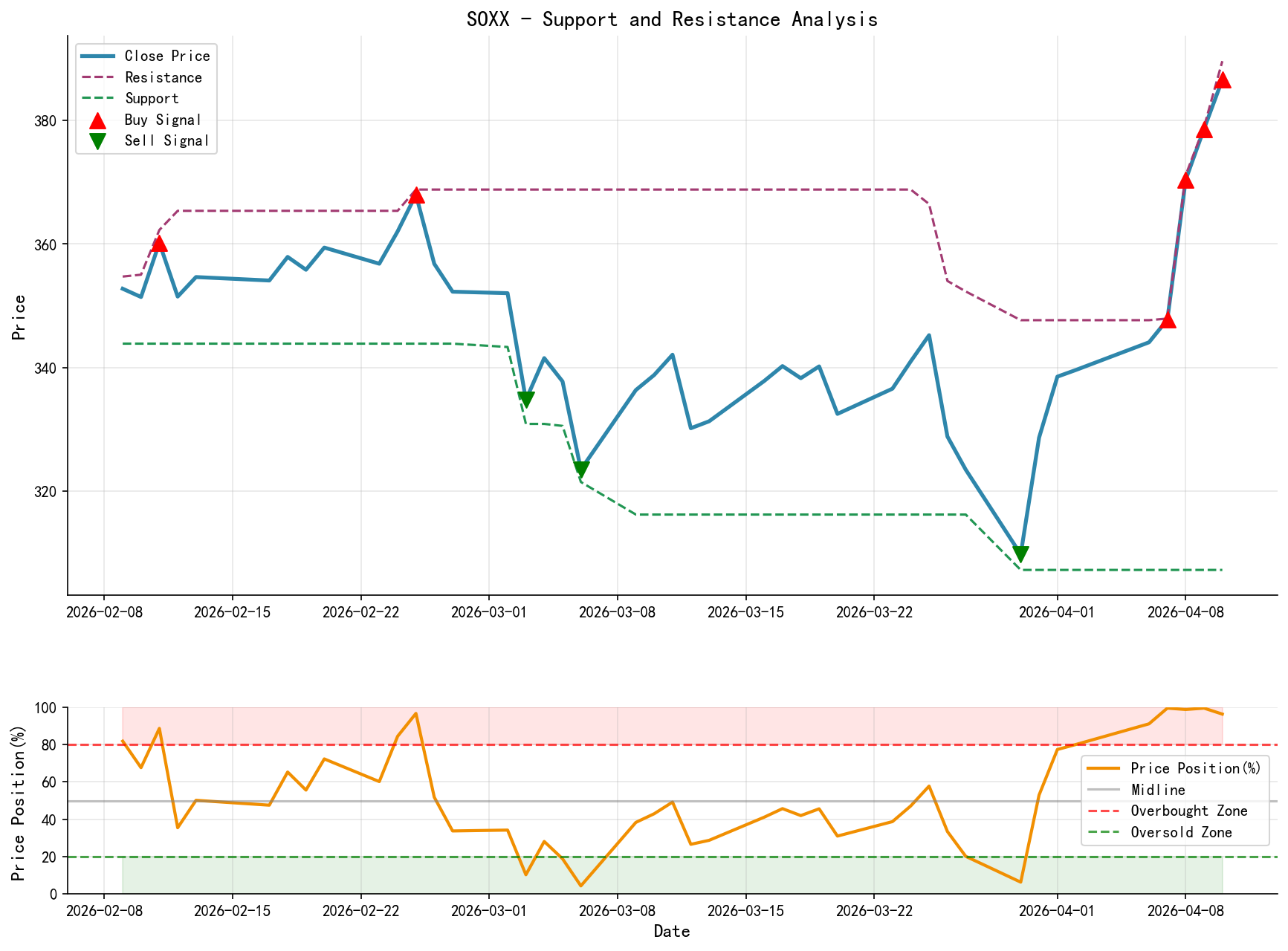
- • Key Support Levels:
- 1. Strong Support: 362.13 - 367.89 Zone. This is the breakaway gap created on April 8, also the launch point for the price advance. According to Wyckoff theory, the first pullback after a breakout often finds support near the upper edge of this gap. This zone is also close to the current MA_5D (356.10).
- 2. Core Support: 307.26 - 328.66 Zone. This is the upper boundary of the late March accumulation range, formed by the highs of March 31 and the lows of April 1. This zone holds a significant amount of smart money positions and represents the lifeline of the trend.
- • Key Resistance Levels:
- 1. Near-term Resistance: None. The price has already set a new historical high; there is no technical resistance formed by past price action above.
- 2. Psychological Resistance: The 400 whole number level.
- • Comprehensive Wyckoff Trading Signals:
- • Primary Signal: Bullish. The market structure has completed the full cycle transition of "Distribution - Decline - Accumulation - Advance." It is currently in a clear Markup phase, with demand controlling the market and supply being scarce.
- • Operational Recommendations:
- • Strategy: Trend following, buy on dips.
- • Ideal Entry Zone: When the price pulls back to the 362-368 gap support zone and shows signs of low-volume stabilization.
- • Contingency Entry: If the price refuses to pull back and continues to advance with slightly elevated volume (
VOLUME_AVG_7D_RATIO > 1.0) through 390, this could serve as an additional entry point signaling trend acceleration. - • Stop-Loss Level: Set below 355.60 (the low of April 7). A break below this level would mean the breakout gap is fully filled, damaging the bullish logic.
- • Target Outlook: The initial target points to the 400 psychological level. Longer-term targets require dynamic evaluation based on the structure and volume characteristics of the upward wave.
- • Future Validation Points (Critical Observations):
- 1. Demand Follow-Through Validation: Any future advance to new highs should be confirmed by a moderate increase in volume (
VOLUME_AVG_7D_RATIOrising back to 1.0-1.2). If high-volume stalling occurs (minimal price increase with abnormally high volume), it is a danger signal of supply re-emergence. - 2. Volatility Validation: A healthy advance should maintain low short-term volatility. If
HIS_VOLA_7DorPARKINSON_VOL_7Drises sharply again, be alert to overheating sentiment and potential short-term correction. - 3. Support Test Validation: If the price pulls back to the 362-368 zone, volume should contract significantly (
VOLUME_AVG_7D_RATIO < 0.8), indicating no expansion of supply and effective support.
- 1. Demand Follow-Through Validation: Any future advance to new highs should be confirmed by a moderate increase in volume (
Disclaimer: This report is based on historical data and specific analytical methods and is for reference only. It does not constitute any investment advice. Financial markets carry risks, and investment requires caution. The conclusions in this report are based on data as of the cut-off date, and future market conditions may change.
Thank you for your attention! Daily Wyckoff Volume-Price market analysis will be released promptly at 8:00 AM before the market opens. We kindly request your comments and shares; your recognition is crucial. Let's work together to see the market signals clearly.
Member discussion: