
All right. As a quantitative trading researcher proficient in the Wyckoff Method, I will compose a comprehensive quantitative analysis report based on the SOLUSDT data you provided.
SOLUSDT Quantitative Analysis Report
Product Code: SOLUSDT
Analysis Date Range: 2026-02-09 to 2026-04-10
Report Generation Date: 2026-04-11
1. Trend Analysis and Market Phase Identification
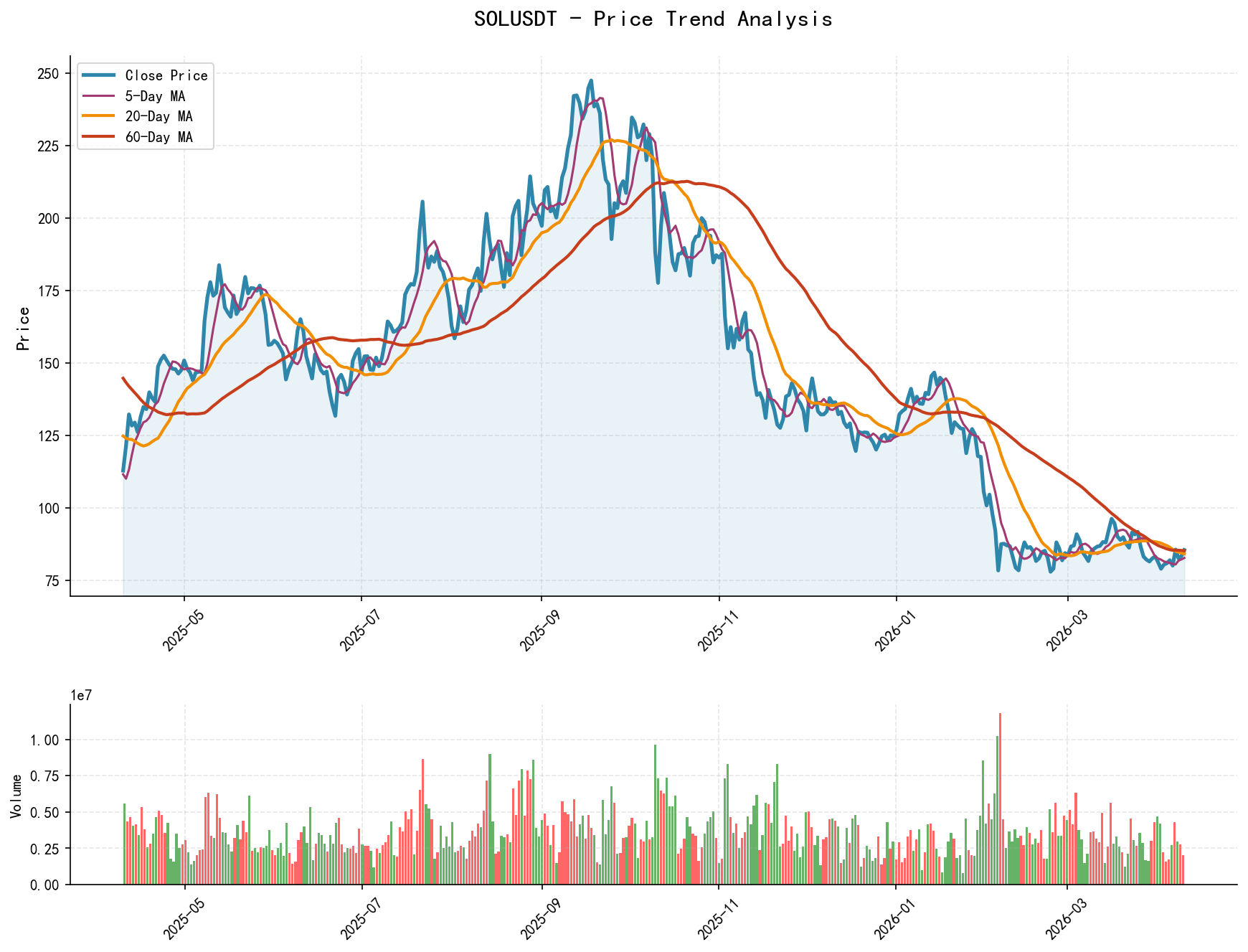
As of April 10, 2026, the subject SOLUSDT had an open price of 83.33, a close price of 85.41, a 5-day moving average of 82.68, a 10-day MA of 81.79, a 20-day MA of 84.07, a daily change of 2.50%, a weekly change of 6.23%, a monthly change of 2.66%, a quarterly change of 2.66%, and an annual change of -31.48%.
Data Analysis:
- • Moving Average Alignment: For most of the analysis period (from February 9th onward), the price (CLOSE) consistently traded below all moving averages (MA_5D to MA_60D), showing a clear bearish alignment. The MA_60D declined from 124.72 to 85.19, and the MA_20D dropped from 110.54 to 84.07, clearly indicating long-term and medium-term downtrends.
- • Moving Average Crossovers: During the decline from late March to early April, the MA_5D and MA_10D repeatedly crossed below the MA_20D and MA_30D, confirming the continuation of the downtrend. However, it's noteworthy that in the recent week (April 7th-10th), the MA_5D began to turn upward and slightly crossed above the MA_20D, which is an early signal worth monitoring.
- • Price Action:
- • Phase 1 (Feb 9 - Feb 23): Price plunged sharply from 86.77 to 77.90, forming a steep descending channel. A large-volume long black candlestick appeared on February 23rd (VOLUME_AVG_7D_RATIO=1.84), aligning with the characteristics of Panic Selling in Wyckoff theory.
- • Phase 2 (Feb 24 - Mar 17): Price rebounded, rising from 78.99 to a peak of 96.20. The gain in this phase was considerable (+21.8%), but volume did not consistently expand significantly (VOLUME_AVG_7D_RATIO < 1.2 most of the time), and the price failed to effectively break through the initial area of the previous decline (around 97-100). This can be viewed as an Automatic Rally following the panic decline.
- • Phase 3 (Mar 18 - Apr 6): Price retreated from 96.20, reaching a low of 80.03. The slope of this decline slowed, and volume generally contracted, constituting a Secondary Test of the panic low. Notably, the test low (80.03) was higher than the panic low (77.90), indicating that demand began to emerge at a higher level.
- • Phase 4 (Recent Week, Apr 7 - 10): Price rebounded from 80.03 to 85.41, accompanied by a significant volume surge on April 7th (VOLUME_AVG_7D_RATIO=1.41). This is the first recent occurrence of a Sign of Strength (SOS) signal, potentially marking the market's attempt to transition from the "test" phase to a new balance or accumulation process.
Conclusion: The market has completed a Wyckoff downtrend cycle over the past two months: "Panic Selling" (February) - "Automatic Rally" (mid-early March) - "Secondary Test" (late March-early April). Currently, it is in the initial rebound stage following the "Secondary Test." The long-term and medium-term trends remain bearish, but short-term (recent week) preliminary signs of stabilization and demand entering the market have emerged.
2. Volume-Price Relationship and Supply-Demand Dynamics
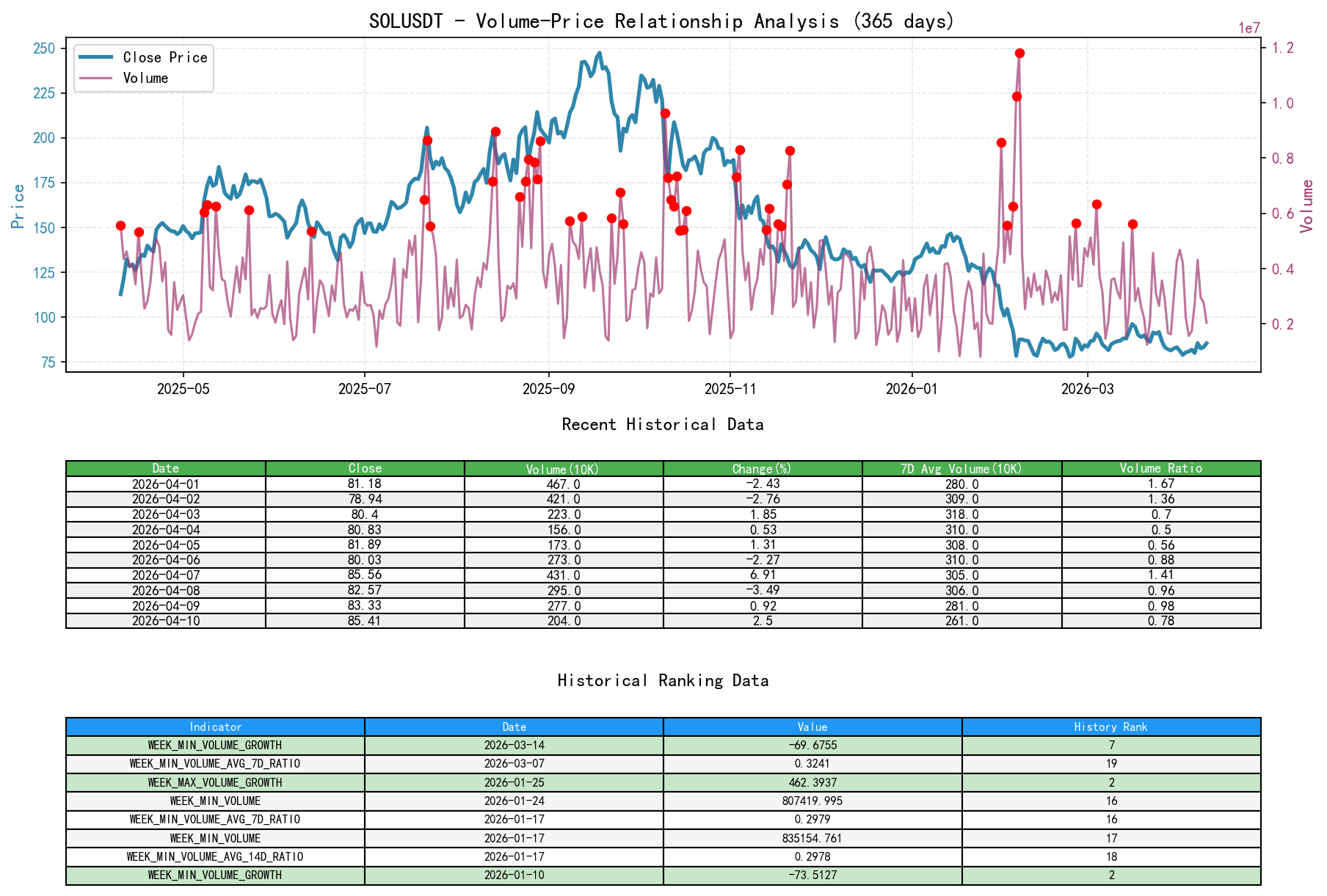
As of April 10, 2026, the subject SOLUSDT had an open price of 83.33, a close price of 85.41, volume of 2040935.14, a daily change of 2.50%, volume of 2040935.14, a 7-day average volume of 2613980.62, and a 7-day volume ratio of 0.78.
Data Analysis:
- • Panic Selling (Supply Dominance): On February 23rd, the price plummeted -5.91%, with volume surging 187% (VOLUME_GROWTH), reaching 1.84 times the 7-day average volume. This is a classic high-volume crash, indicating a massive outflow of supply (selling pressure) and panic market sentiment.
- • Supply Exhaustion (Demand Emergence):
- • On March 7th and March 14th, volume was extremely low, with VOLUME_AVG_7D_RATIO at only 0.32 and 0.48 respectively, ranking as the 19th and 7th lowest levels in nearly a decade for single-day volume relative to the 7-day average (historical ranking data). The price on March 14th closed almost flat. This aligns with the Wyckoff principle of supply exhaustion: selling pressure significantly weakens at low levels, making it difficult for prices to fall further.
- • From April 3rd to 6th, volume during the decline remained below average (VOLUME_AVG_7D_RATIO between 0.56-0.88), indicating insufficient downward momentum (supply).
- • Demand Attempting to Enter:
- • On April 7th, the price surged 6.91%, with volume 41% higher than the 7-day average (VOLUME_AVG_7D_RATIO=1.41). This is a high-volume advance, a clear demand signal following a prolonged decline and supply exhaustion.
- • On April 10th, the price rose 2.50%. Although volume did not expand significantly (VOLUME_AVG_7D_RATIO=0.78), the price closed near the day's high, indicating decent control by buyers.
Conclusion: A critical shift in supply-demand dynamics has occurred: from panic-driven supply release in late February, to significant supply exhaustion in mid-late March, and then to tentative demand entry in early April. The recent (April 7th) high-volume advance is the most important positive volume-price signal in two months, suggesting potential capital beginning to accumulate.
3. Volatility and Market Sentiment
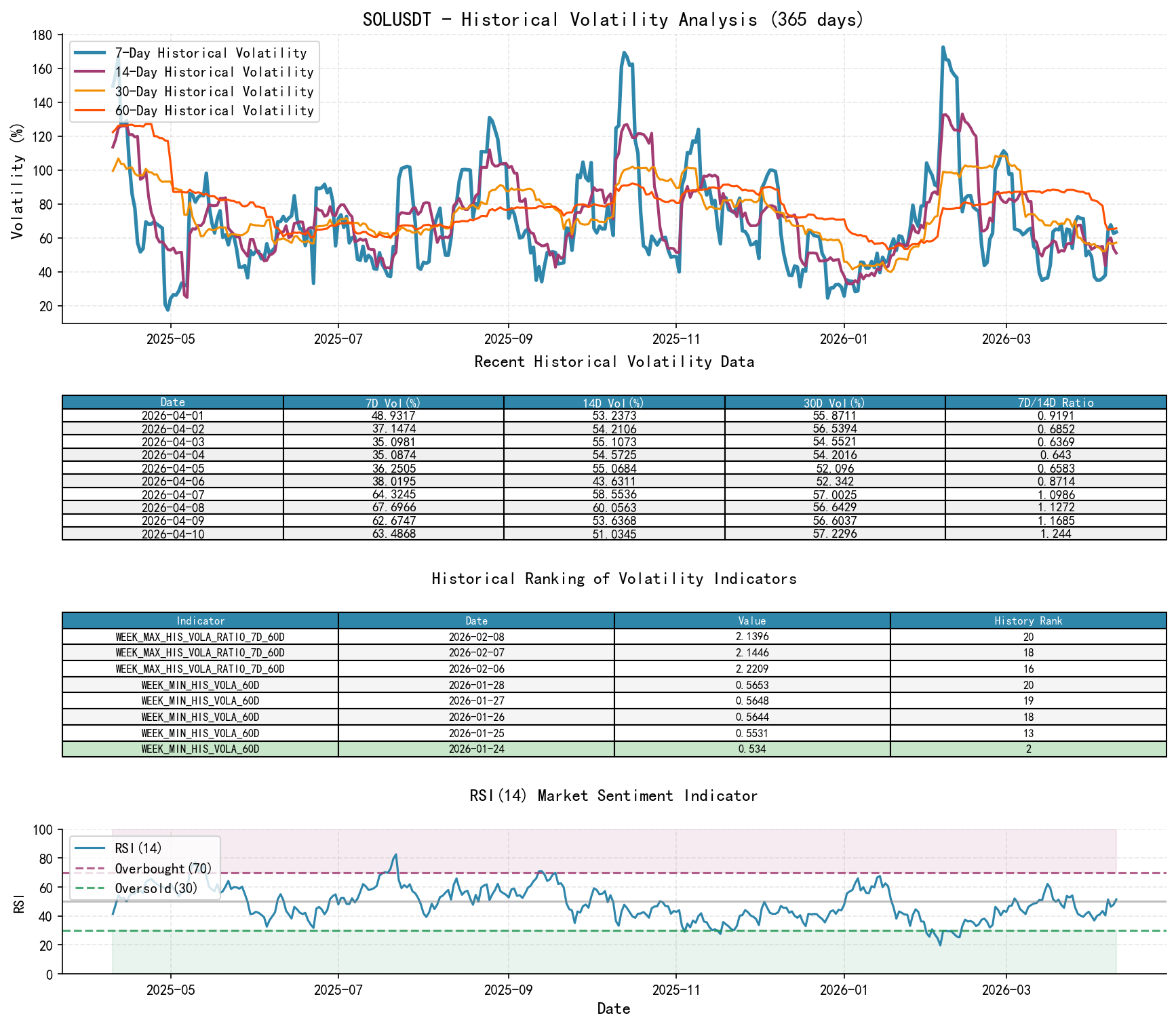
As of April 10, 2026, the subject SOLUSDT had an open price of 83.33, a 7-day intraday volatility of 0.58, a 7-day intraday volatility ratio of 1.01, a 7-day historical volatility of 0.63, a 7-day historical volatility ratio of 1.24, and an RSI of 51.52.
Data Analysis:
- • Volatility Levels and Convergence: In early February, short-term volatility (HIS_VOLA_7D) was as high as 1.59, significantly above long-term volatility (HIS_VOLA_60D=0.77), indicating market panic and disorder. Subsequently, volatility rapidly converged. By February 13th, the HIS_VOLA_RATIO_7D_14D dropped to 0.57, showing a rapid cooling of panic sentiment. Throughout March and April, the ratio of short-term to long-term volatility mostly oscillated within the 0.8-1.2 range, with no extreme values, indicating a calming market sentiment.
- • Verification of Sentiment Extremes:
- • Oversold Confirmation: On February 12th, the RSI_14 fell to 25.38, the 15th lowest value in nearly a decade (historical ranking data). This confirms that market sentiment had entered an extreme oversold zone at that time, setting the stage for the subsequent technical rebound.
- • Sentiment Recovery: The current RSI is 51.52, having recovered from the oversold zone to a neutral range. This shows a significant alleviation of pessimistic sentiment, but it has not yet entered overbought territory.
Conclusion: Market sentiment has recovered from the extreme panic of February (high volatility, extremely oversold RSI). Currently, volatility has normalized, and RSI has returned to neutral, providing a relatively stable emotional environment for the market to establish a new equilibrium zone.
4. Relative Strength and Momentum Performance
Data Analysis:
- • Short-Term Momentum: The WTD_RETURN (weekly return) is +6.23%, indicating that short-term momentum has turned positive with reasonable strength.
- • Medium-Term Momentum: The MTD_RETURN (monthly return) is +2.66%, and the QTD_RETURN (quarterly return) is +2.66%. Although positive, the magnitude is far less than the weekly return, suggesting that medium-term momentum has just turned from negative to positive and remains weak.
- • Long-Term Momentum: The YTD (year-to-date return) is -31.48%, and TTM_12 (past 12 months) is -24.29%. Long-term momentum remains very weak.
Conclusion: Short-term momentum (1 week) has shown significant improvement and turned positive, representing the most positive signal at present. Medium-term momentum (1 month/1 quarter) shows signs of stabilization but has not yet formed a strong uptrend. Long-term momentum remains deeply in negative territory. The momentum structure suggests the market may be in the initial stage of a weak rebound or a bottoming attempt within a long-term downtrend.
5. Large Investor (Smart Money) Behavior Identification
Inference Analysis:
Based on Wyckoff principles and the aforementioned volume-price, volatility, and sentiment data, inferences regarding large investor behavior are drawn:
- 1. Panic Phase (Mid-late February): Retail investors and leveraged traders engaged in panic selling (high-volume crash). Large investors may have partially absorbed this selling, but it was not their primary action; their goal was likely to test market liquidity depth and the limits of selling pressure.
- 2. Automatic Rally and Distribution/Accumulation Transition (March): The overall volume during the March rebound was modest, indicating large investors did not aggressively push prices higher. They were likely observing or conducting range-bound trading (buying low and selling high), with the market in a phase of equilibrium or initial accumulation.
- 3. Secondary Test and Smart Money Positioning (Late March - April):
- • Key Signal 1 (Supply Exhaustion): The historically low volume in mid-late March (ranking 7th historically) indicates that floating supply was nearly depleted. Smart money would not continue heavy selling at this point but would observe the market's natural support without external force.
- • Key Signal 2 (Demand Test): The high-volume advance on April 7th can be interpreted as a Test by smart money. They injected capital to push prices up, testing for any hidden selling pressure (supply) and whether it could attract follow-on buying. The low-volume pullback on April 8th-9th can be viewed as a Successful Test because the pullback was limited in extent and lacked high volume.
- 4. Current Intention: Overall, large investors are likely in a phase of "transitioning from observation to initial position building." After confirming supply exhaustion (ultra-low volume in March), they have begun tentative buying (high volume on April 7th) to assess whether the market can form effective support and construct a bottoming structure in this area.
Conclusion: The market is transitioning from a phase dominated by public selling to one potentially characterized by tentative accumulation by smart money. The recent ultra-low volume and subsequent high-volume advance are the core observation points for this transition process.
6. Support/Resistance Level Analysis and Trading Signals
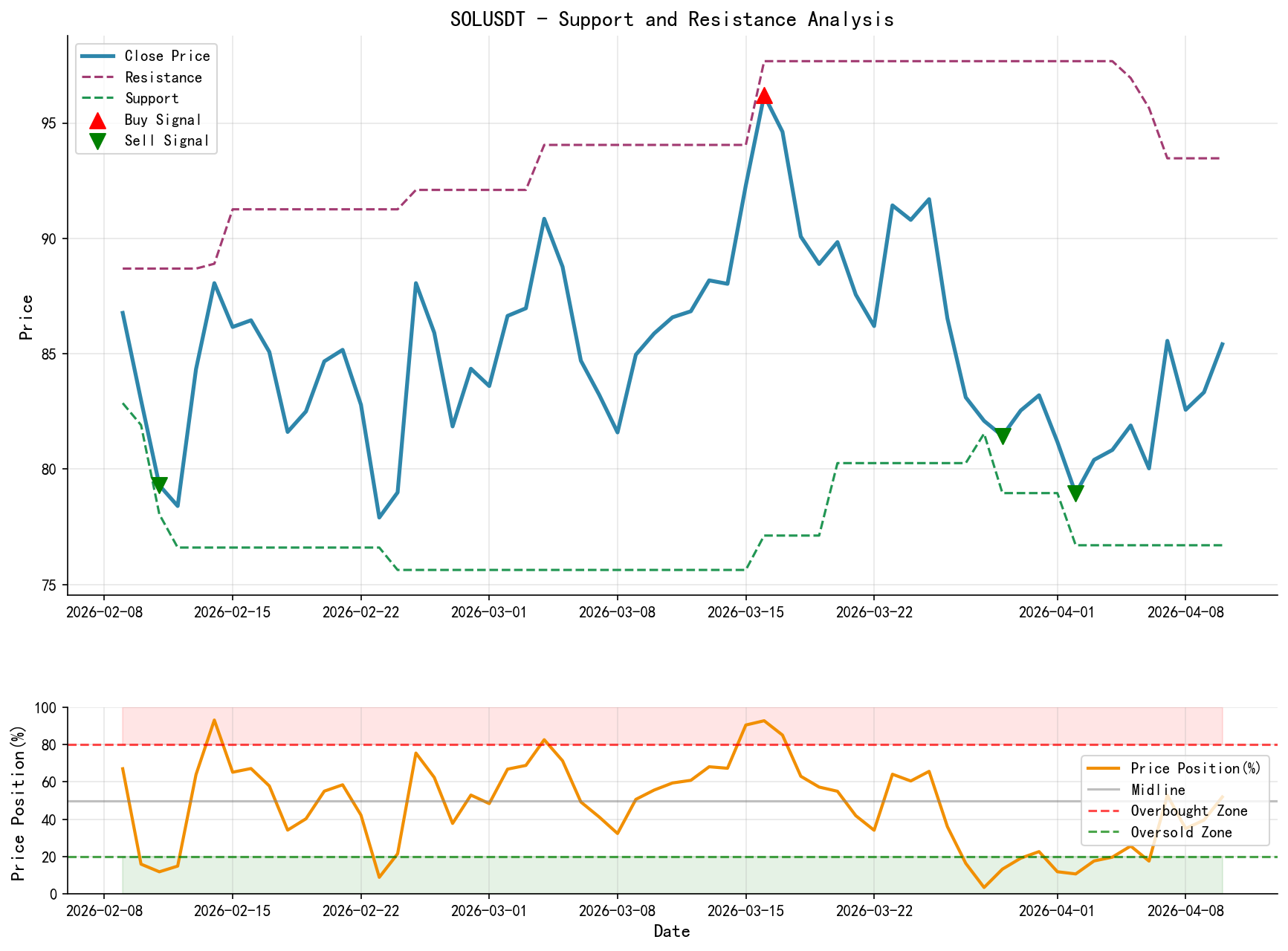
Key Price Levels:
- • Upper Resistance:
- 1. Strong Resistance: 96.20 (The March 16th rebound high, also the end of the Automatic Rally).
- 2. Secondary Resistance: 92.30 / 90.85 (The area formed by highs on March 15th and March 4th).
- • Lower Support:
- 1. Critical Support: 77.90 - 80.03 (The zone formed by the February 23rd panic low and the April 6th Secondary Test low). This area is the recent "Decision Zone" for supply-demand transition.
- 2. Recent Support: 81.44 - 83.20 (The lower bound of the trading congestion area from late March to early April).
Integrated Wyckoff Events and Trading Signals:
- 1. Market State: The market is in the "potential early accumulation" phase following a long-term downtrend. The Panic Selling (SC) and Automatic Rally (AR) are complete. A Secondary Test (ST) has occurred with a higher low, accompanied by an SOS (April 7th) and a subsequent Successful Test, forming the initial pattern of a Wyckoff Spring or Test event.
- 2. Trading Direction: Cautiously Bullish / Neutral to Bullish (for short-to-medium term). The long-term trend remains bearish, but the short-term structure shows positive changes.
- 3. Operational Recommendations:
- • Aggressive Strategy (Left Side): Consider initiating a light long position during a price pullback to the 82.00 - 84.00 range (recent support zone). The stop-loss should be set below 77.90 to manage the risk of the market retesting or even breaking below the panic low.
- • Conservative Strategy (Right Side): Wait for the price to break through and hold above 90.85 (the March 4th high) on high volume, confirming that demand has full control and the uptrend structure is clearer before entering.
- • Observation Strategy: If the price fails to hold the 81.44-83.20 support zone and falls back below 80.00 on high volume, it indicates the April 7th SOS has failed. The market may enter a prolonged basing period or another decline, warranting continued observation.
- 4. Future Confirmation Points:
- • Confirmation Signals: Subsequent advances should be consistently accompanied by moderately expanding volume (VOLUME_AVG_7D_RATIO > 1), with low volume on pullbacks (VOLUME_AVG_7D_RATIO < 0.8). The price needs to effectively break through the 90.85-92.30 resistance zone.
- • Invalidation Signals: The price rapidly falls below 80.00 without significant volume, or the rally stalls (small-bodied candlesticks) around 90 with a sudden surge in volume (re-emergence of supply).
Final Summary:
SOLUSDT has undergone a complete downtrend cycle over the past two months. Currently, key combined signals of supply exhaustion (historically low volume) and tentative demand (high-volume advance) have emerged. Combined with the RSI recovery from historical lows, the positive turn in short-term momentum, and normalized volatility, the market possesses the conditions to attempt forming a potential interim bottom. The Wyckoff framework of "Panic - Automatic Rally - Secondary Test" is preliminarily formed but not yet fully confirmed. Traders should adopt a strategy of "cautiously accumulating on dips, adding positions upon confirmed breakouts," while strictly setting stop-losses to guard against the risk of the market choosing to decline further. The core observation points lie in the subsequent price action within the 77.90-85.40 range and the accompanying volume behavior.
Disclaimer: The content of this report/interpretation is solely market analysis and research based on publicly available information and does not constitute any investment advice or operational guidance. The author strives for objectivity and fairness in the content but makes no guarantees regarding its accuracy or completeness. The market carries risks, and investments require caution. Any investment actions taken based on this report are at the investor's own risk.
Thank you for your attention! Daily Wyckoff volume-price market interpretations are released promptly at 8:00 AM before the market opens. We kindly request you to leave comments and share. Your recognition is crucial. Let's work together to see the market signals clearly.
Member discussion: