Okay, as a quantitative trading researcher proficient in the Wyckoff method, I will compose a comprehensive, in-depth quantitative analysis report based on the SLV data table and historical ranking metrics you provided.
SLV (iShares Silver Trust) Quantitative Analysis Report
Product Code: SLV
Analysis Date Range: 2026-02-09 to 2026-04-10
Report Generation Date: 2026-04-11
1. Trend Analysis and Market Phase Identification
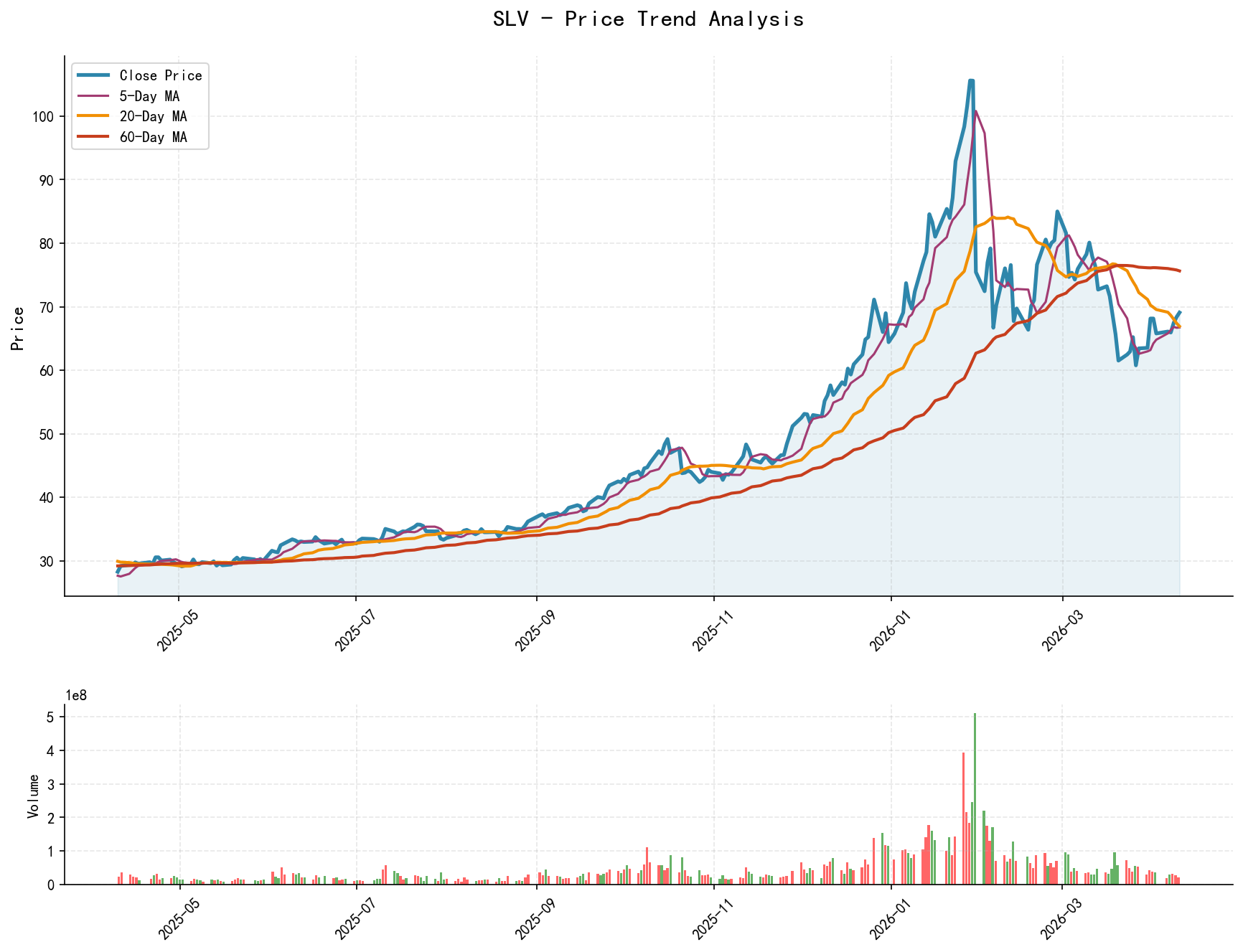
As of 2026-04-10, the underlying asset SLV had an opening price of 69.10, a closing price of 69.08, a 5-day moving average (MA) of 66.74, a 10-day MA of 65.77, a 20-day MA of 66.91, a daily change of 1.01%, a weekly change of 5.00%, a monthly change of 1.38%, a quarterly change of 1.38%, and an annual change of 7.23%.
- 1. Moving Average System Analysis (MA):
- • Current Structure (As of 2026-04-10): Closing Price (69.08) < MA_5D (66.74) < MA_10D (65.77) < MA_20D (66.91) < MA_30D (70.73) < MA_60D (75.63). The price is below all key moving averages, presenting a typical bearish alignment.
- • Recent Evolution: Following the late-February high (84.99, 2026-02-27), the moving averages of various periods have successively turned downwards. The short-term MAs (MA_5D, MA_10D) have recently flattened in the 66-68 range, indicating a weakening of short-term downward momentum. However, the medium-term MAs (MA_20D to MA_60D) maintain a downward slope, with the dominant trend remaining bearish.
- • Key Crossover Signals: In early March (approx. 03-03 to 03-12), the MA_5D crossed below the MA_20D, forming a "death cross," confirming the acceleration of the downtrend that began in late February. Currently, the MA_5D and MA_20D remain in a bearish alignment.
- 2. Price Action and Market Phase Identification (Based on Wyckoff Theory):
- • Distribution Phase Confirmation: In late February (02-23 to 02-27), the price reached a new high (85.27), but the RSI (peak at 58.13) showed signs of a bearish divergence with the price. Subsequently, several high-volume, long bearish candles (declines exceeding 8%, ranking high in volume) appeared on 02-12, 03-02, and 03-03. This is a typical signal of "overwhelming supply appearing," marking the completion of the Distribution Phase and the trend reversal.
- • Markdown Phase: Throughout March, the price unilaterally declined from the 80+ level to the 60+ level under supply dominance, accompanied by multiple panic selling episodes (e.g., 03-19, -4.40%, volume 96.19 million, VOLUME_AVG_60D_RATIO as high as 1.76, ranking in the top 20%). This is a clear Markdown Phase.
- • Potential Accumulation Phase Emergence: Entering April, the price has been oscillating sideways within a narrow 65-69 range. Volume has significantly contracted (04-10 volume only 20.73 million, VOLUME_AVG_60D_RATIO of 0.22, the 3rd lowest in nearly a decade), and price volatility (HIS_VOLA_7D) has compressed to extremely low levels (0.35). This behavior aligns with the early-stage characteristics of the "Accumulation" structure in Wyckoff theory—specifically, a "natural reaction" or "secondary test of support" after a major decline, where downward momentum is exhausted, supply dries up, and smart money begins to quietly accumulate at lower levels.
Summary: The market has completed the cycle from "Distribution" at the late-February high through the "Markdown" in March. The current price is in a low-level, narrow-range consolidation, with volume and volatility contracting sharply, suggesting the market may be entering the early stages of a new Accumulation Phase. However, subsequent signals such as a "Spring" or "Jump Across the Ice" are needed to confirm a trend reversal.
2. Volume-Price Relationship and Supply-Demand Dynamics
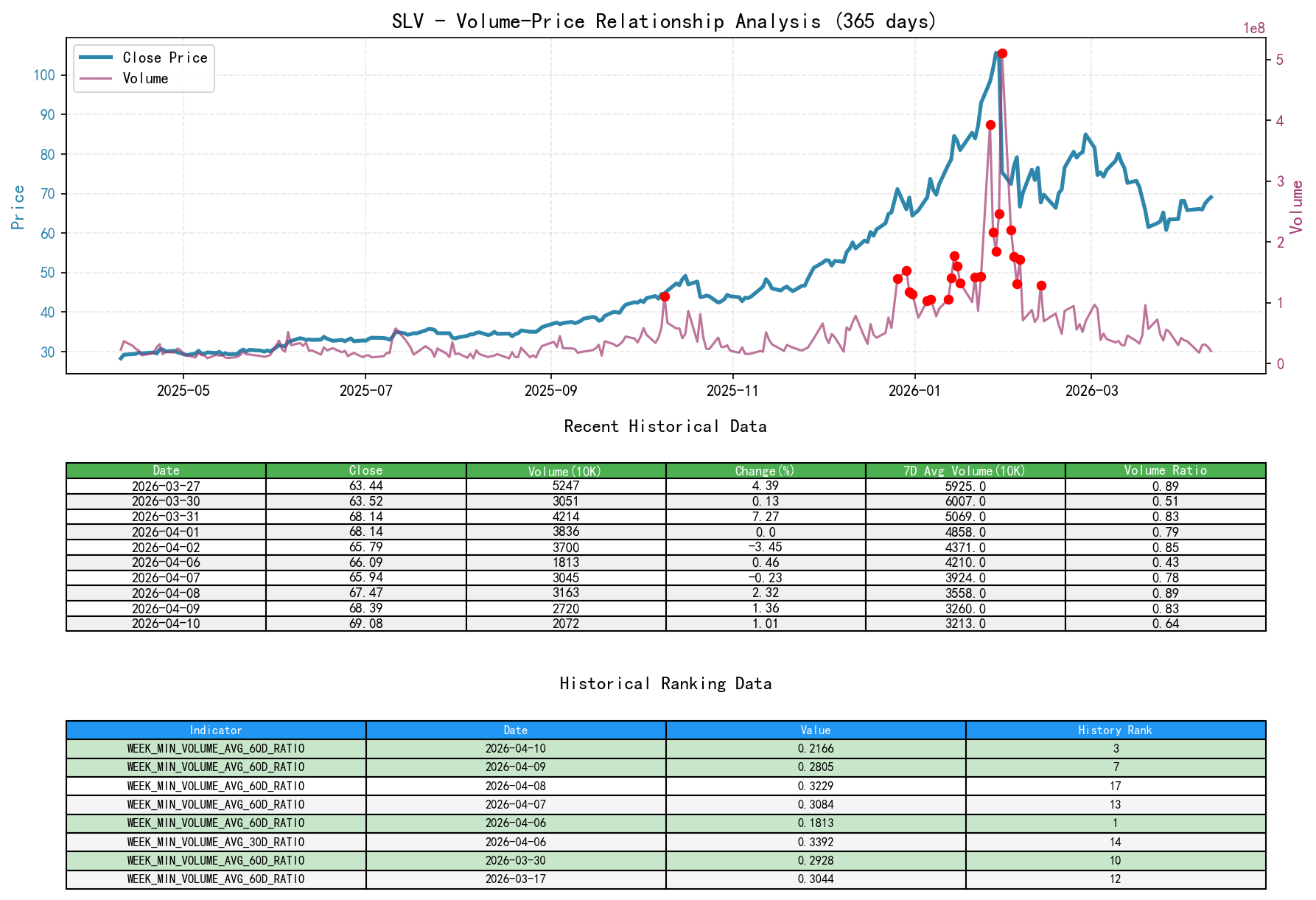
As of 2026-04-10, the underlying asset SLV had an opening price of 69.10, a closing price of 69.08, a volume of 20,725,678, a daily change of 1.01%, a volume of 20,725,678, a 7-day average volume of 32,134,311.43, and a 7-day volume ratio of 0.64.
- 1. Key Days and Supply-Demand Struggle:
- • High-Volume Plunge Dominated by Supply (Supply Overwhelming Demand):
- • 2026-03-19: Price fell -4.40%, volume 96.19 million, an exceptionally high recent volume (VOLUME_GROWTH +105.78%). The VOLUME_AVG_21D_RATIO was 1.76 that day, ranking high historically. This is a classic panic selling day, with high volume created by supply (sellers).
- • 2026-02-12: Price plummeted -11.53%, volume 128 million, the largest single-day decline in the analysis period. That day, PARKINSON_VOL_14D (1.0293) and HIS_VOLA_14D (2.2116) both hit their highest levels in nearly a decade, indicating extreme volatility and supply pressure.
- • Low-Demand, Low-Volume Rally (Insufficient Demand):
- • 2026-04-06 to 2026-04-10: Several consecutive days of slight gains, but volume continued to shrink (04-10 volume was only 21.66% of the 60-day average, historically ranking 3rd lowest). This is a typical "low-volume rally," indicating the rise is primarily driven by short covering or limited buying, lacking confirmation from large-scale demand (institutional capital). The foundation for the rise is fragile.
- • Secondary Test and Signs of Supply Exhaustion:
- • 2026-03-26: Price fell -6.81%, volume 56.08 million, but the VOLUME_AVG_60D_RATIO was only 0.52, significantly lower than previous plunge days (e.g., 03-19). This could be a secondary test of the previous low (03-20), and the shrinking volume suggests supply has weakened.
- • High-Volume Plunge Dominated by Supply (Supply Overwhelming Demand):
- 2. Interpretation of Volume Anomaly Indicators:
- • VOLUME_AVG_60D_RATIO has remained below 0.5 in April, hitting multi-year lows, indicating extremely low current market participation, liquidity drying up—a precursor signal for a potential trend inflection point.
- • VOLUME_GROWTH frequently showed very high positive values (>40%) during the plunge days in mid-to-late March, while showing negative values during the April rally, confirming the weak pattern of "high volume on declines, low volume on rises."
Summary: Supply-demand dynamics clearly show that large-scale supply was released during the March plunge. The market is now in a state of "supply contraction," but demand has not yet manifested on a large scale (evidenced by the low-volume rally). The market is at a fragile node of supply-demand rebalancing.
3. Volatility and Market Sentiment
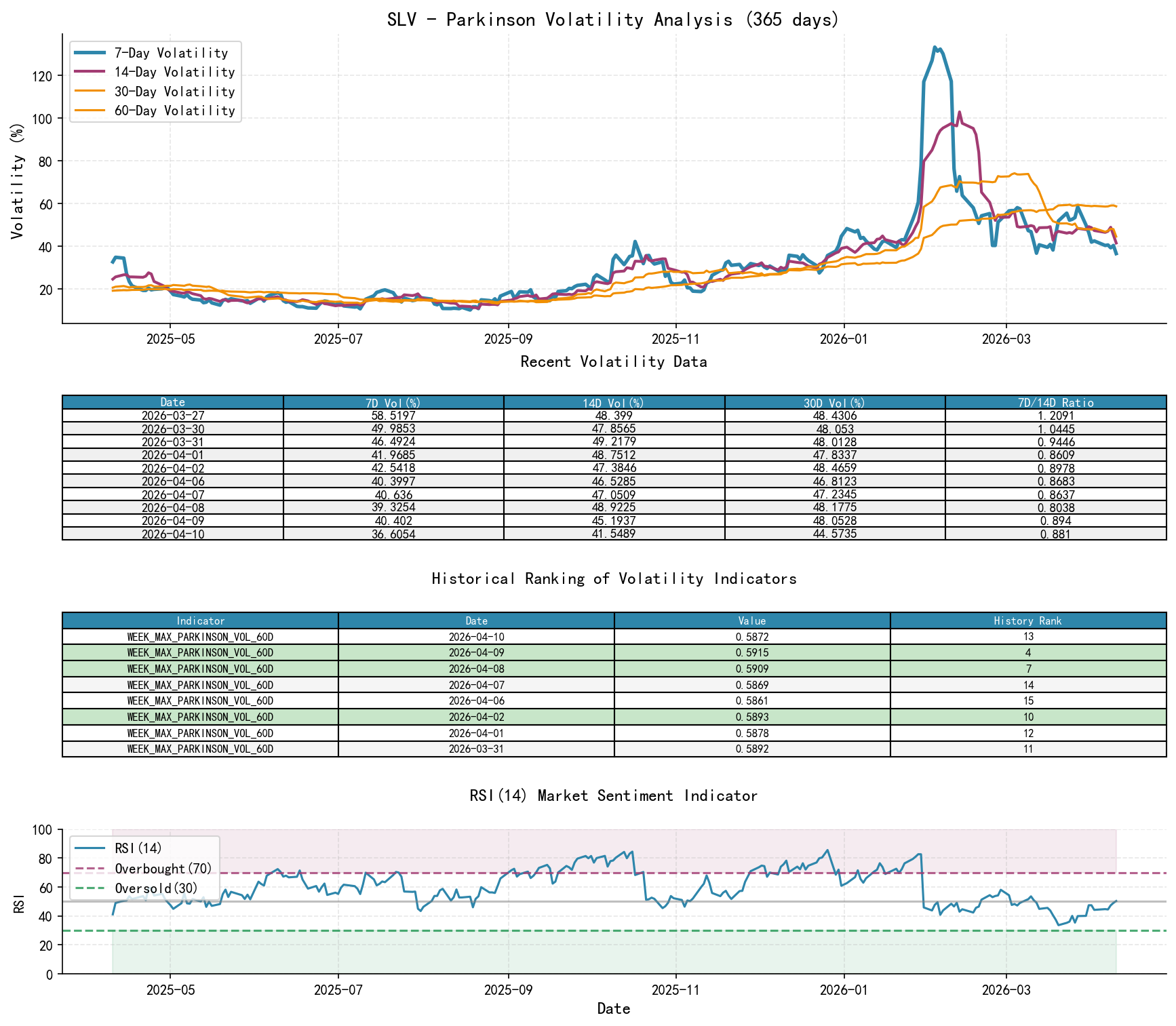
As of 2026-04-10, the underlying asset SLV had an opening price of 69.10, a 7-day intraday volatility of 0.37, a 7-day intraday volatility ratio of 0.88, a 7-day historical volatility of 0.35, a 7-day historical volatility ratio of 0.55, and an RSI of 50.37.
- 1. Volatility Levels and Compression:
- • Historical Highs: In mid-to-late February and early March during the decline, short-term volatility measures (HIS_VOLA_7D, PARKINSON_VOL_7D) reached near-decade highs (e.g., HIS_VOLA_7D was 2.9407 on 02-09, ranking 1st). This corresponded to trend acceleration and panic sentiment.
- • Extreme Compression: Currently (2026-04-10), HIS_VOLA_7D has fallen to 0.3524, and PARKINSON_VOL_7D to 0.3661, both at very low levels. More importantly, HIS_VOLA_RATIO_7D_60D (0.2814) hit its 7th lowest level in nearly a decade, and PARKINSON_RATIO_7D_60D (0.6234) is also at a low level. This indicates that short-term volatility relative to long-term volatility has undergone extreme compression, often foreshadowing market sentiment calming down from panic and potentially brewing a new trend ("calm before the storm").
- 2. Market Sentiment Indicator (RSI):
- • RSI_14 dropped to a recent low of 33.65 on March 20, nearing the oversold zone but not entering extreme oversold territory (<30), indicating the decline was sharp but did not trigger complete despair-driven selling.
- • The current RSI_14 has recovered to 50.37, within the neutral range—neither overbought nor oversold—consistent with the price's low-level consolidation state, providing no clear directional signal.
Summary: The transition of volatility from extreme highs (panic) to extreme lows (compression) is a key signal for a market phase shift. The current extremely low short-term to long-term volatility ratios, combined with low volume, strongly suggest the market is at a critical balance and decision point for bulls and bears, with volatility likely to expand in the future.
4. Relative Strength and Momentum Performance
- 1. Periodic Return Analysis:
- • Short-term (WTD): +5.00%, indicating momentum for an oversold bounce this week, but the quality of this momentum is questionable given its low-volume nature.
- • Medium-term (MTD/QTD): +1.38% / +1.38%, indicating the downtrend has temporarily halted since April, entering a platform of slight positive growth.
- • Long-term (YTD): +7.23%, but the main gains came from the January-February rally, with March's sharp decline nearly erasing all gains. The overall momentum structure shows "low-level consolidation after a high-dive plunge," with medium-to-long-term momentum remaining weak.
Summary: Momentum indicators align with price action, showing short-term downward momentum is exhausted, but upward momentum has not yet formed. The market lacks sustained directional momentum and is in a consolidation period.
5. Large Investor (Smart Money) Behavior Identification
- 1. Distribution Behavior (Completed): The process of price making new highs in late February and the subsequent first high-volume long bearish candle (around 02-12, 02-27), accompanied by historically high volatility and volume, represents the classic action of smart money distributing holdings to the public at high levels.
- 2. Accumulation Behavior (Ongoing/Potential):
- • Buying on Panic: The high-volume plunge on March 19 (-4.40%, huge volume) was likely public panic selling, with smart money quietly absorbing shares at lower levels. The immediate contraction in volume the next day (03-20), with price continuing to fall but lacking energy, supports this assessment.
- • Stealth Accumulation: Entering April, extremely low volume (VOLUME_AVG_60D_RATIO at historical lows) and narrow price ranges suggest large investors may be conducting "stealth accumulation" within the current low range—patiently and dispersedly gathering shares without significantly pushing the price higher. This behavior typically occurs when public interest is extremely low.
- 3. Current Intent: The primary intent of smart money has shifted from "distribution" to "rebuilding positions at low levels." They are testing whether market supply has truly dried up (by observing if declines occur on low volume) and are gradually building long positions using the market's pessimistic sentiment. However, they have not yet shown strong upward driving intent and are still waiting for more opportune timing or further confirmation signals.
Summary: The operational cycle of large investors has switched. Previous distribution is complete, and the current behavioral pattern (low-level, low-volume, narrow-range oscillation) aligns with characteristics of the early Accumulation Phase. However, signals such as a "Spring" or a "Sign of Strength" (high-volume rise) are needed to confirm the completion of accumulation and the transition to a markup phase.
6. Support/Resistance Level Analysis and Trading Signals
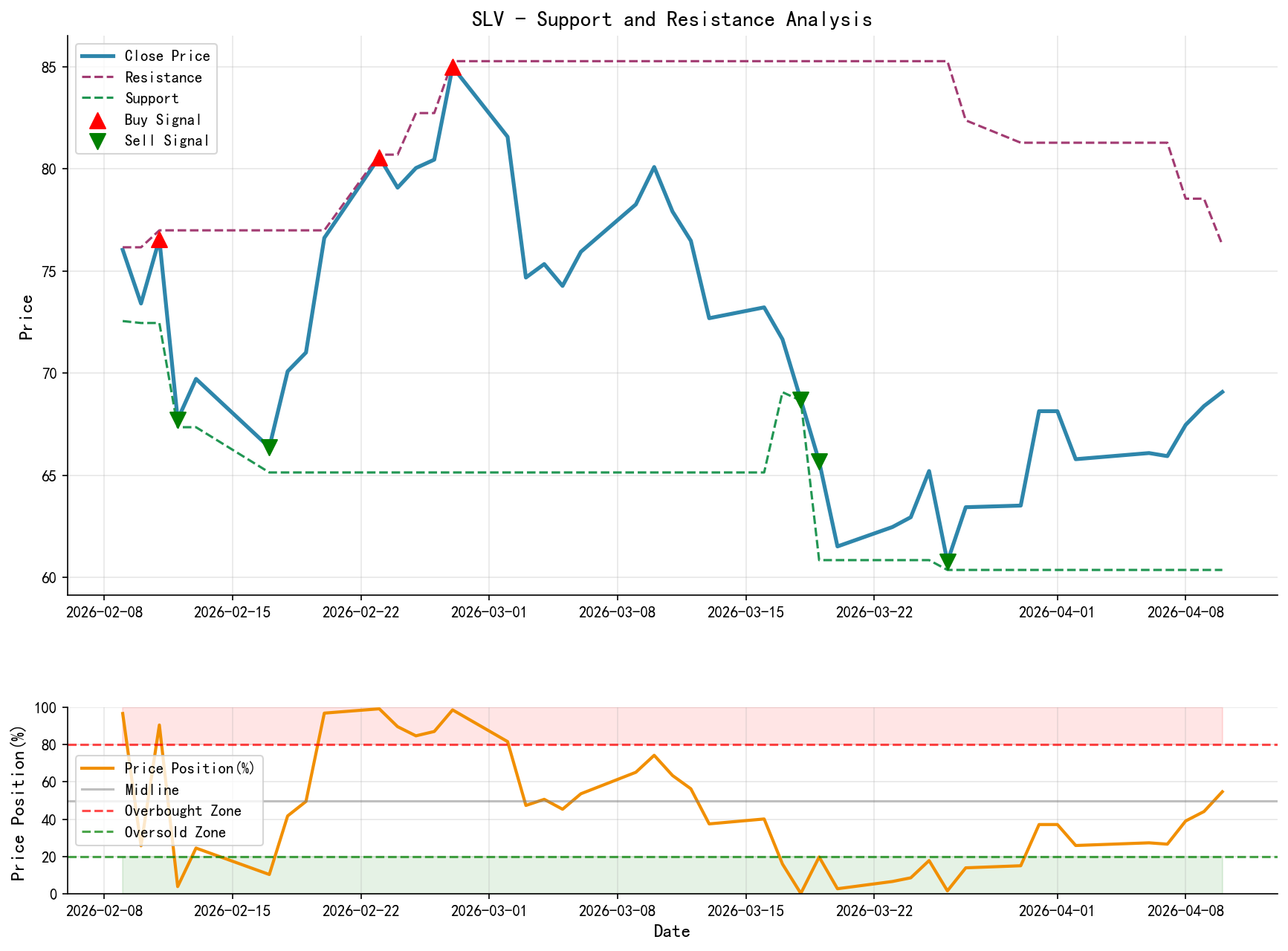
- 1. Key Price Levels:
- • Important Support:
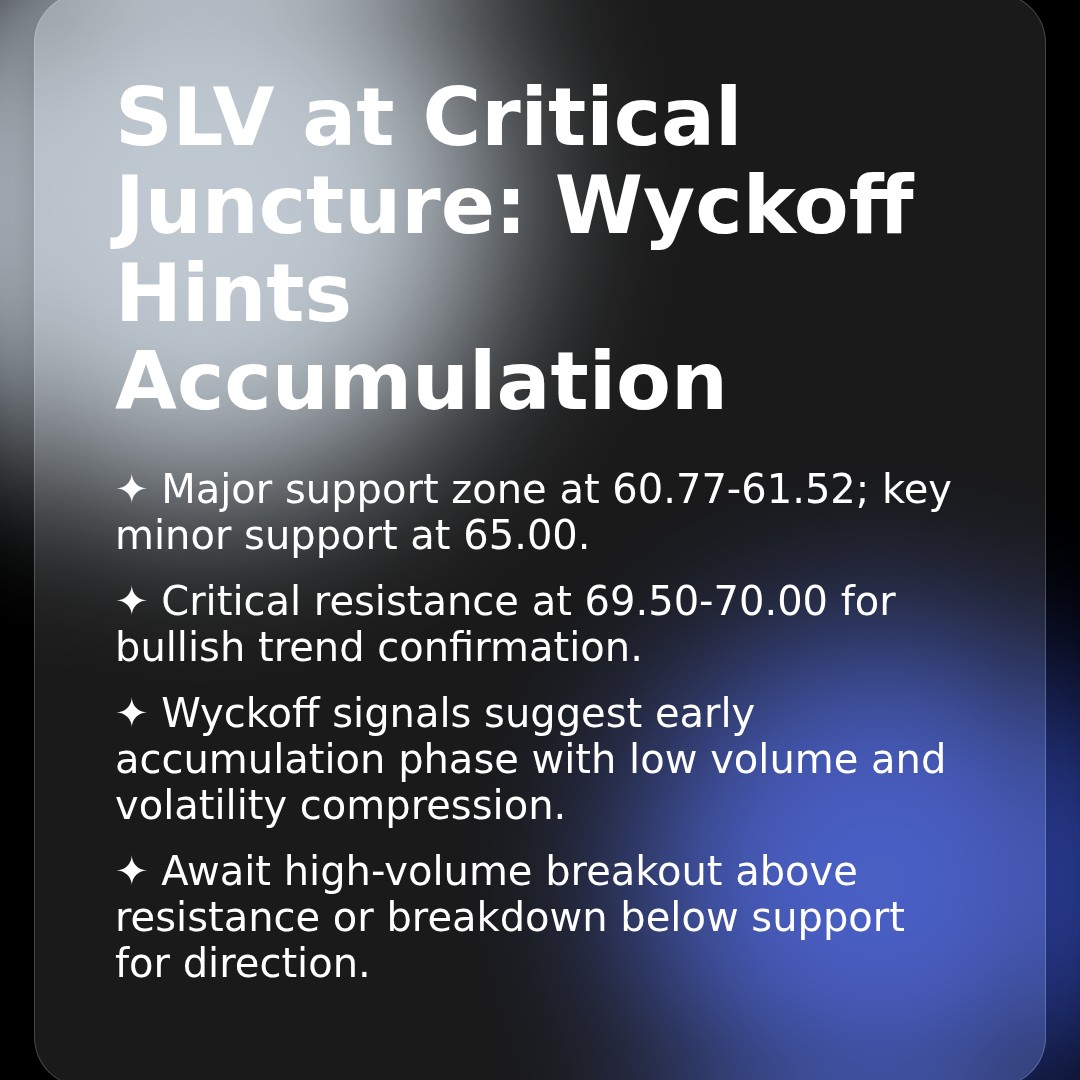
- • Major Support Zone: 60.77 - 61.52 (lows on 2026-03-20, 2026-03-26). This is the bottom area formed by recent panic selling. A break below would open new downside space.
- • Minor Support: 65.00 (lower boundary of recent consolidation range and a psychological level).
- • Key Resistance:
- • Recent Strong Resistance: 69.50 - 70.00 (upper boundary of current consolidation range and near the MA_20D). Breaking this area is the first technical signal of market strengthening.
- • Medium-term Resistance: 76.00 - 78.00 (the consolidation platform during early March's decline).
- • Long-term Resistance: 82.00 - 85.00 (the distribution zone from February).
- • Important Support:
- 2. Wyckoff Composite Trading Signals:
- • Current Situation Assessment: The market exhibits a combination of "narrow-range sideways movement after a decline + extremely low volume + extreme volatility compression." This aligns with the characteristics of the early stages of a "Trading Range (TR)" or "Preliminary Support (PS)" within a Wyckoff Accumulation Structure.
- • **Signal Direction: ** Cautiously Bullish / Seeking Long Opportunities. However, the current moment is not the time for immediate long entry but rather a stage for preparation and observation for a potential bullish trend reversal.
- • Specific Operational Suggestions:
- • Aggressive Strategy (Left-Side): If the price retraces again to the 65.00-66.00 support zone, and the decline process shows continuously shrinking volume (VOLUME_AVG_60D_RATIO < 0.5), this could be viewed as a "secondary test." A small long position can be attempted, with a stop loss set below 64.00.
- • Conservative Strategy (Right-Side): Wait for confirmation signals of demand emergence. Focus on observing whether the price can break through the 69.50 - 70.00 resistance zone on high volume (VOLUME_AVG_60D_RATIO > 1.0). If this occurs, it can be considered a successful "Spring" or "Jump Across the Ice" signal, allowing long entry with an initial stop loss set below the low of the breakout candle.
- • Bearish Strategy: If the price breaks below 65.00 on high volume, it indicates supply is not yet exhausted, accumulation has failed, and the market will resume its downtrend. One can follow the trend to go short, targeting the previous low of 60.77.
- 3. Future Validation Points:
- • Signals Confirming the Bullish Thesis: ① Price breaks above 70.00 on high volume; ② Volume significantly shrinks during pullbacks to support levels; ③ Short-term volatility (HIS_VOLA_7D) begins to expand moderately from its current lows while the price rises.
- • Signals Invalidating the Bullish Thesis: ① Price reverses downward again after a low-volume rally approaches 69.50; ② Price breaks below the 65.00 support on high volume; ③ After compression at lows, volatility expands to the downside (i.e., another high-volume decline occurs).
Final Conclusion:
Based on an in-depth Wyckoff volume-price analysis of SLV, the findings indicate that this asset has completed the distribution-markdown cycle that began in late February and is currently highly likely in the early stages of a major Accumulation Phase. Its characteristics include: price oscillating sideways at low levels, volume hitting multi-year lows, and volatility undergoing extreme compression. The behavioral pattern of large investors has shifted from distribution to tentative accumulation. However, the market has not yet given a clear signal for an upward move.
Operationally, it is advisable to shift from a previous bearish mindset to a neutral-to-bullish one, but avoid aggressive action. Patience is required to wait for the market to reveal its directional choice: either confirming accumulation completion and demand entry via a high-volume breakout above the 69.5-70 resistance, or invalidating the accumulation hypothesis via a high-volume break below the 65 support. The present is a critical observation window for positioning for the next trend.
Disclaimer: This report/analysis is solely market analysis and research based on publicly available information and does not constitute any investment advice or operational guidance. The author strives for objectivity and fairness but makes no guarantees regarding accuracy or completeness. The market involves risks; investment requires caution. Any investment actions based on this report are taken at one's own risk.
Thank you for your attention! Wyckoff Volume-Price market analysis is published daily at 8:00 AM before market opening. Please leave comments and share; your recognition is crucial. Let's work together to see market signals clearly.
Member discussion: