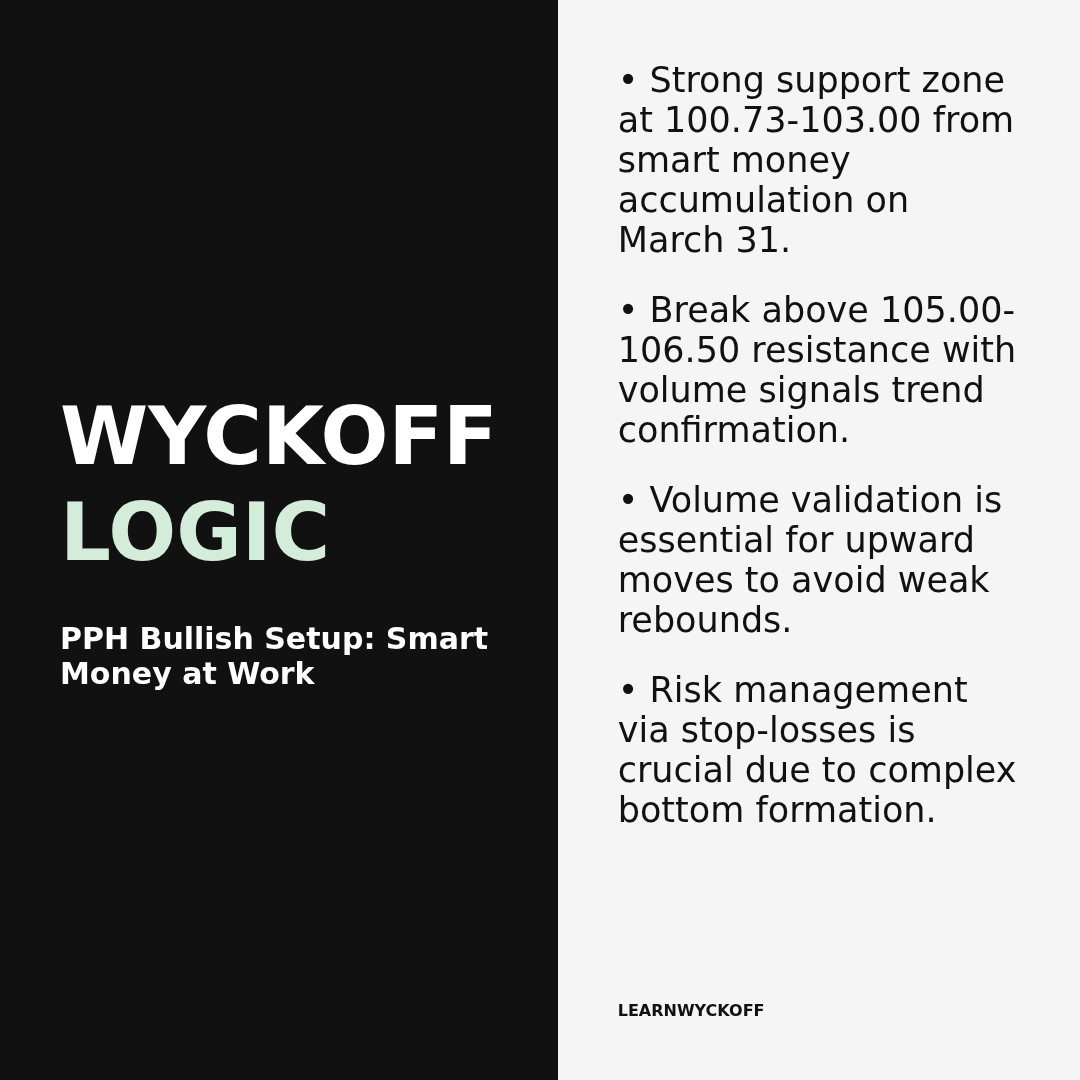
Okay, I will act as a quantitative trading researcher proficient in the Wyckoff method and write you a comprehensive and in-depth quantitative analysis report based on the PPH data (2026-02-09 to 2026-04-10) and historical ranking indicators you provided. The report will strictly follow the six dimensions you proposed, with all conclusions derived from data and in line with Wyckoff's principles of price and volume.
PPH Quantitative Analysis Report
Product Code: PPH
Analysis Date Range: 2026-02-09 to 2026-04-10
Report Generation Time: 2026-04-11
Core Objective: Identify the current market phase, supply-demand dynamics, and large fund behavior, and provide data-driven actionable strategies.
1. Trend Analysis and Market Phase Identification
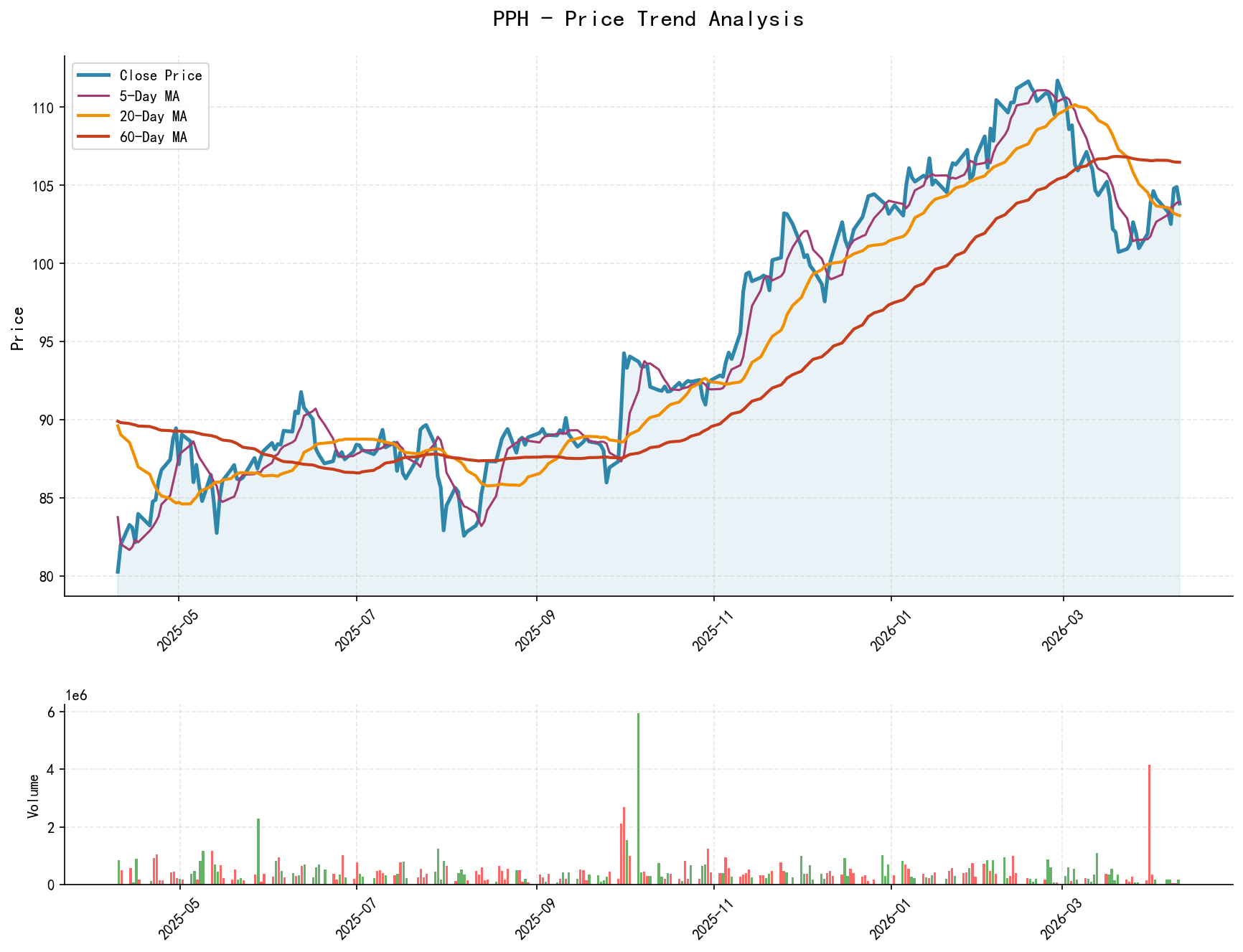
As of 2026-04-10, the underlying asset PPH opened at 105.28, closed at 103.83, with a 5-day moving average (MA) of 103.93, 10-day MA of 103.30, 20-day MA of 103.06, daily change of -1.01%, weekly change of -0.32%, monthly change of -0.05%, quarterly change of -0.05%, and yearly change of +0.64%.
Price and Moving Average Relationship:
As of 2026-04-10, the closing price is 103.83, which is below all moving averages (MA_5D: 103.93, MA_10D: 103.30, MA_20D: 103.06, MA_30D: 104.74, MA_60D: 106.47). The price exhibits a typical bearish alignment (short-term MAs have crossed below medium and long-term MAs: MA_5D < MA_10D < MA_20D < MA_60D), confirming the market is in a medium-term downtrend.
Trend Evolution:
- • Mid-to-late February (Rally and Distribution): The price reached a cyclical high (111.65-111.70) between February 13-17. During this period, MAs were in a bullish alignment, but the RSI approached overbought levels (67.75). Subsequent price declines were accompanied by flattening and intertwining MAs.
- • March (Accelerated Decline and Bottoming): In early March, the price broke below the key medium-term support of the MA_30D, signaling the end of the uptrend and the beginning of a downtrend. The price rapidly fell to the 100.20-102.20 range around March 18-20, and the MA system formed a bearish alignment.
- • Late March to Early April (Oversold Rebound and Test): A high-volume rebound occurred on March 31 (detailed below), but the rebound failed to effectively break through any key moving averages. The current price hovers near the MA_5D, indicating a low-level consolidation following the downtrend.
Inferred Market Phase:
Integrating price, volume, and trend behavior, the market has undergone a complete cycle of "rally - distribution - decline." It is currently in the late stage of the downtrend or the early stage of a potential accumulation phase. The high-volume bullish candle at the end of March could be a signal of a Selling Climax (SC) and initial accumulation, but confirmation requires subsequent prices to stabilize above key moving averages. The current pattern is more consistent with the early characteristics of a "Secondary Test (ST)" or "Basin Building" according to Wyckoff theory.
2. Volume-Price Relationship and Supply-Demand Dynamics
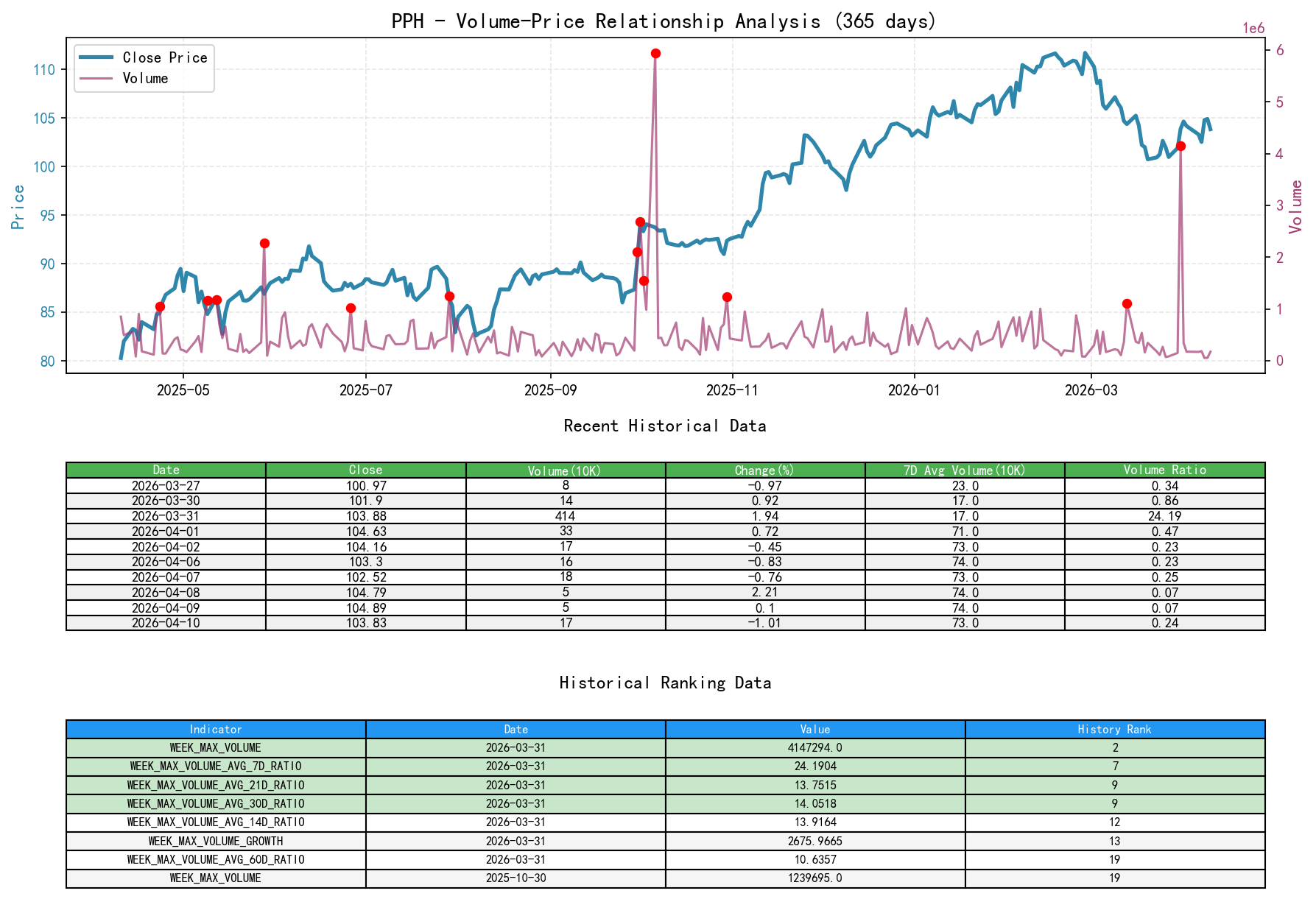
As of 2026-04-10, the underlying asset PPH opened at 105.28, closed at 103.83, volume was 173,700, daily change was -1.01%, volume 173,700, 7-day average volume 731,381.71, 7-day volume ratio 0.24.
Key Day Analysis (Wyckoff Events):
- 1. High-volume Stagnation at Highs (Supply Dominance - Distribution Signal):
- • 2026-02-12: Volume reached 1,003,232 (1.75 times the 7-day average volume, historical rank 16th by dollar volume), but the price only increased by 0.009%. This is a classic case of "high volume without significant price appreciation," indicating strong supply pressure around the 110.30 high. Demand could not push prices higher, suggesting the start of distribution.
- • 2026-02-27: Extremely low volume (76,852) but a large price increase of 2.01%. This is characteristic of an "Upthrust" or "rally test," which failed to sustain, confirming that supply still dominated.
- 2. High-volume Advance at Lows (Demand Dominance - Potential Accumulation Signal):
- • 2026-03-31: Volume reached the second highest in nearly a decade (4,147,294), accompanied by a significant price increase of 1.94%. The opening price (102.42) was higher than the previous day's close (100.93), forming a strong combination of "price rise with volume increase." This aligns with Wyckoff characteristics of a "Selling Climax (SC)" or "Automatic Rally (AR)," indicating that after an extended decline, large capital actively absorbed selling pressure at low levels, with strong demand entering.
- • 2026-03-13: Volume surged to 1,105,457 (4.43 times the 7-day average), and the price fell -0.31%. This is another manifestation of "panic selling," characterized by a high-volume sharp decline. The following day (03-16), the price did not make a new low and rebounded slightly, suggesting potential support in this area.
- 3. Low-volume Consolidation (Exhaustion of Supply or Demand Wait-and-See):
- • From late March to early April, volume significantly contracted compared to the March 31 peak (VOLUME_AVG_7D_RATIO mostly below 0.5). Particularly within the sideways price range (103-105), volume was low, indicating weakened active selling (supply) but no significant entry of demand either. The market is in a state of balance or observation.
Supply-Demand Dynamics Summary:
Supply-side pressure was fully released during the February highs and the March decline (especially on March 13 and 31). Demand-side demonstrated powerful, historically significant absorption for the first time on March 31. The current market is in a supply-demand rebalancing period following the contraction of supply. The high-volume candle on March 31 is a key "demand manifestation" signal, but requires price breakthrough confirmation.
3. Volatility and Market Sentiment
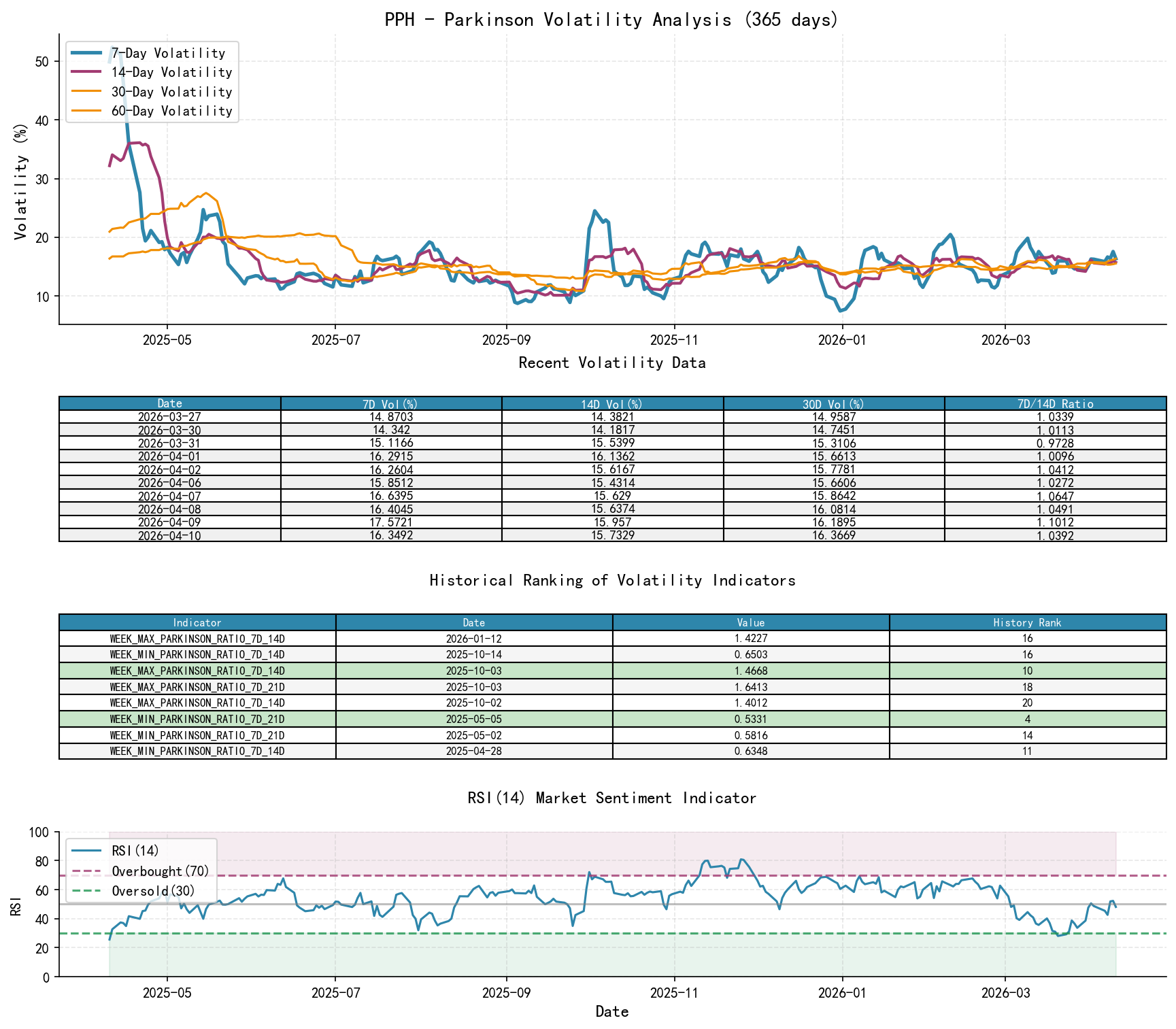
As of 2026-04-10, the underlying asset PPH opened at 105.28, 7-day intraday volatility 0.16, 7-day intraday volatility ratio 1.04, 7-day historical volatility 0.22, 7-day historical volatility ratio 1.06, RSI 48.10.
Volatility Level and Changes:
- • The 7-day historical volatility (HIS_VOLA_7D) reached a local peak of 0.294 on 2026-03-09, with the Parkinson volatility (PARKINSON_VOL_7D) at 0.198 during the same period. Short-term volatility was significantly higher than medium-to-long-term levels (HIS_VOLA_RATIO_7D_14D reached 1.429, ranking 4th in nearly a decade), confirming that the market was in a panic-selling decline phase in early March, with intense sentiment swings.
- • Entering April, although short-term volatility (HIS_VOLA_7D: ~0.22) remains slightly above the 60-day level (HIS_VOLA_60D: ~0.21), the ratio has normalized (HIS_VOLA_RATIO_7D_60D ~1.04). The convergence of volatility from extreme highs indicates that market panic sentiment has significantly subsided, entering a relatively calm consolidation period.
RSI Overbought/Oversold Status:
- • RSI_14 reached a high of 67.75 on February 17, nearing but not entering the traditional overbought zone (>70), showing strong but not extreme upward momentum.
- • On March 20, RSI_14 dropped as low as 28.09, entering the oversold region. Although the price continued to drift lower to 100.73 afterward, the RSI formed a positive divergence (price made a new low, RSI did not), which is an important technical signal of weakening downward momentum, resonating with and validating the high-volume rebound on March 31.
Market Sentiment Conclusion:
The market has moved beyond the panic selling extreme sentiment of March. The current RSI is in a neutral-to-weak zone (48.10), volatility is converging, and sentiment is trending towards calm and observation. This provides a psychological foundation for a potential trend reversal.
4. Relative Strength and Momentum Performance
Cycle Return Analysis:
- • Short-term Momentum (WTD_RETURN): -0.32%, weak, indicating continued adjustment this week.
- • Medium-term Momentum (MTD_RETURN/QTD_RETURN): -0.05% / -0.05%, essentially flat. This suggests that the downward momentum since April has largely stalled.
- • Year-to-date and Long-term Momentum (YTD/TTM_36): +0.64% / +30.46%. Although year-to-date returns are minimal, the 36-month return remains substantial, indicating that the foundation of the long-term uptrend has not been completely broken. The current decline can be viewed as a deep correction within a long-term bull market.
Momentum Summary:
Short-term and medium-term momentum are weak, consistent with the downtrend. However, long-term momentum remains strong, and medium-term momentum (MTD) shows signs of stabilization. The momentum structure implies that if the market can successfully build a bottom in the current region, there is room for upward momentum repair.
5. Large Investor (Smart Money) Behavior Identification
Based on extreme data in volume, price, and volatility, the operational path of smart money can be clearly outlined:
- 1. High-Level Distribution (Distribution): Around February 12 and the surrounding days, "high-volume stagnation" occurred near 111, which is typical institutional distribution behavior. They transferred holdings to retail investors at highs using market optimism.
- 2. Supply Release and Testing During the Decline: During the March decline, smart money did not provide large-scale resistance, allowing the price to release selling pressure. The high-volume decline on March 13 might represent their process of testing remaining market selling pressure and the outflow of some panic selling.
- 3. High-Volume Accumulation During Low-Level Panic (Accumulation): 2026-03-31 was the decisive day. A record-breaking volume (2nd highest in nearly a decade) coupled with a price increase is definitely not retail behavior. This clearly indicates that large capital conducted massive, concentrated buying operations within the 100-103 price range. They leveraged market panic sentiment (SC) to accumulate cheap holdings.
- 4. Current Silence and Observation: Following accumulation, the price entered a low-volume consolidation. Smart money is likely observing market reactions and may be conducting a Secondary Test (ST) in the current region to confirm whether supply has truly dried up, preparing for the next upward move.
Core Judgment: Smart money completed one significant, historically notable bottom accumulation by the end of March. The current market is in the "silent period" or "shaking-out test period" following accumulation.
6. Support/Resistance Level Analysis and Trading Signals
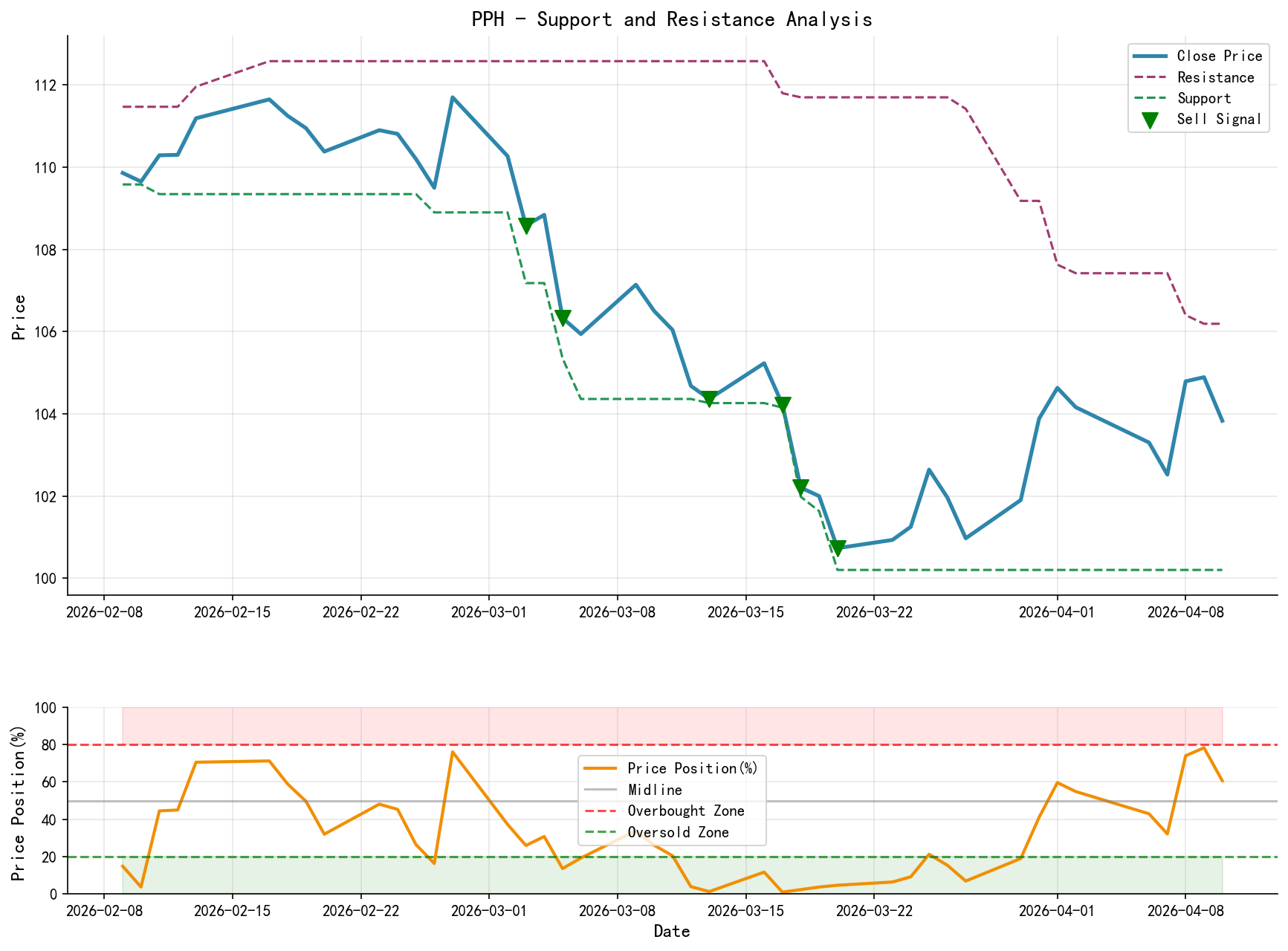
Key Price Levels:
- • Strong Support Zone: 100.73 - 103.00
- • Composed of the March lows (100.73, 101.99) and the opening price (102.42) of the high-volume bullish candle on March 31. This is the zone where smart money clearly intervened, representing an important demand zone.
- • Primary Resistance / Bull-Bear Demarcation Line: 105.00 - 106.50
- • Includes the MA_30D (104.74), the lower edge of previous trading congestion, and the early April rebound high. Breaking through this zone is the first technical signal for trend strengthening.
- • Strong Resistance Zone: 108.00 - 111.70
- • The February distribution range and the location of all medium-to-long-term moving averages. This is the target area that needs to be overcome for a full recovery of the uptrend.
Comprehensive Trading Signals and Operational Recommendations:
- • **Medium-term View: ** Bullish, but in the late stage of bottom formation/early stage of an uptrend. ** Core rationale is the massive accumulation by smart money on March 31, coupled with the current state of shrinking supply and recovering sentiment.
- • Trading Strategy:
- 1. Aggressive Approach: Consider staggered buying on dips within the current price range (103.00 - 104.00), setting the stop-loss below the 100.00 psychological integer support at the lower edge of the strong support zone. The initial position should be light, serving as a base position.
- 2. Conservative Approach: Wait for the price to close above the MA_20D (currently ~103.06) or 105.00 with increased volume (volume exceeding 1.5 times the 7-day average) before following up with a long position. Set the stop-loss below the low of the entry candle.
- • Future Validation Points (Require Continuous Monitoring):
- • Confirmation Signal: Price finds sustained support above the 100-103 support zone, followed by a "Jump across the Creek" style high-volume bullish candle breaking through the 105-106.5 resistance zone.
- • Invalidation Signal: Price breaks below the previous low of 100.73 on high volume and fails to recover quickly. This would imply that the high volume on March 31 was not effective accumulation, the downtrend would likely continue, requiring immediate stop-loss and reassessment.
- • Volume Validation: Any upward price movement must be accompanied by a moderate increase in volume (VOLUME_AVG_7D_RATIO > 1.2). Price rises without volume should be considered weak rebounds and not chased.
Risk Warning: The bottom formation process can be complex, with potential for repeated "shaking-out" movements. Strictly control position sizing and stop-losses, and patiently await confirmation of key signals.
Disclaimer: This report/interpretation is solely market analysis and research based on publicly available information and does not constitute any investment advice or operational guidance. The author strives for objectivity and fairness but makes no guarantees regarding accuracy or completeness. Markets involve risk; investment requires caution. Any investment actions based on this report are undertaken at your own risk.
Thank you for your attention! Wyckoff price-volume market interpretation is released daily before the 8:00 AM market open. Please leave comments and share; your recognition is crucial. Let us see the market signals together.
Member discussion: