Understood, following your instructions. As a quantitative trading researcher well-versed in the Wyckoff Method, I will author a comprehensive and in-depth quantitative analysis report based on the POOL data and historical ranking metrics you provided.
Wyckoff Volume-Price Analysis Report: POOL
Product Code: POOL
Analysis Date Range: 2026-02-09 to 2026-04-10
Report Generation Date: 2026-04-11
Core Methodology: Wyckoff Volume-Price Principles, Quantitative Indicator Analysis
I. Trend Analysis & Market Phase Identification
As of 2026-04-10, the underlying asset POOL has the following metrics: Opening Price 214.56, Closing Price 214.91, 5-day Moving Average (MA_5D) 206.41, 10-day MA (MA_10D) 203.47, 20-day MA (MA_20D) 204.31, Daily Return 0.66%, Weekly Return 5.90%, Monthly Return 6.22%, Quarterly Return 6.22%, Yearly Return -6.05%
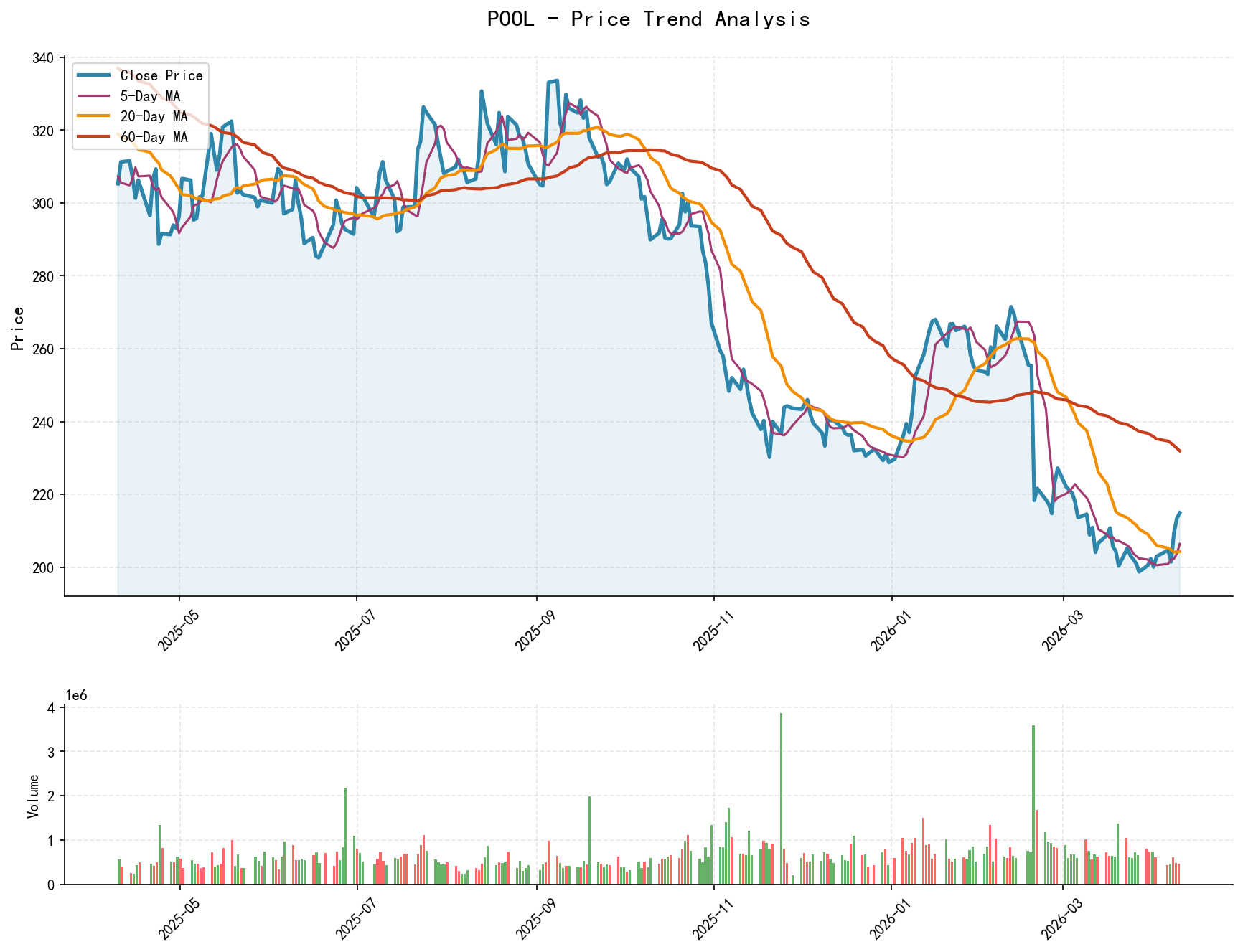
Based on the relationship between price and moving averages, the current market structure can be clearly divided into two phases:
- 1. Breakdown of Bullish Structure and Panic Selling (Early February to February 19th):
- • Initial Phase (Feb 9th-11th): The price (CLOSE) traded above the MA_5D, MA_10D, and MA_20D, forming a short-term bullish alignment. However, the MA_30D and MA_60D remained consistently below the price, indicating the long-term trend had not fully reversed.
- • Turning Point (Feb 12th-18th): The price rallied to a high (278.17 on Feb 12th) but failed to decisively break through prior resistance and began testing the MA_20D. Consecutive declines on Feb 17th-18th caused the price to fall below all short-term MAs (MA_5D, MA_10D, MA_20D), signaling the failure of the short-term uptrend.
- • Panic Phase (Feb 19th): The price opened with a "gap down" and plummeted 14.48% (closing at 218.36), directly breaking below all medium and long-term MAs (MA_30D, MA_60D), establishing a clear bearish alignment. This day marked the market's entry into the Wyckoff Panic Selling phase.
- 2. Consolidation and Initial Recovery Attempt Post-Panic (Feb 19th to Present):
- • Post-Panic Rally and Secondary Test (Feb 20th - Early March): Following the sharp decline, a technical rebound occurred. However, the rebound high (227.18 on Feb 27th) was capped by strong resistance from the MA_20D, leading to another decline. This process constituted a Secondary Test of the panic low.
- • Formation of a Low-Level Accumulation Range (March to Present): The price has mainly oscillated widely within the 200-215 range. A key characteristic is: The MA_5D and MA_10D have repeatedly intertwined, while the MA_20D, MA_30D, and MA_60D maintain a clear bearish alignment and continue their downward trajectory, consistently suppressing the price below the MA_20D. This aligns with the early characteristics of an "Accumulation Range" in Wyckoff theory — large investors are absorbing supply in the low-price area following panic, but a new uptrend has not yet been initiated.
- • Recent Signal (Early April): The MA_5D has begun to cross above the MA_10D, and the price has remained above the cluster of short-term MAs (MA_5D, MA_10D) for multiple consecutive days, indicating a warming of short-term momentum and an attempt to break out of the low-level consolidation range.
Phase Judgment: The market is currently in the early stages of a clearly defined Accumulation phase, marked by the Panic Selling event (Feb 19th). Price is building a support platform in the 200-215 range, but faces layered resistance from medium and long-term moving averages above. A transition from a bearish to a bullish trend requires time and volume confirmation.
II. Volume-Price Relationship & Supply-Demand Dynamics
As of 2026-04-10, the underlying asset POOL has the following metrics: Opening Price 214.56, Closing Price 214.91, Volume 470635, Daily Return 0.66%, Volume 470635, 7-day Average Volume 581765.57, 7-day Volume Ratio 0.81
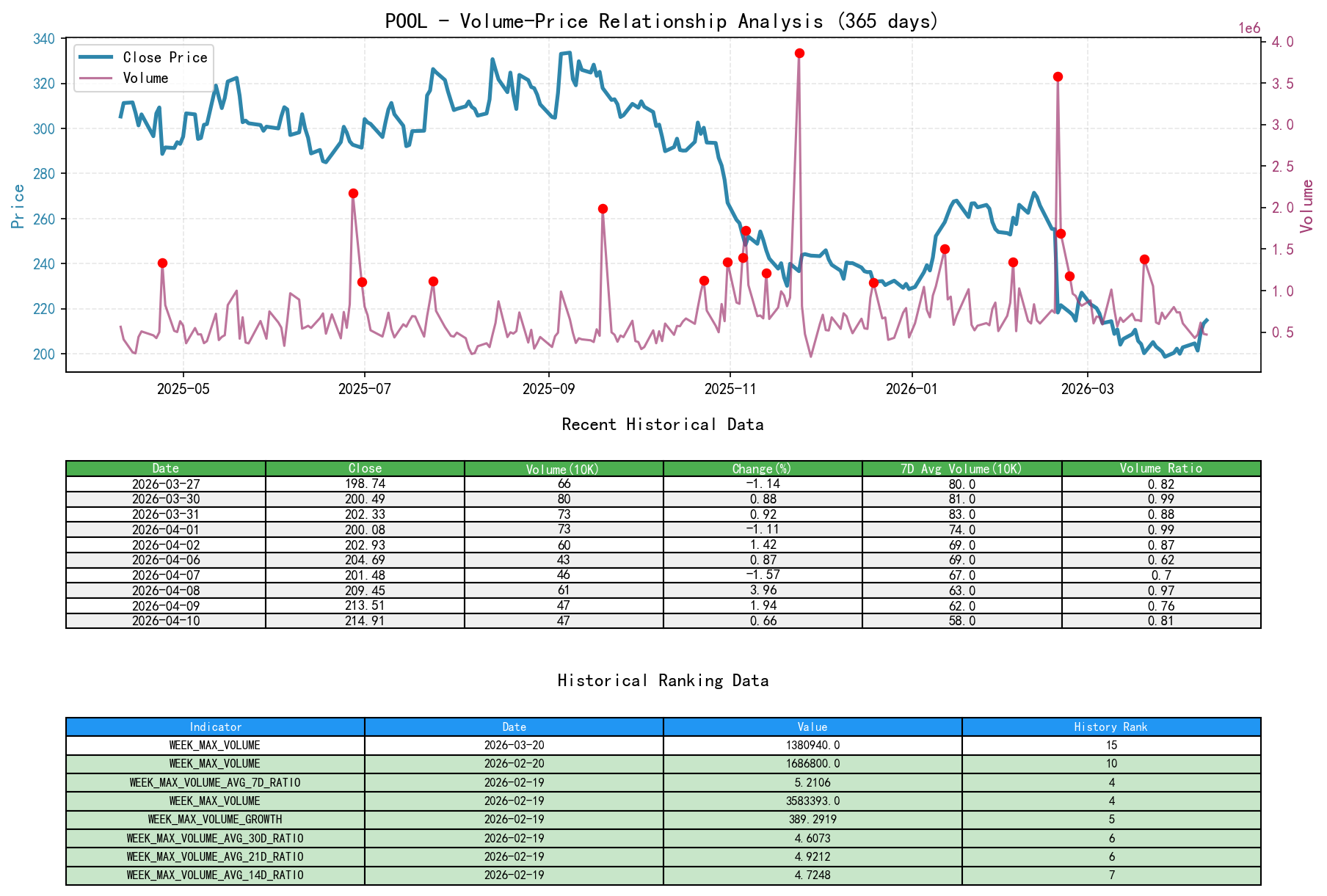
Volume analysis reveals critical junctures in the shift of supply and demand forces:
- 1. Supply in Complete Control — Panic Selling Day (Feb 19th):
- • Volume surged to 3,583,393 shares, ranking as the 4th highest single-day volume in the past decade. The price plunged -14.48% that day. This is a textbook Panic Selling signal: a large number of holders sold indiscriminately under extreme fear, driving supply to a peak.
- • Multiple volume ratio indicators confirm its extremity:
VOLUME_AVG_7D_RATIOreached 5.21 (ranking 4th in the past decade),VOLUME_GROWTHwas 389.29% (ranking 5th). Historical ranking data confirms this was an exceptionally rare selling event.
- 2. Initial Demand Entry and Supply Testing (Feb 20th - Late March):
- • Feb 20th: On the day following the panic, the price closed slightly higher (+1.49%) on still-massive volume (1,686,800 shares, ranking 10th). Combined with the low-open, high-close pattern, this indicates buying interest began actively absorbing panic-driven selling — the first appearance of significant demand.
- • March 20th: The price fell -1.97%, but volume expanded again to 1,380,940 shares (ranking 15th), forming a "high-volume decline." With the price already in the low-level consolidation range, this could be a test for remaining supply or intense battle between bulls and bears at a key level.
- • Supply-Demand Dynamics within the Range: Throughout March's consolidation, the
VOLUME_AVG_7D_RATIOfrequently fell below 0.8, indicating volume was generally below the recent average, consistent with the "low-volume consolidation" characteristic of an accumulation range. Occasional high-volume up days (e.g., March 26th, 30th) showed intermittent demand probing.
- 3. Demand Returns and Attempted Breakout (Early April):
- • April 8th: A high-volume advance (volume 613,647,
VOLUME_AVG_7D_RATIO0.97) with a +3.96% gain saw price break noticeably away from the recent consolidation platform. This is a Sign of Strength (SOS), indicating buyers began attempting to take control. - • April 9th-10th: Price advanced but volume contracted for two consecutive days (
VOLUME_AVG_7D_RATIO0.76 and 0.81 respectively). This is low-volume advancement. In the initial stages of leaving a platform, this may indicate a lack of floating supply, but caution is warranted as subsequent advances may lack stamina if volume doesn't increase.
- • April 8th: A high-volume advance (volume 613,647,
Supply-Demand Judgment: The panic selling released massive supply. During subsequent consolidation, demand began absorbing in an orderly fashion within the 200-215 range. The high-volume, demand-driven advance in early April is a positive signal, but sustainability requires observation. Currently, supply was largely exhausted post-panic, and demand is gathering strength and attempting to gain dominance.
III. Volatility & Market Sentiment
As of 2026-04-10, the underlying asset POOL has the following metrics: Opening Price 214.56, 7-day Parkinson Volatility 0.28, 7-day Parkinson Vol Ratio 0.89, 7-day Historical Volatility 0.35, 7-day Historical Vol Ratio 1.17, RSI 54.97
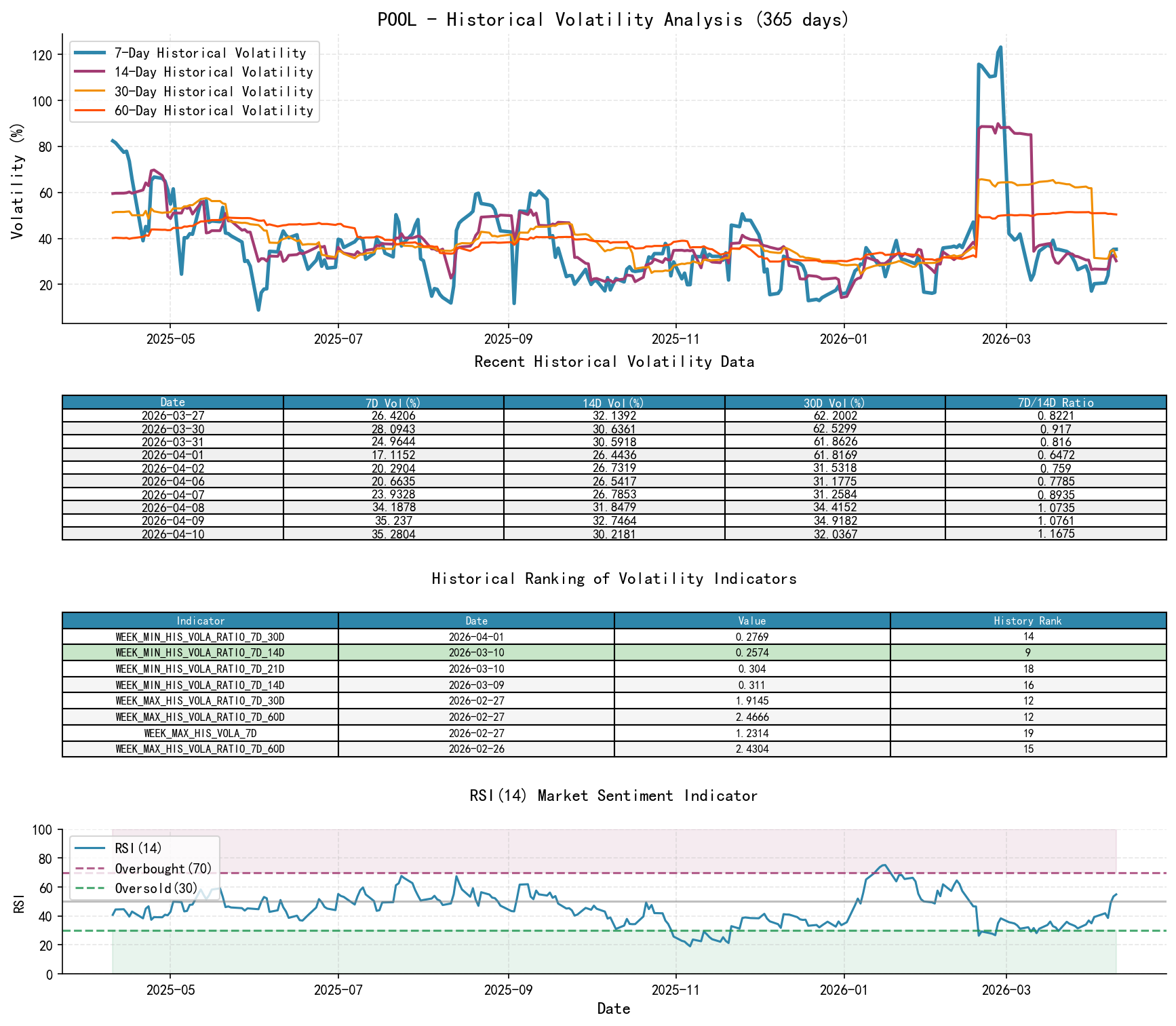
Volatility and sentiment indicators reveal the market's journey from extreme panic to gradual stabilization:
- 1. Volatility Explosion and Sentiment Freeze (Feb 19th and aftermath):
- •
HIS_VOLA_7Dspiked to 1.16 on Feb 19th (ranking 19th in the past decade), andPARKINSON_VOL_7Drose to 0.43, indicating short-term volatility expanded sharply and the market plunged into extreme instability and panic. - •
RSI_14dropped to 26.38 on Feb 19th, entering oversold territory, confirming sentiment reached a pessimistic extreme. - • The volatility ratio
HIS_VOLA_RATIO_7D_60Dreached 2.47 on Feb 27th (ranking 12th in the past decade), meaning short-term volatility was 2.5 times the long-term average, highlighting abnormal market turbulence.
- •
- 2. Volatility Contraction and Sentiment Recovery (Late March to Present):
- • All volatility metrics (
HIS_VOLA_7D,PARKINSON_VOL_7D) have declined significantly from their highs. As of April 10th,HIS_VOLA_7Dis 0.35 andPARKINSON_VOL_7Dis 0.28, returning to normal levels. - • The volatility ratio
HIS_VOLA_RATIO_7D_60Dhas fallen to 0.70, indicating short-term volatility is now below the long-term average, suggesting market sentiment is stabilizing. - •
RSI_14currently stands at 54.97, in a neutral-to-strong zone, neither overbought nor oversold, leaving room for further price movement.
- • All volatility metrics (
Sentiment Judgment: The market has emerged from the extreme panic of February, with sentiment having recovered and stabilized. The current volatility environment is conducive to the development of a trending move rather than disorderly oscillation.
IV. Relative Strength & Momentum Performance
Momentum indicators show significant improvement in the short-term, but medium to long-term pressures remain:
- • Strong Short-Term Momentum:
WTD_RETURN(Weekly Return) is +5.90%,MTD_RETURN(Monthly Return) is +6.22%,QTD_RETURN(Quarterly Return) is +6.22%. All short-term periodic returns have turned positive and show strength, corroborating the early April high-volume price advance. - • Medium/Long-Term Weakness Persists:
YTD(Year-to-Date) return is -6.05%, indicating the stock remains in a downtrend within a longer-term framework.TTM_36(Trailing 36-month) return is -35.88%, reflecting weak long-term trends. - • Momentum Conclusion: Short-term momentum aligns with the volume-price analysis conclusion, confirming the recent demand-driven rebound. However, the stock price needs to overcome resistance from medium and long-term moving averages above to transform short-term momentum into a reversal of the longer-term trend.
V. Large Investor ("Smart Money") Behavior Identification
Based on Wyckoff events and volume-price analysis, large investor behavior is inferred as follows:
- 1. Absorption During Panic Selling (Feb 19th-20th): During the panic-driven stampede selling by retail and weak-handed holders, the enormous volume (top-decile levels) necessarily had corresponding buyers. It is highly likely that smart money engaged in large-scale, proactive buying (accumulation) at these extreme prices, absorbing the panic-driven supply.
- 2. Share Accumulation Within the Accumulation Range (March): Within the 200-215 oscillation range, the recurring pattern of "low volume on declines, higher volume on bounces" is consistent with smart money's characteristic of buying on dips and controlling the pace of accumulation. They used the oscillation to shake out weak holders while building positions.
- 3. Demonstration of Demand and Breakout Attempt (April 8th): The high-volume advance breaking above the upper boundary of the consolidation range is typical smart money behavior — a "Sign of Strength" (SOS). The aim is to test the pressure of remaining supply above and attract trend followers, creating conditions for a potential further markup.
- 4. Current Cautious Stance (April 9th-10th): The consecutive low-volume advances following the breakout may indicate smart money temporarily slowing their buying pace after breaching a key level, observing market follow-through and selling pressure to avoid pushing costs excessively higher. This represents a controlled markup behavior.
Comprehensive Behavior Judgment: Large investors have largely completed massive absorption at the panic bottom and subsequent orderly accumulation within the consolidation range. They are now entering the "Demonstration of Demand" and "Breakout Attempt" phase, intending to push the price away from their cost base and initiate a new markup cycle.
VI. Support/Resistance Level Analysis & Trading Signals
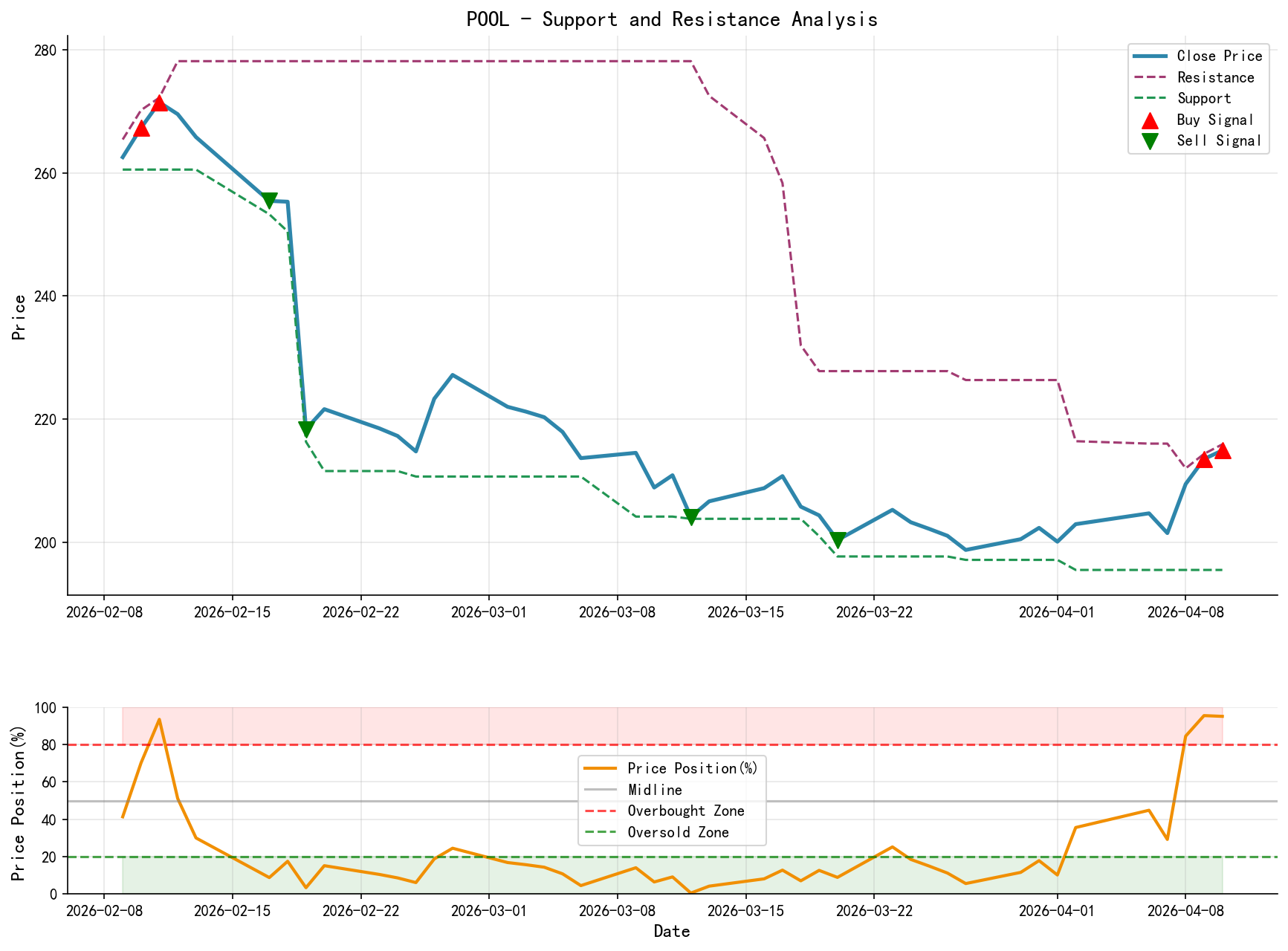
Key Price Levels:
- • Primary Support (Demand Zone): 200 - 205. This area represents the repeated lower bounds of post-panic oscillations and the starting point of recent rebounds, where significant buying interest has accumulated. 198-200 is the final line of defense; a break below would damage the accumulation structure.
- • Key Resistance (Supply Zone): 215 - 220. This area represents the upper boundary of the March consolidation range and the late-February rebound high, containing historical overhead supply. A breakout above this zone is the first important technical signal for a trend reversal to bullish.
- • Strong Resistance: MA_20D (currently ~204.3) is the immediate near-term resistance. 225-230 (the post-crash rebound high in February) is the next resistance level.
Integrated Wyckoff Events & Trading Signals:
- 1. Wyckoff Event Sequence: Panic Selling (SC) → Automatic Rally (AR) → Secondary Test (ST) → Consolidation/Basing (Current Phase) → Sign of Strength (SOS, April 8th) → Subsequent observation needed for a successful Last Point of Support (LPS) or Jump Across the Creek (JOC).
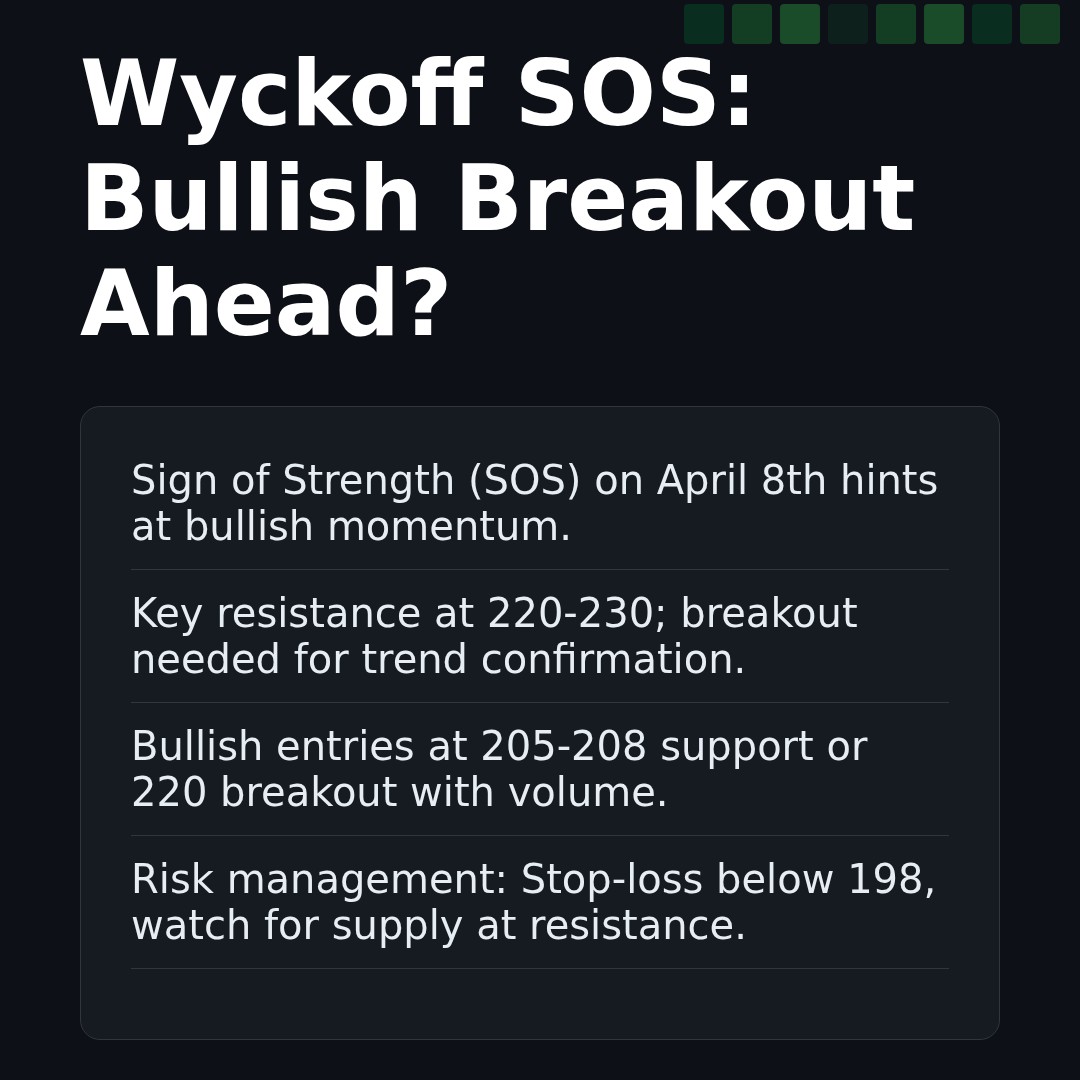
- 2. Current Signal: Short-term bullish, but in a watchful period ahead of key resistance. The high-volume advance on April 8th (SOS) is a positive bullish signal, but requires confirmation from subsequent price action.
- 3. Operational Suggestions:
- • Bullish Strategy (Moderately Aggressive):
- • Entry Point 1 (Cautious): A price pullback to the 205-208 support zone (near MA_5D/MA_10D), accompanied by a low-volume stabilization signal, could be viewed as a lower-risk entry point.
- • Entry Point 2 (Confirmed): A price breakout and sustained hold above the 220 resistance level on increased volume could be considered a confirmed trend strengthening signal, warranting adding to or initiating a position.
- • Stop-Loss Level: Strictly set below 198, i.e., a break below the lower boundary of the primary demand zone.
- • Initial Price Target: 220 (first resistance), with an extended target of 230-235 upon a successful breakout.
- • Risk Warning: If the price fails to break through the 215-220 resistance and falls back below 205 on increased volume, it would indicate supply remains strong, potentially prolonging the accumulation process. Exit and observe from the sidelines in such a scenario.
- • Bullish Strategy (Moderately Aggressive):
Future Confirmation Points:
- 1. Positive Confirmation: Price demonstrates strength in the 215-220 zone (e.g., low-volume consolidation or rapid high-volume breakout) and any pullback holds above the 208 support.
- 2. Negative Confirmation: Price shows clear signs of "high-volume stalling" or "high-volume long upper shadows" in the 215-220 zone, followed by a fall back into the consolidation range.
Disclaimer: This report is based on objective analysis of historical data and Wyckoff theory and does not constitute any investment advice. Markets involve risk, and investing requires caution. Trading decisions should be made independently by investors.
Thank you for your attention! Daily Wyckoff Volume-Price market analysis is released punctually at 8:00 AM before market open. Your comments and shares are greatly appreciated. Let's work together to see the market signals clearly.
Member discussion: