POLUSDT Quantitative Analysis Report
Product Code: POLUSDT
Analysis Date Range: 2026-02-09 to 2026-04-10
Report Generation Time: 2026-04-11
I. Trend Analysis and Market Phase Identification
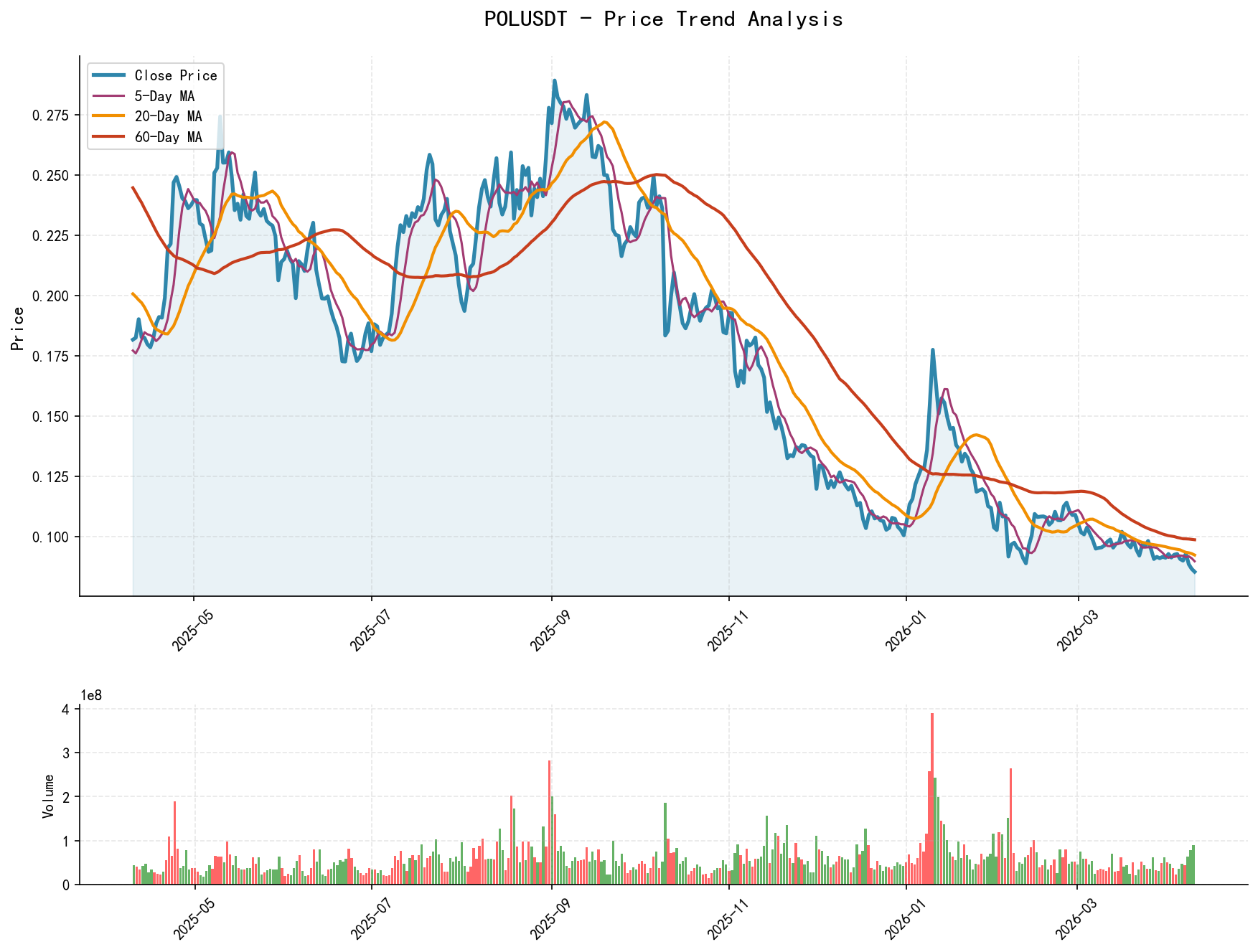
As of April 10, 2026, the underlying asset POLUSDT has an opening price of 0.09, a closing price of 0.09, a 5-day moving average of 0.09, a 10-day moving average of 0.09, a 20-day moving average of 0.09, a daily change of -1.39%, a weekly change of -7.68%, a monthly change of -6.36%, a quarterly change of -6.36%, and an annual change of -15.02%.
- 1. Trend Judgment and Moving Average Alignment:
- • Long-term Trend (Bearish): Over the past two months, the price has shown a clear downtrend. The price has continuously declined from approximately 0.0944 in early February to 0.0854 on April 10th, a drop of nearly 10%. All key moving averages (MA_5D, MA_10D, MA_20D, MA_30D, MA_60D) are arranged in a bearish alignment (MA_5D < MA_10D < MA_20D < MA_30D < MA_60D), with the price consistently trading below all MAs. This is a typical structure of a primary downtrend.
- • Mid-term Rebound and Failure: During the period from February 12th to February 25th, the market experienced a rebound (from 0.0889 to 0.1141, up 28%). During this time, the MA_5D briefly crossed above the MA_20D, forming a "Golden Cross," but failed to effectively lead to a reversal of the long-term moving averages. The rebound high (0.1141) encountered strong resistance from the MA_60D (around 0.118).
- • Trend Resumption and Strengthening: Since February 26th, the rebound ended, and the price resumed its downtrend. On March 6th, the MA_5D crossed below the MA_20D, forming a "Death Cross," confirming the resumption and intensification of the downtrend. By the end of the analysis period, the MA_5D (0.0898) was already far below all longer-term moving averages, indicating a steep downward slope.
- 2. Inferred Market Phase (Based on Wyckoff Theory):
- • Current Phase: End of Decline (Panic Selling) / Potential Beginning of Accumulation.
- • Basis:
- • Price Level: The closing price of 0.0854 on April 10th marked a new low within the data period and is also the lowest closing price and lowest opening price in its nearly 10-year historical ranking (HISTORY_RANK data), indicating the price has entered an extreme low zone.
- • Price Action: The recent decline shows signs of acceleration (consecutive bearish closes from March 27th to April 10th), with expanded intraday trading ranges (e.g., on April 8th, 9th, and 10th).
- • Comparison with Rebound Phase: The previous rebound (February) failed to alter the long-term trend and can be viewed as a "bear market rally" or a "distribution" followed by a continuation of the decline. The current deep decline is testing the market's ultimate point of supply exhaustion.
- • Conclusion: The market has transitioned from "decline after distribution" to a "panic decline" phase, with new price lows being a typical feature of this stage. The key now is to observe the volume behavior during the decline to determine whether it is a continuation of panic selling or the starting point where smart money begins accumulating positions discreetly.
II. Volume-Price Relationship and Supply-Demand Dynamics
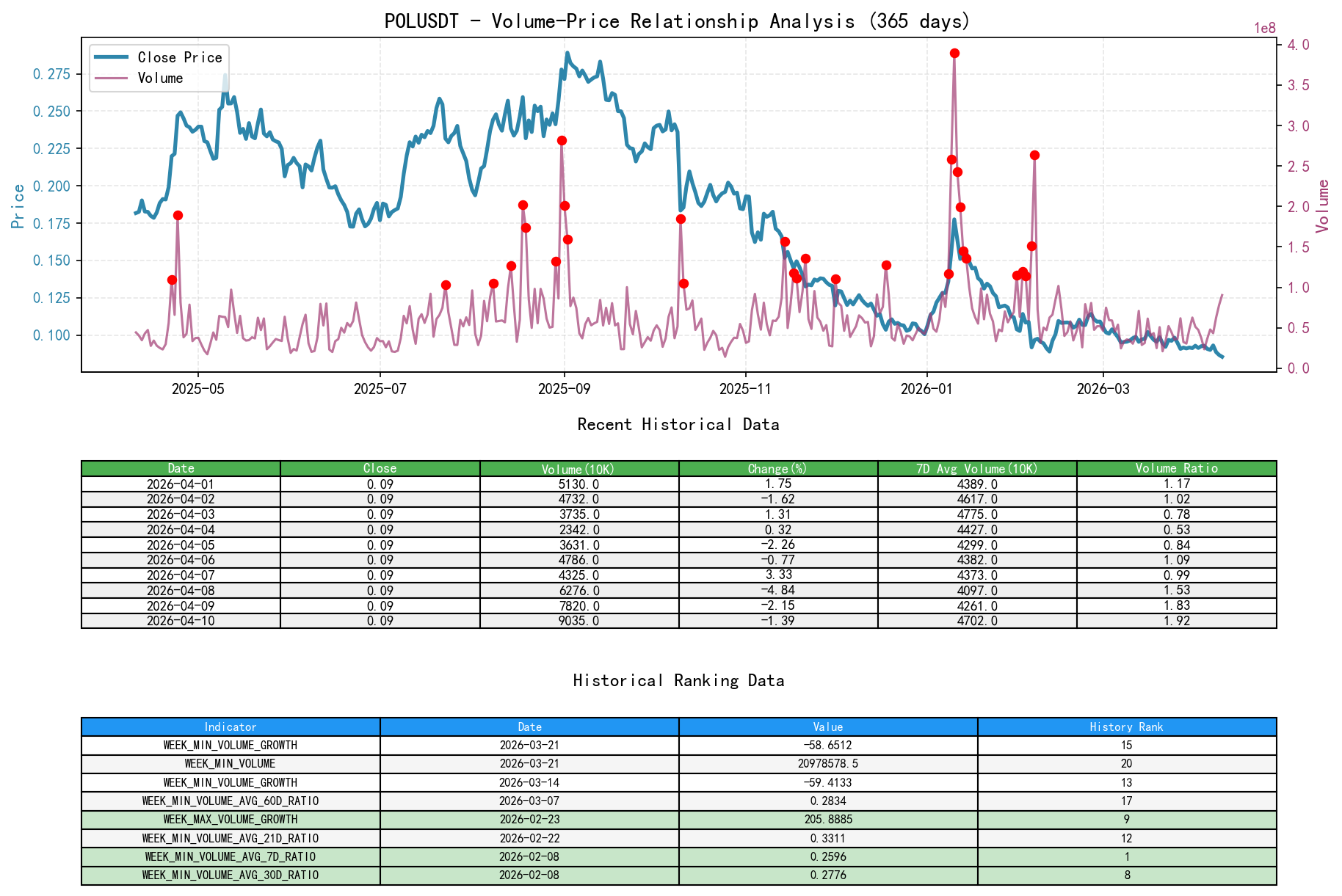
As of April 10, 2026, the underlying asset POLUSDT has an opening price of 0.09, a closing price of 0.09, a trading volume of 90352692.80, a daily change of -1.39%, a trading volume of 90352692.80, a 7-day average volume of 47028034.57, and a 7-day volume ratio of 1.92.
- 1. Key Day Analysis:
- • High-Volume Decline (Supply Dominated):
- • 2026-04-09 & 2026-04-10: These are the most significant signals. Prices fell by -2.15% and -1.39%, respectively, while trading volume surged sharply to 78.2M and 90.4M. The volume/30-day average ratio (VOLUME_AVG_30D_RATIO) reached 1.86 and 2.07, respectively, and the volume/60-day average ratio also hit 1.62 and 1.85. This is a classic characteristic of panic selling, where supply (selling pressure) is extremely strong and active. Historical rankings show that the closing and opening prices on April 10th are the lowest in nearly a decade, but the volume growth rate ranking is not extreme (not in the top 20), indicating that this level of selling is not the most severe in historical declines. However, combined with the price level, its destructive power is significant.
- • High-Volume Stagnation/Decline (Signs of Distribution):
- • 2026-02-15 & 2026-02-26: At the high points of the February rebound (0.1081, 0.1105), there were candlesticks with high volume (VOLUME_AVG_7D_RATIO >1) but closing lower (-1.19%, -3.16%). This is a signal that supply began to outweigh demand at the end of the rebound, corroborating the "failed rebound" judgment in the trend analysis.
- • Low-Volume Rebound (Insufficient Demand):
- • 2026-03-10 to 2026-03-12: During the period of slight price rebound, trading volume was significantly below the 7-day and longer-term averages (VOLUME_AVG_7D_RATIO <0.8), indicating a lack of incremental capital driving the rise, which set the stage for the subsequent decline.
- • High-Volume Advance (Demand Dominated):
- • 2026-02-12 & 2026-02-14: At the beginning of the rebound, there were large bullish candlesticks with high volume (volume ratio >1.7), showing concentrated demand entering the market, successfully reversing the short-term downtrend.
- • High-Volume Decline (Supply Dominated):
- 2. Supply-Demand Transition Points:
- • Potential Selling Climax Point: The high-volume plunge on April 9th and 10th, combined with the multi-year price lows, aligns with some characteristics of a "Selling Climax" in Wyckoff theory—where panic selling erupts. However, a true Selling Climax is typically accompanied by very long lower wicks (panic lows are quickly bought back). Currently, the candlestick bodies remain relatively large, closing near the lows, indicating that buying power has not yet demonstrated overwhelming dominance. Downward momentum may not be fully exhausted, or it may be in the process of climaxing.
- • Demand Attempts: No clear, sustained, demand-dominated structure has been observed, such as low-volume tests of key support followed by high-volume advances. The market remains in the supply release phase.
III. Volatility and Market Sentiment
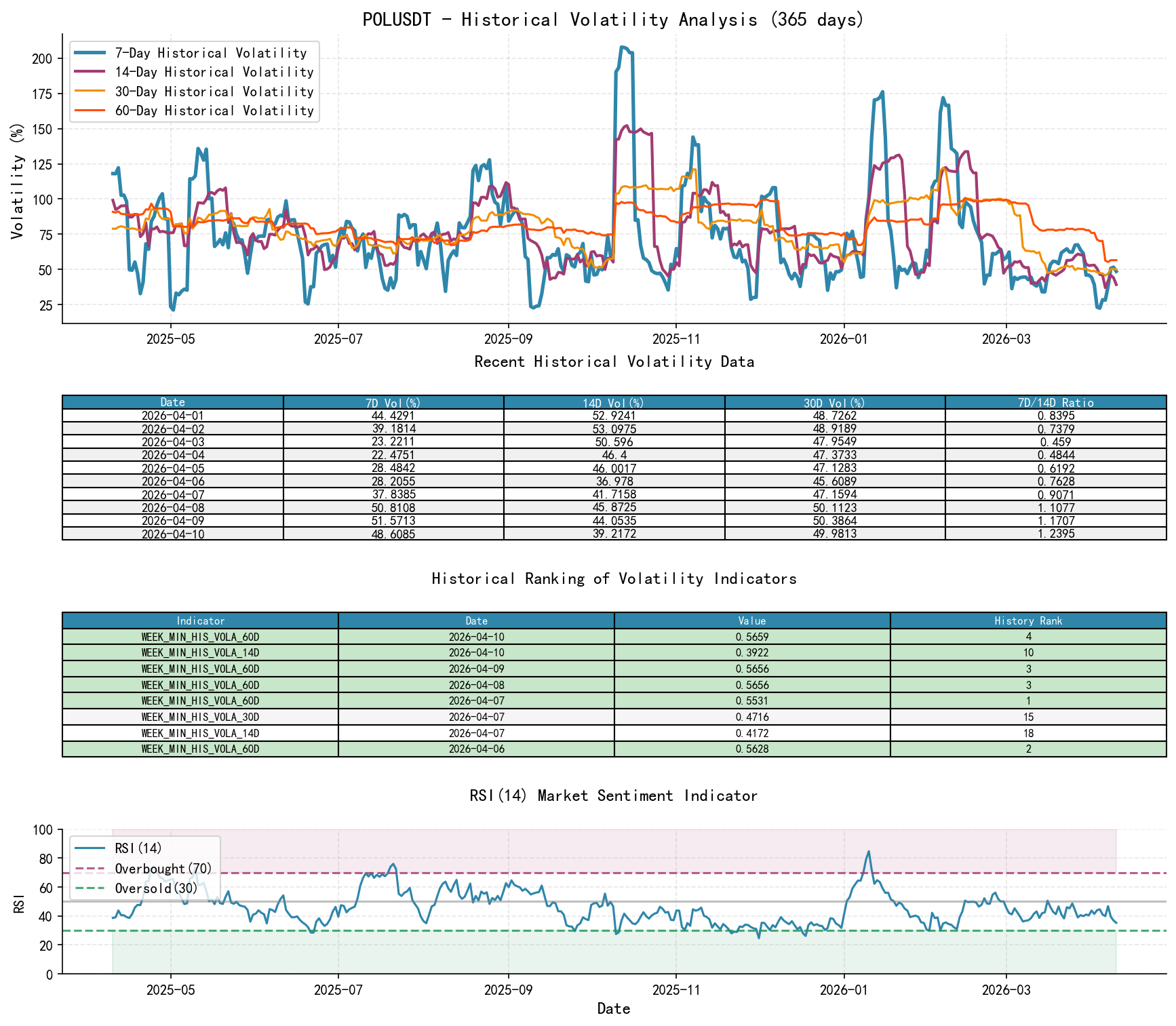
As of April 10, 2026, the underlying asset POLUSDT has an opening price of 0.09, a 7-day Parkinson Volatility of 0.51, a 7-day Parkinson Volatility Volume Ratio of 1.03, a 7-day Historical Volatility of 0.49, a 7-day Historical Volatility Volume Ratio of 1.24, and an RSI of 35.28.
- 1. Volatility Levels and Changes:
- • Volatility in a Low, Converging State: Recently, Historical Volatility (HIS_VOLA) across periods and Parkinson Intraday Volatility have declined to low levels within the data range. For example, HIS_VOLA_60D decreased from 0.96 in early February to 0.57 on April 10th; PARKINSON_VOL_60D decreased from 0.88 to 0.64.
- • Volatility Structure Anomaly (Short-term vs. Long-term): A key signal comes from volatility ratios.
- • Extremely Suppressed Short-Term Volatility:
HIS_VOLA_RATIO_7D_60D(0.8589) andPARKINSON_RATIO_7D_60D(0.8035) show that 7-day volatility is significantly lower than 60-day volatility. Historical rankings show that the value ofHIS_VOLA_RATIO_7D_60D(0.8589) has appeared multiple times recently with low rankings (e.g., 0.3263 ranked 14th on April 3rd, 0.3205 ranked 11th on April 4th), indicating that short-term volatility is in a historically extreme state of suppression relative to long-term volatility. This often occurs after a prolonged, grinding decline, as market sentiment shifts from panic to numbness and watchfulness. - • Divergence Signal: On April 9th-10th, prices experienced a high-volume plunge, but short-term volatility (7D) did not surge simultaneously (HIS_VOLA_7D only 0.486), creating a divergence with the amplified volume. This combination of "high volume, low volatility" may suggest the decline resulted from programmatic or orderly selling rather than emotional stampede. It could also be a precursor to volatility expansion from extreme suppression.
- • Extremely Suppressed Short-Term Volatility:
- 2. Market Sentiment (RSI):
- • Oversold Condition Confirmed: The RSI_14 has declined from a high of 56 in February to 35.28 on April 10th, officially entering the oversold zone (<40). This aligns with the judgment of new price lows and being in the late stage of a downtrend.
- • Divergence Between Sentiment and Volatility: Price new lows + RSI oversold should typically accompany volatility expansion. However, the current short-term volatility ratios are at historical lows, indicating market sentiment is not simply panic but a suppressed pessimism. Selling momentum may be nearing exhaustion, but buying confidence is severely lacking. This is often the breeding ground for major turning points.
IV. Relative Strength and Momentum Performance
- 1. Negative Momentum Across All Periods: Returns for all periods are deeply negative (WTD_RETURN: -7.68%, MTD_RETURN: -6.36%, QTD_RETURN: -6.36%, YTD: -15.02%), confirming the asset is in a comprehensive state of weakness with no periodic strength.
- 2. Momentum Deterioration: Recent momentum has accelerated downward (WTD_RETURN negative value expanded), synchronizing with the price breakdown decline.
- 3. Conclusion: Momentum analysis reinforces the conclusion of the downtrend, showing that downward pressure in the market has not only not eased in the short term but has intensified. Any reversal would require first seeing the momentum indicator (e.g., WTD_RETURN) slow or flatten its decline.
V. Large Investor (Smart Money) Behavior Identification
Based on the comprehensive analysis of volume-price, volatility, and price level above, inferences about smart money intentions are as follows:
- 1. Current Core Contradiction: In a historically extreme low-price zone, there is high-volume decline, but short-term volatility is in a historically suppressed state.
- 2. Behavior Inference:
- • Selling Side: High-volume decline indicates a large amount of selling pressure at low levels. This could be: 1) Stop-loss selling by the last remaining longs; 2) Forced liquidation of funds that failed in their bottom-fishing attempt during the previous rebound; 3) Sustained pressure from large short positions.
- • Buying Side (Key): Such large volume at such low prices necessarily implies corresponding buyers. The lack of a volatility surge suggests these buy orders may be orderly and dispersed, rather than panic buying. This aligns with the characteristic of smart money "accumulating discreetly" amidst panic. They might be receiving shares sold by panicked retail investors and failed longs, but to avoid revealing their intentions prematurely, they are not making concentrated, aggressive purchases. This results in prices still closing near lows and volatility not spiking.
- • Intent Summary: The market presents a situation of "organized selling" and "organized accumulation" coexisting. The current price zone is likely a significant "value area" where smart money is beginning to build positions, but supply (selling pressure) remains heavy, indicating intense competition between the two sides. Smart money is leveraging market pessimism and breakdown psychology to accumulate positions at relatively controlled costs.
VI. Support/Resistance Level Analysis and Trading Signals
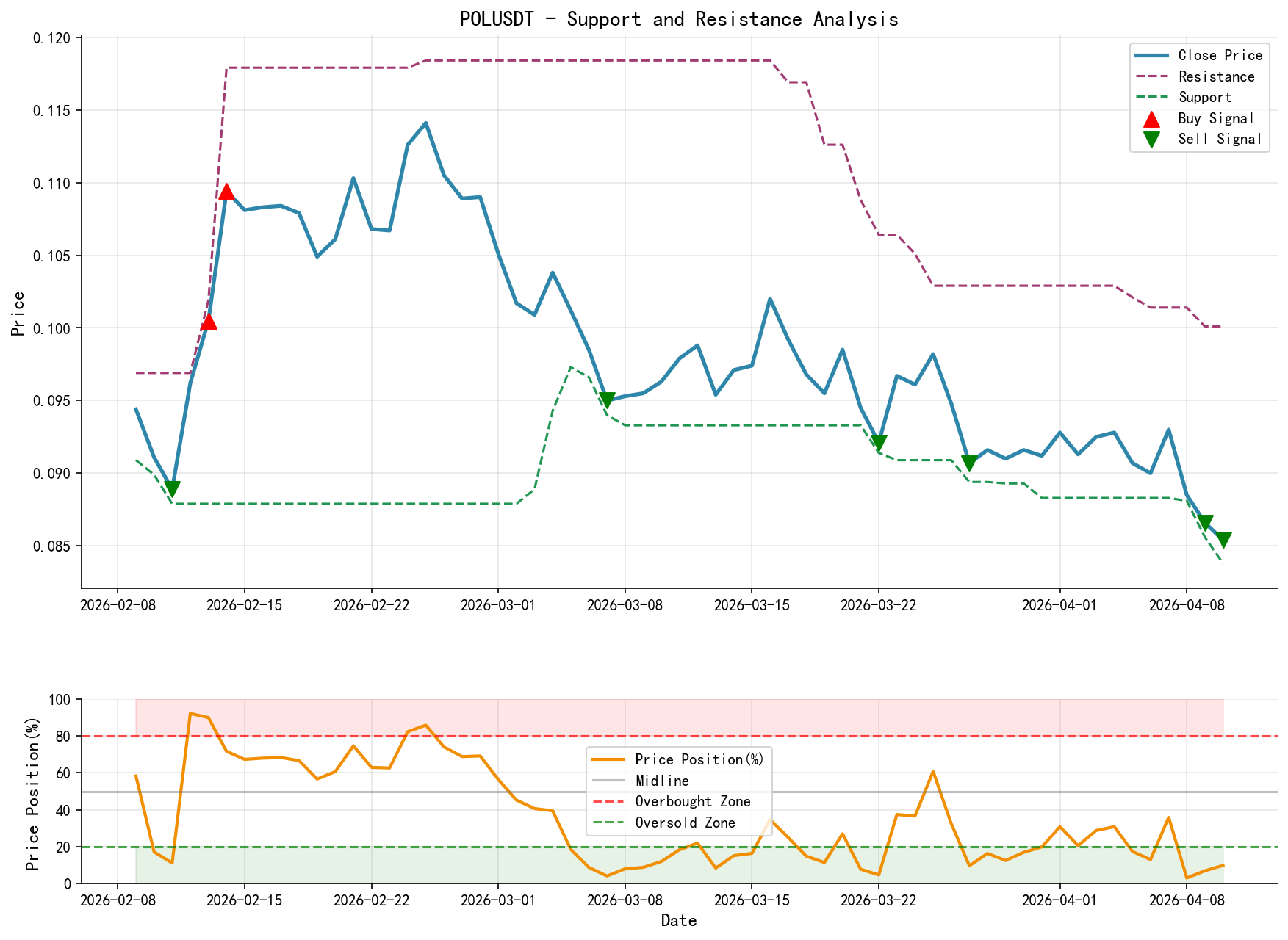
- 1. Key Price Levels:
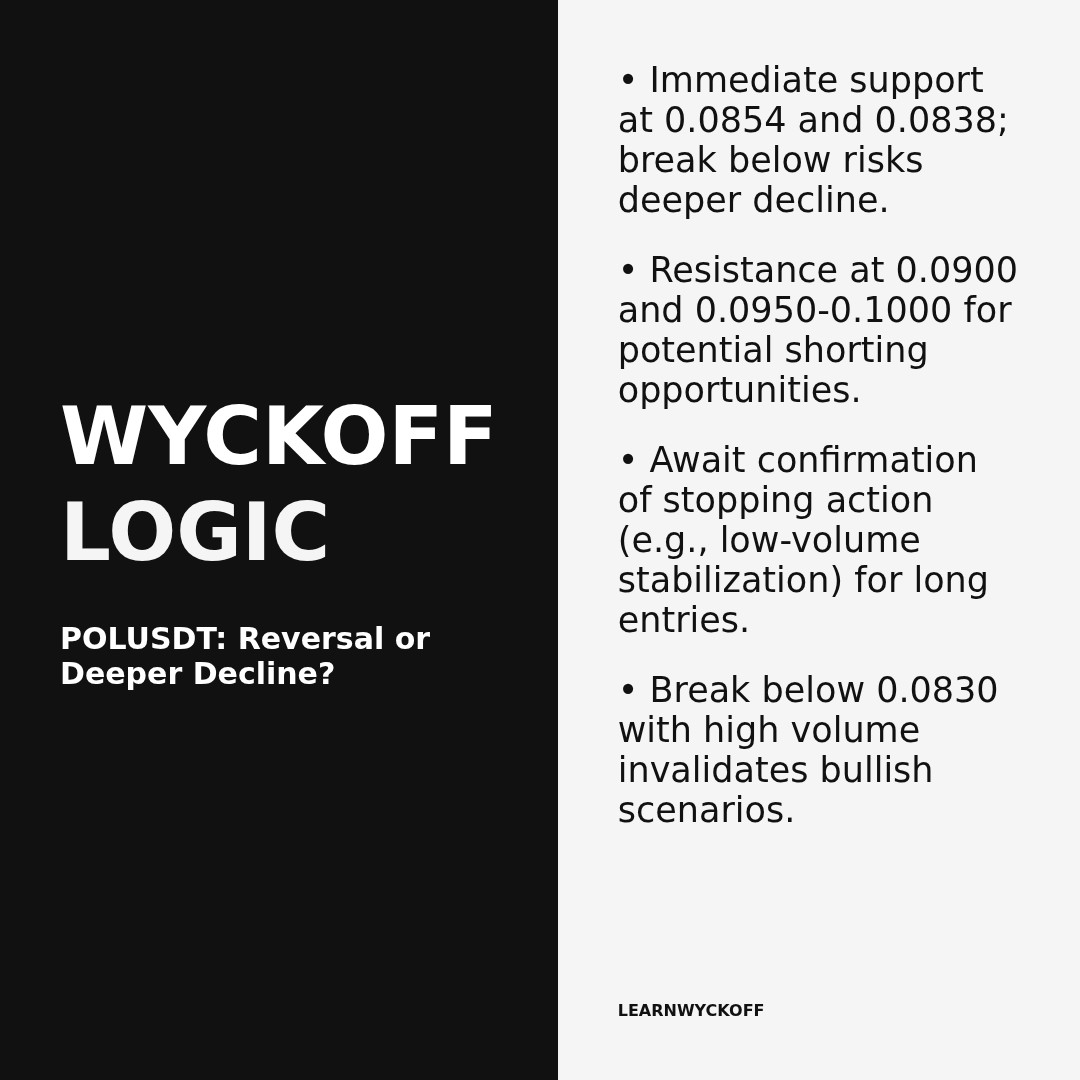
- • Immediate Support: 0.0854 (current close) and the April 10th low of 0.0838. This is the new boundary being tested by the market; a break below opens the door for deeper downside.
- • Lower Support: No clear historical data support exists; watch psychological support at round numbers like 0.0800 and below.
- • Upper Resistance:
- • First Resistance: 0.0900 (recent multiple rebound highs, also a psychological level).
- • Second Resistance: 0.0950 - 0.1000 (previous volume concentration zone and current location of MA_20D and MA_30D).
- • Strong Resistance: 0.1100 - 0.1150 (February rebound highs and long-term resistance from MA_60D).
- 2. Comprehensive Wyckoff Events and Trading Signals:
- • Current Event: Suspected to be at the start of "Panic Selling" or "Automatic Rally." Confirmation from subsequent candlesticks is needed.
- • Bullish/Reversal Signals Pending Verification: Immediate bottom-fishing is not recommended. Although initial signs of smart money accumulation are present, the price trend and momentum remain strongly downward. The market needs to show clear "Stopping Action," such as: low-volume, narrow-range consolidation in the 0.0838-0.0854 zone, or a single candlestick with an extremely long lower wick (hammer), indicating supply is being effectively absorbed.
- • Potential Shorting Signal: If the price rebounds to around 0.0900 or 0.0950 and shows signs of diminishing volume and weak upward momentum, it would present an opportunity to short on rallies, with a stop-loss set above the resistance level.
- 3. Operational Recommendations:
- • Primary Strategy: Cautiously observe, awaiting a Secondary Test signal.
- • Observation Points for Aggressive Investors:
- • Entry Condition (Light Long Position Test): After finding support in the 0.0838-0.0854 zone, a clear high-volume bullish candlestick appears (demand returns), and the subsequent retest of the midpoint or opening price of that candlestick shows significantly low volume (supply exhaustion).
- • Stop-Loss Level: Below 0.0820 (break of new low).
- • Target Level: Initial target 0.0950. After moving the stop-loss to breakeven, observe the 0.1000-0.1050 area.
- • Risk Warning: If the price breaks below 0.0830 with high volume, it indicates supply is far from exhausted, and the panic decline may continue. All bullish hypotheses become invalid, and long positions should be avoided.
Summary: POLUSDT is at the end of a long-term downtrend, with prices entering a historically extreme low zone. The recent high-volume decline combined with extremely suppressed short-term volatility creates a contradictory combination, suggesting smart money may be quietly accumulating amid panic. However, the supply-demand battle is intense, and the trend has not yet reversed. Traders should maintain high patience, waiting for clear volume-price signals indicating supply exhaustion and demand emergence (e.g., low-volume stabilization, high-volume bullish engulfing) before considering long positions. Until then, the trend remains bearish-dominated.
Disclaimer: This report/analysis is solely market analysis and research based on publicly available information and does not constitute any investment advice or operational guidance. While the author strives for objectivity and fairness, no guarantee is made regarding its accuracy or completeness. The markets involve risks; invest cautiously. Any investment actions based on this report are taken at your own risk.
Thank you for your attention! Wyckoff Volume-Price Market Interpretations are published daily at 8:00 before the market opens. Your comments and shares are sincerely appreciated, as your recognition is crucial. Let us see the market signals together.
Member discussion: