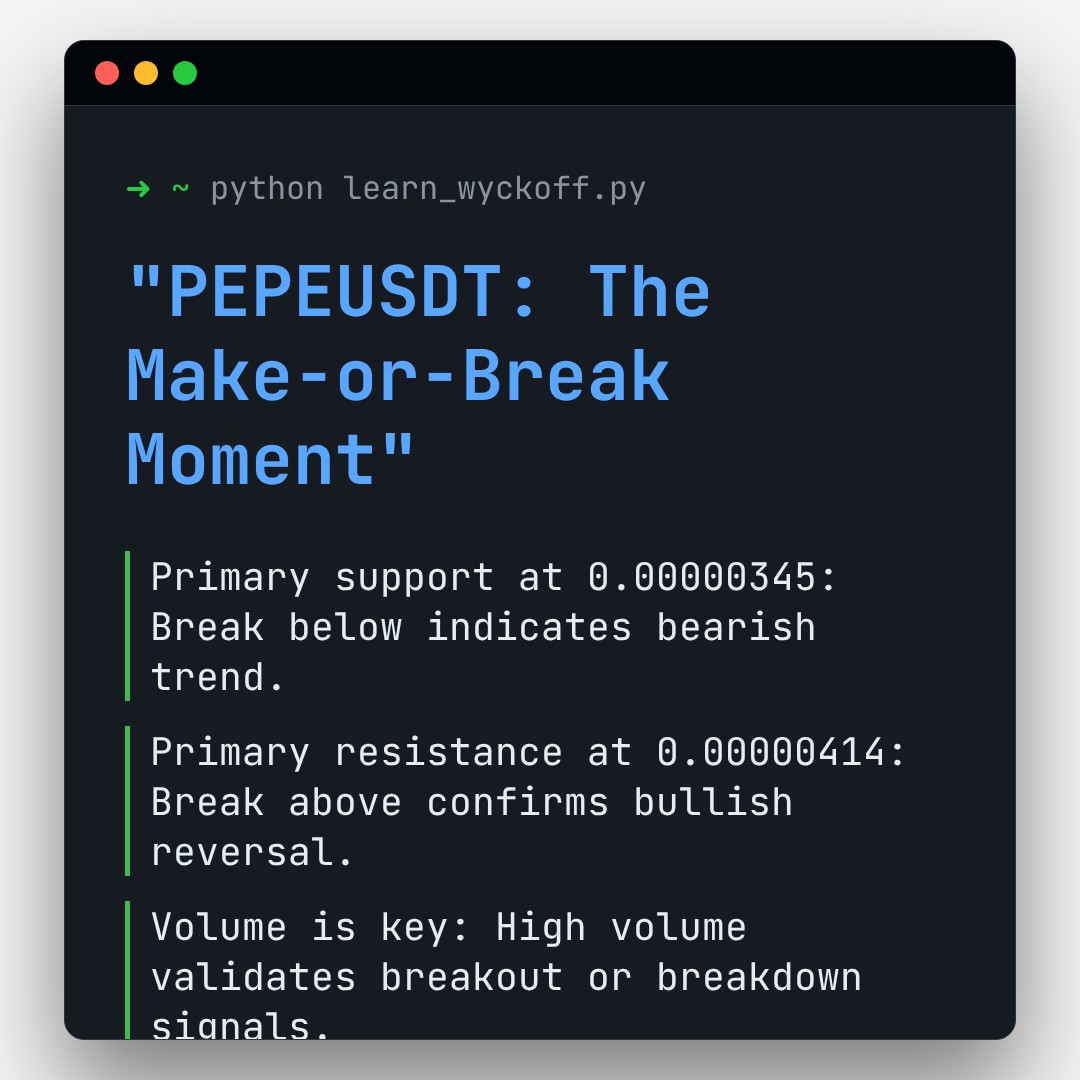
Quantitative Analysis Report - PEPEUSDT
Product Code: PEPEUSDT
Analysis Date Range: 2026-02-09 to 2026-04-10
Report Generation Time: 2026-04-11
1. Trend Analysis and Market Phase Identification
As of April 10, 2026, for the asset PEPEUSDT, the opening price was 0.00, closing price 0.00, 5-day moving average 0.00, 10-day moving average 0.00, 20-day moving average 0.00, daily change 4.56%, weekly change 7.31%, monthly change 7.62%, quarterly change 7.62%, annual change -8.93%.
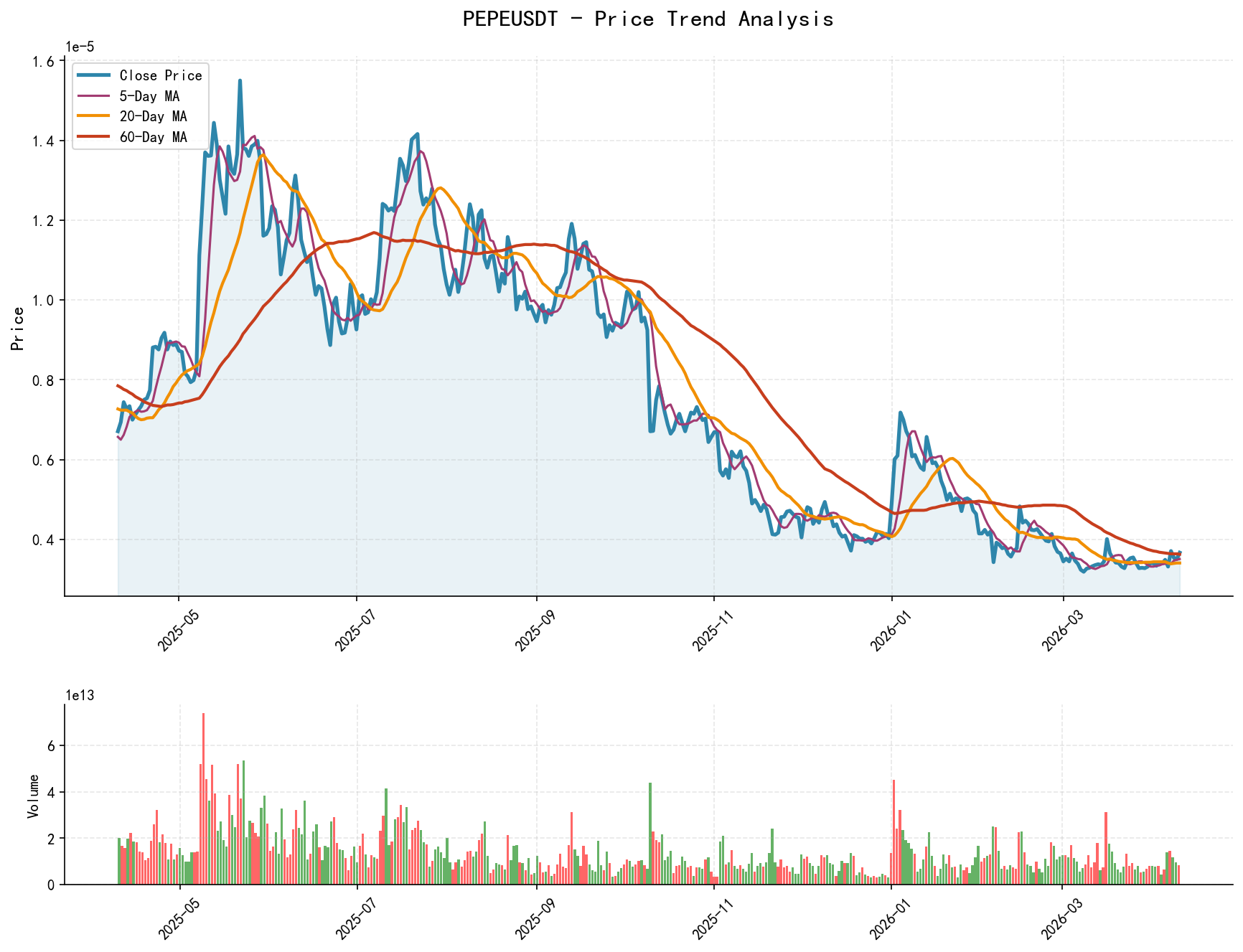
- • Price vs. Moving Average Relationship: As of the close on 2026-04-10 (0.00000367), the price is below all key moving averages (MA_5D: 0.00000351, MA_10D: 0.00000345, MA_20D: 0.00000341, MA_30D: 0.00000344, MA_60D: 0.00000363). The moving averages across all timeframes are in a bearish alignment (MA_5D < MA_10D < MA_20D < MA_30D < MA_60D), confirming the market is in a clear long-term downtrend.
- • Moving Average Crossover Signals: During the data period, MA_5D has consistently remained below MA_20D, with no bullish golden cross occurring. The violent surge on February 14 temporarily pushed up the short-term averages but failed to reverse the downward direction of the medium-term averages (MA_20D, MA_30D, MA_60D). Currently, the short-term MA_5D is flattening, and the price is hovering near it, indicating that short-term downward momentum has slowed, but the medium-term trend remains bearish.
- • Market Phase Identification (Wyckoff Analysis):
- • Markdown and Panic Phase: From late February to early March, the price experienced consecutive declines on relatively low volume, with the RSI consistently in the oversold zone (<30), characteristic of a typical downtrend.
- • Possible Accumulation Test: From March 13 to March 21, after hitting a new low, the price consolidated in a narrow range at the low with expanding volume (VOLUME_AVG_14D_RATIO >1.6) but price stagnation, and the RSI showed a bullish divergence (price made a lower low, RSI did not). This aligns with the Wyckoff concepts of a "Last Point of Support (LPS)" and an "Automatic Rally (AR)", suggesting potential accumulation by large investors at the lows.
- • Distribution and Re-test: The massive (historically ranked 7th) bullish candle on March 16 demonstrated strong demand but was not followed by a continued uptrend; instead, the price fell back on high volume, forming an "Upthrust" pattern. Subsequently, the price has continued to trade sideways in a relatively high range (0.0000033-0.0000037) on shrinking volume, testing the lower support multiple times. This fits the characteristics of a "Distribution Range" or a "Secondary Test (ST)" of an Accumulation Range. Currently, the market is likely in a "complex range of potential secondary accumulation/distribution transition at the lows" dominated by large investors, with the trend direction unclear.
2. Price-Volume Relationship and Supply-Demand Dynamics
As of April 10, 2026, for the asset PEPEUSDT, the opening price was 0.00, closing price 0.00, volume 8368634160258.00, daily change 4.56%, volume 8368634160258.00, 7-day average volume 9800024283202.00, 7-day volume ratio 0.85.
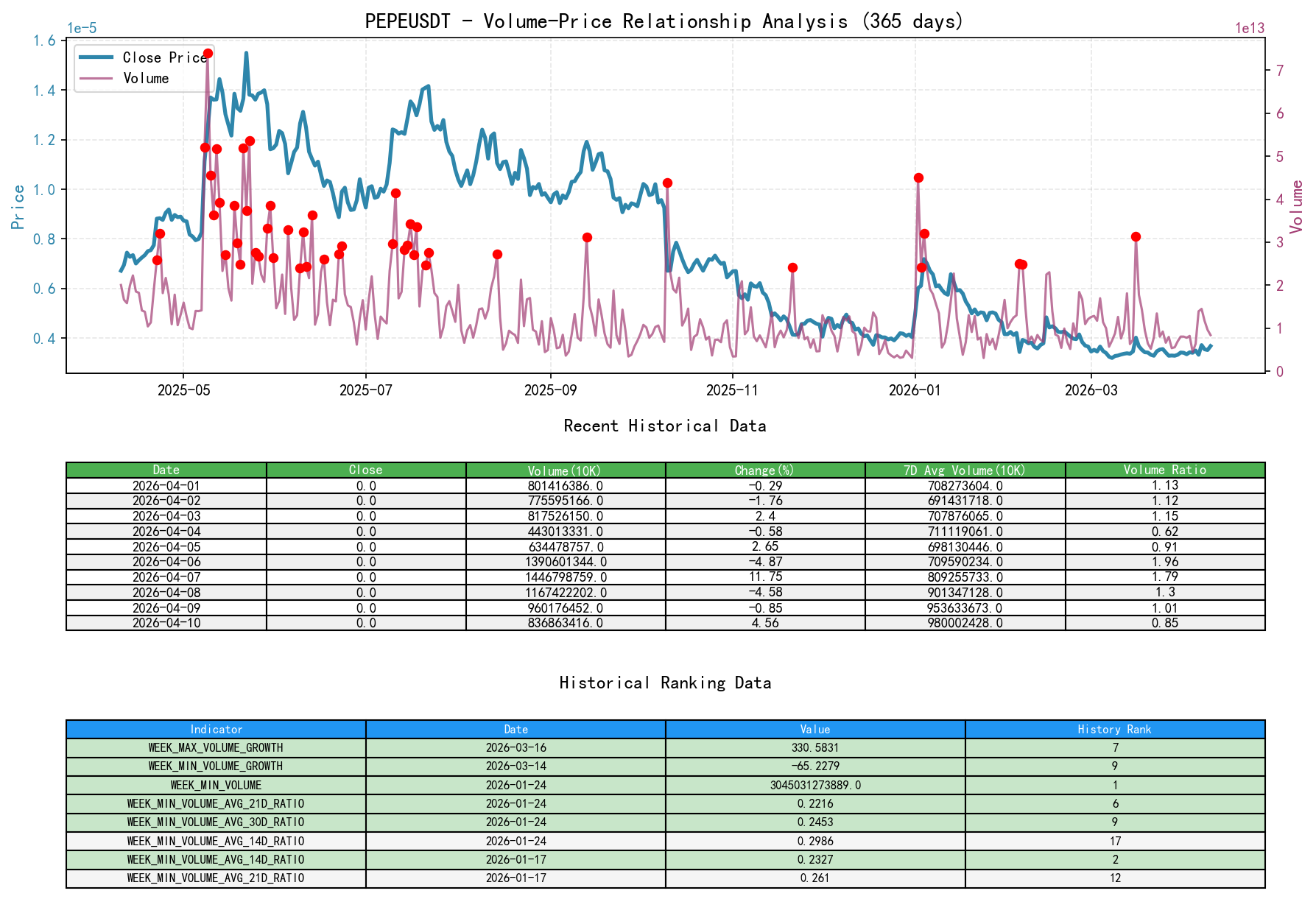
- • Demand-Dominated Days (High-Volume Rally): On 2026-03-16, the price rose 16.23% with a volume increase of 330.58% (historically ranked 7th), reaching 2.78 times the 30-day average volume. This is the strongest demand signal within the data period, indicating massive buying inflow.
- • Supply-Dominated Days (High-Volume Decline/Stagnation):
- • On 2026-03-17, the price fell 8.73% with volume remaining high (VOLUME_AVG_7D_RATIO 1.34). This constituted a "Test of Supply" following the previous day's massive rally, indicating strong selling pressure.
- • On 2026-02-15, the price fell 8.49% on massive volume (VOLUME_AVG_7D_RATIO 2.43). This was a "Panic Selling" event following the surge on February 14, indicating rapid liquidation of floating supply.
- • Lack of Demand (Low-Volume Bounce): In recent sessions (April 1 to April 10), several days saw minor gains, but volume has consistently been below the 7-day and 14-day averages (VOLUME_AVG_7D_RATIO, VOLUME_AVG_14D_RATIO often <1). Notably, on April 10, the price rose 4.56% but volume shrank by about 15% compared to the 7-day average. This suggests the current rally lacks broad market participation and sustained demand support, making its foundation weak.
- • Supply-Demand Summary: The massive demand on March 16 was offset by significant supply the next day, forming a high-volume area of intense battle between bulls and bears. Subsequently, volume has shrunk notably, and the market has entered a wait-and-see state. Price consolidation in the upper half of the March 16 bullish candle's body shows demand is still attempting to defend this zone, but supply has not disappeared, preventing a decisive breakout.
3. Volatility and Market Sentiment
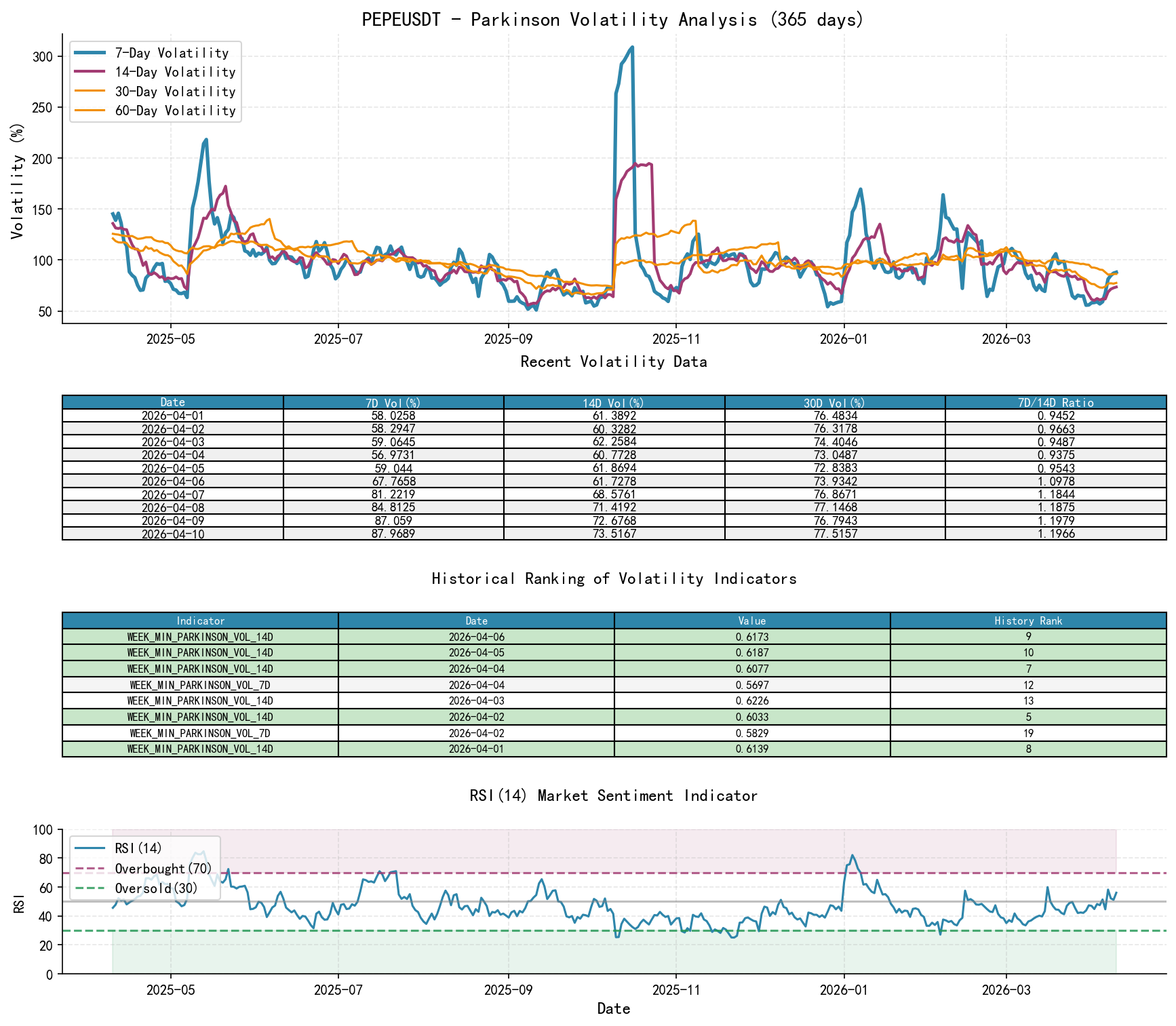
As of April 10, 2026, for the asset PEPEUSDT, the opening price was 0.00, 7-day intraday volatility 0.88, 7-day intraday volatility ratio 1.20, 7-day historical volatility 1.08, 7-day historical volatility ratio 1.41, RSI 56.07.
- • Volatility Levels and Changes:
- • Historical Volatility: The current 7-day historical volatility (HIS_VOLA_7D: 1.078) remains higher than the 14-day (0.762), 21-day (0.722), and 30-day (0.888) volatility. Its HIS_VOLA_RATIO_7D_14D is 1.415, ranking 4th historically, indicating short-term volatility is at an extreme high and market sentiment is unstable. However, the absolute value of volatility has significantly declined from its peak (>2.0) in February-March.
- • Intraday Volatility: Parkinson volatility shows similar characteristics, with the 7-day volatility (0.880) higher than longer-term averages, and its ratio also at a high historical percentile (PARKINSON_RATIO_7D_14D ranking in the top 20%).
- • Volatility Interpretation: Short-term volatility being significantly higher than long-term volatility typically occurs during trend reversals or panic selling/frenzied buying phases. Combined with the current price consolidation at a key level, this suggests the market is transitioning from a high-volatility trend/panic phase toward a potential low-volatility "contraction" phase preceding a directional move.
- • Market Sentiment Indicators: The current RSI_14 reading is 56.07, in the neutral-to-bullish zone, having recovered from the oversold territory in early March. However, the rise in RSI has not been accompanied by a significant expansion in volume, forming a "price-volume divergence", which questions the sustainability of the upward momentum. Market sentiment has recovered from extreme pessimism but has not turned optimistic.
4. Relative Strength and Momentum Performance
- • Periodic Return Analysis:
- • Short-term momentum (WTD_RETURN: 7.31%) and medium-term momentum (MTD_RETURN: 7.62%) are positive, indicating some persistence in the recent rebound.
- • Long-term momentum (YTD: -8.93%, TTM_12: -45.31%) remains significantly negative. This shows that despite the recent rebound, the asset is still in a significant long-term downtrend.
- • Momentum and Price-Volume Validation: The positive short-term momentum contradicts the low-volume bounce price-volume structure, confirming the earlier judgment of "lack of demand". The momentum recovery stems more from a temporary exhaustion of selling pressure rather than the establishment of a new bullish trend.
5. Large Investor ("Smart Money") Behavior Identification
Based on Wyckoff events and price-volume analysis, the inferred behavior of large investors is as follows:
- 1. Panic Selling and Absorption: On February 14-15, the price surge followed by a sharp drop on massive volume (VOLUME_AVG_7D_RATIO >2.4) presented a typical small-scale "Panic Selling" structure. Smart money likely absorbed some supply during the panic, laying the groundwork for subsequent consolidation.
- 2. Low-Level Accumulation and Testing: In mid-March, the price repeatedly tested lows, with intermittent volume spikes and RSI bullish divergence. This is a typical sign of "accumulation" by smart money — quietly building positions amid public fear.
- 3. Shakeout and Distribution Test: The massive bullish candle on March 16 was a strong demonstration of demand, likely aimed at a "Shakeout" to flush out remaining bears and weak bulls. The subsequent high-volume decline could be smart money conducting "test distribution" at relatively higher prices or testing floating supply to gauge overhead pressure.
- 4. Current Intent: Volume has sharply declined within the key price range (0.0000034-0.0000037). This indicates large investors have temporarily halted aggressive operations and entered a wait-and-see mode. They may be waiting for either market forces or external information to determine the next step: an upward breakout to complete the "Accumulation-Uptrend" cycle or a breakdown into a new downtrend.
6. Support/Resistance Level Analysis and Trading Signals
- • Key Support Levels:
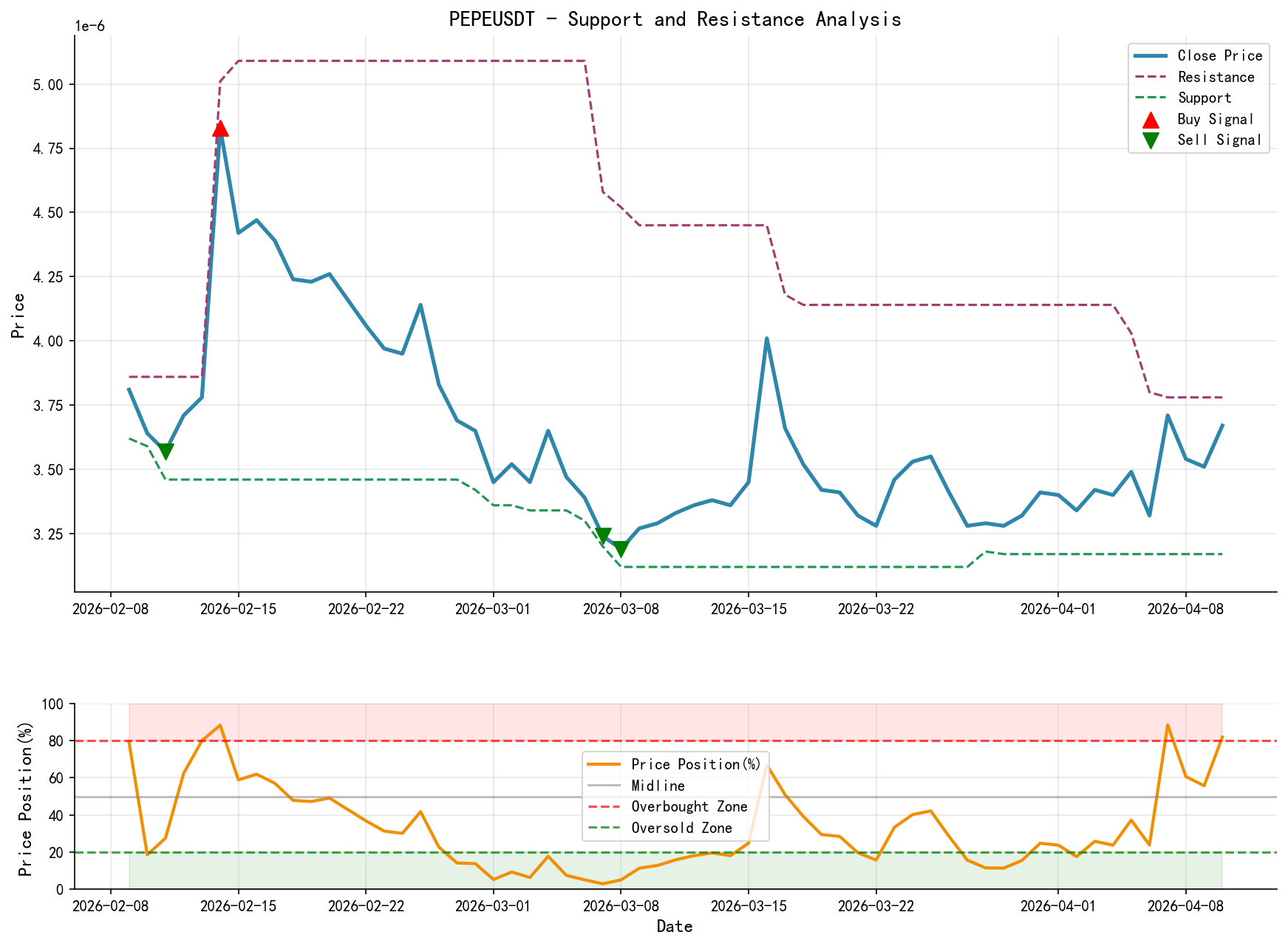
- • S1 (Primary Support): 0.00000345 - The launch point of the massive bullish candle on March 16 and the lower boundary of the recent consolidation range. A break below this level would signal failed accumulation and potentially initiate a new downtrend.
- • S2 (Secondary Support): 0.00000328 - The low point tested multiple times in late March.
- • Key Resistance Levels:
- • R1 (Primary Resistance): 0.00000414 - The high point of the March 16 bullish candle and the upper boundary of the recent consolidation range. A decisive break above this level is the first technical signal for a trend reversal to bullish.
- • R2 (Strong Resistance): 0.00000501 - The high point on February 14, the core of the previous distribution range.
- • Comprehensive Wyckoff Trading Signals:
- • Current Signal: Cautiously Bullish, Awaiting Confirmation. The market structure shows potential low-level accumulation characteristics but lacks the final demand breakout point (Jump Across the Creek).
- • Bullish Confirmation Signal: Price breaks through and sustains above R1 (0.00000414) on high volume (VOLUME_AVG_7D_RATIO >1.5), accompanied by a short-term moving average (MA_5D) crossing above the medium-term average (MA_20D). This would confirm the completion of accumulation and the start of an uptrend.
- • Bearish Confirmation Signal: Price breaks below S1 (0.00000345) on high volume and fails to rebound above it. This would confirm failed accumulation, and the market would seek support at lower levels.
- • Operational Recommendations:
- • Aggressive Strategy: Can consider establishing a small long position in the current price zone (around 0.0000035), with a strict stop-loss below S1 (e.g., 0.00000340). Target is set towards R1.
- • Conservative Strategy: Maintain a wait-and-see approach. Initiate directional trades only after the aforementioned "Bullish Confirmation Signal" or "Bearish Confirmation Signal" appears. Go long on a successful retest of R1 after a breakout; go short on a failed retest of S1 after a breakdown.
- • Future Validation Points:
- 1. Observe volume changes as price approaches R1 or S1. A high-volume breakout/breakdown is key.
- 2. Monitor whether the volatility ratio (HIS_VOLA_RATIO_7D_14D) expands again during a breakout to validate trend strength.
- 3. Watch if the RSI can enter the strong zone (>60) in sync with price increases without divergence.
Summary Conclusion:
PEPEUSDT is currently in a critical consolidation phase following a long-term downtrend. Wyckoff price-volume analysis indicates the market experienced significant smart money activity in March, including panic selling, potential accumulation, and shakeout testing. Currently, price is consolidating with shrinking volume within a range defined by massive volume, leaving the market direction undecided. Historical ranking data highlights the extremity of recent volatility and volume changes. Traders should remain patient, using 0.00000345 as the bull-bear demarcation line and 0.00000414 as the trend reversal signal, waiting for the market to provide a clear signal of supply-demand victory before committing to large positions.
Disclaimer: This report is based on quantitative analysis of provided historical data and does not constitute any investment advice. The cryptocurrency market carries extremely high risk with violent price fluctuations. Investors should make decisions prudently and assume their own risks.
Thank you for your attention! Daily Wyckoff price-volume market interpretation is released promptly before the market opens at 8:00. Please feel free to leave comments and share; your recognition is greatly appreciated. Let's work together to see the market signals.
Member discussion: