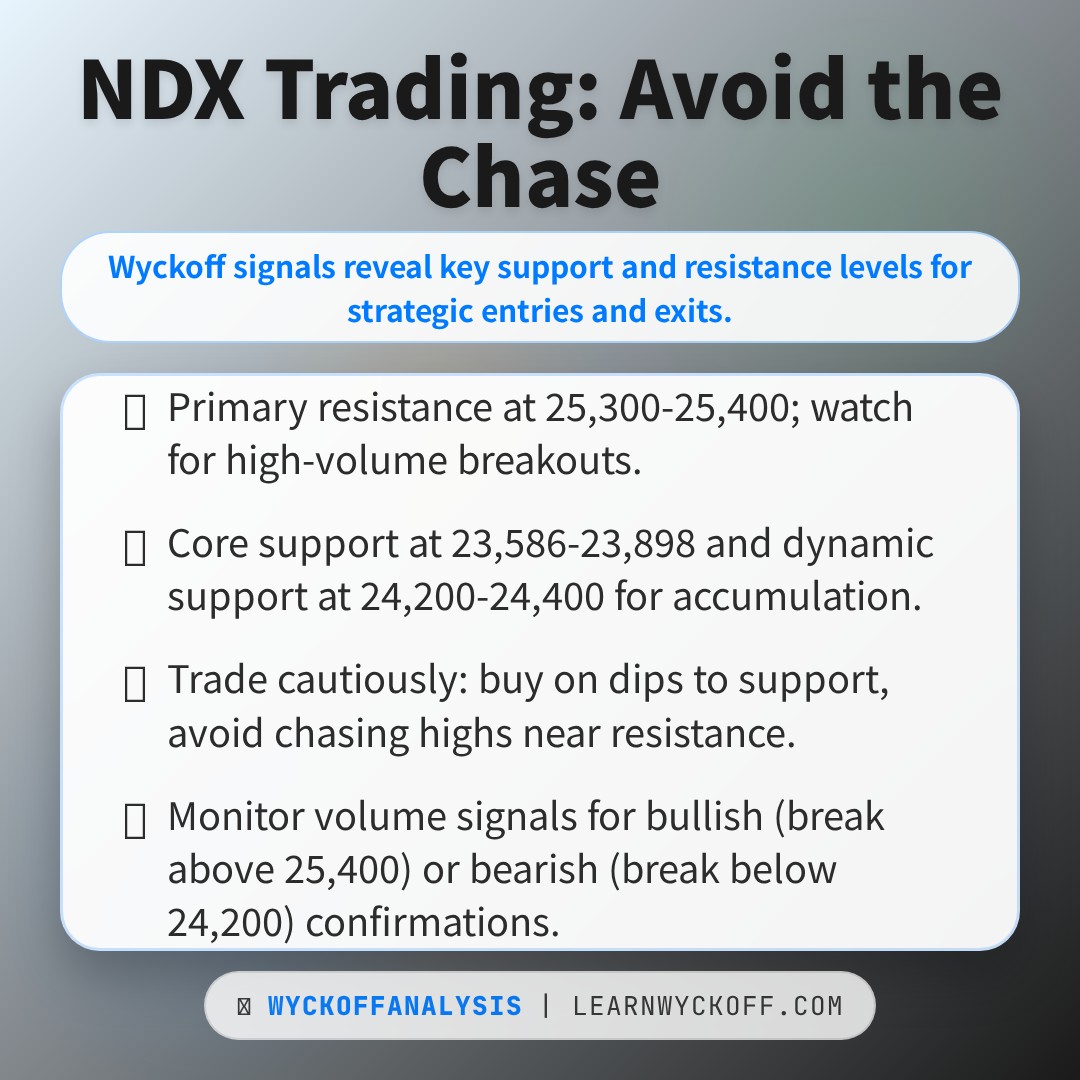
Wyckoff Quantitative Analysis Report for the NASDAQ 100 Index (NDX)
Product Code: NDX
Analysis Period: 2026-02-09 to 2026-04-10
Report Generation Date: 2026-04-11
I. Trend Analysis and Market Phase Identification
As of 2026-04-10, for the underlying asset NDX: Opening price 25165.06, Closing price 25116.34, 5-day moving average 24485.06, 10-day moving average 23985.86, 20-day moving average 24162.06, daily change 0.14%, weekly change 4.45%, monthly change 5.80%, quarterly change 5.80%, year-to-date change -0.53%.
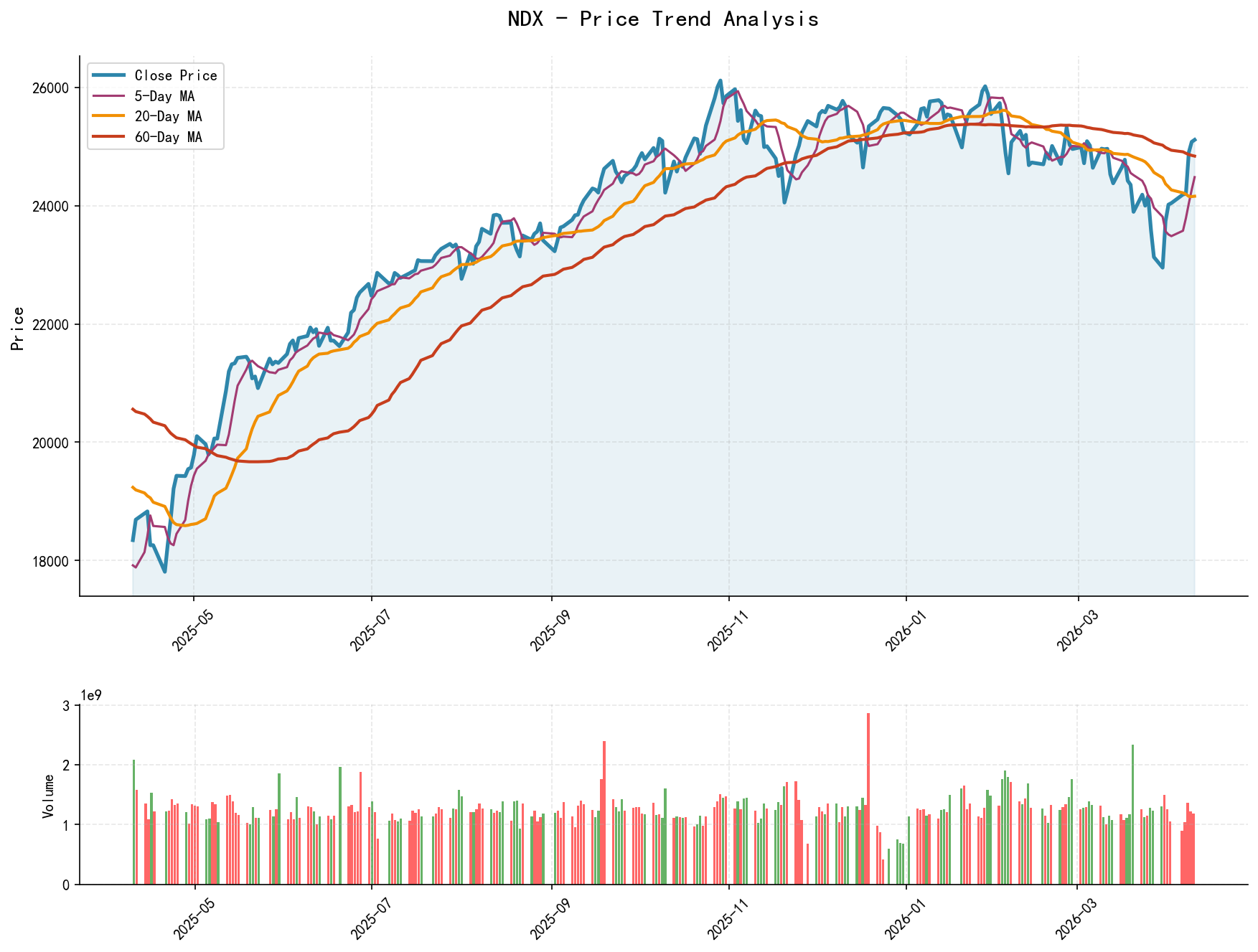
Based on the relationship between price and moving averages (MAs), the market experienced a complete cycle of "panic decline - initial rebound - resistance test" during the analysis period and is currently in a digestion phase following the rebound.
- 1. Trend Structure Analysis:
- • Initial Phase (Mid to Late February): The price (CLOSE) remained consistently below all major moving averages (MA_5D to MA_60D), forming a standard bearish alignment. After the MA_5D and MA_20D formed a death cross, they continued their downward trajectory, confirming a medium-term downtrend.
- • Panic Phase (Mid to Late March): The price touched the cycle low of 23,132.77 on March 27. On that day, the MA_5D (23,967.83) was significantly below the MA_60D (25,064.46), indicating an extremely high deviation rate, which signaled a state of extreme oversold conditions.
- • Rebound and Recovery (Late March to Early April): The price rebounded strongly from the low, successively breaking above the MA_5D, MA_10D, MA_20D, and MA_30D. As of April 10, the closing price (25,116.34) is above the MA_5D (24,485.06), MA_10D (23,985.86), and MA_20D (24,162.06) but remains below the MA_60D (24,841.08). The market structure has shifted from a unilateral downtrend to a pattern where a short-term bullish rebound challenges the long-term downtrend. The MA_5D and MA_20D formed a golden cross in early April, indicating a shift to a bullish short-term trend.
- 2. Market Phase Inference (Based on Wyckoff Theory):
- • Panic Selling: On March 20 and the following days, the market experienced a sharp, high-volume decline (details in Section II), with prices rapidly moving away from the value area, aligning with the characteristics of the "Panic Selling" phase in Wyckoff theory.
- • Automatic Rally and Secondary Test: The strong rally starting on March 31 can be viewed as an "Automatic Rally." Currently, as the price approaches the lower boundary of the previous decline consolidation platform (25,300-25,400), trading volume has contracted, and upward momentum has weakened. This suggests the market is either undergoing a "Secondary Test" of the rebound's validity or entering a "Preliminary Distribution" phase.
II. Price-Volume Relationship and Supply-Demand Dynamics
As of 2026-04-10, for the underlying asset NDX: Opening price 25165.06, Closing price 25116.34, volume 1182308786, daily change 0.14%, volume 1182308786, 7-day average volume 1189864683.71, 7-day volume ratio 0.99.
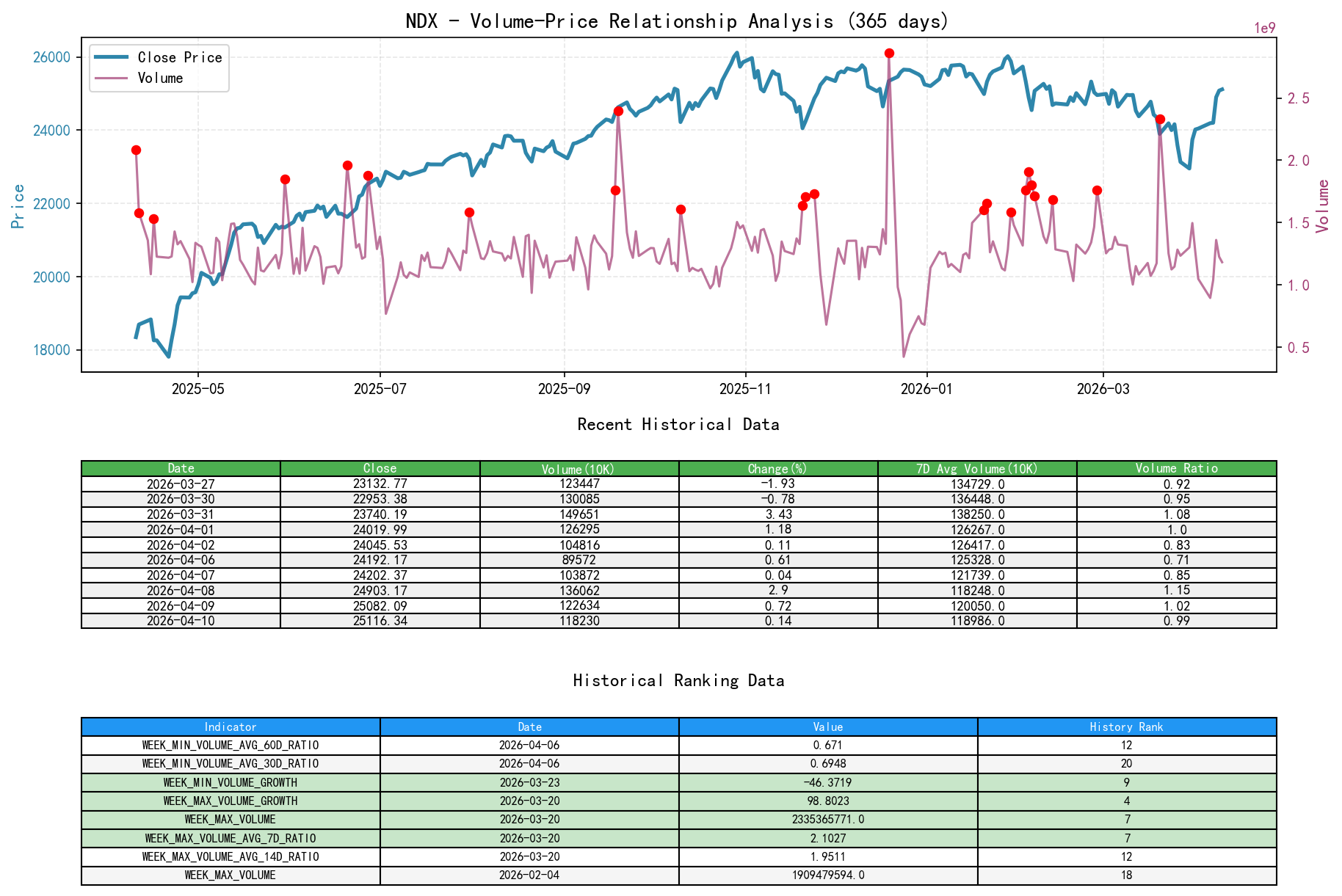
Volume data clearly reveals the market's dynamic progression from "supply dominance" to "initial demand intervention," and currently to a state of "supply-demand stalemate."
- 1. Key Day Analysis:
- • Selling Climax (SC): 2026-03-20 was the decisive trading day. The price fell -1.88%, while volume surged by 98.80% to 2.335 billion, marking the 4th highest single-day volume growth rate in the past decade (HISTORY_RANK: 4). Simultaneously, the ratio of that day's volume to its 7-day average (2.10) ranked 7th highest in the past decade (HISTORY_RANK: 7). This is a classic panic-driven high-volume decline, indicating a massive influx of sell orders (supply), but also potentially signaling that panic selling was being absorbed.
- • Demand Absorption: On 2026-03-31, the price surged +3.43%, with volume increasing by 15.04% to 1.497 billion. This high-volume advance confirmed strong demand entering the market at the panic low, absorbing the selling pressure and completing the supply-demand transition from decline to rebound.
- • Demand Stagnation and Supply Re-emergence: Entering April, as prices reached above the 25,000 level, volume consistently contracted. On April 6, the volume/30-day average ratio (0.69) hit the 20th lowest level for the same period in the past decade (HISTORY_RANK: 20). Low-volume advances (e.g., April 6-10) indicate insufficient follow-through demand near the resistance zone. On April 10, the price gained a mere +0.14%, with volume below all medium-term average levels (all VOLUME_AVG_*D_RATIO < 1), suggesting the market entered a wait-and-see state.
- 2. Supply-Demand Power Shift:
- • Late March:
VOLUME_GROWTHamplified simultaneously with price declines, indicating absolute supply dominance. - • March 31:
VOLUME_GROWTHturned positive alongside a significant price rally, marking the first clear victory of demand over supply. - • Early April:
VOLUME_GROWTHretreated, often into negative territory, andVOLUME_AVG_7D_RATIOremained below 1.0, indicating a weak supply-demand balance with waning demand momentum. Upward movement relied on existing capital, lacking incremental impetus.
- • Late March:
III. Volatility and Market Sentiment
As of 2026-04-10, for the underlying asset NDX: Opening price 25165.06, 7-day intraday volatility 0.15, 7-day intraday volatility volume ratio 0.89, 7-day historical volatility 0.19, 7-day historical volatility volume ratio 0.62, RSI 60.46.
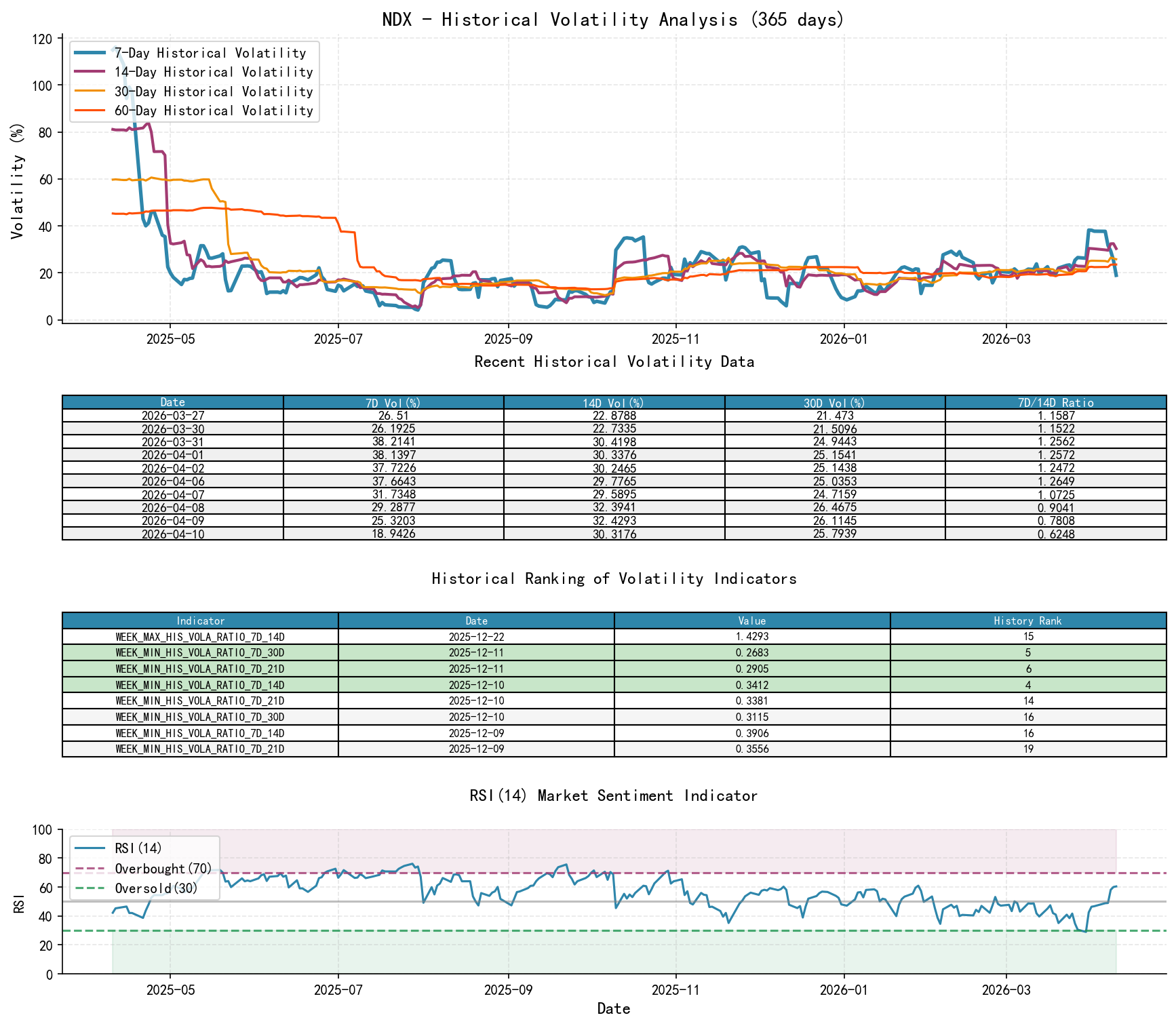
Volatility data corroborates the sentiment path from "extreme panic" to "rapid recovery" and then to "subsiding calm."
- 1. Volatility Peaks and Sentiment Extremes:
- • During the panic day (March 20) and subsequent low confirmation days (March 27, 30), both short-term historical volatility (
HIS_VOLA_7D) and Parkinson volatility (PARKINSON_VOL_7D) surged significantly. Particularly on March 31,HIS_VOLA_7Dreached as high as 0.382, withHIS_VOLA_RATIO_7D_60Dat 1.70, indicating a sharp amplification of short-term volatility and extremely unstable market sentiment. - • Historical Ranking Confirmation: The
RSI_14dropped to a low of 29.00 on March 30, placing it at the 19th most oversold level in the past decade (HISTORY_RANK: 19), confirming the extreme pessimism from a sentiment indicator perspective.
- • During the panic day (March 20) and subsequent low confirmation days (March 27, 30), both short-term historical volatility (
- 2. Volatility Contraction and Sentiment Recovery:
- • As the rebound unfolded, volatility contracted rapidly. By April 10,
HIS_VOLA_7Dhad decreased to 0.189 andPARKINSON_VOL_7Dto 0.154, both below their 60-day average levels (corresponding ratios < 1). Volatility retreated from extreme highs to a normal-to-low range, indicating that market panic has largely subsided, and a consolidation/wait-and-see period has begun. - • The
RSI_14rebounded from the low of 29 to 60.46, moving out of the oversold zone and approaching, but not entering, the overbought zone, reflecting sentiment recovery to a neutral-to-optimistic level.
- • As the rebound unfolded, volatility contracted rapidly. By April 10,
IV. Relative Strength and Momentum Performance
Momentum indicators show a strong short-term rebound, but the medium-to-long-term trend has not fully reversed.
- 1. Strong Short-Term Momentum: The
WTD_RETURN(weekly return) reached +4.45% for the week ending April 8, indicating very strong short-term upward momentum. TheMTD_RETURN(month-to-date return) closed at +5.80% on April 10, confirming the rebound-dominated pattern for April so far. - 2. Medium-Term Momentum Requires Confirmation: Despite the recent rebound, the
YTD(year-to-date return) remains at -0.53%, and theQTD_RETURN(quarter-to-date return) is +5.80%, suggesting that this rebound has merely recovered most of the losses from Q1, and whether the long-term downward pressure has been alleviated remains to be seen. The price has not yet decisively broken above the MA_60D, supporting this assessment.
V. Large Investor ("Smart Money") Behavior Identification
Based on Wyckoff event-driven price-volume analysis, the operational trajectory of large investors can be inferred:
- 1. Accumulation during the Panic Phase: During the historically significant high-volume decline (Selling Climax) on March 20 and the subsequent price discovery lows, the massive volume could not have consisted solely of retail selling. Large capital necessarily engaged in proactive accumulation within the panic price range. This is typical "smart money" behavior of gathering筹码 during public selling.
- 2. Guidance during the Initial Rebound: The high-volume advances on March 31 and April 8 indicate that large investors not only absorbed supply but also provided buying impetus at关键 positions, guiding a shift in market sentiment and propelling the formation of the "Automatic Rally."
- 3. Caution and Testing at Resistance Zones: The persistent low volume near the critical 25,000-25,300 resistance zone indicates that large investors are not actively chasing prices higher at this level. They are likely engaged in:
- • Observation: Testing the inherent strength of market buying.
- • Preparatory Distribution: Distributing a portion of low-cost筹码 to investors chasing the rally at反弹 highs.
- • Shakeout: Possibly creating minor pullbacks to shake out weak-handed followers.
Current behavior leans more towards "preparatory distribution" or "observational testing" rather than a new round of aggressive accumulation.
VI. Support/Resistance Level Analysis and Trading Signals
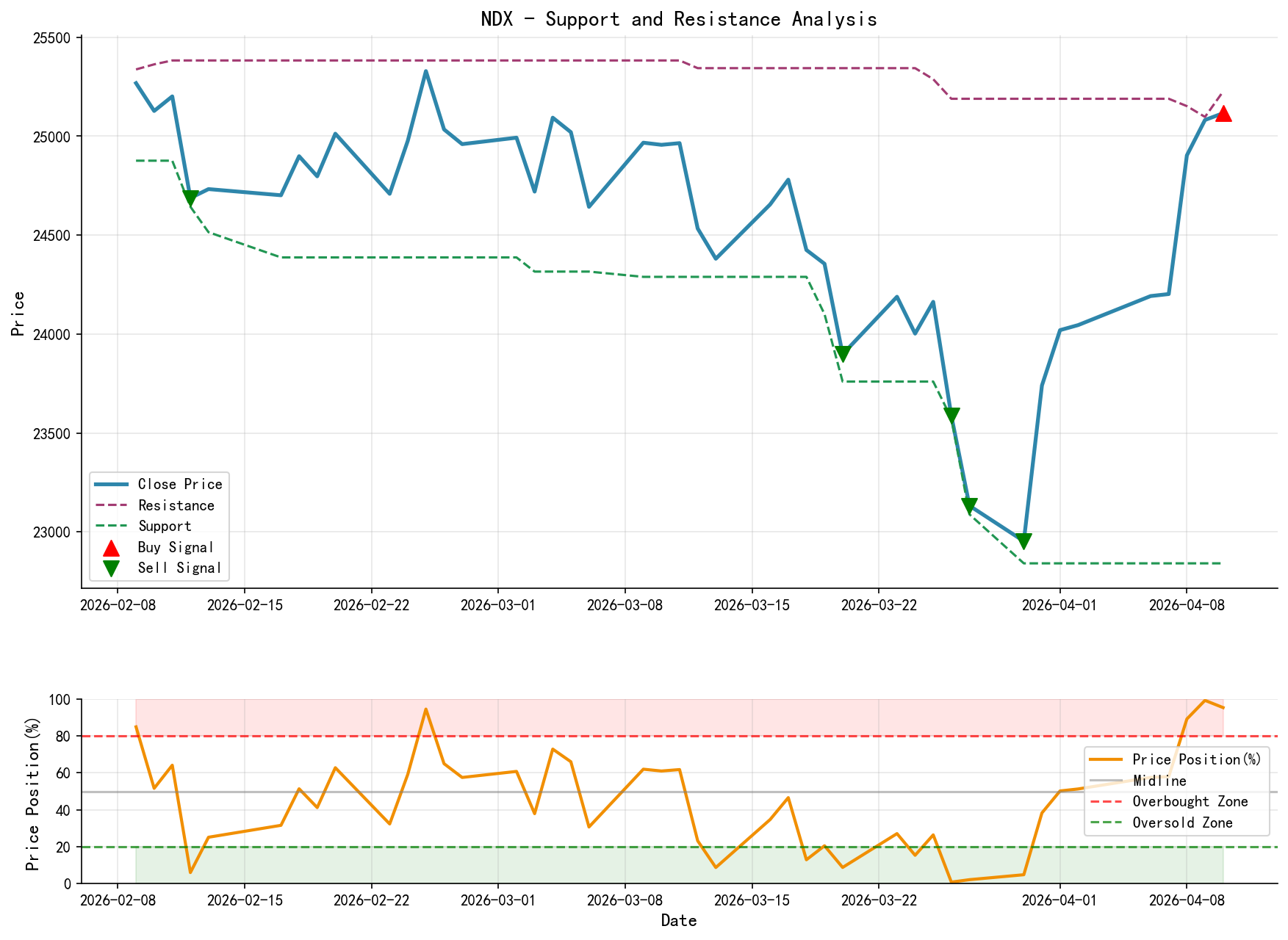
- 1. Key Price Levels:
- • Primary Resistance Zone: 25,300 - 25,400. This area represents multiple反弹 highs from late February to early March (e.g., 25,329.04 on February 25) and the lower boundary of the initial decline platform, coinciding with the MA_60D level.
- • Core Support Zone: 23,586 - 23,898. The low area from March 26-27, confirming the first large-scale demand intervention post-panic selling.
- • Near-Term Dynamic Support: 24,200 - 24,400. The current convergence area of the MA_20D and MA_30D, also the upper edge of the early April rebound gap.
- 2. Integrated Wyckoff Trading Signals and Operational Suggestions:
- • Overall Assessment: Cautiously bullish, but high risk in chasing. The market has completed the panic decline and initial rebound and is currently in a testing phase at the tail end of the反弹 trend.
- • Long Strategy (Conservative):
- • Entry Condition: A price pullback to the 24,200-24,400 support zone accompanied by signs of low-volume stabilization (e.g., small daily candles, a sharp drop in volume) could be viewed as an accumulation opportunity.
- • Stop Loss: Set below 23,850 to guard against a failure of support and a resumption of the downtrend.
- • Target Level: Initially aim for the 25,300 resistance level.
- • Short Strategy/Risk Avoidance (Aggressive):
- • Watch Signal: If clear signs of "high-volume stagnation" or "low-volume minor breakout followed by a quick rejection" (UT/UTAD) appear near the 25,300 resistance, these could be potential short-term shorting or profit-taking signals.
- • Confirmation Signal: A daily close below the 24,200 dynamic support would suggest the rebound may be over, warranting consideration of exiting positions or shifting to defense.
- • Future Validation Points:
- 1. Bullish Validation: Requires observing a high-volume (
VOLUME_AVG_7D_RATIO> 1.1), decisive break and hold above 25,400. This would alter the long-term MA bearish alignment, hinting that the rebound could escalate into a reversal. - 2. Bearish Validation: If the price continues to consolidate with low volume at current levels, fails to advance, and eventually breaks below 24,200 on increased volume, it would signal rebound failure, leading to another test of the core support below.
- 1. Bullish Validation: Requires observing a high-volume (
Conclusion Restated: Following the Panic Selling (SC) in late March, the NDX market experienced a strong technical rebound initiated by smart money accumulation. This rebound has now reached a key resistance zone, with significantly diminished volume indicating a lack of后续 demand. The market is in a Preliminary Distribution or Secondary Test phase. Chasing highs is not advisable. Operations should await pullbacks to support zones for accumulation opportunities or observe the outcome of tests against key resistance levels before making decisions. All assessments are derived from current data and require dynamic validation based on future price action at关键 levels and its accompanying volume behavior.
Disclaimer: This report/interpretation is solely for market analysis and research based on publicly available information and does not constitute any investment advice or operational guidance. While the author strives for objectivity and fairness, no guarantee is made regarding its accuracy or completeness. The market involves risks; investment requires caution. Any investment actions based on this report are taken at one's own risk.
Thank you for your attention! Wyckoff price-volume market interpretations are released daily at 8:00 AM before the market opens. We kindly request your comments and shares; your recognition is crucial. Let's work together to see the market signals.
Member discussion: