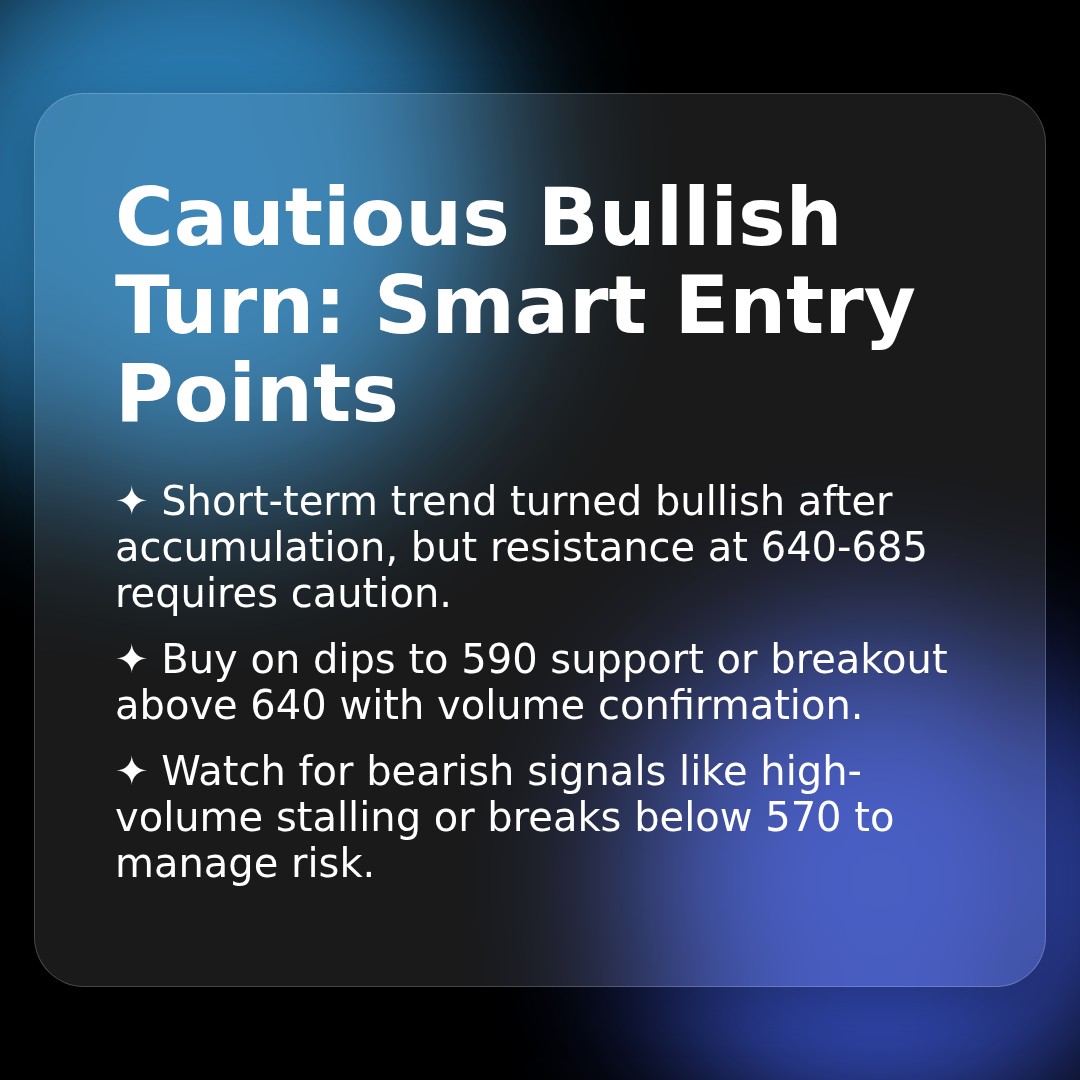
Very well, in accordance with your instructions. The following is a comprehensive, in-depth quantitative analysis report on META based on the principles of Wyckoff's Volume-Price analysis.
META Quantitative Analysis Report (Based on the Wyckoff Method)
Ticker: META
Analysis Date Range: 2026-02-09 to 2026-04-10
Report Generation Date: 2026-04-11
Core Summary: The market is currently in the "Automatic Rally" phase following a panic-driven decline (mid-to-late March). The rally has unfolded with initial volume expansion but is now testing key resistance from long-term moving averages and prior consolidation zones. Large investor behavior shows selling during the panic, followed by signs of aggressive accumulation at lower levels. The short-term trend has shifted to neutral-bullish, but a reversal of the intermediate-term trend requires observation of whether it can break through the key resistance zone with volume.
1. Trend Analysis & Market Phase Identification
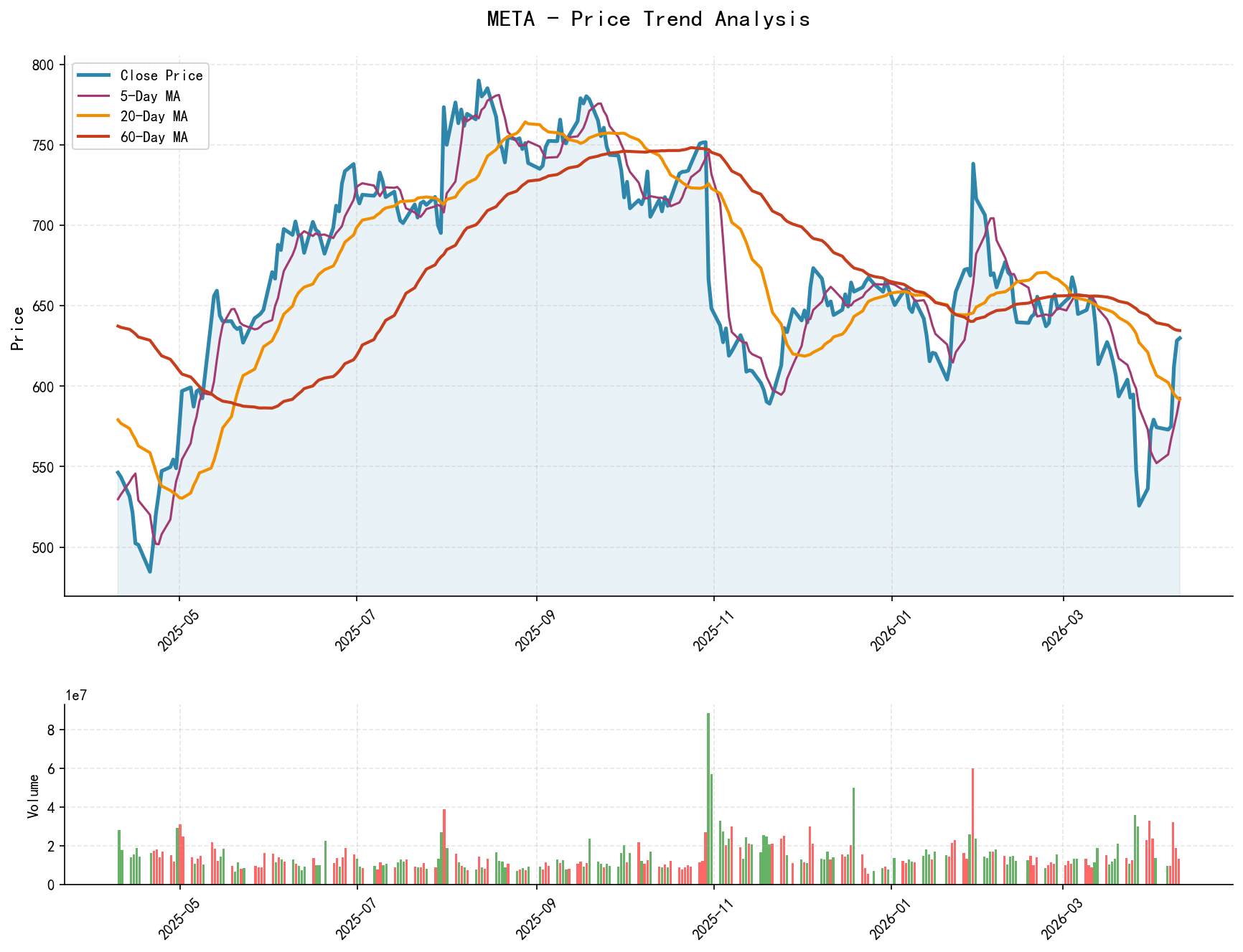
As of 2026-04-10, the subject META: Opening Price629.86, 5-Day MA572.43, 20-Day MA $591.71, Daily Change +0.23%, Weekly Change +9.64%, Monthly Change +10.09%, Quarterly Change +10.09%, Year-to-Date Change -4.58%
- • Moving Average Alignment and Price Relationship:
- • In the first half of the observation period (February to mid-March), the price (closing price) consistently traded below all major moving averages (MA_5D, MA_10D, MA_20D, MA_30D, MA_60D), exhibiting a classic bearish alignment. The MA_5D and MA_10D continuously acted as resistance, confirming the downtrend.
- • As of April 10th, the price (634.60), MA_30D (591.71), but has climbed above the MA_5D (572.43). This indicates that the short-term downtrend has been halted, but the intermediate- and long-term trends are still bearish.
- • Moving Average Crossover Signals: Around March 19th, the MA_5D (644.58) and MA_30D ($649.37), issuing a strong intermediate-term bearish signal, after which the market entered an accelerated decline. Currently, the MA_5D shows signs of crossing above the MA_10D, a potential signal for a short-term trend reversal.
- • Market Phase Inference (Wyckoff Framework):
- • Distribution and Markdown Phase (February - mid-March): Price declined in a volatile manner from the early February high of around $677, with volume expanding on multiple down days (e.g., Feb 12, Mar 12-13), consistent with the characteristics of a markdown phase following distribution.
- • Panic Phase (March 26th - 27th): Price experienced extreme declines (-7.96%, -3.99%), accompanied by a sharp spike in volume to historically high levels (35.78M, 30.13M shares). Parkinson Volatility (0.293 to 0.344) and Historical Volatility (0.603 to 0.620) surged simultaneously. RSI_14 dropped to an extreme low of 22.55. This constitutes the classic Panic Selling event in Wyckoff theory.
- • Automatic Rally Phase (March 31st - April 10th): Following the panic, price rebounded sharply, particularly on March 31st (+6.67%) and April 8th (+6.50%), both accompanied by significantly higher volume (Volume / 7-day Average Ratio reaching 2.16 and 1.58 respectively). This aligns with the "Automatic Rally" characteristic, where price naturally rebounds from an oversold condition to test the previous supply area.
- • Current Phase Assessment: The market is at the tail end of the "Automatic Rally" phase following the "Panic" phase, approaching a test of key resistance to determine whether it will proceed to a "Secondary Test" and "Accumulation," or fail at resistance and resume the downtrend.
2. Volume-Price Relationship & Supply-Demand Dynamics
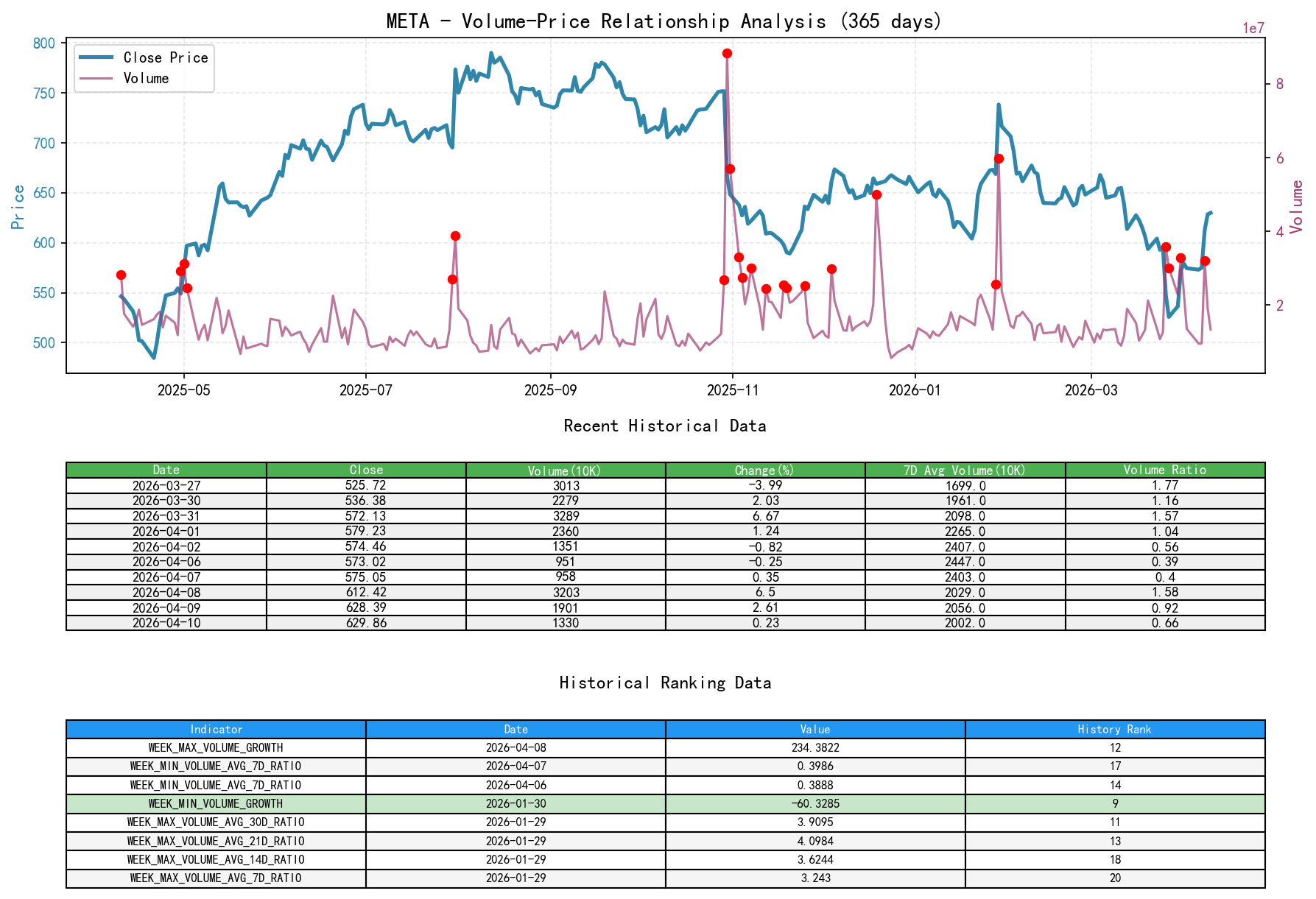
As of 2026-04-10, the subject META: Opening Price629.86, Volume 13,305,227, Daily Change +0.23%, Volume 13,305,227, 7-Day Average Volume 20,024,427.29, 7-Day Volume Ratio 0.66
- • Demand-Dominated Days (Strong Buying):
- • 2026-03-31: Price surged +6.67% on volume of 32.89M shares, 1.57 times the 7-day average (
VOLUME_AVG_7D_RATIO). This is the first strong signal of demand entering the market post-panic, indicating active accumulation at lower levels. - • 2026-04-08: Price gapped up and closed +6.50% on volume of 32.03M shares, 1.58 times the 7-day average. This is confirmation of the rally trend and a reinforcement of demand. Historical ranking data shows the daily volume growth (
WEEK_MAX_VOLUME_GROWTH) was 234.38%, the 12th highest in the past decade, indicating the strength of capital inflow on this day was historically significant. - • 2026-02-20: A volume-expansion (14.18M shares, 7-day average ratio 1.11) rebound of +1.69% occurred during the downtrend, which can be viewed as a failed rally attempt where demand lacked persistence.
- • 2026-03-31: Price surged +6.67% on volume of 32.89M shares, 1.57 times the 7-day average (
- • Supply-Dominated Days (Strong Selling):
- • 2026-03-26: Typical panic selling. Price plunged -7.96% on massive volume of 35.78M shares, 2.68 times the 7-day average. Heavy-volume decline indicates extremely abundant supply, with sellers willing to exit at lower prices.
- • 2026-03-13: Price fell sharply -3.83% on volume of 18.96M shares, 1.63 times the 7-day average. A high-volume breakdown confirmed the acceleration of the downtrend, with supply in absolute control.
- • 2026-02-12: Decline of -2.82% on volume of 14.96M shares, 7-day average ratio 0.99. A volume-backed decline, indicating significant supply pressure even in the early stages of the downtrend.
- • Key Low-Volume Signals (Lack of Demand or Supply Exhaustion):
- • 2026-04-06 & 04-07: Price consolidated within a narrow range, with volume contracting to 0.39 and 0.40 times the 7-day average (historically ranked 14th and 17th lowest respectively). Following a strong rally, this indicates a temporary pause in follow-through buying demand at resistance, but also no significant emergence of new supply, representing healthy consolidation.
- • 2026-02-23 & 02-19: Declines accompanied by significantly lower volume (7-day average ratios of 0.65, 0.75). This suggests weakening downward momentum, potentially temporary supply exhaustion, but lacking demand.
- • Supply-Demand Summary: The panic selling in late March released enormous supply. Subsequently, consecutive and strong demand absorption occurred in the530 zone (Mar 31, Apr 8), successfully reversing the one-sided downtrend. The current rally near $630 is accompanied by lower volume compared to the rally highs. It is crucial to observe whether demand expands again to break through the resistance zone or signs of supply re-emerge (e.g., high-volume stalling).
3. Volatility & Market Sentiment
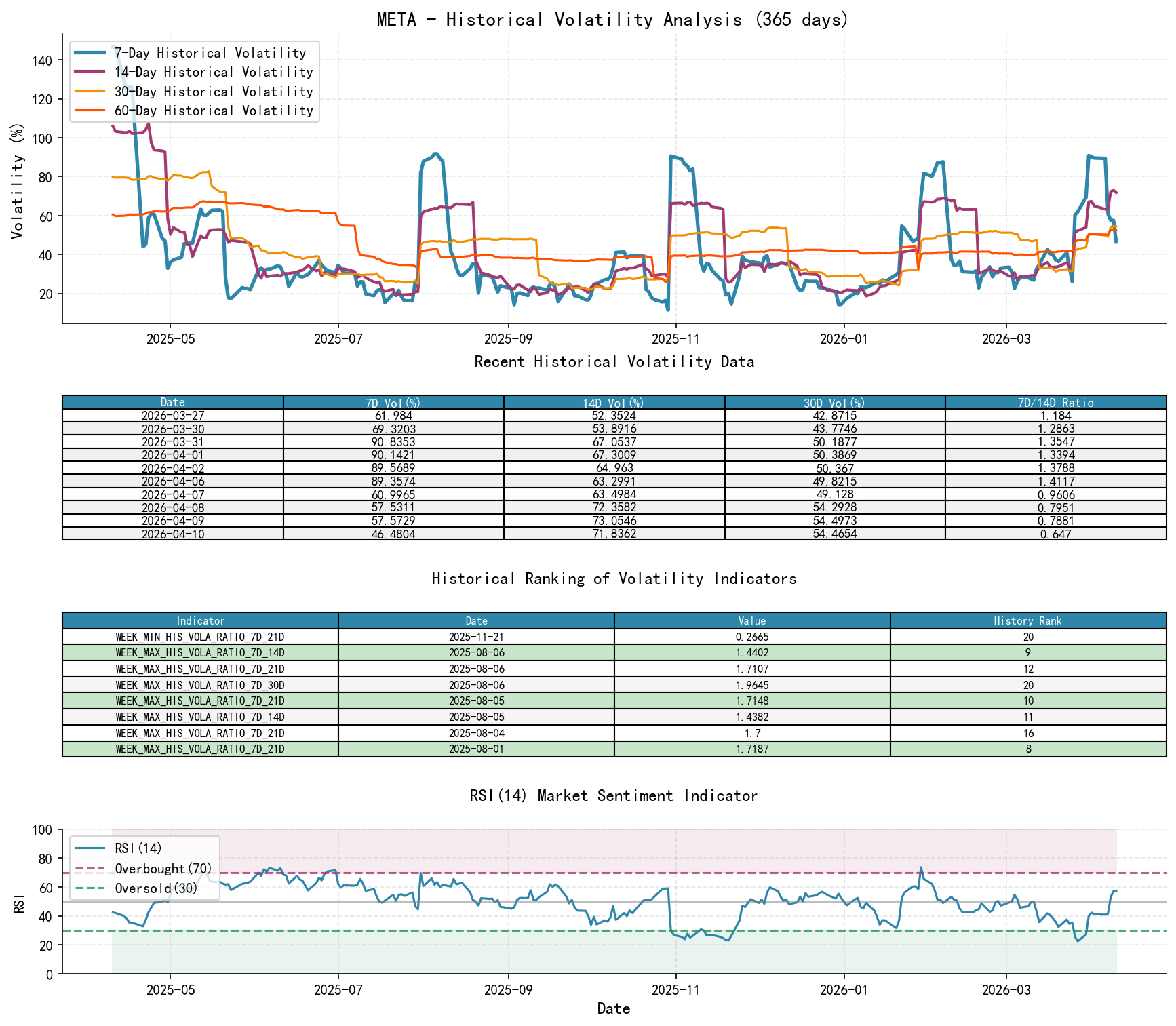
As of 2026-04-10, the subject META: Opening Price $634.47, 7-Day Intraday Volatility 0.34, 7-Day Intraday Volatility Ratio 0.95, 7-Day Historical Volatility 0.46, 7-Day Historical Volatility Ratio 0.65, RSI 57.49
- • Volatility Levels:
- • Extreme Volatility During Panic: During the March 26-31 period, the 7-Day Historical Volatility (
HIS_VOLA_7D) surged from 0.60 to 0.91, and the 7-Day Parkinson Volatility (PARKINSON_VOL_7D) rose from 0.29 to 0.38. The volatility ratios (HIS_VOLA_RATIO_7D_60DandPARKINSON_RATIO_7D_60D) both reached above 1.8 and 1.23, indicating short-term volatility far exceeded long-term levels, placing the market in a state of high panic and disorder. - • Volatility Contraction: Entering April, volatility retreated rapidly from its peak. By April 10th, the 7-Day Historical Volatility had fallen to 0.46 and Parkinson Volatility to 0.34, both having reverted from extreme levels.
- • Extreme Volatility During Panic: During the March 26-31 period, the 7-Day Historical Volatility (
- • Market Sentiment (RSI):
- • Extreme Oversold Confirms Panic: RSI_14 dropped to 22.55 on March 27th. According to historical ranking data, this is the 3rd lowest level in the past decade, indicating extreme oversold conditions and confirming the panic climax in market sentiment.
- • Sentiment Recovery: With the rally, RSI recovered to 57.49 by April 10th, entering a neutral-to-strong zone, indicating short-term sentiment has recovered from the panic.
- • Sentiment & Volatility Conclusion: The market has undergone a classic transition from "High Volatility + Extreme Oversold (Panic)" to "Volatility Contraction + Sentiment Recovery (Rally)". Current volatility has subsided to normal ranges and sentiment has stabilized, providing the conditions for a potential structural shift in the market (from downtrend to consolidation or uptrend).
4. Relative Strength & Momentum Performance
- • Momentum Trend:
- • Short-Term Momentum Strengthens:
WTD_RETURN(Weekly Return) transitioned from deeply negative values in late March to +9.64% by April 10th.MTD_RETURN(Monthly Return) stands at +10.09%, indicating very strong short-term momentum, consistent with the price rally phase. - • Intermediate-Term Momentum Remains Weak but Improving:
QTD_RETURN(Quarterly Return) andYTD(Year-to-Date Return) are +10.09% and -4.58% respectively. This shows that despite the recent strong rally, year-to-date losses have not been fully recouped. Confirmation of an intermediate-term trend reversal requires more time and price breakthroughs. - • Momentum Validation: The strength in short-term momentum validates the volume-price signal of the high-volume rally, increasing the credibility of the rebound.
- • Short-Term Momentum Strengthens:
5. Large Investor ("Smart Money") Behavior Identification
- • Distribution: During the decline from February to early March, there were multiple instances of high-volume declines (e.g., Feb 12, Mar 12-13), suggesting sustained selling (distribution) by large capital during the gradual downtrend.
- • Panic Selling & Accumulation:
- 1. Massive Volume Plunge on Mar 26-27: This represents collective market panic, encompassing both retail stop-losses and potentially passive or emotional selling by some institutions.
- 2. Key Smart Money Behavior Evidence: Immediately following the panic, significant high-volume advances occurred on Mar 31 and Apr 8. Historical rankings show the volume surge on Apr 8 was at a decadal level. Such massive buying immediately after a panic low is highly indicative of organized, planned accumulation by large investors (smart money). They absorbed all the selling that emerged during the panic.
- • Current Behavior Inference: Smart money conducted evident Accumulation in the570 region. The price has now rallied to around $630, near the upper bound of their cost area. They may currently hold positions and observe the market's reaction to the rally. If price undergoes low-volume consolidation or a minor pullback (secondary test) at the resistance zone without making new lows, it would further confirm their accumulation intent.
6. Support/Resistance Level Analysis & Trading Signals
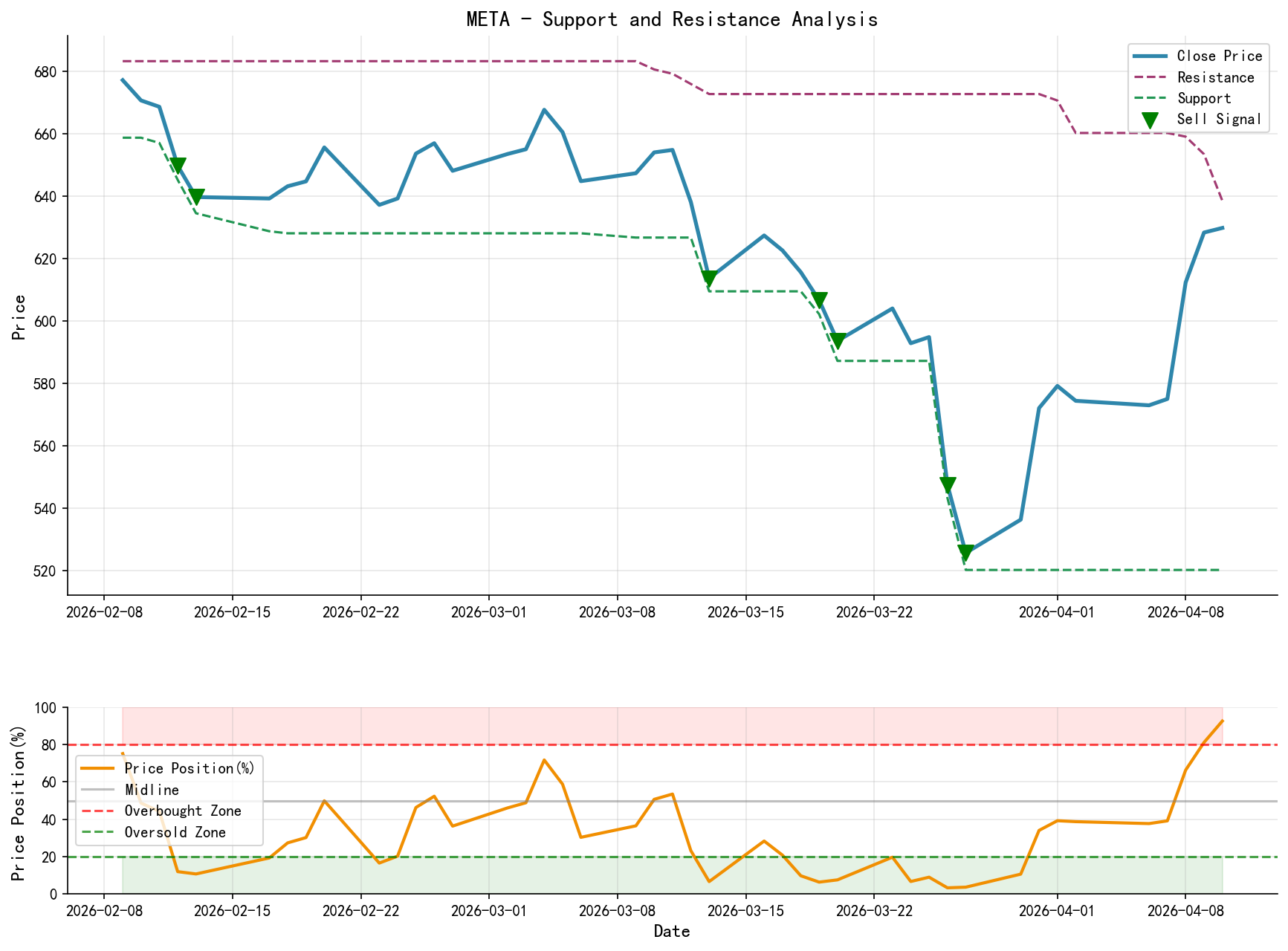
- • Key Support Levels:
- • Primary Support Zone:530. This is the low area formed by the panic selling on March 27th and the zone where smart money clearly intervened. Any pullback to this zone that stabilizes on low volume would be a significant secondary test signal.
- • Secondary Support Zone:580. The launch platform for the early April rally and the convergence area for short-term moving averages (MA_5D, MA_10D).
- • Key Resistance Levels:
- • Primary Resistance:640. The current location of the MA_60D ($634.60) and also the high area from April 10th. Breaking above this level is the first technical signal for a reversal of the intermediate-term downtrend.
- • Core Resistance:665. The consolidation and volume concentration zone from late February to early March, near the MA_30D.
- • Strong Resistance:685. The rally high zone from early February.
- • Integrated Trading Signals & Operational Suggestions:
- • Overall Assessment: The short-term trend has shifted from bearish to bullish, and the market structure has changed due to strong accumulation post-panic. However, the rally has entered a key technical resistance zone, making chasing the rally inadvisable. The strategy should be neutral-bullish, favoring buying on dips and following confirmed breakouts.
- • Bullish/Buying Scenarios (Require the following conditions):
- 1. Aggressive Dip Buying: If price retraces to the590 support zone (near MA_10D) and shows signs of stabilization with contracting volume, this could be viewed as a secondary test of the accumulation zone, presenting a dip-buying opportunity. Set stop-loss below $570.
- 2. Conservative Breakout Follow-through: If price breaks and sustains above $640 (MA_60D) with volume expansion (Volume / 7-day Average > 1.2), this could be seen as the initiation signal for an intermediate-term trend reversal, warranting a follow-through long position. Initial target665.
- • Bearish/Cautious Scenarios:
- 1. If price shows clear signs of high-volume stalling or forms long upper shadows (significant single-day volume expansion with minimal gains or a close in the red) within the640 zone, this signals the re-emergence of supply. Reduce long exposure and shift to a cautious stance.
- 2. If price breaks below the $570 support on high volume, it would signal a potential failure of the current rally, likely leading to a renewed test of lows. Shift to a defensive posture.
- • Future Validation Points:
- 1. Confirmation Signal: Price breaks above $640 with a high-volume bullish candlestick within the next 1-2 weeks.
- 2. Invalidation Signal: Price fails to break600 on increased volume, and the RSI falls back below 50.
Disclaimer: This report is based on historical data and quantitative model analysis and does not constitute specific investment advice. Financial markets carry risks. Investors should make independent judgments and decisions based on their own circumstances.
Thank you for your attention! The Wyckoff Volume-Price Market Interpretation is published daily at 8:00 AM, before the market opens. Feedback and shares are highly appreciated. Your recognition is crucial. Let's work together to see the market signals clearly.
Member discussion: