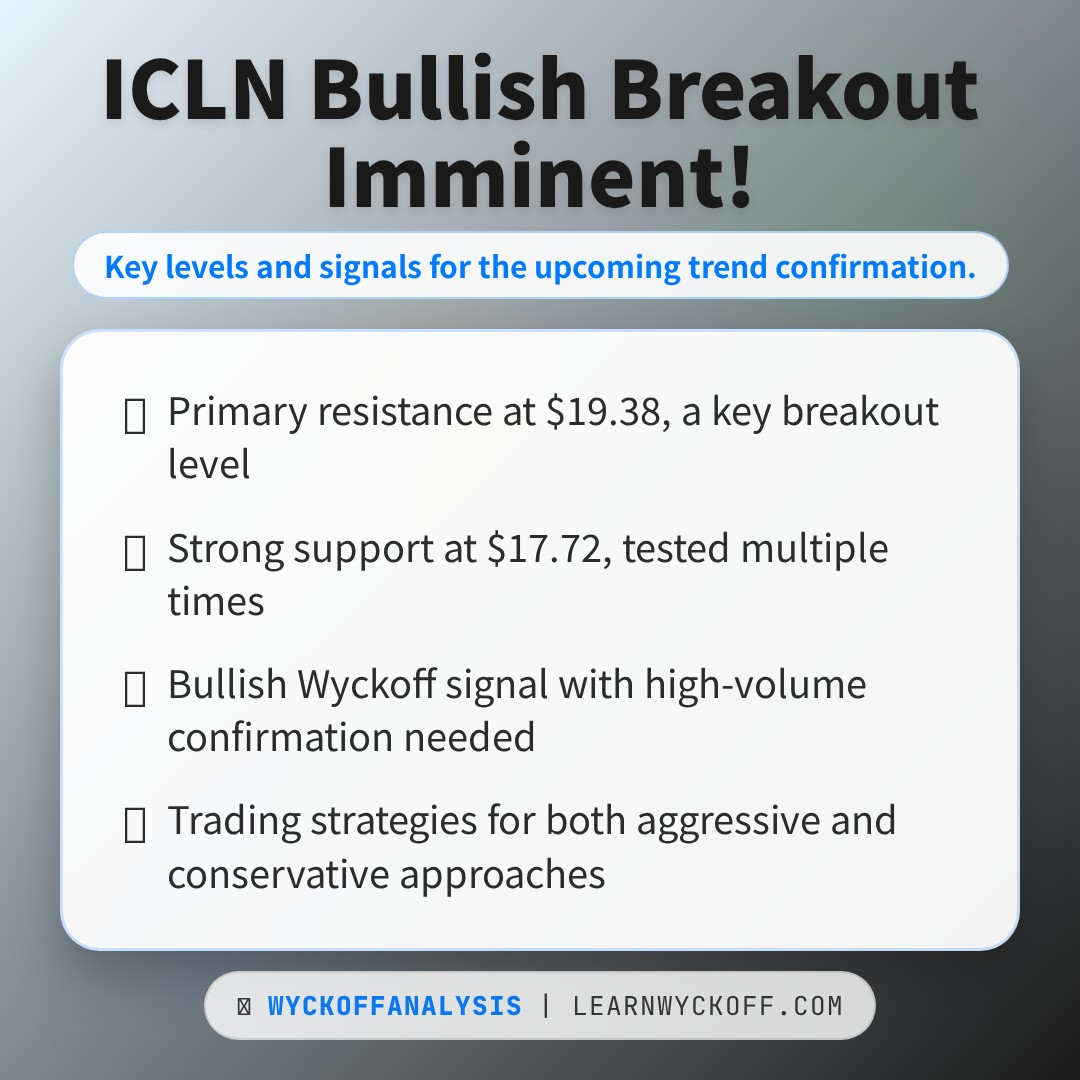
ICLN Quantitative Analysis Report: Supply and Demand Dynamics and Institutional Intent Analysis Based on the Wyckoff Method
Product Code: ICLN
Analysis Date Range: 2026-02-09 to 2026-04-10
Report Generation Time: 2026-04-11
Core Methodology: Wyckoff Volume-Price Analysis
1. Trend Analysis and Market Phase Identification
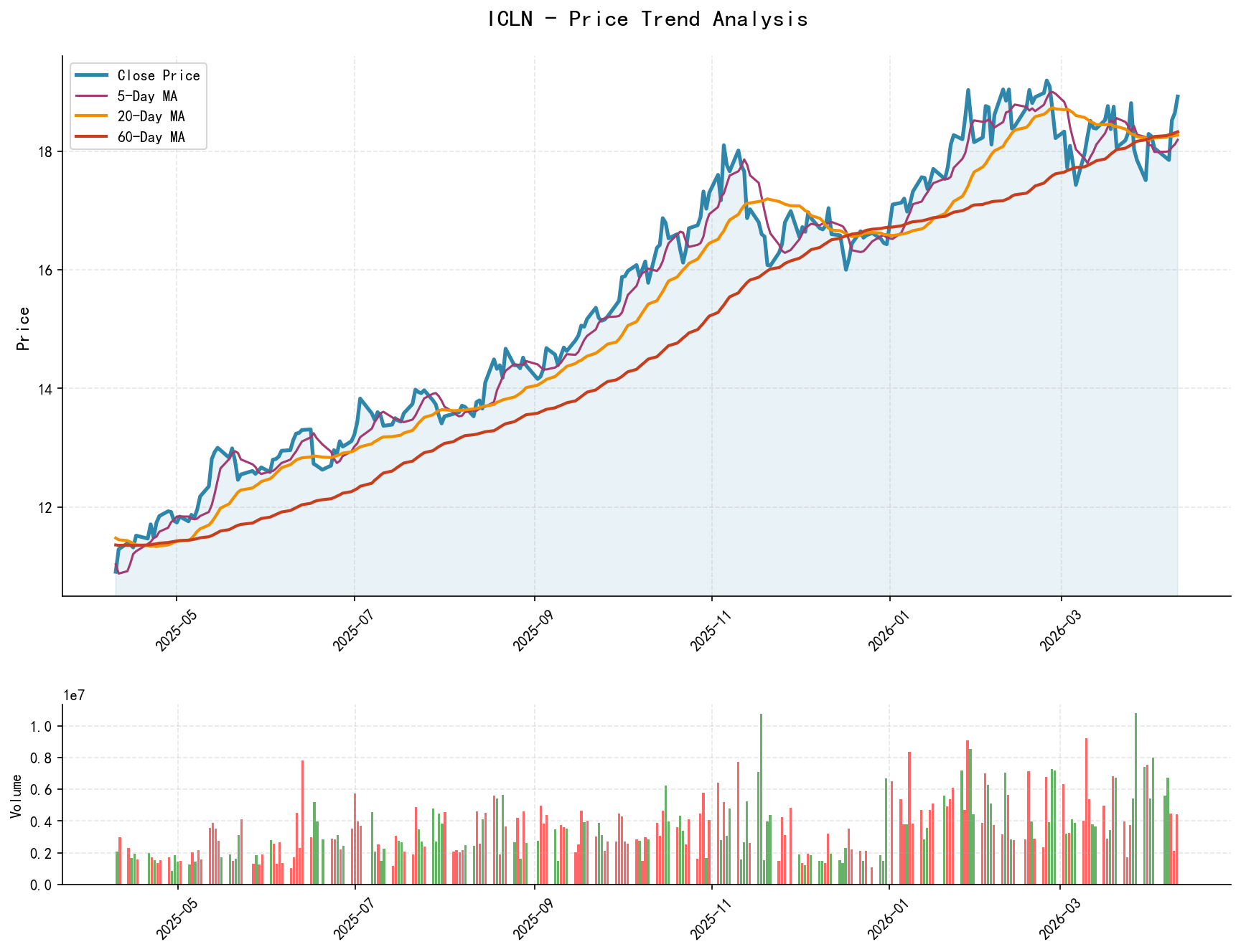
As of April 10, 2026, the underlying asset ICLN had an opening price of 18.78, a closing price of 18.92, a 5-day moving average of 18.19, a 10-day moving average of 18.09, a 20-day moving average of 18.27, a daily change of 1.50%, a weekly change of 4.82%, a monthly change of 3.44%, a quarterly change of 3.44%, and an annual change of 15.16%.
Data Observations:
- • Moving Average Alignment: As of 2026-04-10, the price closed at18.19, MA_20D:18.33). The moving averages show a standard bullish alignment (MA_5D > MA_10D > MA_20D > MA_60D), indicating a structurally intact medium-term uptrend.
- • Trend Evolution: During the analysis period, the price experienced a significant "Rally-Pullback-Recovery" cycle.
- • Rally Phase (Early February to February 24): Price pushed from19.19 (high), while moving averages across timeframes continued to diverge upward.
- • Pullback/Consolidation Phase (February 26 to March 27): Price retraced from the17.43 (March 6 low), a decline of approximately -9.2%. During this period, MA_5D crossed below MA_20D multiple times, but MA_60D maintained its upward trajectory, defining the nature of the pullback.
- • Recovery/Secondary Rally Phase (March 30 to Present): Price rebounded from the19.19.
Wyckoff Phase Inference:
The market experienced a Markdown following Distribution in late February, with panic selling (e.g., high-volume decline on March 6) appearing in the17.72 area in early March. Subsequent price action and volume patterns suggest the market underwent Re-accumulation within the17.72 range. The current market is in the early stages of a new Markup phase, testing the previous high supply zone.
2. Volume-Price Relationship and Supply-Demand Dynamics
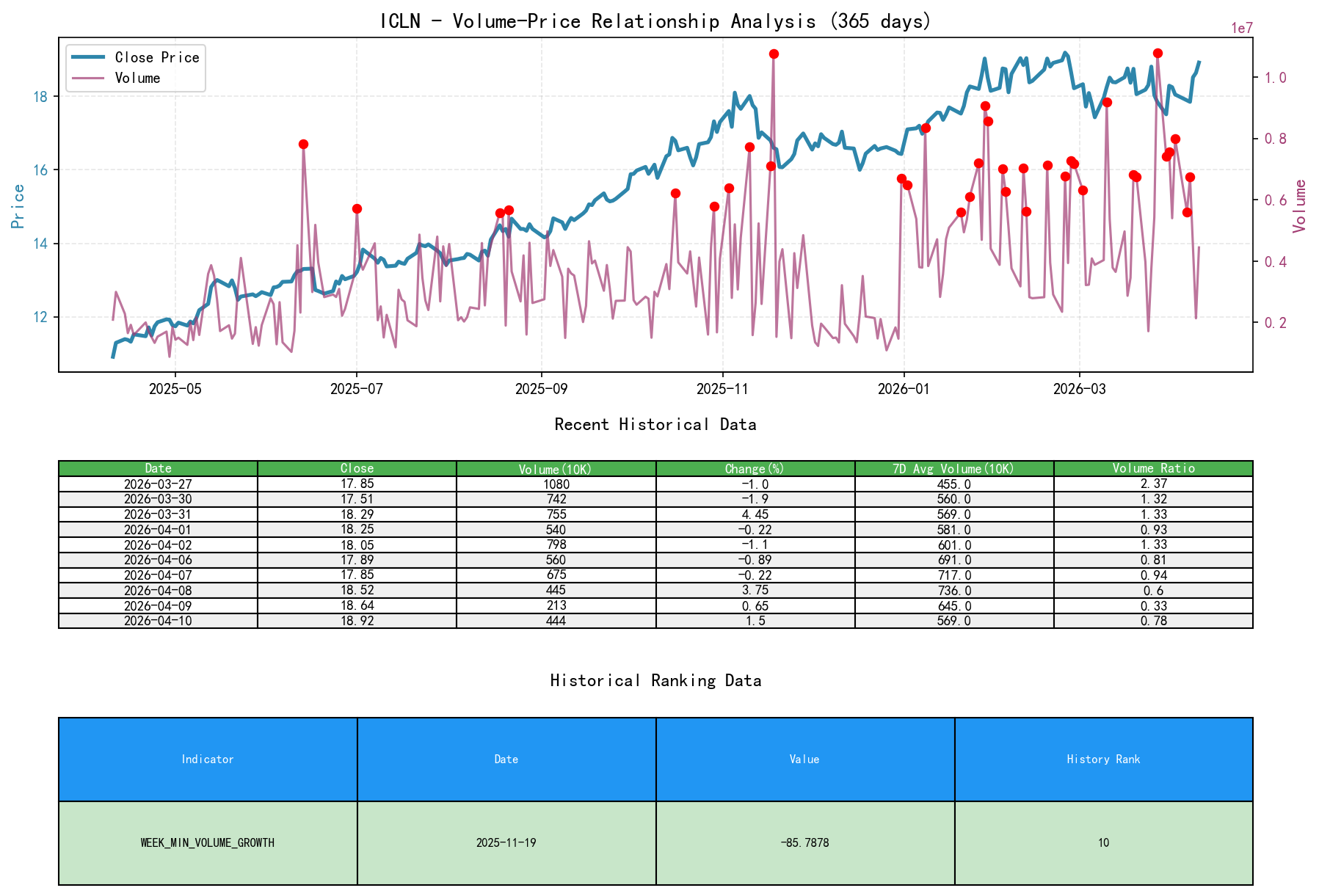
As of April 10, 2026, the underlying asset ICLN had an opening price of 18.78, a closing price of 18.92, a volume of 4,446,894, a daily change of 1.50%, a volume of 4,446,894, a 7-day average volume of 5,699,308.43, and a 7-day volume ratio of 0.78.
Wyckoff Analysis of Key Days:
- 1. Supply-Driven High-Volume Decline (Distribution and Panic):
- • 2026-02-26/27: Price declined significantly for two consecutive days (-2.20%, -2.41%), with volume surging 85% and remaining high respectively (VOLUME_AVG_7D_RATIO > 1.7). This is classic Panic Selling, showing substantial supply entering the market, rapidly driving prices lower.
- • 2026-03-06: Price fell -2.02%, volume did not reach a new high but was above recent average (VOLUME_AVG_7D_RATIO=0.77). Combined with preceding declines, this constitutes a Selling Climax Day within the downtrend.
- 2. Demand-Driven High-Volume Rally (Accumulation and Recovery):
- • 2026-03-31: Near the previous low, price surged 4.45% with significantly increased volume (VOLUME_AVG_14D_RATIO=1.49). This is a strong signal of demand entering, indicating active buying at the retracement low, confirming the effectiveness of the accumulation zone.
- • 2026-04-08/10: Price rose consecutively (+3.75%, +1.50%), with volume on April 10 growing 108% (VOLUME_GROWTH) and a VOLUME_AVG_7D_RATIO of 0.78. Although the ratio is not high, combined with the price breaking above the recent consolidation range and closing near the high, this represents a breakout with volume confirmation, suggesting demand is beginning to control the situation.
- 3. Low-Demand, Low-Volume Rebound:
- • 2026-03-12 to 03-17: During the rebound process, volume consistently remained below the 7-day and 14-day averages (VOLUME_AVG_7D_RATIO mostly between 0.6-0.8). This reflects cautious demand in the early stages of the rebound; the rise was driven by short covering or limited buying, requiring further observation.
Supply-Demand Power Shift: Data indicates that supply was fully released during the decline in early March (high-volume decline). Subsequently, demand demonstrated initial strength during the high-volume surge in late March and was reinforced by the high-volume breakout in early April. The current supply-demand balance is tilting towards the demand side.
3. Volatility and Market Sentiment
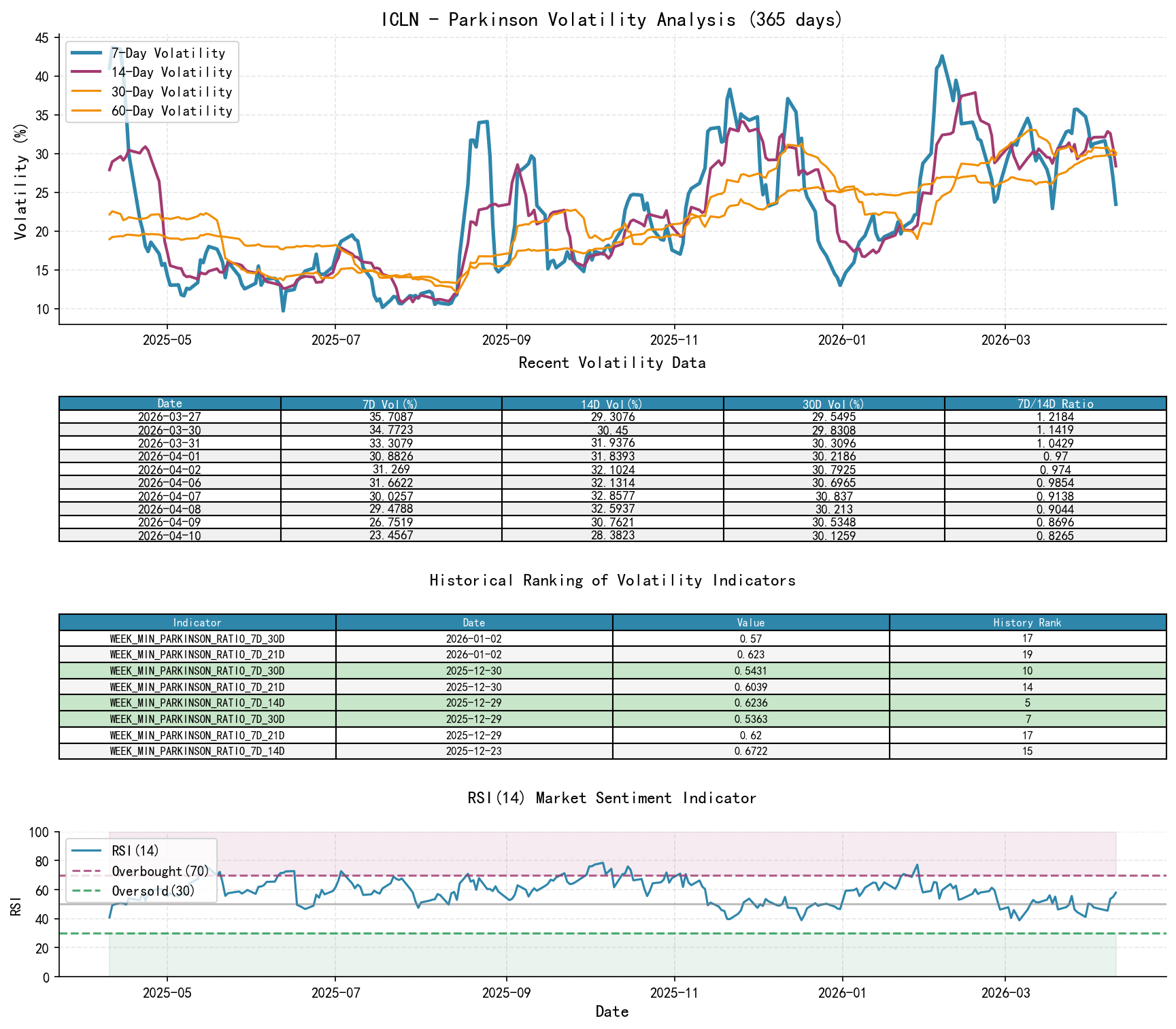
As of April 10, 2026, the underlying asset ICLN had an opening price of 18.78, a 7-day intraday volatility of 0.23, a 7-day intraday volatility ratio of 0.83, a 7-day historical volatility of 0.32, a 7-day historical volatility ratio of 0.74, and an RSI of 57.96.
Volatility Analysis:
- • Level and Trend: As of April 10, short-term volatility has converged significantly. The 7-day historical volatility (HIS_VOLA_7D) is 0.32, considerably lower than the 14-day value of 0.43 (HIS_VOLA_RATIO_7D_14D=0.74). Parkinson intraday volatility shows a similar trend (PARKINSON_RATIO_7D_14D=0.83). This indicates that following the intense volatility in March, market sentiment has stabilized, and volatility has returned to normal levels.
- • Sentiment Extremes Verification:
- • March 6: RSI_14 touched 38.85, approaching the oversold zone, while volatility was at a recent high (HIS_VOLA_7D=0.37), confirming that pessimistic sentiment reached a short-term extreme, coinciding with the price low.
- • Current: RSI_14 is at 57.96, in a healthy bullish range, not yet overbought. Combined with declining volatility, this shows optimistic but not overheated market sentiment.
4. Relative Strength and Momentum Performance
Momentum Cycle Analysis:
- • Short-term (WTD): As of April 10, the week-to-date return reached +4.82%, indicating strong momentum, consistent with the price breakout.
- • Medium-term (MTD/QTD): Month-to-date return is +3.44%, quarter-to-date return is +3.44%. Despite the deep correction in March (QTD briefly turned negative), the price has quickly recovered losses and reached a new high within the quarter, indicating strong internal momentum and recovery power post-correction.
- • Long-term (YTD): Year-to-date return is +15.16%, significantly positive. Combined with the bullish moving average alignment, this confirms that the dominance of the long-term uptrend remains unchanged.
Conclusion: Momentum analysis shows that following a healthy medium-term correction, ICLN's short-term and long-term momentum have realigned upwards, displaying typical "trend continuation" characteristics.
5. Large Investor (Smart Money) Behavior Identification
Based on Wyckoff principle-driven volume-price analysis, the operational intent of large investors is inferred as follows:
- 1. Distribution Activity (Late February): In the19.38 area, high-volume stagnation (February 24) and high-volume decline (February 26-27) occurred. This aligns with institutional distribution characteristics: utilizing market optimism to distribute holdings to retail investors chasing highs.
- 2. Accumulation Activity (March): After the price fell to the17.72 area, high-volume selling exhaustion appeared (March 31 surge of 4.45%). High-volume absorption following panic is a classic marker of smart money re-accumulation. They gathered shares sold by panic and stop-loss orders in this zone.
- 3. Testing and Shakeout (Mid to Late March): The low-volume rebound from March 17-23 can be viewed as a test of supply above the accumulation zone. The low-volume declines on March 20 and 26 exhibit Shakeout properties, aimed at flushing out weak long positions to reduce selling pressure for the subsequent rally.
- 4. Current Intent (Early April): The high-volume rallies on April 8 and 10, especially with prices closing at range highs, indicate that smart money, having completed accumulation, is initiating price advancement, intending to test and break through the previous distribution area to start a new uptrend.
6. Support/Resistance Level Analysis and Trading Signals
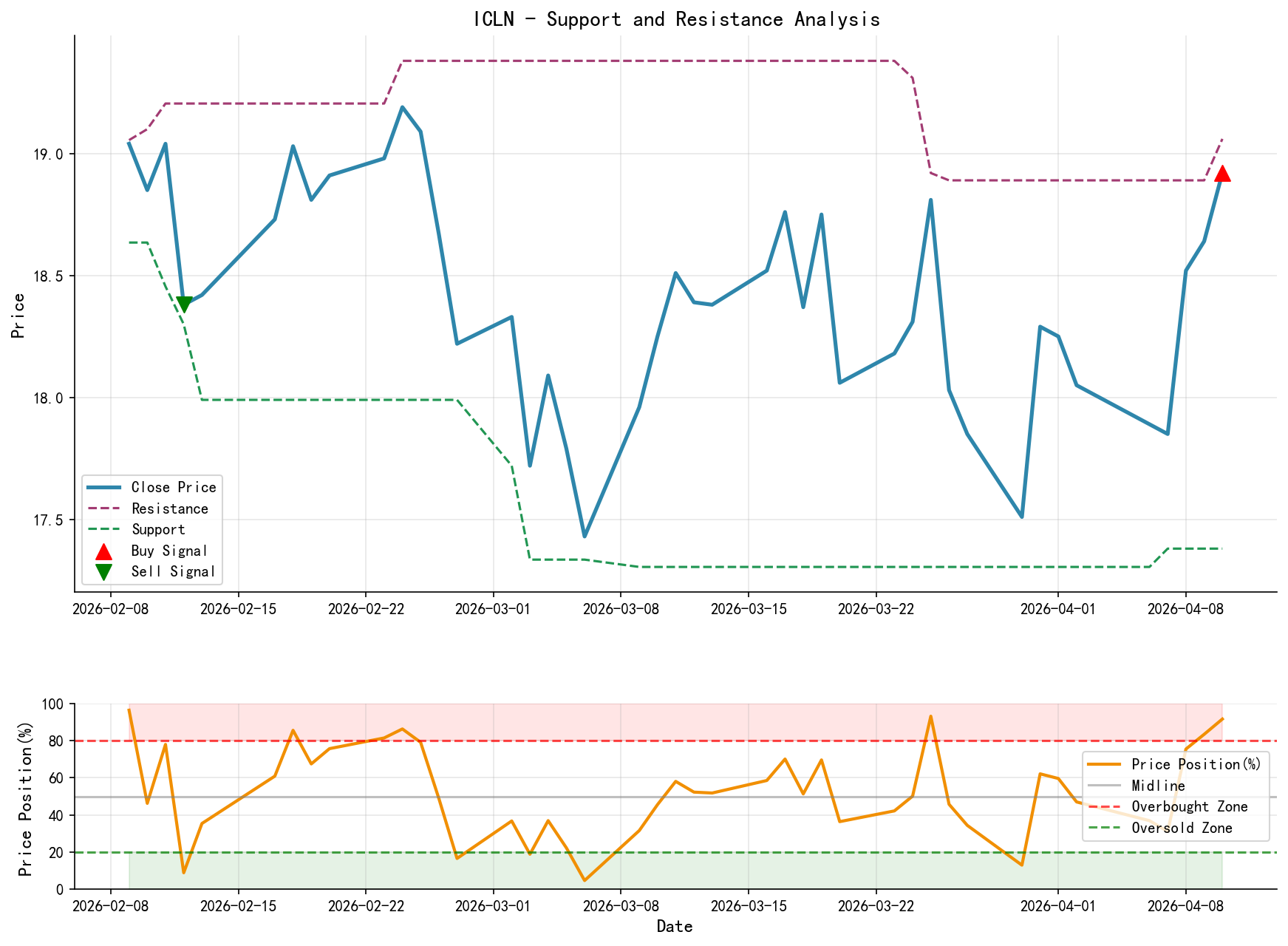
Key Price Levels:
- • Primary Resistance:19.38 (Area around the 2026-02-24 high and previous highs). This is the key supply zone determining whether the uptrend can continue.
- • Secondary Resistance:19.00 (Recent high and psychological level).
- • Primary Support:17.72 (Low area tested multiple times in March 2026, upper boundary of accumulation zone). This is a crucial defensive line for bulls.
- • Secondary Support: Around18.33 (near the 60-day MA).
Comprehensive Wyckoff Trading Signal:
- • Signal Nature: Bullish. Four aspects form a confluence: market structure (bullish alignment), supply-demand dynamics (demand control), smart money behavior (accumulation followed by advancement), and momentum (recovery upwards).
- • Core Logic: Having completed re-accumulation in the17.72 zone, large investors are guiding the price to test previous highs. A high-volume breakout above $19.38 will confirm a new uptrend.
Trading Recommendations:
- 1. Aggressive Strategy (Existing Position): Continue holding. Set the stop-loss below the lower boundary of the accumulation zone at $17.38.
- 2. Aggressive Strategy (Seeking Entry):
- • Entry Point 1 (Near Current Price): Initiate a small position around the current price (~18.27** (20-day MA) as a stop-loss reference.
- • Entry Point 2 (Breakout Confirmation): If price closes above $19.38 on high volume (VOLUME_AVG_7D_RATIO > 1.2), add to the position or enter.
- 3. Conservative Strategy: Wait for a high-volume breakout above $19.38, then enter on a pullback test of that breakout level.
Future Validation Points:
- 1. Trend Continuation Confirmation: Price must successfully break out and stabilize above $19.38. If high-volume stagnation or long upper shadows reappear at this level, it indicates supply remains strong and the rally may be hindered.
- 2. Trend Failure Signal: If price breaks below $18.27 (20-day MA) on high volume, it indicates insufficient current demand, the rally attempt may fail, and the market may return to consolidation or test the primary support zone.
Disclaimer: This report is based entirely on objective quantitative analysis of the provided data. All conclusions are derived from data models and the application of Wyckoff principles and do not constitute any investment advice. Financial markets carry risks; please make decisions prudently.
Thank you for your attention! Wyckoff volume-price market analysis is released daily at 8:00 AM before the market opens. Your feedback and shares are greatly appreciated. Let's work together to understand market signals.
Member discussion: