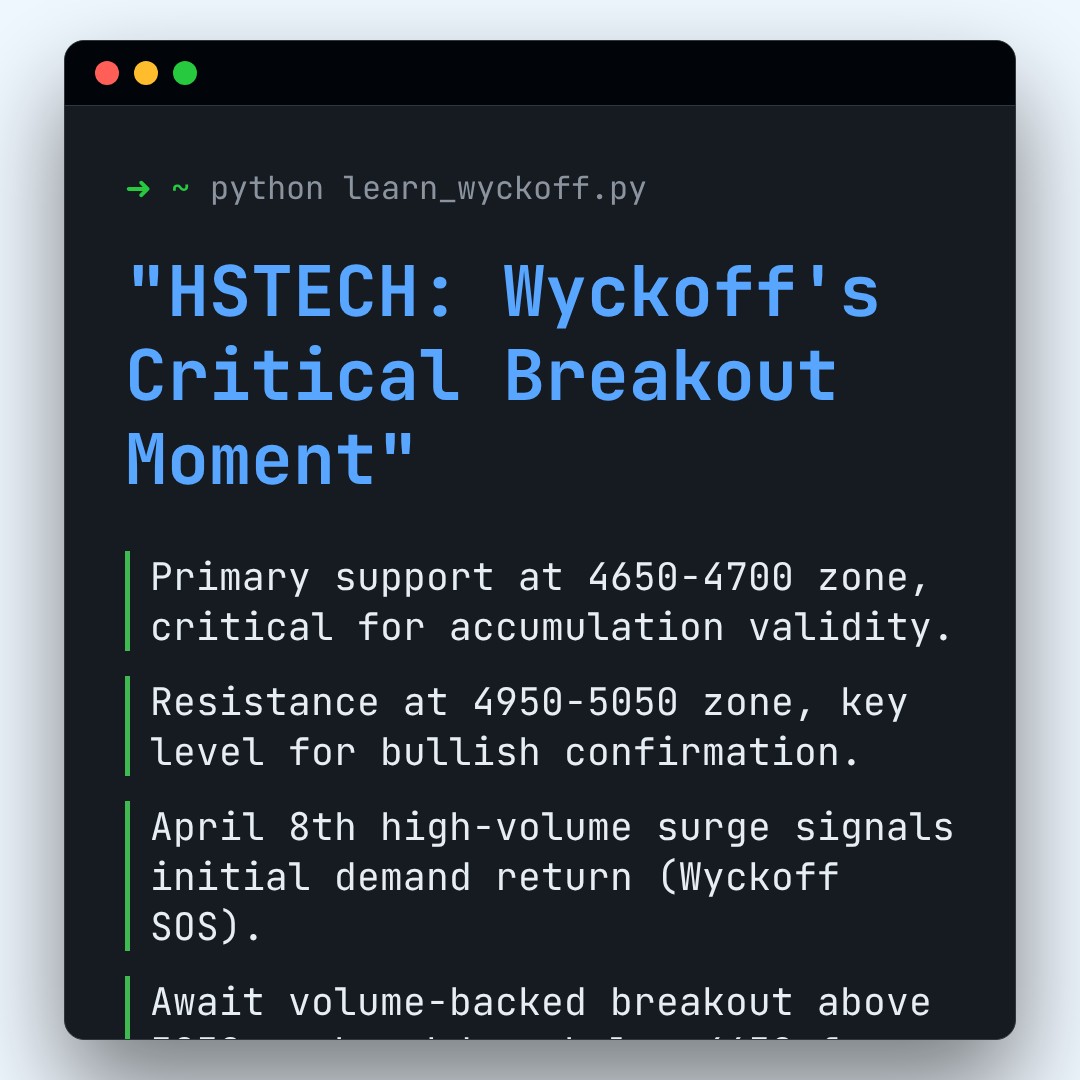
Very well, in accordance with your instructions. Below is an in-depth quantitative analysis report based on the HSTECH data you provided, strictly adhering to Wyckoff's volume-price principles.
HSTECH Wyckoff Volume-Price Analysis Report
Product Code: HSTECH
Analysis Date Range: 2026-02-09 to 2026-04-10
Report Generation Date: 2026-04-10
1. Trend Analysis and Market Phase Identification
As of April 10, 2026, the underlying asset HSTECH had an opening price of 4844.15, a closing price of 4860.26, a 5-day moving average of 4766.06, a 10-day moving average of 4781.38, a 20-day moving average of 4892.19, a daily change of 0.80%, a weekly change of 3.87%, a monthly change of 4.53%, a quarterly change of 4.53%, and a yearly change of -11.89%.
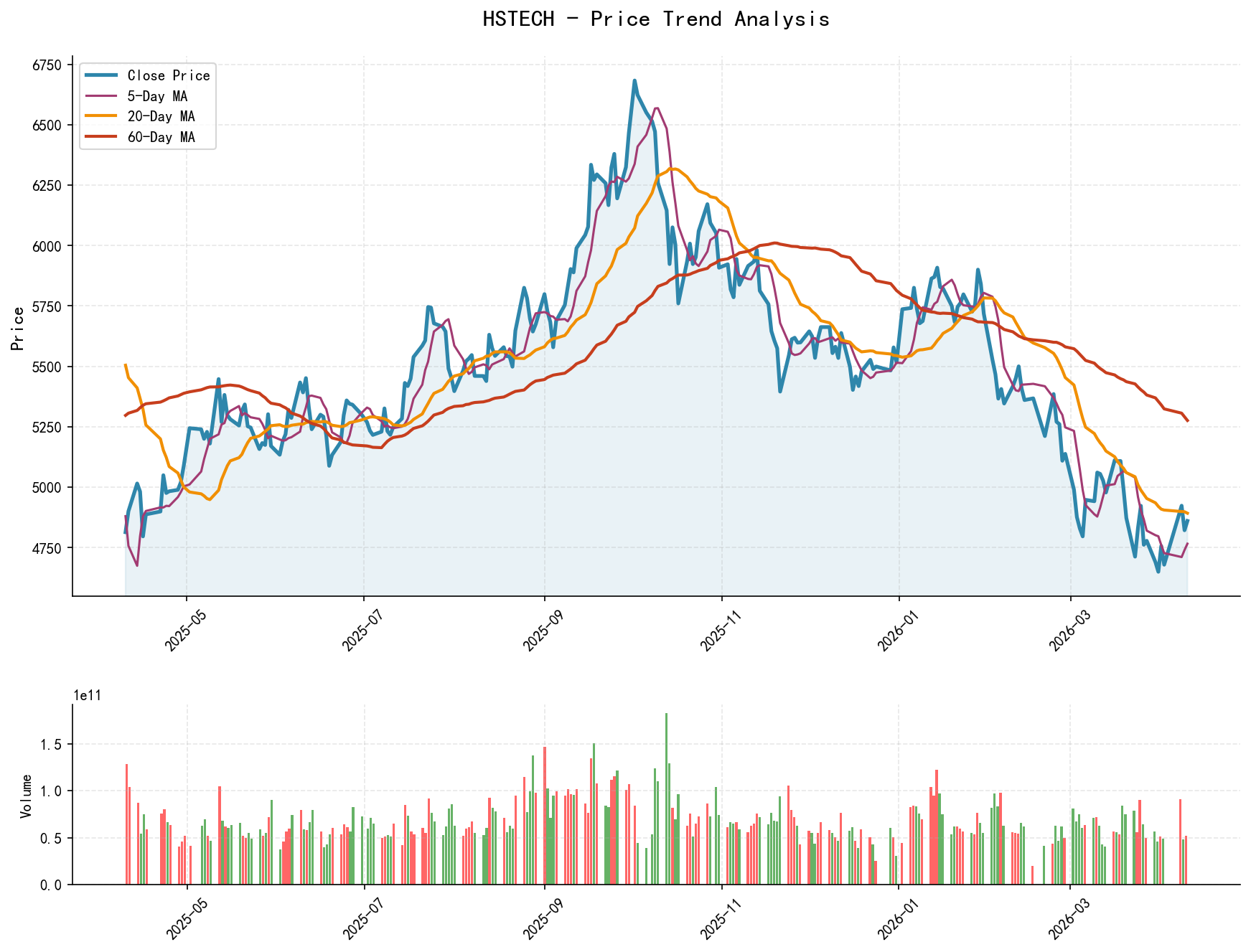
- • Trend Structure: During the analysis period, HSTECH exhibited a clear bearish alignment. The price consistently traded below all key moving averages (MA_5D, MA_10D, MA_20D, MA_30D, MA_60D). Notably, the MA_60D continuously declined from around 5700 points to 5276 points, and the MA_20D also fell from 5700 points to 4892 points, confirming the medium- to long-term downtrend. Recently (early April), although a price rebound occurred, it remains suppressed below the MA_20D and MA_30D.
- • Moving Average Crossover Signals: Since mid-February, the MA_5D persistently crossed below longer-term moving averages, forming bearish crossovers. Although there were two brief upward inflections in the MA_5D during late March and early April, neither successfully broke above the MA_10D or MA_20D, resulting in failed rebounds. This indicates that the dominant force of the medium-term downtrend has not yet changed.
- • Market Phase Inference (Wyckoff Perspective): Combining price action and volume-price relationships, the market transitioned from "Distribution/Decline" to a potential "Panic Selling/Accumulation" phase during the analysis period.
- • Mid-February to Early March 2026: The price accelerated its decline from around 5500 points to below 4800 points, consistent with the characteristics of a "Decline" phase.
- • Early to Mid-March 2026: The price experienced consecutive sharp declines on March 2nd, 3rd, and 4th (with changes of -2.89%, -2.26%, -0.96%), accompanied by significantly above-average volume exceeding 130% of the average (e.g.,
VOLUME_AVG_60D_RATIO=1.31on March 2nd), and the RSI_14 reaching an extreme low of 25.8. This aligns with the characteristics of a "Selling Climax" in Wyckoff theory, where market sentiment collapses, and public investors sell indiscriminately. - • Late March to Early April 2026: Following the formation of the panic low (~4650 points), the market entered a wide trading range (4650-4950). During this period, attempts at price rebounds were met with resistance and pullbacks, with volume expanding on down days and being relatively subdued on rebound days. This is consistent with the process of "Secondary Testing" and the potential construction of an "Accumulation range," where large investors are absorbing supply at low levels, but demand is not yet sufficient to immediately drive a trend reversal.
2. Volume-Price Relationship and Supply-Demand Dynamics
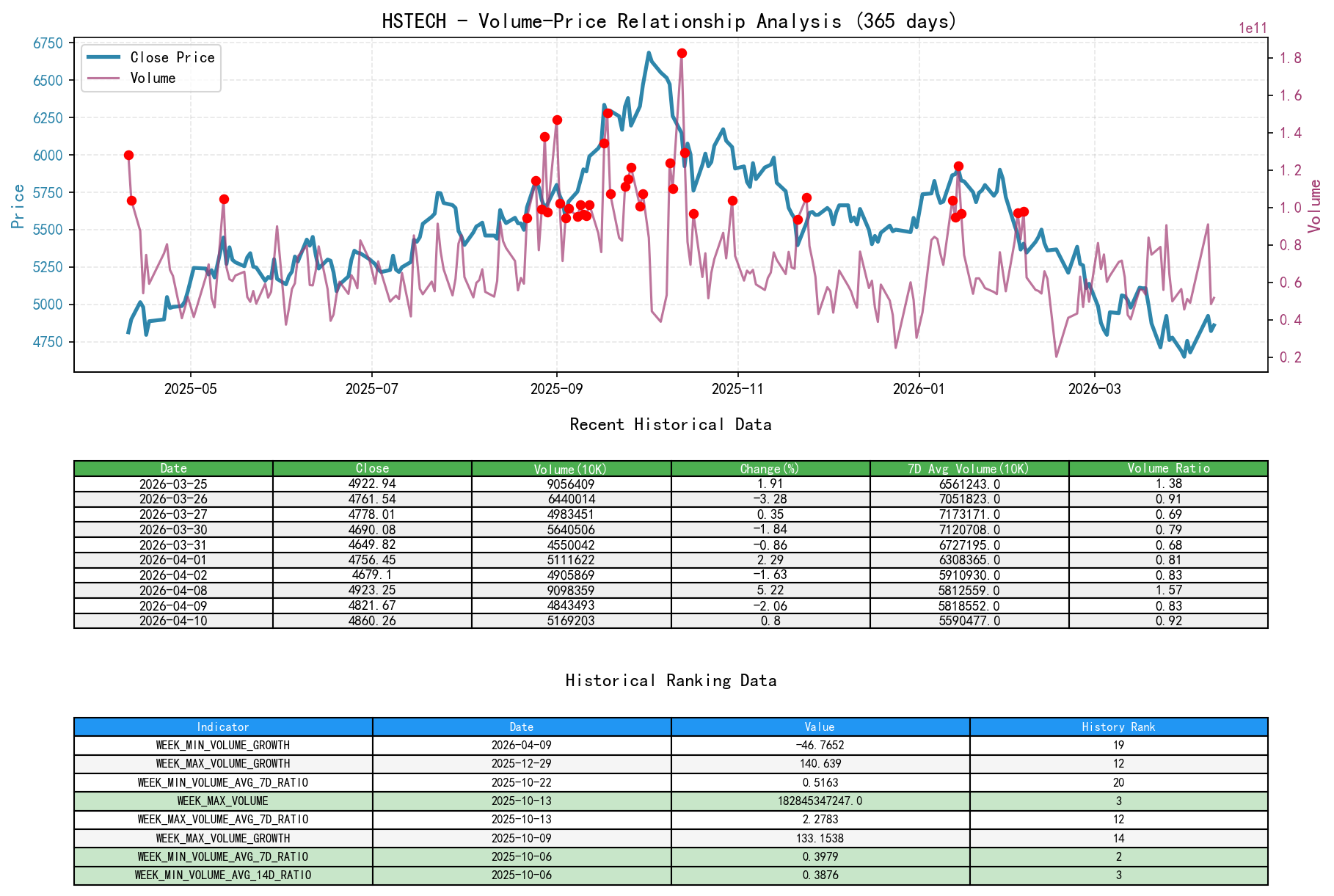
As of April 10, 2026, the underlying asset HSTECH had an opening price of 4844.15, a closing price of 4860.26, a volume of 51692036932, a daily change of 0.80%, a volume of 51692036932, a 7-day average volume of 55904778966.71, and a 7-day volume ratio of 0.92.
- • Key Day Analysis:
- • Panic Selling Day (2026-03-02): The price plummeted -2.89%, volume reached a recent high, with
VOLUME_AVG_60D_RATIOas high as 1.31. This is a typical day of concentrated supply release, but considering subsequent price action, it may represent the final exhaustion of downward momentum. - • Demand Recovery Test Day (2026-04-08): The price surged 5.22%, closing near the day's high, with volume spiking to a recent high (
VOLUME_AVG_60D_RATIO=1.38). This is the first occurrence of "high-volume advance" within the analysis period, indicating strong demand entering at the upper bound of the trading range, attempting to test overhead supply. - • Supply-Dominated Pullback Day (2026-04-09): Following the previous day's surge, the price opened higher but closed down -2.06%, with volume contracting rapidly (
VOLUME_AVG_14D_RATIO=0.75). This represents a pullback after "high volume/stagnation," showing that significant supply pressure remains near the 4950-point level.
- • Panic Selling Day (2026-03-02): The price plummeted -2.89%, volume reached a recent high, with
- • Evolution of Supply-Demand Pattern: Overall, supply dominated the market from February to early March. After mid-March, panic selling emerged, suggesting a possible short-term exhaustion of supply. Subsequently, the market entered a range-bound phase, exhibiting the initial accumulation structure of "low volume on advances, high volume on declines" (e.g., March 23rd and 26th declines on high volume). It wasn't until the high-volume surge on April 8th that the first clear signal emerged of demand organizing and attempting to gain dominance. However, the pullback the next day (April 9th) indicates intense battle between supply and demand, with demand yet to achieve overwhelming superiority.
3. Volatility and Market Sentiment
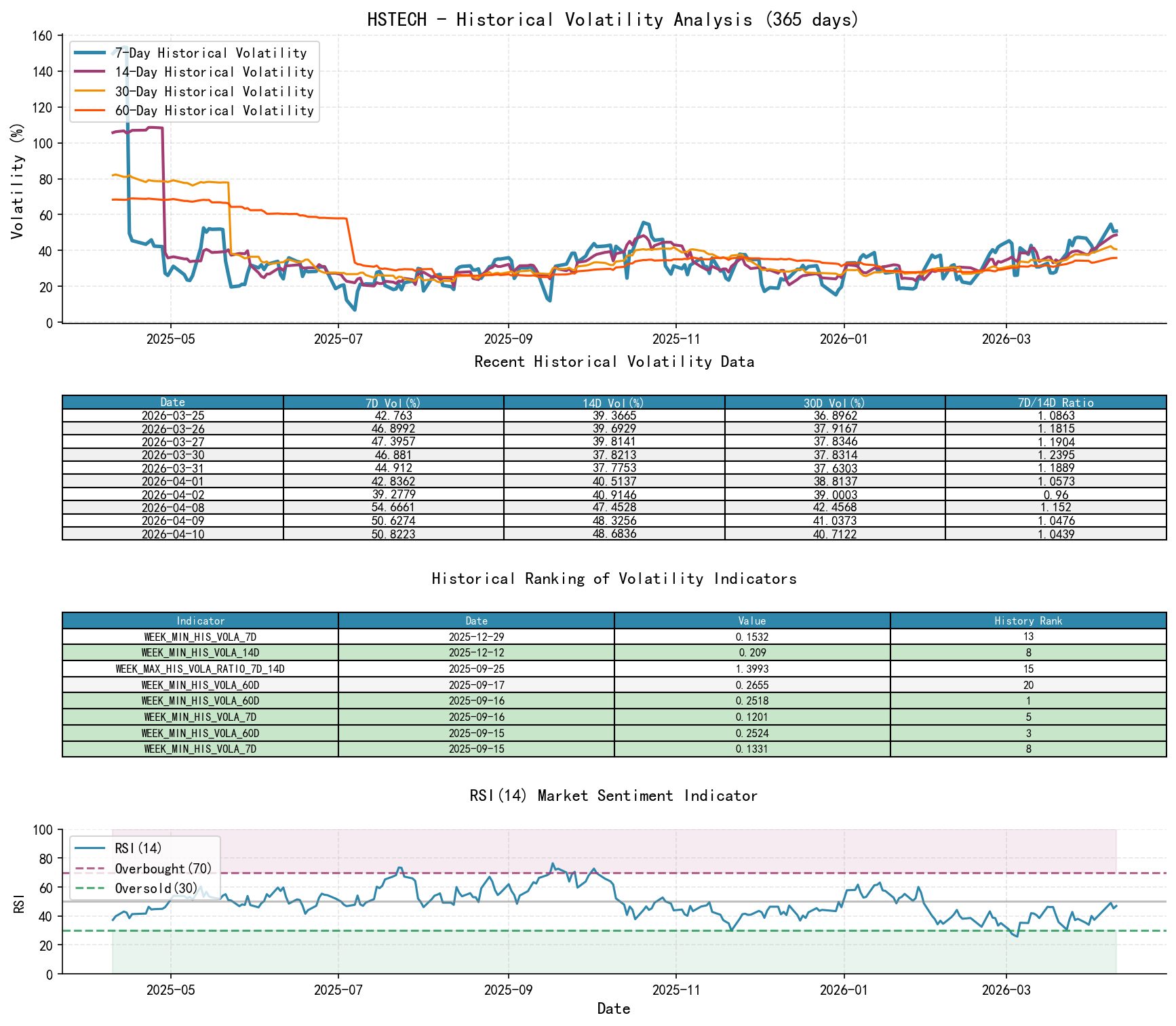
As of April 10, 2026, the underlying asset HSTECH had an opening price of 4844.15, a 7-day intraday volatility of 0.25, a 7-day intraday volatility ratio of 0.86, a 7-day historical volatility of 0.51, a 7-day historical volatility ratio of 1.04, and an RSI of 46.96.
- • Volatility Level: Market volatility peaked in early March.
HIS_VOLA_7Drose to 0.454 on March 2nd, andPARKINSON_VOL_7Dreached a high of 0.333 on March 6th, reflecting extreme market instability and panic. - • Volatility Structure: During the sharpest phase of the decline, short-term volatility was significantly higher than long-term volatility (e.g.,
HIS_VOLA_RATIO_7D_60D=1.51,PARKINSON_RATIO_7D_60D=1.14on March 2nd), a typical characteristic of accelerating trends and panic sentiment. Entering April, although these ratios remain above 1, they have retreated from extreme highs, indicating a shift in market sentiment from panic to divergence and consolidation. - • Overbought/Oversold Status: The RSI_14 touched 25.8, a deeply oversold region, on March 5th. Historical ranking data shows this value is the 15th lowest weekly minimum RSI in the past decade, confirming the extreme pessimism in market sentiment at that time, which is often a left-side signal for a potential reversal. The current RSI_14 has recovered to around 47.0, residing in a neutral-to-weak zone, having moved away from extreme oversold levels, providing room for a technical rebound.
4. Relative Strength and Momentum Performance
- • Periodic Returns: The YTD return is -11.89%, QTD return is 4.53% (due to the April rebound), MTD return is 4.53%, and WTD return is 3.87%. The data shows that medium- to long-term momentum remains negative, but short-term momentum (weekly, monthly) has turned significantly positive. This indicates that the momentum of the downtrend is waning, while short-term rebounding forces are gathering. This aligns with the technical pattern of price finding support near 4650 points and initiating a rebound.
5. Smart Money Behavior Identification
- • Accumulation Behavior: The massive volume during the "Selling Climax" in early March (e.g., March 2nd, 3rd) was not solely retail selling. According to Wyckoff principles, high volume at the end of a decline implies an equivalent amount of capital is absorbing the supply. Combined with the subsequent "Secondary Test" (price revisiting lows without making new ones, with relatively moderate volume), it can be inferred that smart money likely conducted preliminary, organized accumulation in the 4650-4750 zone.
- • Testing and Shakeouts: The several failed rebounds from late March to early April can be seen as "tests" of overhead supply pressure. The sharp rally on April 8th was a "demand test" organized by smart money, aiming to gauge the level of selling pressure in the 4950-5050 zone. The pullback on April 9th can be interpreted as a natural reaction to encountering supply resistance after the test.
- • Behavior Summary: The data suggests that large investors engaged in "panic bottom-fishing" and "range-building" during March. The current phase (early April) may see their behavior shifting from "passive accumulation" to "active testing," intending to confirm the strength of overhead supply and prepare for a potential trend reversal. The rapid contraction in volume from extreme highs on April 9th (
VOLUME_GROWTHat -46.77%, historically ranked as the 19th lowest weekly contraction in the past decade) indicates that during the price pullback, large-scale selling did not persist, and supply did not emerge en masse.
6. Support/Resistance Level Analysis and Trading Signals
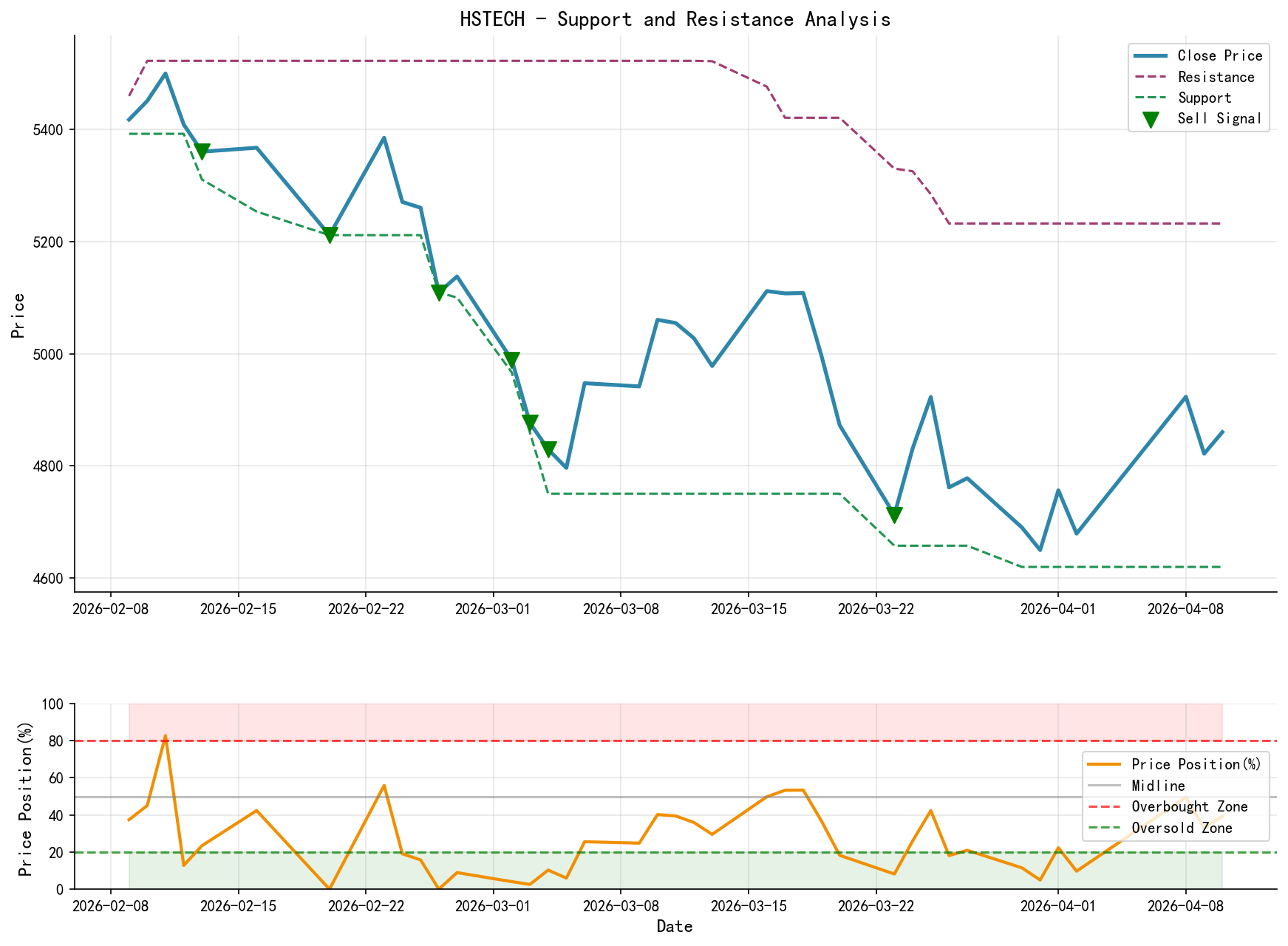
- • Key Levels:
- • Support Levels:
- 1. Primary Support: 4650-4700 zone. This is the low formed by the March panic selling and the bottom of subsequent "Secondary Tests," holding significant support meaning.
- 2. Secondary Support: 4800-4850 zone. The lower bound of the recent trading range and the starting point of the April rebound.
- • Resistance Levels:
- 1. Primary Resistance: 4950-5050 zone. This is the high zone of the high-volume surge on April 8th, also a previous (mid-March) volume concentration area and the location of the MA_30D, indicating strong supply.
- 2. Secondary Resistance: 5100-5150 zone. The MA_20D and the lower edge of the late-February declining consolidation platform.
- • Support Levels:
- • Integrated Wyckoff Events and Trading Signals:
- • Current Phase Judgment: The market may be transitioning from an "Accumulation range" towards "Preliminary Signs of an Uptrend." The panic and consolidation in March form a potential accumulation background, and the high-volume surge on April 8th is the first positive demand signal (Sign of Strength, SOS).
- • Bullish Signal Confirmation Point: Price needs to break above and sustain above the 5050-point level with strong volume (
VOLUME_AVG_60D_RATIO> 1.1). This would complete the Wyckoff "Accumulation-Breakout" structure, confirming that demand has ultimately overcome supply, and the trend may shift to upward. - • Bearish Failure Signal: Price breaking below the 4650-point support on high volume. This would negate the accumulation hypothesis, plunging the market into a deeper decline.
- • Operational Suggestions:
- • Aggressive Strategy (Based on Accumulation Hypothesis): Consider testing the long side with light positions in the 4800-4850 support zone, setting a stop loss below 4750. Target the 5050 level. This strategy bets on support at the range's lower bound and an upward test.
- • Conservative Strategy (Awaiting Confirmation): Maintain a wait-and-see approach. Initiate long positions after price closes above 5050 with strong volume, setting a stop loss below 4950. Alternatively, consider positioning when price retraces to the 4700 vicinity again, showing signs of low-volume stalling.
- • Risk Warning: If the price consolidates below 4950 without upward momentum and subsequently declines on high volume again, be alert to accumulation failure and exit to the sidelines.
Summary Conclusion: Based on Wyckoff volume-price analysis, HSTECH showed signs of smart money accumulation near the 4650-point level after the panic-driven decline in February-March. The current market is in a critical supply-demand equilibrium zone. The high-volume surge on April 8th is a significant signal of demand returning, but confirmation of a trend reversal still requires a valid price breakout above the 5050-point resistance. It is recommended that traders monitor the breakout direction within the 4800-5050 range and adjust positions strictly according to the validation points mentioned above. Historical ranking data (extremely low RSI, extreme volume contraction) reinforces the judgment of market sentiment bottoming in early March and current temporary supply exhaustion, increasing the validity of support at the range's lower bound.
Disclaimer: This report/analysis is solely market analysis and research based on publicly available information and does not constitute any investment advice or operational guidance. The author strives for objectivity and impartiality but makes no guarantees regarding accuracy or completeness. Markets involve risks; investment requires caution. Any investment actions based on this report are undertaken at your own risk.
Thank you for your attention! Wyckoff Volume-Price Market Insights are released daily at 8:00 AM before market open. Please feel free to leave comments and share; your recognition is crucial. Let's work together to see the market signals clearly.
Member discussion: