
ETHUSDT Wyckoff Volume-Price Analysis Report
Product Code: ETHUSDT
Analysis Date Range: 2026-02-09 to 2026-04-10
Report Generation Date: 2026-04-11
Executive Summary
Based on Wyckoff volume-price principles, an analysis of ETHUSDT market data over the past two months leads to the following core conclusion: The market completed a process of Panic Selling and Preliminary Accumulation in the2,000 zone around the end of Q1 (late February to early March). Subsequently, price initiated a demand-driven (buying pressure) rally, which confirmed an uptrend on March 16 via a Sign of Strength (high-volume breakout). Currently (as of April 10), price is at a rally high (2,250-$2,300) and await new supply-demand signals.
1. Trend Analysis and Market Phase Identification
As of 2026-04-10, the subject ETHUSDT had an open price of 2190.17, a close price of 2254.87, a 5-day moving average (MA) of 2167.51, a 10-day MA of 2125.98, a 20-day MA of 2096.75, a daily change of 2.95%, a weekly change of 9.79%, a monthly change of 7.10%, a quarterly change of 7.10%, and a yearly change of -24.12%.
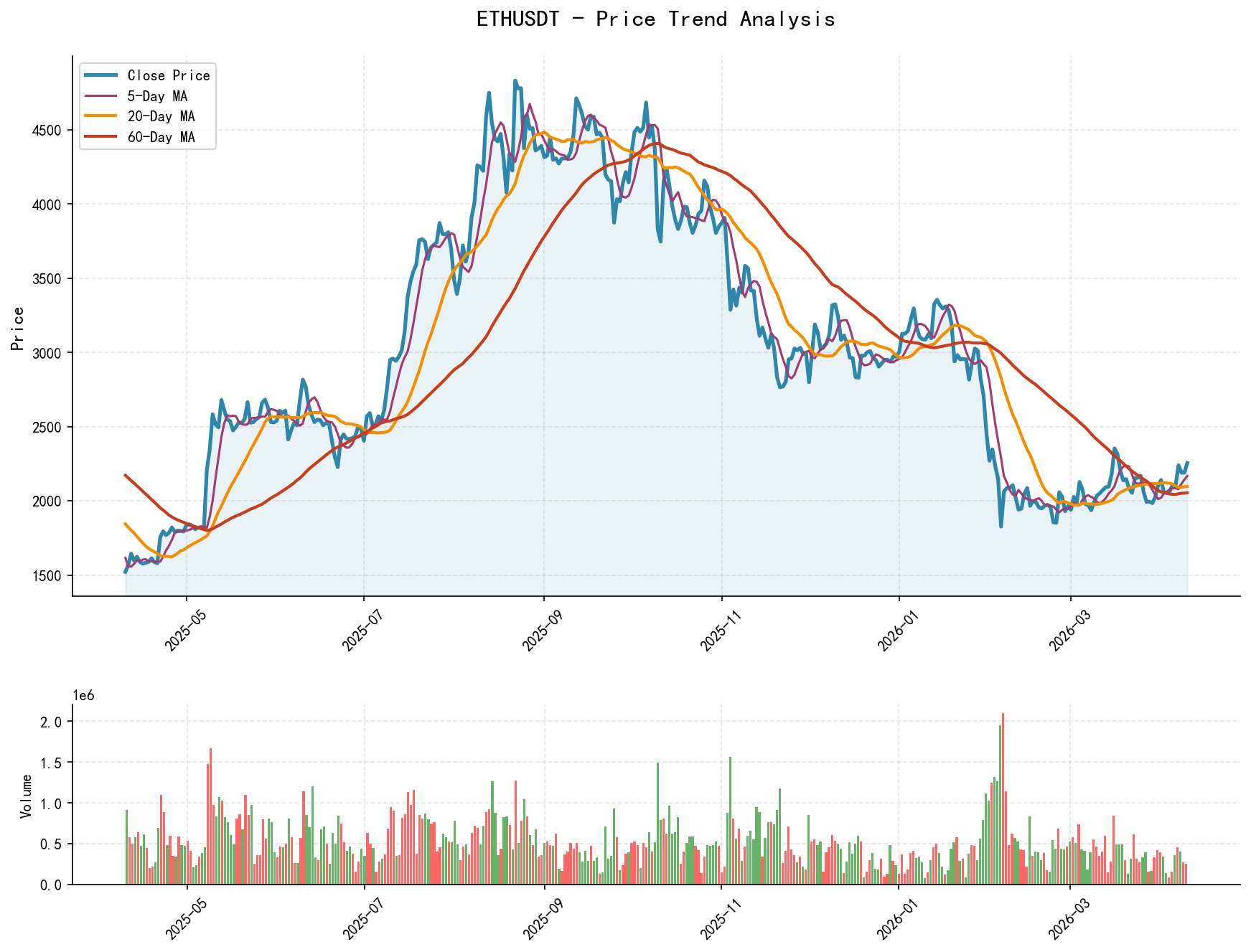
Moving Average Alignment and Price Action:
- • Long-term Trend (Bear-dominated): At the beginning of the analysis period, price consistently traded below the MA_60D (long-term MA) and MA_30D (medium-term MA), indicating a clear medium-to-long-term downtrend. The MA_60D declined from approximately2054, serving as the primary resistance line.
- • Key Turning Point (Mid-March): On March 16, price (2,054), indicating the market is in a powerful rally phase within a long-term downtrend, but the long-term trend has not yet been fully reversed.
- • Inferred Market Phases:
- 1. Feb 9 - Feb 25 (Decline and Panic): Price declined steadily from1,856, with volume spiking to a high on Feb 23. This aligns with the characteristics of the "Panic Selling" phase in Wyckoff theory: accelerated price decline, surging volume, and extreme pessimism.
- 2. Feb 25 - Mar 15 (Accumulation and Testing): Price experienced wide-range consolidation within the2,100 band. Several high-volume up-days (e.g., Feb 25, Mar 4) and low-volume down-days occurred, typical of an "Accumulation Range": smart money absorbing panic-driven selling at lows and shaking out weak hands through volatility.
- 3. Mar 16 - Apr 10 (Markup and Testing): The high-volume bullish candlestick on March 16 marked the initiation of an "Uptrend". Subsequent pullbacks (e.g., Mar 18-19) did not breach the prior consolidation high ($2,100), constituting a "Successful Test" of the breakout. Recently (Apr 7-10), price made new highs on diminishing volume, warranting vigilance for a transition into "Upthrust" or "Initial Distribution".
2. Volume-Price Relationship and Supply-Demand Dynamics
As of 2026-04-10, the subject ETHUSDT had an open price of 2190.17, a close price of 2254.87, volume of 256030.88, a daily change of 2.95%, volume of 256030.88, a 7-day average volume of 268044.15, and a 7-day volume ratio of 0.96.
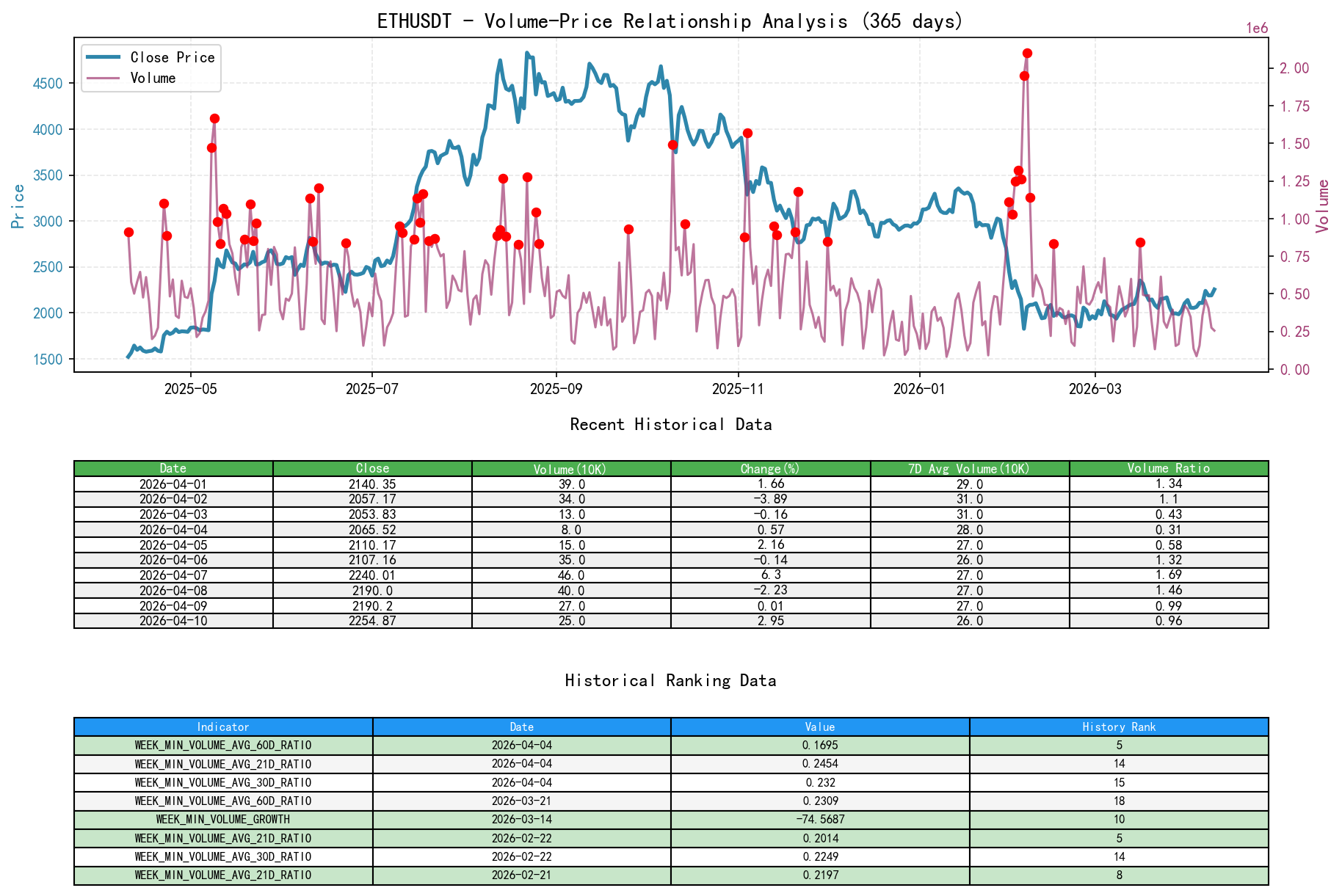
Key Day Analysis:
- • Panic Selling Day (2026-02-23): Price plummeted -5.19%, closing at $1,856. Volume surged to 547,360, with a VOLUME_AVG_60D_RATIO as high as 1.117, indicating selling pressure peaked recently. Combined with historical ranking data (WEEK_MIN_VOLUME_AVG_60D_RATIO hit the fifth lowest in nearly ten years at 0.169 on 04-04, contrasting the high volume on Feb 23), this is a classic supply-dominated panic day.
- • Demand-Driven Rebound Day (2026-02-25): Following the panic low, price surged +11.10% on amplified volume of 682,979, with a VOLUME_AVG_60D_RATIO of 1.372. This is a clear signal of demand stepping in to absorb supply, marking the end of the panic phase and the beginning of accumulation.
- • Breakout Confirmation Day (2026-03-16): Price jumped +8.02% with volume skyrocketing to 845,893 and a VOLUME_AVG_60D_RATIO as high as 1.530. This was the strongest demand-dominated day of the rally, confirming the uptrend.
- • Volume-Price Divergence Warning Days (2026-04-08 to 2026-04-10): Price consecutively made new highs (2,254) while volume continuously contracted. On April 10, price rose 2.95%, but the VOLUME_AVG_60D_RATIO was only 0.638 and the VOLUME_AVG_14D_RATIO was 0.874. This is a typical "price rises, demand shrinks" volume-price divergence, indicating waning upward momentum and potential supply emerging at highs.
3. Volatility and Market Sentiment
As of 2026-04-10, the subject ETHUSDT had an open price of 2190.17, a 7-day intraday volatility of 0.53, a 7-day intraday volatility volume ratio of 1.03, a 7-day historical volatility of 0.51, a 7-day historical volatility volume ratio of 1.07, and an RSI of 60.71.
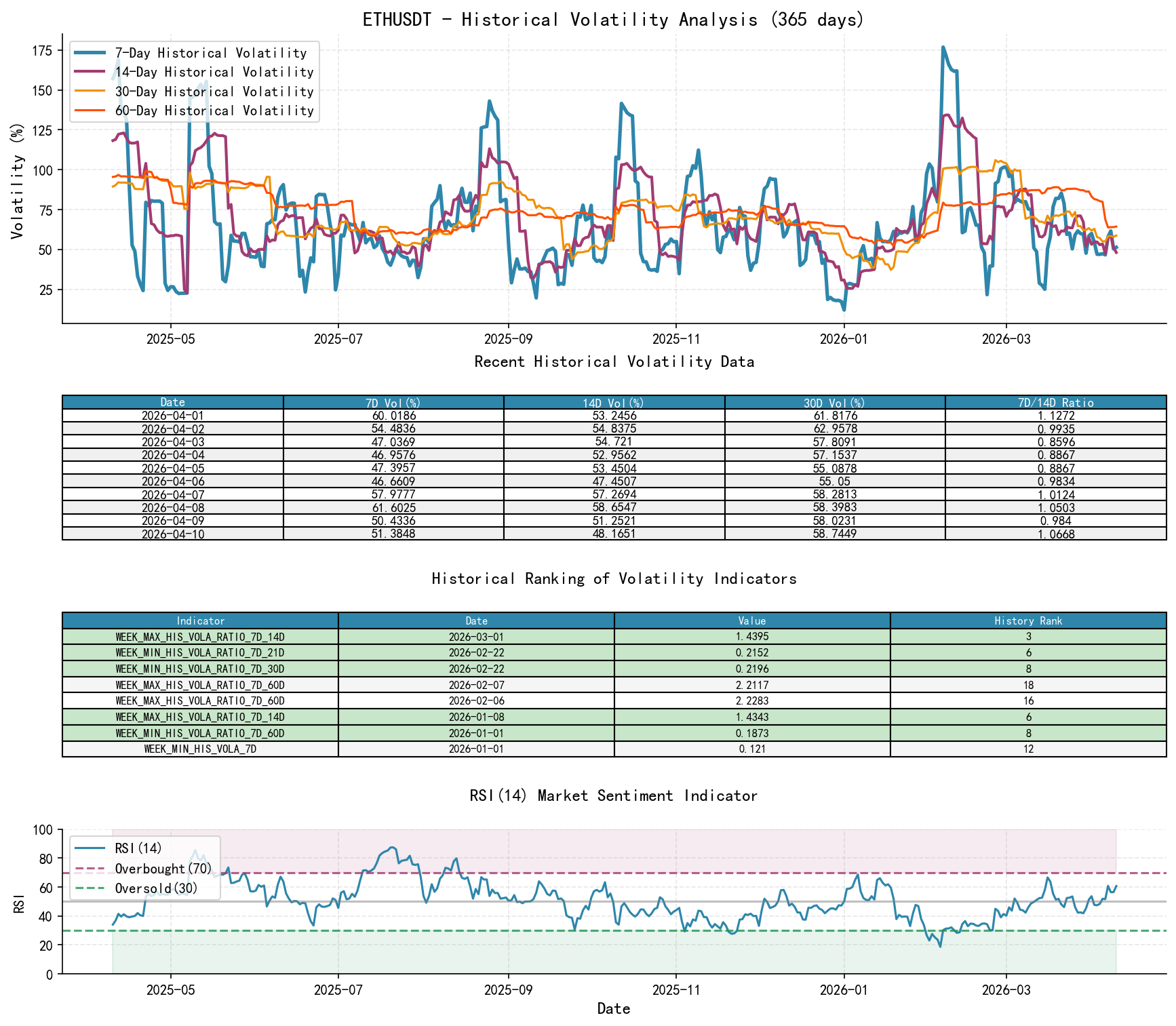
Volatility Analysis:
- • Volatility Explosion During Panic: In late February, short-term historical volatility (HIS_VOLA_7D) consistently exceeded long-term volatility (HIS_VOLA_60D), with HIS_VOLA_RATIO_7D_60D remaining above 2.0. Historical rankings show WEEK_MAX_HIS_VOLA_RATIO_7D_14D reached the third highest in nearly ten years at 1.4395 on 03-01, confirming the market was in an emotional, high-volatility panic state at that time.
- • Volatility Convergence After Trend Establishment: Entering April, short-term volatility rapidly declined. HIS_VOLA_RATIO_7D_60D has fallen to 0.798, and PARKINSON_RATIO_7D_60D has dropped to 0.861. The return of volatility from extreme highs to normal levels indicates market sentiment is stabilizing, and the one-sided panic decline has subsided.
- • RSI Sentiment Indicator: RSI_14 fell to 30.28 (oversold territory) on Feb 23, validating the market sentiment low. Subsequently, RSI climbed erratically, reaching 60.71 on Apr 10, moving out of oversold territory into a strong zone, but not yet into overbought territory (>70), leaving room for potential future adjustments.
4. Relative Strength and Momentum Performance
- • Momentum Shift: In terms of returns, QTD_RETURN (Quarter-to-date) bottomed at -29.15% on Mar 31 and recovered significantly to -24.12% by Apr 10. More importantly, WTD_RETURN (Week-to-date) reached +9.79% on Apr 10, indicating very strong short-term momentum.
- • Momentum, Trend, and Volume-Price Verification: The strong short-term momentum (WTD) corroborates other signals like the price breakout above MAs and high volume on key days (Mar 16), confirming the validity of this rally. However, the recent volume-price divergence (waning demand) suggests this strong momentum may be difficult to sustain.
5. Large Investor ("Smart Money") Behavior Identification
- • Accumulation Behavior (Late Feb - Early Mar): In the2,000 range, the market exhibited "Panic Selling" with massive volume (Feb 23), immediately followed by "high-volume stopping of the decline and rebound" (Feb 25). This is a classic manifestation of "Stopping Action" in Wyckoff theory, inferred as large investors actively absorbing supply during retail panic selling.
- • Shakeout and Testing Behavior (Early Mar): After rebounding near $2,100, price experienced multiple low-volume declines or high-volume pullbacks (e.g., Mar 6, Mar 8) but consistently held above prior lows. This represents "Testing" and "Shakeout" of the accumulation range, aimed at flushing out weak holders and consolidating the cost basis.
- • Suspected Distribution Behavior (Early Apr): Price climbed above $2,250 without significant volume expansion, forming a volume-price divergence. This is suspected to be large investors beginning "gentle Distribution" by selling inventory to chasing retail buyers while demand still exists but subsequent buying power is weak. Confirmation of a distribution phase would require subsequent "high-volume stalling" or "high-volume decline".
6. Support/Resistance Level Analysis and Trading Signals
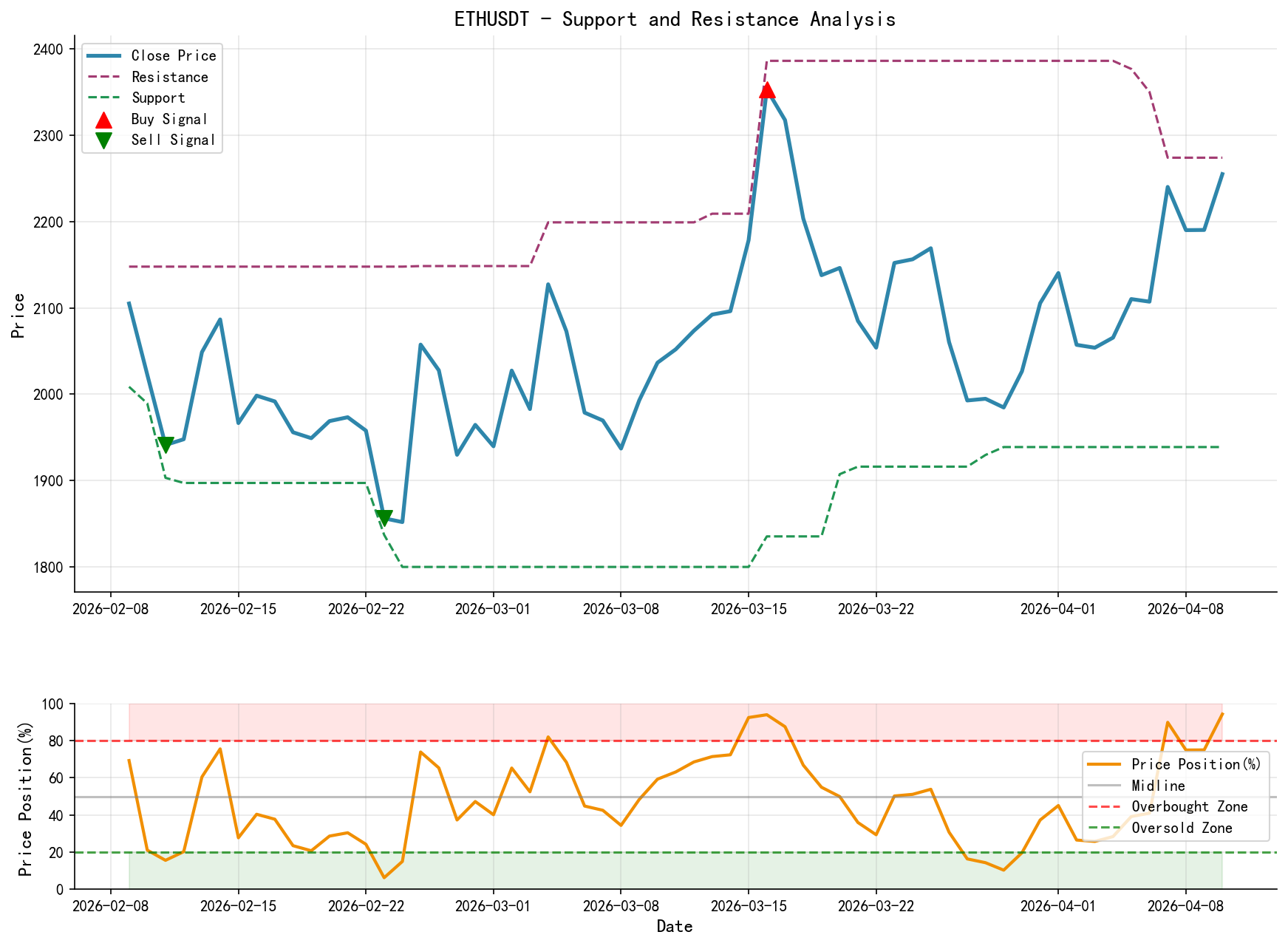
- • Key Support Levels:
- 1.2,180: Recent minor consolidation highs and the April 8-9 trading range, also the convergence area of MA_5D/MA_10D. A break below this zone would signal damage to the short-term uptrend structure.
- 2.2,100: The upper boundary of the March accumulation range and a support level tested multiple times, serving as the lifeline for this rally.
- 3. $1,856: The panic low of this cycle, representing the ultimate strong support.
- • Key Resistance Levels:
- 1.2,300: The current price zone, also near the March 17 high ($2,376). This zone exhibits volume-price divergence, making it a strong resistance area.
- 2. $2,376 (March 17 High): A breakout above this level would require significantly amplified volume to confirm renewed demand.
- • Integrated Trading Signals and Operational Recommendations:
- • Market State: Potential initial distribution within an uptrend.
- • Core Contradiction: The medium-term trend has shifted to a rally, but short-term signals show demand weakening.
- • Operational Recommendations:
- 1. Holders: It is recommended to take partial profits in the2,300 resistance zone and move stop-losses above the position to below2,376 with volume.
- 2. Non-Holders: Adopt a wait-and-see approach; avoid chasing highs. The market needs to digest recent gains and rebuild demand. A more ideal long entry would be to wait for a price pullback to the2,150 support zones, accompanied by a low-volume stopping of the decline signal (successful test).
- 3. Short-Sellers: The current environment is not ideal for initiating shorts. A clear short signal would require price breaking below the $2,150 support with expanding volume, confirming supply has regained market control.
- • Future Validation Points:
- 1. Bullish Validation: Price pulls back to the vicinity of2,100, accompanied by extremely low volume (VOLUME_AVG_14D_RATIO < 0.6), followed by a high-volume bullish candlestick rebound.
- 2. Bearish Validation: Price exhibits "high-volume stalling" or "high-volume decline" (e.g., gain <1% with VOLUME_AVG_14D_RATIO > 1.2, or decline with expanding volume) at or above2,150 with volume, a downtrend may resume.
Disclaimer: This report is based entirely on quantitative analysis and theoretical deduction of the provided historical data and does not constitute any investment advice. Financial markets carry risks, and past performance is not indicative of future results. Investors should make independent judgments and bear risks according to their own circumstances.
Thank you for your attention! Daily Wyckoff volume-price market insights are published promptly before the 8:00 AM market open. Please feel free to leave comments and share. Your recognition is crucial. Let's work together to see the market signals clearly.
Member discussion: