
Understood. As a quantitative trading researcher proficient in the Wyckoff Method, I will compose a comprehensive and in-depth quantitative analysis report for you based on the provided BTCUSDT data (from 2026-02-09 to 2026-04-10) and historical ranking metrics.
Quantitative Analysis Report Driven by the Wyckoff Method
Product Code: BTCUSDT
Analysis Period: 2026-02-09 to 2026-04-10
Report Generation Date: 2026-04-11
1. Trend Analysis and Market Phase Identification
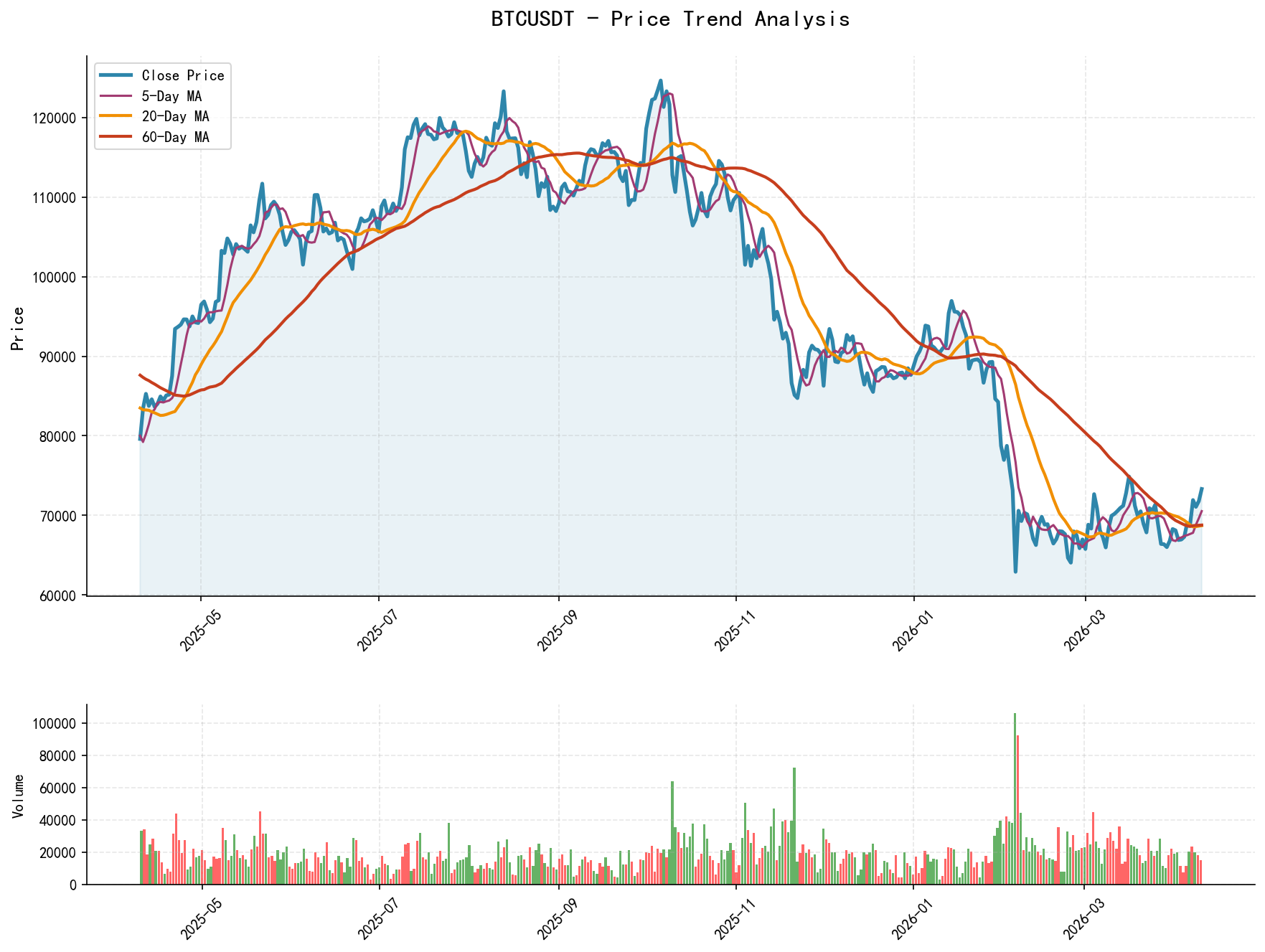
As of April 10, 2026, the target BTCUSDT opened at 71787.98, closed at 73316.08, with a 5-day moving average (MA) at 70533.99, a 10-day MA at 69023.51, and a 20-day MA at 68711.24. The daily change was +2.13%, the weekly change +9.49%, the monthly change +7.37%, the quarterly change +7.37%, and the year-to-date change -16.35%.
Data Derivation:
- • Current Trend Structure: As of April 10th, the price (73316) has broken above all key moving averages (MA_5D > MA_10D > MA_20D > MA_30D > MA_60D), forming a typical bullish alignment. Specifically, the MA_5D (70533.99) has clearly crossed above both the MA_20D (68711.24) and the MA_60D (68783.40), confirming a strengthening short-term trend.
- • Recent Price Action Evolution: Reviewing the entire analysis period:
- • 2026-02-09 to 2026-03-01: The market was in a clear downtrend. The price consistently traded below all major moving averages (especially the MA_20D and MA_60D), with the MAs in a bearish alignment. The market transitioned from a "Distribution" phase into a "Decline" phase, experiencing acceleration around February 23rd-24th.
- • 2026-03-02 to Present: A fundamental reversal occurred in the market. On March 2nd, the price surged 4.64% on high volume, consecutively breaking through the MA_5D, MA_10D, and MA_20D. Subsequently, the price consolidated and moved higher above the MA cluster. After successfully testing and finding support at the MA_20D around the end of March, it initiated the current new upward leg.
- • Wyckoff Phase Identification: Synthesizing price action and volume-price relationships, the market experienced a Selling Climax followed by an Automatic Rally in late February. The consolidation in March can be interpreted as a process of Secondary Testing and Accumulation. The rally since early April, particularly the high-volume breakout on April 7th, indicates the market is transitioning from the Accumulation phase to the early stages of the "Markup" phase.
2. Volume-Price Relationship and Supply-Demand Dynamics
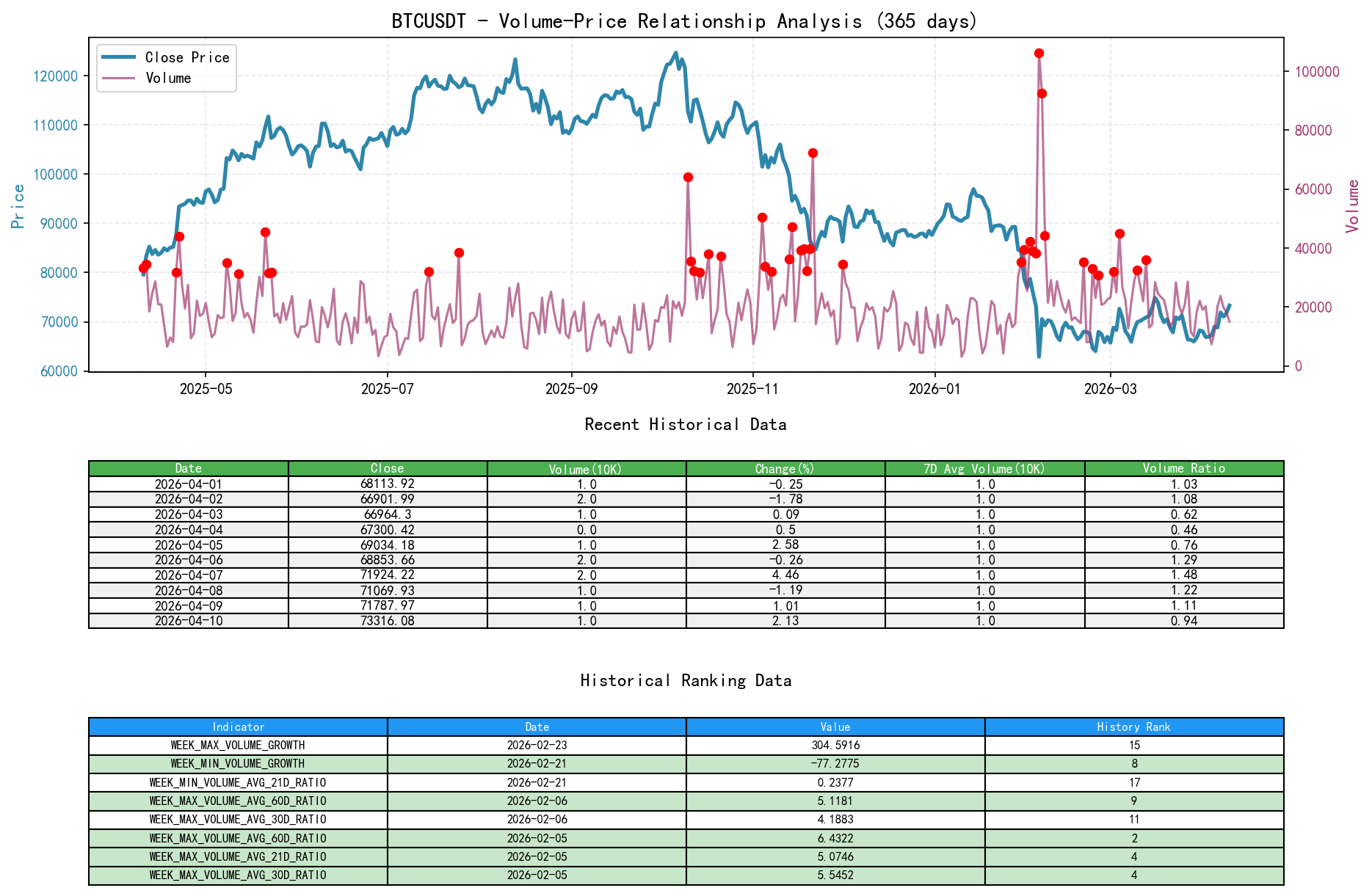
As of April 10, 2026, the target BTCUSDT opened at 71787.98, closed at 73316.08, with a daily volume of 15038.65, a daily change of +2.13%, a 7-day average volume of 16075.62, and a 7-day volume ratio of 0.94.
Core Alpha Signal Extraction:
- 1. Selling Climax and Demand Entry Signals (Late February):
- • February 23rd: Price plummeted -4.42%, but volume surged by 304.59% (
VOLUME_GROWTH), with the volume-to-60-day-average ratio (VOLUME_AVG_60D_RATIO) reaching as high as 1.58. According to historical ranking, this day's volume growth ranked 15th in the past decade. This is a classic panic selling event, with the enormous volume indicating a massive transfer of holdings. - • Key Turning Point (February 25th): Near the panic low, the price rebounded strongly by +6.13%, with volume increasing by 33.10% (
VOLUME_GROWTH) and the volume-to-60-day-average ratio at 1.43. This suggests that following the panic selling, strong demand (smart money) began actively absorbing supply, providing preliminary confirmation of supply exhaustion and demand dominance.
- • February 23rd: Price plummeted -4.42%, but volume surged by 304.59% (
- 2. Uptrend Confirmation and Demand Dominance Signals (March to Early April):
- • March 4th: Price surged +6.33% on volume that expanded by 79.88% (
VOLUME_GROWTH), with the volume-to-14-day-average ratio (VOLUME_AVG_14D_RATIO) reaching 2.01. This is a "Sign of Strength" breakout from the consolidation range, clearly demonstrating overwhelming demand. - • Healthy Pullbacks within the Uptrend (March 7th, March 21st): Price experienced minor declines, but volume contracted by -43.79% and -26.07% respectively. This aligns with the Wyckoff characteristic of "low-volume pullbacks" in a healthy uptrend, indicating that significant supply did not emerge.
- • Recent Potential Warning Signal (April 9th-10th): Price rose for two consecutive days (+1.01%, +2.13%), but volume contracted successively (-8.30%, -17.18%), with the
VOLUME_AVG_7D_RATIOdropping below 0.94. A preliminary volume-price divergence has appeared, suggesting weakening demand for chasing the rally at current levels. Caution is warranted for a potential short-term pullback or consolidation.
- • March 4th: Price surged +6.33% on volume that expanded by 79.88% (
3. Volatility and Market Sentiment
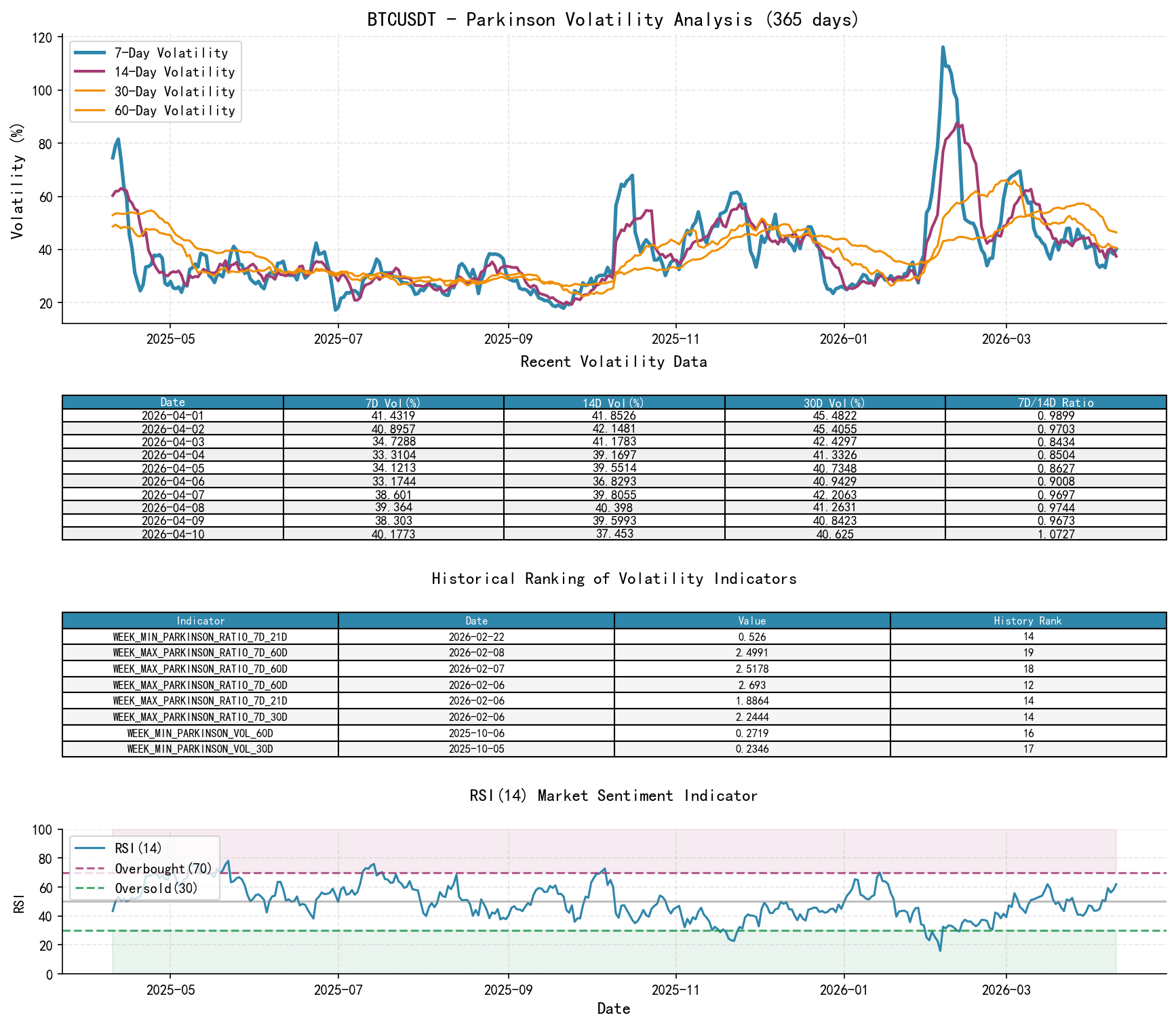
As of April 10, 2026, the target BTCUSDT opened at 71787.98, with a 7-day Parkinson volatility of 0.40, a 7-day Parkinson volatility ratio of 1.07, a 7-day historical volatility of 0.36, a 7-day historical volatility ratio of 1.13, and an RSI of 62.01.
Data Derivation:
- 1. Volatility Extremes and Sentiment Reversals:
- • In early February, short-term volatility was significantly higher than long-term volatility. For example, on February 9th, the 7-day-to-60-day historical volatility ratio (
HIS_VOLA_RATIO_7D_60D) was as high as 2.51, ranking 11th in the past decade, indicating extreme panic and market turmoil. - • Sentiment Bottom and Reversal: After the panic, volatility rapidly converged. By February 21st-22nd,
HIS_VOLA_RATIO_7D_21Ddropped to lows of 0.285 and 0.269 respectively. The value on February 22nd ranked as the 11th lowest in the past decade, andPARKINSON_RATIO_7D_21Dalso reached 0.526, ranking 14th lowest. Extreme convergence in volatility often signals exhaustion of trend momentum and extreme pessimism in market sentiment, typically a precursor to a trend reversal. - • Current State: Recent volatility levels (
HIS_VOLA_7D: 0.36,PARKINSON_VOL_7D: 0.40) have receded from their March highs and are at moderate levels. This indicates market sentiment has retreated from the optimistic exuberance of early March to a more rational state, which is conducive to steady trend development.
- • In early February, short-term volatility was significantly higher than long-term volatility. For example, on February 9th, the 7-day-to-60-day historical volatility ratio (
- 2. Overbought/Oversold Verification:
- • In late February,
RSI_14fell into the oversold region below 30, resonating with the panic price decline. - • The current
RSI_14is 62.01, within the strong zone but not yet overbought (>70), leaving room for further price appreciation.
- • In late February,
4. Relative Strength and Momentum Performance
Data Derivation:
- • Momentum Structure Shift: The periodic return rates clearly depict the shift in market momentum.
- • The long-term (Year-to-Date) return is -16.35%, indicating the overall market is still in a recovery state for the year.
- • The medium-term (Quarter-to-Date / Month-to-Date) returns have turned positive (+7.37%), showing the rally since late Q1 has reversed the medium-term downtrend.
- • Short-term (Week-to-Date) momentum is strongest, with a return of +9.49%.
- • Conclusion: The momentum structure presents a bullish alignment of "short-term > medium-term > long-term". This pattern of returns turning positive from the near-term to the longer-term is a classic characteristic marking the end of a downtrend and the establishment of a new uptrend, corroborating the conclusions from the trend analysis.
5. Large Investor (Smart Money) Behavior Identification
Intent Inference Based on Wyckoff Principles:
- 1. Accumulation During Late February Panic: The record-breaking high-volume plunge on February 23rd is a classic scenario of retail panic selling (supply) and large investors covertly absorbing shares (demand). The subsequent low-volume stabilization and high-volume rebound (February 25th) validated the proactive accumulation behavior of smart money exploiting panic sentiment.
- 2. Testing and Adding Positions in March: During the March consolidation, a volume-price structure characterized by "high volume on rallies, low volume on declines" occurred multiple times. This aligns with the behavioral pattern of smart money conducting secondary tests to verify support while continuing to accumulate positions after initial establishment, using the "shakeout".
- 3. Lift-off in Early April and Potential Distribution Observation: The high-volume breakout on April 7th can be interpreted as smart money beginning to lift prices (Markup) away from their cost base after completing preliminary accumulation. However, the "rising price, declining volume" divergence observed in the last two days (April 9th-10th) warrants close attention. This could be a natural pause within the uptrend, or it could be a sign that smart money is slowing down ahead of key resistance, or even beginning preliminary tests of distribution. Subsequent volume-price action is needed for confirmation.
6. Support/Resistance Level Analysis and Trading Signals
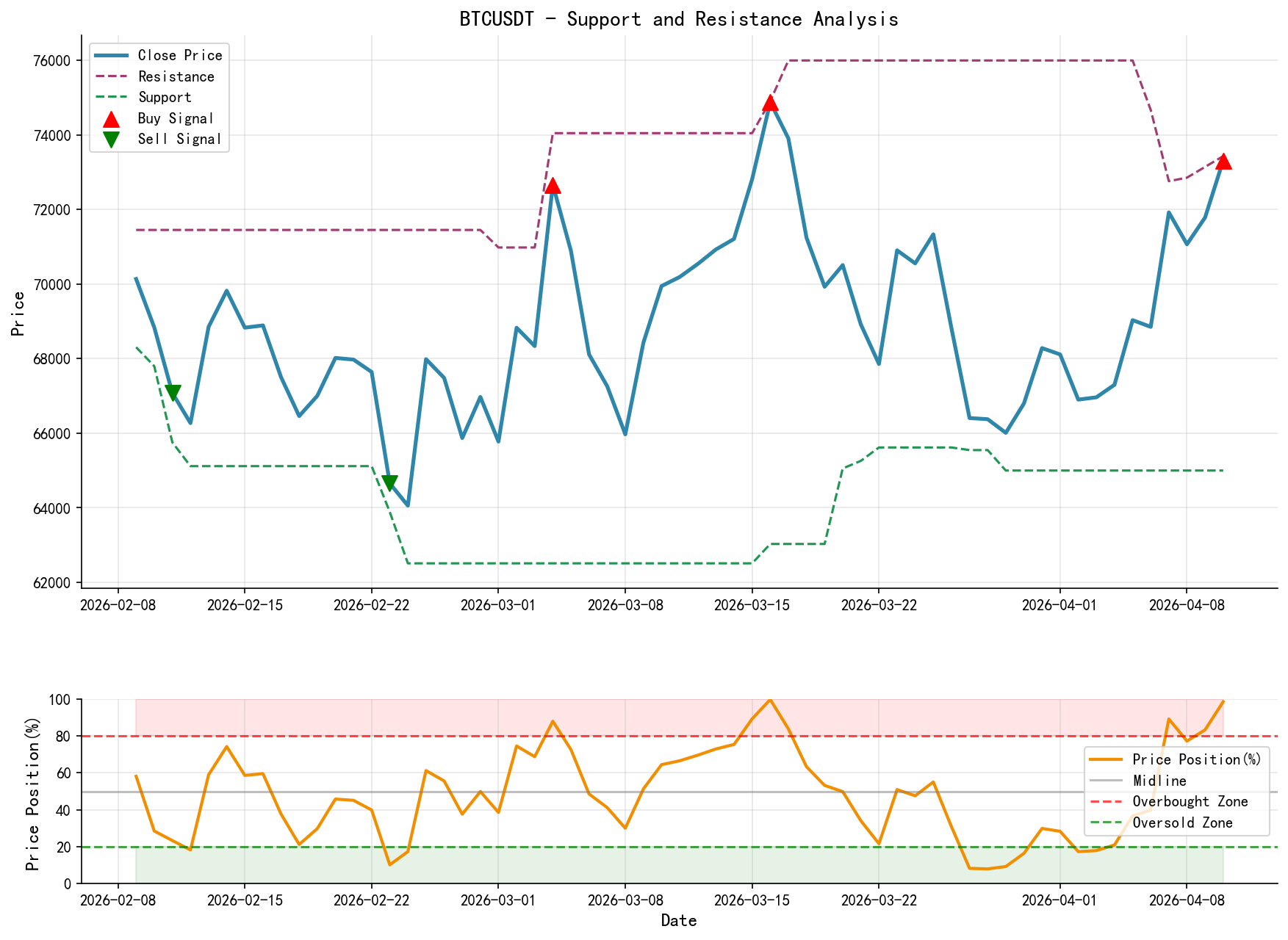
Key Level Identification:
- • Strong Support Zones:
- 1. 70500-71000 Range: The recent breakout platform (highs from April 7th-9th) and the vicinity of the MA_5D (~70533), serving as the first dynamic support.
- 2. 68000-68500 Range: The upper boundary of the late-March consolidation range and the vicinity of the MA_20D (~68711), acting as the medium-term bull-bear demarcation line.
- 3. 64000-65000 Range: The bottom area formed by the panic lows in February, representing the core long-term support.
- • Strong Resistance Zones:
- 1. 74000-75000 Range: A dense resistance area formed by the April 10th high (73434) and the rebound highs from mid-March (74909, ~76000).
- 2. 78000-80000 Range: The lower boundary of the prior large consolidation range (January-February), representing longer-term resistance.
Integrated Wyckoff Event Trading Signals and Operational Recommendations:
- • Comprehensive Judgment: The market has completed its transition from a decline to accumulation and is currently in the early stages of a new upward cycle. However, it faces near-term key technical resistance and shows preliminary volume-price divergence warning signals.
- • **Signal: ** Short-term view: consolidation/pullback likely. Medium-term view: bullish trend remains intact.
- • Operational Recommendations:
- 1. Long Strategy (Primary):
- • Ideal Entry Point: Wait for a price pullback to the 70500-71000 support zone. Observing either contracting volume (weakening supply) or renewed high-volume stabilization (return of demand) could be considered an opportunity to buy on dips.
- • Stop-loss: Set below 68000 to guard against an unexpected trend reversal.
- • Targets: First target at the 74000-75000 resistance zone. If a high-volume, decisive breakout occurs, the next target would be 78000-80000.
- 2. Short Strategy (Contrarian/Short-term):
- • Consider light, short-term short positions only if the price rallies into the 74000-75000 resistance zone and exhibits clear supply-dominant candlestick patterns such as "high-volume stagnation" or "long upper shadows".
- • Place a tight stop-loss just above the recent high.
- 1. Long Strategy (Primary):
- • Future Validation Points:
- 1. Bullish Validation: Price finds support in the 70500-71000 zone and rallies again on high volume, breaking through the 74000 resistance.
- 2. Bearish Warning: Price breaks down through the 68000 key support on high volume, accompanied by renewed volatility expansion. This could signal the failure of the current rally, potentially leading the market back into a consolidation or decline pattern.
- 3. Divergence Resolution: If subsequent trading sessions show price advances accompanied by a significant expansion in volume (
VOLUME_AVG_7D_RATIO> 1.2), the current volume-price divergence warning would be negated.
Disclaimer: All conclusions in this report are derived from quantitative analysis and theoretical interpretation based on the provided historical data and do not constitute any investment advice. Financial markets involve risks, and past performance is not indicative of future results. Please make decisions based on your independent judgment.
Thank you for your attention! Daily Wyckoff volume-price market analysis is released promptly before the 8:00 AM market open. Please feel free to leave comments and share. Your recognition is paramount. Let's work together to perceive market signals.
Member discussion: