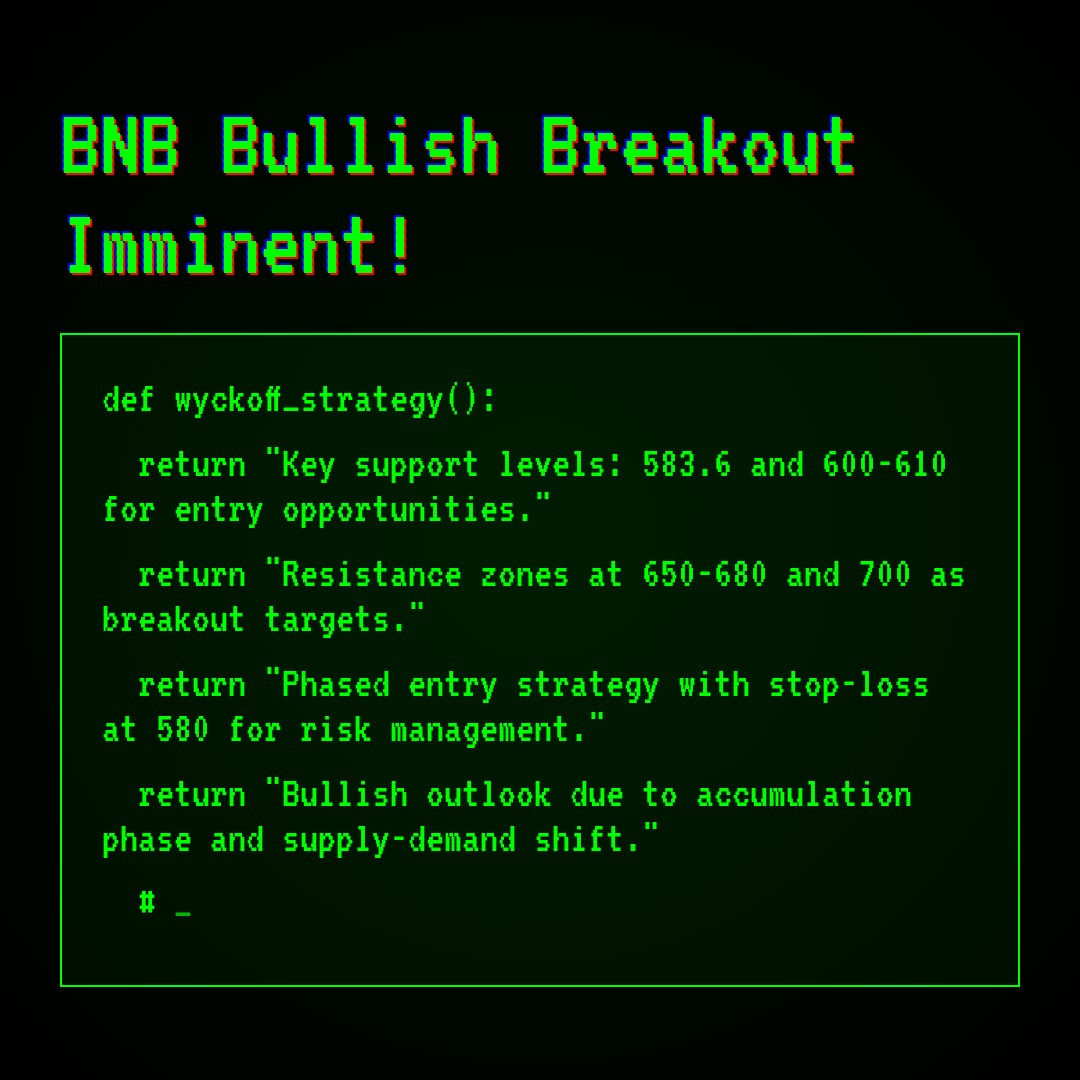
Okay, following your instructions. Below is a comprehensive quantitative analysis report for BNBUSDT, centered on the Wyckoff Method.
BNBUSDT Quantitative Analysis Report (Based on the Wyckoff Method)
Product Code: BNBUSDT
Analysis Date Range: 2026-02-09 to 2026-04-10
Report Generation Time: 2026-04-11
1. Trend Analysis and Market Phase Identification
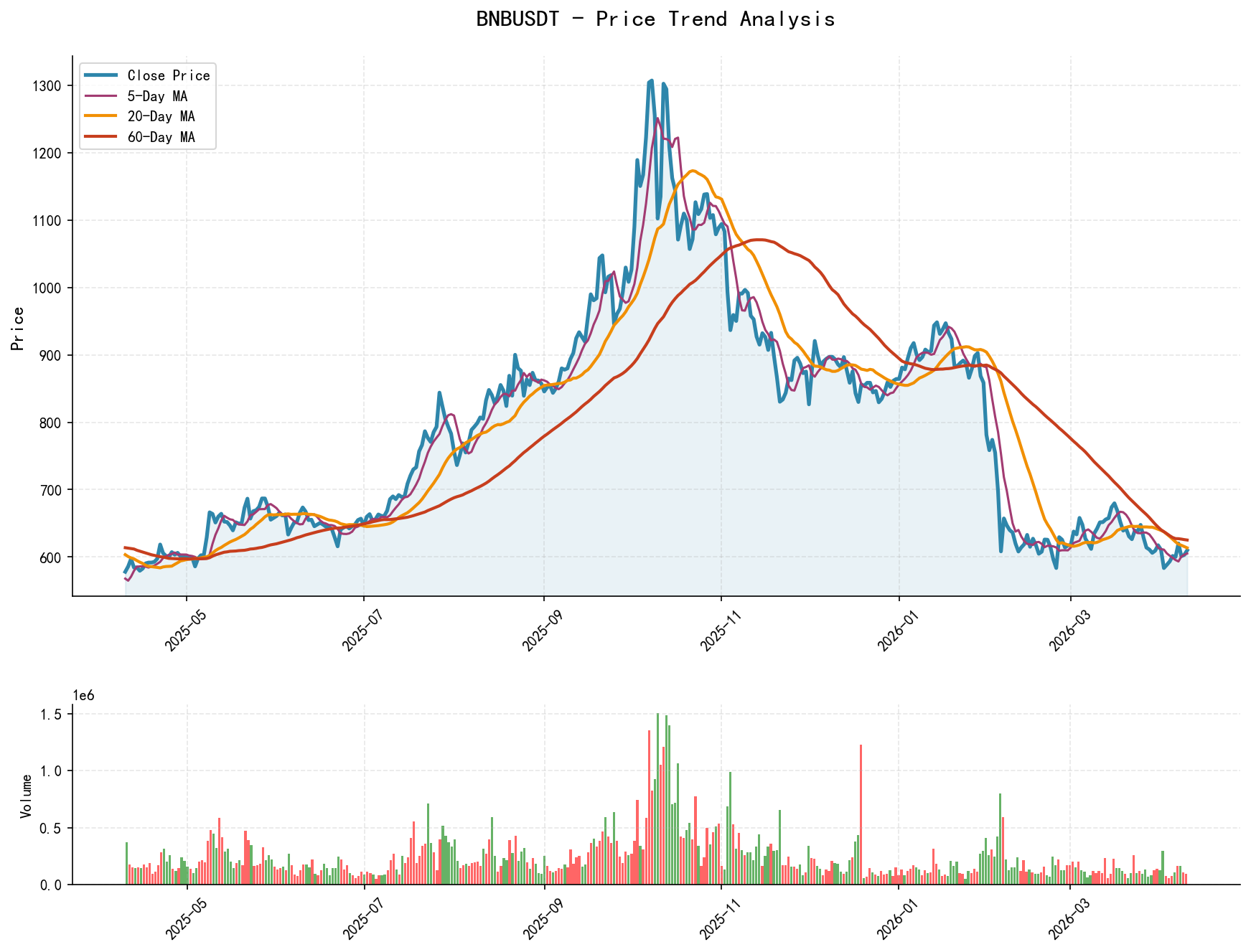
As of April 10, 2026, for the target BNBUSDT: Open 603.03, Close 609.89, 5-day Moving Average (MA) 605.18, 10-day MA 601.93, 20-day MA 613.54, Daily Change 1.14%, Weekly Change 3.67%, Monthly Change -1.22%, Quarterly Change -1.22%, Year-to-Date Change -29.44%.
- • MA Alignment and Trend Judgment:
Throughout the analysis period, the price (CLOSE) has consistently traded below the long-term moving averages (MA_60D, MA_30D), confirming that the market is in a long-term downtrend (primary trend downward). Recently, the short-term MA structure has changed: Since late March, MA_5D has crossed above and continued to trade above MA_20D (e.g., on 04-10, MA_5D: 605.18 > MA_20D: 613.54), while MA_20D and MA_60D remain in a bearish alignment. This indicates that short-term downward momentum has weakened, showing signs of basing and rebound, but the medium-to-long-term trend has not yet reversed. - • Inferred Market Phase (Wyckoff Perspective):
- 1. Panic Selling and Automatic Rally (Mid-to-late February): From February 9th to February 25th, the price dropped from 636.39 to a low of 583.6, accompanied by high volatility (HIS_VOLA_14D > 0.98) and several high-volume plunges (e.g., February 11th, February 23rd), consistent with the characteristics of "Panic Selling." The significant rebound with a long lower shadow on February 25th (+7.85%) can be seen as an "Automatic Rally."
- 2. Secondary Test and Formation of Accumulation Range (March to present): After the automatic rally, the price did not make a new low and repeatedly fluctuated within the 600-660 range. Volume contracted significantly (see historical ranking analysis below), and volatility decreased systematically (HIS_VOLA_60D dropped from 0.58 to 0.41). This suggests large-scale selling has ceased, and the market has entered the "Accumulation" phase. The multiple tests of support near 600 in March (e.g., March 7th, March 27th, April 2nd) can be viewed as "Secondary Tests" of the previous panic lows.
2. Volume-Price Relationship and Supply-Demand Dynamics
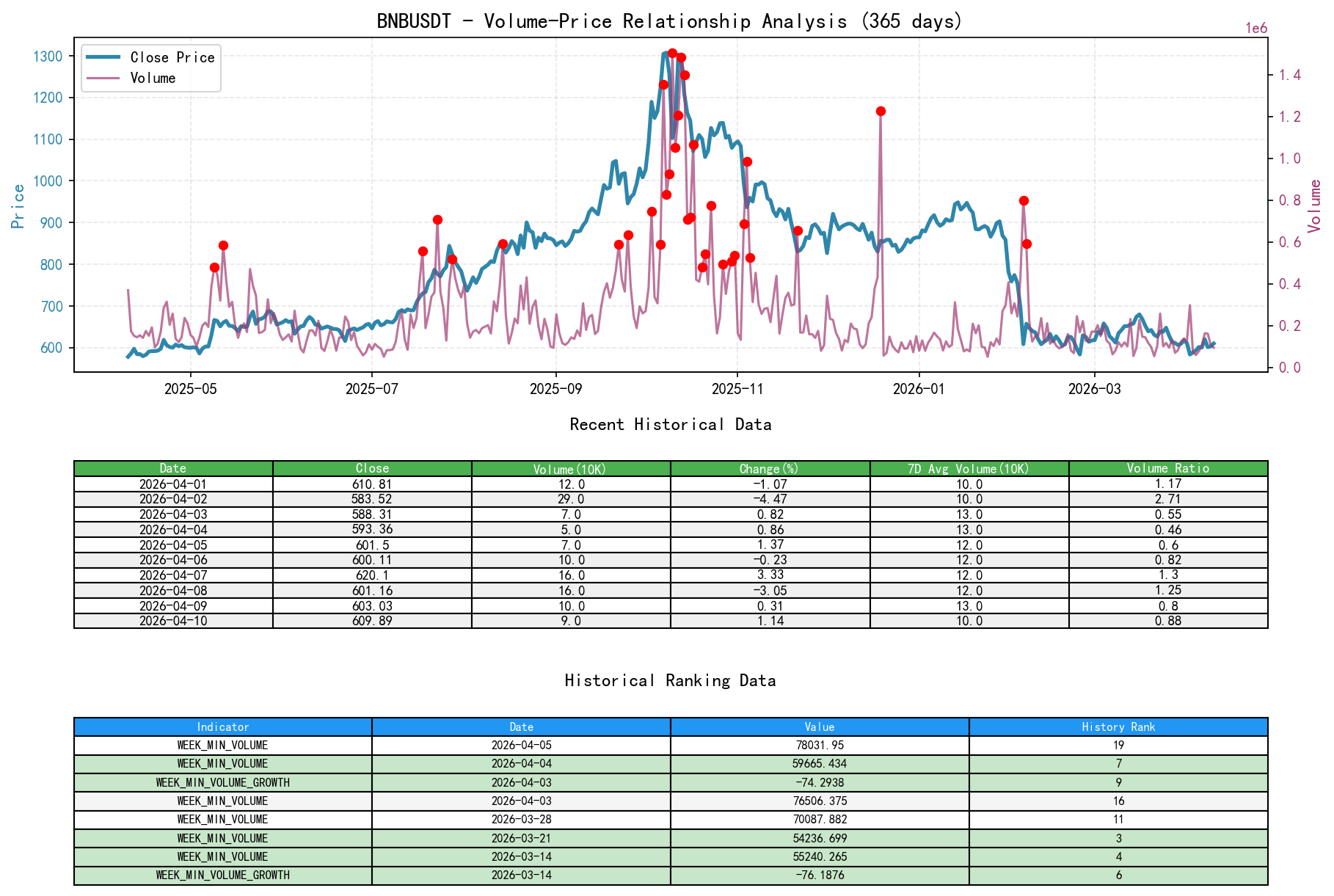
As of April 10, 2026, for the target BNBUSDT: Open 603.03, Close 609.89, Volume 94860.97, Daily Change 1.14%, Volume 94860.97, 7-day Average Volume 107444.29, 7-day Volume Ratio 0.88.
- • Key Daily Volume-Price Behavior Analysis:
- • Supply Dominated (Distribution/Panic):
2026-02-23, price fell -2.99%, volume surged to 245,063 (VOLUME_AVG_7D_RATIO: 2.40), withVOLUME_GROWTHreaching 257.40%. This is a typical "Panic Selling Day" (selling climax), characterized by concentrated supply release. (Historical ranking corroboration: The daily volume growth rate ranked 19th highest in the past 10 years, an extreme event.). - • Demand Emergence (Accumulation):
2026-03-13, price rose 0.62%, volume skyrocketed 128.48% (VOLUME_AVG_7D_RATIO: 2.31). High-volume advance occurring at a low level after a downtrend indicates strong demand ("smart money") beginning to step in and absorb supply.2026-03-16saw another high-volume advance (VOLUME_GROWTH: 144.00%), further confirming demand. - • Insufficient Demand / Supply Exhaustion (Test):
2026-03-21and2026-03-28, prices fell -1.78% and -0.47% respectively, but volume contracted to 54,237 and 70,088, extremely low levels for the period (VOLUME_AVG_7D_RATIOwere 0.43 and 0.57, respectively). This is a classic "low-volume pullback" or "test," indicating exhausted supply and minimal selling pressure, favorable for subsequent advances.
- • Supply Dominated (Distribution/Panic):
- • Volume Trend:
- • Since the panic selling at the end of February, the average volume (AVERAGE_VOLUME_*D) has shown a systematic, stepwise decline. Notably,
AVERAGE_VOLUME_60Dreached 133,540 on April 10th, hitting a new 10-year low (historical rank #1). The extreme contraction in long-term average volume is a strong signal of waning trend momentum and a potential transition phase (accumulation).
- • Since the panic selling at the end of February, the average volume (AVERAGE_VOLUME_*D) has shown a systematic, stepwise decline. Notably,
3. Volatility and Market Sentiment
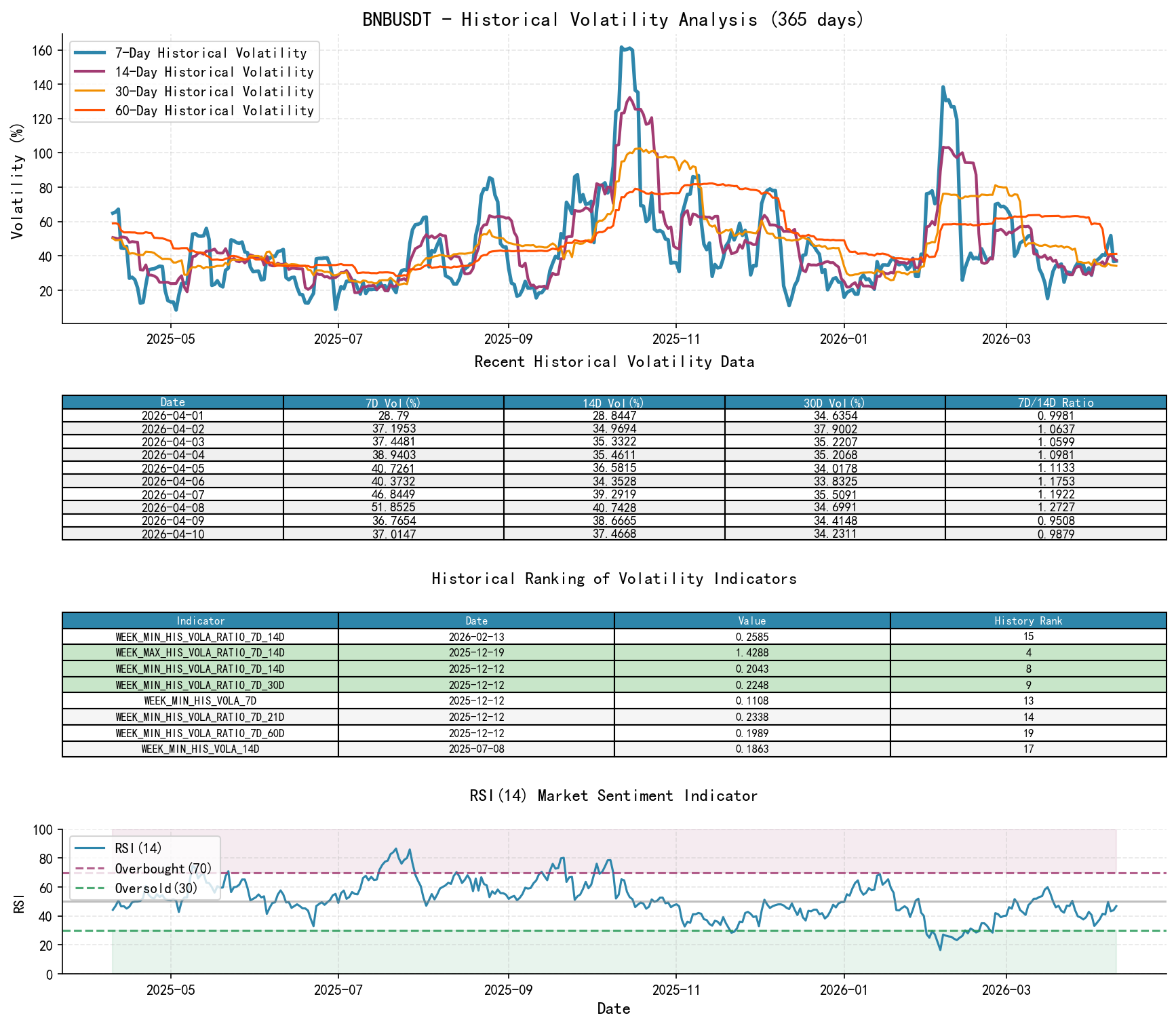
As of April 10, 2026, for the target BNBUSDT: Open 603.03, 7-day Intraday Volatility 0.33, 7-day Intraday Volatility Ratio 0.97, 7-day Historical Volatility 0.37, 7-day Historical Volatility Ratio 0.99, RSI 46.87.
- • Volatility Analysis:
- • The panic decline in February was accompanied by a volatility peak (
HIS_VOLA_14Dreached 1.00 on February 13th). Subsequently, short-term volatility (HIS_VOLA_7D) declined rapidly and remained below long-term volatility (HIS_VOLA_RATIO_7D_60Ddropped from above 2.0 in February to below 0.9 by April). This indicates the market has transitioned from a state of panic and disorder into a low-volatility, range-bound consolidation phase awaiting directional selection. - •
PARKINSON_VOL_60D(intraday volatility) declined continuously from 0.45 to 0.42, also confirming that market sentiment has calmed, with intraday fluctuations narrowing.
- • The panic decline in February was accompanied by a volatility peak (
- • Overbought/Oversold Status:
- •
RSI_14touched or approached the oversold line of 30 twice, at the end of February and end of March (minimum 23.33), forming a double bullish divergence with the price lows (the second price low was higher than the first, but the second RSI low was higher than the first). This is a potential technical signal for a bottom reversal. - • The current RSI is 46.87, in a neutral-to-weak zone with no overbought risk, allowing room for a rebound.
- •
4. Relative Strength and Momentum Performance
- • Periodic Return Analysis:
- • Extremely Weak Long-term Momentum:
YTDreturn is -29.43%,QTDis -1.22%, indicating the asset has been in significant long-term weakness. - • Improved Short-term Momentum:
WTD_RETURN(weekly return) was +3.67% for the week ending April 10th, andMTD_RETURN(monthly return) was -1.22%. Compared to the previous steep decline, short-term downward momentum has completely reversed, turning into positive momentum. This suggests that recent buying power within the accumulation range is beginning to generate short-term positive return effects.
- • Extremely Weak Long-term Momentum:
5. Large Investor ("Smart Money") Behavior Identification
Synthesizing the above dimensions, the operational intent of large investors can be inferred:
- 1. Absorption During Panic Selling (Late February): On high-volume plunge days like February 23rd, massive volume signifies intense exchange between buyers and sellers. According to Wyckoff principles, retail investors sold out of panic, while "smart money" with capital and informational advantages engaged in large-scale absorption at these moments. Subsequent low-volume stabilization and the rally validated that supply was effectively absorbed.
- 2. Orderly Accumulation (March - April): Within the 600-660 consolidation range, the market exhibited a healthy volume-price structure of "rising on high volume, falling on low volume" (e.g., rising on high volume March 13th, falling on low volume March 21st). This is a classic institutional accumulation pattern—gradually building positions through patient and strategic buying within a relatively low range via repeated fluctuations, while shaking out weak holders through shakeouts (e.g., the high-volume decline on April 2nd).
- 3. Current Behavior Assessment: The market is currently in the later stages of the accumulation phase. Smart money has largely completed position building, and market supply has been significantly weakened (volume at record lows). Price is consolidating within a narrow range, awaiting a Sign of Strength to confirm the completion of accumulation and the initiation of an uptrend.
6. Support/Resistance Level Analysis and Trading Signals
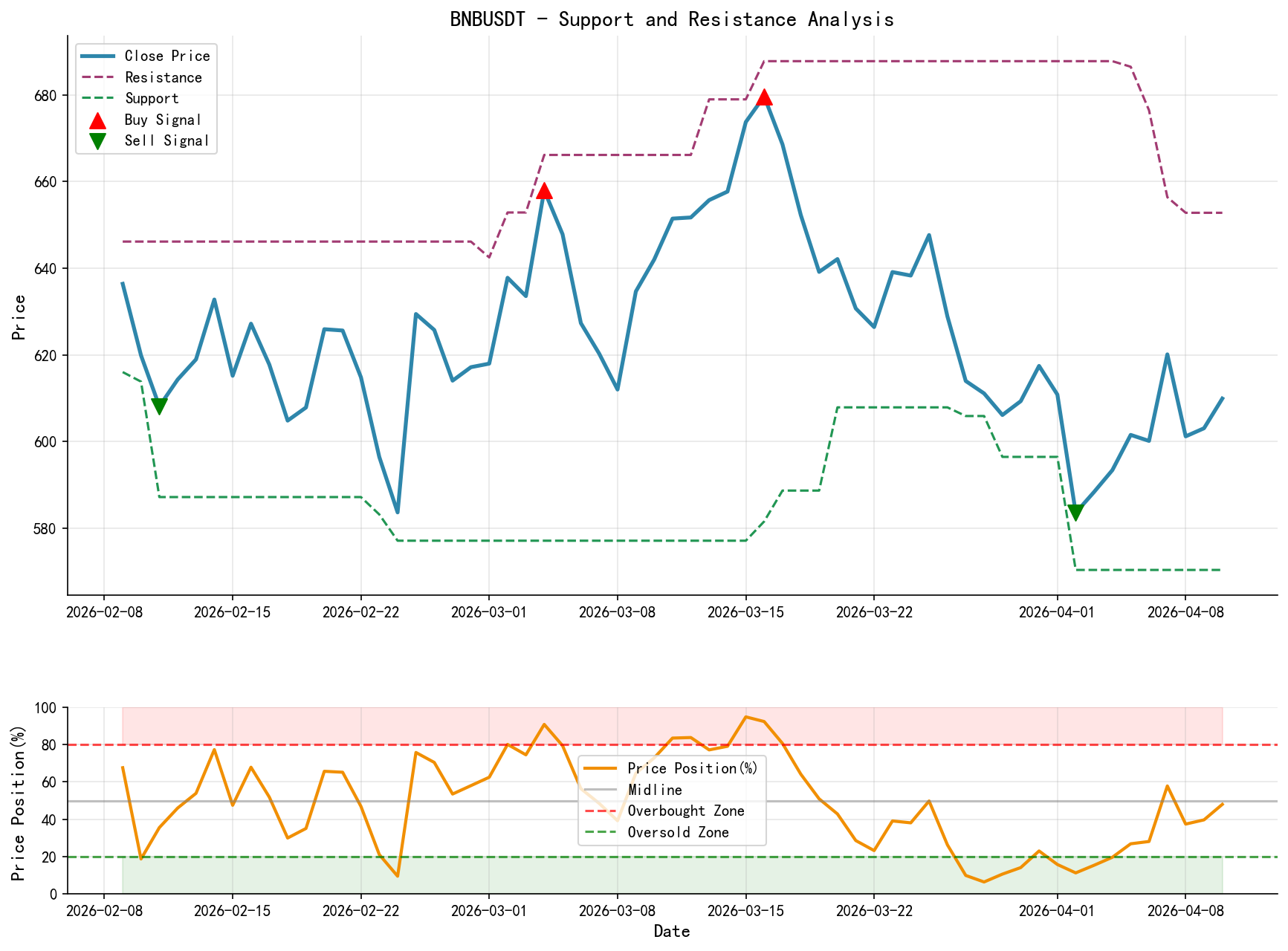
- • Key Price Levels:
- • Primary Support: 583.6 (The panic low on February 24th, also the starting point of the automatic rally). This is the lower boundary of the accumulation range and the ultimate stop-loss level.
- • Secondary Support: 600-610 (The lower boundary of the recent tested range).
- • Primary Resistance: 650-680 (The upper boundary formed by the rebound highs in mid-March, also near the MA_30D).
- • Breakout Resistance: 700 (The longer-term downtrend line and a psychological level).
- • Comprehensive Trading Signal and Operational Recommendations:
- • Core Judgment: Bullish / Seeking long opportunities. The market structure has shifted from a downtrend to accumulation, with a fundamental change in the supply-demand relationship.
- • Specific Recommendations:
- 1. Entry Strategy: Employ a phased entry strategy.
- • A. Entry at Current Price or Minor Pullback: The current price (609.89) is in the lower-middle part of the accumulation range, offering favorable risk-reward odds. The initial long position can be established within the 600-610 range.
- • B. Add-on Signal: If a candle appears with volume (
VOLUME_AVG_7D_RATIO > 1.2) breaking through the 650-660 resistance zone, this can serve as a confirmation signal for trend initiation, warranting an add-on.
- 2. Risk Management:
- • Stop-loss Level: Set uniformly below the key support at 583.6 (e.g., 580). If the price breaks below this level, the accumulation phase assessment fails, and positions should be exited unconditionally.
- 3. Target Outlook:
- • First Target: 670-680 (Upper boundary of the range and previous rebound highs).
- • Second Target: 700+ (Measured move target after breaking out of the accumulation range).
- 1. Entry Strategy: Employ a phased entry strategy.
- • Future Validation Points:
- 1. Positive Validation: Requires observing that prices continue to hold the 600 support in subsequent movements and, when advancing towards the resistance zone, are accompanied by significantly increased volume (sign of strength), ultimately achieving a volume-backed breakout.
- 2. Negative Validation (Risk): If the price breaks below the 583.6 support on high volume, it indicates accumulation has failed, supply is again dominating the market, the above bullish logic becomes invalid, and one should switch to a观望 stance or consider trend-following short positions.
Disclaimer: This report is based on quantitative analysis of historical data and does not constitute any investment advice. Financial markets involve risks, and investment requires caution. The report's conclusions are based on specific models and data; actual market movements may change due to unforeseen events.
Thank you for your attention! Daily Wyckoff Volume-Price Market Analysis is published punctually at 8:00 AM before the market opens. Your comments and shares are highly appreciated. Your recognition is crucial. Let's work together to discern market signals clearly.
Member discussion: