Quantitative Analysis Report: 513980
Report Date: 2026-04-10
Analysis Period: 2026-02-09 to 2026-04-10
Report Objective: Analyze the current market structure, supply-demand dynamics, and the intentions of large investors based on the Wyckoff price-volume principles, providing actionable comprehensive judgments.
1. Trend Analysis and Market Phase Identification
As of 2026-04-10, the security 513980 opened at 0.65, closed at 0.65. The 5-day MA is 0.64, 10-day MA is 0.63, 20-day MA is 0.64, with a daily change of +0.15%. Weekly return is +4.00%, monthly return is +4.67%, quarterly return is +4.67%, and year-to-date return is -8.45%.
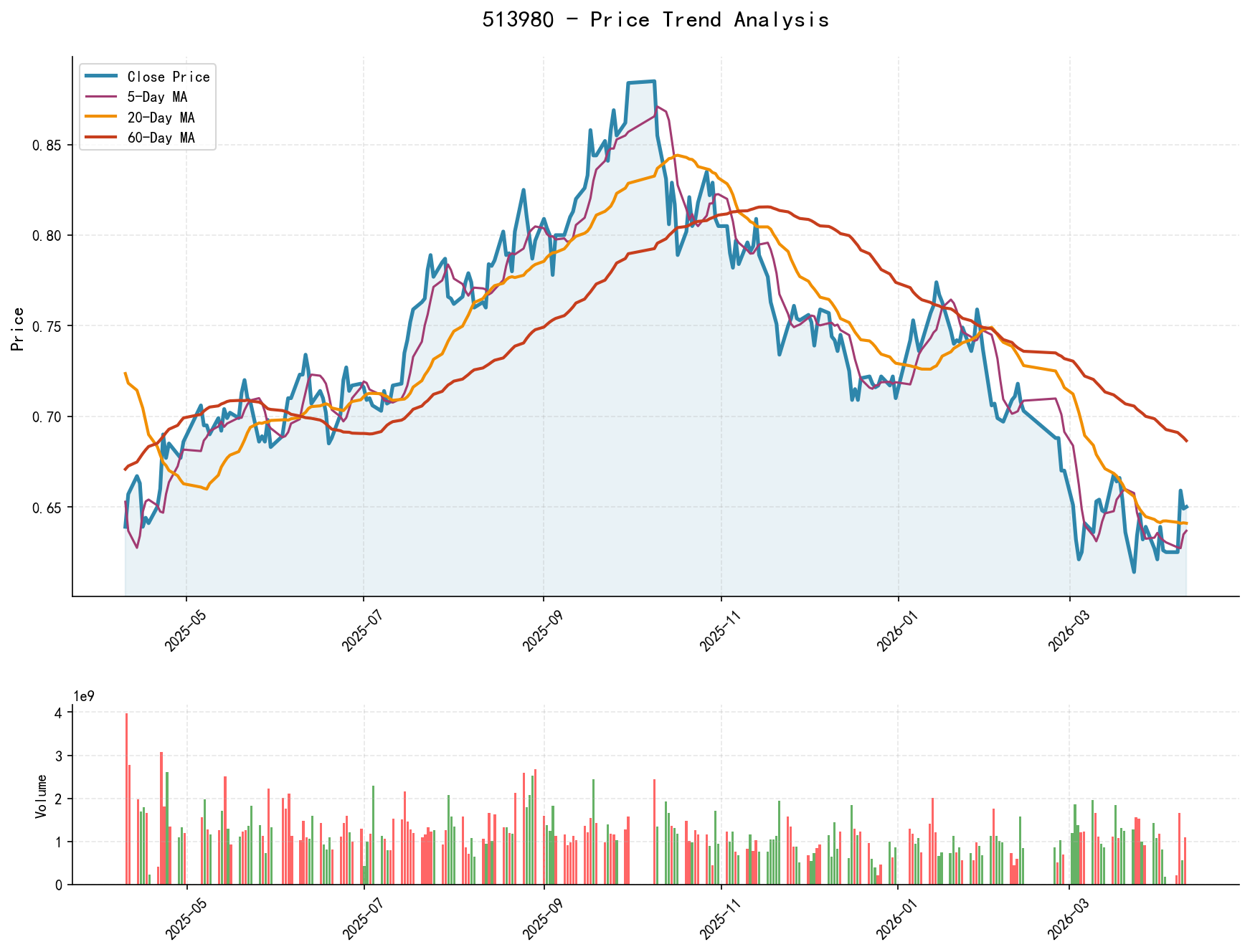
- • Moving Average Alignment and Trend Status: As of 2026-04-10, the closing price of 0.650 is above the 5-day MA (0.637) and 10-day MA (0.634), but remains suppressed by the 20-day MA (0.641), 30-day MA (0.642), and 60-day MA (0.687). Since hitting a low of 0.614 in mid-March, the short-term MAs (5-day, 10-day) have turned upward and formed a golden cross (e.g., MA_5D crossed above MA_10D on 04-01). However, the medium- and long-term MAs (20-day, 30-day, 60-day) still exhibit a bearish alignment and are declining slowly. This suggests the long-term downtrend may be transitioning into a "decelerating decline or attempted basing" phase, but a clear bullish trend has not yet been established.
- • Price Action and Inferred Market Phase (Wyckoff Perspective):
- • Panic/Decline Phase (Mid-Feb to Early March): Price fell consecutively from 0.709 to 0.614 (2026-03-30), with several high-volume down days (e.g., 02-26, -2.62%, VOLUME_AVG_7D_RATIO=1.30), characteristic of panic selling.
- • Possible Accumulation/Basing Phase (Late March to Early April): Price oscillated repeatedly within the 0.614-0.636 range, accompanied by two key candlesticks:
- 1. 2026-03-30: Price declined (-1.88%) on significantly higher volume (+55.06%). This constitutes a "Test" of the previous low, but the close did not set a new low, indicating weakening supply.
- 2. 2026-04-08: Price surged +5.44% on extremely high volume (+641% VOLUME_GROWTH), breaking above the recent consolidation range's upper bound. This ranks as the 3rd highest single-day volume growth event in nearly 10 years. Combined with the price action, this is likely a signal of "significant demand entering after panic selling" or a "breakout in the late stages of accumulation."
- • Current Phase Assessment: The market is transitioning from an "oversold rebound" towards "potential confirmation of an accumulation phase." The massive bullish candlestick on 04-08 is a strong demand signal. However, the subsequent sessions (04-09, 04-10) showed low-volume, minor pullbacks, representing a "backtest of the breakout." The key is observing whether demand re-emerges during this test.
2. Price-Volume Relationship and Supply-Demand Dynamics
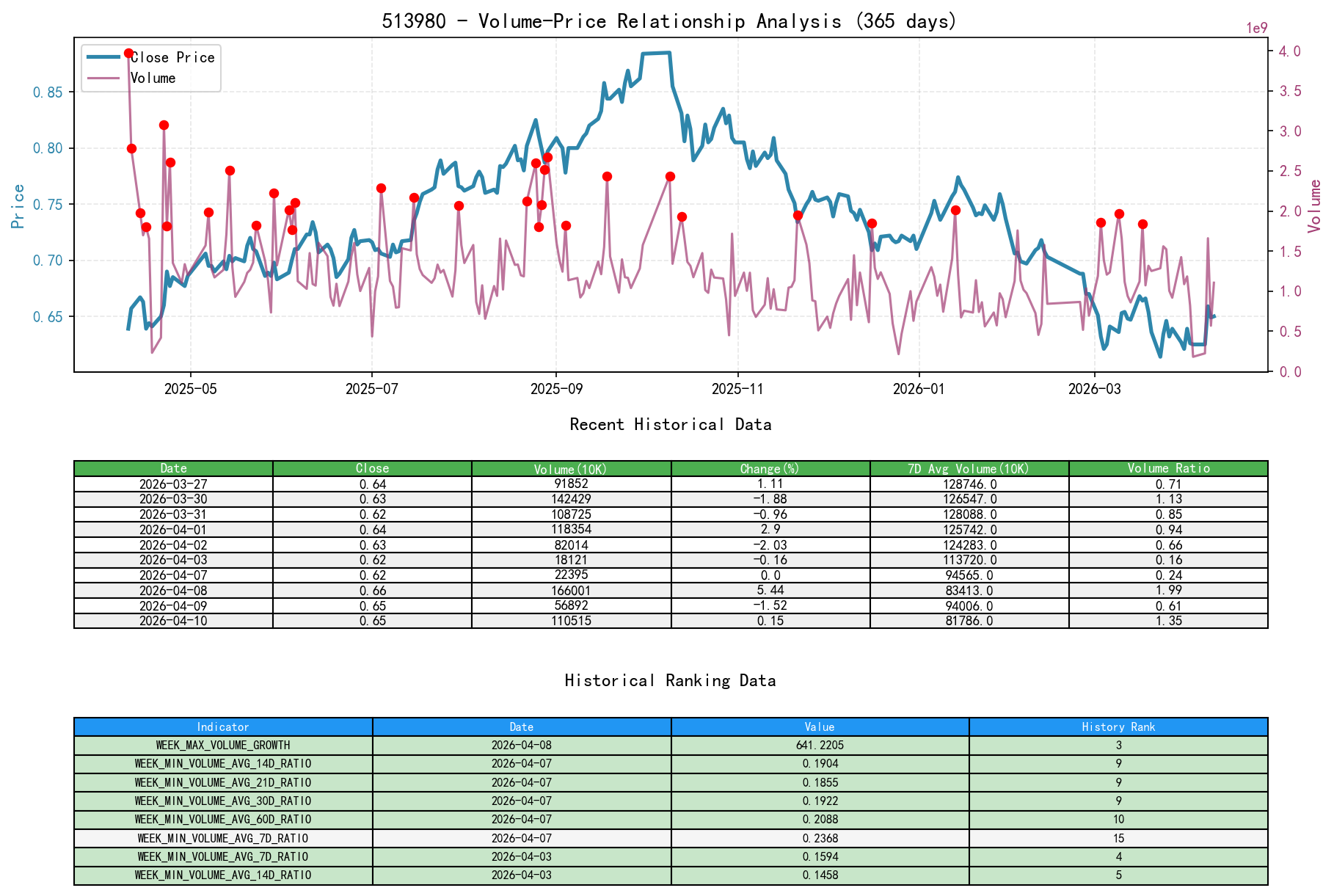
As of 2026-04-10, the security 513980 opened at 0.65, closed at 0.65, with a volume of 1,105,153,000. Daily change was +0.15%. The 7-day average volume is 817,865,992.86, and the 7-day volume ratio is 1.35.
- • Key Demand Days (Demand Dominant):
- • 2026-04-08 (PCT_CHANGE: +5.44%, VOLUME_GROWTH: +641.22%): A textbook example of a high-volume advance. The volume growth rate is the 3rd highest in nearly a decade, indicating aggressive entry by large capital and demand overwhelming supply. This is the strongest Alpha signal in the period.
- • 2026-03-10 (PCT_CHANGE: +2.67%, VOLUME_GROWTH: -15.77%): An advance on low volume, suggesting insufficient demand during the initial rebound and strong market caution.
- • Key Supply Days (Supply Dominant):
- • 2026-02-12 (PCT_CHANGE: -1.39%, VOLUME_GROWTH: +167.04%): A decline on high volume, showing significant supply emerging during the downtrend.
- • 2026-03-23 (PCT_CHANGE: -3.46%, VOLUME_GROWTH: +2.74%): Price declined sharply with only a marginal increase in volume. This is "low-volume decline" (following a Selling Climax), hinting at diminished panic selling and exhaustion of supply, creating conditions for a subsequent rebound.
- • Abnormal Volume Analysis:
- • Extremely Light Volume Periods: On 04-03 and 04-07, volume ratios relative to various moving averages (VOLUME_AVG_*_RATIO) were at historically extreme lows (ranking within the top 10 lowest), indicating extremely thin trading and participant indecision. This often precedes a trend change.
- • Extremely Active Volume Period: On 04-08, all volume ratio metrics surged above 1.5, particularly the VOLUME_AVG_7D_RATIO reaching 1.99, confirming the validity of the breakout and the determination behind it.
3. Volatility and Market Sentiment
As of 2026-04-10, the security 513980 opened at 0.65. The 7-day Parkinson volatility is 0.20, 7-day Parkinson volatility ratio is 0.76. The 7-day historical volatility is 0.49, 7-day historical volatility ratio is 1.04. The RSI is 50.60.
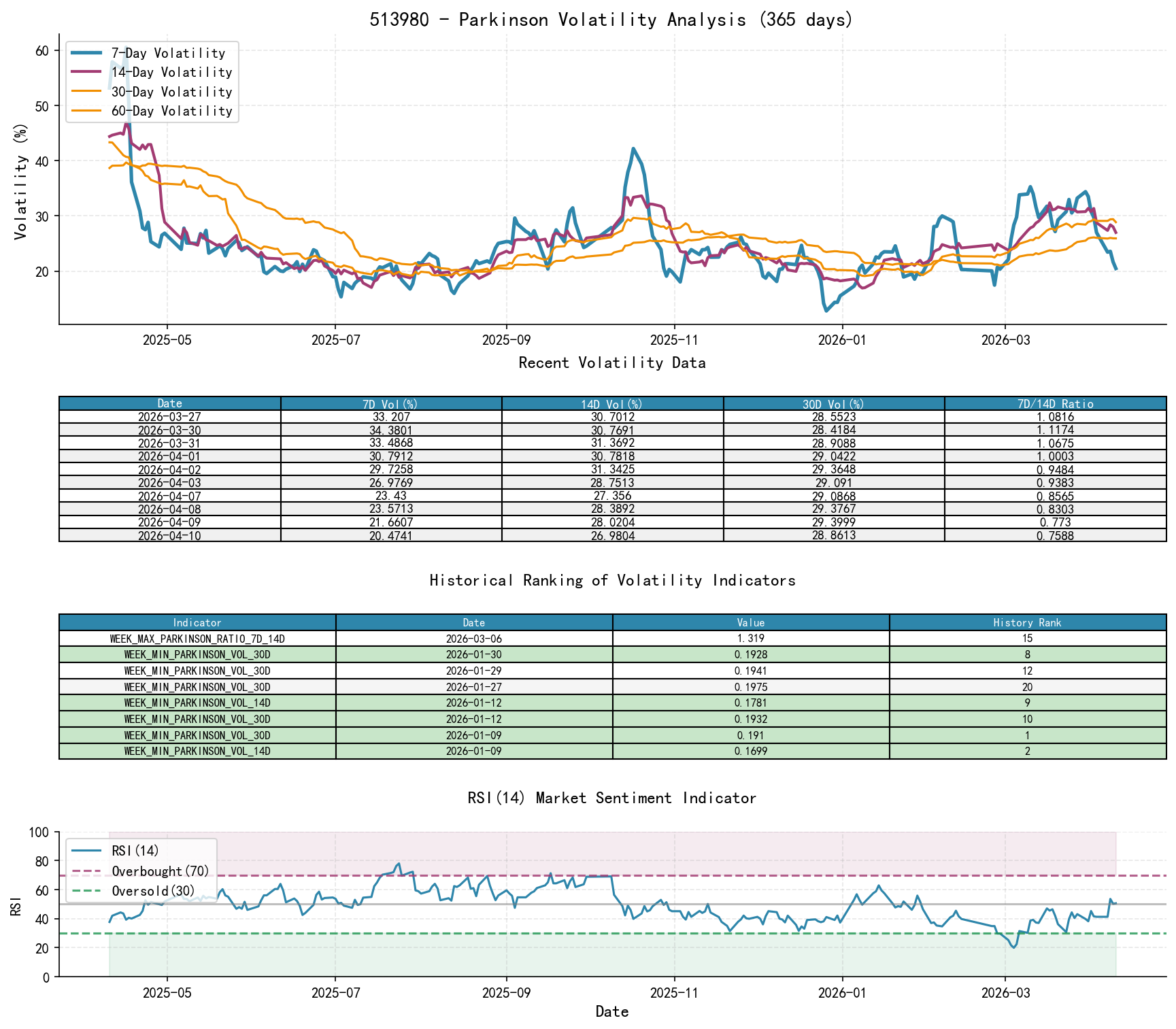
- • Volatility Level: Parkinson volatility and historical volatility peaked in the late March to early April period (e.g., 03-24, PARKINSON_VOL_7D=0.33, HIS_VOLA_7D=0.52), corresponding to the phase of intense price swings. Currently (04-10), short-term volatility (HIS_VOLA_7D=0.49) remains significantly higher than long-term volatility (HIS_VOLA_60D=0.35). The volatility ratio HIS_VOLA_RATIO_7D_60D is 1.39, indicating market sentiment has not fully stabilized but has recovered from panic.
- • Sentiment Extremes Validation: The RSI_14 dropped to 19.94 on 03-04, the 3rd lowest value in nearly 10 years, confirming the market entered an extreme oversold zone with highly pessimistic sentiment. This constitutes the left-side condition for a Wyckoff-based "oversold rebound" or "accumulation." The current RSI_14 has recovered to 50.60, exiting the oversold zone, reflecting sentiment repair.
4. Relative Strength and Momentum Performance
- • Return Analysis: The product's short-term momentum has strengthened notably. Weekly return (WTD_RETURN) is +4.00%, and monthly return (MTD_RETURN) is +4.67%, both turning positive. However, quarterly (QTD_RETURN: +4.67%) and year-to-date (YTD: -8.45%) returns remain negative, indicating that the medium-term trend repair has just begun, and the long-term trend remains weak. The strength in short-term momentum resonates with the massive bullish candlestick on 04-08, enhancing the reliability of the rebound.
5. Large Investor (Smart Money) Behavior Identification
- • Accumulation Behavior Inference: During mid-to-late March, price consolidated at low levels (0.614-0.636) on shrinking volume (e.g., 04-03, 04-07), with RSI extremely oversold. This aligns with the characteristics of a Wyckoff "accumulation range": smart money quietly absorbing supply from the public's panic selling at low prices. The massive bullish candlestick on 04-08 marks the transition of accumulation behavior from "covert" to "actively pushing prices higher," where smart money rapidly moves price away from its cost zone, preventing the loss of cheap shares.
- • Distribution Behavior Exclusion: Throughout the period, there were no typical distribution patterns of "high-volume stagnation or decline at highs." The main high-volume declines occurred during the downtrend (February), representing panic selling rather than distribution.
- • Current Intent: Having completed preliminary accumulation, large investors are attempting to guide prices into an uptrend. The low-volume pullback on 04-09 and 04-10 can be interpreted as smart money testing market selling pressure and potentially continuing to accumulate shares during this process. If volume remains low during the pullback (supply does not expand), it indicates good control.
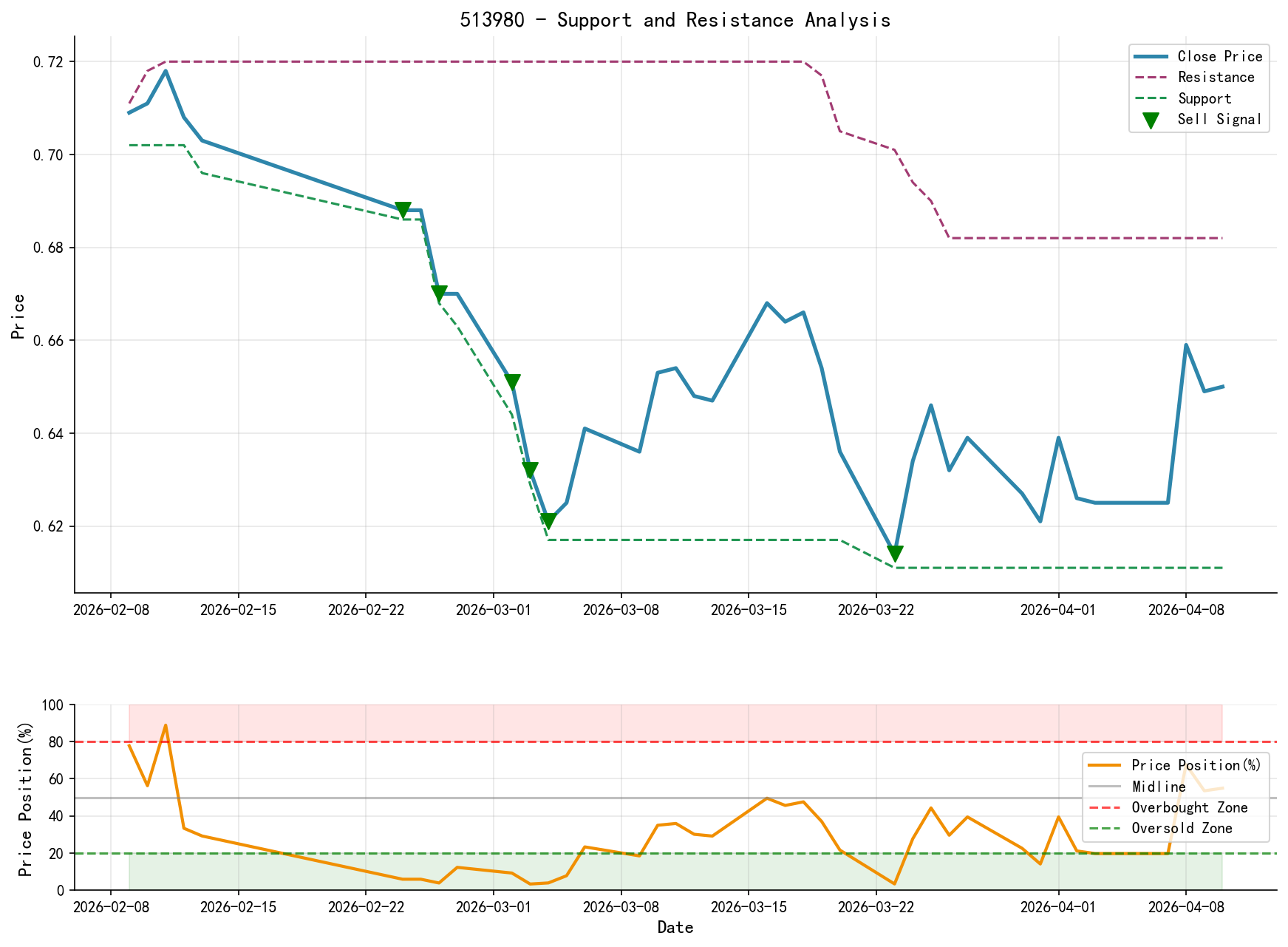
6. Support/Resistance Level Analysis and Trading Signals
- • Key Support Levels:
- • S1 (Primary Support): 0.640 - 0.645. Corresponds to the recently breached upper bound of the consolidation range, near the 10-day MA, and the midpoint of the 04-08 bullish candlestick. Demand should emerge in this zone.
- • S2 (Strong Support): 0.614 - 0.625. The lower bound of the late-March consolidation range and the cycle low, serving as a critical defensive line for bulls.
- • Key Resistance Levels:
- • R1 (Immediate Resistance): 0.660 - 0.665. The high of 04-09 and the upper shadow area of the 04-08 candlestick.
- • R2 (Medium-term Resistance): 0.686. The location of the 60-day MA, also the starting platform for the late-February decline, representing strong resistance.
- • Comprehensive Trading Signal and Operational Recommendations:
- • Primary View: Bullish (short-to-medium term). Market structure indicates large investors have completed preliminary accumulation and initiated a rebound. The market is currently in the pullback test phase following the breakout.
- • Operational Recommendations:
- 1. Aggressive Bullish Strategy: Consider establishing long positions when price pulls back to the S1 (0.640-0.645) zone and shows signs of low-volume stabilization or demand candlesticks (e.g., lower shadow, small bullish candlestick) on an intraday timeframe. Set initial stop-loss below S2 (e.g., 0.610).
- 2. Conservative Bullish Strategy: Wait for price to break above R1 (0.665) again on elevated volume (VOLUME_AVG_7D_RATIO > 1.2) before entering. Set stop-loss below the low of the entry candlestick.
- 3. Bearish Strategy: Avoid for now. Reconsider only if price breaks decisively below S2 (0.614) on high volume, which would indicate accumulation failure and a likely resumption of the downtrend.
- • Future Confirmation Points:
- 1. Bullish Confirmation: (1) Sustained low volume during the pullback to S1; (2) Subsequent ability to rise again on moderately increasing volume; (3) Price stabilizes above 0.660 within the next 1-2 weeks.
- 2. Bearish Confirmation (Risk Signal): (1) High-volume decline during the pullback, breaking below S1; (2) Price fails to reach R1 before turning down, forming a lower high.
Conclusion Restated:
Based on Wyckoff-based price-volume data analysis, after experiencing panic selling and extreme oversold conditions in March, 513980 exhibited a rare, decade-high-volume demand entry signal on April 8th. Integrating this with extremely low volume at the lows, explosive volume at key levels, and extreme RSI readings, we have high confidence in judging that large investors have completed accumulation at low levels and are beginning to drive prices into a rebound/reversal cycle. The current strategy should focus on seeking opportunities to buy on dips, closely observing the test of support levels to confirm the sustainability of demand.
Disclaimer: This report is based on historical data and quantitative model analysis and does not constitute direct investment advice. Markets carry risks, invest with caution.
Thank you for your attention! Wyckoff price-volume market insights are published daily by 8:00 AM before market open. Your comments and shares are greatly appreciated. Your recognition is vital. Let's work together to see the market signals clearly.
Member discussion: