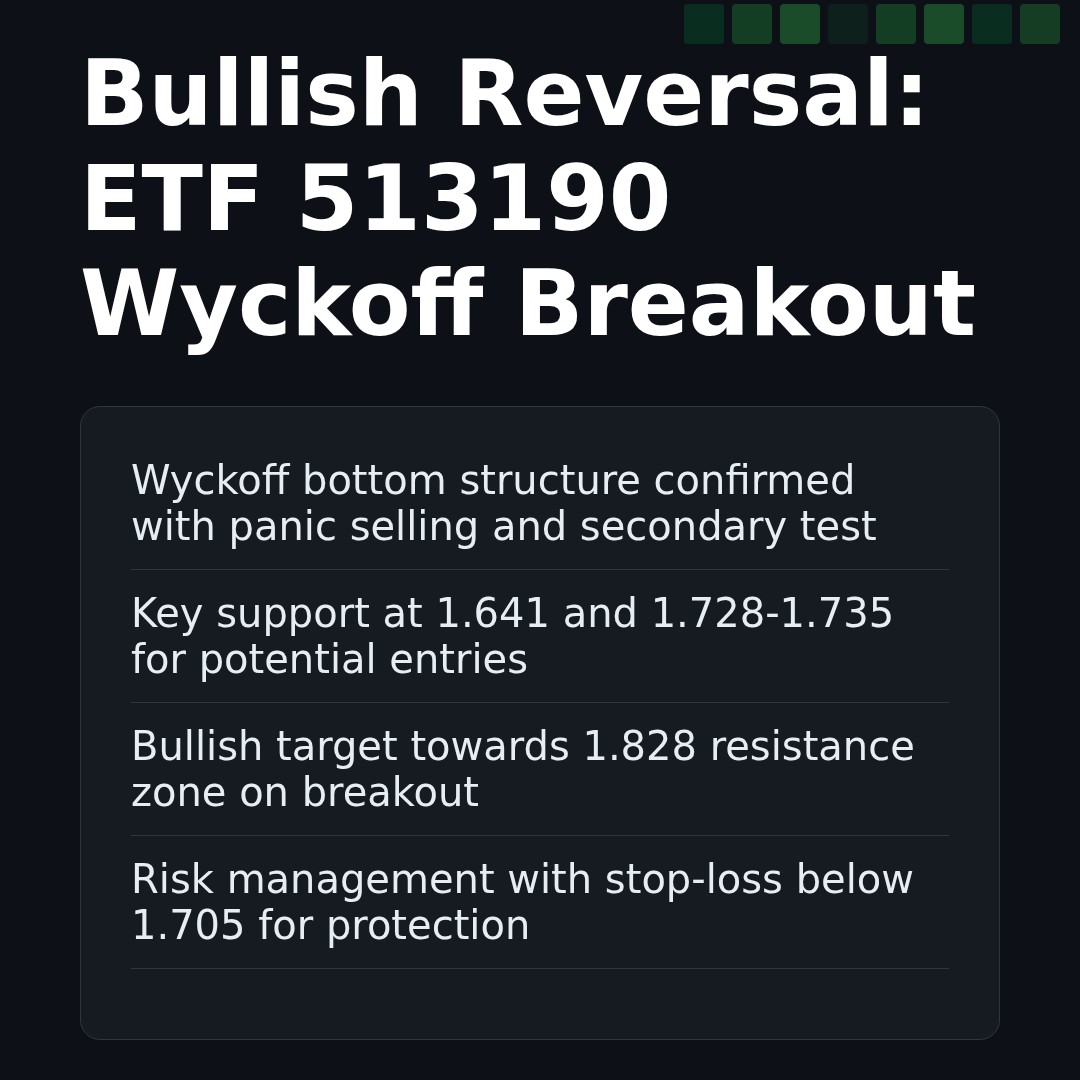
As a quantitative trading researcher proficient in the Wyckoff Method, I will compile a comprehensive and in-depth quantitative analysis report for you based on the complete dataset provided.
ETF 513190 Wyckoff Price-Volume Analysis Report
Product Code: 513190
Analysis Date Range: 2026-02-09 to 2026-04-10
Report Generation Date: 2026-04-10
1. Trend Analysis and Market Phase Identification
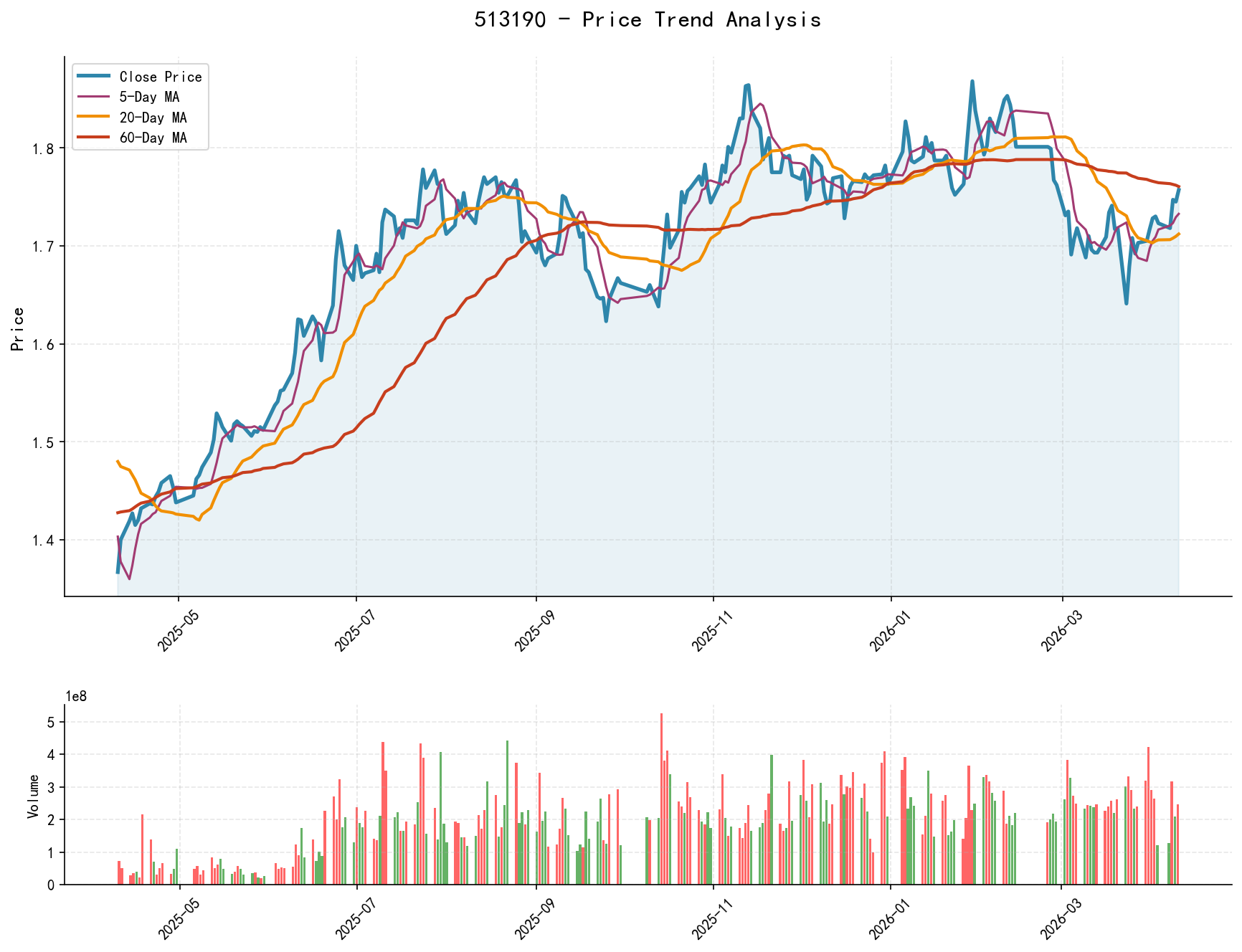
As of April 10, 2026, the underlying asset 513190 has an opening price of 1.75, a closing price of 1.76, a 5-day moving average of 1.73, a 10-day moving average of 1.72, a 20-day moving average of 1.71, a daily change of +0.69%, a weekly change of +1.97%, a monthly change of +2.33%, a quarterly change of +2.33%, and an annual change of -0.34%.
- • Moving Average Alignment and Trend Status:
- • At the beginning of the analysis period (Feb 9-13), the price (closing price 1.849-1.801) traded above all short-term moving averages (MA_5D, MA_10D, MA_20D), showing a short-term bullish alignment, but had already started to cross below the MA_5D, indicating waning upward momentum.
- • Starting from February 24th, the price (closing price 1.801) decisively broke below all short-term moving averages, leading the MA_5D to form death crosses with the MA_10D and MA_20D. By late March, the fully established bearish alignment of MA_5D < MA_10D < MA_20D < MA_30D < MA_60D confirmed the market's entry into a downtrend.
- • Current Status (April 10th): The price (1.757) has successfully moved above the MA_5D (1.733) and MA_10D (1.721), but remains below the MA_20D (1.712), MA_30D (1.715), and MA_60D (1.760). This signifies that the market has exited the unilateral downtrend and entered a phase of bottom consolidation and rally testing. The MA_5D is about to cross above the MA_10D, forming the initial shape of a "golden cross," which is a positive signal of strengthening short-term momentum.
- • Price Action and Inferred Market Phase (Wyckoff Perspective):
- • Mid-to-Late February (1.849-1.801): Prices showed increasing volume without significant price advance near the previous high zone (1.85-1.86) (e.g., rising on high volume on Feb 9th, followed by a small gain on low volume on Feb 10th). This aligns with the initial characteristics of "Distribution" in Wyckoff theory, where smart money distributes holdings to the public at high prices.
- • Late February to Late March (1.801-1.641): Prices declined continuously. Although there were rebounds (e.g., Mar 3rd, Mar 17th), successive highs were lower (1.844 -> 1.801 -> 1.735 -> 1.718 -> 1.641), forming a downtrend. The heavy-volume sharp decline on March 23rd (-4.48%, volume 300M) is a typical "Panic Selling" or the "automatic reaction" phase in the Wyckoff downtrend, marking the climax of selling sentiment.
- • Late March to Early April (1.641-1.757): Following the panic selling, prices did not make new lows. Instead, consecutive high-volume rebounds occurred on March 24th-25th and March 30th-31st. The rise in early April was accompanied by steadily increasing volume and a steady price climb. This suggests the market may be entering a phase of "Re-accumulation" or the initial "markup" phase. After absorbing supply at panic lows, smart money begins to test supply at higher levels.
2. Price-Volume Relationship and Supply-Demand Dynamics
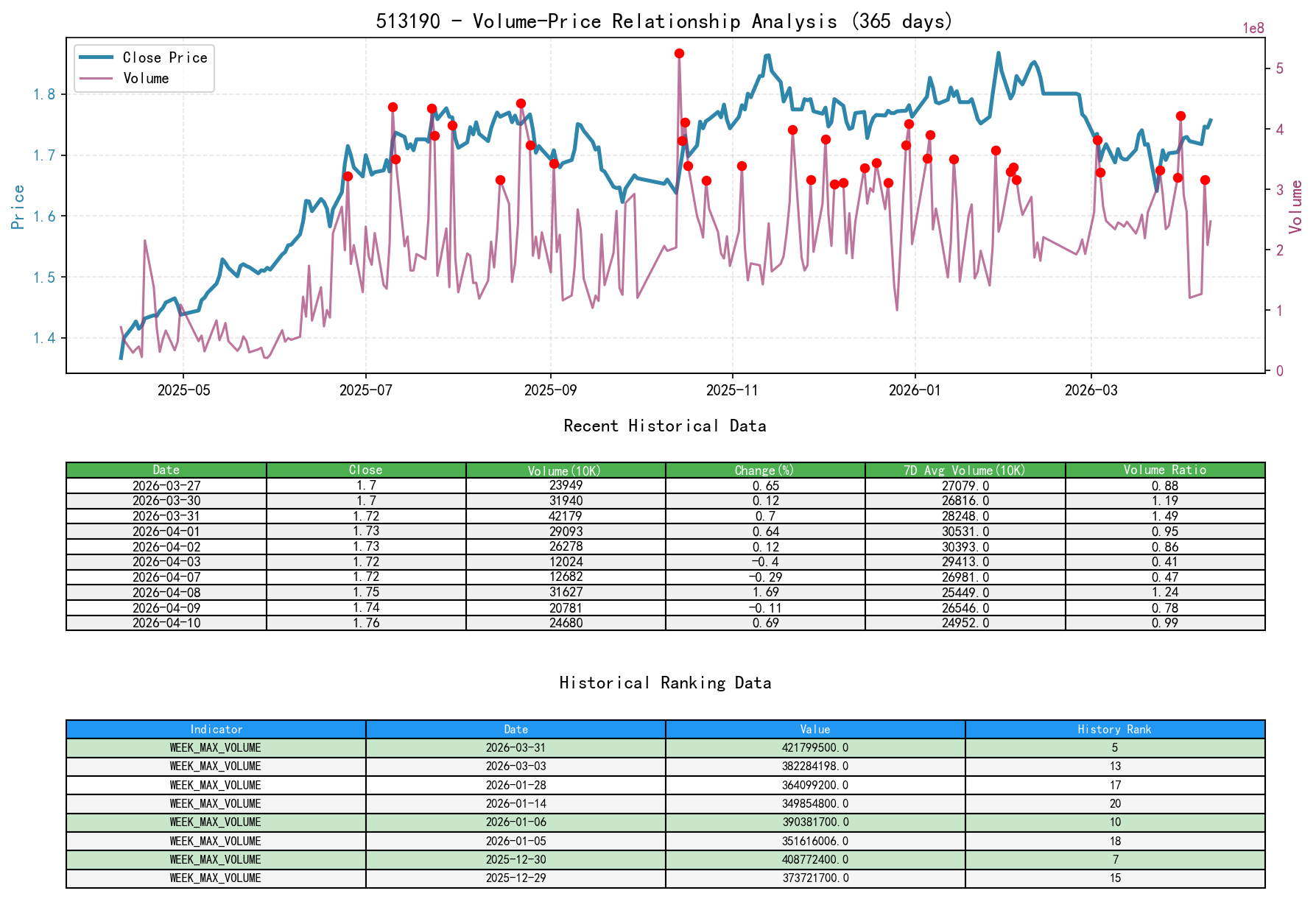
As of April 10, 2026, the underlying asset 513190 has an opening price of 1.75, a closing price of 1.76, a daily volume of 246,804,300, a daily change of +0.69%, a daily volume of 246,804,300, a 7-day average volume of 249,524,242.86, and a 7-day volume ratio of 0.99.
- • Key Day Analysis:
- • Supply-Dominated Days (High-volume decline/stagnation):
- • 2026-02-13: Price fell -1.48%, volume 221M shares, significantly higher than the previous day (182M shares). High-volume decline, clearly indicating supply emergence.
- • 2026-02-26: Price fell sharply -1.78%, volume 217M shares, higher than the 7-day and 14-day average volume. High-volume breakdown decline, indicating strong supply.
- • 2026-03-04: Price fell sharply -2.54%, volume 328M shares, a recent record high volume. Extremely heavy-volume暴跌, indicating panic supply gushing out.
- • 2026-03-23: Price plummeted -4.48%, volume 301M shares,
VOLUME_AVG_14D_RATIO=1.156,VOLUME_AVG_60D_RATIO=1.190. Extreme high-volume暴跌, marking the final panic before supply exhaustion (ultimate shakeout).
- • Demand-Dominated Days (High-volume advance):
- • 2026-03-24: The day after the panic, price rebounded +2.32%, volume 331M shares (
VOLUME_GROWTH=10.25%). High-volume rebound halting the decline, indicating strong demand actively absorbing shares at the panic low, preliminarily confirming the validity of the March 23rd low. - • 2026-03-31: Price increased +0.70%, volume 422M shares, setting an extreme value of ranked 5th for single-day volume in nearly 10 years (
HISTORY_RANK=5). This is a highly convincing demand signal, indicating smart money conducted large-scale active buying at relatively low levels. - • 2026-04-08: Price increased +1.69%, volume 316M shares (
VOLUME_GROWTH=149.38%),VOLUME_AVG_7D_RATIO=1.243. Significantly high-volume breakout rally, demand fully controlling the market, pushing prices out of the bottom consolidation range.
- • 2026-03-24: The day after the panic, price rebounded +2.32%, volume 331M shares (
- • Insufficient Demand Days (Low-volume rebound):
- • 2026-03-05/06/10: The rebounds on these days were generally accompanied by relatively low volume ratios compared to their 7-day and 14-day averages (
VOLUME_AVG_7D_RATIObetween 0.78-0.96), constituting low-volume rebounds with insufficient demand follow-through. Consequently, the rebounds quickly failed, and prices revisited lows.
- • 2026-03-05/06/10: The rebounds on these days were generally accompanied by relatively low volume ratios compared to their 7-day and 14-day averages (
- • Supply-Dominated Days (High-volume decline/stagnation):
- • Supply-Demand Dynamics Summary: A fundamental shift in market supply-demand forces occurred around March 23rd. Prior to that, it was a declining market with supply persistently overwhelming demand. After the "ultimate shakeout" on March 23rd released the final batch of panic selling, demand began to intervene strongly (March 24th, 31st) and ultimately gained dominance in the form of a high-volume rally on April 8th. The current (April 10th) price-volume alignment is ideal (price up, volume stable), indicating limited supply pressure during the advance.
3. Volatility and Market Sentiment
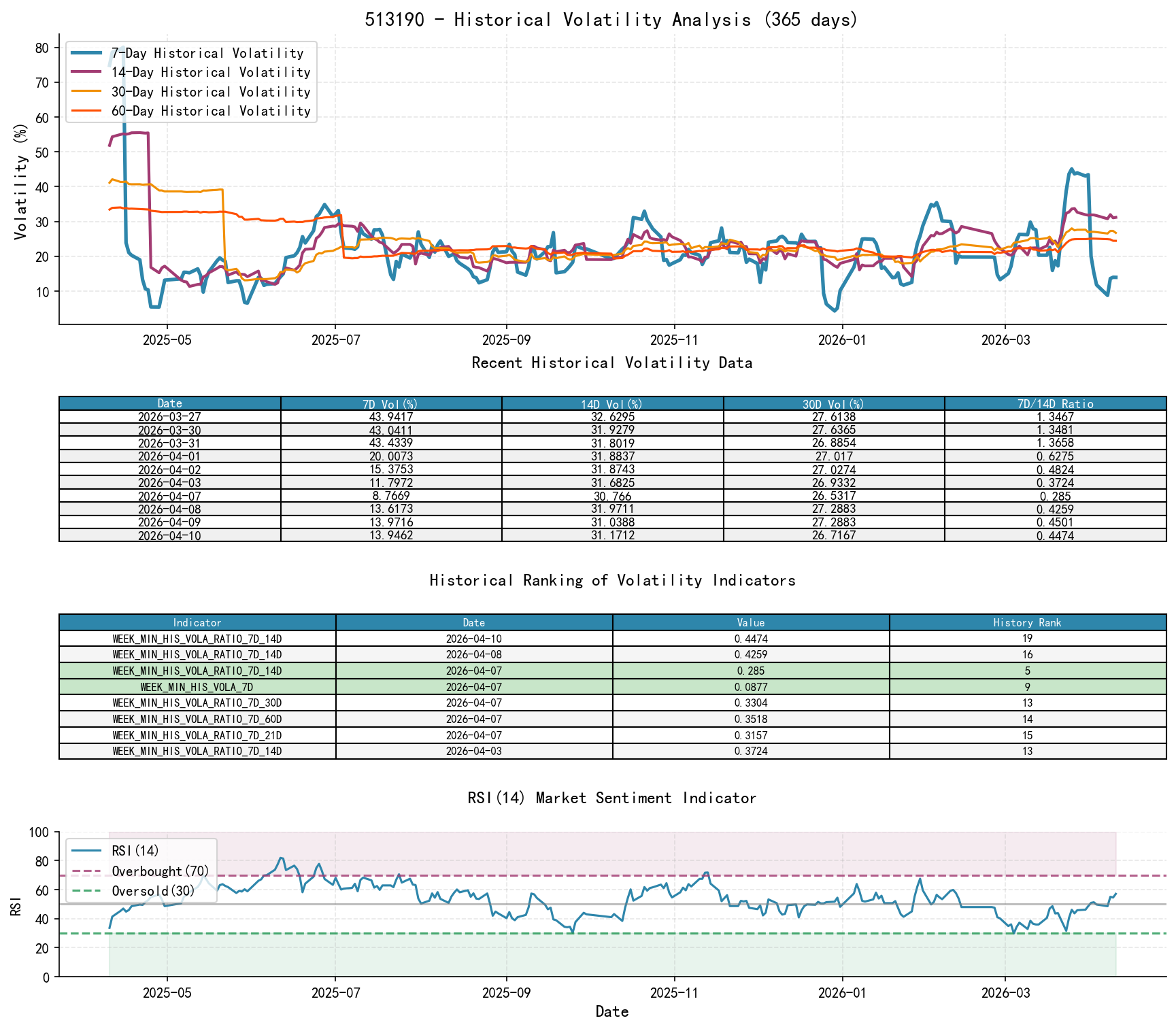
As of April 10, 2026, the underlying asset 513190 has an opening price of 1.75, a 7-day intraday volatility of 0.13, a 7-day intraday volatility ratio of 0.77, a 7-day historical volatility of 0.14, a 7-day historical volatility ratio of 0.45, and an RSI of 57.15.
- • Volatility Levels and Changes:
- • Historical Volatility (
HIS_VOLA) peaked in mid-to-late March.HIS_VOLA_7Dreached as high as 0.451 on March 25th, withHIS_VOLA_7D_RATIO_7D_60Dat 1.817 (ranked 1st in nearly 10 years), indicating extreme market panic and turbulence. - • Key Turning Point: Entering April, short-term volatility dropped sharply.
HIS_VOLA_7Dplummeted from 0.451 on March 25th to 0.139 on April 10th.HIS_VOLA_RATIO_7D_14Dfell from above 1.33 in late March to 0.447 on April 10th (situated in the lower range of the past 10 years, ranked 19th lowest). This indicates the market has rapidly transitioned from a state of "panic and disorder" to a "calm and orderly" rally state. Volatility contraction often occurs in the early stages of a trend or at the end of consolidation. - • Parkinson Intraday Volatility (
PARKINSON_VOL_7D) also declined to 0.135 (20th lowest in nearly 10 years), confirming the narrowing of intraday price swings and reduced selling pressure.
- • Historical Volatility (
- • Overbought/Oversold Status (RSI):
- • RSI_14 touched 29.81 on March 4th (ranked 5th lowest in nearly 10 years), confirming the market had entered a severely oversold zone, providing a technical basis for the subsequent rebound.
- • The current RSI_14 is 57.15, having moved out of the oversold zone into a neutral-to-strong area. This indicates the rally has momentum support, is not yet overbought, and has room to move higher.
4. Relative Strength and Momentum Performance
- • Periodic Return Analysis:
- • Short-Term Momentum Turns Positive:
WTD_RETURN(weekly return) successfully turned positive from negative values at the end of March (-3.89%), reaching +1.97% on April 10th.MTD_RETURN(monthly return) also expanded from +0.64% on April 1st to +2.33% on April 10th. Short-term momentum has significantly strengthened. - • Mid-Term Momentum Awaits Further Recovery:
QTD_RETURN(quarterly return) andYTD(year-to-date return) remain negative (-0.34%), but have recovered substantially from the March lows (-6.92%). This indicates the mid-term downtrend has been halted, but a complete reversal requires more time.
- • Short-Term Momentum Turns Positive:
- • Momentum Conclusion: The underlying asset has demonstrated clear short-term relative strength, with momentum shifting from weak to strong, mutually confirming the conclusion of "demand taking dominance" from the price-volume analysis.
5. Large Investor (Smart Money) Behavior Identification
Based on the above price-volume, volatility, and momentum analysis, the operational path of large investors can be clearly outlined:
- 1. Distribution (Early to Mid-February): Distributing holdings to the public chasing highs through rallies and consolidation in the 1.85-1.86 zone. Manifested as high-volume stagnation at highs.
- 2. Allowing Decline and Observation (Late February to Mid-March): During the price decline, smart money did not buy in large scale (rebounds were mostly low-volume), intending to let market forces release selling pressure naturally while observing for genuine support levels.
- 3. Accumulation During Panic (March 23rd-31st): After the "ultimate shakeout" (March 23rd) created a panic low (1.641), smart money decisively entered the market on a large scale. The 5th highest single-day volume in nearly 10 years (March 31st) and subsequent sustained high volume are clear evidence of their "re-accumulation" at relatively low levels. They absorbed all the selling from the panic.
- 4. Markup and Testing (Early April to Present): After completing accumulation, smart money began marking up prices (high-volume rally on April 8th), aiming to test for remaining supply (overhead resistance from trapped holders) and to create space for a potential subsequent trending advance. The current healthy price-volume relationship suggests preliminary success in this test.
6. Support/Resistance Level Analysis and Trading Signals
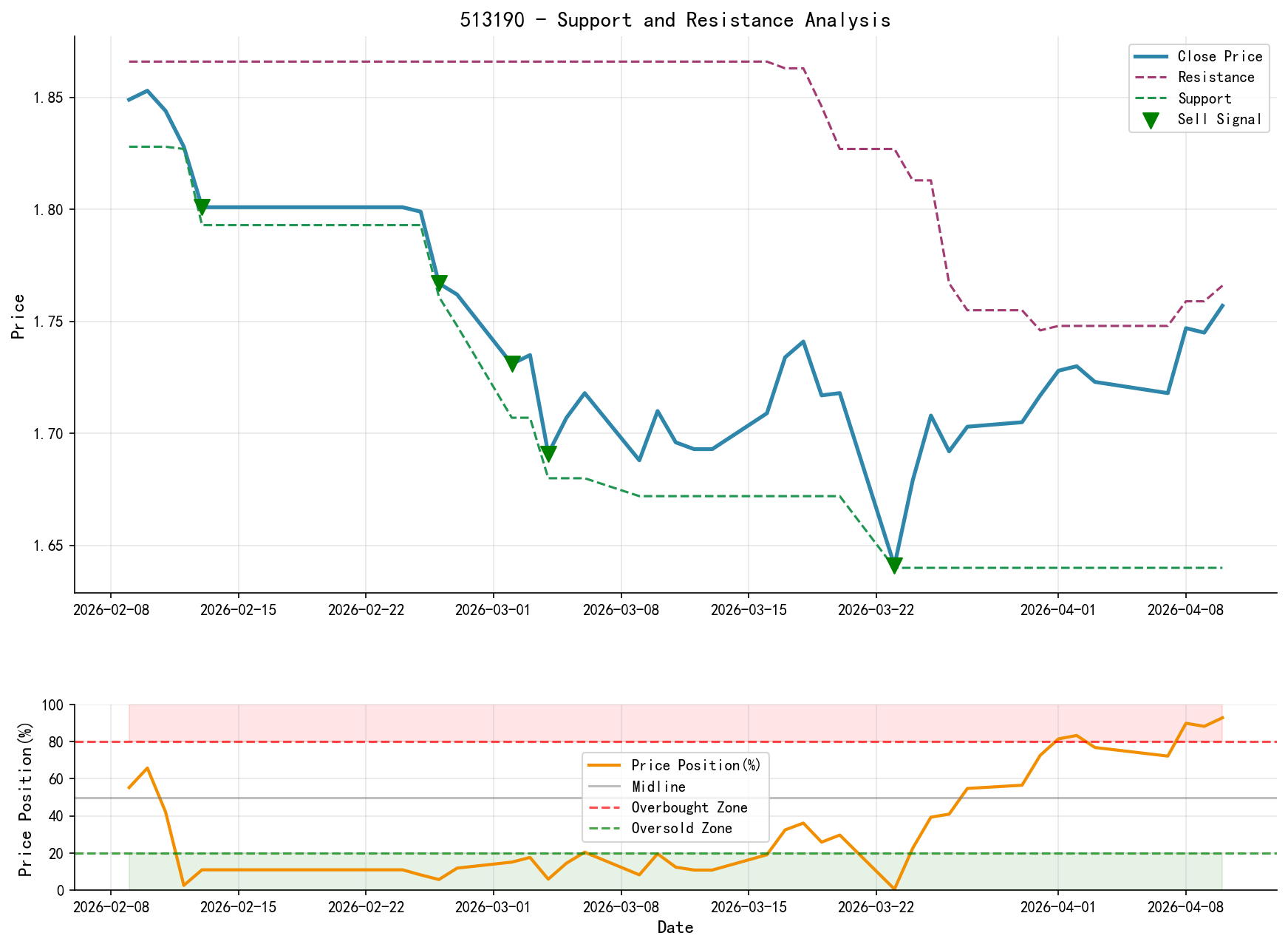
- • Key Support Levels:
- • Primary Support (Spring Low): 1.641 (March 23, 2026 low). This is the extreme low formed by panic selling and the area where smart money accumulated heavily, holding significant support importance.
- • Secondary Support (Demand Entry Zone): The 1.728 - 1.735 area (around the April 1st close and April 8th open). This is the starting point of the recent high-volume rally and has transformed from resistance into support.
- • Key Resistance Levels:
- • Near-term Resistance: 1.766 (April 10, 2026 high). A break above this level would confirm a strengthening short-term rally pattern.
- • Primary Resistance (Distribution Zone): The 1.828 - 1.866 area (February consolidation highs). This is the previous distribution range, likely containing substantial overhead supply, and is a key test for a potential mid-term trend reversal.
- • Integrated Wyckoff Events and Trading Signals:
- • Market Structure: Has completed the classic bottoming structure of "Panic Selling" (SC) -> "Automatic Rally" (AR) -> "Secondary Test" (ST). March 23rd was the SC, March 24th-31st the AR, and the early April consolidation can be viewed as the ST. The ST did not make a new low and was accompanied by contracting volume, indicating a healthy structure.
- • Current Signal: Bullish. The market has exited the downtrend, smart money has completed accumulation and begun markup testing.
- • Operational Suggestions:
- • Entry Consideration: Consider establishing positions in batches when prices pull back near the secondary support zone 1.728-1.735 and show signs of stabilizing on low volume.
- • Stop-loss Level: Set below the key support at 1.641, or more aggressively below 1.705 (the starting point of the April 8th high-volume bullish candle).
- • Target Level: Initial target towards the lower boundary of the primary resistance zone around 1.828.
- • Future Validation Points:
- 1. Confirmation Signal: Price breaks above 1.766 on high volume (above the 20-day average) and holds.
- 2. Strengthening Signal: When price approaches the 1.828-1.866 resistance zone, it exhibits "high-volume breakout" or "low-volume consolidation," rather than "high-volume stagnation," significantly increasing the probability of a mid-term reversal.
- 3. Risk Signal: If price falls below 1.705 accompanied by increasing volume, it suggests the current rebound might be a failed "secondary test," requiring re-evaluation of the market structure and triggering stop-loss exits.
Conclusion Restatement: ETF 513190 exhibits clear characteristics of bottom formation. Based on Wyckoff price-volume principles, the data indicates that large investors completed substantial accumulation at the panic lows in late March and initiated a rally test in early April. Short-term momentum has turned positive, volatility has normalized, and market sentiment is recovering. It is recommended to adopt a cautiously optimistic bullish perspective, seek entry opportunities near key support levels, and closely monitor the test results of overhead resistance to validate the strength of a potential trend reversal.
Disclaimer: This report/interpretation is solely market analysis and research based on publicly available information and does not constitute any investment advice or operational guidance. The author strives for objectivity and fairness but makes no guarantees regarding accuracy or completeness. The market carries risks, and investment requires caution. Any investment actions based on this report are undertaken at one's own risk.
Thank you for your attention! Wyckoff price-volume market interpretation is released daily at 8:00 AM before the market opens. Your comments and shares are greatly appreciated. Your recognition is crucial. Let's work together to see the market signals.
Member discussion: