Product Code: 513120
Analysis Date Range: 2026-02-09 to 2026-04-10 (based on the latest date provided in the data table)
Data Generation Date: 2026-04-10 17:20:13
Report Generation Date: 2026-04-10
In-Depth Quantitative Analysis Report Based on Wyckoff Price-Volume Principles
1. Trend Analysis and Market Phase Identification
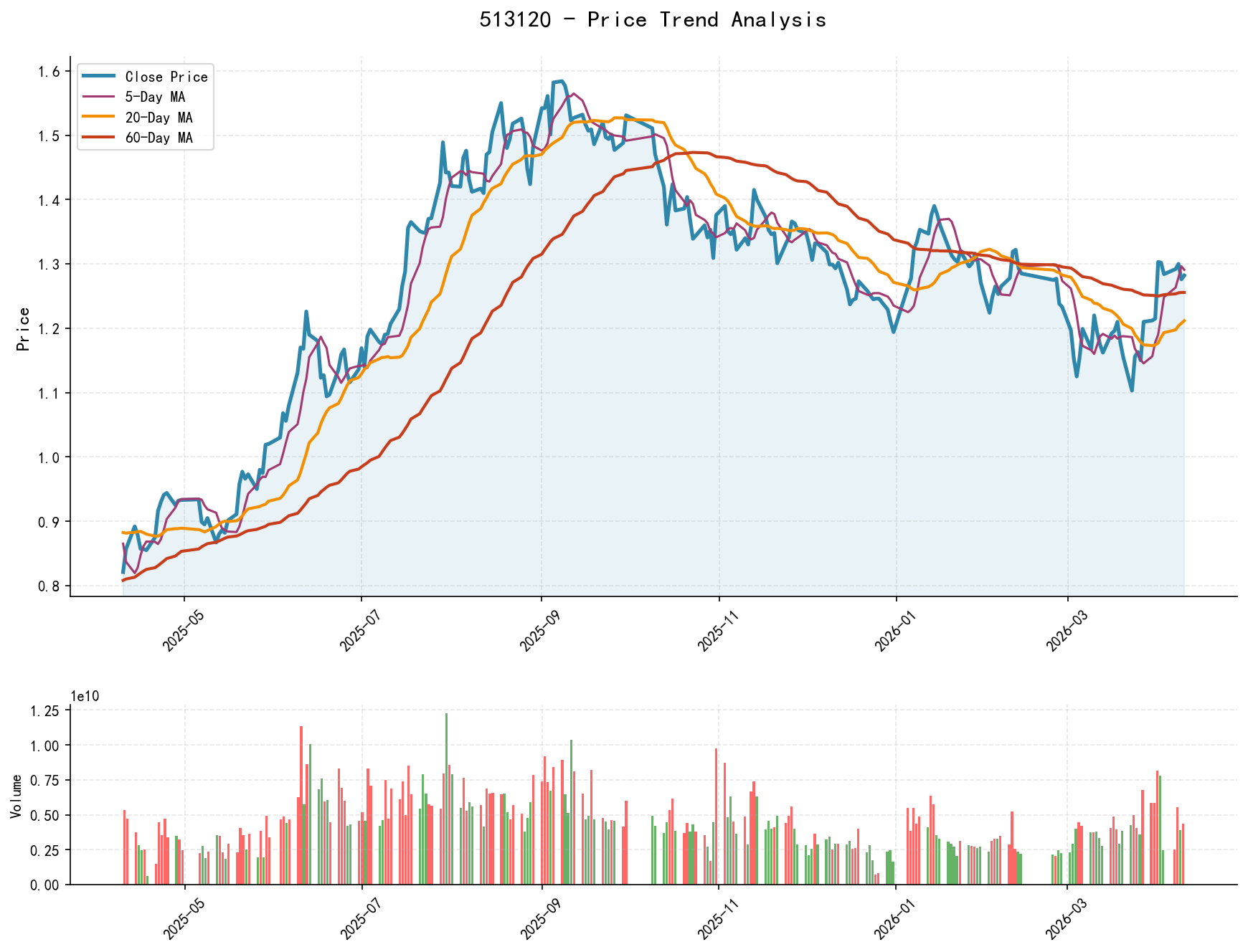
As of April 10, 2026, the underlying asset 513120 has an open price of 1.29, a close price of 1.28, a 5-day moving average of 1.29, a 10-day moving average of 1.25, a 20-day moving average of 1.21, a daily change of 0.47%, a weekly change of -0.16%, a monthly change of 5.51%, a quarterly change of 5.51%, and an annual change of 7.37%.
- • Moving Average Alignment Analysis:
As of the analysis date (2026-04-10), the price (1.282) is above the cluster of short-term moving averages, showing the embryonic form of a "bullish alignment": MA_5D (1.291) > MA_10D (1.254) > MA_20D (1.212). However, the price has not yet decisively broken through the critical medium-to-long-term moving average MA_60D (1.256). This indicates a short-term trend reversal from bearish to bullish, but the reversal of the medium-term trend remains unstable. - • Moving Average Crossover Signals:
- • Key Crossovers: Important crossovers of short-term moving averages above medium-term ones were observed during the data period. For instance, around March 10, 2026, the MA_5D crossed above and remained above the MA_20D. Around April 1, 2026, the price strongly broke through the MA_60D on high volume.
- • Significance of Crossover Direction: This series of upward crossovers signals a strong rebound force following the deep decline in early March. However, given that the MA_60D is still above the MA_20D and the price is consolidating around the MA_60D, the market structure, from a longer-term perspective, remains in a state of repair and has not yet formed a solid long-term bullish alignment.
- • Market Phase Inference (Based on Wyckoff Theory):
Combining price action and moving average changes, the market has likely undergone the following phase evolution:- 1. Panic/End of Distribution (Late February - Early March): The price declined continuously from 1.319 to 1.153, a drop exceeding 12%, accompanied by significant high-volume down days (e.g., February 26). RSI_14 hit an extreme historical low of 25.70 on March 4.
- 2. Accumulation and Secondary Test (Mid-March): The price fluctuated repeatedly within the 1.15-1.20 range, with trading volume significantly higher than the average during the preceding decline phase, indicating fund accumulation at low levels. This aligns with the Wyckoff "accumulation range" characteristic.
- 3. Markup (or Initial Upleg) (Late March - Early April): The price broke out of the 1.20-1.25 consolidation range on high volume and recorded a massive high-volume bullish candle with a 7.24% gain on April 1. This is a clear "demand dominance" signal, marking a likely entry into the markup phase.
- 4. Distribution or Consolidation (Current, Early April): After reaching a high of 1.334, the price has consolidated narrowly within the 1.28-1.30 range for several consecutive sessions. Volume has receded from its peak but remains above the long-term average. Wyckoff Perspective: This may be a signal of "initial supply appearance." Following the high-volume breakout, the price failed to sustain new highs and instead formed small-body candlesticks at relatively high levels (April 2, 3, 9) with contracting volume, suggesting a temporary exhaustion of upward momentum. The market is entering the early stages of the "distribution phase," or at least a "correction within an uptrend."
2. Volume-Price Relationship and Supply-Demand Dynamics
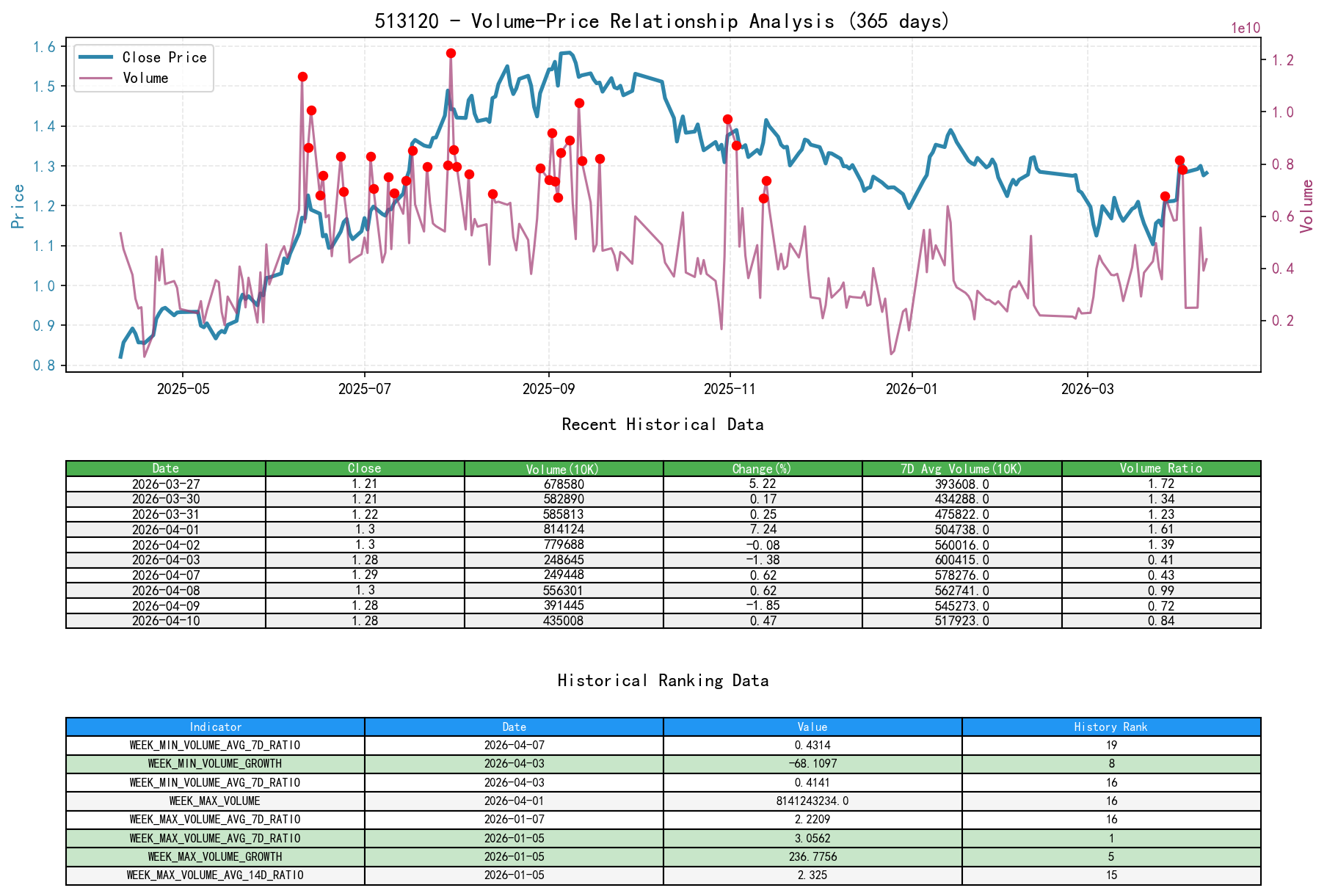
As of April 10, 2026, the underlying asset 513120 has an open price of 1.29, a close price of 1.28, a trading volume of 4,350,085,300, a daily change of 0.47%, a trading volume of 4,350,085,300, a 7-day average volume of 5,179,238,168.43, and a 7-day volume ratio of 0.84.
- • Core Volume-Price Analysis:
- • High-Volume Advance (Demand Dominance):
- • 2026-02-10: Price increased by 3.21%, volume surged by 83.8%, with the volume/7-day average ratio as high as 1.73. This is a classic "strong demand" day.
- • 2026-04-01: Price increased by 7.24%, volume grew by 38.97% compared to the previous day, and the volume/7-day average ratio reached 1.61. More critically, the daily volume (81.41 million lots) ranked 16th highest in the past decade, and the daily gain (7.24%) ranked 3rd highest. This is an overwhelmingly strong demand signal, indicating active accumulation or markup by large funds (smart money).
- • High-Volume Stagnation/Decline (Supply Dominance):
- • 2026-04-02: Price decreased slightly by -0.08%, while volume remained extremely high at 77.97 million lots (volume/14-day average ratio of 1.66). This is a classic signal of "initial significant supply appearance" at highs, indicating strong selling pressure above 1.30.
- • 2026-04-03: Price declined by -1.38%, with volume plummeting by -68.11% compared to the previous day. The volume/7-day average ratio was only 0.41, ranking 16th lowest in the past decade. This is a typical "low-volume decline," indicating a sharp contraction in follow-up demand and a shift from the previous day's "supply-demand stalemate" to "demand exhaustion."
- • Low-Volume Rebound (Insufficient Demand):
- • April 9 & 10, 2026: The price rebounded slightly after the decline, but volumes were only 0.72x and 0.84x of the recent average, respectively. This represents a typical "insufficient demand" type of rebound, where the advance lacks volume support.
- • High-Volume Advance (Demand Dominance):
- • Supply-Demand Strength Shift:
The data clearly shows a complete cycle from "demand explosion" (April 1) -> "supply-demand balance, supply emergence" (April 2) -> "demand exhaustion" (April 3 and thereafter). Currently (April 10), the market is in a state of weak demand and temporarily inactive large-scale supply, but the balance is tilting toward the bears.
3. Volatility and Market Sentiment
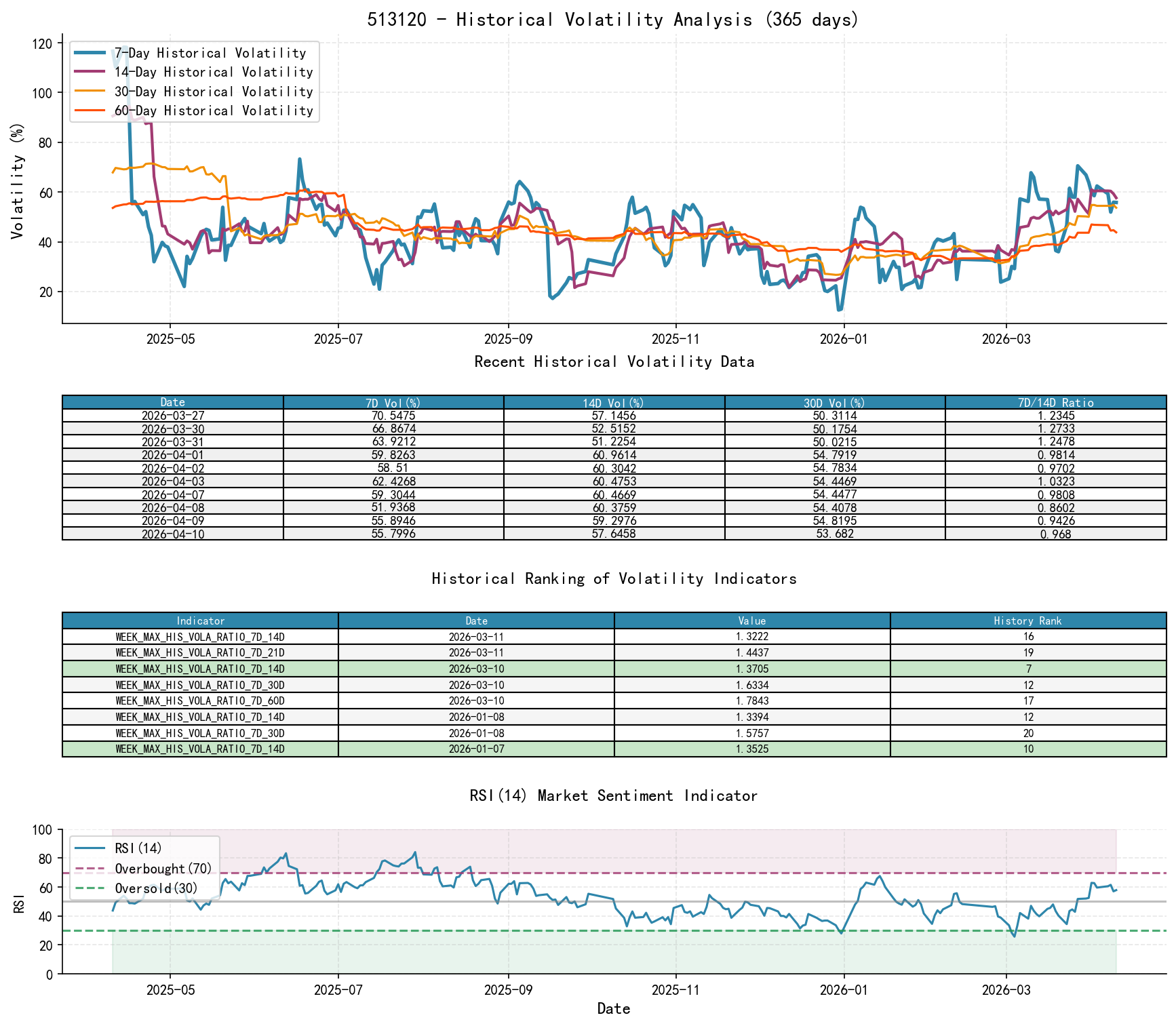
As of April 10, 2026, the underlying asset 513120 has an open price of 1.29, a 7-day intraday volatility of 0.35, a 7-day intraday volatility ratio of 0.91, a 7-day historical volatility of 0.56, a 7-day historical volatility ratio of 0.97, and an RSI of 57.90.
- • Volatility Level and Changes:
- • Early March (Panic Period): Historical Volatility (HIS_VOLA) and Parkinson Volatility rose significantly. For example, on March 4-5, HIS_VOLA_7D reached above 0.60, approximately 1.3 times its 60-day average, indicating tense market sentiment.
- • Critical Signal: On March 10, 2026, HIS_VOLA_RATIO_7D_14D reached 1.3705, ranking 7th highest in the past decade. This indicates that short-term volatility expanded abnormally, far exceeding the medium-term average. Combined with the 4.45% high-volume advance on that day, this reflects not panic but the volatility characteristic of "excitement/trend initiation."
- • Current (Early April): Various volatility indicators (HIS_VOLA, PARKINSON_VOL) have retreated from their peaks, with HIS_VOLA_RATIO_7D_14D falling back to around 0.97. Converging volatility indicates a shift in market sentiment from excitement to observation and caution.
- • Overbought/Oversold Status (RSI):
- • Confirmation of Extreme Sentiment Points: On March 4, 2026, RSI_14 touched 25.70, ranking 1st lowest in the past decade, confirming the market panic and deep oversold conditions at that time. This provided room and a sentiment foundation for the subsequent rebound.
- • Current Status: RSI_14 is currently 57.90, having recovered from extreme oversold levels to near neutral, not yet entering the overbought zone (>70). This suggests that if prices correct in the future, RSI still has room to decline, but the short-term risk of a crash directly due to overbought conditions is relatively low.
4. Relative Strength and Momentum Performance
- • Periodic Return Analysis:
- • Short-Term Momentum (WTD_RETURN): The current value is -0.16%, turning from positive to negative, indicating the exhaustion of short-term upward momentum, consistent with the volume-price analysis conclusion.
- • Medium-Term Momentum (QTD_RETURN, YTD): QTD return is 5.51%, and YTD return is 7.37%, both positive, indicating that from a medium-term (quarterly, annual) perspective, the underlying asset remains in an upward trend, partially preserving the rebound gains from the March lows.
- • Momentum Validation: The strong QTD return coincides with the high-volume advance phase in March-April, validating the upward repair of the medium-term trend. However, the weakness in WTD momentum suggests a potential short-term correction.
5. Large Investor (Smart Money) Behavior Identification
Based on the above analysis, the operational trajectory of large investors can be inferred:
- 1. Panic Buying/Accumulation (Early to Mid-March): When the price fell to the 1.15-1.20 range, RSI hit historical extremes, and panic pervaded the market, smart money engaged in low-level accumulation through high-volume consolidation or rebounds (e.g., March 5, 6, 10). The hallmark is: low price accompanied by significantly elevated volume.
- 2. Accelerated Accumulation and Initial Markup (Late March - April 1): On March 27, 30, 31, and April 1, consecutive high-volume advances with volume/average ratios > 1.5 occurred. The "high-volume bullish candle" on April 1, in particular, was a landmark event where smart money publicly and forcefully declared their market control. They likely completed major position building and began marking up the price during this period, attracting public investors (followers) to enter.
- 3. Distribution Initiation/Market Reaction Testing (April 2 - Present): After driving the price to around 1.33, the "high-volume stagnation" on April 2 was the first clear signal that smart money began distributing shares to followers at high levels. The subsequent "low-volume decline" on April 3 was a test where they temporarily stopped buying to observe the strength of inherent market demand. A typical distribution structure is: high-volume advance (attracting attention) -> high-volume stagnation (distribution begins) -> low-volume decline (demand exhaustion). The current market is in the early or middle stages of this structure.
Key Conclusion: Large investors likely completed their main accumulation in March and began phased profit-taking or position adjustments during the markup in early April. The dominant market force is slowly shifting from "demand" to "supply."
6. Support/Resistance Level Analysis and Trading Signals
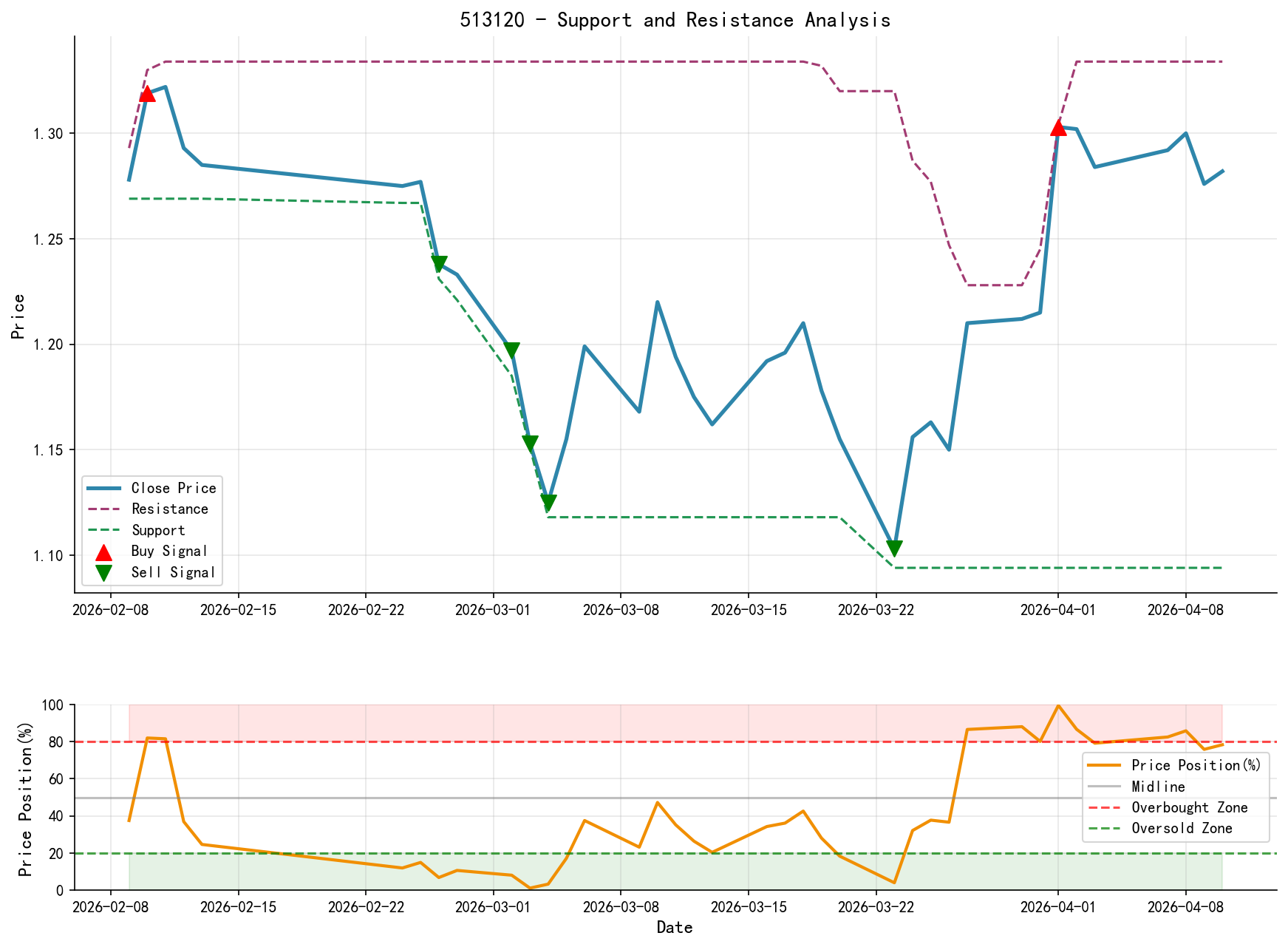
- • Key Support Levels:
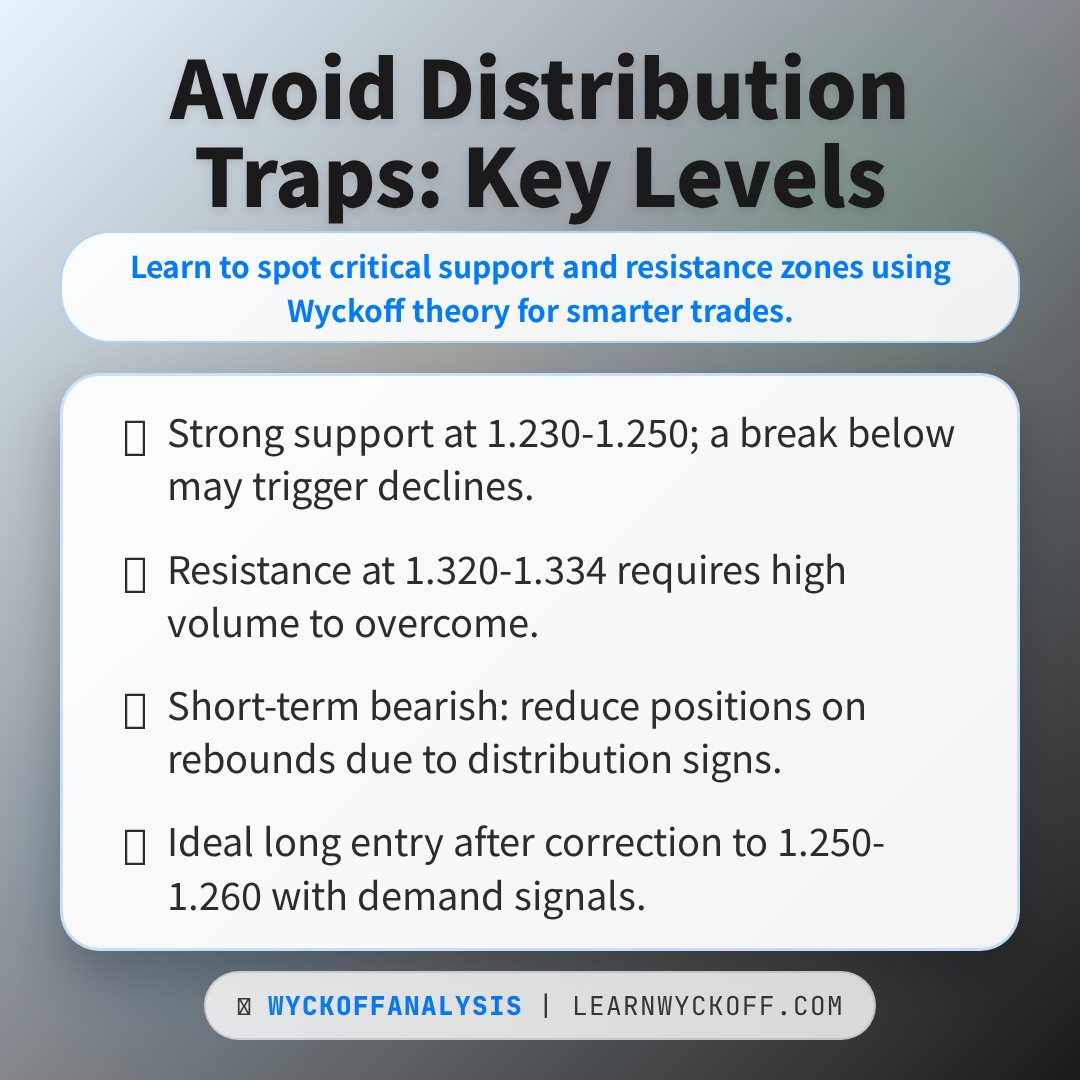
- • Strong Support: 1.230 - 1.250. This is the upper boundary of the consolidation range before the late-March breakout and is also near the current MA_60D. A low-volume pause in decline or renewed high-volume stabilization within this range would be a crucial line of defense for bulls.
- • Critical Support: 1.150 - 1.170. This is the low area of the panic decline in March, representing the major accumulation cost zone for large investors. A break below this area would imply a breakdown of the entire medium-term rebound structure.
- • Key Resistance Levels:
- • Near-term Resistance: 1.320 - 1.334. This is the high area reached in early April and the current zone where distribution pressure is evident. A decisive breakout of this area requires new, stronger demand (volume) to drive it.
- • Next Resistance: Based on pattern measurement, if 1.334 is decisively broken, the theoretical target extends above 1.40.
- • Integrated Trading Signals:
- • Short-term Signal: Bearish / Look for opportunities to reduce positions on rebounds.
- • Reasons: 1) Volume-price analysis shows demand exhaustion and supply emergence (April 2-3). 2) Short-term momentum has turned negative, with price consolidating at highs. 3) The market is in the early stages of the Wyckoff "distribution phase."
- • Medium-term Signal: Neutral-Bullish / Wait for entry opportunities after a correction.
- • Reasons: 1) Medium-term returns remain positive, and the overall trend structure has improved since the March lows. 2) The accumulation behavior of large investors in the 1.15-1.20 zone provides medium-term support. However, the current price does not offer medium-term value for chasing highs.
- • Short-term Signal: Bearish / Look for opportunities to reduce positions on rebounds.
- • Operational Suggestions:
- • Current Holders: Consider partially taking profits by reducing positions near the 1.300-1.320 resistance zone.
- • Observers/Shorts: Closely monitor price action at the 1.320-1.334 resistance zone. If secondary supply signals such as "high-volume upper shadows" or "high-volume stagnation" appear, consider initiating light short positions with a stop-loss set above 1.335. Target the 1.250 support area.
- • Potential Longs: Maintain patience and wait for the market to complete its adjustment. The ideal long entry timing is when the price retraces to the 1.250-1.260 support area and shows signs of demand returning, such as "low-volume stabilization" or "high-volume engulfing bullish reversal." Set the initial stop-loss below 1.230.
- • Future Validation Points:
- 1. Confirming Bearish View: Price breaks below the 1.250 support level on high volume, and subsequent rebounds fail to reclaim it.
- 2. Invalidating Bearish View/Shifting to Bullish: After a brief consolidation around the current level (1.28-1.30), the price once again breaks out strongly on high volume (volume/7-day average ratio > 1.2) above the 1.334 high, setting new highs. This would imply "distribution" failure and the market entering a new upward wave.
Disclaimer: This report/interpretation is solely for market analysis and research based on publicly available information and does not constitute any investment advice or operational guidance. The author strives for objectivity and impartiality but makes no guarantees regarding accuracy or completeness. The market involves risks; investment requires caution. Any investment actions based on this report are taken at your own risk.
Thank you for your attention! Wyckoff Volume-Price market analysis is published daily at 8:00 AM before the market opens. Please leave comments, reposts, and shares—your recognition is crucial. Let us see the market signals together.
Member discussion: