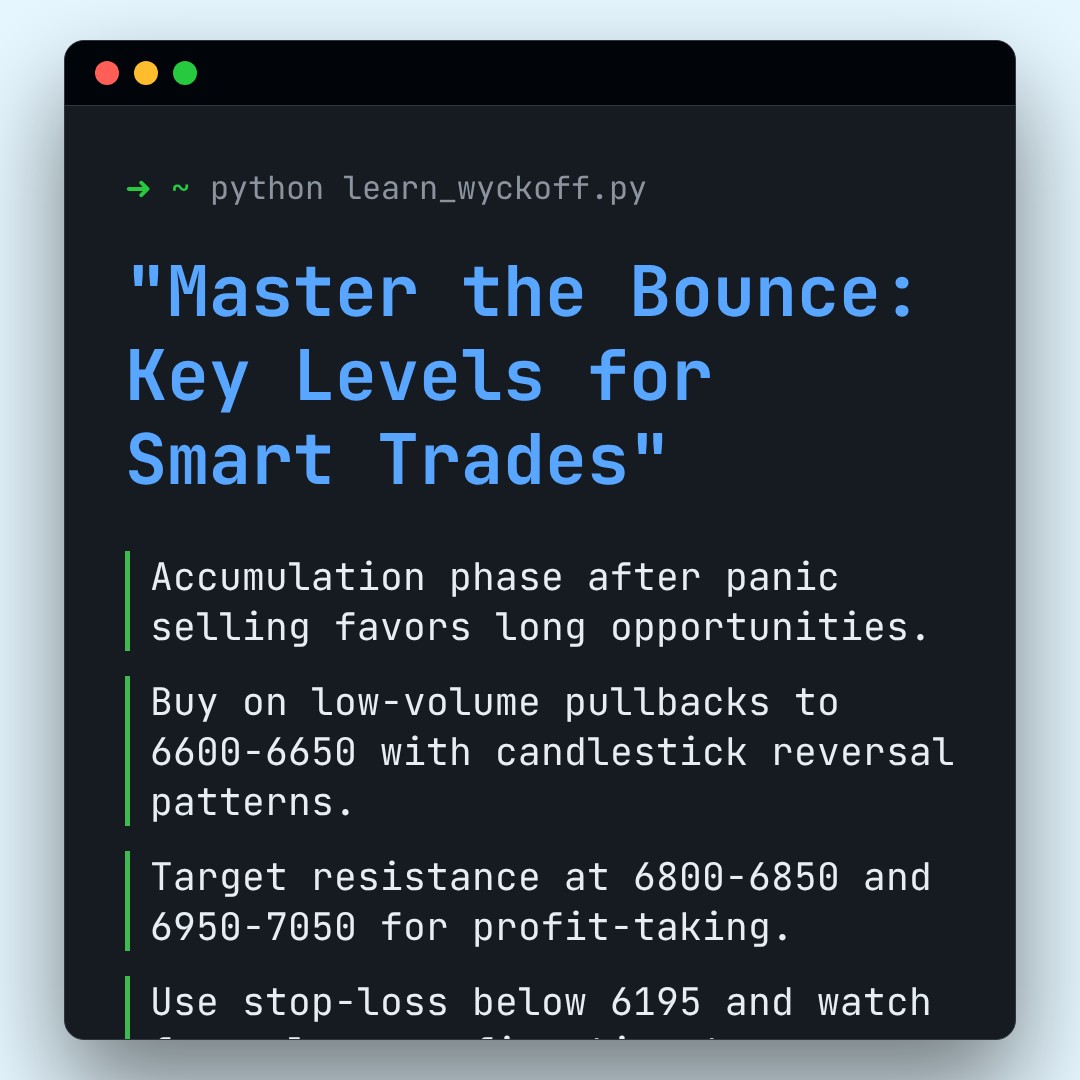
Very well. As a quantitative trading researcher proficient in the Wyckoff Method, I will prepare a comprehensive and in-depth quantitative analysis report based on the product code 399989 data and historical ranking metrics provided for the period from 2026-02-09 to 2026-04-10.
Wyckoff Volume-Price Analysis Report
Product Code: 399989
Analysis Period: 2026-02-09 to 2026-04-10
Report Generation Time: 2026-04-10
1. Trend Analysis and Market Phase Identification
As of April 10, 2026, for the underlying asset 399989: opening price 6698.50, closing price 6752.98, 5-day moving average (MA_5D) 6678.87, 10-day moving average (MA_10D) 6617.64, 20-day moving average (MA_20D) 6600.09, daily return 1.10%, weekly return 2.44%, monthly return 2.91%, quarterly return 2.91%, year-to-date (YTD) return -0.10%.
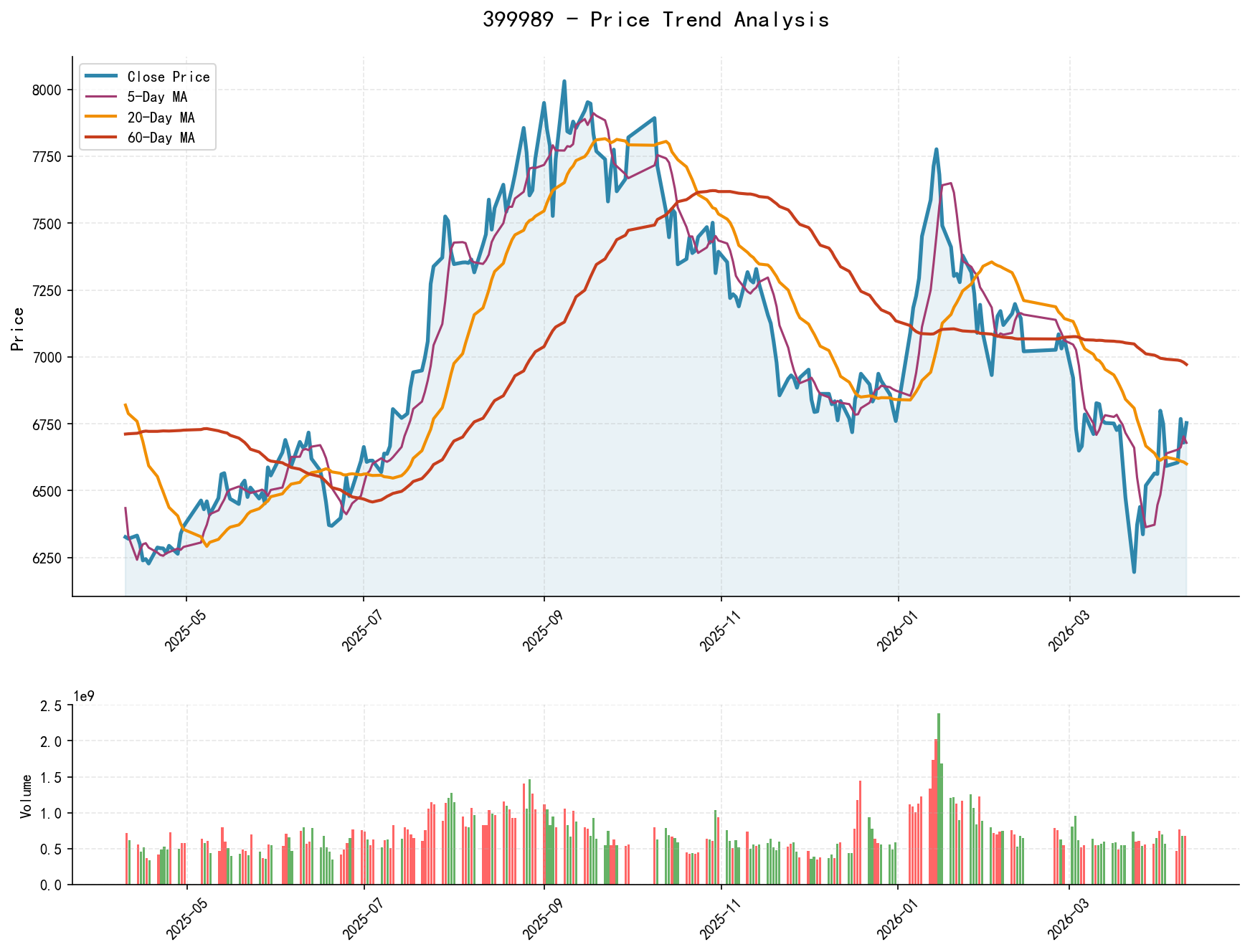
- • Moving Average Arrangement and Price Relationship: During the entire analysis period, the price experienced a significant decline followed by a rebound. In the early stage (early February), the price fluctuated around the MA_5D and MA_10D but was consistently suppressed by the MA_20D, MA_30D, and MA_60D, forming a bearish alignment framework. By mid-March, the price dropped sharply, moving away from all moving averages. Entering the rebound period from late March to early April, the price successively broke above the MA_5D, MA_10D, and MA_20D. However, as of April 10th, the closing price of 6752.98 remains significantly below the MA_30D (6673.84) and MA_60D (6971.47), indicating that the medium-term (30-60 day) trend is still downward, while the short-term (5-20 day) trend has turned upward. This "short-term bullish, medium-term bearish" moving average structure typically occurs during the initial rebound or retracement phase following a prolonged downtrend.
- • Moving Average Crossover Signals: Following the extreme low point on March 23rd (6195.82), the price rebound drove the MA_5D to cross above the MA_10D and MA_20D in early April, forming a short-term bullish crossover. This is a signal of a decelerating downtrend and a localized increase in buying pressure. However, the MA_10D, MA_20D, MA_30D, and MA_60D have not yet formed a bullish alignment, confirming that a medium-term trend reversal is not yet confirmed.
- • Inferred Market Phase (Based on Wyckoff): Combined with price action and volume, the market experienced typical phases of "Panic Selling" (mid to late March) followed by "Automatic Rally" and "Secondary Test/Accumulation".
- 1. Panic Selling Phase (March 19th - March 23rd): The price declined sharply and consecutively, especially the -4.31% plunge on March 23rd to a new phase low of 6195.82, accompanied by a sharp spike in volume (733 million). This is a strong signal of selling pressure release and emotional capitulation.
- 2. Automatic Rally Phase (March 24th - April 1st): A rapid rebound followed the panic, with the price recovering approximately 9.7% from the low. Volume remained active but lower than on the panic day.
- 3. Secondary Test/Accumulation Phase (April 2nd - April 10th): The price retraced from the rally high but did not make a new low. Volume during this period remained above the earlier average (e.g., high-volume rise on April 8th), and volume contracted relatively when the price tested support near the lows (e.g., April 3rd, 7th). This aligns with the Wyckoff characteristic of "large investors accumulating shares at low levels." The current market is likely in the later stage of this phase, brewing a directional decision.
2. Volume-Price Relationship and Supply-Demand Dynamics
As of April 10, 2026, for the underlying asset 399989: opening price 6698.50, closing price 6752.98, volume 675,396,500, daily return 1.10%, volume 675,396,500, 7-day average volume 653,850,111.86, 7-day volume ratio 1.03.
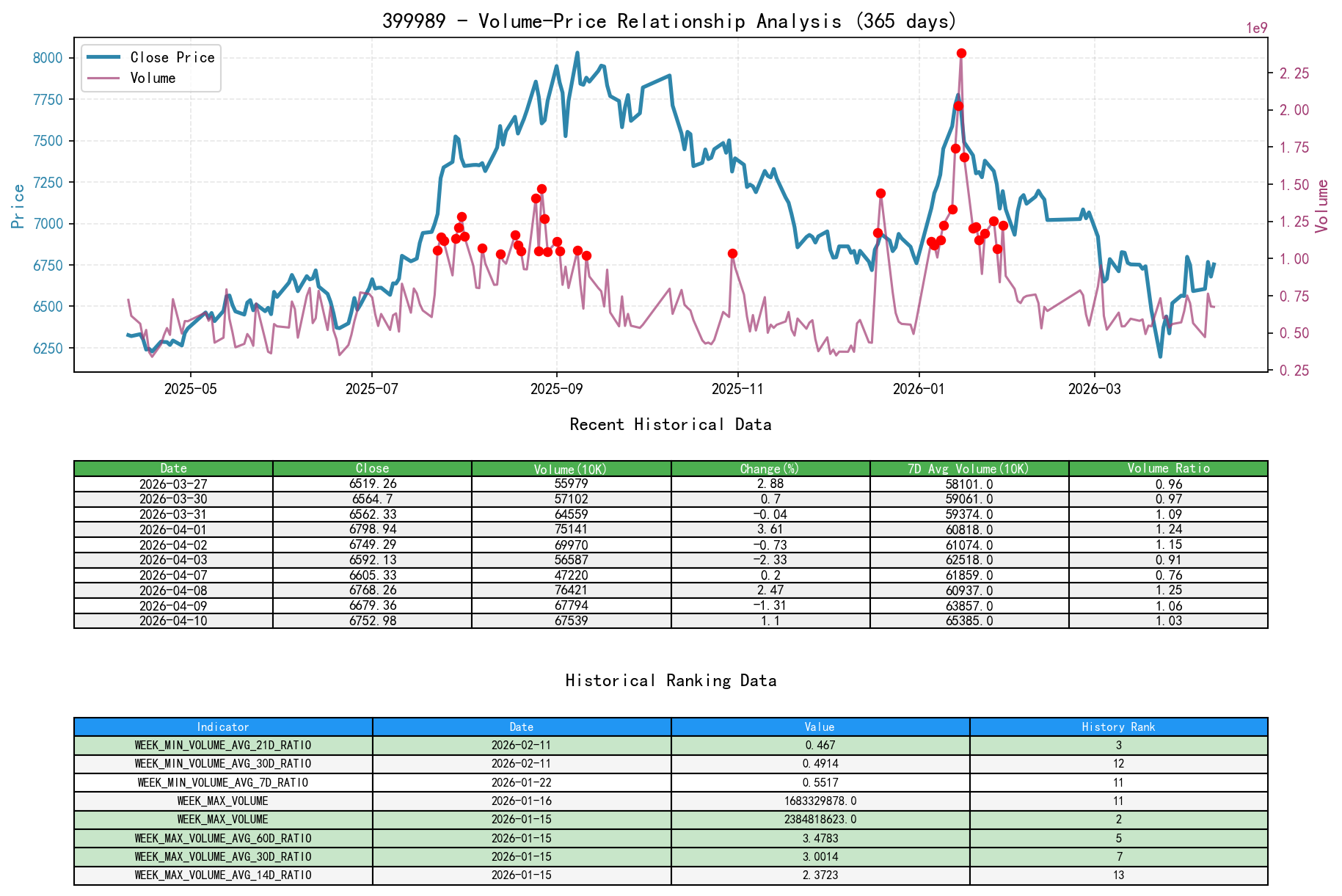
- • Key Volume-Price Signal Identification:
- 1. Emergence of Supply at Highs (Feb 9th - 13th): On Feb 9th and 10th, the price showed stagnation (minimal gains) above the 7160 level, but with massive volume (758 million, 701 million). Subsequently, on Feb 11th-13th, the price turned downward, especially on the 13th with a high-volume decline of -1.73% (volume 648 million). This is a classic signal of exhausted demand and supply dominance, foreshadowing the subsequent decline.
- 2. Panic Selling (March 23rd): Price plummeted -4.31% with volume surging to 733 million, and the
VOLUME_AVG_14D_RATIOreached 1.24. This represents an extreme supply peak and panic release, which Wyckoff suggests may signal exhaustion of selling pressure. - 3. Demand Validation during the Rally (April 1st): Price surged +3.61% with synchronized volume expansion to 751 million, and the
VOLUME_AVG_14D_RATIOreached 1.29. This is evidence of strong demand intervention, supporting the validity of the "Automatic Rally." - 4. Supply Test during Pullback (April 3rd, 7th): Volume contracted significantly during price pullbacks (566 million and 472 million, respectively), with
VOLUME_AVG_7D_RATIObelow 1 on both days, indicating limited selling pressure and a lack of large-scale supply returning to the market.
- • Volume Extremes (Supported by Historical Ranking):
- • The data shows that average volume was at historically high levels both in the February high region and the late March low region.
WEEK_MAX_AVERAGE_VOLUME_21DandWEEK_MAX_AVERAGE_VOLUME_30Dreached the 18th and 19th highest levels, respectively, in the past 10 years. This sustained historically high volume indicates large-scale share transfer occurred during this period, consistent with the volume-price characteristics of "Distribution" and "Accumulation" phases.
- • The data shows that average volume was at historically high levels both in the February high region and the late March low region.
3. Volatility and Market Sentiment
As of April 10, 2026, for the underlying asset 399989: opening price 6698.50, 7-day intraday volatility (Parkinson) 0.22, 7-day Parkinson volatility ratio 0.89, 7-day historical volatility (HIS_VOLA_7D) 0.40, 7-day historical volatility ratio 0.93, RSI 52.36.
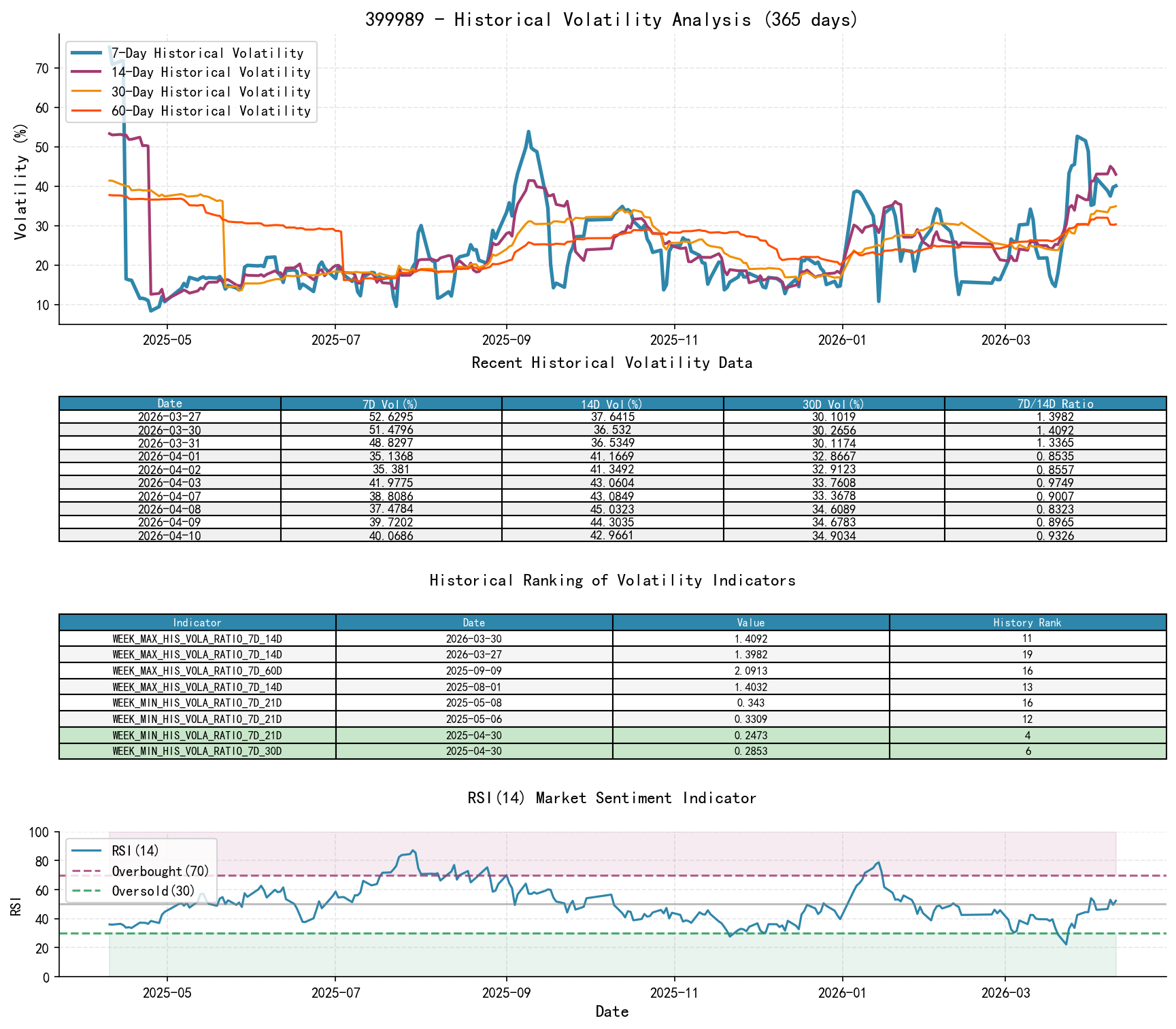
- • Volatility Changes: Short-term volatility spiked extremely in late March. On March 27th,
HIS_VOLA_7Dreached 0.526 andPARKINSON_VOL_7Dreached 0.280. The ratio indicatorHIS_VOLA_RATIO_7D_14Dreached 1.409 on March 30th, ranking 11th in the past 10-year history, indicating short-term volatility far exceeded medium-term levels, a typical characteristic of panic or trend acceleration. Entering April,HIS_VOLA_7Dretreated to around 0.40 andPARKINSON_VOL_7Dfell below 0.22, showing market sentiment gradually converging and stabilizing from panic. - • Market Sentiment Indicators:
RSI_14dropped to 22.25 on March 23rd, in the severely oversold region, confirming the panic sentiment extreme. Subsequently, the RSI rebounded, recovering to 52.36 as of April 10th, entering the neutral-to-strong zone, indicating short-term momentum has shifted from bearish to bullish, moving away from extreme pessimism.
4. Relative Strength and Momentum Performance
- • Periodic Return Analysis:
- • Short-Term Momentum Turns Positive:
WTD_RETURN(for the week ending April 10th) is +2.44%, andMTD_RETURN(for April to date) is +2.91%, showing strong short-term momentum. - • Weak but Improving Medium-Term Momentum:
QTD_RETURN(for the quarter to date) is +2.91%, butYTD(year-to-date) remains at -0.10%.TTM_12(trailing 12-month) return is +6.74%, whileTTM_36(trailing 36-month) remains at -35.59%. This indicates that while the long-term trend is still weak, the recent (1-3 month) rebound momentum is working to repair the longer-term (1-year) decline.
- • Short-Term Momentum Turns Positive:
- • Conclusion: The underlying asset exhibits strong short-term rebound momentum, which is beginning to penetrate into the medium-term (quarterly). This validates the chart signals of "price moving away from lows, short-term moving average golden cross, RSI exiting oversold territory."
5. Large Investor (Smart Money) Behavior Identification
Based on the above volume-price, volatility, and momentum analysis, the operational intent of large investors is inferred as follows:
- 1. Distribution Behavior in Early-Mid February: In the 7100-7200 zone, high-volume stagnation and decline occurred, aligning with Wyckoff's "Distribution" characteristics. Large investors likely supplied shares to the market in this area.
- 2. Accumulation Behavior during Panic in Late March: When the price plunged to around 6200, historically significant volume appeared. This was not just panic selling by retail investors but likely also included proactive buying and accumulation by large investors at extreme low prices. The historically high volume rankings support the significance of this transfer.
- 3. Control Behavior during April Rally and Pullback: The rally (April 1st) was accompanied by massive volume, indicating active buying; while the pullbacks (April 3rd, 7th) showed clear volume contraction, indicating supply did not increase significantly following the price rebound, and selling pressure was controlled. This fits the "Accumulation Range" characteristic: demand absorbs supply and prevents further price decline. The current market's alternating pattern of low-volume pullbacks and high-volume rallies is typical behavior of smart money consolidating low-priced holdings and testing market selling pressure.
6. Support/Resistance Level Analysis and Trading Signals
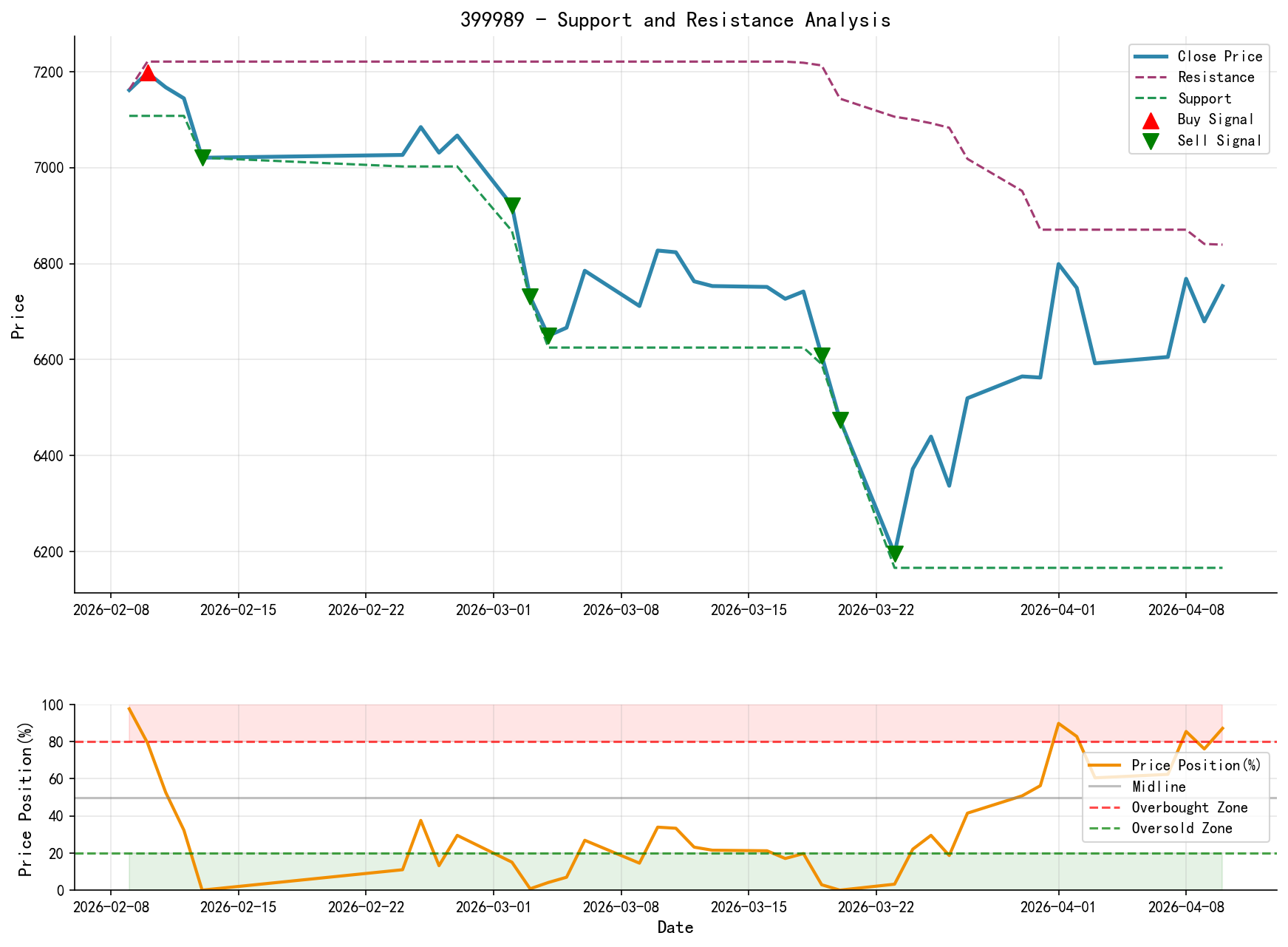
- • Key Support Levels:
- • S1 (Strong Support): 6195 - 6200 Zone. This is the low formed by the March 23rd panic selling and the starting point of this rebound, holding strong psychological and technical significance.
- • S2 (Secondary Support): 6600 - 6650 Zone. Recent multiple pullbacks (April 3rd, 7th) found support and rebounded in this area, which is also the convergence zone for short-term moving averages (MA_5D/MA_10D).
- • Key Resistance Levels:
- • R1 (Near-term Resistance): 6800 - 6850 Zone. The rally high on April 1st and the upper wick area reached on April 10th, facing pressure from previous high-volume zones.
- • R2 (Core Resistance): 6950 - 7050 Zone. The MA_60D (6971) coincides with the lower boundary of the consolidation platform before the breakdown in mid-March, serving as the medium-term bull-bear demarcation line.
- • Comprehensive Trading Signals and Operational Recommendations:
- • Overall Assessment: The market has exited the "Panic Selling" phase and entered the construction period of an "Accumulation" structure. The short-term trend is upward but faces strong resistance from medium-term moving averages. The strategy should primarily focus on seeking pullback opportunities for long positions, while remaining vigilant of the risk of rejection at key resistance levels.
- • Bullish Scenario and Operations:
- • Entry Timing: When the price pulls back on low volume to the S2 (6600-6650) support zone and shows a reversal candlestick pattern (e.g., long lower wick, bullish engulfing), it can be considered an accumulation opportunity.
- • Target Levels: Initial target at R1 (6800-6850), with a secondary target at R2 (6950-7050) upon a breakout.
- • Stop-loss Level: Should be set below the key support S1 (6195), such as at 6150. This is a wide stop-loss based on potential "shakeout" behavior within the accumulation range.
- • Future Validation Points (Confirmation Signals):
- 1. Bullish Confirmation: A high-volume breakout (
VOLUME_AVG_30D_RATIO> 1.2) and sustained hold above the R2 resistance zone (MA_60D) would confirm a medium-term trend reversal, completion of accumulation, and the start of an uptrend. - 2. Bearish Confirmation/Risk Warning: If, after rallying to the R1 or R2 zone, the price again exhibits "high-volume stagnation or decline" volume-price divergence signals (e.g., long upper wick + high volume), it would suggest the rebound may be ending, with accumulation turning into distribution. Exit positions decisively and adopt a wait-and-see approach.
- 3. Structure Failure: A high-volume breakdown below the S1 (6195) support would imply accumulation failure, the downtrend will resume, and all bullish assumptions become invalid.
- 1. Bullish Confirmation: A high-volume breakout (
Disclaimer: This report is based on an objective analysis of the provided historical data and Wyckoff principles. All conclusions are derived from data inference. Financial markets carry inherent risks, and past performance does not guarantee future results. This report does not constitute any specific investment advice. Investors should make independent judgments and bear the risks of their decisions.
Thank you for your attention! Wyckoff volume-price market interpretation is released daily at 8:00 AM before the market opens. Please leave comments and share. Your recognition is crucial. Let's see the market signals together.
Member discussion: