Understood, following your instructions. Below is the in-depth quantitative analysis report I have authored as a quantitative trading researcher proficient in the Wyckoff Method, based on the provided 399986 data and historical ranking indicators.
Quantitative Analysis Report: 399986 (CSI Bank Index)
Product Code: 399986
Analysis Date Range: 2026-02-09 to 2026-04-10
Report Generation Time: 2026-04-10
I. Trend Analysis and Market Phase Identification
As of April 10, 2026, the underlying asset 399986 recorded: Opening price 7217.98, Closing price 7203.27, 5-day moving average 7271.23, 10-day moving average 7279.27, 20-day moving average 7269.40, Daily change -0.14%, Weekly change -1.11%, Monthly change -1.61%, Quarterly change -1.61%, Yearly change -5.26%.
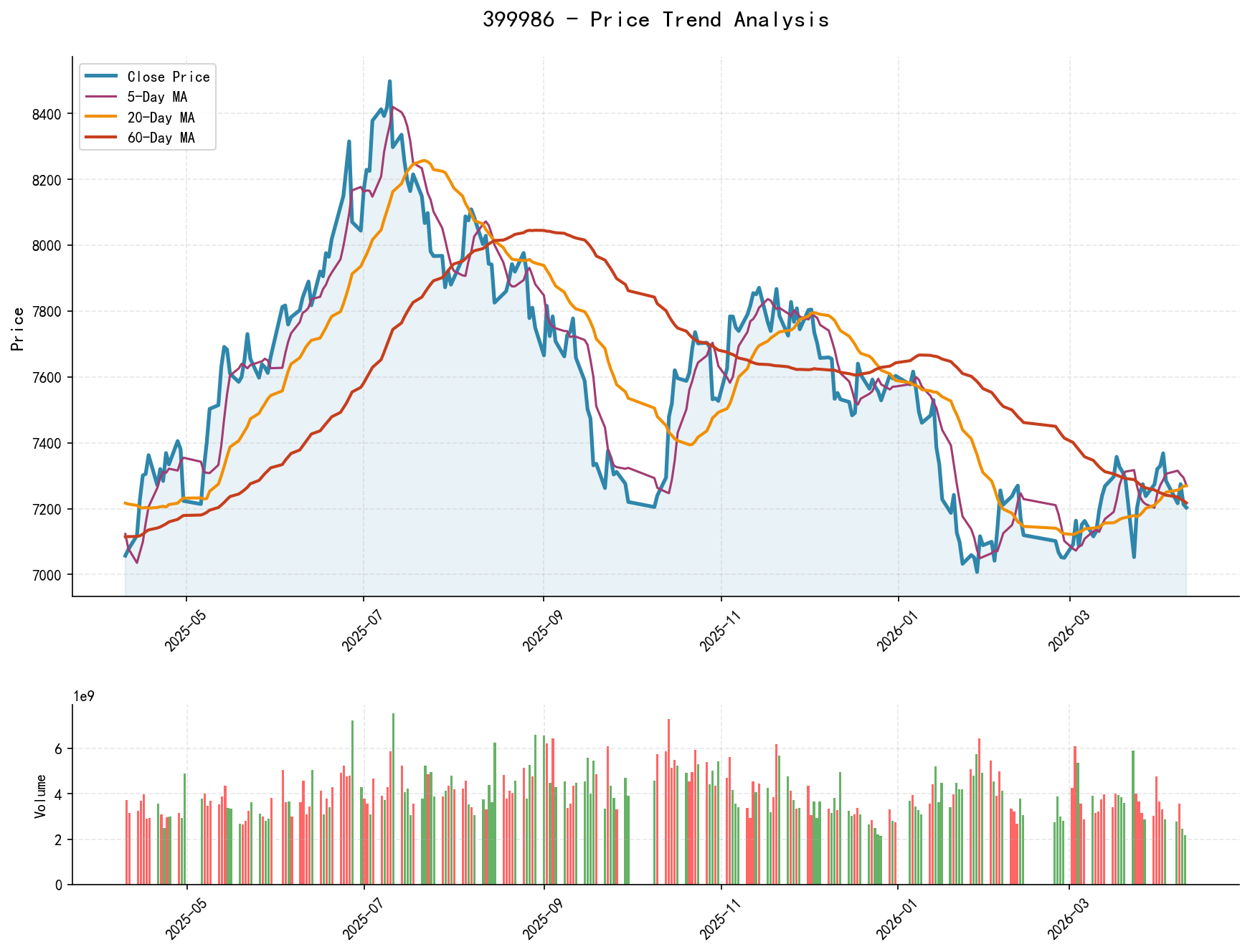
Based on the relationship between price and moving averages, the current market is in a clear intermediate-term bearish trend and may be in the transition phase from "Distribution" to "Markdown".
- 1. Bearish Alignment Confirmation: As of the final day of the analysis period (2026-04-10), the price (7203.27) is below all major moving averages. The moving averages display a standard bearish alignment:
MA_5D (7271.23) < MA_10D (7279.27) < MA_20D (7269.40) < MA_30D (7219.64) < MA_60D (7217.51). This clearly defines a downtrend. - 2. Moving Average Crossover Signals: During the period from March 31 to April 1, a price rebound briefly broke above MA_5D and MA_10D, but MA_5D failed to decisively cross above MA_20D to form a "Golden Cross", and the rebound subsequently failed. Recently (since April 8), MA_5D has turned downward again and crossed below MA_10D, confirming the resurgence of downward momentum. This aligns with the characteristics of a "Weak Rally" in Wyckoff theory.
- 3. Market Phase Inference:
- • Early Distribution (Mid-to-late March): Price rebounded from its late February low, reaching a high of 7377.00 on March 17. However, volume failed to expand consistently (volume contracted March 16-20), forming the initial pattern of an "Upthrust".
- • Distribution Confirmation & Markdown Initiation (March 23 - Early April): On March 23, the market experienced a Selling Climax (SC), plunging 3.28% (Historical Rank 14) accompanied by massive volume near 6 billion (Volume Ratio 1.56). Although a volume-backed rally (Automatic Rally, AR) occurred the next day, indicating demand absorption, the rebound high (7396.88 on April 2) failed to convincingly surpass the previous high, forming a "Lower High". Subsequently, price fell back below all moving averages, confirming the completion of distribution and the entry into the Markdown Phase.
- • Current Phase (April 10): After a continuous, slow decline, price has reached an extremely low volume level (volume 2.19 billion, the recent lowest). This is consistent with the potential occurrence of a Secondary Test (ST) or a consolidation within a downtrend in Wyckoff's Markdown Phase. The market is testing for exhaustion of demand and may be preparing for the next leg down.
II. Volume-Price Relationship and Supply-Demand Dynamics
As of April 10, 2026, the underlying asset 399986 recorded: Opening price 7217.98, Closing price 7203.27, Volume 2189959600, Daily change -0.14%, Volume 2189959600, 7-day average volume 3344325445.14, 7-day volume ratio 0.65.
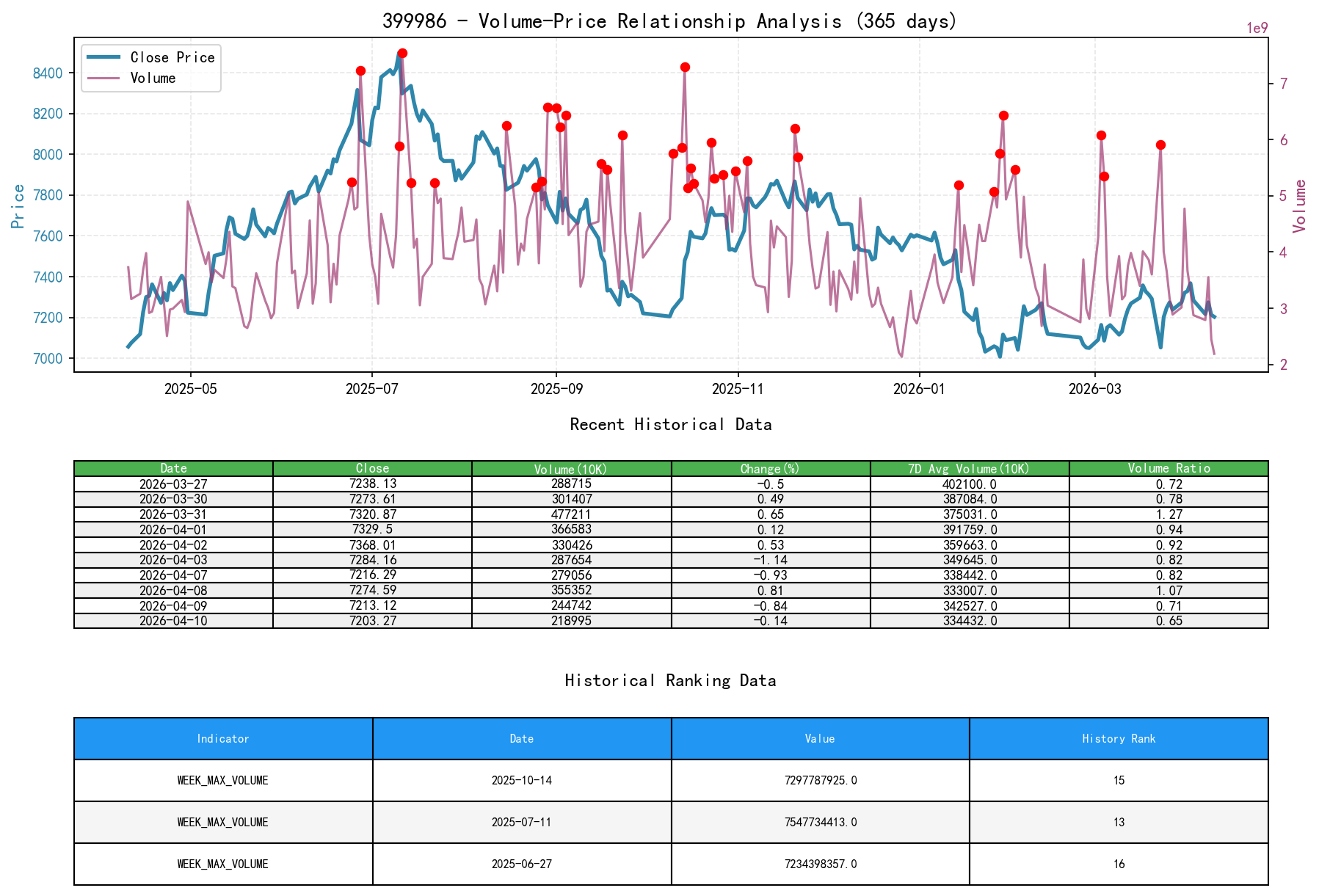
Volume analysis is central to the Wyckoff method. The current data reveals a landscape of severely insufficient demand, with supply not intensively released yet still dominating the market.
- 1. Key Day Analysis:
- • Selling Climax Day (SC - 2026-03-23): Price plummeted -3.28% with volume surging to 5.91 billion (VOLUME_AVG_7D_RATIO=1.56). This is a classic supply-dominated panic selling day. Historical ranking data shows this was the 14th largest single-day drop in nearly 10 years, indicating an extreme event.
- • Automatic Rally Day (AR - 2026-03-24): The next day saw a volume-backed rise of 2.11% with volume at 4.01 billion (VOLUME_AVG_14D_RATIO=1.27). This indicates demand stepped in at the panic low, attempting to absorb supply.
- • Upthrust & Insufficient Demand (2026-04-02 to 04-10): On April 2, price rebounded to a new high of 7396.88, but volume (3.30 billion) did not significantly expand relative to the 7-day and 14-day averages (ratio <1), showing a "Price Rise on Shrinking Volume" divergence, a clear signal of weak demand. The subsequent declines (April 3, April 7) were accompanied by continuously shrinking volume, indicating supply did not increase substantially, but demand has completely withdrawn.
- 2. Quantifying Volume Anomalies: The volume ratios on the final day (April 10) are at extreme lows:
VOLUME_AVG_7D_RATIO=0.65,VOLUME_AVG_14D_RATIO=0.62. These are well below the 1.0 threshold, indicating market participation has hit rock bottom, characteristic of a "Low-Volume Decline". This is a volume-price signal that the downtrend may continue or enter an "exhaustion" state. The consistently negativeVOLUME_GROWTHalso confirms the decline in trading activity.
III. Volatility and Market Sentiment
As of April 10, 2026, the underlying asset 399986 recorded: Opening price 7217.98, 7-day Parkinson volatility 0.12, 7-day Parkinson volatility ratio 0.81, 7-day historical volatility 0.15, 7-day historical volatility ratio 0.60, RSI 46.99.
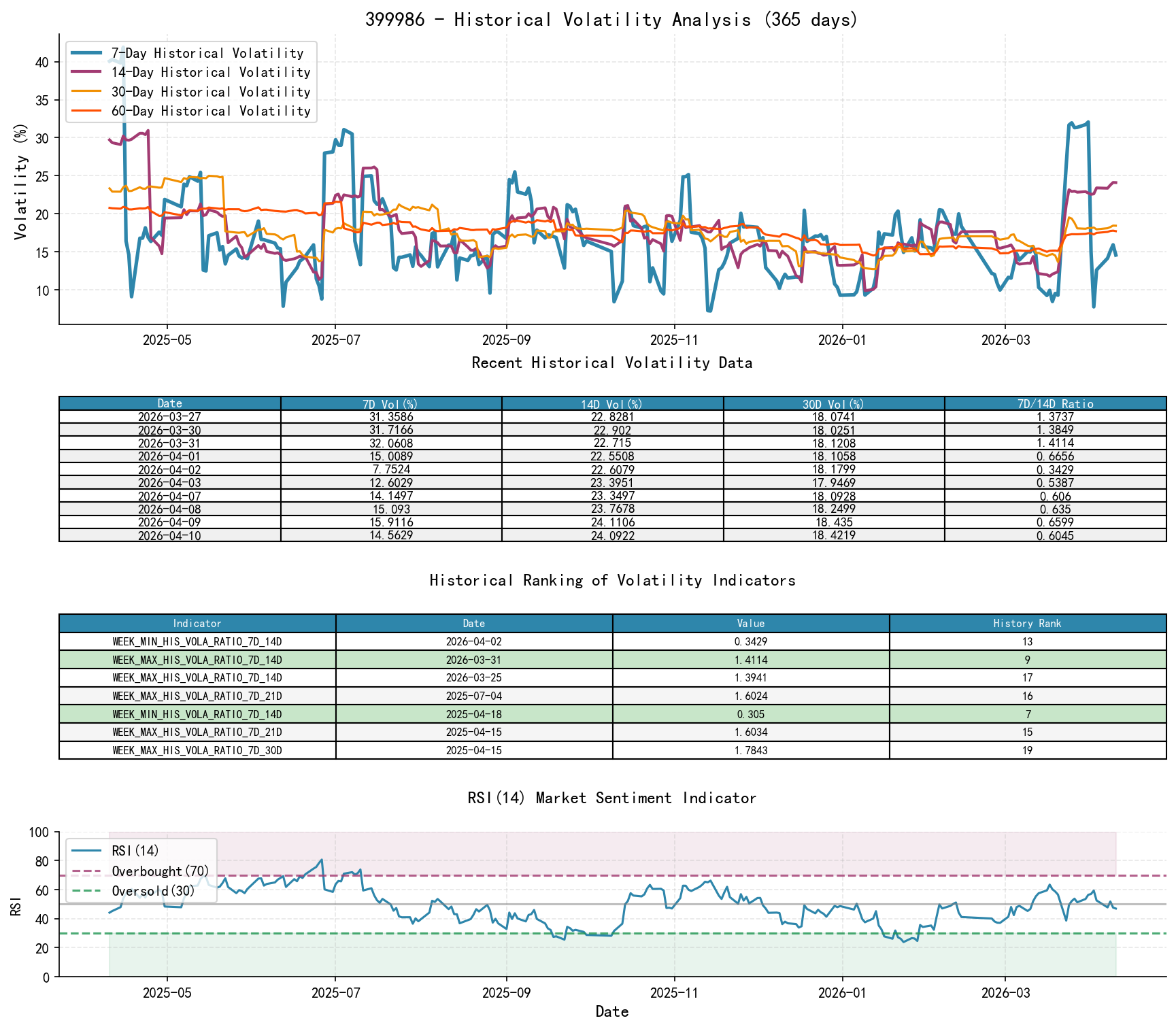
Volatility data and market sentiment indicators show the market is transitioning from a period of sentiment recovery post-extreme panic to a low-volatility prelude to directional selection.
- 1. Volatility Levels and Changes:
- • Panic Period Highs: On March 23-25, both
HIS_VOLA_7DandPARKINSON_VOL_7Dpeaked (>30% and >16% respectively). Historical ranking data points out thatWEEK_MAX_HIS_VOLA_RATIO_7D_14Dreached the 17th and 9th highest extreme values in nearly 10 years on March 25 and 31 respectively, confirming the abnormal spike in volatility and market panic at that time. - • Current Compression Period: As of April 10, short-term volatility has contracted significantly:
HIS_VOLA_7D=14.56%,PARKINSON_VOL_7D=12.19%. Volatility ratiosHIS_VOLA_RATIO_7D_14D=0.60andPARKINSON_RATIO_7D_14D=0.81are both less than 1, indicating short-term volatility is now below the medium-term level, and market sentiment has shifted from panic to suppression and观望 (watchfulness). This extreme Volatility Compression often precedes a significant directional breakout.
- • Panic Period Highs: On March 23-25, both
- 2. Sentiment Indicator Verification: The current
RSI_14value is 46.99, in the neutral-weak zone, not yet entering oversold territory (<30). This aligns with the phenomena of slow decline without a crash and volatility compression, indicating market sentiment is biased towards pessimism but not extreme, suggesting there is still room for downward momentum to release.
IV. Relative Strength and Momentum Performance
Momentum indicators have turned negative across the board, confirming the deterioration of the price trend.
- 1. Periodic Returns: Returns for all periods are negative:
YTD=-5.26%,QTD=-1.61%,MTD=-1.61%. This confirms the index is in a state of relative weakness across short, medium, and long-term dimensions. - 2. Momentum Confirmation: Since retreating from the rebound high in late March (April 2), short-term momentum (observed via
WTD_RETURN) quickly turned negative, resonating with the trend judgment of price breaking below short-term moving averages (MA_5D, MA_10D), strengthening the reliability of the bearish conclusion.
V. Large Investor ("Smart Money") Behavior Identification
Based on volume-price and volatility analysis, the behavioral trajectory of large investors can be inferred:
- 1. Absorption During Panic (March 23-24): During the massive selling on March 23, large funds necessarily acted as counterparties absorbing shares. The subsequent day's volume-backed rally indicates some smart money recognized value in that zone, engaging in tentative buying or short covering. This is typical behavior of accumulating positions during a Selling Climax event.
- 2. Distribution and Exit During the Rally (March 31 - April 2): When price rallied to the 7396-point previous high area, volume failed to consistently exceed average levels, indicating large-scale demand did not follow through. Smart money likely used this rally for distribution or reducing long positions rather than launching a new offensive. This explains why the rally was weak and quickly terminated.
- 3. Current Watchfulness and Testing (April 7-10): The consistently low volume recently (volume hitting stage lows) indicates both large buyers and sellers are in a state of watchfulness. Sellers are waiting for better prices or are no longer in a hurry to sell, while buyers are waiting for clearer signs of stabilization or lower prices. The market has entered a stalemate phase of "supply-demand balance", with smart money testing the market's absorption capacity and selling pressure.
VI. Support/Resistance Level Analysis and Trading Signals
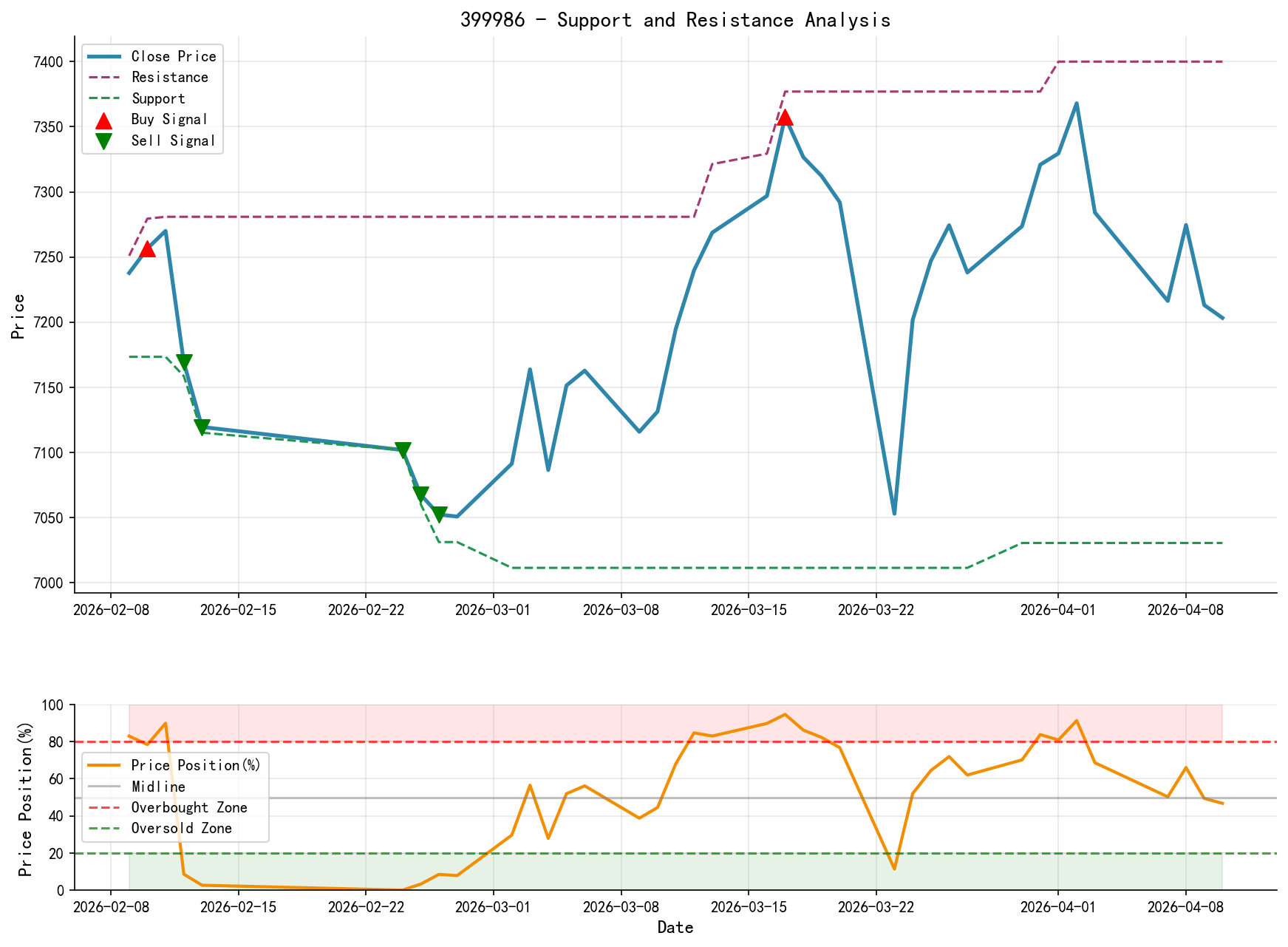
Key Levels:
- • Resistance Levels:
- 1. Strong Resistance Zone: 7396-7377 points (The "Double Top" area formed by the April 2 and March 17 highs). Any rebound to this zone without volume confirmation presents a selling or shorting opportunity.
- 2. Dynamic Resistance: MA_5D & MA_10D (7270-7280 points). The currently declining moving averages will constitute the first barrier for any rebound.
- • Support Levels:
- 1. Recent Support: 7216 points (April 7 low). A breakdown would confirm a consolidation within the downtrend.
- 2. Critical Support: 7050 points (February 27 low). This is the area where the previous panic selling (SC) occurred. An effective breakdown here would open up more significant downside potential.
Integrated Wyckoff Events and Trading Signals:
- 1. Current Market State: The market is in the Markdown Phase following completed distribution, recently exhibiting "low-volume decline" and testing previous support. Volatility compression is at an extreme, suggesting an imminent directional move.
- 2. Trading Signal: Bearish/Watchful. The primary trend is down, secondary rallies have failed, and the volume-price structure indicates a demand vacuum.
- 3. Operational Recommendations:
- • For Holders (Long Positions): Should use any weak rally towards the moving averages (7270-7280) or the resistance zone (7377-7396) to reduce positions or implement stop-losses.
- • For Shorts or Those on the Sidelines:
- • Aggressive Strategy: If price rebounds to the 7270-7280 zone (MA band) and shows signs of stalling with low volume, consider establishing short positions, with stops placed above 7396.
- • Conservative Strategy: Maintain watchfulness, waiting for key signals. A bearish confirmation signal would be a breakdown of the 7216-point support on increased volume. A bullish invalidation signal would be a high-volume breakout and sustained hold above 7396 points.
- 4. Future Validation Points:
- • Confirming Downtrend Continuation: Observe price breaking down below 7216 points on increased volume, with
RSI_14weakening concurrently and volatility expanding again. - • Invalidating the Bearish Hypothesis: Price stabilizes within the 7050-7216 range, and a "Spring" or "Strong Secondary Test" structure appears (low-volume test holding above the previous low, followed by a volume-backed rise), accompanied by a significant recovery in volume and
VOLUME_AVG_7D_RATIOreturning above 1.0.
- • Confirming Downtrend Continuation: Observe price breaking down below 7216 points on increased volume, with
Summary Conclusion:
The analysis of 399986 based on Wyckoff volume-price principles indicates the index is in a clear intermediate-term downtrend. The panic selling in late March, while attracting smart money absorption, was followed by a failed rally due to insufficient demand, confirming the distribution structure. The market has currently entered a watchful period of low-volume decline, with volatility compressed to low levels, suggesting a directional breakout is imminent. Until price breaks key support (7216 points) on volume or a clear bottom reversal structure emerges, the strategic stance should prioritize risk avoidance or cautious shorting. All judgments are derived from data and require close monitoring of the aforementioned "Future Validation Points" for strategy adjustment.
Disclaimer: This report/interpretation is solely market analysis and research based on publicly available information and does not constitute any investment advice or operational guidance. The author strives for objectivity and fairness but makes no guarantees regarding accuracy or completeness. The market carries risks, and investment requires caution. Any investment actions based on this report are undertaken at one's own risk.
Thank you for your attention! Wyckoff volume-price market interpretations are published daily at 8:00 before the market opens. Your comments and shares are greatly appreciated, as your recognition is crucial. Let's work together to see the market signals clearly.
Member discussion: