
Wyckoff Quantitative Analysis Report - 399935
Product Code: 399935
Analysis Date Range: 2026-02-09 to 2026-04-10
Report Generation Date: 2026-04-10
1. Trend Analysis and Market Phase Identification
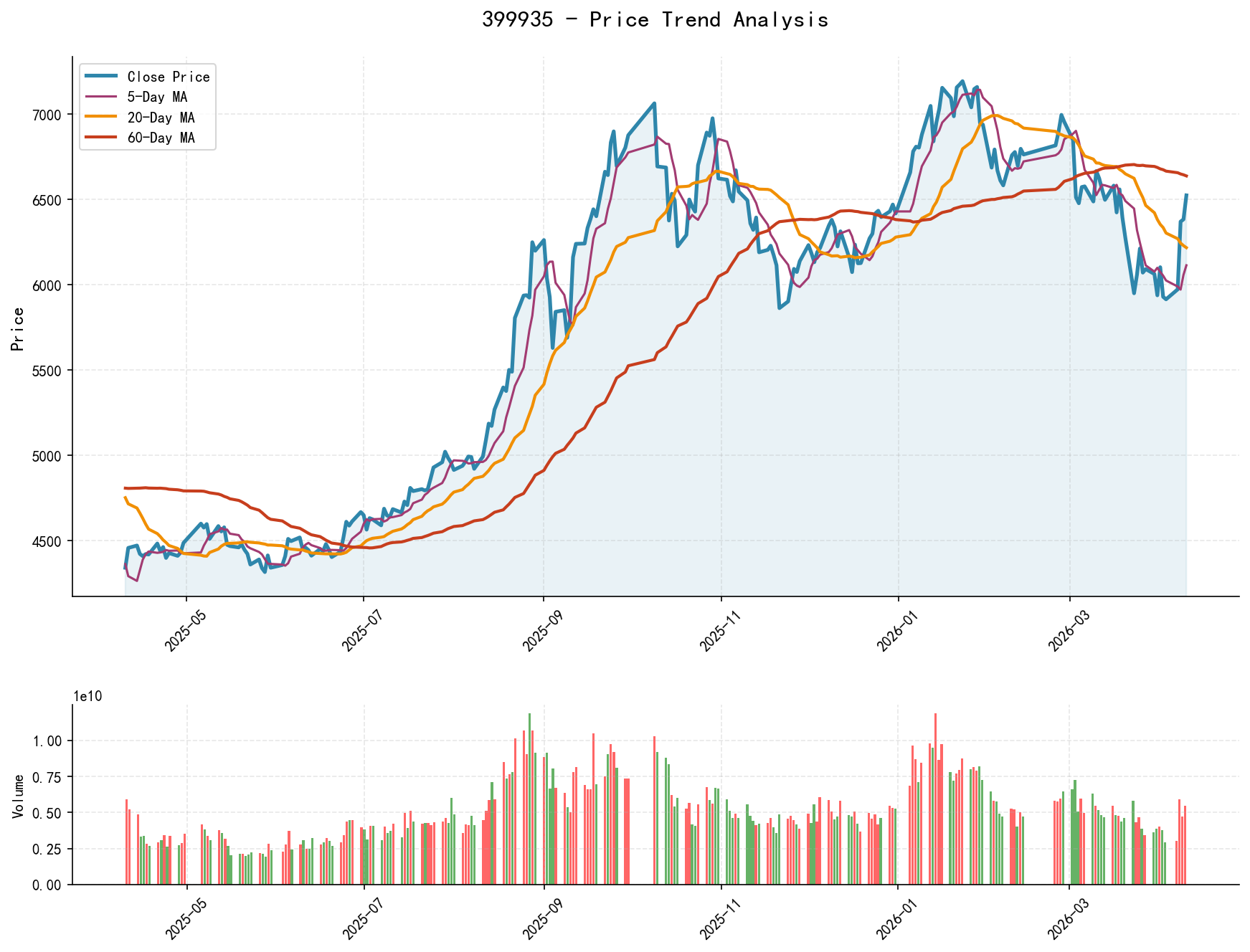
As of April 10, 2026, the underlying asset 399935 opened at 6459.36, closed at 6523.97, with a 5-day moving average (MA5) of 6114.20, a 10-day moving average (MA10) of 6083.88, and a 20-day moving average (MA20) of 6217.41. Daily change: +2.20%. Weekly change: +10.30%. Monthly change: +9.86%. Quarterly change: +9.86%. Year-to-date change: +1.65%.
- • Moving Average Alignment and Price Relationship:
- • Long-term Trend (Bear-dominated): As of the analysis period end (2026-04-10), the price (6523.97) is positioned between MA60 (6637.72) and MA30 (6368.79). The alignment MA20 (6217.41) < MA30 < MA60 indicates a long-term bearish arrangement. The price has been continuously pressured below MA30 since mid-March, confirming a weak medium-term trend.
- • Short-term Rebound (Bullish Repair): The price staged a strong three-day rally in early April (April 8-10), successfully breaking above MA5 (6114.20) and MA10 (6083.88), and drove MA5 above MA10, forming a short-term bullish alignment. This marks a shift in the short-term trend from decline to a corrective rebound.
- • Key Crossover Signal: A bullish
MA_CROSS_5_10"golden cross" (MA5 crossing above MA10) occurred on 2026-04-08, providing technical confirmation for the initiation of the recent rebound.
- • Price Action and Inferred Market Phase (Wyckoff Framework):
- • Phase 1: Panic Selling and Initial Support: This phase is clearly recorded in the data. On March 23rd, the index plummeted -5.17%, with volume surging 24.68% sequentially to 5.8 billion (
VOLUME_AVG_60D_RATIO=0.92), and the RSI dropped to an extremely oversold level of 30.08. Combined with its historical ranking as the 20th largest single-day drop in the past 10 years, this aligns with characteristics of panic selling. Subsequently, from March 24th to 31st, the price oscillated repeatedly within a low range (5923-6102) with moderately increased volume, showing initial signs of support and absorption. - • Phase 2: Automatic Rally and Accumulation Suspicions: On April 8th, the price closed near its daily high, surging 6.65% (historical rank: 7th), with volume exploding by 95.62% to 5.9 billion (
VOLUME_AVG_60D_RATIO=0.96, historical rank: 11th). This "high-volume breakout rally" is a typical feature of an automatic rally, strongly suggesting that large buyers ("smart money") were absorbing selling pressure at the lower range, indicating a potential transition into an Accumulation phase. - • Current Phase: Secondary Test or Rebound Continuation: On April 9th and 10th, prices continued to rise but at a decelerating pace, with volume failing to surpass the high of the 8th, showing a divergence pattern of "rising price with declining volume". This can be interpreted as a secondary test of previous selling pressure or a natural exhaustion of rebound momentum. The market is testing whether supply (selling pressure) re-emerges at higher rebound levels.
- • Phase 1: Panic Selling and Initial Support: This phase is clearly recorded in the data. On March 23rd, the index plummeted -5.17%, with volume surging 24.68% sequentially to 5.8 billion (
Conclusion: The market has undergone a complete process of panic decline (late March) → initial stabilization (end of March) → strong rebound (early April). It is currently at a critical juncture, transitioning from a potential accumulation phase towards a new uptrend, or facing a secondary test after the rebound. The short-term trend has turned bullish, but the medium-term trend remains suppressed by longer-term moving averages.
2. Volume-Price Relationship and Supply-Demand Dynamics
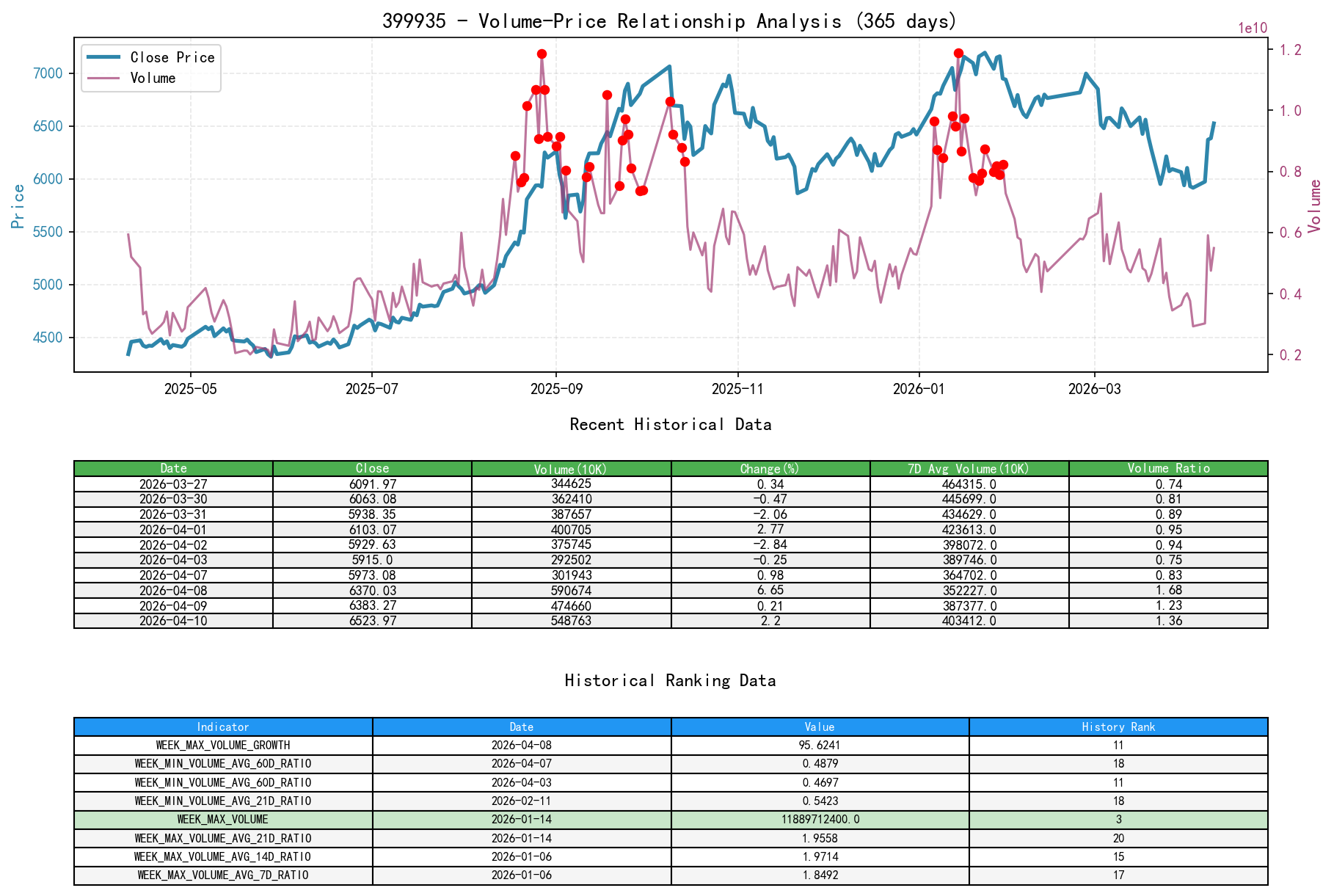
As of April 10, 2026, the underlying asset 399935 opened at 6459.36, closed at 6523.97, with a volume of 5,487,638,200, daily change of +2.20%, and a 7-day average volume of 4,034,127,271.43, resulting in a 7-day volume ratio of 1.36.
- • Identification of Core Supply-Demand Events:
- 1. Supply-Driven Panic Selling (2026-03-23): A price plunge of -5.17% accompanied by huge volume (5.8 billion) is a classic "high-volume decline", indicating a massive outflow of panic supply (sell climax). This is a preliminary signal of a potential trend termination.
- 2. Demand-Driven Strong Rebound (2026-04-08): A price surge of 6.65% accompanied by even larger volume (5.9 billion) is a classic "high-volume advance". The
VOLUME_GROWTHof 95.6% and its historical rank of 11th indicate exceptionally strong and aggressive demand (buying climax), successfully absorbing residual selling post-panic and previous trapped positions. - 3. Weakening Demand / Emerging Supply (2026-04-09 & 10): On April 9th, the gain narrowed to 0.21% with volume declining 19.6%; on April 10th, the gain was 2.20%, and while volume recovered 15.6% sequentially, the absolute level remained below that of the 8th. For two consecutive days, the
VOLUME_AVG_60D_RATIOwas lower than on the 8th, showing a "price up, volume down" divergence, suggesting waning follow-through demand or the emergence of new supply (profit-taking or breakout selling) at current levels.
- • Quantitative Analysis of Volume Anomalies:
- • Demand Peak: The
VOLUME_AVG_60D_RATIO(0.96) andVOLUME_GROWTH(95.62%) on April 8th point to abnormally intense buying demand. - • Supply Exhaustion Signal: Following the panic selling on March 23rd, the overall volume level (compared to the 60-day average) did not continuously contract; instead, it expanded during the rebound, indicating active trading and sufficient turnover, facilitating the transfer of holdings from weak to strong hands.
- • Demand Peak: The
Conclusion: The market's supply-demand relationship underwent a decisive shift on April 8th, with demand overpowering supply to initiate this rebound. However, the failure of volume to expand further in the subsequent two sessions warrants caution regarding potential demand exhaustion or new supply entry. Overall, the high-volume turnover from late March to early April constitutes a potential "accumulation range".
3. Volatility and Market Sentiment
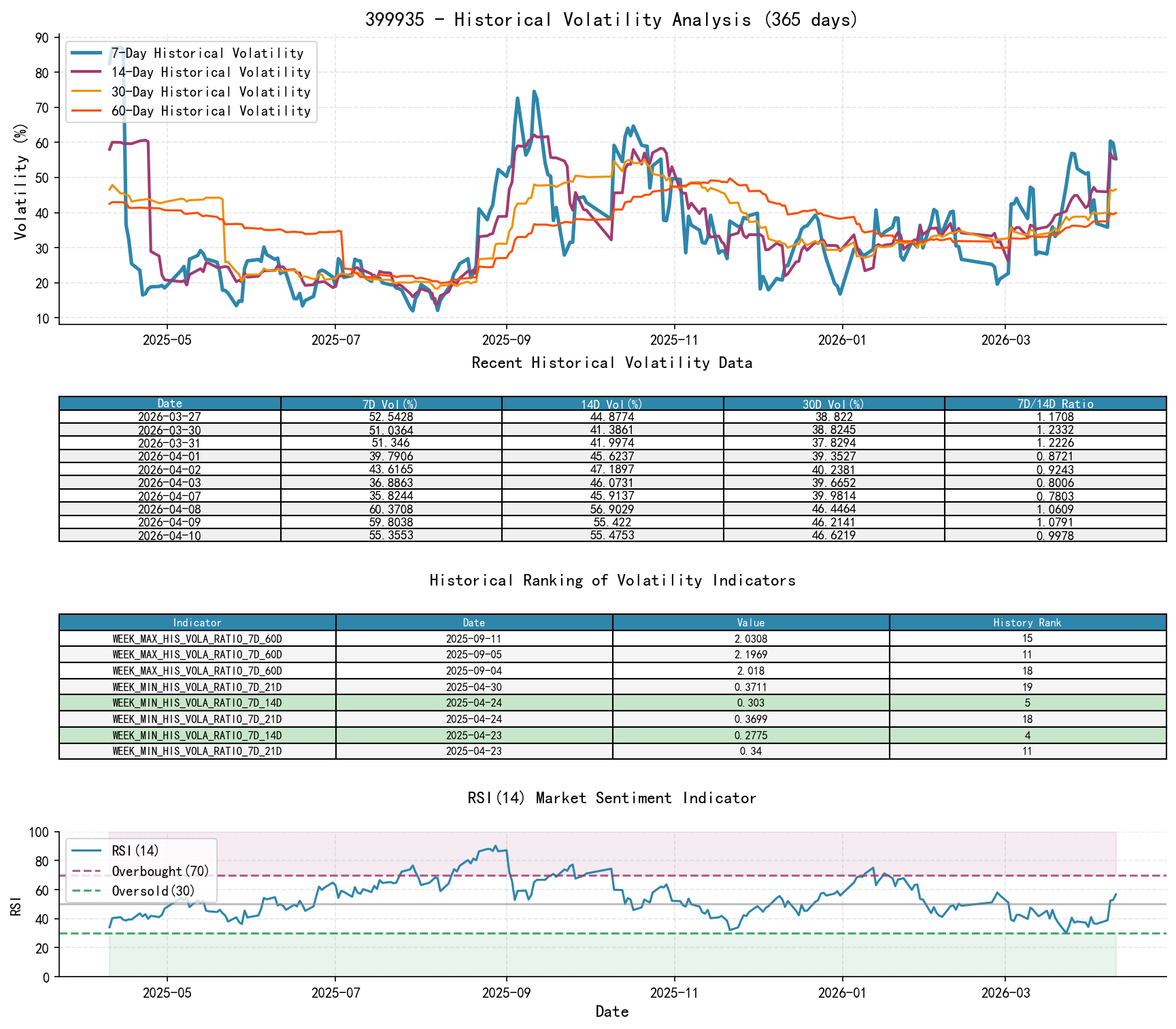
As of April 10, 2026, the underlying asset 399935 opened at 6459.36, with a 7-day intraday volatility (Parkinson) of 0.24 (ratio vs 60-day avg: 0.83), a 7-day historical volatility of 0.55 (ratio vs 60-day avg: 1.00), and an RSI of 56.77.
- • Volatility Levels and Changes:
- • Panic and Turning Period (Late March to Early April): Both
HIS_VOLA_7DandPARKINSON_VOL_7Dshowed significant peaks around the March 23rd plunge and the April 8th surge. Particularly on April 8th,HIS_VOLA_RATIO_7D_60Dreached 1.52, indicating short-term volatility was 52% above its long-term average, reflecting a rapid sentiment shift from extreme panic (late March) to extreme optimism (early April). - • Stabilizing Sentiment (Current): As of April 10th,
HIS_VOLA_RATIO_7D_60Dhas receded to 1.39, andPARKINSON_RATIO_7D_60Dto 0.86. This indicates that while short-term volatility remains above its long-term mean, intraday volatility (Parkinson) has converged below its long-term average. Market sentiment has recovered somewhat from extreme states, with panic fading.
- • Panic and Turning Period (Late March to Early April): Both
- • RSI Confirmation of Sentiment Extremes:
- • The RSI dropped to 30.08 on March 23rd, confirming an extremely oversold market condition and providing a technical basis for a rebound.
- • The RSI rose to 56.77 by April 10th, moving out of the oversold zone into a neutral-to-strong region, not yet overbought (>70), leaving room for further upside in the rebound.
Conclusion: Volatility data and RSI corroborate each other. The market experienced an extreme sentiment panic point in late March, followed by rapid sentiment repair during the violent rebound in early April. Current sentiment indicators show the market has moved out of panic and is in a relatively healthy neutral zone, with short-term volatility having somewhat收敛.
4. Relative Strength and Momentum Performance
- • Periodic Return Analysis:
- • Strong Short-term Momentum:
WTD_RETURN(week-to-date as of April 10th) is as high as +10.30%, andMTD_RETURN(month-to-date for April) is +9.86%, indicating very strong short-term momentum, fully consistent with the demand explosion identified in the volume-price analysis. - • Medium-term Momentum Turns Positive but Unstable:
QTD_RETURN(quarter-to-date) is +9.86%, primarily contributed by the April rebound.YTD(year-to-date) has just turned positive to +1.65%, suggesting the long-term downtrend has been preliminarily contained, but the sustainability of the medium-term (MTD, QTD) strength is key. - • Momentum Validation: The strong short-term momentum (WTD, MTD) validates the effectiveness of the high-volume advance on April 8th, indicating the market possesses powerful short-term bullish momentum.
- • Strong Short-term Momentum:
Conclusion: The underlying asset has demonstrated极强的 relative strength and momentum in the short term, dominating the market rebound. However, the medium-to-long-term momentum indicator (YTD) has only weakly turned positive, suggesting that a reversal of its long-term trend still requires time and further confirmation through upward breakthroughs.
5. Identification of Large Investor ("Smart Money") Behavior
Based on Wyckoff events and market structure, large investor behavior is inferred as follows:
- 1. Absorption During Panic Selling (Late March): The high-volume plunge on March 23rd can be viewed as a "Selling Climax," typically accompanied by irrational selling from public investors. The subsequent low-range oscillation with relatively active volume (
VOLUME_AVG_60D_RATIObetween 0.6-0.9) and failure to make new lows suggests institutional funds were absorbing supply (Accumulation) covertly, rather than mere retail bottom-fishing. - 2. Active Pushing and Testing (April 8th): The massive long green candle on April 8th is typical "scrambling for shares" behavior. Smart money used substantial buying power to rapidly push prices higher, likely aiming to: a) Confirm the validity of underlying support; b) Force short covering; c) Test the strength of selling pressure at resistance levels above. The day's volume historical rank of 11th indicates this was a标志性 large-scale action by smart money.
- 3. Observation and Testing Supply (April 9-10): The volume-price divergence over the two days following the rebound may represent a shift in smart money strategy: from "active buying and pushing" to "observing market reaction." They are testing whether at higher price levels, public investors choose to follow with buying (sustained demand) or opt for profit-taking (emerging supply). This constitutes an observation post-"shakeout" or "secondary test" behavior.
Conclusion: Large investors conducted preliminary accumulation during the late March panic and launched a concentrated, force-demonstrating buy on April 8th aimed at reversing market sentiment and trend. They may now be entering an observation and testing phase to judge the sustainability of the rebound and the true supply pressure above.
6. Support/Resistance Level Analysis and Trading Signals
- • Key Levels:
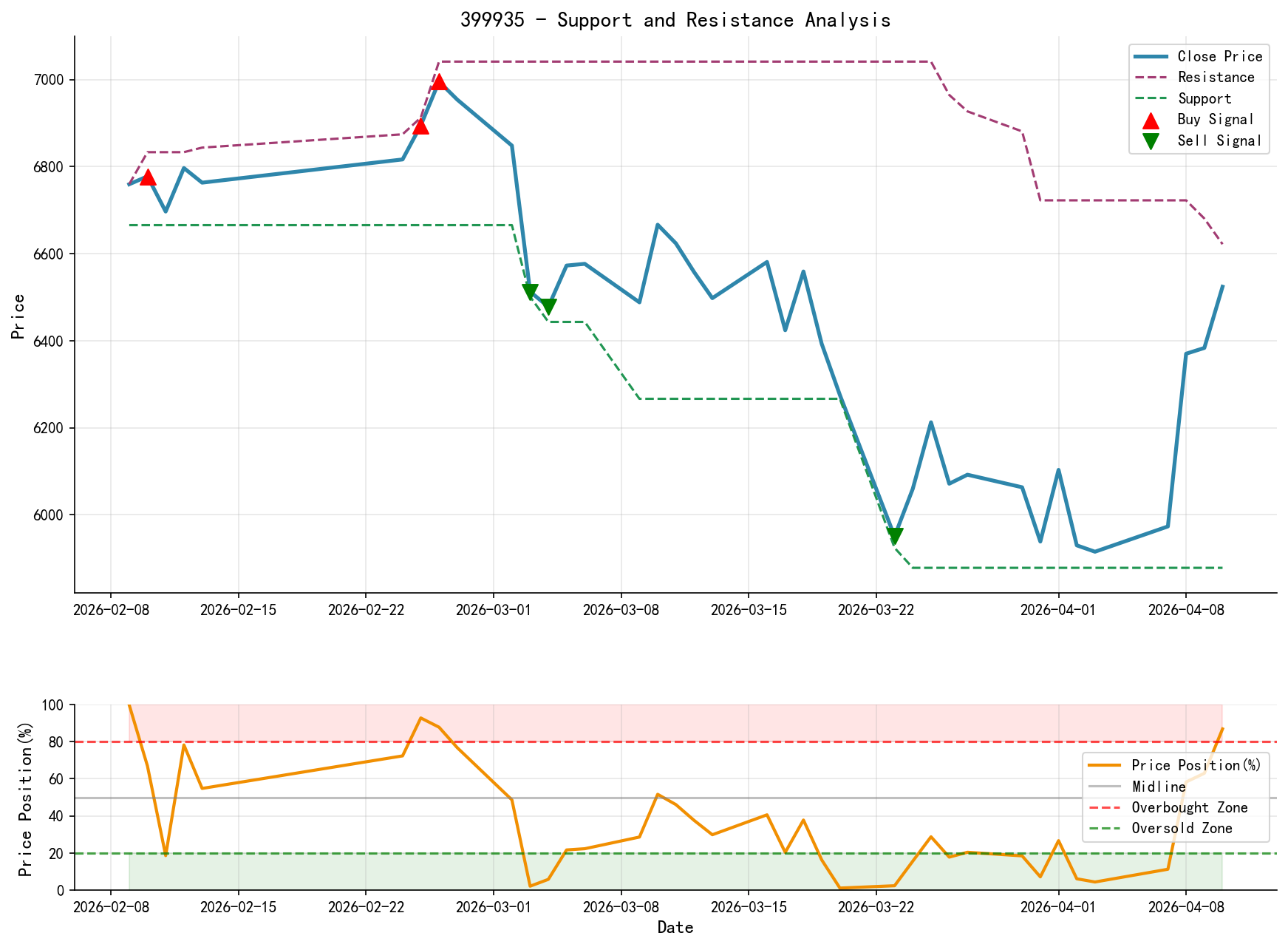
- • Strong Resistance Zone: 6800 - 7050 points. This area represents the high-density zone from the late February rebound (corresponding to historical ranking data for
WEEK_MAX_CLOSEranks 12-20) and is also near MA30 (~6368) and the starting point of the previous decline. This is the first major hurdle to test the quality of the rebound. - • Minor Resistance / Recent High: 6580 points. The high on April 10th. A breakout above this level opens the path to test the strong resistance zone.
- • Key Support Zone: 6000 - 6100 points. This is the launch platform for the early April rebound and the area tested multiple times without breaking in late March. An effective breach of this zone would signal rebound failure.
- • Bull-Bear Demarcation Lines: MA30 (6368) and MA60 (6637). A decisive break above MA30 is the first step towards medium-term strength; overcoming MA60 could potentially宣布 a long-term trend reversal.
- • Strong Resistance Zone: 6800 - 7050 points. This area represents the high-density zone from the late February rebound (corresponding to historical ranking data for
- • Comprehensive Trading Signals and Operational Suggestions:
- • Overall Assessment: Bullish in the short term, but the rebound has entered a key resistance zone, warranting caution against pullback risks. The market is in a "rebound-testing" phase; the ultimate trend direction depends on the outcome of testing overhead resistance.
- • Bullish Scenario (Requiring Confirmation): If the price pulls back to the 6250-6350 area (MA10 to MA30 region) and finds support with contracting volume (supply exhaustion), it could be considered a buying opportunity. The entry signal would be a renewed high-volume advance (
VOLUME_AVG_60D_RATIO > 1.1). Initial stop-loss can be placed below the 6100 point support. - • Bearish/Watchful Scenario: If the price shows clear signs of high-volume stagnation (large daily range with minimal closing gain and huge volume) or long upper shadows near 6580 points or the 6800 point zone, it signals emerging supply, and consideration should be given to reducing positions or adopting a wait-and-see approach.
- • Future Key Validation Points:
- 1. Demand Validation: Whether volume expands (
VOLUME_AVG_60D_RATIO > 1.1) as price approaches resistance levels, indicating demand overcoming supply. - 2. Supply Validation: Whether volume contracts (
VOLUME_AVG_60D_RATIO < 0.7) during price pullbacks, indicating limited supply. - 3. Structure Validation: Whether the price can establish a Higher Low (HL) over the next 1-2 weeks, confirming the雏形 of an uptrend.
- 1. Demand Validation: Whether volume expands (
Final Action Recommendation: For aggressive traders, small long positions can be试探 attempted if the price retraces to the support zone with accompanying demand signals, using strict stop-losses. For conservative investors, waiting on the sidelines is advised until the market completes its test of the 6800-7000 point strong resistance zone and forms a clear structure (e.g., breakout or rejection) before making decisions. The risk of chasing the current move outweighs the potential reward.
Disclaimer: This report/analysis content is solely market analysis and research based on publicly available information and does not constitute any investment advice or operational guidance. The author strives for objectivity and impartiality but makes no guarantees regarding its accuracy or completeness. Markets involve risks, and investments require caution. Any investment actions taken based on this report are at your own risk.
Thank you for your attention! Daily Wyckoff Volume-Price Market Interpretation is released promptly at 8:00 AM before the market opens. We kindly request your comments and shares; your recognition is crucial. Let's work together to see the market signals clearly.
Member discussion: