Wyckoff Quantitative Analysis Report: Product Code 399934
Report Date: 2026-04-10
Analysis Period: 2026-02-09 to 2026-04-10
1. Trend Analysis and Market Phase Identification
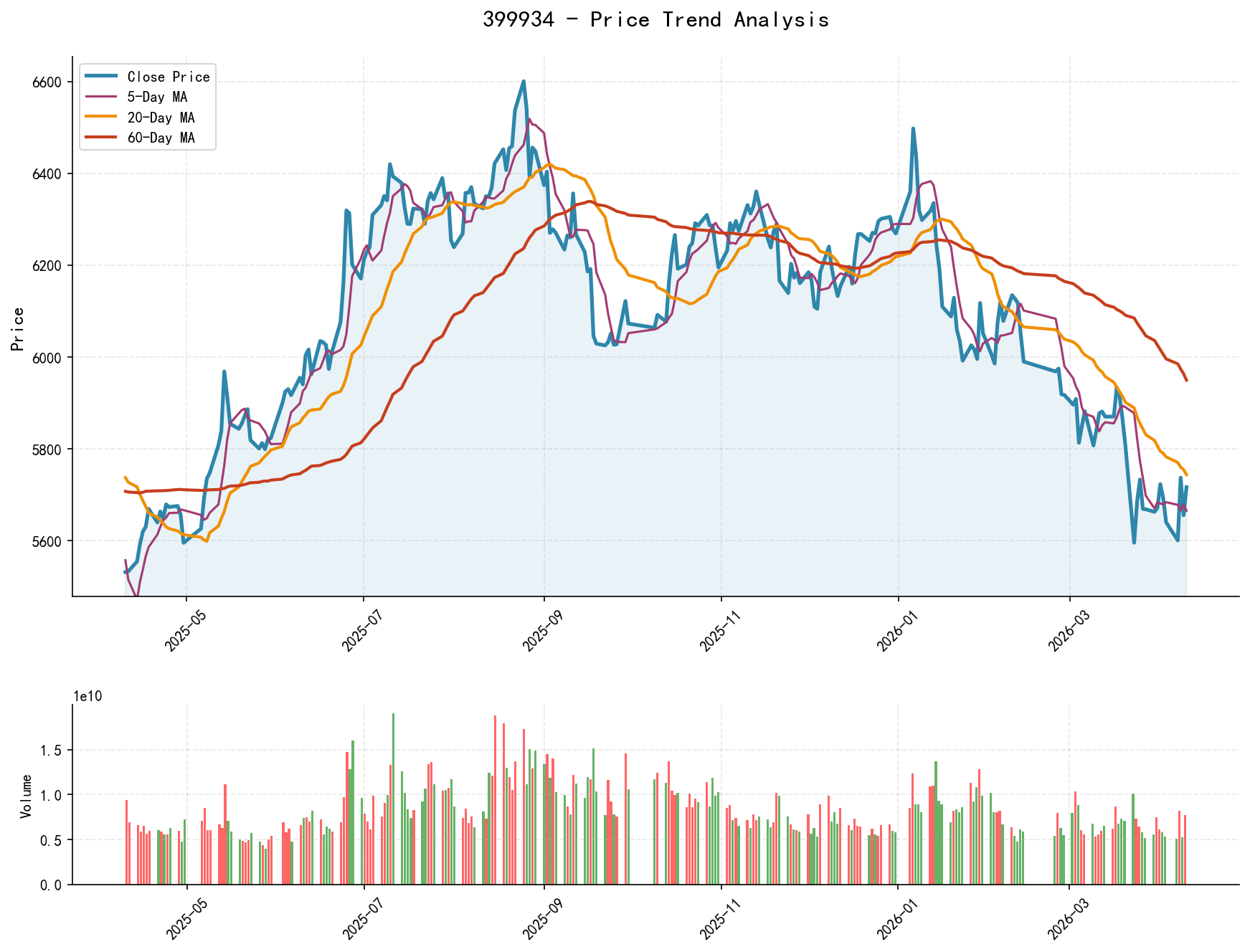
As of April 10, 2026, the underlying asset 399934 had an open price of 5689.89, a close price of 5716.54, a 5-day moving average of 5665.24, a 10-day moving average of 5672.14, a 20-day moving average of 5743.79, a daily change of 1.08%, a weekly change of 1.35%, a monthly change of 0.79%, a quarterly change of 0.79%, and a year-to-date change of -8.82%.
- • Moving Average Arrangement and Price Relationship:
- • Throughout the analysis period, the price (CLOSE) experienced a significant downtrend. Since the February high of 6134.90, the price continued to decline, reaching the cycle low of 5595.56 on March 23rd. During this time, the price consistently traded below all major moving averages (MA_5D, MA_10D, MA_20D, MA_30D, MA_60D), forming a standard bearish alignment.
- • As of the last day of the analysis period (April 10th), the price (5716.54) remained below the MA_20D (5743.79) and MA_60D (5949.63), indicating that the medium-to-long-term downtrend has not undergone a fundamental reversal. The short-term MAs MA_5D (5665.24) and MA_10D (5672.14) are entangled, showing a slowdown in the short-term decline and entry into a consolidation phase.
- • Moving Average Crossover Signals:
- • No significant "golden cross" signals, where short-term moving averages cross above long-term ones, were observed during the period. Conversely, short-term moving averages consistently remained below long-term ones; relationships such as MA_5D below MA_20D and MA_10D below MA_60D maintained a bearish alignment, confirming the mid-term downtrend.
- • Market Phase Inference (Based on Wyckoff Theory):
- • Primary Phase: Decline and Panic Selling. From mid-February to late March, the price transitioned from an orderly decline (February) to an accelerated plunge (March 23rd, -3.63%), aligning with the characteristics of the "Decline" to "Panic Selling" phases in Wyckoff theory.
- • Current Phase: Automatic Rally and Secondary Test. Following the panic low on March 23rd, the market experienced an "Automatic Rally," with the price rebounding above 5700. Subsequently, the market entered consolidation with diminished volume. This aligns with the initial characteristics of the "Secondary Test" phase following panic selling, where the market is testing for persistent supply (selling pressure) near the panic low.
2. Volume-Price Relationship and Supply-Demand Dynamics
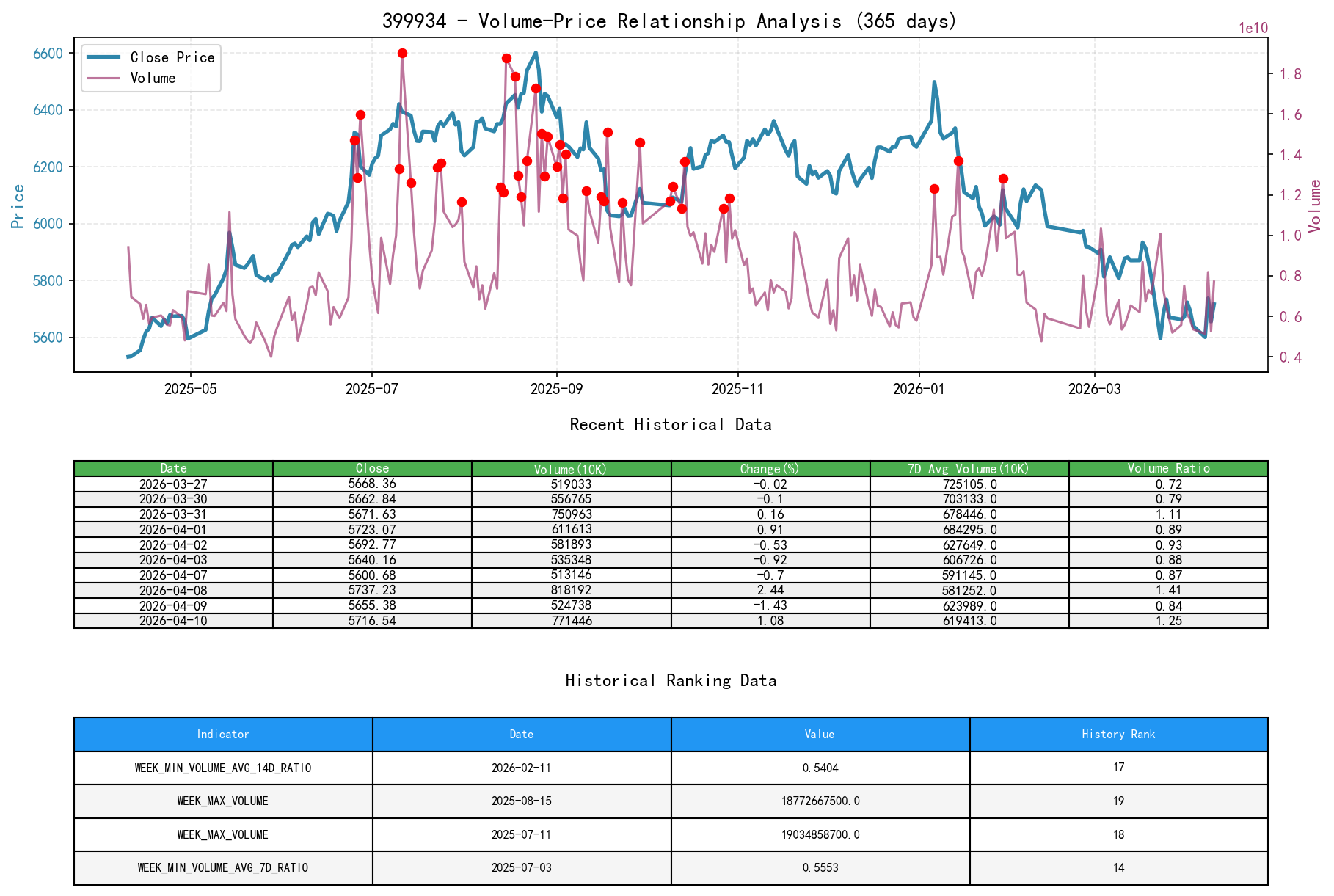
As of April 10, 2026, the underlying asset 399934 had an open price of 5689.89, a close price of 5716.54, a trading volume of 7714463100, a daily change of 1.08%, a trading volume of 7714463100, a 7-day average volume of 6194139057.14, and a 7-day volume ratio of 1.25.
- • Key Day Analysis:
- • Panic Selling Day (2026-03-23): Price plunged -3.63%, with volume surging to 10.08 billion (VOLUME_AVG_30D_RATIO=1.44), one of the highest single-day volumes in the cycle. Price down, volume up, closing near the day's low—this is a classic panic selling signal dominated by supply, indicating massive, indiscriminate selling.
- • Demand Attempt Days (2026-04-08 & 2026-04-10):
- • April 8th: Price rose +2.44%, with volume at 8.18 billion (VOLUME_AVG_30D_RATIO=1.22). Price up, volume up, closing near the day's high, showing significant demand entering to absorb supply after the decline. This is a preliminary positive signal.
- • April 10th (Period End Day): Price rose +1.08%, with volume at 7.71 billion (VOLUME_AVG_30D_RATIO=1.15). Price up, volume up, but the candlestick left a long upper shadow, indicating supply resistance was encountered when the rebound reached the high of 5776. Overall, demand attempted to dominate, but overhead pressure became apparent.
- • Supply Appearance Days (2026-03-09, 2026-04-09): Price declined (-1.27%, -1.43%) accompanied by relatively high volume (VOLUME_AVG_7D_RATIO>0.94), representing down days on increased volume. This indicates supply re-emerging during the rebound, hindering price advancement.
- • Volume Anomaly Analysis:
- • The VOLUME_GROWTH on the Panic Day (March 23rd) was as high as +41.99%, and all volume ratios (VOLUME_AVG_*D_RATIO) were greater than 1, confirming the extremity of the selling activity.
- • During the initial rebound after the Panic Day (March 24th - April 1st), *VOLUME_AVG_D_RATIO was less than 1 on most days, showing insufficient rebound volume and weak follow-through demand.
- • Recently (April 8th, 10th), volume ratios have returned above 1, especially relative to the 7-day and 30-day averages, indicating demand strength has increased at the current level.
3. Volatility and Market Sentiment
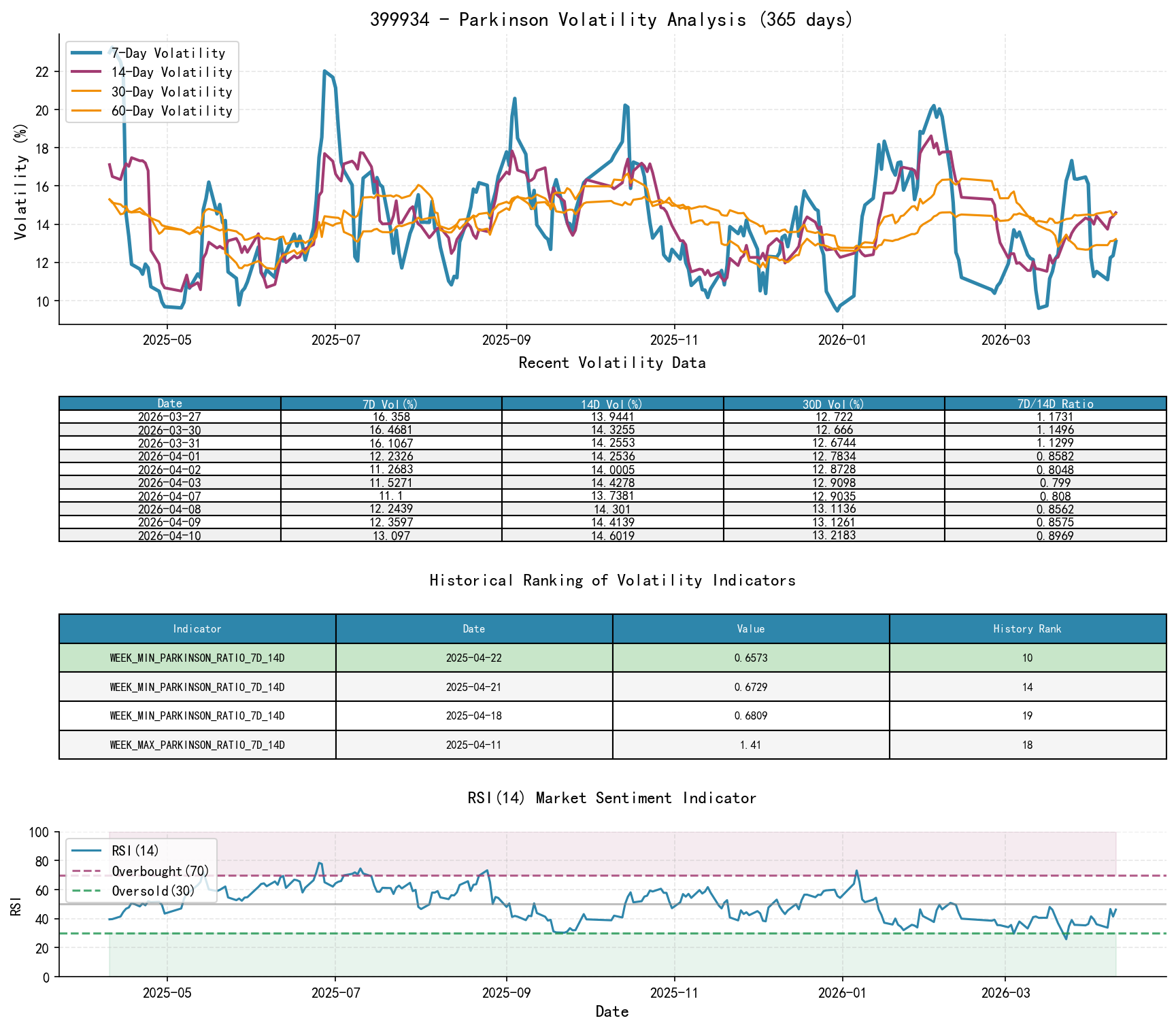
As of April 10, 2026, the underlying asset 399934 had an open price of 5689.89, a 7-day intraday volatility of 0.13, a 7-day intraday volatility volume ratio of 0.90, a 7-day historical volatility of 0.26, a 7-day historical volatility volume ratio of 0.91, and an RSI of 46.28.
- • Volatility Level and Changes:
- • Panic Period Characteristics Are Pronounced: Around March 23rd, both HIS_VOLA_7D and PARKINSON_VOL_7D reached their cycle peaks (0.2826, 0.1627). HIS_VOLA_RATIO_7D_60D was as high as 1.55, and PARKINSON_RATIO_7D_60D was 1.14, indicating short-term volatility far exceeding the long-term average. This is a typical data characteristic of market panic and trend acceleration.
- • Volatility Convergence: After the Panic Day, volatility indicators continued to decline. As of April 10th, HIS_VOLA_RATIO_7D_60D (1.36) and PARKINSON_RATIO_7D_60D (0.90) remain above or near equilibrium levels, showing that while market sentiment has recovered from extreme panic, it is not yet fully stabilized.
- • Overbought/Oversold Status (RSI):
- • The RSI_14 dropped to 25.83 on March 23rd, entering the traditional oversold territory, resonating with the panic price decline and confirming extreme pessimism.
- • Subsequently, the RSI oscillated higher, reaching 46.28 as of April 10th. It has moved out of the oversold zone but not into the overbought zone, indicating sentiment has recovered from extreme pessimism to neutral-weak, providing an emotional foundation for a rebound.
4. Relative Strength and Momentum Performance
- • Periodic Return Analysis:
- • All Periodic Returns Are Negative: YTD, QTD, and MTD returns are all negative (-8.82%, 0.79%, 0.79%), indicating relative weakness in the year-to-date, quarter-to-date, and month-to-date dimensions.
- • Momentum Divergence: WTD_RETURN (+1.35%) has turned positive, while MTD_RETURN (+0.79%) remains low. This verifies that short-term momentum shows signs of rebounding, but mid-term momentum remains weak, casting doubt on the sustainability and height of the rebound. The momentum structure does not support a trend reversal, only an oversold rebound.
5. Large Investor (Smart Money) Behavior Identification
- • Panic Selling Period (Mid-to-late March): The massive plunge on March 23rd is typical of late-stage Distribution or Panic Selling. At this time, panicked retail investors and some institutions were likely the main sellers. The key point is that such enormous volume must have been met with counterparty buying. Wyckoff theory posits that massive volume during panic often implies large investors are passively or actively absorbing the sell-off, which may be preparation for future accumulation, but this requires verification by subsequent price action.
- • Consolidation/Rebound Period (Late March to Early April): Diminished volume during the initial rebound (most VOLUME_AVG_RATIO values less than 1) indicates large investors did not make substantial purchases at this level, possibly remaining观望 or engaging in small-scale testing. The market was driven by short covering and少量抄底资金.
- • Recent Rebound on Increased Volume (April 8th, 10th): Price rose on increased volume, especially on April 10th, where the price探阻力后虽回落但仍收涨. This may暗示 institutional funds beginning tentative accumulation or short covering. However, the upper shadow also indicates明显的供应 (profit-taking or减持盘) was encountered in this zone; the buying行为遭遇抵抗. The current phase may be the early testing stage of Accumulation, where large investors are testing overhead supply pressure and market follow-through willingness.
6. Support/Resistance Level Analysis and Trading Signals
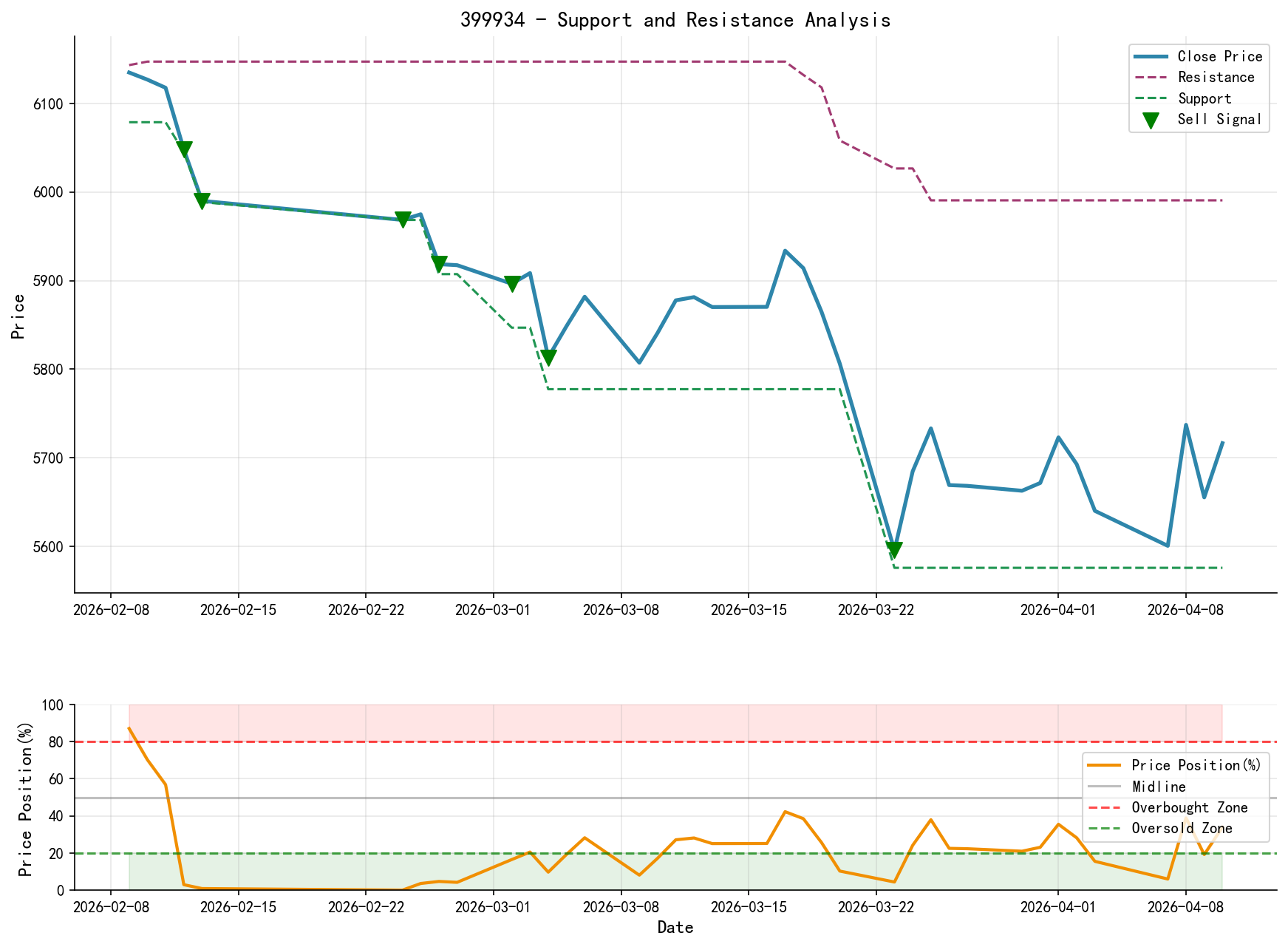
- • Key Support Levels:
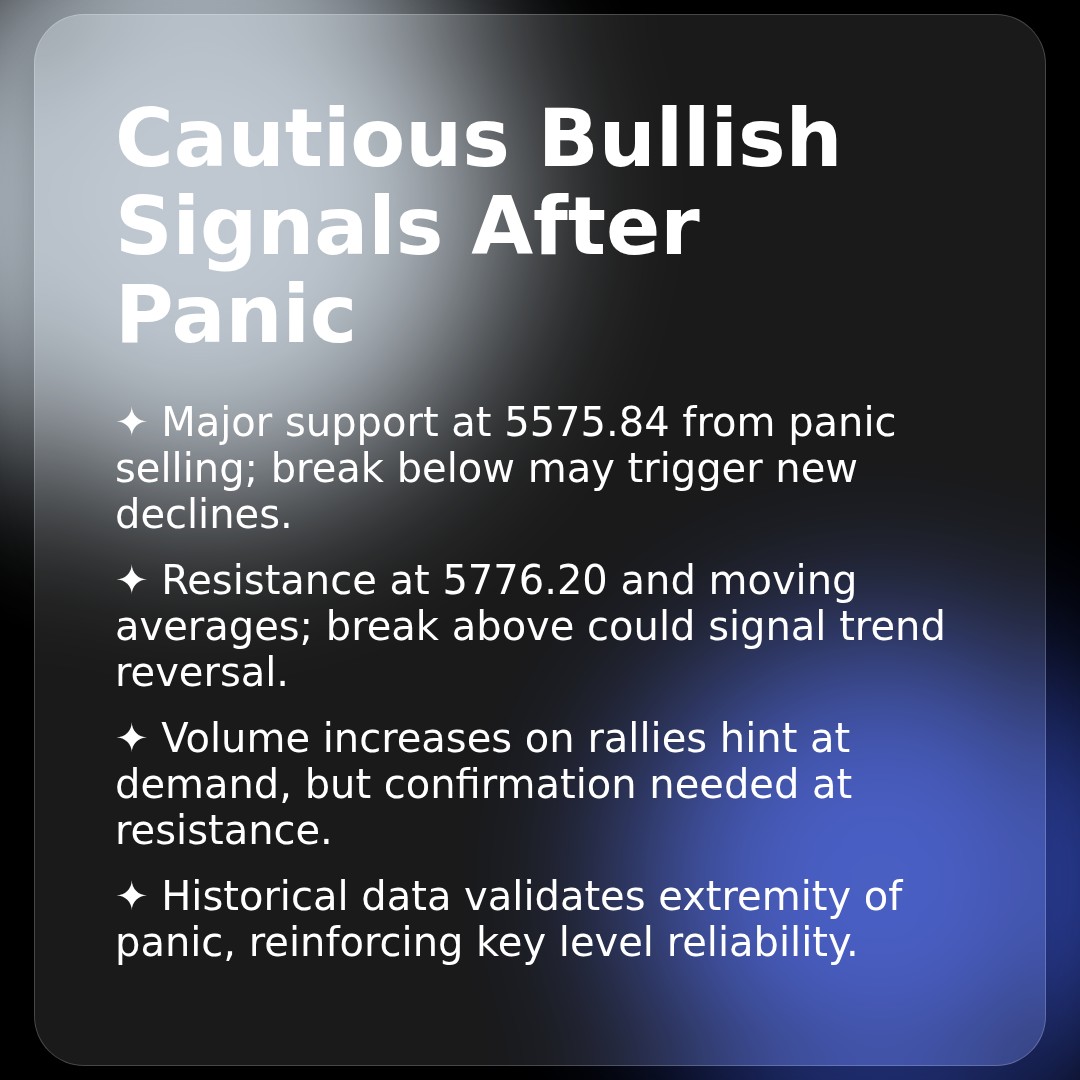
- • Major Support: 5575.84 (2026-03-23 LOW). This is the low formed by panic selling and the极限测试 location of this decline. A decisive break below this level would open新的下跌空间.
- • Secondary Support: 5650-5680 zone. The area of recent多次回踩 lows, also where the price opened and pulled back to on April 10th.
- • Key Resistance Levels:
- • Recent Resistance: 5776.20 (2026-04-10 HIGH). The latest反弹高点, also the location where supply appeared as indicated by the upper shadow.
- • Important Resistance: MA_20D (5743) and MA_60D (5950). Medium-to-long-term moving averages are significant trend resistance levels. A decisive break above MA_20D signals a moderation of the downtrend, while a break above MA_60D could potentially signal a trend reversal.
- • Historical Ranking Data Integration and Extremity Judgment:
- • The data indicates that the single-day decline on 2026-03-23 (-3.63%) ranks 15th in the past decade's history. This, from a long-term perspective, confirms the significant extremity of that day's drop, belonging to a low-probability panic event, strengthening the reliability of our判断 that day as a "Panic Selling" key day.
- • The volume ratio on 2026-02-11 (0.54) ranks 17th in the past decade's history, indicating a state of thin trading and浓厚观望情绪 at that time, which is also historically notable.
- • Comprehensive Wyckoff Trading Signals and Operational Suggestions:
- • Macro Judgment: The market is in a transition phase from Panic Decline towards Attempting to Form a Base. The primary panic selling has occurred (March 23rd), followed by an automatic rally. Currently, it is in the phase of conducting a secondary test on the panic low and confirming demand.
- • **Current Signal: Cautiously bullish, but confirmation is needed. The increased volume上涨 on April 8th and 10th are positive preliminary demand signals, but price remains constrained by key moving averages, and the rebound faces supply testing.
- • Operational Suggestions:
- 1. Long Strategy (Light Position Probing): Consider establishing a small long position when the price retraces to the 5650-5680 support zone and shows signs of stabilization on diminished volume. The initial stop-loss should be set below the 5575 low.
- 2. Add Position/Trend Confirmation Condition: If the price subsequently breaks above and sustains above the recent high of 5776 and the MA_20D on increased volume (VOLUME_AVG_30D_RATIO > 1.2), this can be视为需求战胜供应、反弹可能升级的信号, allowing for consideration of适度加仓.
- 3. Short Strategy/Risk Avoidance: If the price shows increased volume with停滞或下跌 again near 5776 or MA_20D, it is a signal that supply remains strong, and long positions should be avoided. If the price breaks below the 5650 support accompanied by放大成交量, the secondary test may have failed, and the downtrend could resume; consider exiting or seeking shorting opportunities.
- • Future Key Validation Points:
- • Bullish Validation: Whether the price can find support (indicating萎缩供应) in the 5650-5700 zone during subsequent pullbacks in the form of diminished or温和放量 volume, and then攻击 again on increased volume.
- • Bearish Validation: Whether明显的 放量滞涨或长上影线K线 (supply re-emergence) reappears when the price rebounds to the 5770-5800 zone. Or if it directly breaks below the 5575 support on increased volume.
Disclaimer: This report is based on quantitative analysis of provided historical data. All conclusions are derived from model inferences and are for reference only, not constituting any investment advice. The market carries risks, and investment requires caution.
Thank you for your attention! Wyckoff Volume-Price行情解读 is published daily at 8:00 AM before market open. We kindly request comments and shares; your recognition is crucial. Let's work together to see the market signals.
Member discussion: