
Received. As a quantitative trading researcher proficient in the Wyckoff Method, I will draft a comprehensive, in-depth quantitative analysis report for you based on the provided daily data and historical ranking data for product code 399808.
Wyckoff Price-Volume Principle Quantitative Analysis Report
Product Code: 399808
Analysis Date Range: 2026-02-09 to 2026-04-10
Report Generation Time: Generated based on data as of 2026-04-10
1. Trend Analysis and Market Phase Identification
As of April 10, 2026, the underlying asset 399808 had an opening price of 2934.76, a closing price of 3010.13. Key moving averages: MA_5D at 2873.35, MA_10D at 2951.10, MA_20D at 3018.23. Performance metrics: daily change +3.41%, weekly change +6.91%, monthly change +1.95%, quarterly change +1.95%, yearly change +6.93%.
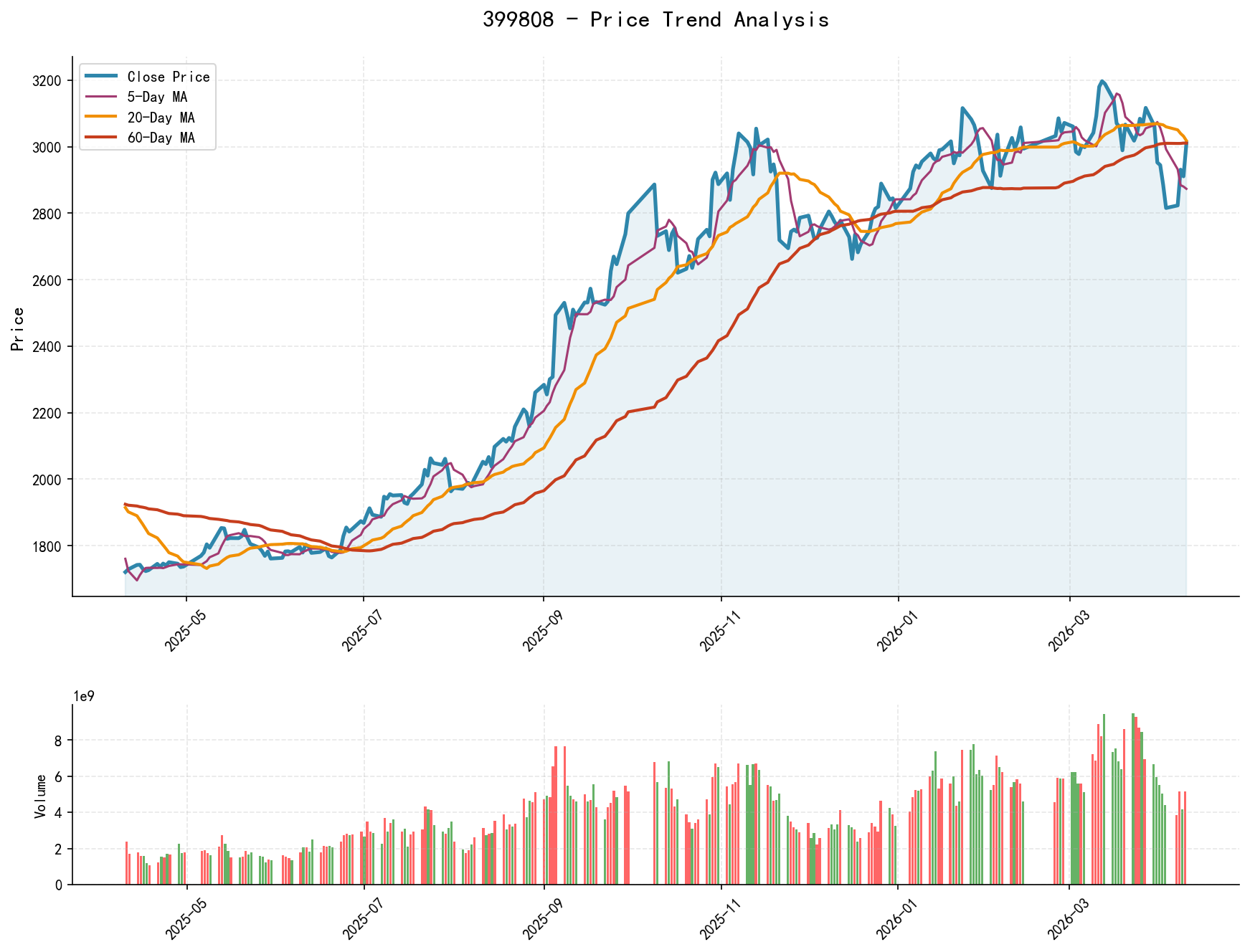
Price and Moving Average Alignment Analysis:
From the beginning of the analysis period until mid-March 2026, the price consistently traded above the key moving averages (MA_5D, MA_10D, MA_20D, MA_30D). The moving averages were arranged in a bullish alignment (MA_5D > MA_10D > MA_20D > MA_30D > MA_60D), confirming the market was in a robust uptrend (Markup Phase).
The turning point occurred on 2026-03-17, when the closing price (3070.20) simultaneously fell below both the MA_5D (3159.80) and MA_10D (3080.53) for the first time, constituting a clear signal of short-term trend breakdown. Subsequently, the price continued to decline. By 2026-04-03, all short-term moving averages (MA_5D, MA_10D, MA_20D) had fallen below the medium-to-long-term moving averages (MA_30D, MA_60D), forming a bearish alignment. This marked the market's formal entry into a Declining Phase. Recently (2026-04-08 to 04-10), the price has rebounded but remains below the MA_30D (3027.36) and MA_20D (3018.23), indicating the downtrend has temporarily met resistance but has not yet reversed.
Market Phase Inference:
According to Wyckoff theory, combined with price and moving average behavior:
- • 2026-03-11 to 03-13: While setting a new phase high (3253.97), the price was accompanied by record-breaking volume (94.23 million lots, historically ranked 2nd) and turnover (historically ranked 10th), constituting a classic Distribution characteristic. This is the initial stage where large investors transfer holdings to retail participants.
- • 2026-03-16 to 04-03: Price declined on high volume, particularly on March 23rd (a drop of -1.58%, with volume hitting a historical record high) and March 31st (a drop of -3.58%). This represents the Panic Selling or Automatic Decline phase following distribution. The market rapidly switched from the frenzy at the end of the uptrend to the panic at the beginning of the downtrend.
- • 2026-04-07 to 04-10: The price halted its decline and rebounded near the previous low (~2820 points), with moderately increasing volume. This aligns with the potential Secondary Test or Preliminary Support characteristics seen in the late stages of a decline, signaling that the market may be attempting to build a pause platform within the downtrend or a potential reversal base. However, entry into an Accumulation phase is not yet confirmed.
2. Price-Volume Relationship and Supply-Demand Dynamics
As of April 10, 2026, the underlying asset 399808 had an opening price of 2934.76, a closing price of 3010.13, volume of 5,155,861,700, daily change of +3.41%, volume of 5,155,861,700, 7-day average volume of 4,855,433,729.43, and a 7-day volume ratio of 1.06.
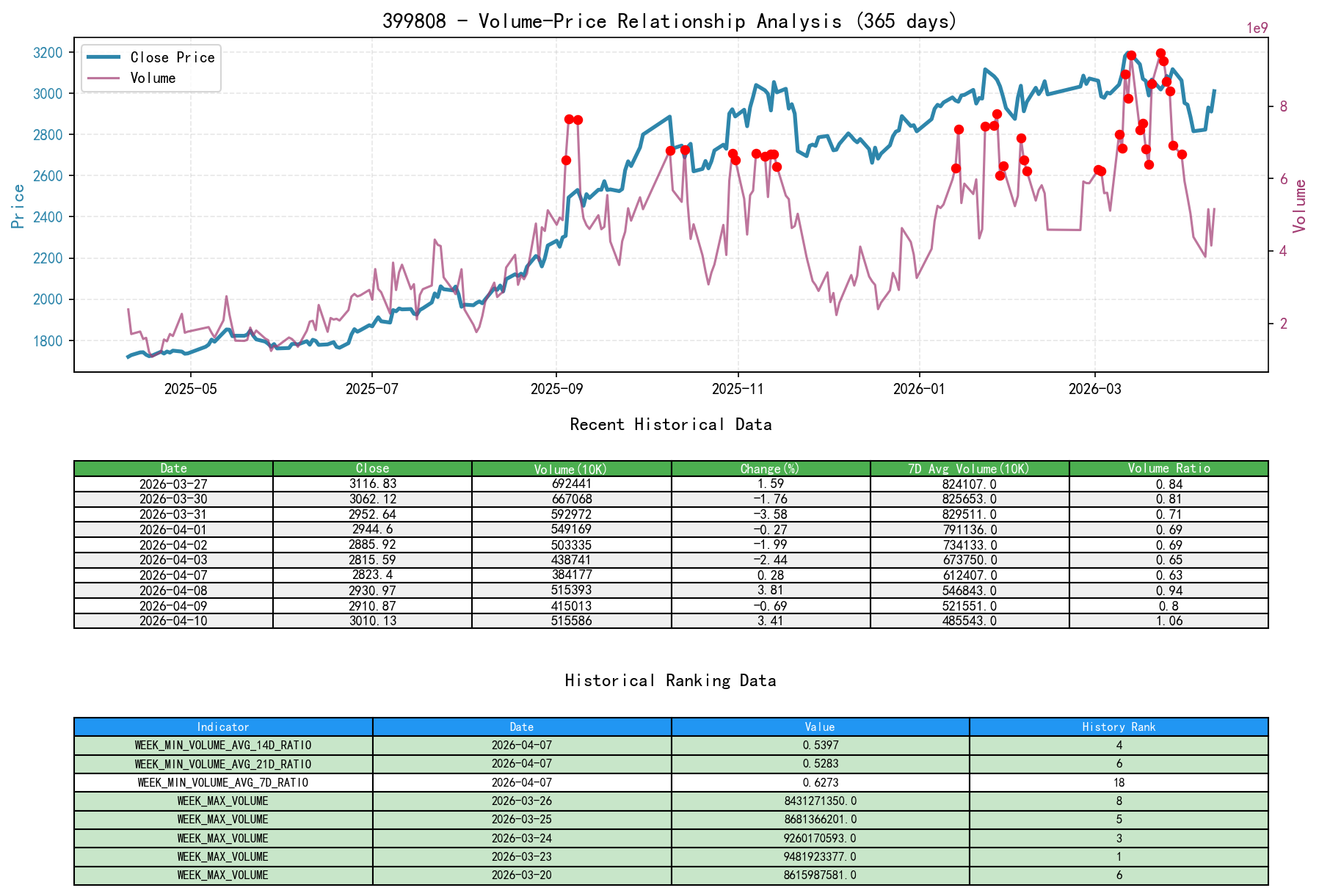
Key Price-Volume Day Analysis:
- • 2026-03-11: High-volume advance + breakout. Price surged 2.85% with volume reaching 88.95 million lots (historically ranked 4th). This is a strong demand signal. However, considering its occurrence near previous highs, it constitutes "Climactic Buying," often foreshadowing the exhaustion of upward momentum and serves as a prelude to distribution rather than the start of a new upswing.
- • 2026-03-12 to 03-13: High-volume stalling. Price oscillated within a small range, but volume remained at historically extreme levels (82.09 million lots / 94.23 million lots). This is a classic signal of Supply Overwhelming Demand, indicating exceptionally strong selling pressure (supply) at historical highs, with buyers unable to push prices higher, confirming the distribution process.
- • 2026-03-23 to 03-24: High-volume decline. Price fell on historically record-breaking volume (1st: 94.82 million lots; 3rd: 92.60 million lots). This is clear evidence of panic selling, where supply (selling pressure) dominated overwhelmingly. The volume ratio values (VOLUME_AVG_14D_RATIO at 1.33 and 1.26 respectively) were both at historical highs, verifying the extremity of the event.
- • 2026-04-03: Low-volume decline. Price fell -2.44%, but volume (43.87 million lots) was only 65% of the 7-day average (VOLUME_AVG_7D_RATIO=0.65), marking one of the lowest volume days recently. This suggests supply power diminished after the accelerated decline, and panic may have temporarily subsided.
- • 2026-04-08 and 04-10: High-volume rebound. Price rose 3.81% and 3.41% respectively, with volume significantly higher than previous days (VOLUME_GROWTH at 34.16% and 24.23%), and the volume ratio (VOLUME_AVG_14D_RATIO) moving away from extreme lows. This signals the re-emergence of demand, potentially representing new buying interest entering near the support level, attempting to challenge supply.
Supply-Demand Pattern Summary:
The market has completed a full cycle from Demand Climax (March 11th) -> Supply Dominance (mid-to-late March) -> Extreme Supply Release (Panic Selling) -> Weakening Supply, Tentative Demand Entry (early April). Currently, it is in a tentative phase where demand is counterattacking after a strong release of supply.
3. Volatility and Market Sentiment
As of April 10, 2026, the underlying asset 399808 had an opening price of 2934.76. Volatility metrics: 7-day intraday Parkinson volatility 0.29, 7-day Parkinson volatility ratio 0.83, 7-day historical volatility 0.46, 7-day historical volatility ratio 1.13, RSI 51.44.
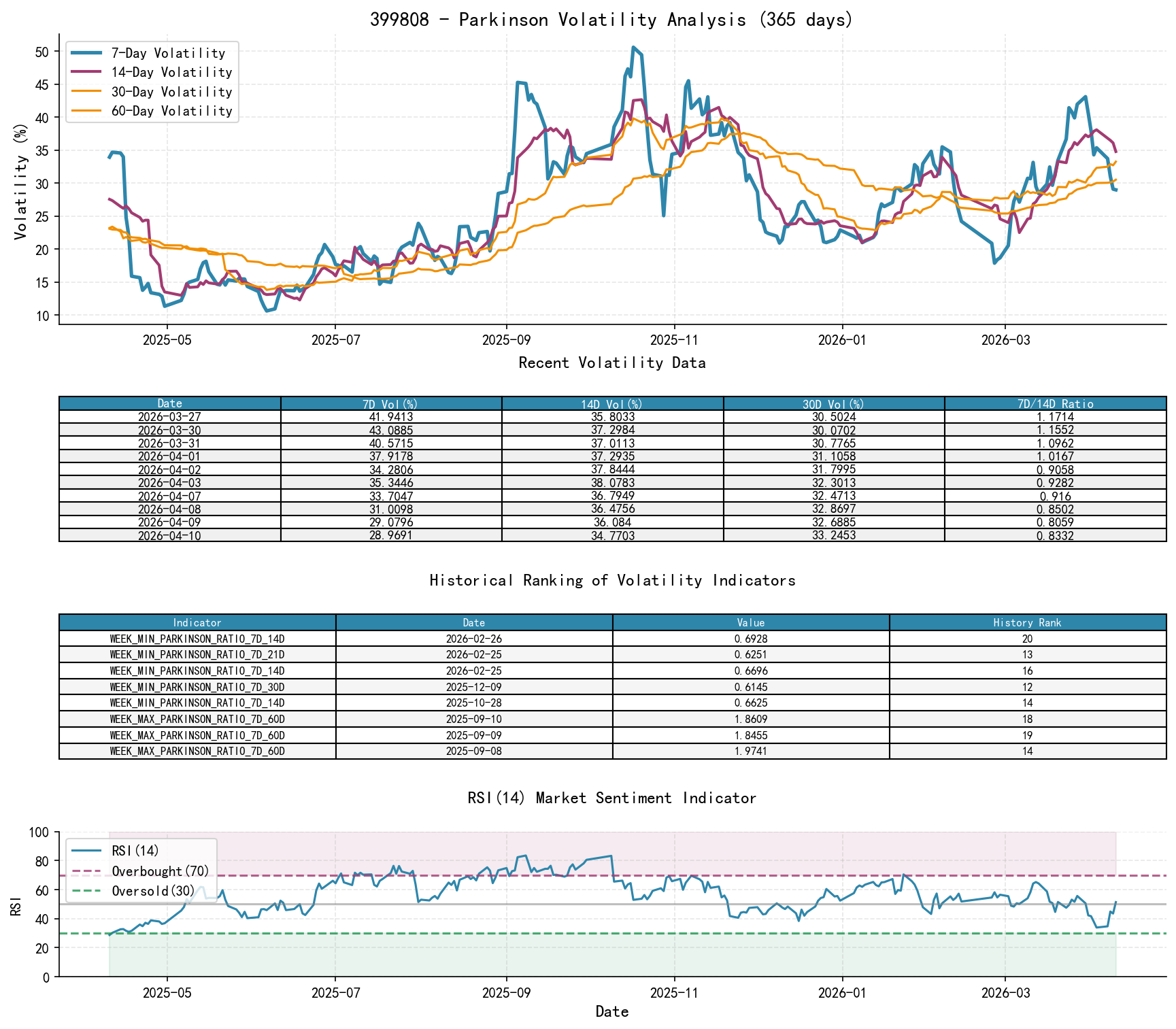
Volatility Analysis:
- • Historical Volatility (HIS_VOLA): The 7-day volatility surged above 0.46 during 2026-04-08 to 04-10, significantly higher than the 14-day volatility (HIS_VOLA_RATIO_7D_14D > 1.13), indicating increased short-term market sentiment volatility. This typically occurs during trend transition/testing periods, reflecting significant divergence between bulls and bears.
- • Intraday Volatility (PARKINSON_VOL): The 7-day Parkinson volatility rapidly retreated from the high level in late March (0.43) to 0.29 on April 10th. Simultaneously, the short-term/long-term volatility ratio (PARKINSON_RATIO_7D_14D=0.83) shows convergence in intraday price ranges. This suggests that despite intraday rallies, the overall trading range is narrowing, potentially signaling a shift from disorderly panic to consolidation.
- • RSI Sentiment Indicator: The RSI_14 reached overbought territory (64-65) from 2026-03-11 to 13, then declined steadily, touching oversold territory (33.90) on 2026-04-03. Currently (2026-04-10), the RSI has recovered to 51.44, in a neutral-to-weak zone, indicating extreme oversold sentiment has been repaired, but buying momentum is not strong.
Sentiment Cycle Summary:
Market sentiment completed a rapid shift from "Greed/Frenzy" (mid-March RSI overbought with record volume) to "Panic/Despair" (early April RSI oversold with暴跌). Currently, it is in a post-panic recovery phase, with sentiment indicators trending neutral. However, amplified short-term volatility indicates fierce ongoing battle between bulls and bears.
4. Relative Strength and Momentum Performance
Momentum Cycle Analysis:
- • Short-term Momentum (WTD_RETURN): Mostly positive before mid-March, indicating robust short-term upward momentum; turned negative after late March, indicating short-term momentum溃散; entering April, particularly in the current analysis week (week of 2026-04-10), WTD_RETURN is +6.91%, showing a significant and robust rebound in short-term momentum.
- • Medium-term Momentum (MTD_RETURN/QTD_RETURN): MTD_RETURN once plunged to -4.64% in April, now rebounded to +1.95%; QTD_RETURN is +1.95%. Medium-term momentum was severely damaged, but recent rebounds show signs of repair, though the strength is far weaker than the short-term rebound.
- • Long-term Momentum (YTD/TTM_12): YTD return is +6.93%, while TTM_12 (past 12 months) return is as high as +74.94%, indicating the foundation of the underlying asset's long-term uptrend remains very solid. The current decline appears more like a deep correction within a long-term bull market.
Momentum Conclusion:
The momentum structure presents a pattern of "strong long-term, weak medium-term, strong short-term rebound." The strong short-term rebound is a technical correction towards the long-term trendline and oversold conditions. However, confirmation of a medium-term trend reversal requires more time and signals.
5. Large Investor (Smart Money) Behavior Identification
Based on the above price-volume, volatility, and momentum analysis, the inferred operational intentions of large investors are as follows:
- 1. Distribution in mid-to-early March 2026: Large investors systematically reduced or rotated positions in the high-price zone around 3200 points, leveraging market frenzy and record-breaking volume (historically highest volumes concentrated in this period). High-volume stalling is the classic signal of Smart Money exiting.
- 2. Shakeout & Letting it Drop in late March 2026: After distribution was completed, the market lost support from large capital, leading to a natural price decline. During the high-volume暴跌, some institutions may have adjusted positions or made small-scale acquisitions. However, the primary purpose was to wash out retail筹码 that followed the trend at highs through sharp declines, creating conditions for future low-cost repurchasing.
- 3. Testing & Possible Accumulation from early April 2026 to present: After the price fell to the 2800-2850 zone (a retreat of ~13% from previous highs) and showed signs of low-volume decline (supply exhaustion), Smart Money began conducting Secondary Tests. The high-volume positive candles on April 8th and 10th, especially the strong intraday recovery from lows on April 10th, indicate active buying and absorption of selling pressure in this zone. This is a sign that Preliminary Support or the bottom of a potential Accumulation Range may be forming. However, subsequent confirmation via a "Spring" or "Final Shakeout" is needed to verify the solidity of this range.
Core Judgment: Large investors have completed a round of high-level distribution. Currently, they are utilizing post-decline panic sentiment for tentative positioning and筹码 accumulation in the key support zone (2800-2900). Market dominance is slowly transitioning from sellers in the distribution phase to potential buyers in the accumulation phase.
6. Support/Resistance Level Analysis and Trading Signals
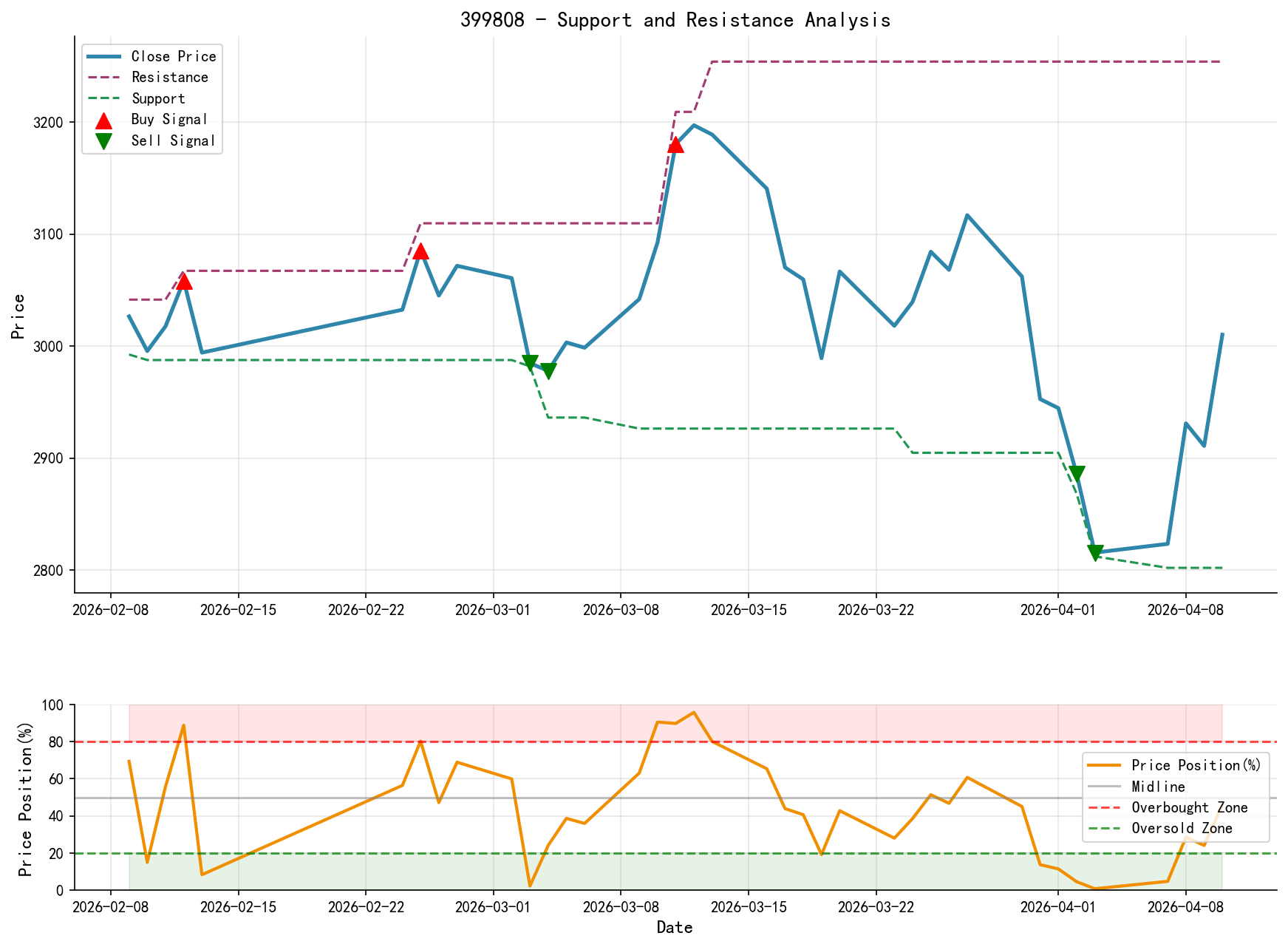
Key Price Levels:
- • Major Support Zone: 2800-2850. This is the double-bottom zone formed on 2026-04-03 and 04-07, the endpoint of the recent panic selling, and the starting point of the recent rebound. A high-volume break below this zone would open new downside space.
- • Secondary Support Zone: 2950-3000. The recent rebound highs and the convergence area of MA_20D/MA_30D, also a psychological level.
- • Core Resistance Zone: 3150-3200. The lower boundary of the previous distribution range and the March high zone, where significant套牢盘 is堆积, posing a key test for any future rebound.
- • Minor Resistance Zone: 3050-3100. The recent震荡 upper bound and area near MA_10D.
Integrated Wyckoff Events and Trading Signals:
The current market exhibits characteristics of the "initial construction phase of a potential accumulation range." We have observed雏形 of Panic Selling (PS), Preliminary Support (PS), and Secondary Test (ST).
- • Trading View: Cautiously Bullish / Consolidation & Bottoming. The most panic-driven phase of the market may have passed, but a new uptrend is not yet established.
- • Operational Recommendations:
- 1. Bullish Strategy (Left-side / Aggressive): Consider establishing试探性 long positions in batches near the 2800-2850 support zone, combined with low-volume pullbacks (VOLUME_AVG_7D_RATIO < 0.8). Set a clear stop-loss below 2800 (e.g., 2780).
- 2. Bullish Strategy (Right-side / Conservative): Wait for the price to break out and consolidate above the 3050-3100 resistance zone (i.e., break the recent震荡 platform) with significantly放大 volume (VOLUME_AVG_7D_RATIO > 1.2) as a confirmation signal for a potential trend reversal before following up.
- 3. Bearish Strategy: If the price反弹至 3150-3200 strong resistance zone and shows signs of high-volume stalling or rejection again, it could be viewed as a secondary distribution opportunity. If the price breaks below the 2800 support on high volume, the downtrend would restart, and one should consider shorting顺势.
- • Future Validation Points:
- 1. Bullish Validation: Price shows a "Spring" effect (briefly跌破支撑后快速收回) or "Test on High Support" (volume极度萎缩 during support test) near the support zone, followed by high-volume advance (JOC).
- 2. Bearish Validation: During反弹至 resistance zones (3050 or 3150),出现 "Upthrust" (UT) or "Supply Test" (ST) candlestick patterns accompanied by放大 volume again.
- 3. Key Indicators: Continuously monitor the behavior of VOLUME_AVG_7D_RATIO at key price levels and whether RSI_14 can hold above 40 during pullbacks and advance again. These are core clues for determining whether demand has genuinely returned.
Disclaimer: All conclusions in this report are derived based on the provided data and Wyckoff Price-Volume Principle analysis. The report aims to analyze market structure and investor behavior and does not constitute any specific investment advice. Financial markets involve risks. Investors should make independent judgments and prudent decisions based on their own circumstances.
Thank you for your attention! Daily Wyckoff Price-Volume market insights are released promptly before the market opens at 8:00 AM. Your comments and shares are greatly appreciated. Your recognition is crucial. Let us see the market signals together.
Member discussion: