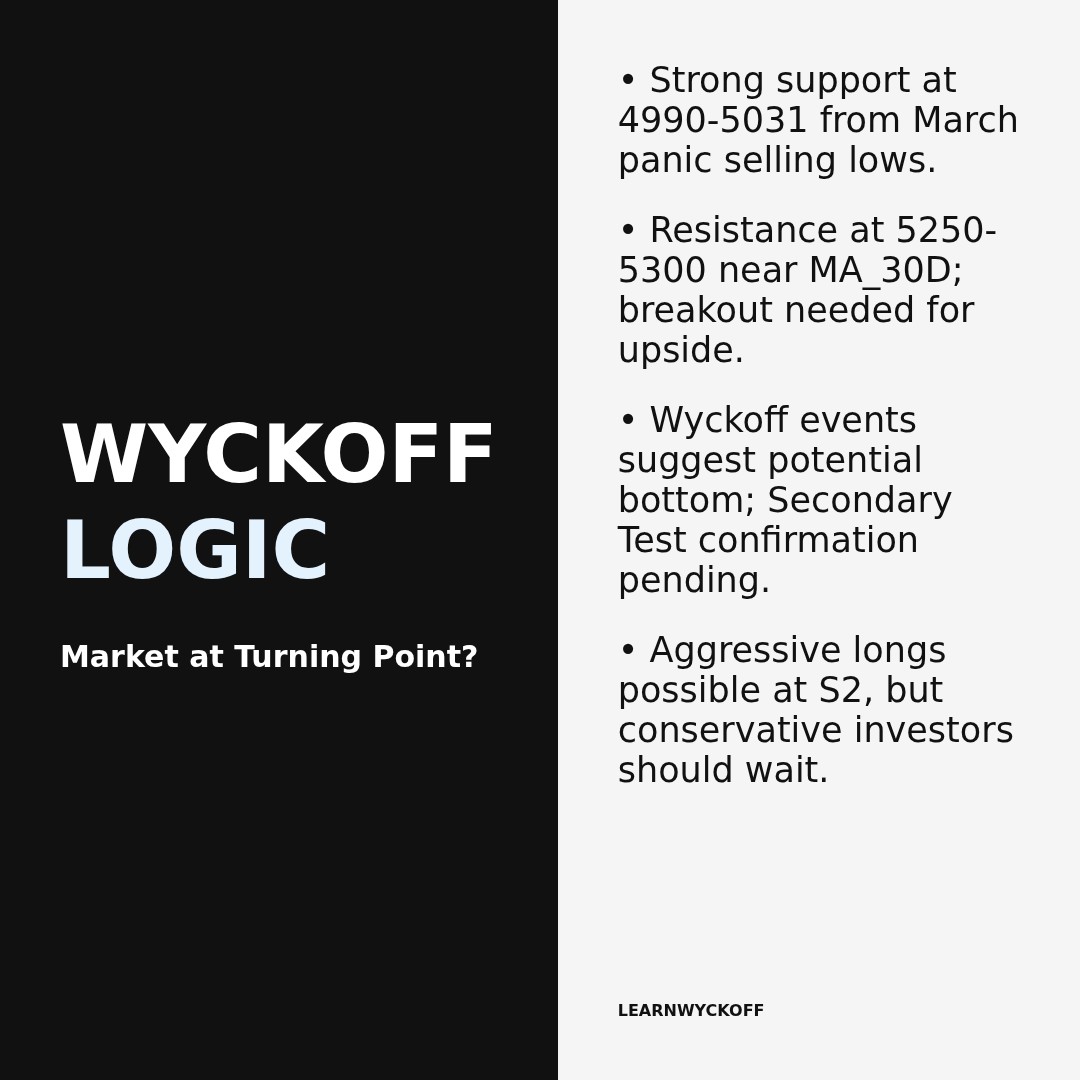
Quantitative Analysis Report: Deep Insights Based on Wyckoff Theory
Product Code: 000989.SH
Analysis Period: 2026-02-09 to 2026-04-10
Report Generation Date: 2026-04-10
Core Methodology: Wyckoff Volume-Price Principles
1. Trend Analysis and Market Phase Identification
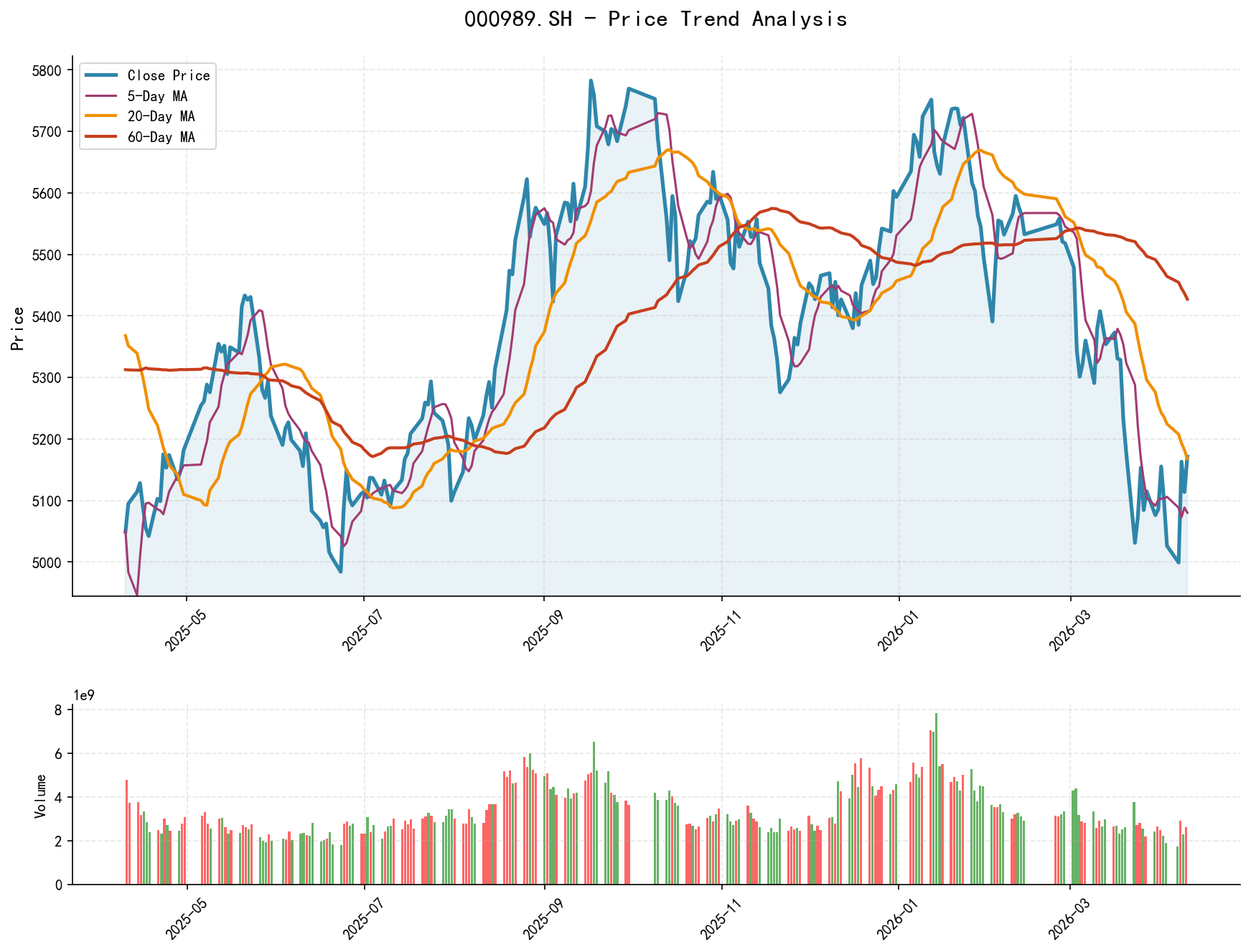
As of April 10, 2026, the underlying asset 000989.SH has an opening price of 5135.91, a closing price of 5171.35, a 5-day moving average (MA_5D) of 5080.07, a 10-day moving average (MA_10D) of 5091.66, a 20-day moving average (MA_20D) of 5167.56, a daily gain of 1.13%, a weekly gain of 2.89%, a monthly gain of 1.69%, a quarterly gain of 1.69%, and a yearly loss of -7.54%.
Observations:
- • Price-MA Relationship: As of the analysis date (2026-04-10), the closing price
5171.35is below all moving averages (MA_5D: 5080.07,MA_10D: 5091.66,MA_20D: 5167.56,MA_30D: 5242.51,MA_60D: 5427.20), forming a standard bearish alignment. The price has been consistently suppressed by short-to-medium-term moving averages, indicating a clear downtrend. - • Moving Average Crossover Signals:
MA_5Dcontinues to trade belowMA_20D, andMA_10Dis also significantly lower thanMA_30D. Since mid-March,MA_5Dhas repeatedly crossed belowMA_10DandMA_20D, confirming the intensification of the medium-term downtrend. Recently (early April),MA_5Dshows signs of flattening and a slight upward turn, but no effective bullish crossover of any level has formed. - • Price Action and Phase Inference:
- • 2026-02-09 to 2026-02-13: Price consolidated within a narrow range of 5560-5600, with trading volume (
VOLUME_AVG_7D_RATIO≈ 0.9) slightly below average, exhibiting characteristics of "Distribution" or trend stagnation. - • 2026-02-24 to 2026-03-23: Price entered a primary downtrend wave, falling from around 5550 to 5031, a decline exceeding 9.3%. On March 23, a single-day plunge of 2.83% occurred with a 44% surge in volume (
VOLUME_GROWTH= 44.11%, ranking 7th for weekly maximums in the past 10 years). This is a typical signature of "Panic Selling" or a "Selling Climax." - • 2026-03-24 to 2026-04-10: Following the panic low, the market experienced an "Automatic Rally," rebounding to 5171. The rally was accompanied by moderate volume expansion (
VOLUME_AVG_7D_RATIOincreased from 0.97 to 1.13), indicating some demand participation. The market is likely now entering a phase of "Secondary Test" or attempting to establish a new trading range.
- • 2026-02-09 to 2026-02-13: Price consolidated within a narrow range of 5560-5600, with trading volume (
Conclusion: The market has undergone a complete process from distribution transitioning into panic selling over the past two months. It is currently in a rebound and consolidation phase following the panic sell-off. The long-term trend remains bearish, but short-term downward momentum has been exhausted due to the panic release, entering an observation period for potential basing.
2. Volume-Price Relationship and Supply-Demand Dynamics
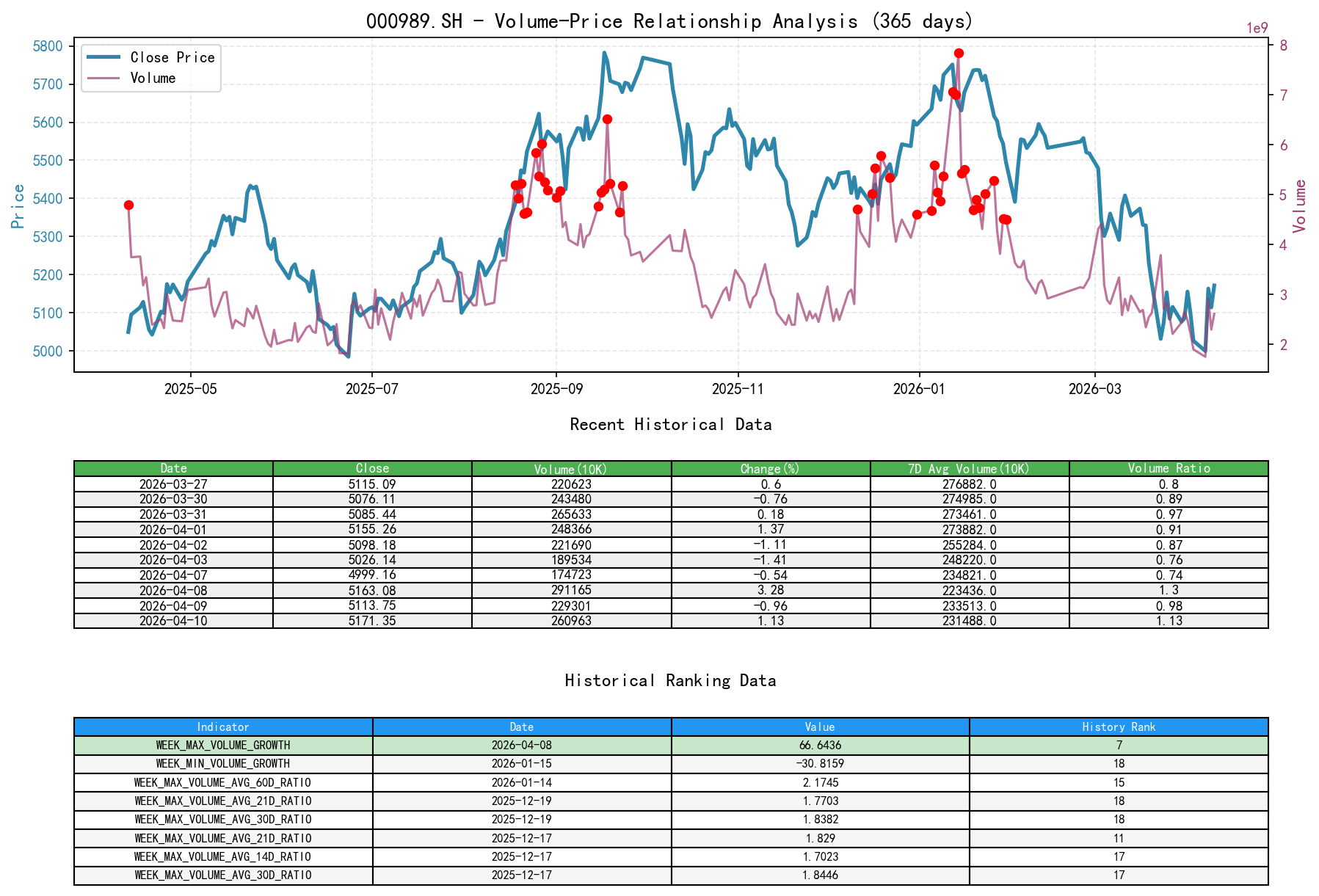
As of April 10, 2026, the underlying asset 000989.SH has an opening price of 5135.91, a closing price of 5171.35, a trading volume of 2609632700, a daily gain of 1.13%, a trading volume of 2609632700, a 7-day average volume of 2314880500.00, and a 7-day volume ratio of 1.13.
Key Data Interpretation:
- • Panic Day (2026-03-23): Price plummeted -2.83%, volume surged 44.11% (
VOLUME_GROWTH). The ratio of volume to its 7-day average (VOLUME_AVG_7D_RATIO) reached 1.43, exceeding 1.24 against both 14-day and 21-day averages. Consistent with the Wyckoff "Panic Selling" volume-price signature: significant volume accompanying a sharp price decline indicates massive supply (sell-side pressure) being released in panic. - • Stabilization and Rally Confirmation (2026-03-24 to 2026-03-25): The day after the panic (Mar 24), price rose slightly by 0.85%, while volume (
VOLUME_AVG_7D_RATIO=0.97) remained high. This suggests that at the panic low, commensurate demand (buying) absorbed the selling pressure, preventing further decline, signaling potential "smart money" accumulation. On Mar 25, a 1.56% gain on elevated volume (VOLUME_AVG_7D_RATIO=1.03) preliminarily confirmed rally demand. - • Recent Demand Display (2026-04-08): Price surged 3.28%, with volume 30% above the 7-day average (
VOLUME_AVG_7D_RATIO=1.30), marking the strongest demand-dominated day recently. This indicates incremental capital actively buying at current levels. - • Demand Quality Verification (2026-04-09 & 2026-04-10): Following the surge, a minor pullback of -0.96% occurred on low volume (volume ratio back near average at
VOLUME_AVG_7D_RATIO=0.98), representing healthy profit-taking. Today (Apr 10), price rose 1.13% again on increased volume (VOLUME_AVG_7D_RATIO=1.13), indicating persistent demand and an intact rebound structure.
Conclusion: Supply was released to an extreme during the March 23 panic (supported by historical volume rankings). Subsequently, effective demand absorption and a rally emerged. Recently (Apr 8), a significant signal of strong demand return appeared. The supply-demand dynamic has shifted from "unilateral supply overwhelming all" to a transitional stage of "supply exhaustion, demand attempting to enter."
3. Volatility and Market Sentiment
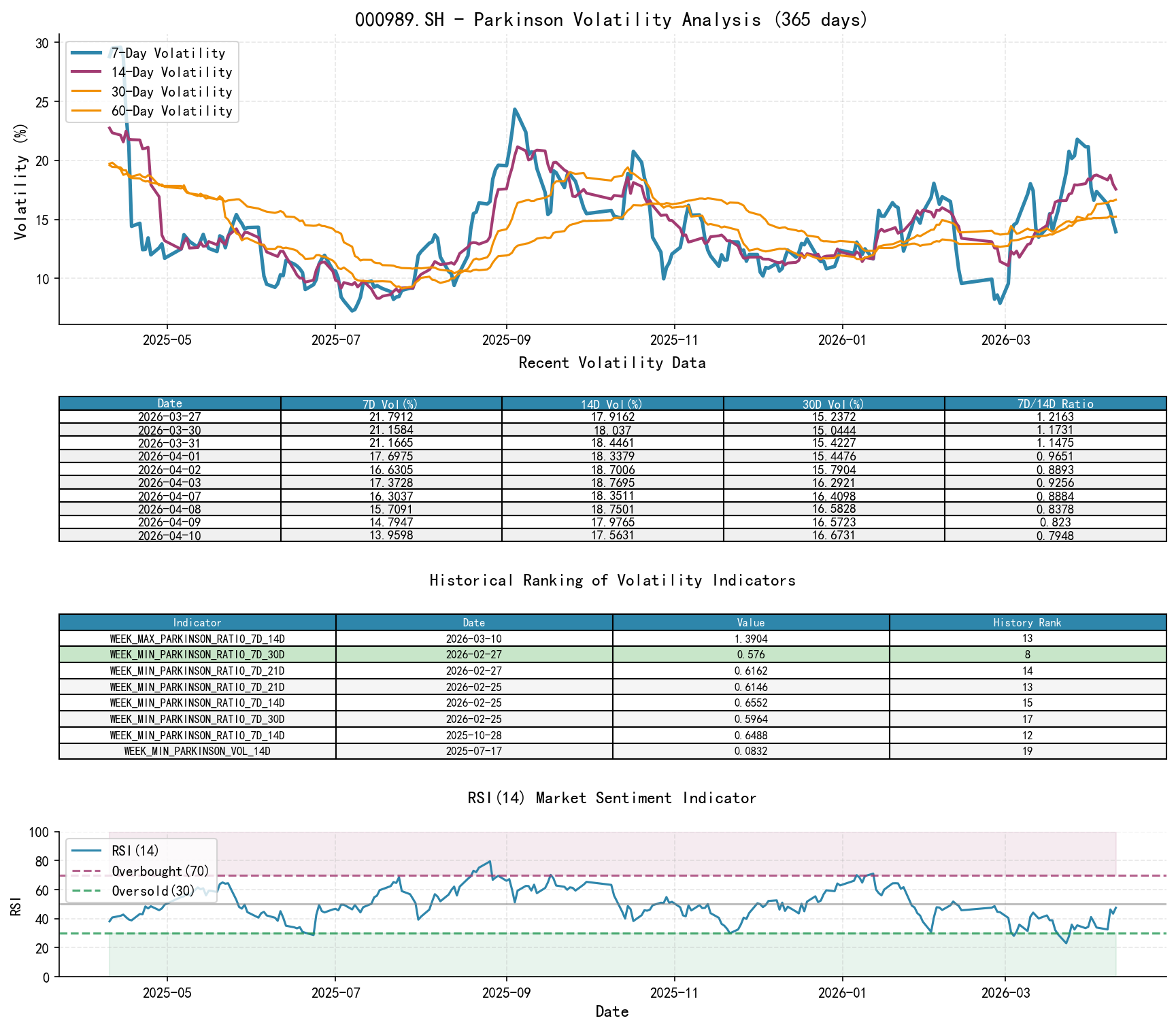
As of April 10, 2026, the underlying asset 000989.SH has an opening price of 5135.91, a 7-day Parkinson volatility of 0.14, a 7-day Parkinson volatility ratio of 0.79, a 7-day historical volatility of 0.33, a 7-day historical volatility ratio of 1.09, and an RSI of 47.56.
Observations:
- • Volatility Peak and Panic Sentiment: Volatility spiked sharply at the end of the March decline.
HIS_VOLA_7Dpeaked at 0.2645 on Mar 10, and its ratio toHIS_VOLA_14D(HIS_VOLA_RATIO_7D_14D) had a weekly maximum of 1.4188, ranking 16th in the past 10 years. The weekly maximum forPARKINSON_RATIO_7D_14Dwas 1.3904, ranking 13th. This dual-confirms the extreme panic and irrational sentiment at that time. - • Volatility Convergence and Sentiment Stabilization: Entering April, volatility has significantly converged. As of today,
HIS_VOLA_7D(0.3272), while slightly elevated, is far below the March peak. Its ratios to 14-day and 21-day averages (HIS_VOLA_RATIO_7D_14D=1.09,HIS_VOLA_RATIO_7D_21D=1.26) show short-term volatility is only marginally above medium-term levels.PARKINSON_RATIO_7D_14Dhas dropped to 0.79, indicating intraday volatility is significantly below recent average levels. - • RSI Oversold Confirmation:
RSI_14hit an extreme low of 23.04 on Mar 23, with its weekly minimum ranking 12th in the past 10 years, confirming the market was in a severely oversold condition, setting the stage for a technical rebound. The current RSI of 47.56 has moved out of the oversold zone to a neutral-weak position, indicating sentiment recovery from extreme panic.
Conclusion: Market sentiment experienced a complete cycle from panic (volatility ratios hitting historical highs) to stabilization (volatility convergence) in late March. The current volatility structure suggests the disorderly decline triggered by panic has ended, and the market has entered a phase of sentiment repair and order reconstruction.
4. Relative Strength and Momentum Performance
Observations:
- • Short-term Momentum Improvement:
WTD_RETURN(week-to-date return) is +2.89%, indicating short-term momentum has turned positive, aligning with the price rebound. - • Medium-term Momentum Still Weak:
MTD_RETURN(month-to-date) at +1.69% andQTD_RETURN(quarter-to-date) at +1.69%, though positive, primarily benefit from the April rebound and overall magnitude is limited.YTD_RETURN(year-to-date) at -7.54% clearly reveals the market's weakness since the year began. - • Momentum Shift: The momentum structure exhibits a "short-term > medium-term > long-term" characteristic, typical of the first positive rebound within a downtrend. It validates the deceleration of the downtrend and the accumulation of short-term bullish momentum.
Conclusion: The underlying asset's short-term relative strength has shown significant improvement, but medium and long-term momentum remain weak. This suggests the current advance is more likely defined as a "rebound from oversold conditions" rather than a trend reversal, though its strength warrants attention.
5. Large Investor (Smart Money) Behavior Identification
Based on Wyckoff principles and the above volume-price and volatility analysis, inferences regarding large investor behavior are as follows:
- • During the Late March Panic Selling (Mar 23-24): Retail investors and leveraged funds likely engaged in panic-driven, stampede-like selling (supply). Conversely, smart money (institutions/major players) may have executed planned accumulation during and after the high-volume stabilization. They absorbed the panic-driven sell orders, explaining why prices did not continue to collapse after the massive volume but instead stabilized quickly.
- • During the Early April Rebound (Apr 8): The large-volume surge day indicates dominant capital actively buying to push prices higher, testing market selling pressure and attracting followers. This could be a mark-up of previously accumulated positions or the beginning of a new round of position building.
- • Behavior Pattern Inference: Synthesizing the above, the suspected operational path of large investors is "absorption during panic (accumulation) -> guiding price rebound (testing supply) -> observing rebound strength to determine subsequent actions." The market is currently in the "observing rebound strength" stage.
6. Support/Resistance Level Analysis and Trading Signals
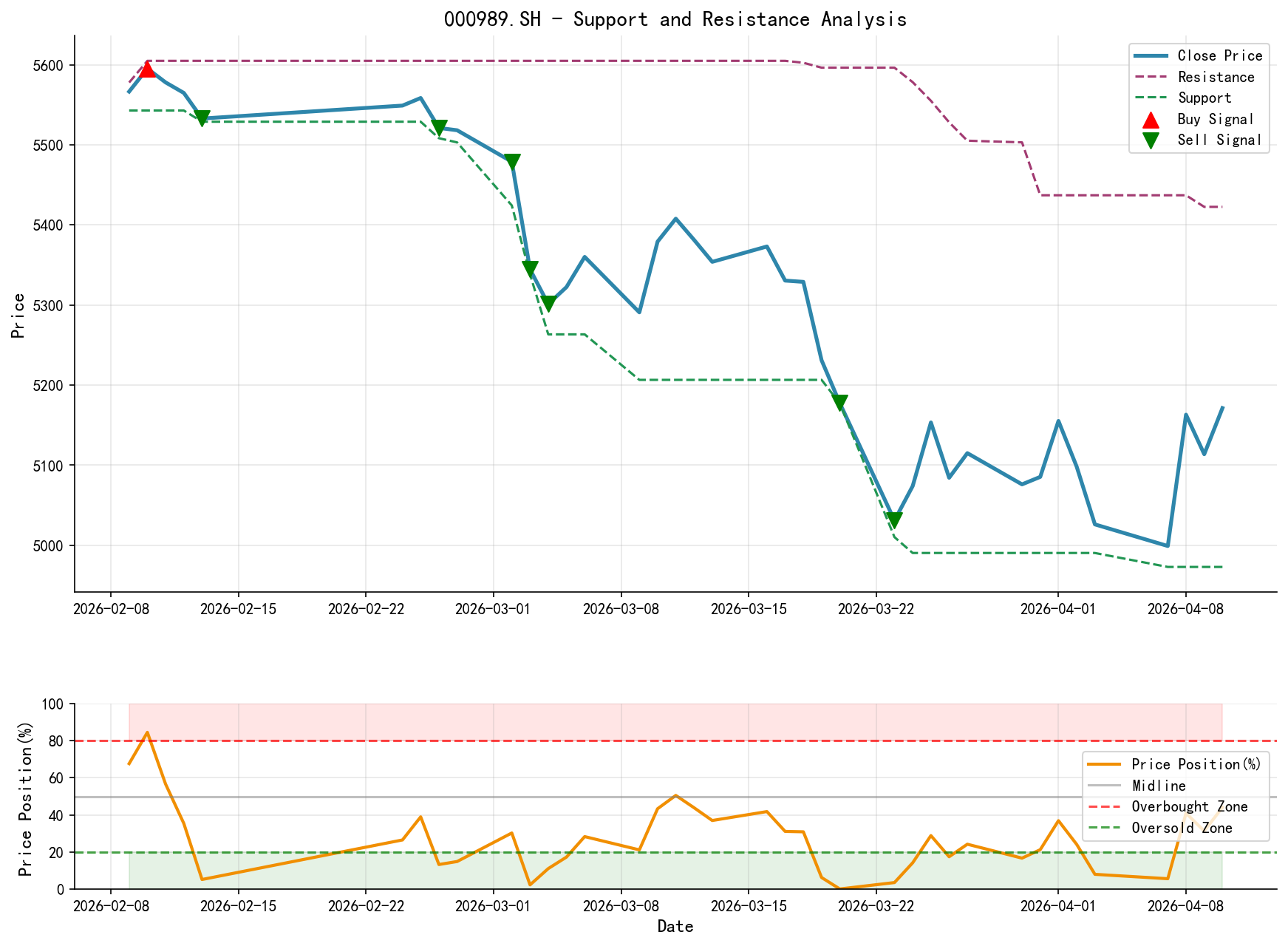
- • Key Support Levels:
- • S1 (Strong Support): 4990 – 5031 points. The low range formed during the Mar 23-24 panic selling, also the lowest point of this decline. Significant transaction volume exists here, making it a critical psychological and technical support.
- • S2 (Secondary Support): 5080 – 5100 points. The starting platform of the recent rebound and the current location of
MA_5D.
- • Key Resistance Levels:
- • R1 (Near-term Resistance): 5250 – 5300 points. A consolidation platform during the mid-to-late March decline, also near the
MA_30D(5242). - • R2 (Strong Resistance): 5400 – 5600 points. The distribution range from February to early March, also the area of
MA_60D(5427), characterized by dense overhead supply.
- • R1 (Near-term Resistance): 5250 – 5300 points. A consolidation platform during the mid-to-late March decline, also near the
- • Composite Trading Signal:
- • Primary Trend: Long-term bearish, but short-term downtrend is interrupted.
- • Wyckoff Events: "Panic Selling" and "Automatic Rally" have been observed. The market is brewing a "Secondary Test."
- • Synthesis: The market is in the early stage of potential bottom formation. Bearish sentiment has been fully released, but a bullish trend is not yet established.
- • Operational Suggestions:
- • For Aggressive Investors: Consider a light long position trial near the S2 (5080-5100) area upon observing signs of low-volume stabilization, with a stop-loss set below S1 (4990). Target the R1 (5250-5300) area.
- • For Conservative Investors: Recommend waiting and observing, awaiting clearer confirmation of a successful "Secondary Test." This would involve the price retesting the S1 area without making new lows, accompanied by significantly diminished volume (indicating supply exhaustion), followed by a volume-backed breakout above the recent high (5171), before considering a long entry.
- • Future Validation Points:
- 1. Bullish Validation: A volume-backed breakout and sustained hold above the
MA_20D(5167) and theR1resistance zone, coupled with aMA_5Dcrossing aboveMA_10D, would enhance bottom validity. - 2. Bearish Validation: A weak rebound followed by a renewed volume-backed break below the S1 (4990) support would signify "Secondary Test" failure and a resumption of the downtrend, warranting strict avoidance.
- 1. Bullish Validation: A volume-backed breakout and sustained hold above the
Disclaimer: This report is based entirely on quantitative analysis of the provided historical data, deriving conclusions following Wyckoff volume-price principles, and contains no subjective forecasts. All data, indicators, and conclusions are for research reference only and do not constitute specific investment advice. Financial markets carry risks; invest with caution.
Thank you for your attention! Daily Wyckoff volume-price market analysis is released promptly at 8:00 AM before market open. We kindly ask for your comments and shares; your recognition is vital. Let us together discern the market signals.
Member discussion: