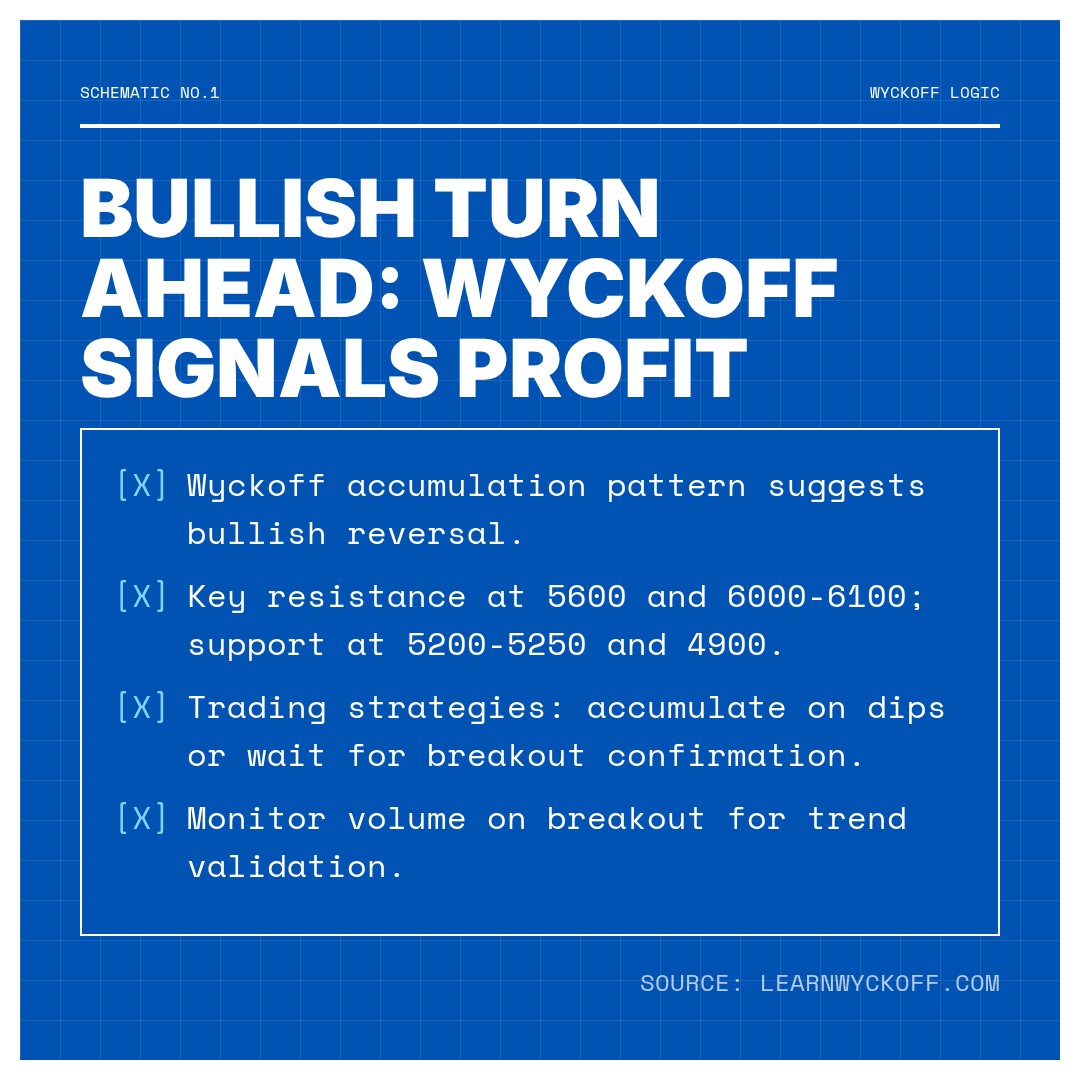
Wyckoff Quantitative Analysis Report: 000987.SH
Report Date: 2026-04-10
Analysis Period: 2026-02-09 to 2026-04-10 (Data covers 60 trading days)
Data Source: Provided structured daily data and historical ranking data.
1. Trend Analysis and Market Phase Identification
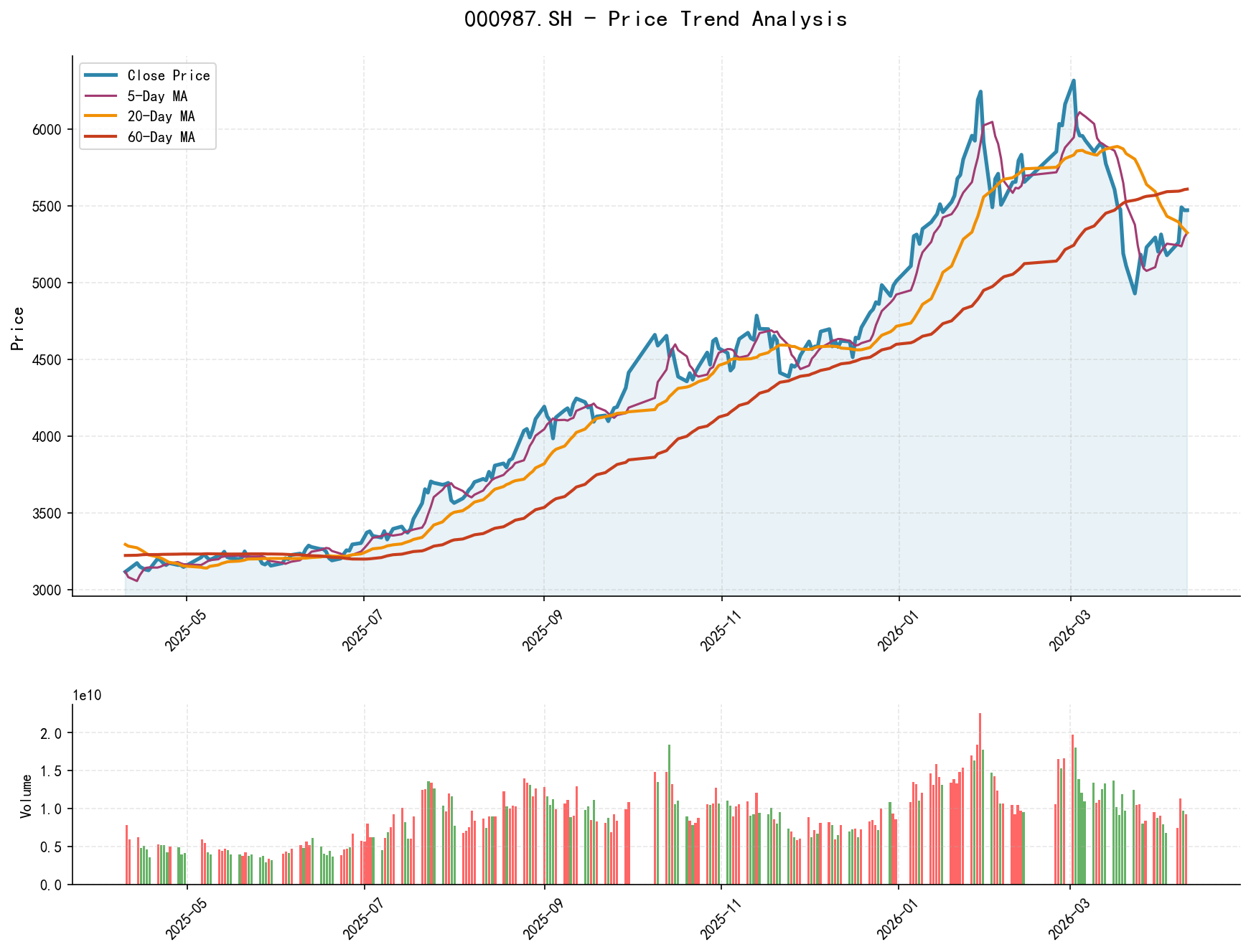
As of April 10, 2026, for the target security 000987.SH: Opening Price 5508.85, Closing Price 5471.97, 5-Day MA 5326.16, 10-Day MA 5278.01, 20-Day MA 5324.68, Daily Change 0.01%, Weekly Change 5.67%, Monthly Change 5.20%, Quarterly Change 5.20%, Year-to-Date Change 9.21%
Price and Moving Average System Analysis:
- • Current Alignment: As of April 10, the price (5471.97) is above the 5-day (5326.16), 10-day (5278.01), and 20-day (5324.68) MAs, but below the 30-day (5549.68) and 60-day (5609.39) MAs. This presents a pattern of "short-term MAs crossing upwards but suppressed by medium-to-long-term MAs."
- • Crossover Signals: Recently (April 7-10), the 5-day MA has crossed above the 20-day MA (MA_CROSS_5_20), and the 5-day, 10-day, and 20-day MAs are beginning to form a bullish alignment, indicating that the short-term downtrend has been halted and reversed into a rebound. However, the 20-day MA remains significantly below the 30-day and 60-day MAs, suggesting the medium-term downtrend has not yet reversed.
- • Market Phase Inference (Wyckoff Perspective):
- 1. Distribution Phase (Late February to Early March): The rapid price surge within the 6000-6324 range from late February to March 2nd, accompanied by massive turnover (March 2nd turnover reaching the second highest in nearly ten years) and extremely high historical volatility (21D volatility ranking historical 2nd), constitutes a classic "Upthrust" (UT), characteristic of major distribution.
- 2. Decline and Panic Phase (Early to Mid-March): Following the peak on March 2nd, the price collapsed, hitting a low of 5164.94 on March 19th. Although there were rebounds during this period, volume contracted, fitting the characteristics of a downtrend. The sharp drop of -5.28% on March 19th (decline ranking 11th in nearly ten years) marked the occurrence of a Selling Climax (SC).
- 3. Potential Accumulation/Basing Phase (Late March to Present): After the panic low, the price did not make a new low and formed a higher low (4899.60) and a higher close (5230.43) between March 23rd-27th. On April 8th, there was a significant rise (+4.36%) on high volume (volume was 1.55 times the 60-day average), a typical Wyckoff manifestation of a "Sign of Strength" (SOS) following a "Spring" or the "Last Point of Support" (LPS), suggesting potential institutional accumulation at current levels.
Conclusion: The market has emerged from the panicky decline in March (the decline phase post-distribution) and is currently in the early stage of a potential "Accumulation" or "Basing" phase. The short-term trend is rebounding upwards but is now facing a critical test at the key resistance of the 30-day and 60-day medium-to-long-term moving averages.
2. Volume-Price Relationship and Supply-Demand Dynamics
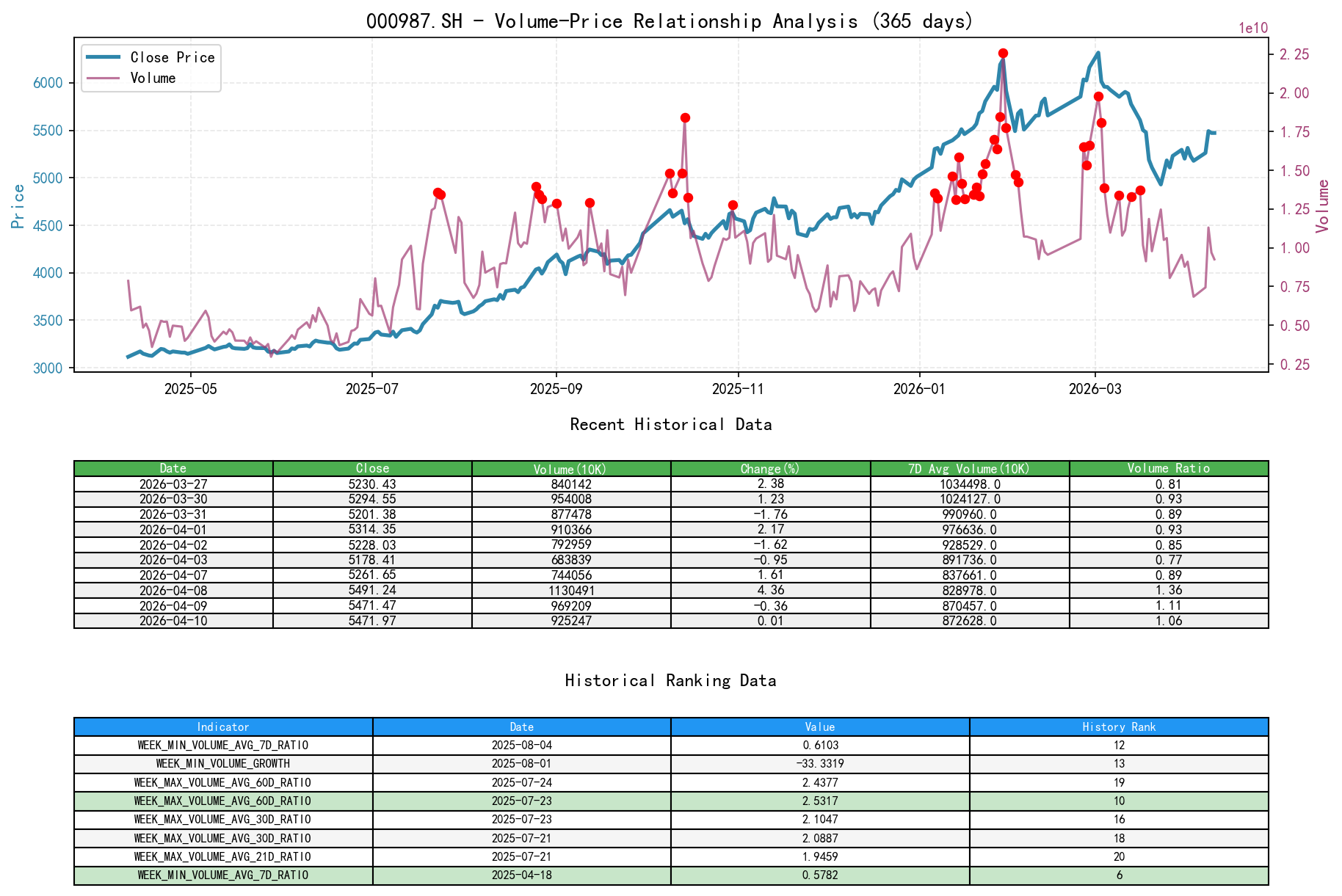
As of April 10, 2026, for the target security 000987.SH: Opening Price 5508.85, Closing Price 5471.97, Volume 9252472500, Daily Change 0.01%, Volume 9252472500, 7-Day Average Volume 8726287785.71, 7-Day Volume Ratio 1.06
Key Day Analysis:
- • Supply-Dominated Distribution Signal (2026-03-02): On this day, the price hit a new all-time high (6317.28) with a daily gain of +2.51%, but the turnover reached 374.3 billion, the second highest in nearly ten years. This is a classic case of "stalling on high volume" (UT on Volume), indicating that massive supply (selling pressure) overwhelmed demand at the historical high, a strong top distribution signal.
- • Selling Climax (2026-03-19): The price plummeted -5.28%, but volume (VOLUME_AVG_60D_RATIO=0.96) did not expand significantly to extreme levels. Intraday volatility (PARKINSON_VOL_7D=0.33) and short-term historical volatility (HIS_VOLA_7D=0.38) were both lower than during the previous peak. This suggests the decline was more due to a lack of buying (demand vacuum) rather than active massive selling, indicating limited panic.
- • Strong Demand Return Signal (2026-04-08): The price surged +4.36% on a sharp increase in volume (VOLUME_AVG_60D_RATIO=1.55). This is the first strong demand signal characterized by "price rising with increasing volume" since the decline began in early March. The day's opening gap up and close near the high constitute a Wyckoff "Sign of Strength" (SOS).
- • Insufficient Follow-Through Demand (2026-04-09, 2026-04-10): In the two days following the SOS, the price experienced minor fluctuations with volume declining day by day (VOLUME_GROWTH: -14.27%, -4.54%). This is a "natural reaction test" to the SOS; contracting volume indicates supply did not re-emerge in large quantities, fitting the profile of a healthy rebound.
Volume Analysis:
- • Trading Activity: The current volume (92.52 million shares) to 60-day average volume (125.5 million shares) ratio (VOLUME_AVG_60D_RATIO) is 0.74, indicating overall market participation remains below the average of the past two months, in a relatively quiet state.
- • Supply-Demand Transition: The sequence of volume-price relationships in March (stalling on high volume at highs -> contracting volume during decline -> rising on high volume at lows) clearly depicts the transition from "overwhelming supply dominance" to "initial demand entry."
Conclusion: A critical shift in supply-demand dynamics has occurred. The massive supply from early March has been digested, and the strong high-volume rise on April 8th marks the beginning of active demand entry. The subsequent low-volume retracement is healthy testing behavior. The market is currently gradually shifting short-term initiative to the demand side.
3. Volatility and Market Sentiment
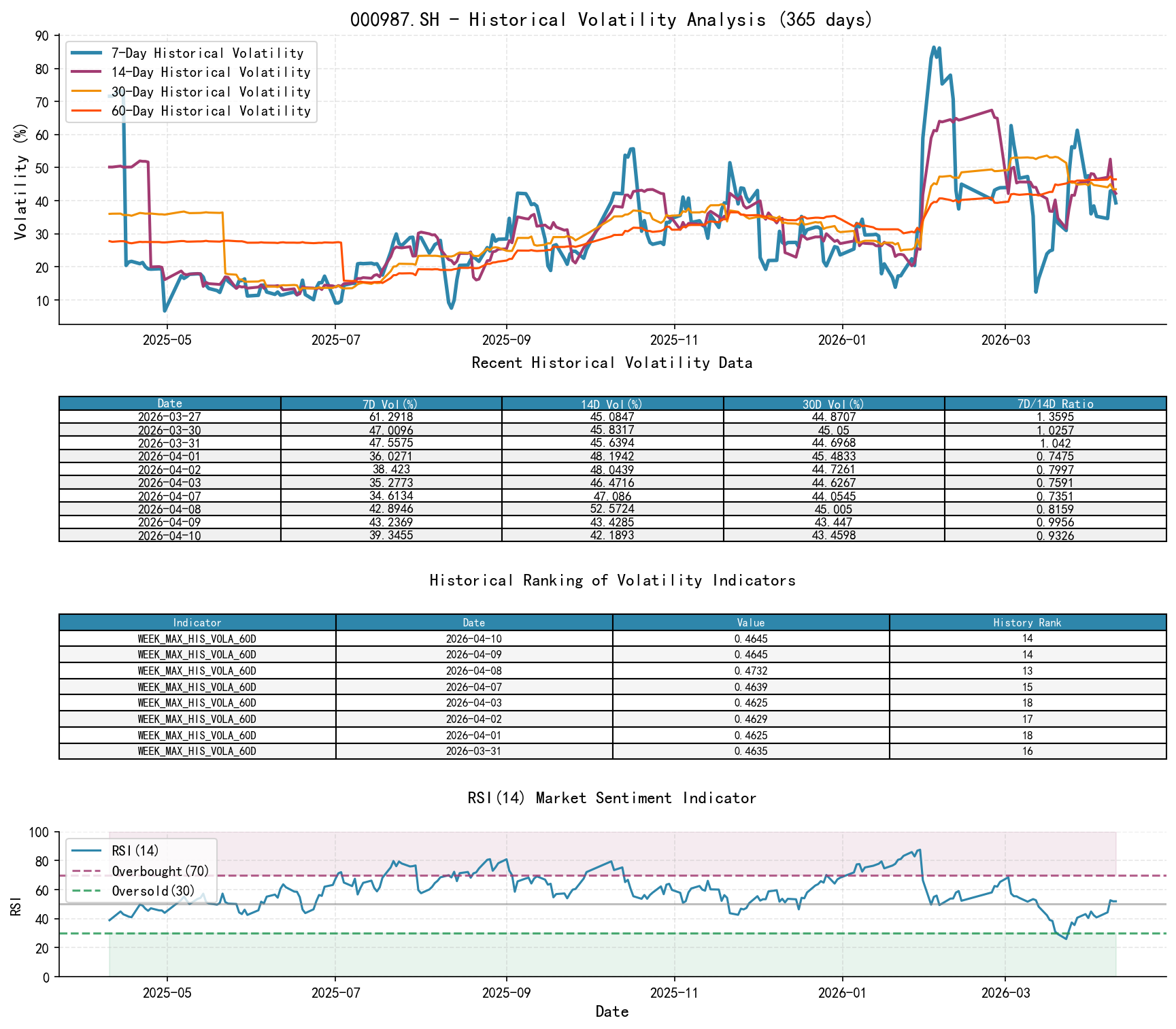
As of April 10, 2026, for the target security 000987.SH: Opening Price 5508.85, 7-Day Intraday Volatility 0.21, 7-Day Intraday Volatility Volume Ratio 0.76, 7-Day Historical Volatility 0.39, 7-Day Historical Volatility Volume Ratio 0.93, RSI 51.99
Volatility Levels:
- • Historical Highs: During the distribution in early March and the subsequent decline, historical volatility (HIS_VOLA) and Parkinson intraday volatility across multiple periods reached historical highs. For example, the 21-day historical volatility on March 3rd (0.6234) ranked historical 2nd, and the 30-day historical volatility entered the historical top 20 multiple times in mid-March, indicating market sentiment experienced extreme panic and confusion.
- • Current State: As of April 10th, volatility across all periods has retreated significantly from peak levels. The ratio of short-term volatility (HIS_VOLA_7D=0.393) to medium-to-long-term volatility (HIS_VOLA_RATIO_7D_60D=0.847) is now below 1, indicating market sentiment has calmed and converged from panic, with volatility returning to normal levels.
RSI Overbought/Oversold:
- • Extreme Oversold: RSI_14 dropped to 31.04 on March 19th, entering oversold territory, confirming the panic sentiment at that time.
- • Current State: RSI_14 is currently at 52.0, having rebounded from the oversold zone to a neutral range, indicating selling pressure has been released and sentiment has partially recovered. However, it has not entered overbought territory, leaving room for further potential rebound.
Conclusion: Market sentiment has recovered from the extreme panic of March and is currently in a calm recovery period. The convergence of volatility and RSI exiting the oversold zone provide an emotional foundation for price rebound and repair.
4. Relative Strength and Momentum Performance
Periodic Return Analysis:
- • Short-Term Momentum (WTD): The weekly return (as of April 10th) is +5.67%, indicating a strong positive reversal in short-term momentum, consistent with the observation of price breaking above short-term MAs and rising on increased volume.
- • Medium-Term Momentum (MTD/QTD): The return since the beginning of April is +5.20%, and the quarter-to-date return is +5.20%. This indicates that the quarter's decline has been effectively repaired in early April, with quarterly momentum turning positive.
- • Long-Term Momentum (YTD): The year-to-date return is +9.21%. Despite the deep retracement in March, the security maintains a positive return for the year, demonstrating a degree of long-term relative resilience.
Momentum and Volume-Price Validation: The strong positive short-term momentum (WTD +5.67%) perfectly coincides with the "demand-dominated" high-volume rise event (SOS) on April 8th. Momentum and supply-demand analysis mutually validate each other, enhancing the credibility of the rebound signal.
Conclusion: Short-term and quarterly momentum have clearly turned positive and resonate with the key day's demand signal. The security has maintained relative strength year-to-date, suggesting the decline was more due to overall market or phase-specific adjustments rather than a long-term deterioration of its own fundamentals.
5. Large Investor (Smart Money) Behavior Identification
Based on Wyckoff principles and the above volume-price analysis, inferences regarding large investor intentions are as follows:
- 1. Distribution at Highs (Late February - Early March): In the 6000-6300 range, by creating a "climactic rise" and massive turnover (historically high turnover), large investors successfully completed large-scale distribution, transferring holdings to retail investors chasing the high.
- 2. Observation and Testing During the Decline (Mid to Late March): During the panicky price decline, volume did not show sustained, massive levels exceeding those seen during distribution, indicating smart money did not make large-scale purchases in this phase but was observing the process of supply exhaustion. The low-volume decline is characteristic of retail selling.
- 3. Active Accumulation at Lows (Early April): The high-volume bullish candlestick on April 8th is the key signal of smart money behavior. After the panic low and initial price stabilization, smart money aggressively bought with above-average volume (VOLUME_AVG_60D_RATIO=1.55), indicating they perceive current levels as having investment value and have begun orderly accumulation. The subsequent low-volume retracement (LPS) reflects their control over the pace to avoid pushing prices up too quickly.
Core Judgment: The operational intent of large investors has shifted clearly from "Distribution" to "Preliminary Accumulation". The current market is in the early stage of smart money's accumulation phase.
6. Support/Resistance Level Analysis and Trading Signals
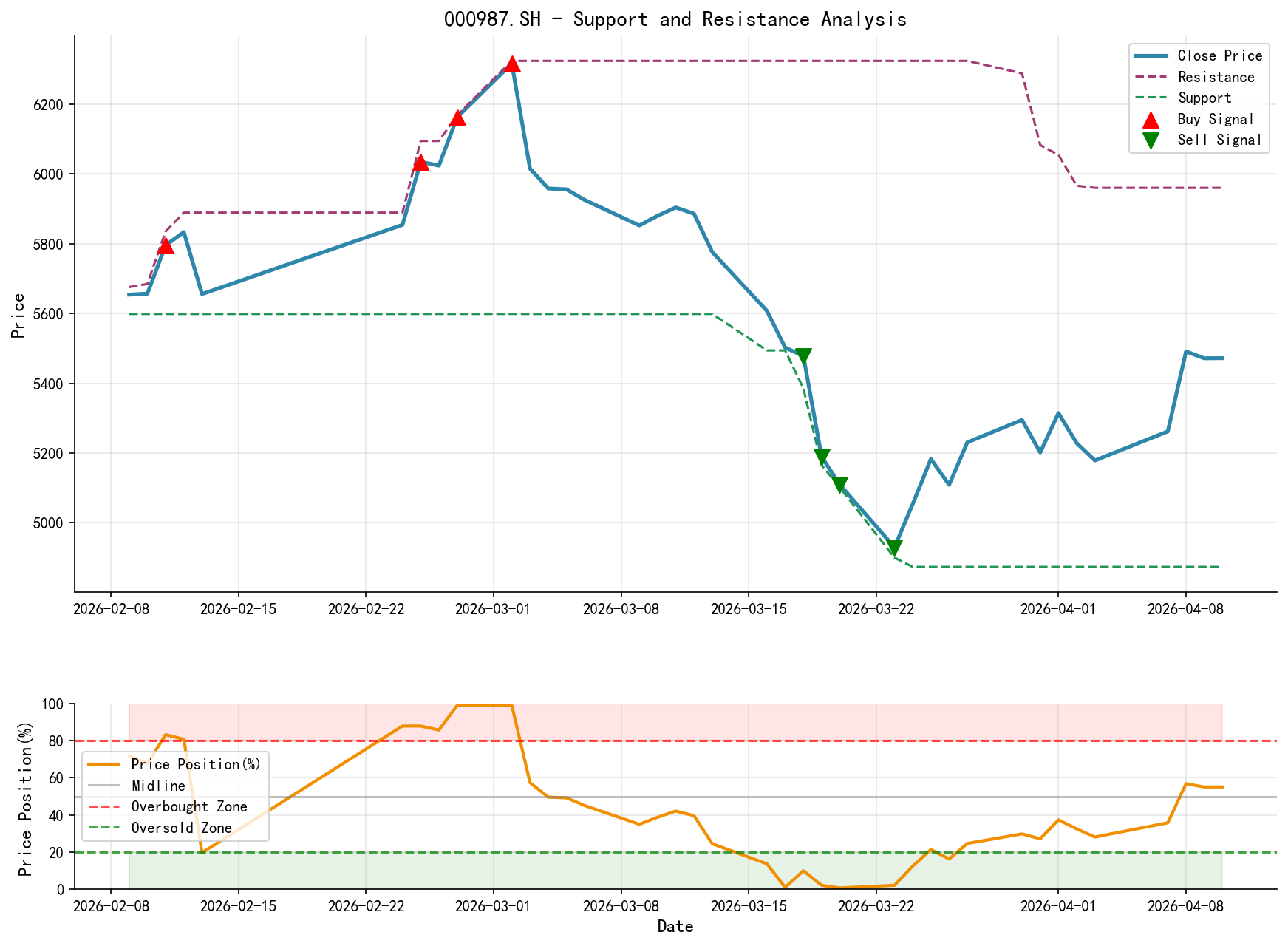
Key Price Levels:
- • Near-Term Resistance:
- • R1: 5549-5610 Zone: The convergence area of the 30-day and 60-day MAs, the first major hurdle for a medium-term trend reversal.
- • R2: 6000-6100 Zone: The rebound high from late March and the previous volume concentration area, also the lower boundary of the prior distribution zone, representing significant pressure.
- • Near-Term Support:
- • S1: 5200-5250 Zone: The starting point of the early April rebound and the recent small platform, also the LPS area of this SOS.
- • S2: 4900 Zone: The panic low on March 23rd, representing the strongest support.
Comprehensive Wyckoff Trading Signals:
- • Primary Signal: Bullish / Look for long opportunities. The market structure has shown the embryonic form of the classic accumulation sequence: "Selling Climax (SC) -> Automatic Rally (AR) -> Secondary Test (ST) forming a higher low -> Sign of Strength (SOS) -> Low-volume retracement (LPS)."
- • Operational Suggestions:
- • Aggressive Strategy: Consider the current level (~5470) or a minor pullback to the S1 (5200-5250) area as an initial accumulation zone, with a stop-loss set below S2 (4900). The initial target is R1 (5600).
- • Conservative Strategy: Wait for the price to break above and stabilize above R1 (5600) on increased volume, then enter on a confirmed pullback, using a stop-loss below the pullback low. The target is R2 (6000).
- • Future Validation Points (Require Close Monitoring):
- 1. Confirmation Signal: Whether the price can break through R1 (5600) with significant volume (VOLUME_AVG_60D_RATIO > 1.2). This is key to determining if the rebound can upgrade into a medium-term reversal.
- 2. Risk Signal: If the price falls below S1 (5200) on increased volume again and makes new lows, the current accumulation hypothesis becomes invalid, and the market may enter a longer basing period or a new downtrend.
Final Conclusion: Based on Wyckoff volume-price analysis, 000987.SH has completed a full cycle of "Distribution - Decline - Panic" and is currently showing early signs of "Preliminary Accumulation by Large Investors." Short-term technicals have improved, sentiment is recovering, and momentum has turned positive. A strategy of "cautious optimism, accumulating on dips" is recommended, using the recent battle between key resistance and support levels as the core basis for trading decisions.
Disclaimer: The content of this report/interpretation is solely market analysis and research based on public information and does not constitute any investment advice or operational guidance. The author strives for objectivity and fairness but makes no guarantees regarding accuracy or completeness. The market involves risks; investment requires caution. Any investment actions based on this report are taken at your own risk.
Thank you for your attention! Wyckoff Volume-Price Market Analysis is published daily at 8:00 AM before the market opens. We kindly ask for your comments and shares; your recognition is crucial. Let's work together to see the market signals clearly.
Member discussion: