
Quantitative Analysis Report: 000986.SH
Product Code: 000986.SH
Analysis Date Range: 2026-02-09 to 2026-04-10
Report Generation Date: 2026-04-10
1. Trend Analysis and Market Phase Identification
As of April 10, 2026, the subject 000986.SH has an opening price of 2768.43, closing price of 2786.00, 5-day moving average (MA) of 2808.33, 10-day MA of 2822.09, 20-day MA of 2871.94, with daily change of +0.10%, weekly change of -0.38%, monthly change of -0.31%, quarterly change of -0.31%, and year-to-date change of +19.35%.
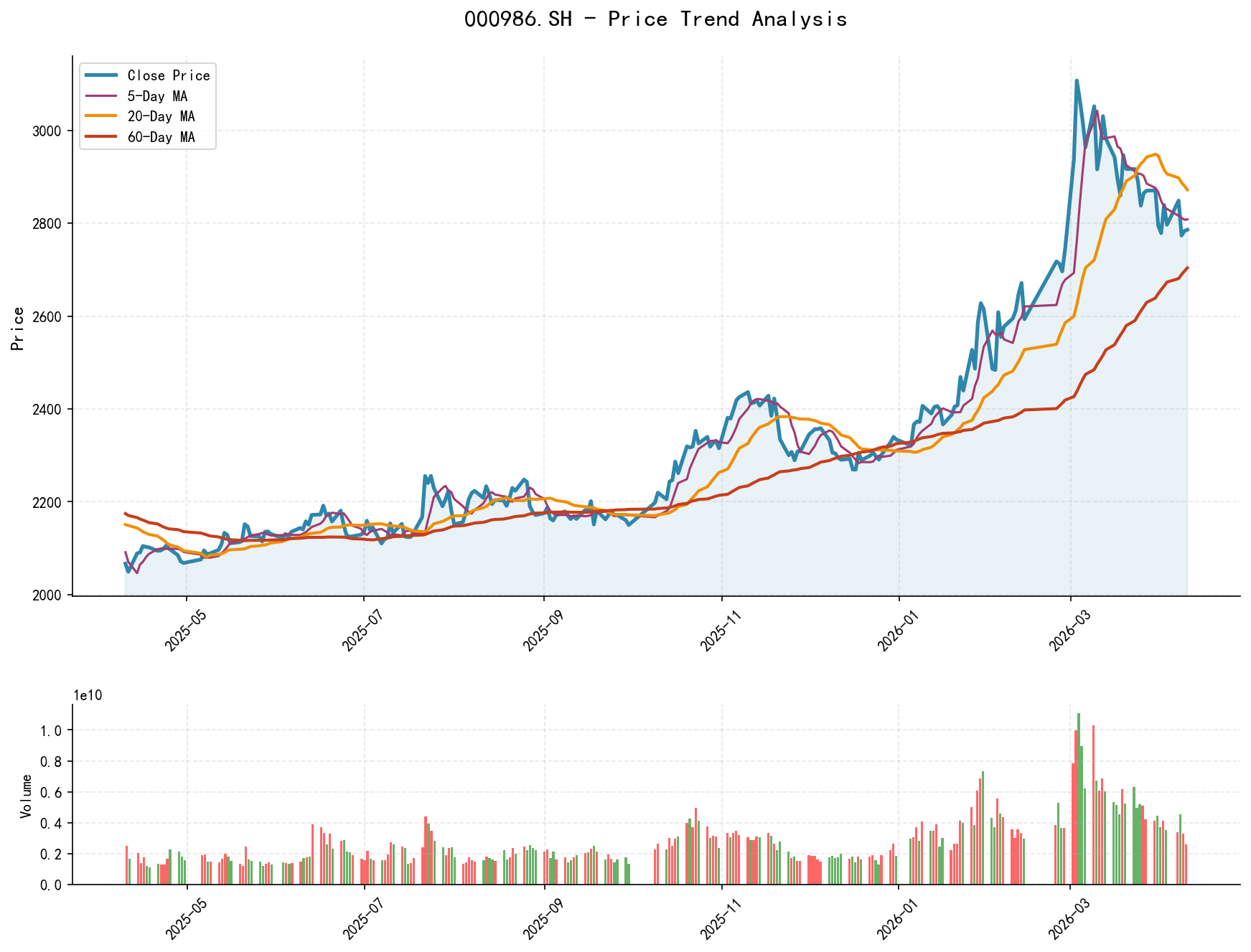
- • MA Alignment and Price Relationship:
- • Initial Strength (Late February to Early March): The price initiated a move from late February, consistently trading above all short-term MAs (MA_5D, MA_10D), and led the medium- and long-term MAs (MA_20D, MA_30D, MA_60D) to form a standard bullish alignment. The price broke out with consecutive large bullish candles on March 2nd and 3rd, reaching the cycle high.
- • Trend Reversal and Breakdown (Early March to April): The price peaked after reaching a historical first in trading volume on March 4th (110.65 billion CNY, historical rank #1). Subsequently, the price fluctuated downward. The MA_5D crossed below the MA_20D in mid-March, signaling the end of the short-term uptrend. As of April 10th, the price (2786.00) has fallen below the MA_5D (2808.33), MA_10D (2822.09), and MA_20D (2871.94), barely holding above the MA_30D (2896.65) and MA_60D (2703.86). The market structure has shifted from a bullish alignment to a bearish alignment of short-term MAs, with only the long-term MA (MA_60D) acting as the final support below.
- • Market Phase Inference:
- • Early March: Trend Rally and Possible Distribution Phase. The price accelerated upward, with trading volume (approx. 10 billion shares on March 3rd, historical rank #3) and turnover (103.5 billion CNY, historical rank #3) reaching historical extremes. Combined with the subsequent price action, this phase more closely aligns with the characteristics of a Distribution phase in Wyckoff theory — the public frantically buys while large investors distribute their holdings.
- • Mid-March to Present: Clear Post-Distribution Decline and Testing Phase. The price declined from its highs, with successively lower highs and lows, entering a downtrend. The decline in early April was accompanied by significantly reduced volume, indicating that supply (selling pressure) began to weaken, and the market entered a phase of seeking demand and testing support.
2. Volume-Price Relationship and Supply-Demand Dynamics
As of April 10, 2026, the subject 000986.SH has an opening price of 2768.43, closing price of 2786.00, trading volume of 2,606,852,000 shares, daily change of +0.10%, trading volume of 2,606,852,000 shares, 7-day average volume of 3,860,182,057.14 shares, and 7-day volume ratio of 0.68.
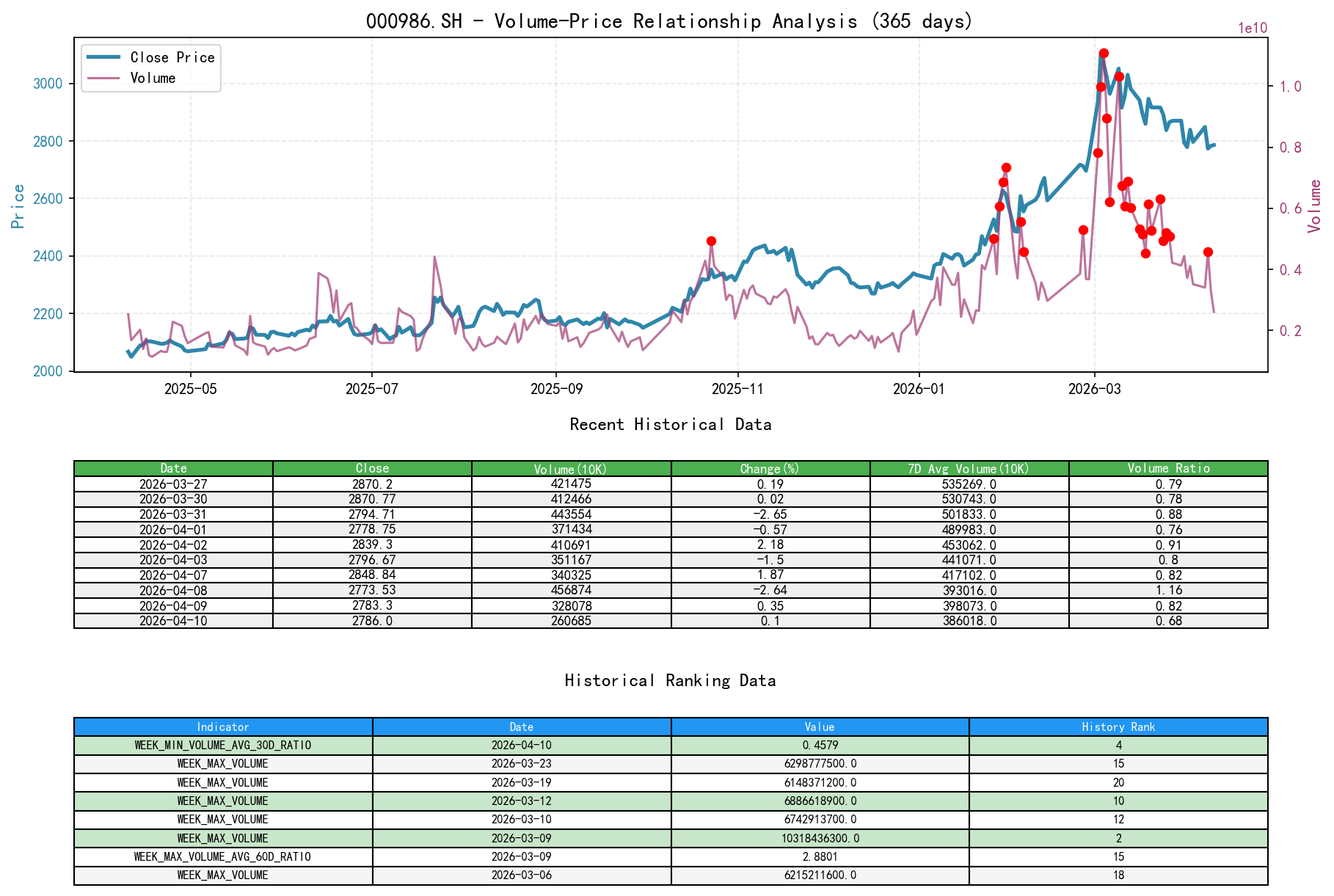
- • Key Day Volume-Price Action Analysis:
- • Demand-Driven Buying Frenzy (2026-03-02 / 2026-03-03): The price surged by 6.98% and 5.81% respectively (historical daily gain ranks #1 and #5), accompanied by a sharp increase in trading volume (7.82B and 9.99B shares) and turnover (78.4B and 103.5B CNY). This is a strong signal of demand entering the market. However, considering the subsequent stagnation, it can be viewed as a Buying Climax, creating conditions for subsequent distribution.
- • Supply-Driven Distribution (2026-03-04): Core Signal Day. Following consecutive surges, the price opened higher but closed lower on the day (-1.28%), while both trading volume (11.096B shares) and turnover (110.65B CNY) set the highest historical records in nearly a decade (rank #1). This is a textbook case of high volume with price stagnation, indicating massive supply overwhelming demand and confirming distribution activity. The
VOLUME_AVG_60D_RATIOreached 3.43 (historical rank #6), verifying the extreme anomaly in volume. - • Demand-Depleted Rebound (2026-03-09 / 2026-03-12): After the decline, the price experienced two rebounds exceeding 2.5%. However, the accompanying volume (
VOLUME_AVG_14D_RATIOof 1.88 and 1.07 respectively) was significantly lower than the previous massive levels, constituting low-volume rebounds. This indicates weak follow-through demand and suggests the rebound is unsustainable, typical of the "lower rally high" pattern within a distribution structure. - • Supply Exhaustion and Panic Selling (2026-03-10 / 2026-03-31): On March 10th, the price fell sharply by -4.46%, with volume remaining high (
VOLUME_AVG_14D_RATIOof 1.13), constituting a high-volume decline. The volatility (HIS_VOLA_7D0.815) reached the eighth highest in nearly a decade, indicating Panic Selling. By March 31st, the price fell again by -2.65%, but volume (VOLUME_AVG_7D_RATIO0.88) had begun to contract, hinting that panic selling was gradually exhausting itself. - • Supply Contraction, Entering Balance/Accumulation Test (2026-04-10): On the current day (April 10th), the price rose slightly by 0.10%, accompanied by a significant contraction in volume (2.607B shares). The
VOLUME_AVG_30D_RATIOis only 0.458, ranking as the fourth lowest in nearly a decade for this metric (WEEK_MIN_VOLUME_AVG_30D_RATIOhistorical rank #4). This aligns with the Wyckoff characteristics following "Exhaustion" or an "Automatic Rally" — supply has sharply decreased, and the market has entered a low-volume equilibrium or testing phase, awaiting new demand signals.
3. Volatility and Market Sentiment
As of April 10, 2026, the subject 000986.SH has an opening price of 2768.43, 7-day intraday volatility (Parkinson) of 0.23, 7-day intraday volatility ratio of 1.00, 7-day historical volatility of 0.33, 7-day historical volatility ratio of 1.16, and RSI of 46.41.
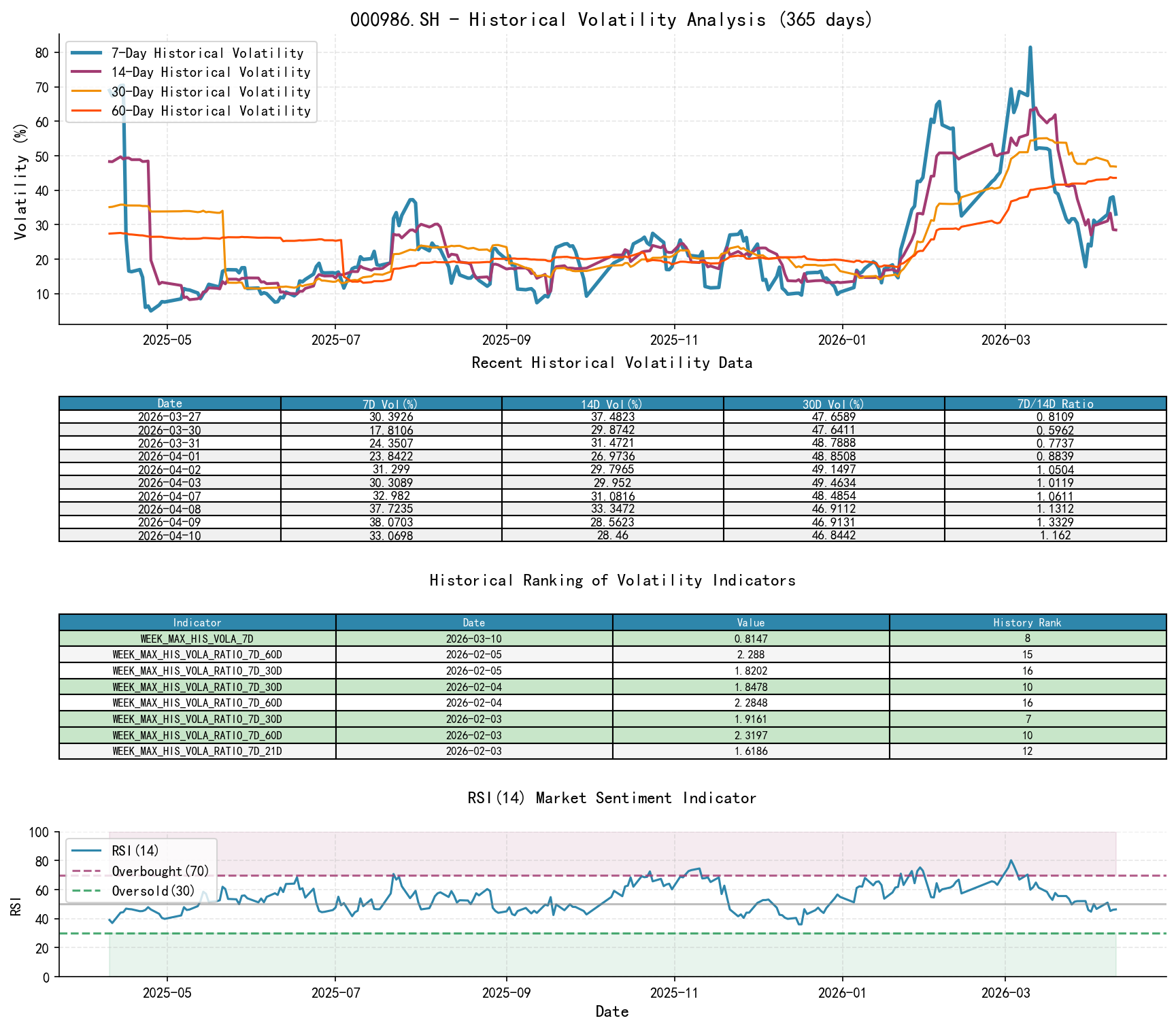
- • Volatility Levels and Changes:
- • Sentiment Climax and Panic (Early March):
HIS_VOLA_7Dreached 0.694 and 0.815 on March 3rd and 10th respectively (the latter ranking #8 historically), withPARKINSON_VOL_7Dalso spiking simultaneously. Volatility ratios (e.g.,HIS_VOLA_RATIO_7D_60D) significantly exceeded 1, indicating a dramatic short-term surge in volatility and extreme market sentiment ranging from euphoria to panic. - • Sentiment Convergence and Stabilization (Current): As of April 10th,
HIS_VOLA_7Dhas retreated to 0.331, andPARKINSON_VOL_7Dhas dropped to 0.230. Volatility ratios (e.g.,HIS_VOLA_RATIO_7D_14Dat 1.16), while still slightly above 1, have significantly converged from extreme highs. This suggests the market has recovered from panic and entered a low-volatility consolidation state.
- • Sentiment Climax and Panic (Early March):
- • Overbought/Oversold Status (RSI):
- • Severely Overbought (March 3rd):
RSI_14was as high as 80.29, marking the eighth highest in nearly a decade (historical rank #8), corroborating the extreme optimism and irrational state of the market at that time. - • Returning to Neutral (Current): As of April 10th,
RSI_14is 46.41, having moved out of the oversold territory (recently touching a low of 44.83 in late March) and is now in a neutral-to-weak position. Sentiment indicators show the market has completed a cycle from extreme optimism to pessimistic release and is currently in a relatively calm period.
- • Severely Overbought (March 3rd):
4. Relative Strength and Momentum Performance
- • Periodic Return Analysis:
- • Short-Term Momentum (-):
WTD_RETURNis -0.38%,MTD_RETURNis -0.31%, indicating weak short-term momentum. - • Decaying Mid-Term Momentum (-):
QTD_RETURNis -0.31% (due to quarter start), but combined withYTD(19.35%) and the March peak, mid-term (quarterly) momentum has significantly weakened since the March peak. - • Long-Term Momentum Remains (+):
YTDreturn remains at 19.35%, andTTM_12is 34.80%, indicating the foundation of the long-term uptrend has not been completely broken, although the recent correction has eroded most of the year's gains.
- • Short-Term Momentum (-):
- • Comprehensive Momentum Assessment: The product exhibits a typical "rally and subsequent decline" momentum characteristic. Short- and mid-term momentum has turned negative or significantly weakened, but long-term annualized returns remain positive, suggesting the current phase is a deep correction within a longer-term uptrend.
5. Smart Money (Large Investor) Behavior Identification
Based on the above volume-price, trend, and volatility analysis, the operational intent of large investors (Smart Money) can be inferred:
- 1. Frenzied Buying and Distribution in Early March: Smart Money drove the price up from late February to early March, attracting public participation. At the peak of market euphoria and record-breaking volume on March 3rd-4th, they conducted large-scale distribution. The historical #1 turnover on March 4th accompanied by a price decline is a clear signal of "large supply overwhelming public demand."
- 2. Utilizing Rebound for Continued Distribution: During the rebounds on March 9th and 12th, volume failed to surpass previous highs, indicating Smart Money was not aggressively buying at these levels and may have continued distributing remaining holdings.
- 3. Triggering and Observing Panic Selling: The sharp declines on March 10th and 31st, accompanied by high volatility, represent Panic Selling that occurred naturally after Smart Money withdrew support. Smart Money typically does not rush to buy during this phase but observes the process of supply exhaustion.
- 4. Current Phase: Testing Demand, Preparing for Next Action: Current volume has contracted to an extreme low level in nearly a decade (
VOLUME_AVG_30D_RATIOat a historical low), indicating floating supply has significantly decreased. Smart Money is likely testing market demand strength (e.g., observing if price can find support at key levels) while potentially accumulating shares at lower prices in preparation for the next possible cycle. There is no evidence yet of large-scale accumulation beginning.
6. Support/Resistance Level Analysis and Trading Signals
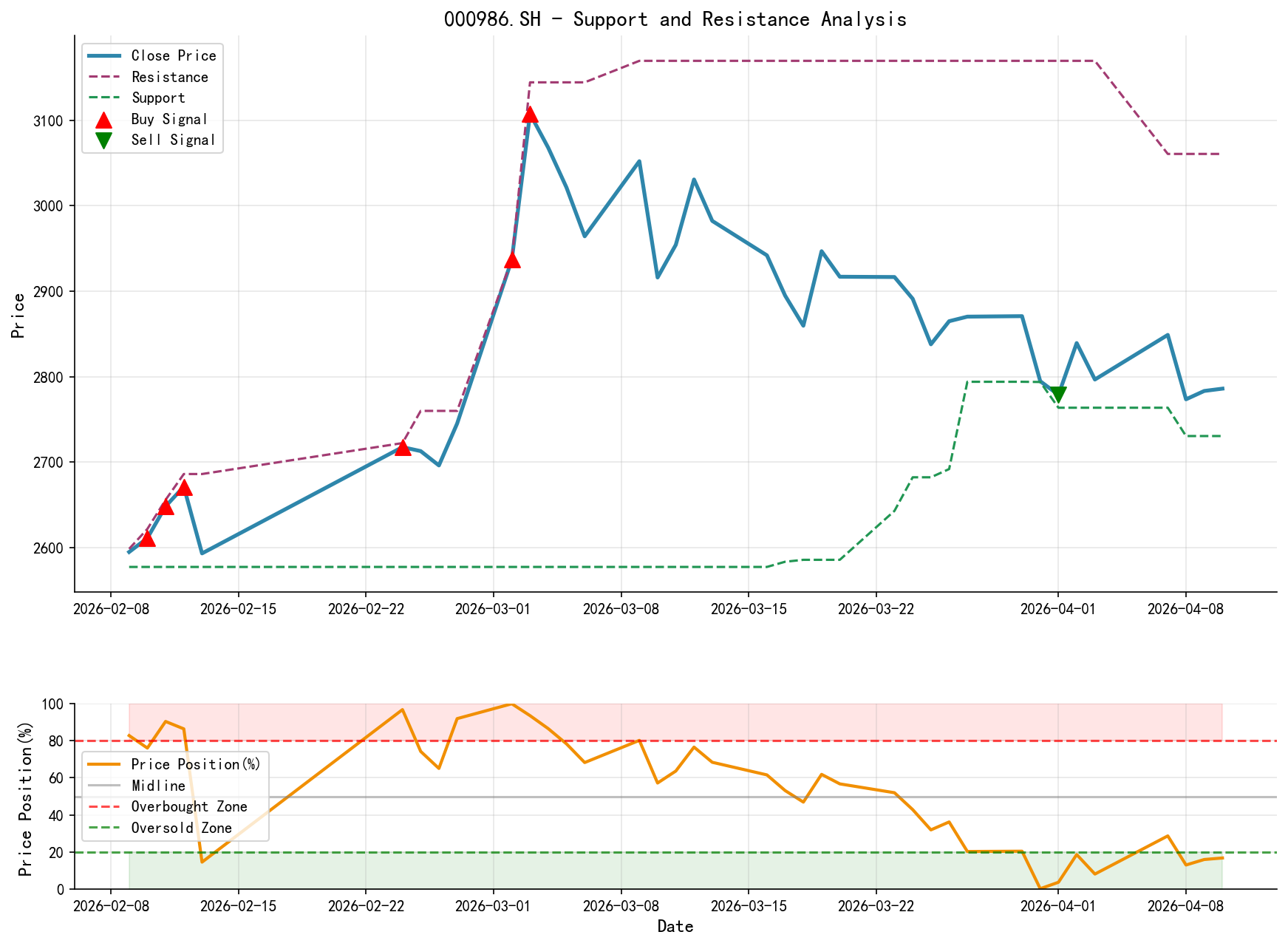
- • Key Support Levels:
- • S1 (Immediate Support): 2750 - 2778 range. The price has found support multiple times in this area recently (April 1st low of 2763.68, April 8th low of 2730.58). MA_60D (2703.86) is the most crucial long-term trend support line below.
- • S2 (Strong Support): 2700 - 2712 range. The price consolidation zone and stage low from February 25th-26th.
- • Key Resistance Levels:
- • R1 (Recent Resistance): 2865 - 2895 range. Constituted by the current MA_20D (2871.94) and recent rebound highs (March 24th high of 2894.54).
- • R2 (Strong Resistance / Upper Bound of Distribution Zone): 2937 - 3107 range. The historical high-volume trading zone from early March, forming substantial overhead supply (resistance from trapped longs).
- • Comprehensive Trading Signals and Operational Recommendations:
- • Primary Trend: Bearish/Neutral. The market is in a post-distribution downtrend, with the short-term structure broken.
- • Operational Recommendations:
- 1. Bears/Observers: Maintain a defensive/observational stance. Any low-volume rebound towards the R1 resistance zone represents a selling (or shorting) opportunity with higher risk than reward, not a buying opportunity.
- 2. Potential Bulls/Monitors: Exercise patience, waiting for clear demand signals. Avoid bottom-fishing (left-side trading) in a downtrend. Wait for validation through the following Wyckoff events:
- • Signal One (Secondary Test): When price retests the S1 or S2 support level, accompanied by extremely low volume (a Spring or Test), indicating supply exhaustion.
- • Signal Two (Demand Confirmation): Following the above test, a high-volume bullish candle (Sign of Strength) that breaks the recent downtrend line or closes above the MA_20D, with significantly increased volume (
VOLUME_AVG_7D_RATIO > 1.2).
- • Specific Tactics:
- • Entry Point (Long): After the consecutive appearance of the two signals mentioned above, enter on a pullback following the high-volume bullish candle.
- • Stop-Loss Level: Place below the support low established during Signal One.
- • Initial Target: R1 resistance zone.
- • Future Validation Points:
- • Bearish Validation: If the price breaks below the MA_60D (2703) key support on high volume, the downtrend will likely deepen, with the next target around the 2600 area.
- • Bullish Validation: If the price can sustain a rally on increasing volume (volume recovering above its average levels) and close decisively above the MA_20D, it may signal the end of this correction and the market entering a new equilibrium or uptrend structure.
Core Conclusion: 000986.SH, after experiencing a frenzy-driven rally propelled by record-high volume (top historical ranks), has confirmed entry into a mid-term correction phase following distribution. Current market supply has contracted sharply, placing the market in a state of low-volume equilibrium. Smart Money has completed its primary distribution and is currently in an observation and testing phase. Traders should remain patient. Prior to the appearance of clear Wyckoff demand signals, a defensive and observational stance is recommended, avoiding the temptation to "catch a falling knife" within the downtrend. The next significant trading opportunity will emerge when the market demonstrates renewed demand dominance through a "low-volume test" followed by a "high-volume advance."
Disclaimer: This report/analysis is solely market analysis and research based on publicly available information and does not constitute any investment advice or operational guidance. The author strives for objectivity and impartiality but makes no guarantees regarding the accuracy or completeness of the content. Markets involve risks; investments require caution. Any investment actions taken based on this report are undertaken at your own risk.
Thank you for your attention! Daily Wyckoff Volume-Price Market Analysis is published promptly at 8:00 AM before market open. Your comments and shares are sincerely appreciated and highly valued. Let's work together to perceive market signals.
Member discussion: