
Excellent, received. As a quantitative trading researcher proficient in the Wyckoff Method, I will draft a comprehensive and in-depth quantitative analysis report based on the provided data for 000300.SH (CSI 300 Index) and its historical rankings. The report will strictly adhere to the six dimensions and requirements you specified. All conclusions are derived from data and conform to Wyckoff's principles of volume and price analysis.
CSI 300 Index (000300.SH) Wyckoff Volume-Price Analysis Report
Analysis Date Range: 2026-02-09 to 2026-04-10
Report Generation Date: 2026-04-10
1. Trend Analysis and Market Phase Identification
As of 2026-04-10, the subject 000300.SH has: Opening Price 4594.95, Closing Price 4636.57, 5-day MA 4504.42, 10-day MA 4497.03, 20-day MA 4543.74, Daily Change +1.54%, Weekly Change +4.41%, Monthly Change +4.19%, Quarterly Change +4.19%, Year-to-Date Change +0.14%.
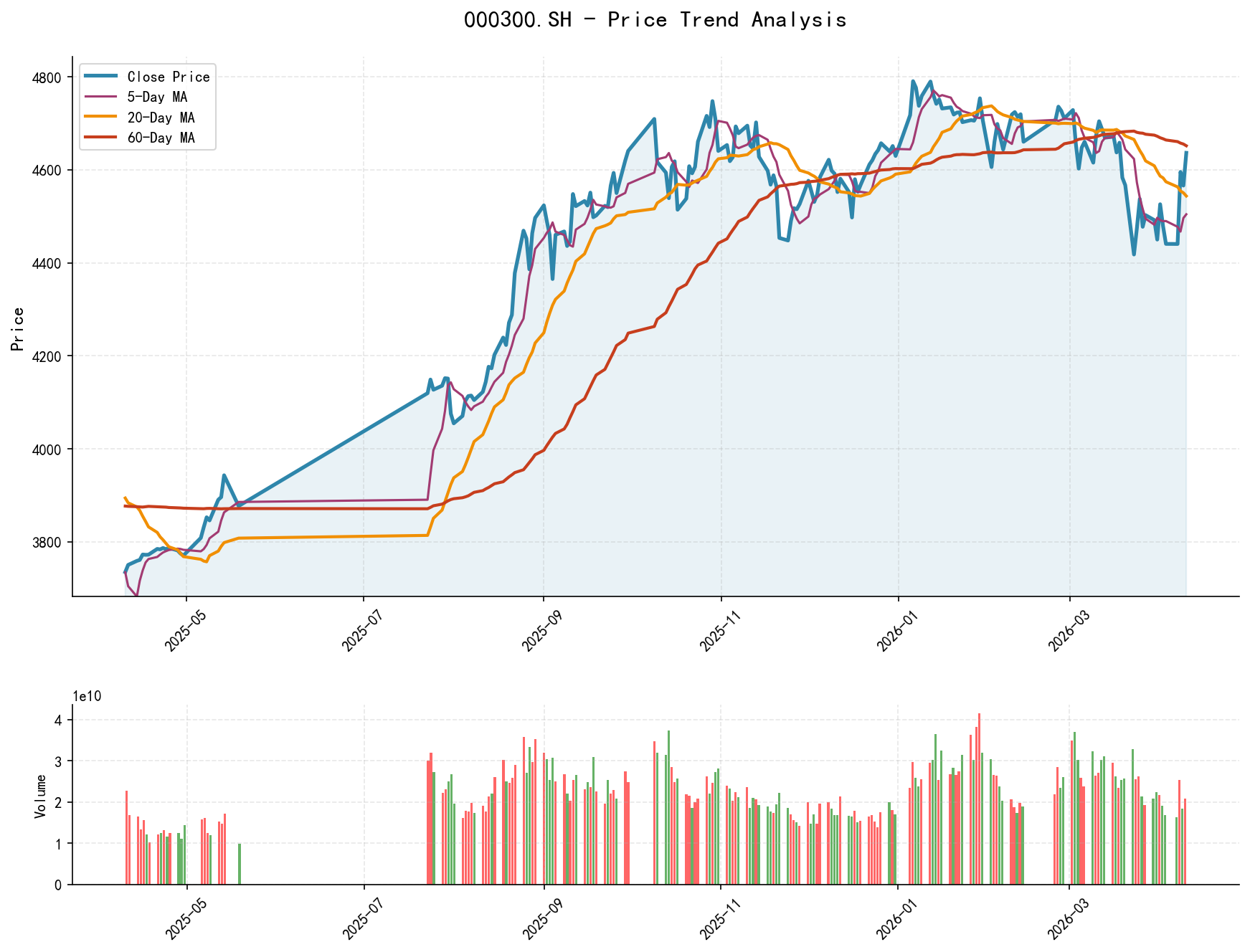
- 1. Moving Average Alignment and Trend Structure:
- • Initial Phase (Early to Mid-February): The price (CLOSE) fluctuated narrowly above the 4700 level but consistently remained below the MA_5D, MA_10D, MA_20D, and MA_30D (around 4700-4710), only slightly above the MA_60D (~4638). This formed a short-to-medium-term bearish moving average alignment, indicating a weak, consolidating market with some support from the long-term moving average (MA_60D).
- • Decline and Panic Phase (Mid to Late March): Starting from March 3rd (-1.54%), the price began a rapid decline, effectively breaking below all moving averages. By March 23rd, the price hit a low of 4417.997, well below the diverging bearish moving average system (MA_60D: ~4683). This stage is a classic accelerated decline within a bearish alignment.
- • Rebound and Trend Reversal Attempt (Early April): After stabilizing around 4417, a massive high-volume bullish candlestick (+3.49%) appeared on April 8th, decisively breaking above the MA_5D, MA_10D, MA_20D, and MA_30D. As of April 10th, the MA_5D (4504) has crossed above the MA_60D (4651), forming a short-term golden cross. The price stands firmly above all short-term moving averages but remains below the MA_60D. The market structure is transitioning from a bearish alignment to a bottom consolidation and repair phase. The long-term trend (MA_60D) has not yet reversed, but the short-term trend has significantly strengthened.
- 2. Inferred Market Phase:
Integrating price action and Wyckoff theory, the market experienced a complete weak cycle during the analysis period:- • February to Early March: Distribution and Initial Decline Phase. Prices oscillated repeatedly in the 4700-4730 range but failed to achieve a decisive breakout, with relatively moderate volume (VOLUME_AVG_14D_RATIO < 1). This is characteristic of large-scale capital distributing holdings at a resistance zone.
- • Mid to Late March: Markdown and Panic/Selling Climax Phase. Prices broke below key supports (e.g., 4650, 4600) with consecutive medium-sized bearish candles. Volatility (HIS_VOLA_7D rose from 0.15 to above 0.32) and volume (March 23rd volume surged 27.2%) spiked sharply, particularly the high-volume plunge (-3.26%) on March 23rd, aligning with the characteristics of panic selling.
- • Late March to Early April: Automatic Rally and Potential Secondary Test. The price rebounded swiftly from the panic low (4417) to 4595, accompanied by significantly amplified volume (April 8th VOLUME_GROWTH +55.77%). This represents the natural return of buying interest following panic selling. The subsequent low-volume pullback (April 9th, -0.64%) can be viewed as a secondary test of the panic low area, testing whether supply has been exhausted. The current market (as of April 10th) is in the early stage of recovering from panic selling and attempting to establish a new uptrend.
2. Volume-Price Relationship and Supply-Demand Dynamics
As of 2026-04-10, the subject 000300.SH has: Opening Price 4594.95, Closing Price 4636.57, Volume 20,867,860,500, Daily Change +1.54%, Volume 20,867,860,500, 7-day Average Volume 20,017,949,000.00, 7-day Volume Ratio 1.04.
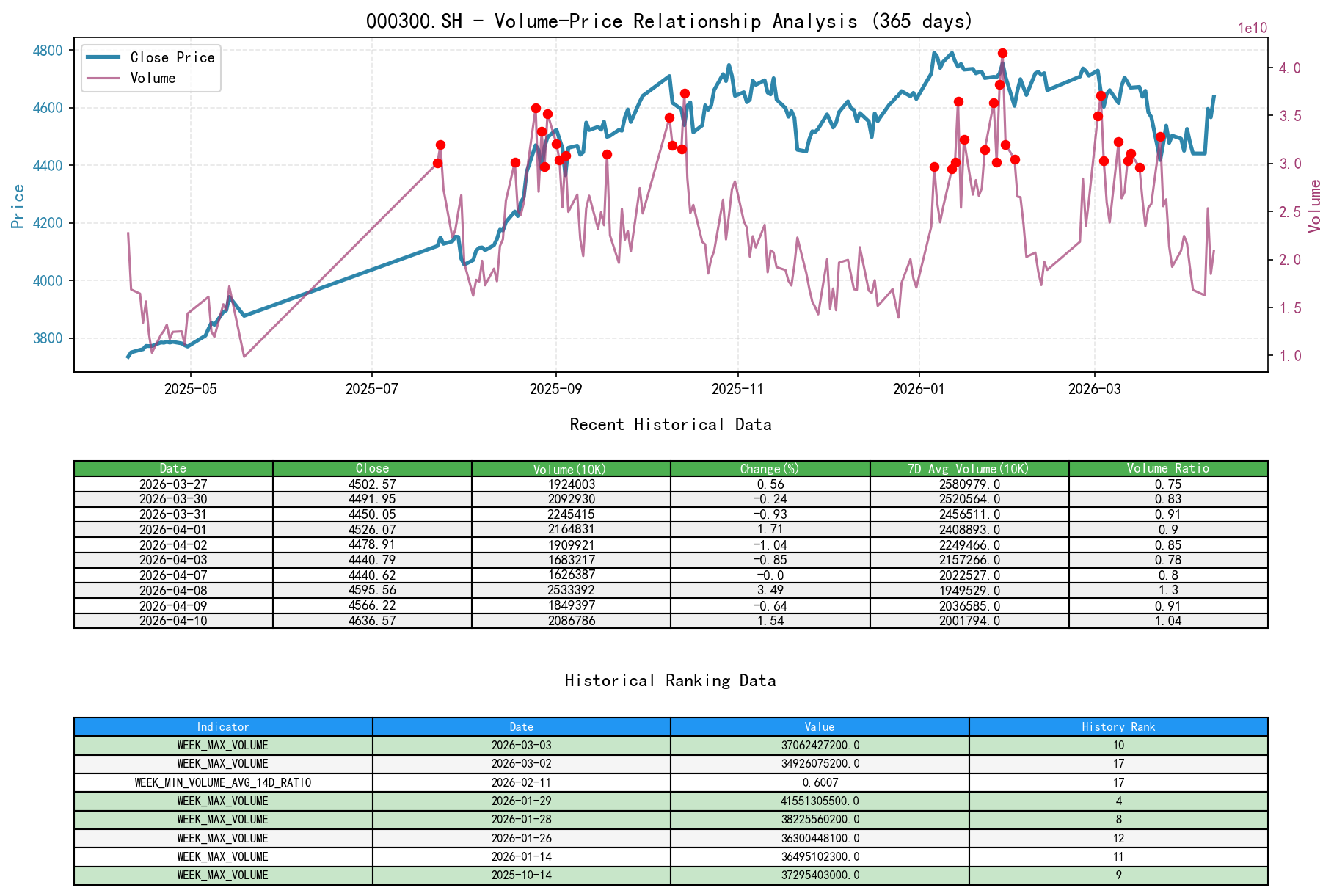
- 1. Identification of Key Volume-Price Days:
- • Supply-Driven High-Volume Decline (Distribution/Panic):
- • 2026-03-23: Price plummeted -3.26%, volume surged 27.23% (VOLUME_GROWTH), with massive turnover (671.7 billion). The
VOLUME_AVG_30D_RATIOreached a high of 1.254, andVOLUME_AVG_60D_RATIOwas 1.280. This is a typical panic selling day, where concentrated supply created a potential seasonal low (SC).
- • 2026-03-23: Price plummeted -3.26%, volume surged 27.23% (VOLUME_GROWTH), with massive turnover (671.7 billion). The
- • Demand-Driven High-Volume Advance (Accumulation/Buying Rush):
- • 2026-04-08: Price surged +3.49%, volume exploded by 55.77%, with
VOLUME_AVG_7D_RATIOreaching 1.299. Historical rankings show this day's gain (WEEK_MAX_PCT_CHANGE) ranked 17th highest in the past decade. This is a strong signal of demand entry post-panic, indicating substantial capital actively absorbing shares at lower levels. - • 2026-04-10: Price continued to rise +1.54%, with volume increasing a further 12.84% from the previous day, and
VOLUME_AVG_7D_RATIOat 1.042. The pattern of advancing on high volume continued, confirming persistent demand.
- • 2026-04-08: Price surged +3.49%, volume exploded by 55.77%, with
- • Weak-Demand Low-Volume Rebound/Rise (Warning Signal):
- • 2026-03-10/11: Prices rebounded during a decline consolidation, but volume was noticeably lower than during the prior panic days (negative VOLUME_GROWTH), with
VOLUME_AVG_14D_RATIOaround 1.0. This indicates a weak rebound, which ultimately proved to be a pullback within the downtrend. - • 2026-04-09: A low-volume pullback occurred the day after the large advance (-0.64%,
VOLUME_GROWTH -27.00%), withVOLUME_AVG_7D_RATIOdropping to 0.908. This can be interpreted as healthy profit-taking or a test of the breakout. The key is whether subsequent sessions can again show high volume.
- • 2026-03-10/11: Prices rebounded during a decline consolidation, but volume was noticeably lower than during the prior panic days (negative VOLUME_GROWTH), with
- • Supply-Driven High-Volume Decline (Distribution/Panic):
- 2. Supply-Demand Power Shift:
- • The data clearly shows the turning point in supply-demand forces: March 23rd (panic selling, supply climax) -> April 8th (forceful buying, demand climax).
- • Volume ratio indicators show recent activity far exceeding medium-to-long-term averages (
VOLUME_AVG_60D_RATIOhas frequently exceeded 1.0 from late March onward). Historical ranking data confirms that the 60-day average volume (WEEK_MAX_AVERAGE_VOLUME_60D) over the past two months ranks exceptionally high (1st to 7th) within the past decade. This indicates that market participation (whether selling or buying) during the current phase has reached historically rare levels, serving as strong evidence of significant institutional activity.
3. Volatility and Market Sentiment
As of 2026-04-10, the subject 000300.SH has: Opening Price 4594.95, 7-day Intraday Volatility 0.13, 7-day Intraday Volatility Ratio 0.82, 7-day Historical Volatility 0.32, 7-day Historical Volatility Ratio 1.00, RSI 55.57.
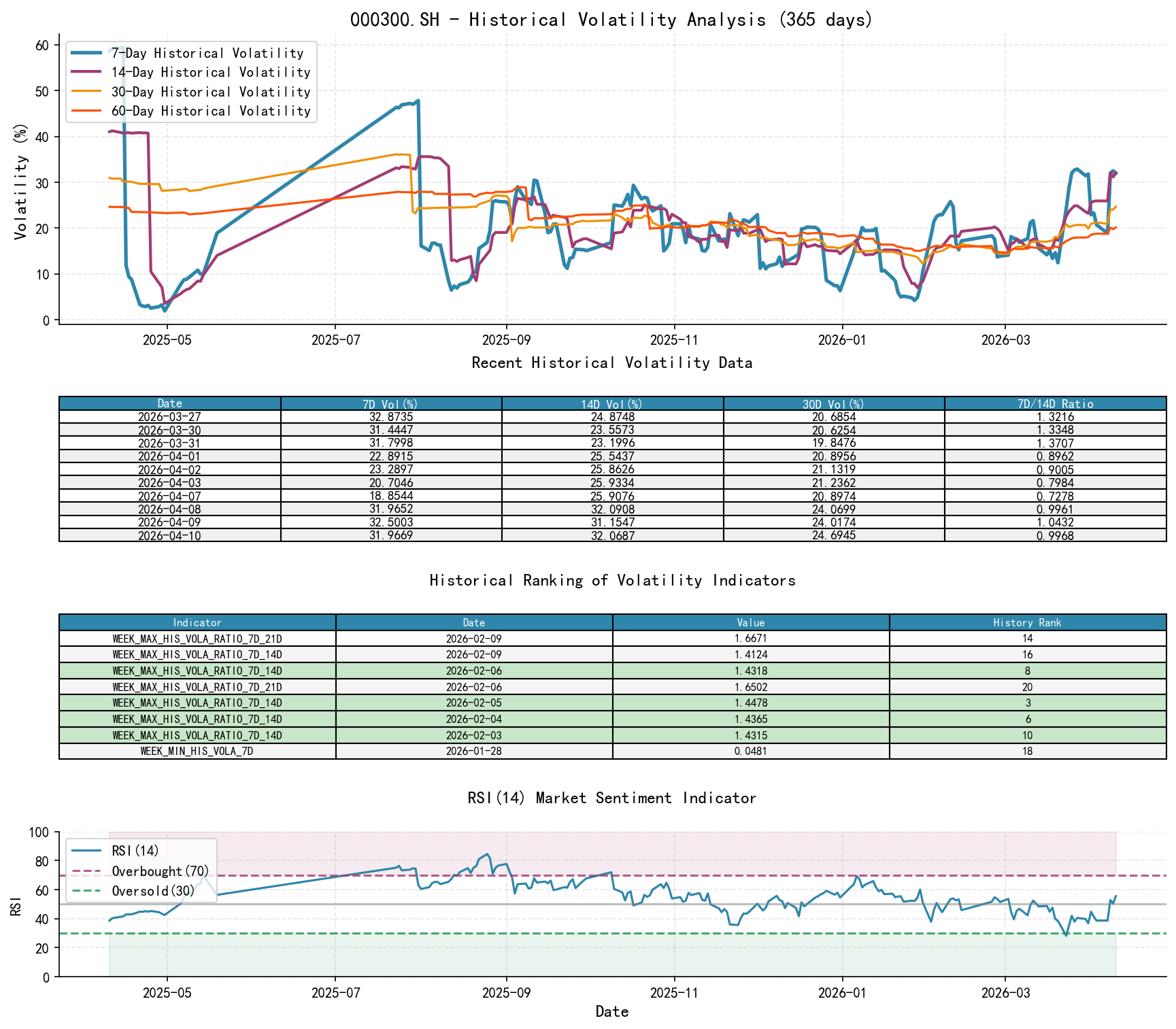
- 1. Volatility Level and Changes:
- • Volatility Explosion During Panic Period: During the decline/panic phase in late March,
HIS_VOLA_7Drapidly climbed from around 0.14 to above 0.32 (March 25-27). Simultaneously, short-term volatility surged relative to long-term volatility, withHIS_VOLA_RATIO_7D_60Dpeaking at 1.83 (March 25th) andPARKINSON_RATIO_7D_60Dpeaking at 1.36 (March 24th). This clearly indicates market sentiment entered a state of extreme panic. - • Volatility Convergence and Sentiment Recovery: Entering April, as prices rebounded, volatility began to converge rapidly.
HIS_VOLA_7Dremained near its high of 0.32, but the ratio indicators declined (HIS_VOLA_RATIO_7D_14Dfell back near 1.0,PARKINSON_RATIO_7D_14Ddropped to 0.82). This suggests short-term panic has subsided, and market volatility is normalizing, which is conducive to stable trend development.
- • Volatility Explosion During Panic Period: During the decline/panic phase in late March,
- 2. Overbought/Oversold Status (RSI):
- • Validation of Sentiment Extremes: At the March 23rd panic low,
RSI_14dropped to 28.23, entering the oversold zone, resonating with the technical picture of panic selling. - • Current Status: As of April 10th,
RSI_14has recovered to 55.57, in a neutral-to-strong zone. It is neither overbought nor oversold, leaving room for further price appreciation.
- • Validation of Sentiment Extremes: At the March 23rd panic low,
4. Relative Strength and Momentum Performance
- 1. Periodic Return Analysis:
- • Strong Short-Term Momentum Reversal:
WTD_RETURN(weekly return) strongly turned positive from negative values in late March, reaching +4.41% as of April 10th, indicating very strong short-term momentum. - • Medium-Term Momentum Repair:
MTD_RETURN(monthly return) recovered from -5.53% at the end of March to +4.19%.QTD_RETURN(quarterly return) also turned positive to +4.19%. This shows the rebound that began in early April is forceful enough to reverse the previous monthly and quarterly downtrends. - • Long-Term Momentum Awaits Confirmation:
YTD(year-to-date return) is still just +0.14%, having barely turned positive. A complete reversal of the long-term trend requires the price to decisively break above and sustain above key resistance levels (e.g., the February highs).
- • Strong Short-Term Momentum Reversal:
- 2. Momentum Conclusion:
Short-term and medium-term momentum have clearly shifted from weak to strong, corroborating the conclusion of "robust demand return" from the volume-price analysis. The market is rapidly recovering from an extremely weak momentum environment.
5. Large Investor (Smart Money) Behavior Identification
Based on cross-verification from the above four dimensions, we can clearly delineate the behavioral path of large investors:
- 1. Who Was the Absorber During the Late March Panic Selling? The market witnessed historically high turnover (historically high volume rankings) on March 23rd and the following days. The Wyckoff principle posits that high volume during a Selling Climax is a typical scenario where the public sells out of fear, and large investors (smart money) absorb the shares. The extremely high 60-day average volume ranking suggests this absorbing behavior was sustained and large-scale.
- 2. Who Was Buying on the Massive April 8th Advance? Following the panic low, the market did not drift lower but instead experienced an even more forceful high-volume advance after brief consolidation. This rules out a purely technical rebound and indicates that the large investors who absorbed panic selling are now actively pushing the price higher to move away from their cost basis and attract market attention. This is a hallmark behavior signaling the transition from "accumulation" to "markup."
- 3. Current Behavioral Positioning: Large investors have likely completed passive accumulation in the panic zone (late March) and are currently engaged in testing and shaking out via active markup (early April). The low-volume pullback on April 9th can be seen as a mild "shakeout" or "test" to observe selling pressure during the markup. The renewed high-volume advance on April 10th indicates the test was passed and demand remains firm.
6. Support/Resistance Level Analysis and Trading Signals
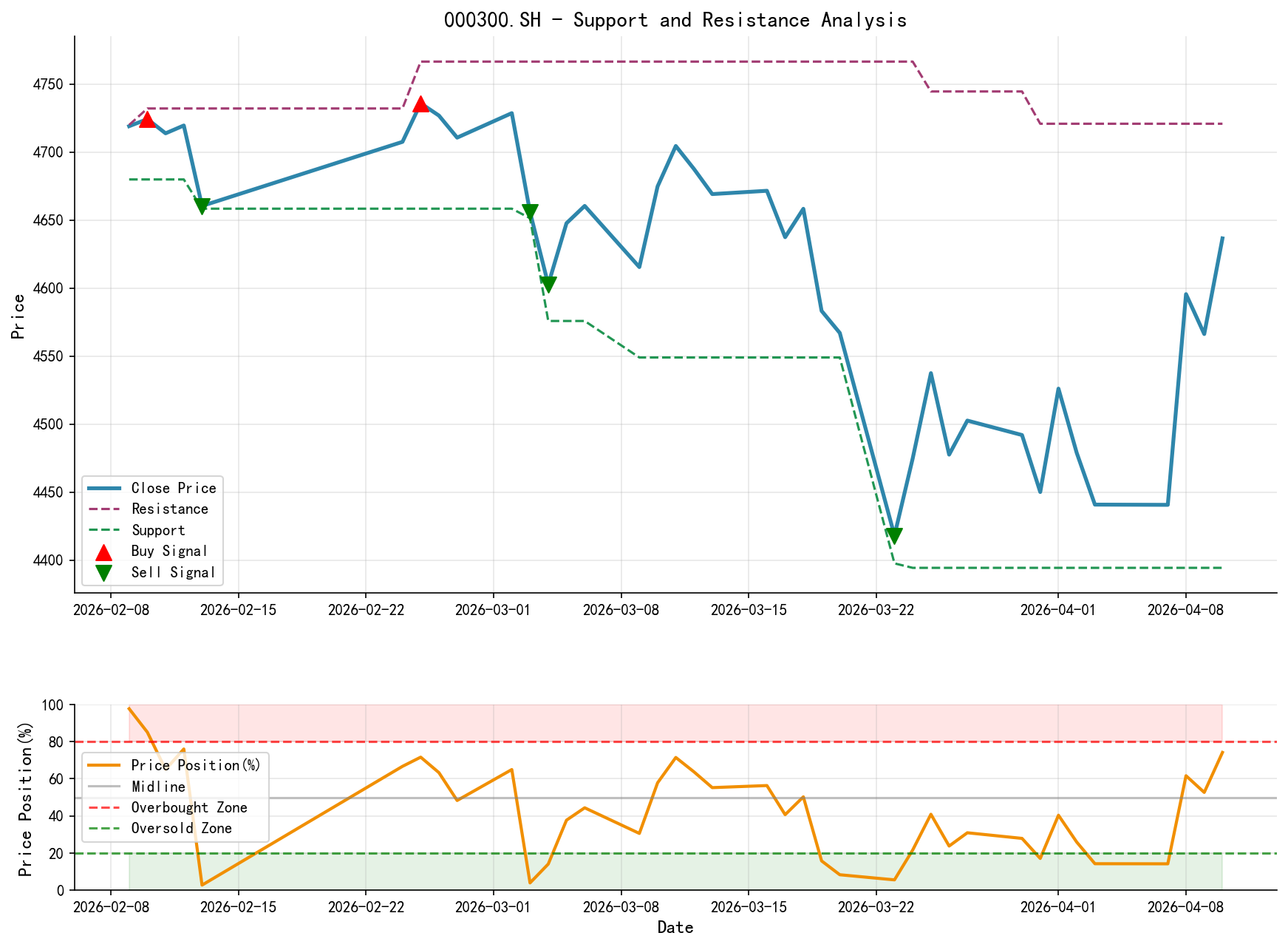
- 1. Key Price Levels:
- • Primary Support (S1): 4417-4450 zone. This is the low area formed by the March panic selling and the starting point of the current demand counterattack. A break below this level would invalidate the "panic-accumulation" hypothesis.
- • Secondary Support (S2): 4550-4580 zone. This corresponds to the midpoint of the April 8th long bullish candle and the recent consolidation platform, also where short-term moving averages (MA_5D/10D) are clustered.
- • Primary Resistance (R1): 4750-4800 zone. This is the high consolidation platform from February and the upper boundary of the prior distribution area.
- • Long-Term Resistance (R2): MA_60D (currently ~4651) and the 4700 level. This is the direct pressure from the long-term trendline. A decisive break above this zone is key to confirming a medium-term trend reversal.
- 2. Integrated Trading Signal and Operational Suggestions:
- • Integrated Judgment: Bullish. The market is in the automatic rally phase following panic selling, showing initial signs of potentially evolving into a new uptrend. Smart money accumulation in the panic zone is strongly supported by volume-price data and historical volume rankings.
- • Operational Suggestions:
- 1. Long Strategy (Primary): Consider entry opportunities when the price retraces to the S2 zone (4550-4580), combined with signs of low-volume stabilization (e.g., small candlesticks,
VOLUME_AVG_7D_RATIO < 0.8). Initial stop-loss can be set below S1 (4417). - 2. Aggressive Long: If the price breaks above R2 (4700 level) with volume (
VOLUME_AVG_7D_RATIO > 1.1) and sustains the breakout, this can serve as a confirmation signal for adding to positions. - 3. Short Strategy (Observation/Hedge): In the current demand-dominated structure, active shorting is not advisable. Consider light hedging only if the price experiences a low-volume rally to R1 (4750-4800) and shows signs of stalling (long upper shadows, inside bars, etc.).
- 1. Long Strategy (Primary): Consider entry opportunities when the price retraces to the S2 zone (4550-4580), combined with signs of low-volume stabilization (e.g., small candlesticks,
- • Future Validation Points:
- 1. Confirmation Signals: Prices maintain a healthy volume-price structure of low-volume pullbacks and high-volume advances over the next 1-2 weeks, successfully sustaining above the MA_60D and the 4700 level.
- 2. Invalidation Signals: The price quickly falls back below 4550, accompanied by high-volume decline that erases most of the gains from the April 8th advance. This would mean the current rebound is merely a continuation pattern within the downtrend, and demand is not truly in control.
- 3. Key Monitoring Metrics: Continuously monitor the relationship between
VOLUME_AVG_7D_RATIOand price movement, and watch for potential divergence ifRSI_14becomes excessively overbought (>70) during advances.
Disclaimer: This report is based on objective analysis of historical data and Wyckoff's volume-price principles. All conclusions are derived from data and do not constitute any investment advice. Financial markets involve risk. Investors should make independent decisions and bear the corresponding risks.
Thank you for your attention! Daily Wyckoff Volume-Price Market Interpretations are released promptly at 8:00 AM before market open. Your comments and shares are greatly appreciated. Your recognition is crucial. Let's work together to better perceive market signals.
Member discussion: