Understood. Based on the provided 000001.SH data (2026-02-09 to 2026-04-10) and historical ranking indicators, I will now compile a comprehensive and in-depth quantitative analysis report for you, strictly adhering to the principles of Wyckoff's volume-price analysis.
Wyckoff Method Quantitative Analysis Report for 000001.SH
Product Code: 000001.SH (Shanghai Composite Index)
Analysis Period: 2026-02-09 to 2026-04-10
Report Generation Date: 2026-04-10
1. Trend Analysis and Market Phase Identification
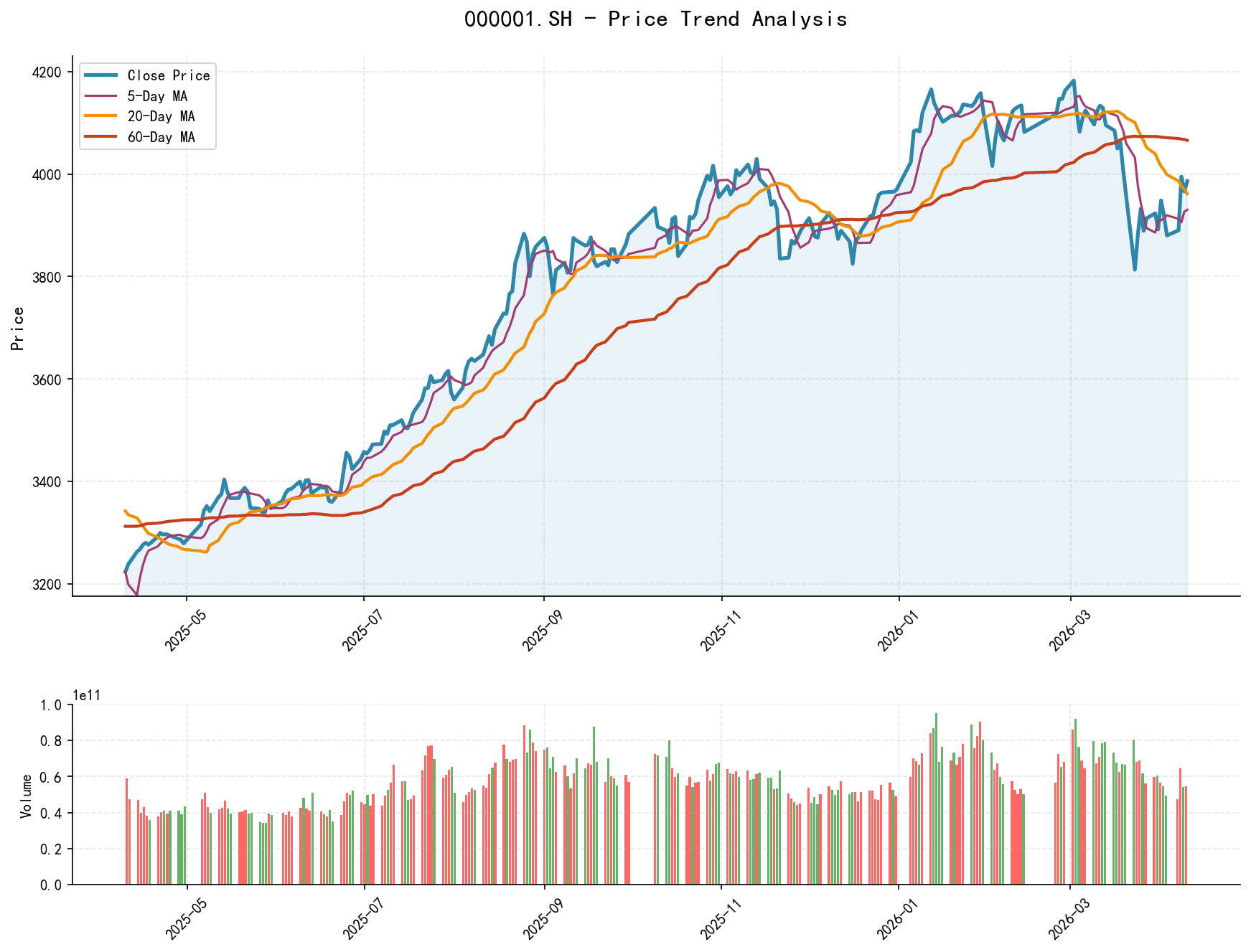
As of April 10, 2026, the underlying asset 000001.SH has an opening price of 3985.46, a closing price of 3985.22, a 5-day moving average (MA) of 3930.14, a 10-day MA of 3921.72, and a 20-day MA of 3961.47. The daily change is +0.51%, the weekly change is +2.74%, the monthly change is +2.42%, the quarterly change is +2.42%, and the yearly change is +0.44%.
Moving Average Alignment Analysis:
- • Recent Trend Evolution: From late February to early March, the price (CLOSE) traded above all major moving averages (MA_5D/10D/20D/30D/60D), forming a short-term bullish alignment. However, following the peak on March 3rd (high of 4197.228), the market entered a sharp correction. By March 23rd, the price touched a low of 3794.684, falling significantly below all short-term MAs and subsequently breaching the MA_30D and MA_60D, establishing a clear bearish alignment.
- • Current Status: During the latter part of the analysis period (April 1st to 10th), the price rebounded and has now successfully risen above the MA_5D and MA_10D, but remains below the MA_20D (3961.47), MA_30D (4017.09), and MA_60D (4065.68). This indicates a moderation in the short-term downtrend, but the medium-term (20+ days) trend remains bearish. The market is attempting to recover from the deep decline.
- • Moving Average Crossover Signals: The data sequence shows that the MA_5D crossed below both the MA_10D and MA_20D in mid-to-late March, confirming the initiation of the downtrend. Currently, the MA_5D (3930.14) has crossed above the MA_10D (3921.72), forming a "short-term golden cross." This is a preliminary signal of a potential trend change but requires confirmation from longer-term moving averages.
Market Phase Inference (Wyckoff Principles):
Based on price action and volume-price relationships (detailed below), the data reveals a complete cycle from "Distribution" to "Panic Selling," and potentially towards "Accumulation."
- • Distribution Phase: From late February to March 3rd, the price reached its highest closing price in nearly a decade (Historical Rank #1), but trading volume showed abnormal expansion (volume of 91.1B on March 3rd, Historical Rank #7). This suggests substantial selling pressure (supply) emerged at historical highs, where "smart money" was likely distributing holdings.
- • Markdown Phase: After March 3rd, the price began a rapid decline, with intermittent rallies forming lower highs, consistent with a downtrend.
- • Panic Selling: On March 23rd, the market experienced a single-day plunge of -3.63% (ranking 15th for weekly declines in the past decade), with volume reaching 80.5B, accompanied by an extreme spike in volatility (HIS_VOLA_RATIO_7D_60D reached 1.428, indicating short-term panic far exceeded the long-term average). This aligns with the Wyckoff characteristic of "Panic Selling," typically driven by irrational selling from the public.
- • Automatic Rally and Secondary Test: Following the panic low (3794.684), the market quickly rallied above 3930, constituting an "Automatic Rally." Subsequently, the price retraced and consolidated within the 3850-3950 range from March 27th to early April, with volume contracting relative to the panic day. This can be viewed as a "Secondary Test" of the panic low. The current market is likely in a critical transition period from the "Secondary Test" towards the "Accumulation" phase.
2. Volume-Price Relationship and Supply-Demand Dynamics
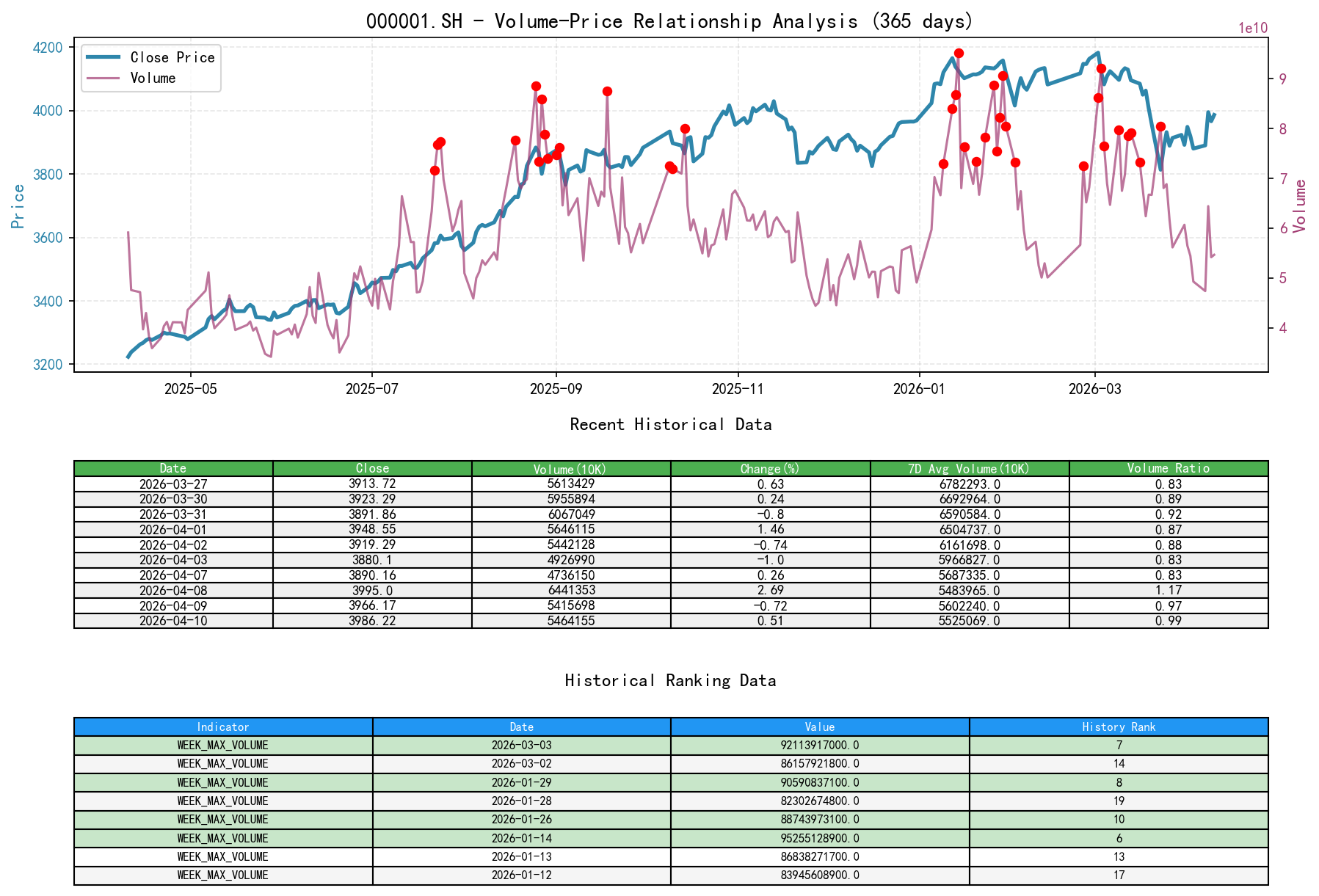
As of April 10, 2026, the underlying asset 000001.SH has an opening price of 3985.46, a closing price of 3985.22, volume of 54641554100, a daily change of +0.51%, and a 7-day average volume ratio of 0.99.
Key Day Analysis:
- 1. High-Volume Stagnation/Decline at Highs (Supply Dominant):
- • 2026-03-03: Price fell -1.43% on volume reaching the 7th highest in the past decade (92.1B). This is a textbook example of "expanding supply," indicating that massive selling completely overwhelmed buying at relatively high levels, confirming distribution activity.
- • 2026-03-04: Following the previous day's high-volume decline, another decline of -0.98% occurred on significant volume (76.5B), indicating sustained supply dominance.
- 2. Panic Selling and High-Volume Absorption at Lows (Panic vs. Accumulation Opportunity):
- • 2026-03-23: Panic day, characterized by price decline on expanding volume. Such extreme emotional release often signals a nearing end to the decline.
- • 2026-03-24/25: Two consecutive days of rally post-panic, with volume remaining at relatively high levels of 68-69B (VOLUME_AVG_7D_RATIO > 0.99). Key Insight: The fact that volume did not contract rapidly but remained active during the rally after a deep decline suggests funds were actively absorbing supply on the bounce, potentially an initial sign of accumulation by large investors.
- 3. Demand Validation During Rally:
- • 2026-04-08: Price rose strongly by 2.69% on expanding volume of 64.4B (VOLUME_AVG_7D_RATIO 1.17). This was the first instance of a "price rise on expanding volume" recently, indicating renewed demand entry.
- • Recent Period (Apr 8-10): Price showed slight gains amid consolidation, with the volume-to-7-day-average ratio (VOLUME_AVG_7D_RATIO) maintained at a healthy 0.99-0.99, suggesting stable demand without apparent low-volume stagnation.
Volume Level Assessment:
Throughout the analysis period, the market's average volume has been at historically high levels. For example, the 60-day average volume (AVERAGE_VOLUME_60D) ranked between 1st and 8th in the past decade by early April. This high baseline volume indicates extremely high market participation and frequent activity by large funds. Sustained high volume near the panic low increases the likelihood of an "Accumulation" phase.
3. Volatility and Market Sentiment
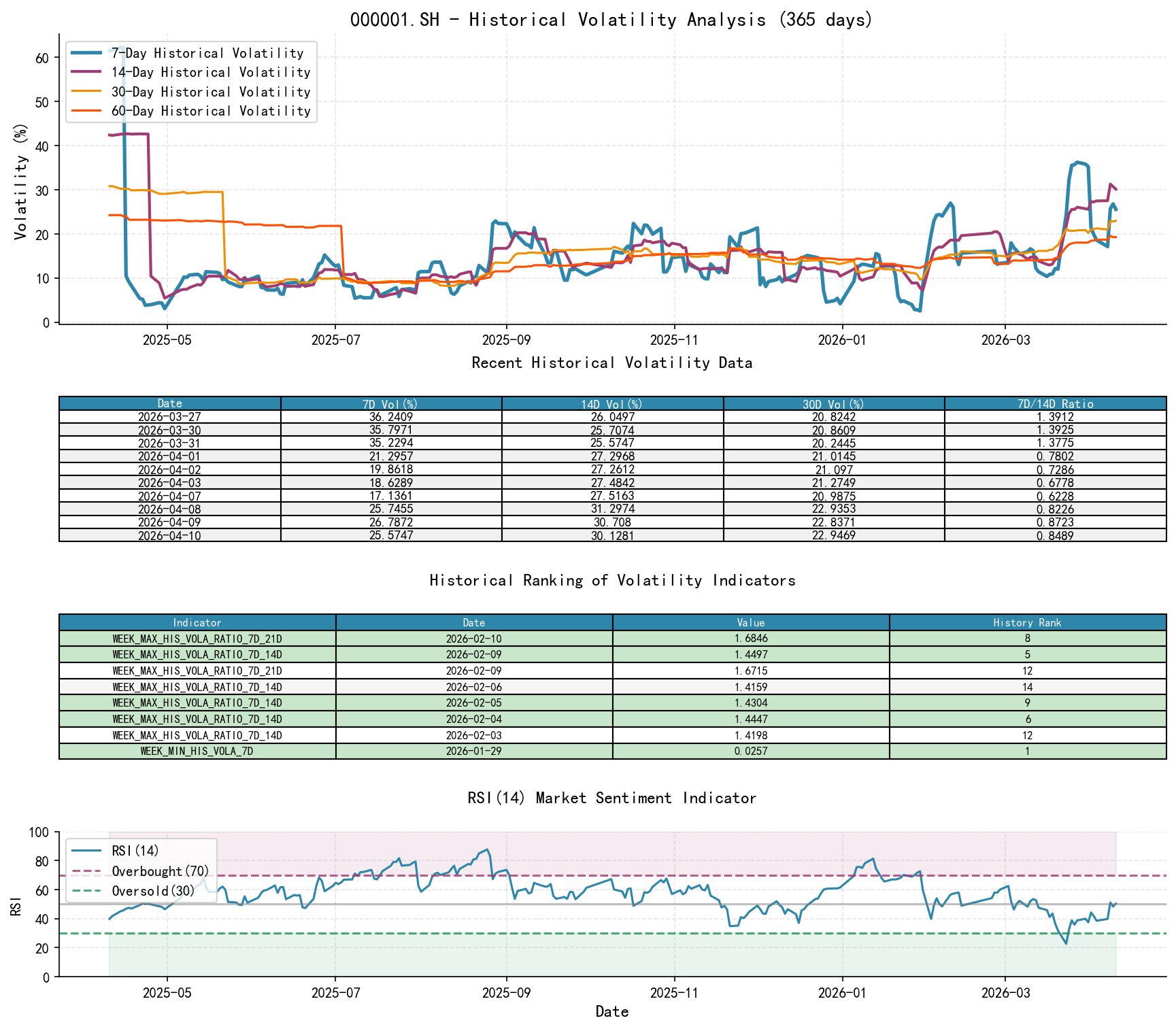
As of April 10, 2026, the underlying asset 000001.SH has an opening price of 3985.46, a 7-day intraday volatility of 0.12, a 7-day intraday volatility ratio of 0.76, a 7-day historical volatility of 0.26, a 7-day historical volatility ratio of 0.85, and an RSI of 50.39.
Volatility Analysis:
- • Extreme Sentiment: During the accelerated decline in mid-to-late March, the ratio of short-term volatility (HIS_VOLA_7D) to long-term volatility (HIS_VOLA_60D) surged sharply. For instance, on March 24th, HIS_VOLA_RATIO_7D_60D reached a high of 1.83 (at historically extreme levels), clearly marking the peak of market panic.
- • Sentiment Convergence: Entering April, HIS_VOLA_RATIO_7D_60D has retreated from extreme highs to 1.32 (as of April 10th), and PARKINSON_RATIO_7D_60D has fallen back to 0.91. This indicates a significant alleviation of market panic, with volatility transitioning from "abnormal divergence" back to "convergence," which is conducive to the formation of a阶段性 market bottom.
RSI Overbought/Oversold Validation:
- • RSI_14 touched 22.66 on March 23rd (ranking 9th lowest for weekly data in the past decade), entering deeply oversold territory. This resonates with the price action on the "Panic Selling" day, confirming extreme pessimism from a momentum perspective.
- • The current RSI_14 has rebounded to 50.39, moving out of the oversold zone into a neutral-to-strong area, supporting the assessment of short-term trend repair.
4. Relative Strength and Momentum Performance
- • Short-Term Momentum Improvement: WTD_RETURN (weekly return) turned significantly positive (+2.74%) during the week of April 8th, ending several consecutive weeks of weakness.
- • Mid-Term Momentum Still Weak but Stabilizing: MTD_RETURN (month-to-date return) turned positive in April (+2.42%), compared to -6.51% in March. QTD_RETURN (quarter-to-date return) also turned positive in early April. This suggests that after the deep decline at the end of Q1 (March), short-term downward momentum has exhausted, and the market is beginning to attempt building upward momentum at the start of the new quarter.
- • Momentum and Volume-Price Validation: The improvement in short-term momentum corroborates the "price rise on expanding volume" (April 8th) and the stable volume during the rebound, enhancing the validity of the rally.
5. Large Investor (Smart Money) Behavior Identification
Integrating the above dimensions allows for inferences regarding the operational intent and behavior patterns of large investors:
- 1. Distribution at Highs: The high-volume declines at historical highs (4180-4200 zone) in early March represent classic "Distribution" behavior by smart money. They utilized market optimism and record highs to transfer holdings to the public.
- 2. Absorption During and After Panic: The volume-price pattern from March 23rd-25th is critical. The panic day flushed out the last of the long stop-loss orders and public panic selling. In the following two days, instead of collapsing further due to panic, the price rallied supported by relatively high volume. This strongly suggests that organized large funds were selectively absorbing supply, capitalizing on the panic sentiment.
- 3. Testing and Position Building: The range-bound consolidation from late March to early April, with volume receding from panic peaks but remaining at decent absolute levels, can be interpreted as smart money "testing" the validity of the low support while continuing a measured, ongoing position build-up (accumulation) at relatively low levels.
- 4. Current Behavior: The medium-sized bullish candlestick on April 8th, accompanied by expanding volume, can be seen as a sign that smart money is concluding the testing phase and beginning to actively push prices higher to attract follow-on buying, aiming to move away from their cost base.
6. Support/Resistance Level Analysis and Trading Signals
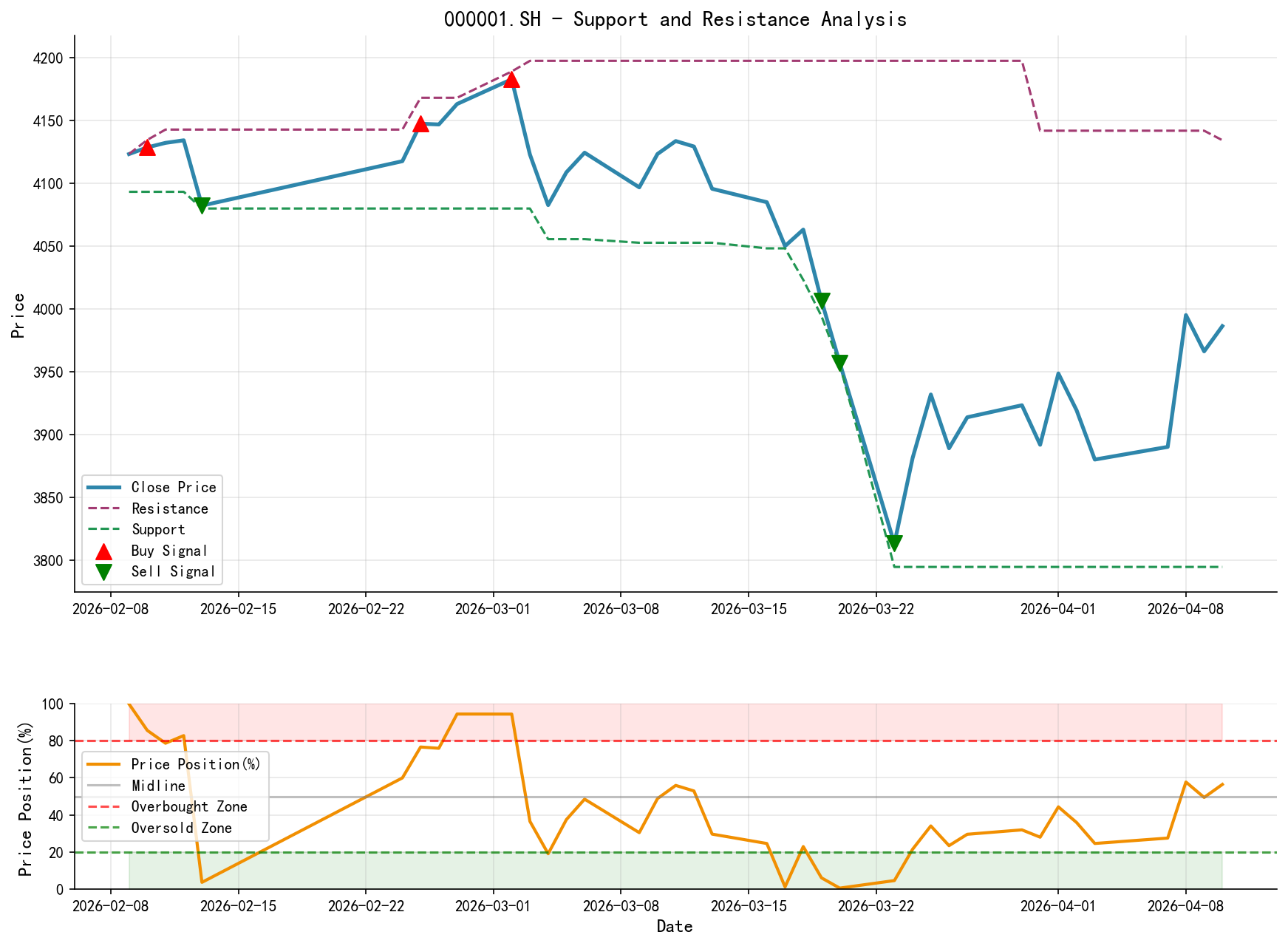
Key Price Levels:
- • Strong Support: 3800 points (area of the March 23rd panic low). This level has endured panic selling and subsequent "secondary testing," making it the most critical current support.
- • Secondary Support: 3900 points (lower boundary of the early April consolidation range and vicinity of the recent MA_5D).
- • Strong Resistance: 4180 points (pre-March 2nd high close, Historical Rank #1). This level holds significant trapped supply and is a key medium-term resistance.
- • Near-Term Resistance: 4010 points (April 10th high,接近 MA_30D) and 4060 points (vicinity of MA_60D).
Integrated Trading Signals and Operational Suggestions:
- 1. Market Characterization: The data suggests the market has likely completed the process from "Distribution" to "Panic Selling" and is currently in the late stages of a complex "Accumulation" or "Secondary Test" phase. A significant intermediate-term low may have been established on March 23rd.
- 2. Trading Direction: Bullish / Seek long opportunities. Based on high-volume absorption post-panic, volatility convergence, RSI bullish divergence, and improving short-term momentum, the risk of further sharp declines is reduced, and the probability of an upward repair phase has increased.
- 3. Specific Operational Suggestions:
- • Aggressive Strategy (Buy on Pullback): Wait for a price pullback to the 3920-3950 zone (near MA_10D support), accompanied by signs of volume contraction and price stabilization, which could be viewed as an entry opportunity. Initial stop-loss can be set below 3880 (breach of the recent consolidation platform).
- • Conservative Strategy (Follow the Breakout): If the price breaks above the 4010-4020 resistance zone (i.e., sustainably above MA_30D) on expanding volume (VOLUME_AVG_7D_RATIO > 1.1), this could be considered a confirmation signal that the Accumulation phase is ending and an uptrend phase is beginning, warranting consideration for adding or initiating long positions. The initial target could be set towards 4100-4120.
- • Observation/Exit Signal: If the price rallies on low volume to around 4010 and then reverses downward, breaking below 3900 points, it would indicate a failed secondary test and potentially delayed accumulation. Long positioning plans should be paused.
- 4. Future Validation Points (Require Continuous Monitoring):
- • Bullish Confirmation Points: ① Price sustains above MA_30D (~4020 points) accompanied by volume not lower than the 7-day average. ② Any subsequent pullback should have a higher low than the previous one (e.g., above 3900) and occur on contracting volume.
- • Bearish Invalidation Points: A breakdown below 3880 points on expanding volume, especially if approaching or breaching the 3800 strong support again, would invalidate the "Accumulation" hypothesis, potentially signaling a more prolonged low-level consolidation or a new leg down.
Disclaimer: This report/interpretation is solely for market analysis and research based on publicly available information and does not constitute any investment advice or operational guidance. While the author strives for objectivity and fairness, no guarantees are made regarding its accuracy or completeness. Markets involve risks; investments require caution. Any investment actions based on this report are taken at one's own risk.
Thank you for your attention! Wyckoff volume-price market interpretations are published daily at 8:00 AM before market open. Your comments and shares are sincerely appreciated; your recognition is paramount. Let's work together to see the market signals clearly.
Member discussion: