Understood. As per your instructions, I will act as a quantitative trading researcher proficient in the Wyckoff Method and, based on the provided ICLN data, compose a comprehensive, in-depth quantitative analysis report.
ICLN Quantitative Analysis Report (Based on the Wyckoff Method)
Ticker: ICLN
Analysis Period: 2025-12-29 to 2026-02-25
Report Generated On: 2026-02-26
1. Trend Analysis and Market Phase Identification
As of February 25, 2026, the underlying asset ICLN has an opening price of 19.15, a closing price of 19.09, a 5-day moving average (MA) of 18.98, a 10-day MA of 18.83, a 20-day MA of 18.71, a daily change of -0.52%, a weekly change of 0.32%, a monthly change of 5.18%, a quarterly change of 16.19%, and a year-to-date change of 16.19%.

- • Moving Average Alignment and Price Position Analysis:
As of the end of the analysis period (2026-02-25), the closing price (19.09) is consistently positioned above all major moving averages (MA_5D=18.984, MA_10D=18.834, MA_20D=18.705, MA_30D=18.387, MA_60D=17.551), exhibiting a classic bullish alignment pattern. Looking back to the start of the period (2025-12-29), the price was below all major moving averages, indicating a bearish trend. The critical trend reversal point occurred on 2026-01-02, when a surge of 4.08% on exceptionally high volume (volume ratio of 2.44 times the 30-day average) decisively broke through the resistance of multiple moving averages. Subsequently, the MA_5D crossed above the MA_20D around January 6th, forming a "golden cross," formally confirming the initiation of the uptrend. - • Inferred Market Phase (Based on Wyckoff Cycle):
Based on price action and volume-price relationships, the market underwent a relatively complete phase transition of the Wyckoff cycle during the analysis period:- 1. Accumulation Phase (2025-12-29 to 2026-01-02): At the beginning of the period, the price fluctuated downward in a narrow range of 16.40-16.65, with low volume and volatility compressed to historically extreme levels (see historical ranking data), consistent with basing characteristics following a "selling climax." The high-volume, strong bullish candlestick on January 2nd is a clear "sign of demand entering," marking the end of accumulation.
- 2. Markup Phase (2026-01-02 to 2026-01-28): The price advanced steadily along an upward channel. During this phase, the volume-price relationship was ideal (rising on increasing volume, retreating on decreasing volume), and the bullish moving average alignment continuously strengthened, representing a typical public participation markup phase.
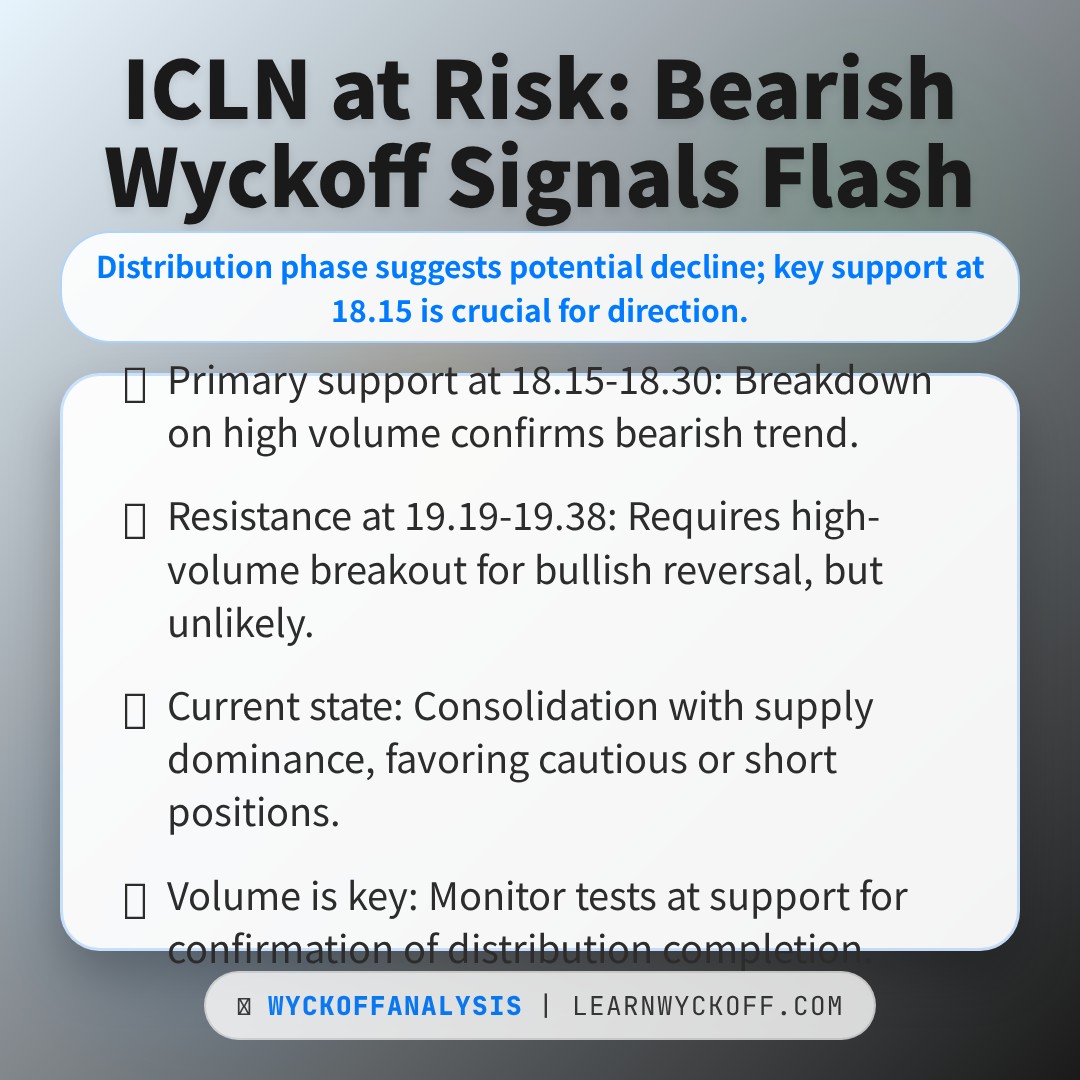
- 3. Distribution Phase (2026-01-28 to Present): After reaching a phase high of 19.03 on January 28th, the following day saw a high-volume, long bearish candlestick (down -2.73%, with volume reaching 2.08 times the 30-day average), a strong "sign of supply appearing" warning. Subsequently, the price entered a wide-ranging consolidation between 18.15 and 19.19, showing repeated signs of weak upward momentum and high-volume stalling (e.g., February 3rd, February 24th). This suggests that large investors may be distributing holdings within this range, indicating that the market has entered the distribution phase characteristic of the late stage of an uptrend.
2. Volume-Price Relationship and Supply-Demand Dynamics
As of February 25, 2026, the underlying asset ICLN has an opening price of 19.15, a closing price of 19.09, a volume of 3,930,943, a daily change of -0.52%, a volume of 3,930,943, a 7-day average volume of 4,108,175.86, and a 7-day volume ratio of 0.96.

- • Key Daily Volume-Price Signals:
- • Demand Dominated Days (Strong Signals):
- • 2026-01-02:
PCT_CHANGE+4.08%,VOLUME6.497 million (VOLUME_AVG_30D_RATIO=2.44). Classic "breakout on high volume," supply was fully absorbed, demand in absolute control. - • 2026-01-08:
PCT_CHANGE+0.82%,VOLUME8.355 million (VOLUME_AVG_30D_RATIO=3.18). Another huge volume surge during the advance, confirming a healthy uptrend and sustained strong demand.
- • 2026-01-02:
- • Supply Dominated Days (Warning Signals):
- • 2026-01-29:
PCT_CHANGE-2.73%,VOLUME8.560 million (VOLUME_AVG_30D_RATIO=2.08). A high-volume decline following a new high is one of the clearest signals of a potential uptrend termination, indicating significant supply emerging at the top. - • 2026-02-12:
PCT_CHANGE-3.47%,VOLUME2.824 million (VOLUME_AVG_30D_RATIO=0.53). After rebounding near the previous high, a medium bearish candlestick appeared on lower volume, indicating insufficient demand, weak bounce, and supply suppressing the price again.
- • 2026-01-29:
- • Lack of Demand Days (Weakness Signals):
- • 2026-02-25 (Latest Trading Day):
PCT_CHANGE-0.52%,VOLUME3.931 million (VOLUME_AVG_30D_RATIO=0.78). The price retreated from recent highs with volume shrinking below the 30-day average, suggesting that follow-through buying demand is drying up.
- • 2026-02-25 (Latest Trading Day):
- • Demand Dominated Days (Strong Signals):
- • Supply-Demand Power Shift Conclusion:
A significant shift in supply-demand power occurred during the analysis period. In January 2026, demand consistently overwhelmed supply, driving the price higher. Entering February 2026, supply began to strengthen notably and suppress the price at key levels (above 19.00), while demand intensity gradually waned, manifesting as weaker volume on rallies and occasional high volume on declines. The current market is in a state of equilibrium with a slight edge for supply.
3. Volatility and Market Sentiment
As of February 25, 2026, the underlying asset ICLN has an opening price of 19.15, a 7-day intraday Parkinson volatility of 0.24, a 7-day Parkinson volatility ratio of 0.82, a 7-day historical volatility of 0.20, a 7-day historical volatility ratio of 0.56, and an RSI of 59.56.

- • Volatility Levels and Changes:
- • At the start of the period, short-term volatility was extremely compressed. Historical ranking data shows that on 2025-12-29/30, the ratios of 7-day to longer-period (14D/21D/30D) Parkinson volatility were near decade-long historical lows (ranked 5-19). This indicates extremely suppressed market sentiment and volatility converging to an extreme, typically preceding a major directional shift, which was confirmed by the large bullish candlestick on January 2nd.
- • During the uptrend, both Historical Volatility (
HIS_VOLA_7D) and Parkinson Volatility (PARKINSON_VOL_7D) increased, peaking around the end of January (HIS_VOLA_7D~0.35,PARKINSON_VOL_7D~0.27), coinciding with the price peak. Recent volatility has retreated, but volatility ratios (e.g.,PARKINSON_RATIO_7D_14D=0.82) are not at extreme values. This suggests market sentiment has shifted from the optimism of the markup phase to the relative neutrality of the current consolidation phase, without signs of panic or euphoria.
- • RSI Sentiment Indicator Validation:
TheRSI_14reached 77.23 on January 28th when the price peaked, entering the overbought zone and resonating with the price top. Subsequently, the RSI corrected, with the latest reading at 59.56, in the neutral-to-strong region. It neither provides a clear overbought sell signal nor indicates an oversold buying opportunity, consistent with the judgment that the market is in a high-level consolidation phase.
4. Relative Strength and Momentum Performance
- • Periodic Return Analysis:
- •
YTD(Year-to-Date) +16.19%,QTD(Quarter-to-Date) +16.19%, indicating very strong absolute momentum in the medium to long term. - •
MTD(Month-to-Date) +5.18%,WTD(Week-to-Date) +0.32%, show that short-term momentum has significantly slowed compared to the January surge, entering a state of high-level consolidation. - • The momentum evolution path is clear: Strong Mid-term Rally -> Short-term Momentum Decay. This aligns with the Wyckoff phase judgment of "a markup trend entering its final distribution stage," where momentum fails to make new highs, suggesting the core force driving the price higher is weakening.
- •
5. Large Investor (Smart Money) Behavior Identification
Based on Wyckoff volume-price principles, the behavior of large investors (Smart Money) is inferred as follows:
- 1. Accumulation: In late December 2025, Smart Money likely engaged in patient accumulation within the 16.40-16.60 range, characterized by extremely low volatility and light volume. Extremely low volatility rankings (historical top 5%-7%) indicate very low market attention, creating conditions for institutions to accumulate positions at low cost.
- 2. Markup: In early January 2026, Smart Money rapidly marked up the price with consecutive high-volume bullish candlesticks (Jan 2nd, 8th), moving it away from the accumulation zone, attracting public participation, and initiating the uptrend.
- 3. Distribution (Ongoing): Starting from the landmark event of the "high-volume bearish candlestick" on January 29th, Smart Money's intent likely shifted from markup to distribution. The subsequent two months of wide-range consolidation at high levels (18.15-19.19), accompanied by repeated instances of "stalling on high volume" (e.g., Feb 3rd, 24th), are classic characteristics of a distribution range—using volatility and optimism to transfer holdings to subsequent buyers. The low-volume decline on the latest trading day suggests that large-scale selling pressure from Smart Money may have temporarily eased, but there are no signs of them re-entering aggressively.
Core Judgment: The current market is in a "Distribution Phase" led by large investors. Public investors may still be buying, attracted by the prior strong rally, but Smart Money is utilizing this sentiment for position transfer.
6. Support/Resistance Level Analysis and Trading Signals

- • Key Price Levels:
- • Primary Resistance (Supply Zone): 19.19 - 19.38 (the high area tested multiple times recently). A decisive breakout above this zone requires sustained high volume; otherwise, it remains a supply area.
- • Secondary Resistance: 19.00 (psychological level and recent consolidation pivot).
- • Primary Support (Demand Zone): 18.15 - 18.30 (the rebound starting point after the high-volume decline at the end of January, also the low point of the early February pullback). A high-volume breakdown below this zone would strongly confirm the completion of distribution and the market's entry into a decline phase.
- • Secondary Support: 18.60 (lower bound of recent consolidation range and near the 20-day MA).
- • Integrated Wyckoff Events and Trading Signals:
- • Current Market State: Consolidation within a distribution range, supply and demand are temporarily balanced but leaning towards supply.
- • Dominant Signal: Neutral/Cautiously Bearish. Until clear "signs of demand returning" appear, aggressive long positions at this level are not advisable.
- • Bearish Confirmation Signal: A price break below the primary support at 18.15 on high volume. This would constitute a Wyckoff event such as "ice breaking" or "decline after distribution completion," serving as a clear signal for a trend reversal to bearish.
- • Bullish Reversal Signal: The price sustaining above 19.38 on high volume (volume ratio > 1.5), indicating supply is fully absorbed and the uptrend may resume. However, this contradicts current volume-price evidence and has a low probability.
- • Operational Recommendations and Risk Control:
- • Long Investors: Should consider reducing positions or taking profits when the price rebounds towards resistance levels (19.00-19.19). Any new long positions should be taken with extreme caution, with stop-losses set below 18.15.
- • Short Investors/Hedgers: Could explore opportunities to initiate short positions when the price encounters resistance above 19.00 and retreats, or upon a high-volume break below 18.60, with initial stop-losses placed above 19.38.
- • Future Validation Points: Closely monitor the price's behavior when testing the 18.15-18.30 support zone. A quick rebound after a low-volume test suggests distribution may still be ongoing; a high-volume breakdown signals the start of a decline phase.
Conclusion Restatement: Based on Wyckoff volume-price analysis, ICLN, after a strong rally, has shown clear signs of distribution by large investors since late January 2026. The current market is in a high-risk zone, with supply and demand forces achieving a fragile equilibrium at elevated levels, but with supply having a slight edge. A defensive strategy is recommended for investors, awaiting a clear directional move from the price at key support levels before making decisions. Historical volatility ranking data effectively enhances confidence in the judgment of initial accumulation and the subsequent trend change.
Disclaimer: The content of this report/interpretation is solely market analysis and research based on publicly available information and does not constitute any investment advice or operational guidance. The author strives for objectivity and fairness but makes no guarantees regarding its accuracy or completeness. The market involves risks; investment requires caution. Any investment actions based on this report are undertaken at one's own risk.
Thank you for your attention! Daily Wyckoff Volume-Price Market Interpretation will be released promptly at 8:00 AM before the market opens. Your comments and shares are sincerely appreciated; your recognition is crucial. Let us see the market signals together.
Member discussion: