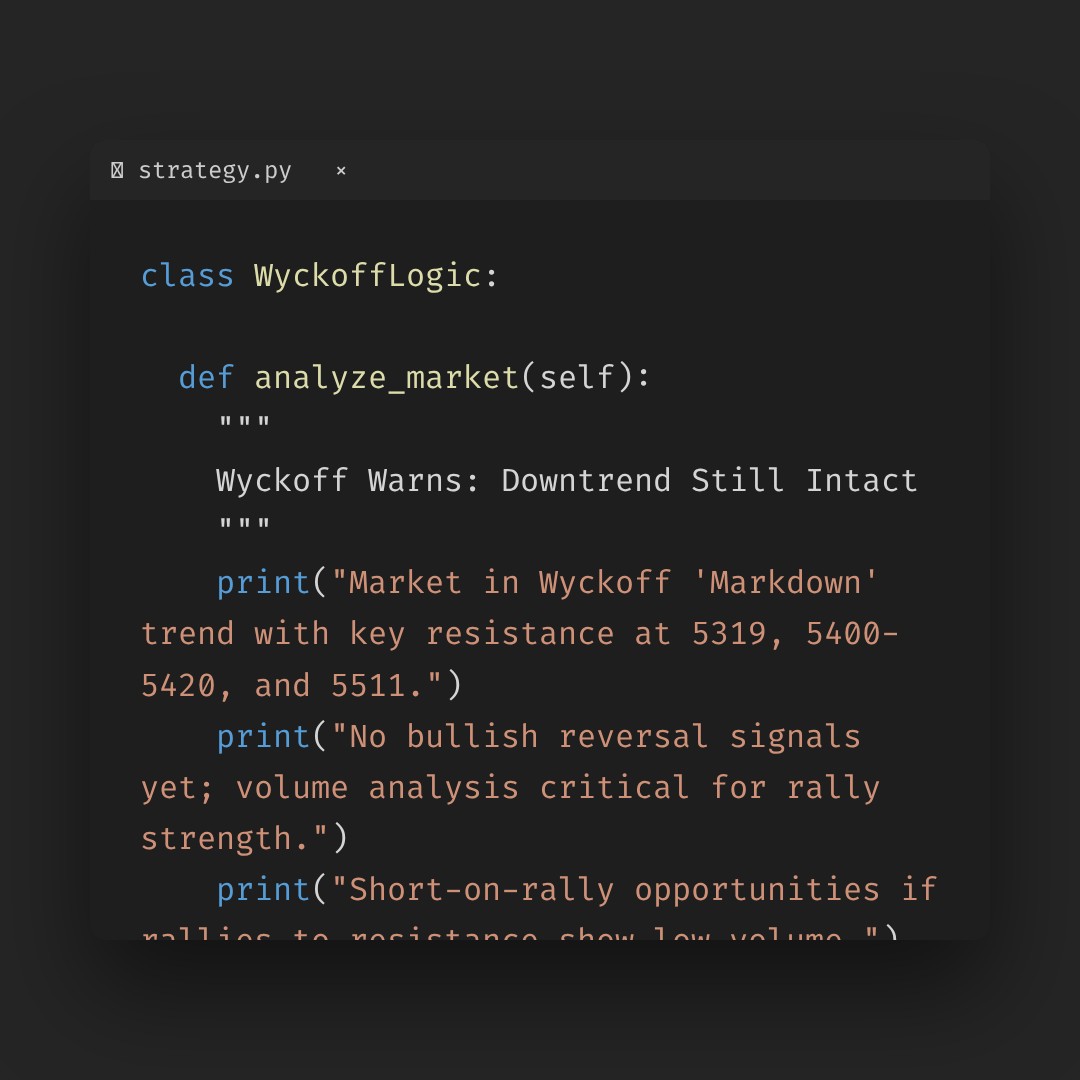
Alright, I will conduct an in-depth quantitative analysis of the HSTECH product based on the Wyckoff method. The report will strictly adhere to the six dimensions you have provided, with all conclusions derived from data analysis.


Wyckoff Quantitative Analysis Report: HSTECH

Product Code: HSTECH
Analysis Date Range: 2025-12-29 to 2026-02-25
Report Generation Time: 2026-02-25
Core Methodology: Wyckoff Volume-Price Principles, Alpha Signal Extraction, Large Trader Behavior Identification

1. Trend Analysis and Market Phase Identification

As of February 25, 2026, the underlying asset HSTECH had an opening price of 5316.09, a closing price of 5260.50, a 5-day moving average (MA) of 5319.10, a 10-day MA of 5371.93, a 20-day MA of 5511.18, a daily change of -0.19%, a weekly change of -1.99%, a monthly change of -8.00%, a quarterly change of -4.63%, and a yearly change of -4.63%.

HSTECH Price Trend Analysis Chart, including closing price and multiple moving averages
  • MA Alignment and Trend:
    • Current State: As of February 25, the closing price (5260.50) has fallen below all key moving averages (MA_5D: 5319.10, MA_10D: 5371.93, MA_20D: 5511.18, MA_30D: 5604.82, MA_60D: 5594.89), forming a typical "bearish alignment".
    • Trend Evolution: Since the high in mid-January 2026 (around 5900), the price has shown a clear downtrend. All period MAs (especially medium-to-long term MAs like MA_20D/MA_30D/MA_60D) have turned downward, confirming the end of the medium-term uptrend and the establishment of a downtrend.
    • Crossover Signals: From late January to early February, the price fell below the MA_60D (long-term MA), a significant signal of long-term trend weakness. Subsequently, short-term MAs (MA_5D, MA_10D) crossed below the medium-to-long term MAs, forming bearish crossovers, confirming the acceleration of downward momentum.
  • Market Phase Identification (Wyckoff-based):
    • Phase Judgment: Based on comprehensive volume-price behavior, since late January, the market is transitioning from the late stages of "Distribution" towards the "Markdown" or even "Panic" phase.
    • Reasoning Process:
      1. 1. Distribution: In mid-January, prices consolidated at a high range of 5800-5900. During this period (e.g., Jan 12, 14), there were significant volume spikes (VOLUME_AVG_60D_RATIO > 1.8), but price appreciation was weak, showing the classic distribution characteristic of "volume expansion without significant price appreciation".
      2. 2. Markdown/Panic: Entering February, prices broke down and declined consecutively. Particularly from February 2 to February 5, there were episodes of "high-volume plunges" (e.g., Feb 3 decline of -4.39% with volume 1.5 times the 60-day average). This aligns with the Wyckoff principle where, after distribution completes, supply overwhelmingly overcomes demand, leading the market into accelerated decline, potentially triggering panic selling. Although the RSI on February 25 (38.49) is not at extreme oversold levels, the continued new lows in price indicate the downtrend remains dominant.

2. Volume-Price Relationship and Supply-Demand Dynamics

As of February 25, 2026, the underlying asset HSTECH had an opening price of 5316.09, a closing price of 5260.50, a volume of 46815281665, a daily change of -0.19%, a volume of 46815281665, a 7-day average volume of 49917869841.71, and a 7-day volume ratio of 0.94.

HSTECH Volume-Price Relationship Line Chart and Historical Ranking Analysis
  • Key Days and Supply-Demand Shifts:
    • Demand-Dominated Days (Bullish):
      • 2026-01-02: Volume-backed rise (+4.00%, VOLUME_AVG_60D_RATIO: 0.65). This was a strong rebound from the prior decline, showing concentrated demand entering around the 5500 level.
      • 2026-01-12: High-volume rally (+3.10%, VOLUME_AVG_60D_RATIO: 1.58). Occurred after consolidation; demand attempted to push prices higher but failed to sustain, constituting a failed re-accumulation or a test of supply at the upper bound of the distribution range.
    • Supply-Dominated Days (Bearish):
      • 2026-01-15 & 2026-01-20: Down days with significantly higher volume than recent averages (VOLUME_AVG_14D_RATIO > 1.4), indicating "supply expansion" with persistent and heavy selling pressure.
      • 2026-02-02 to 2026-02-05: Consecutive high-volume plunges (VOLUME_AVG_60D_RATIO all >1.27). This is a clear signal of panic selling, where significant selling pressure exits indiscriminately, showing overwhelming supply dominance. Historical ranking data shows the massive volume surge at the beginning of the period (Dec 29, VOLUME_GROWTH 140.64%) ranked as the 12th highest in the past 10 years, indicating abnormal liquidity at that time, foreshadowing subsequent violent volatility.
    • Demand Deficiency Days (Weak Rebound):
      • 2026-02-09 to 2026-02-11: Minor price rebounds with volumes consistently below medium-to-long term averages (VOLUME_AVG_60D_RATIO < 0.85). This indicates the rebound lacks demand follow-through, a typical "low-volume rally", suggesting difficulty in sustainability.
    • Supply Exhaustion Days (Potential Halting of Decline):
      • 2026-02-06 & 2026-02-25: Price declines accompanied by significantly shrunken volume below the 60-day MA (RATIO 0.94 and 0.75 respectively). This hints that active selling pressure may be weakening. Although prices made new lows, supply did not expand, requiring close monitoring for potential formation of an "oversold spring" or "terminal shakeout" pattern.
  • Alpha Signals (Supply-Demand Strength):
    • Bearish Alpha: Price decline AND VOLUME_AVG_60D_RATIO > 1.1, a strong signal of supply expansion (e.g., Feb 2-5).
    • Potential Bullish Alpha: Price declines to a new low BUT VOLUME_AVG_60D_RATIO < 0.8 AND RSI_14 < 35, potentially signaling supply exhaustion and a reversal opportunity (current RSI condition not met, requires waiting).

3. Volatility and Market Sentiment

As of February 25, 2026, the underlying asset HSTECH had an opening price of 5316.09, a 7-day intraday Parkinson volatility of 0.21, a 7-day intraday volatility ratio of 0.90, a 7-day historical volatility of 0.39, a 7-day historical volatility ratio of 1.24, and an RSI of 38.49.

HSTECH Parkinson Volatility Analysis Chart and Historical Ranking Data
  • Volatility Level and Changes:
    • Current Level: Short-term volatility (HIS_VOLA_7D: 0.389, PARKINSON_VOL_7D: 0.209) is significantly higher than the low levels at the end of December (HIS_VOLA_7D ~0.15, PARKINSON_VOL_7D ~0.16).
    • Volatility Expansion: HIS_VOLA_RATIO_7D_60D surged from an extremely low value of 0.47 at end-December to the current 1.37; PARKINSON_RATIO_7D_60D also rose from 0.67 to 0.99. This indicates short-term volatility has far exceeded its long-term average, suggesting the market is in a high-volatility, high-sentiment state of panic or trend acceleration.
    • Historical Extremes: Historical ranking data confirms the low-volatility environment on Dec 29-30 (PARKINSON_VOL_7D ranked 5th and 3rd lowest, HIS_VOLA_21D ranked 8th lowest) was extremely rare in the past 10 years. This provides a clear "calm before the storm" context for the subsequent sharp volatility spike (panic).
  • Sentiment Indicator (RSI):
    • • The current RSI_14 is 38.49, out of the oversold zone (<30) but still in the weak range. Within a downtrend, an RSI not reaching extreme lows often implies downward momentum is not fully exhausted, or the decline is occurring via gradual erosion. A potential panic-driven sell-off (accompanied by high volume) driving the RSI into deep oversold territory may be needed to form a solid foundation for a sentiment reversal.

4. Relative Strength and Momentum Performance

  • Comprehensive Negative Momentum:
    • Short-term: WTD_RETURN is -1.99%, negative for two consecutive weeks.
    • Medium-term: MTD_RETURN is -8.00%, QTD_RETURN is -4.63%, indicating HSTECH has been under significant negative momentum throughout February and Q1 2026 to date.
    • Conclusion: Momentum indicators across all timeframes point to weakness, corroborating the conclusions of a bearish MA alignment and supply-dominant volume-price relationships. The asset itself lacks intrinsic upward momentum.

5. Large Trader ("Smart Money") Behavior Identification

  • Distribution Phase (Mid-late January): In the 5800-5900 zone, large traders utilized market optimism and high-volume rallies for distribution. The large-volume bullish candles on Jan 12 and 14 likely represent an "upthrust" or "distribution buying climax", where smart money transferred holdings to the chasing public.
  • Markdown and Shakeout (Early February): After prices broke below key support, the high-volume plunges from Feb 2-5 resulted from combined large short-side pressure and panic selling. Smart money likely accelerated selling during this process to lock in profits or establish short positions, while shaking out weak long holdings.
  • Current Behavior (Late February): With prices dropping to the 5250-5300 zone, volume has contracted (e.g., Feb 25). Smart money may have paused large-scale selling, shifting to observation. They are assessing: 1) Whether panic is sufficient; 2) Whether prices are low enough to attract them to start covering or establishing counter-trend positions. A low-volume decline is a sign of temporary supply exhaustion, but not evidence of demand entry.

6. Support/Resistance Level Analysis and Integrated Trading Signals

  • Key Support Levels:
    • S1: 5250-5260 Zone: Psychological and technical support formed by the recent low (Feb 25). A high-volume break below could target the 5200 psychological level.
    • S2: 5200: Major psychological barrier and a potential bearish target.
  • Key Resistance Levels:
    • R1: 5319 (MA_5D): Nearest dynamic resistance; any rebound must first overcome this level.
    • R2: 5400-5420: Minor consolidation platform during the prior decline (Feb 9-13), forming a strong resistance zone. Also near the MA_10D.
    • R3: 5511 (MA_20D): Mid-term trend divider; reclaiming this level would be necessary to initially reverse the short-term downtrend.
  • Integrated Wyckoff Events and Trading Signals:
    • Current Primary Event: The market is in a "Markdown" trend, having recently experienced a round of "Panic Selling" (early Feb), and is currently in a phase of "Secondary Test" or "Oversold Rally".
    • Trading Signals: Observation / Cautious Bearish on Rallies. The market has not yet shown reliable bottom reversal signals (e.g., high-volume bullish breakout above key resistance, clear spring effect).
      • Bearish / Short-on-Rally Scenario: If prices rally near R1 (5319) or R2 (5400), accompanied by contracting volume again (VOLUME_AVG_60D_RATIO < 0.9), this could be seen as a signal of a weak rally ending, presenting a higher-risk opportunity to short on strength. Stops can be placed above the resistance level.
      • Potential Bullish Scenario (Requires Confirmation): Price stabilizes near S1 or S2 and shows "high-volume advance" (single-day gain >2%, VOLUME_AVG_60D_RATIO > 1.2) or a "Spring" effect (breaking below support then quickly reclaiming it with volume). This would be preliminary evidence of smart money beginning accumulation, allowing consideration for a light long position trial with a stop below the new low.
  • Future Validation Points:
    1. 1. Demand Validation: Can there be at least two consecutive days of high-volume advance, with closing prices consistently above MA_5D and MA_10D?
    2. 2. Supply Exhaustion Validation: When price makes new lows, does volume continue to contract (VOLUME_AVG_60D_RATIO < 0.7)? Simultaneously, does the RSI show bullish divergence?
    3. 3. Reversal Failure Validation: Any low-volume rally (RATIO < 0.8) that reverses downward upon reaching resistance would confirm the continuation of the downtrend.

Disclaimer: This report is based on quantitative analysis of historical data and does not constitute any investment advice. Markets involve risks; invest cautiously.


Thank you for your attention! Daily Wyckoff Volume-Price Market Analysis is released promptly before the market opens at 8:00 AM. Please feel free to comment and share; your recognition is crucial. Let's work together to see the market signals clearly.